
- ISSN 1001-1455 CN 51-1148/O3
- EI、Scopus、CA、JST、EBSCO、DOAJ收录
- 力学类中文核心期刊
- 中国科技核心期刊、CSCD统计源期刊

| Citation: | LIANG Yifan, XU Xiaohui, GUO Wei, XU Tianhan, CHEN Liangyu, JI Yuguo, SHI Benjun. Vacuum chamber simulation test system for large-yield multi-point concentrated explosion cratering effects[J]. Explosion And Shock Waves, 2026, 46(10): 104101. doi: 10.11883/bzycj-2025-0095

|

| [1] |
SADOVSKII M A, ADUSHKIN V V, RODIONOV V N, et al. A method of modeling large cratering explosions [J]. Combustion, Explosion, and Shock Waves, 1967, 3(1): 73–79. DOI: 10.1007/BF00741616.
|
| [2] |
ADUSHKIN V V, PERNIK L M. Design of linear charges for caving a slope by a large-scale explosion [J]. Soviet Mining, 1989, 25(6): 505–509. DOI: 10.1007/BF02528298.
|
| [3] |
ADUSHKIN V V, KAMALYAN R Z, KOROLEV K D. Character of the interaction of concentrated excavation charges detonated at different times [J]. Combustion, Explosion and Shock Waves, 1989, 25(6): 782–785. DOI: 10.1007/BF00758751.
|
| [4] |
BLINOV I M, VAKHRAMEEV Y S. The method for modelling large-scale outburst explosions by microexplosions of explosive charges [J]. Fizika Goreniya I Vzryva, 1995, 31(2): 102–109.
|
| [5] |
VAKHRAMEEV Y S. Physical foundations for approximately modeling explosions with ejecta [J]. Combustion, Explosion, and Shock Waves, 1995, 31(1): 120–125. DOI: 10.1007/BF00755969.
|
| [6] |
徐小辉, 邱艳宇, 王明洋, 等. 大当量浅埋地下爆炸抛掷成坑效应的缩比模拟实验装置 [J]. 爆炸与冲击, 2018, 38(6): 1333–1343. DOI: 10.11883/bzycj-2017-0144.
XU X H, QIU Y Y, WANG M Y, et al. Development of the testing apparatus for modeling large equivalent underground cratering explosions [J]. Explosion and Shock Waves, 2018, 38(6): 1333–1343. DOI: 10.11883/bzycj-2017-0144.
|
| [7] |
徐小辉, 邱艳宇, 王明洋, 等. 大当量地下浅埋爆炸真空室模拟相似材料研究 [J]. 岩石力学与工程学报, 2018, 37(S1): 3550–3556. DOI: 10.13722/j.cnki.jrme.2016.1539.
XU X H, QIU Y Y, WANG M Y, et al. Similar materials for vacuum chamber model test under large scale throw blasting [J]. Chinese Journal of Rock Mechanics and Engineering, 2018, 37(S1): 3550–3556. DOI: 10.13722/j.cnki.jrme.2016.1539.
|
| [8] |
王明洋, 徐小辉, 邱艳宇, 等. 一种用于模拟爆炸效应的爆源装置: CN201710295250.6 [P]. 2017-04-28.
WANG M Y, XU X H, QIU Y Y, et al. Explosion resource device for simulating explosion effect: CN201710295250.6 [P]. 2017-04-28.
|
| [9] |
ADUSHKIN V V, SPIVAK A. Underground explosions: WGC-2015-03 [R]. Lexington: Weston Geophysical Corp, 2015.
|
| [10] |
郭纬, 徐小辉, 李干, 等. 二级高压驱动阵列弹珠同步弹射微型爆源的研制 [J]. 爆炸与冲击, 2022, 42(8): 084101. DOI: 10.11883/bzycj-2021-0343.
GUO W, XU X H, LI G, et al. Development of a miniature explosion device initiated by a synchronous launcher of marbles driven by two-stage high-pressure gas [J]. Explosion and Shock Waves, 2022, 42(8): 084101. DOI: 10.11883/bzycj-2021-0343.
|
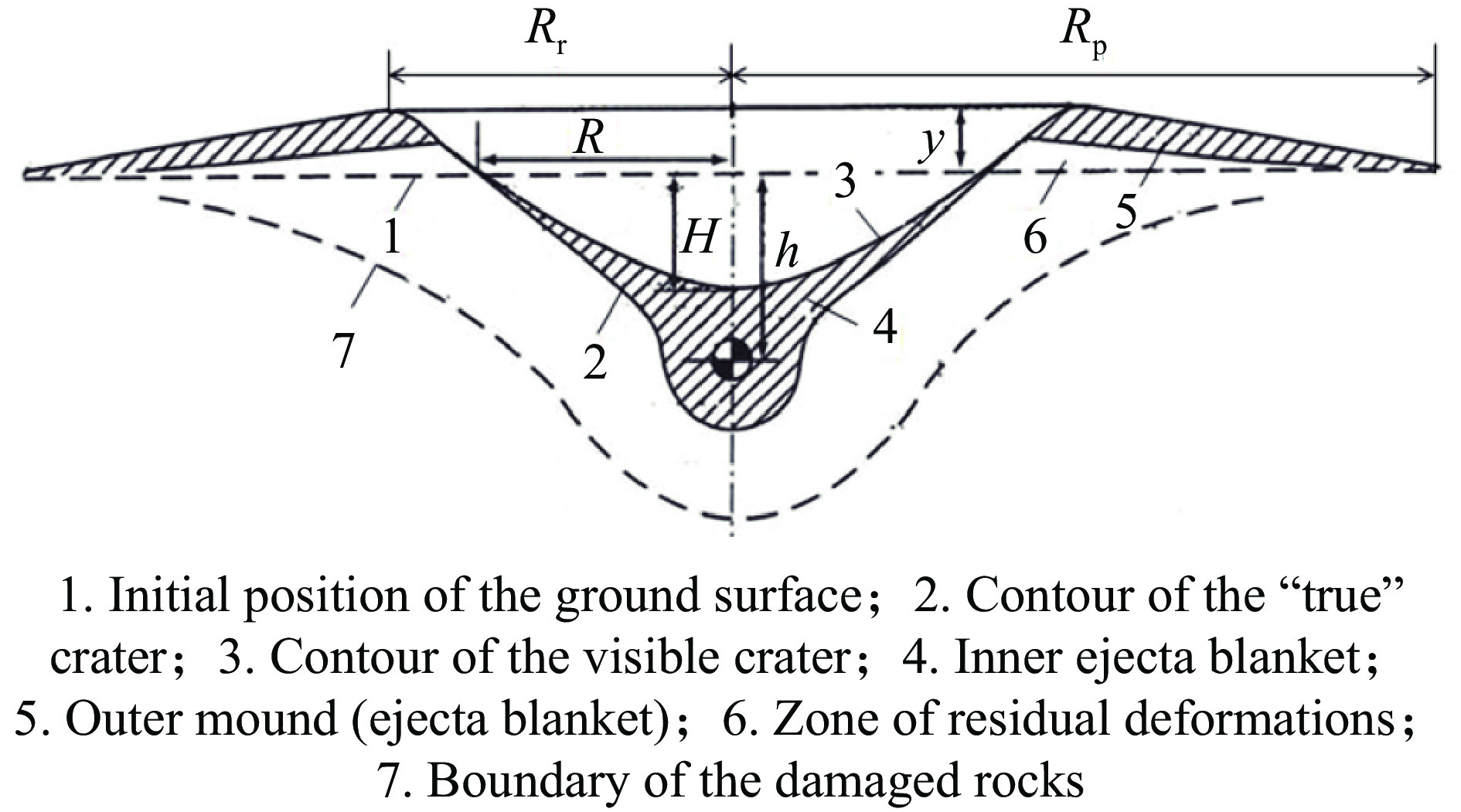
Figures(14) / Tables(5)



 DownLoad:


