
- ISSN 1001-1455 CN 51-1148/O3
- EI、Scopus、CA、JST、EBSCO、DOAJ收录
- 力学类中文核心期刊
- 中国科技核心期刊、CSCD统计源期刊

| Citation: | YUAN Jichen, HUANG Xiaxu, XIE Guoliang. Characterization method of material constitutive relationship at high strain rates based on GNN/KAN[J]. Explosion And Shock Waves, 2026, 46(5): 051421. doi: 10.11883/bzycj-2025-0103

|

| [1] |
ZERILLI F J, ARMSTRONG R W. Dislocation-mechanics-based constitutive relations for material dynamics calculations [J]. Journal of Applied Physics, 1987, 61(5): 1816–1825. DOI: 10.1063/1.338024.
|
| [2] |
PERZYNA P. Fundamental problems in viscoplasticity [J]. Advances in Applied Mechanics, 1966, 9: 243–377. DOI: 10.1016/S0065-2156(08)70009-7.
|
| [3] |
Johnson G R. A constitutive model and data for metals subjected to large strains, high strain rates and high temperatures[C]//Proceedings of the 7th International Symposium on Ballistics, The Hague, Netherlands, 1983.
|
| [4] |
LIU F X, WANG S J, XIE G L, et al. Microstructural evolution and modified constitutive model of nanoscale Al2O3 dispersion-strengthened copper under high strain rate deformation [J]. Materials Science and Engineering: A, 2024, 913: 146997. DOI: 10.1016/j.msea.2024.146997.
|
| [5] |
BREIMAN L. Random forests [J]. Machine Learning, 2001, 45(1): 5–32. DOI: 10.1023/A:1010933404324.
|
| [6] |
MITCHELL M. An introduction to genetic algorithms [M]. Cambridge: The MIT Press, 1998. DOI: 10.7551/mitpress/3927.001.0001.
|
| [7] |
CORTES C, VAPNIK V. Support-vector networks [J]. Machine Learning, 1995, 20(3): 273–297. DOI: 10.1007/bf00994018.
|
| [8] |
RUMELHART D E, HINTON G E, WILLIAMS R J. Learning representations by back-propagating errors [J]. Nature, 1986, 323(6088): 533–536. DOI: 10.1038/323533a0.
|
| [9] |
LECUN Y, BOSER B, DENKER J S, et al. Backpropagation applied to handwritten zip code recognition [J]. Neural Computation, 1989, 1(4): 541–551. DOI: 10.1162/neco.1989.1.4.541.
|
| [10] |
初红艳, 赵凯林, 程强. 盘形锻件等效应力分析及神经网络预测 [J]. 北京工业大学学报, 2021, 47(2): 103–111. DOI: 10.11936/bjutxb2019080014.
CHU H Y, ZHAO K L, CHENG Q. Equivalent stress analysis and neural network prediction of disk forgings [J]. Journal of Beijing University of Technology, 2021, 47(2): 103–111. DOI: 10.11936/bjutxb2019080014.
|
| [11] |
林启权, 卜根, 王镇柱, 等. 基于BP神经网络的DP980钢板本构关系 [J]. 塑性工程学报, 2022, 29(8): 139–144. DOI: 10.3969/j.issn.1007-2012.2022.08.017.
LIN Q Q, BU G, WANG Z Z, et al. Constitutive relationship of DP980 steel sheet based on BP neural network [J]. Journal of Plasticity Engineering, 2022, 29(8): 139–144. DOI: 10.3969/j.issn.1007-2012.2022.08.017.
|
| [12] |
魏令港, 黄靓, 曾令宏. 基于改进特征筛选的随机森林算法对锂渣混凝土强度的预测研究 [J]. 材料导报, 2024, 38(9): 22050319. DOI: 10.11896/cldb.22050319.
WEI L G, HUANG L, ZENG L H. Using random forest with improved variable selection to predict the compressive strength of concrete with lithium slag [J]. Materials Reports, 2024, 38(9): 22050319. DOI: 10.11896/cldb.22050319.
|
| [13] |
王彦磊, 王仁超, 龙益彬, 等. 基于改进随机森林算法的渡槽位移及应力预测模型 [J]. 水电能源科学, 2020, 38(5): 122–124, 10. DOI: 10.20040/j.cnki.1000-7709.2020.05.030.
WANG Y L, WANG R C, LONG Y B, et al. Aqueduct displacement and stress prediction model based on improved random forest algorithm [J]. Water Resources and Power, 2020, 38(5): 122–124, 10. DOI: 10.20040/j.cnki.1000-7709.2020.05.030.
|
| [14] |
丁军, 古愉川, 黄霞, 等. 基于改进遗传算法优化人工神经网络的304不锈钢流变应力预测准确性研究 [J]. 机械工程学报, 2022, 58(10): 78–86. DOI: 10.3901/JME.2022.10.078.
DING J, GU Y C, HUANG X, et al. Research on prediction accuracy of flow stress of 304 stainless steel based on artificial neural network optimized by improved genetic algorithm [J]. Journal of Mechanical Engineering, 2022, 58(10): 78–86. DOI: 10.3901/JME.2022.10.078.
|
| [15] |
黄俊杰, 朱剑琴, 程泽源. 基于卷积神经网络双层壁三维热应力预测方法 [J]. 航空动力学报, 2023, 38(7): 1658–1667. DOI: 10.13224/j.cnki.jasp.20220754.
HUANG J J, ZHU J Q, CHENG Z Y. Three-dimensional thermal stress prediction method in double-wall structure using convolutional neural networks [J]. Journal of Aerospace Power, 2023, 38(7): 1658–1667. DOI: 10.13224/j.cnki.jasp.20220754.
|
| [16] |
SCARSELLI F, GORI M, TSOI A C, et al. The graph neural network model [J]. IEEE Transactions on Neural Networks, 2009, 20(1): 61–80. DOI: 10.1109/TNN.2008.2005605.
|
| [17] |
董志浩. 基于图神经网络的材料性质预测及其应用研究 [D]. 苏州: 苏州大学, 2023. DOI: 10.27351/d.cnki.gszhu.2023.000186.
DONG Z H. Research and applications of material property prediction based on graph neural networks [D]. Suzhou: Soochow University, 2023. DOI: 10.27351/d.cnki.gszhu.2023.000186.
|
| [18] |
MAURIZI M, GAO C, BERTO F. Predicting stress, strain and deformation fields in materials and structures with graph neural networks [J]. Scientific Reports, 2022, 12(1): 21834. DOI: 10.1038/s41598-022-26424-3.
|
| [19] |
郑哲, 江文强, 王璋奇, 等. 基于图神经网络的结构力学响应预测模型研究 [J/OL]. 工程力学, 1–11. [2024-12-09]. https://engineeringmechanics.cn/cn/article/doi/ 10.6052/j.issn.1000-4750.2023.10.0801. DOI: 10.6052/j.issn.1000-4750.2023.10.0801.
ZHENG Z, JIANG W Q, WANG Z Q, et al. Research on the prediction model of mechanical response for structures based on graph neural network [J/OL]. Engineering Mechanics, 1–11[2024-12-09]. https://engineeringmechanics.cn/cn/article/doi/ 10.6052/j.issn.1000-4750.2023.10.0801. DOI: 10.6052/j.issn.1000-4750.2023.10.0801.
|
| [20] |
LIU Z M, WANG Y X, VAIDYA S, et al. KAN: Kolmogorov-Arnold networks [C]//Proceedings of the 13th International Conference on Learning Representations. Singapore: ICLR, 2025: 1–47.
|
| [21] |
夏天, 高志玉, 赵斐, 等. 金属材料塑性本构模型建立研究进展 [J]. 塑性工程学报, 2024, 31(9): 23–35. DOI: 10.3969/j.issn.1007-2012.2024.09.002.
XIA T, GAO Z Y, ZHAO F, et al. Research progress on establishing of plastic constitutive models for metal materials [J]. Journal of Plasticity Engineering, 2024, 31(9): 23–35. DOI: 10.3969/j.issn.1007-2012.2024.09.002.
|
| [22] |
GILMER J, SCHOENHOLZ S S, RILEY P F, et al. Neural message passing for quantum chemistry [C]//Proceedings of the 34th International Conference on Machine Learning. Sydney: PMLR, 2017: 1263–1272.
|
| [23] |
王平. 金属塑性成型力学 [M]. 第2版. 北京: 冶金工业出版社, 2013.
|
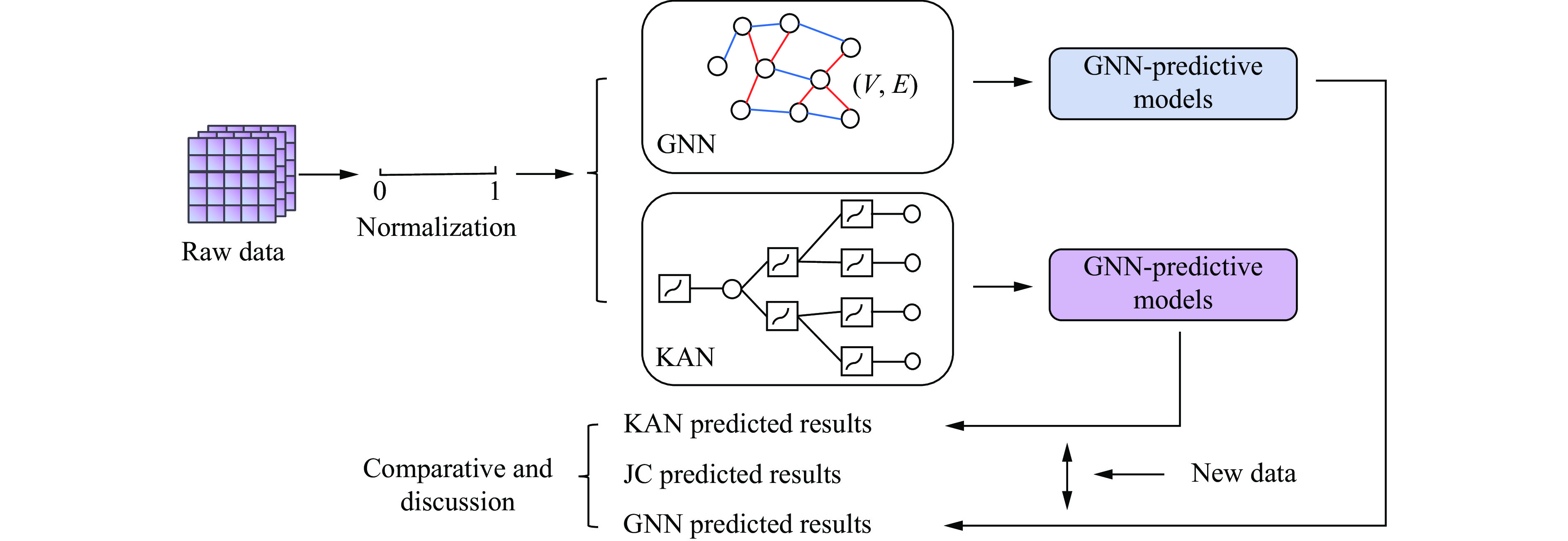
Figures(10) / Tables(1)



 DownLoad:


