



Parameter analysis and validation for Riemann-SPH simulation of hypervelocity impact on basalt material
-
摘要: 为研究超高速撞击玄武岩材料光滑粒子流体动力学(smoothed particle hydrodynamics,SPH)仿真中的参数影响,基于现有Riemann-SPH方法对地面超高速撞击玄武岩实验进行了仿真分析与验证,发现SPH仿真结果受算法参数与材料模型参数影响较大,同时材料强度模型与损伤模型的影响存在耦合性。研究结果表明:超高速撞击SPH仿真中,考虑人工应力法可以避免固体冲击仿真中出现的拉伸不稳定性;对于超高速撞击场景,使用Wendland C2核函数并设置光滑长度半径内期望粒子数为2.5,可实现计算精度和效率的兼顾,其计算速度比变分辨率粒子分布方法提升了20倍以上。在地面实验的仿真中,弹丸材料可能发生相变,而玄武岩靶体在不同模型与参数组合下产生了相似的仿真响应结果。建议使用更符合岩石材料力学特性的Lundborg强度模型和Benz-Asphaug概率损伤模型,并考虑相变计算,最终得到参数搜索取值规律,即在反向搜索未知参数时,应以其他参数的合理取值为约束,从而避免较大的参数误差。在保证合理的模型参数情况下,仿真得到的撞击坑尺寸和动量传递因子与实验的误差在10%~20%范围内。相关参数取值方法为开展超高速撞击防御小行星SPH仿真及参数选择提供了依据。Abstract: To study the effects of parameters in smoothed particle hydrodynamics (SPH) simulations of hypervelocity impacts on basalt, numerical analysis and validation were performed using the Riemann-SPH method based on ground-based impact tests. By adjusting various simulation parameters, the influence of parameters on the simulation can be obtained. Results show that both algorithmic and material parameters significantly influence the simulation, with coupling between strength and damage models. Applying the artificial stress method helps suppress tensile instability in solid impacts. Using the Wendland C2 kernel with a target of 2.5 particles within the smoothing length optimizes both accuracy and efficiency, and variable-resolution particle distribution improves performance by over 20 times. In simulations, the impactor may undergo a phase transition, and different model and parameter combinations can yield similar responses. It is recommended to employ the Lundborg strength model and the Benz-Asphaug stochastic damage model, which better represent the mechanical behavior of rocky materials, and to account for phase transitions. Parameter search should be constrained by reasonably known values to avoid large errors or non-uniqueness. With reasonable parameters, simulated crater size and momentum transfer factor match experiments within 10%–20% error. These strategies support SPH applications in asteroid defense and parameter selection.
-
Key words:
- hypervelocity impact /
- SPH method /
- planetary defense /
- parameter analysis
-
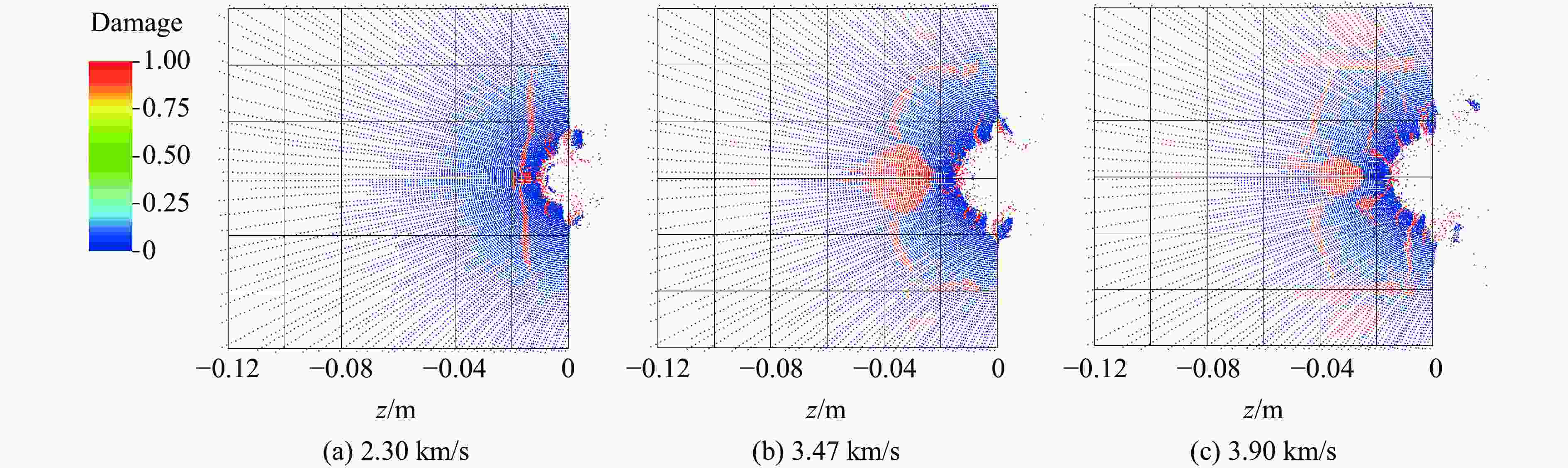
图 3 不同撞击速度的仿真剖面图
Figure 3. Simulation cross-sectional views at different impact velocities
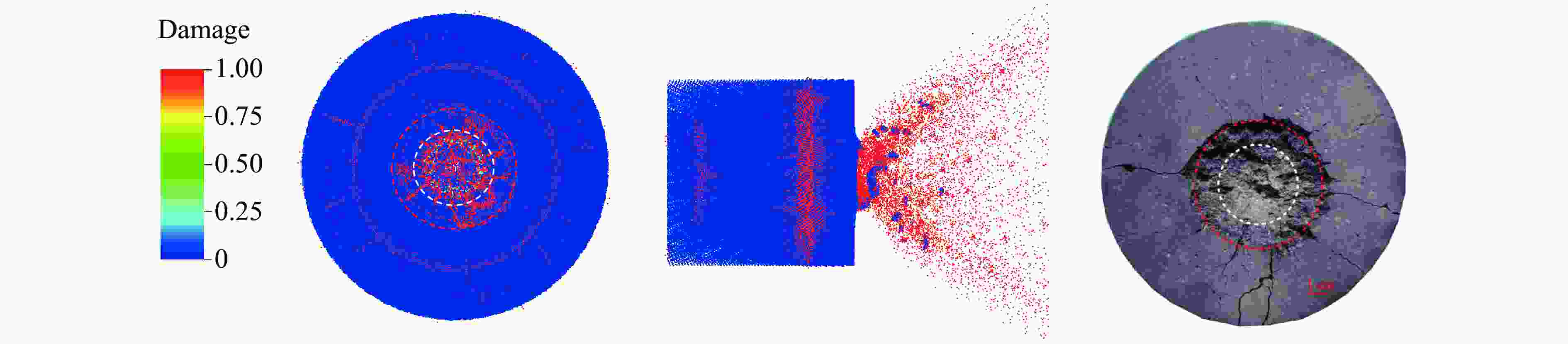
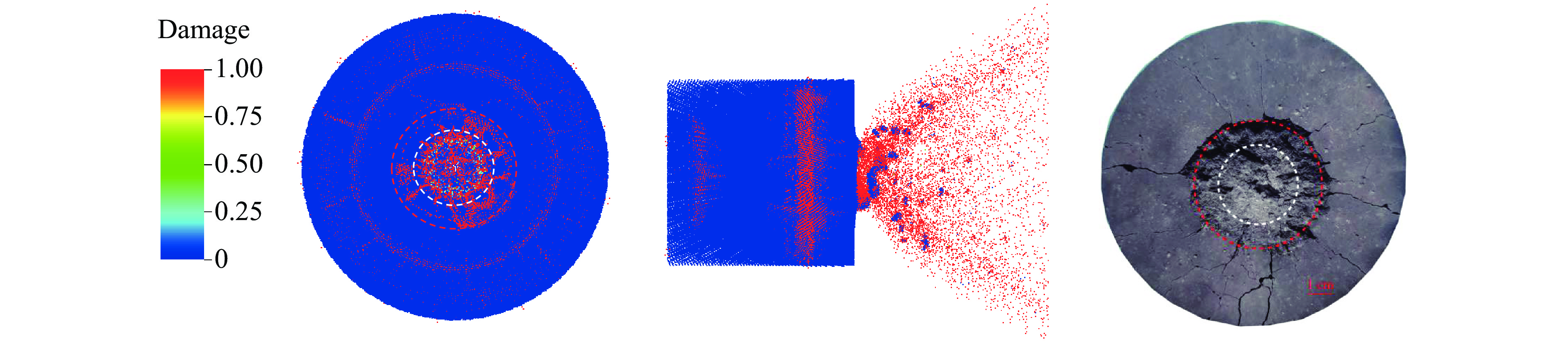
图 4 撞击速度为3.90 km/s时的靶体外观(红色虚线为完整坑,白色虚线为中心碗状深坑)
Figure 4. Appearances of the target at the impact velocity of 3.90 km/s (the red dotted line is the complete pit, and the white dotted line is the center bowl-shaped deep pit)
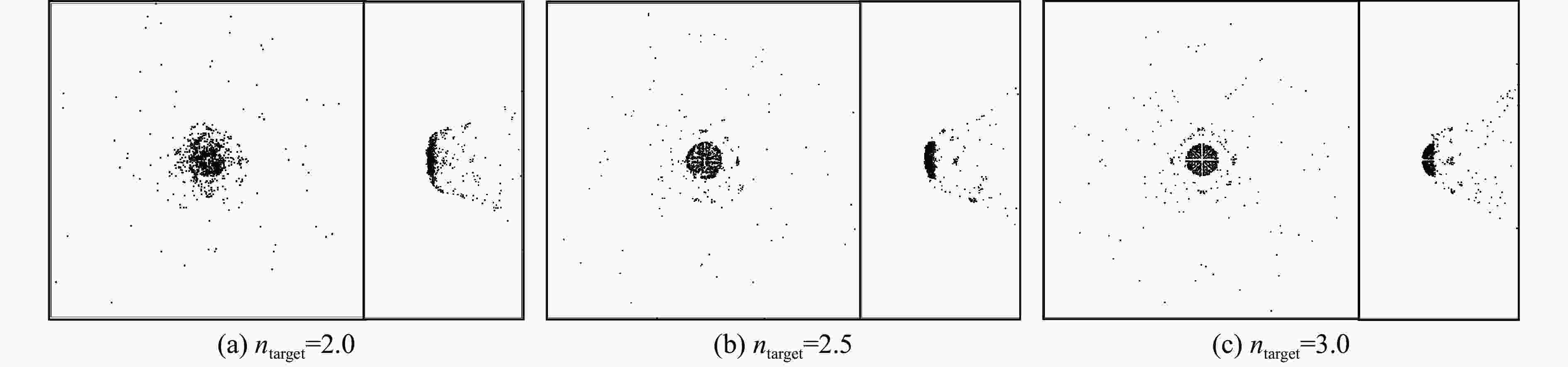
图 5 不同$ {n}_{\text{target}} $的弹丸粒子形态
Figure 5. Particle morphologies of projectiles with different $ {n}_{\text{target}} $
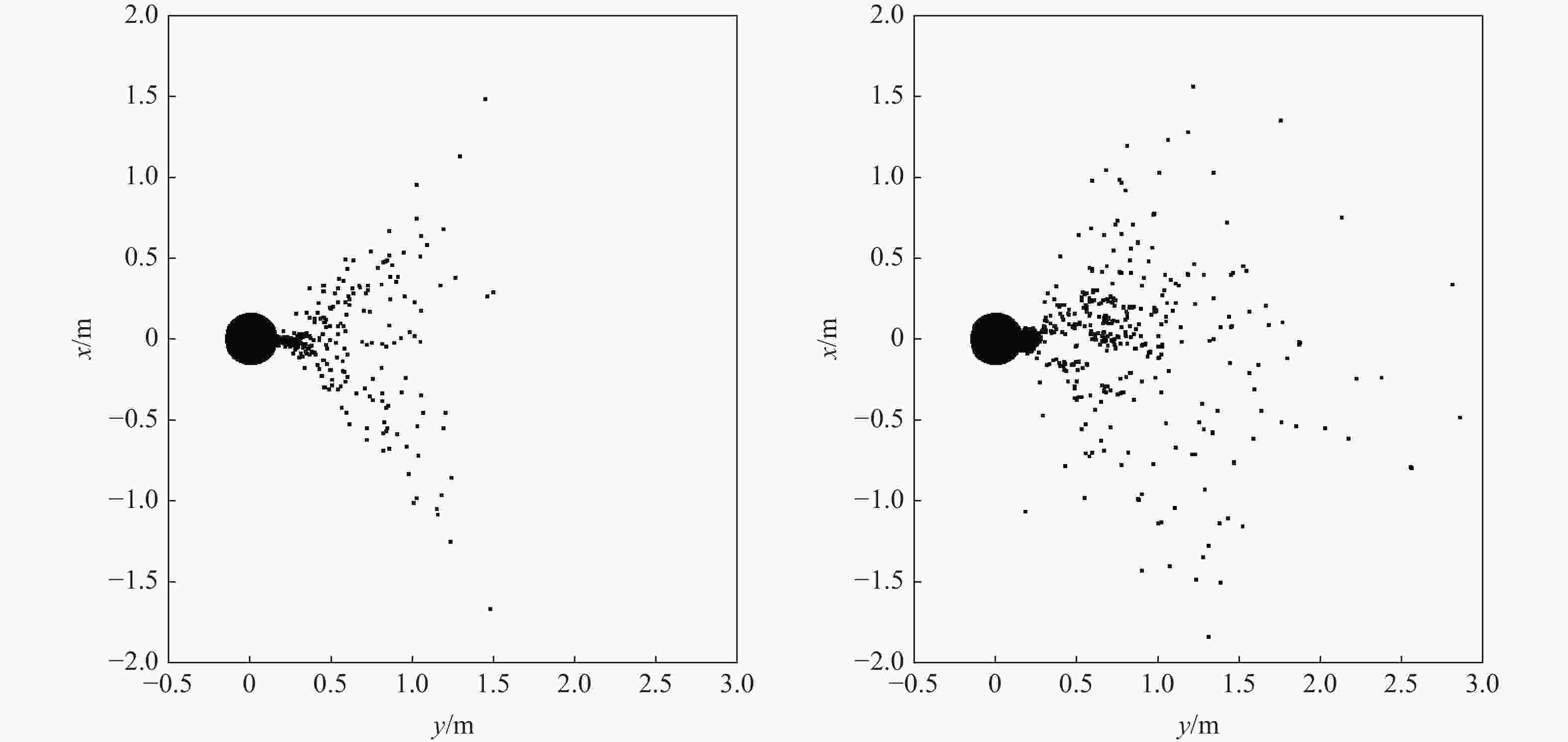
图 6 采用不同拉伸不稳定性处理方法后的粒子分布
Figure 6. Particle distributions using different tensile instability treatment methods
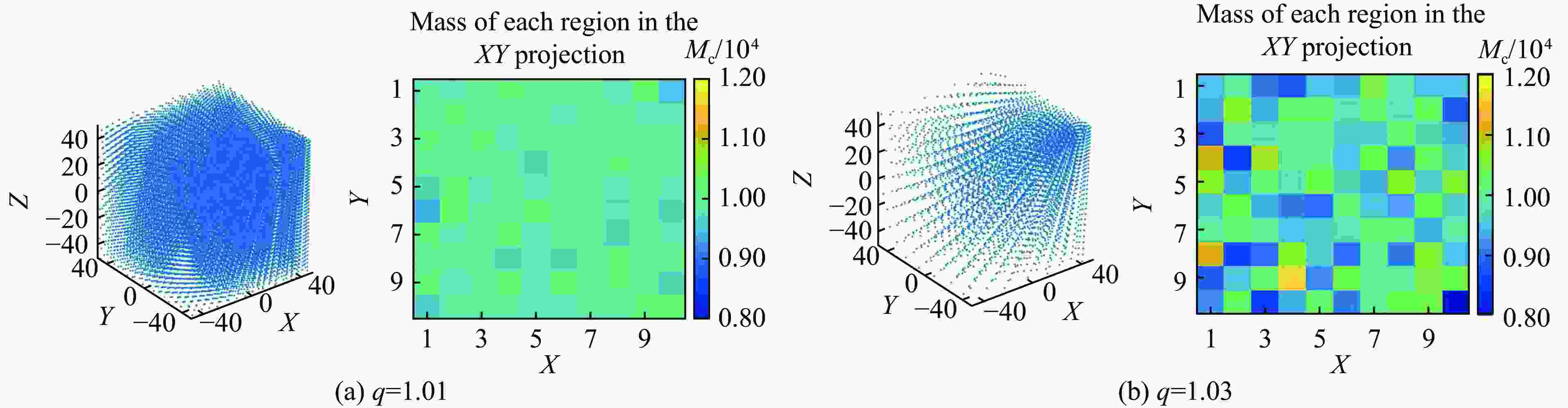
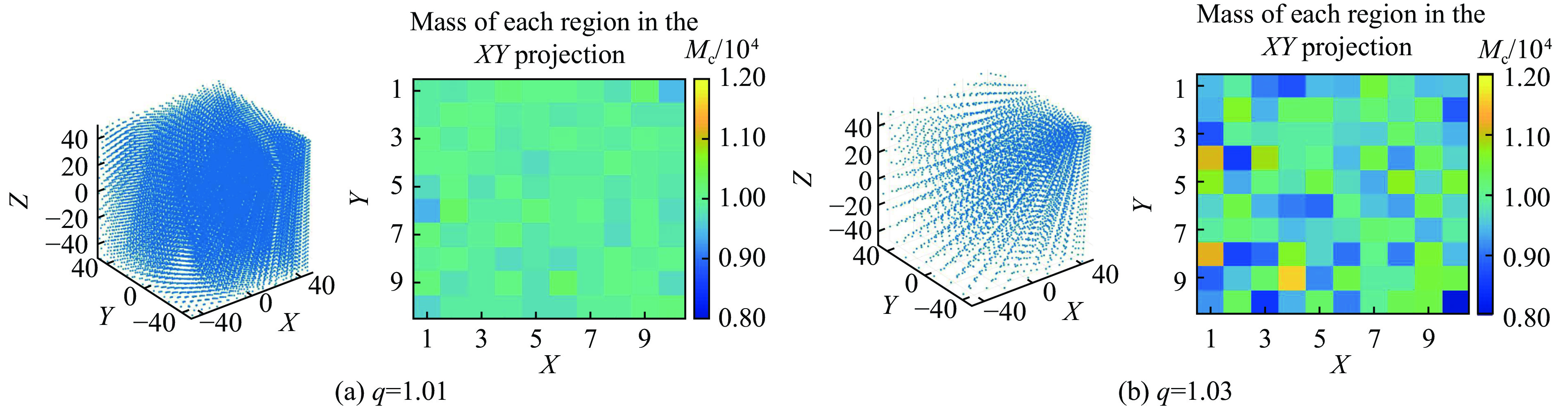
图 7 变分辨率粒子分布法测试
Figure 7. Testing of the variable resolution particle distribution method
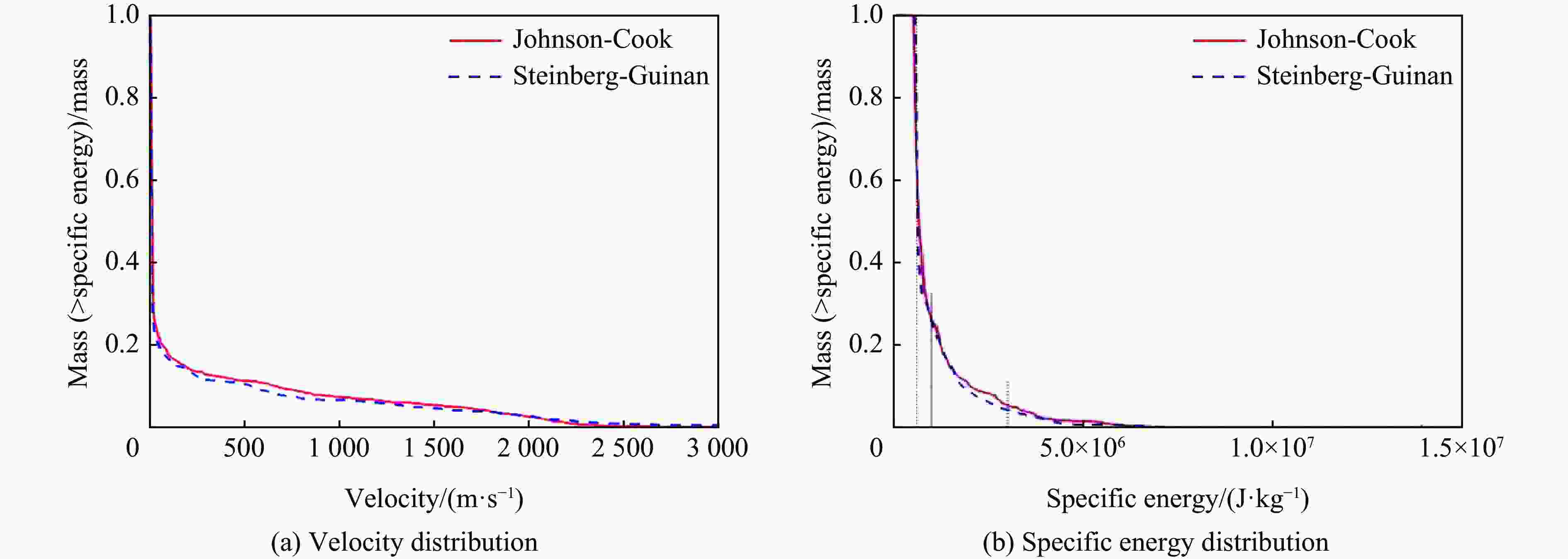
图 8 不同强度模型下弹丸状态分布
Figure 8. State distribution of projectiles under different intensity models
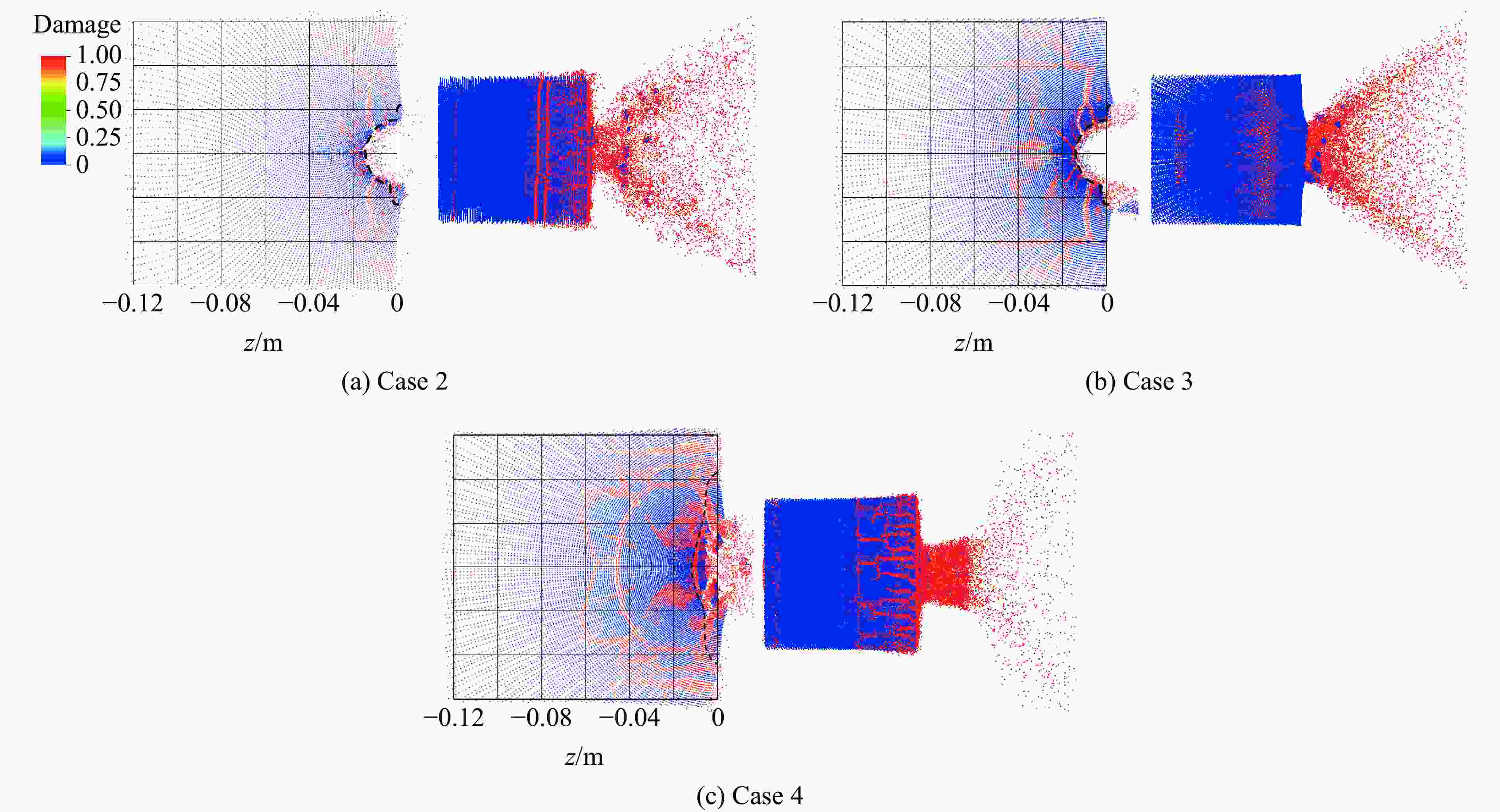
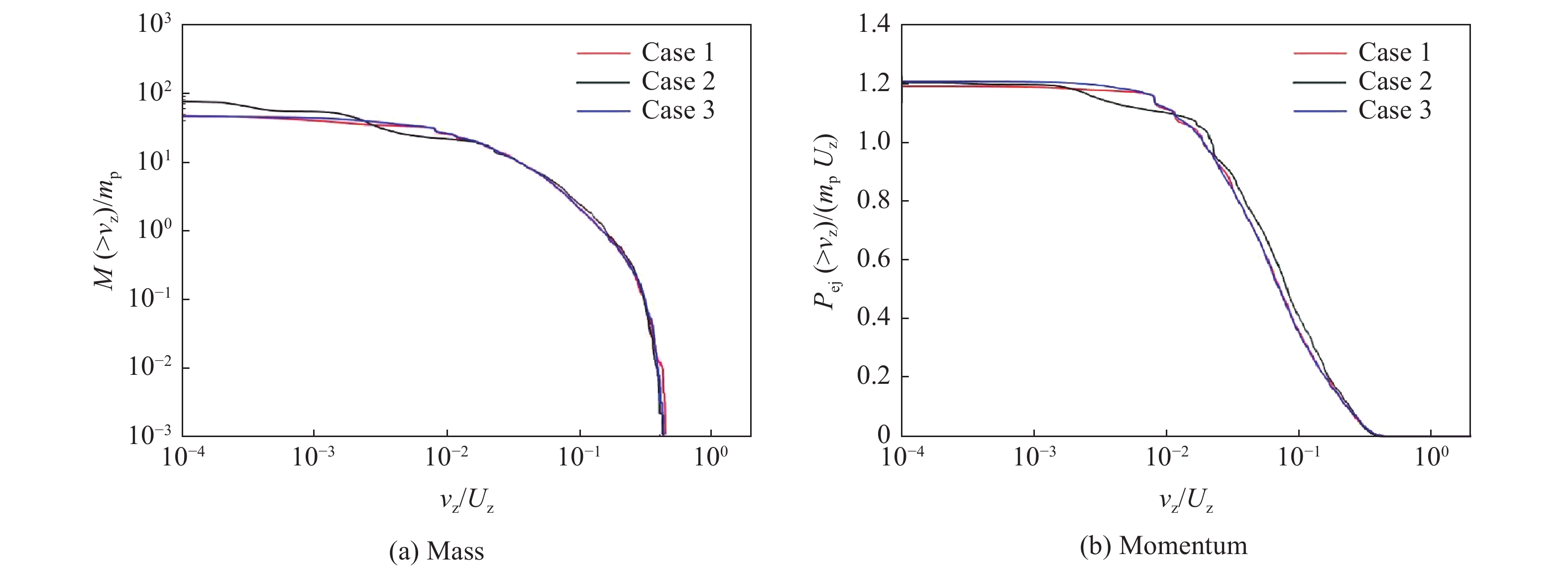
图 9 工况2~ 4的靶体损伤(黑色虚线为撞击坑)
Figure 9. Target damage diagrams of cases 2−4 (the black dotted line is the crater)
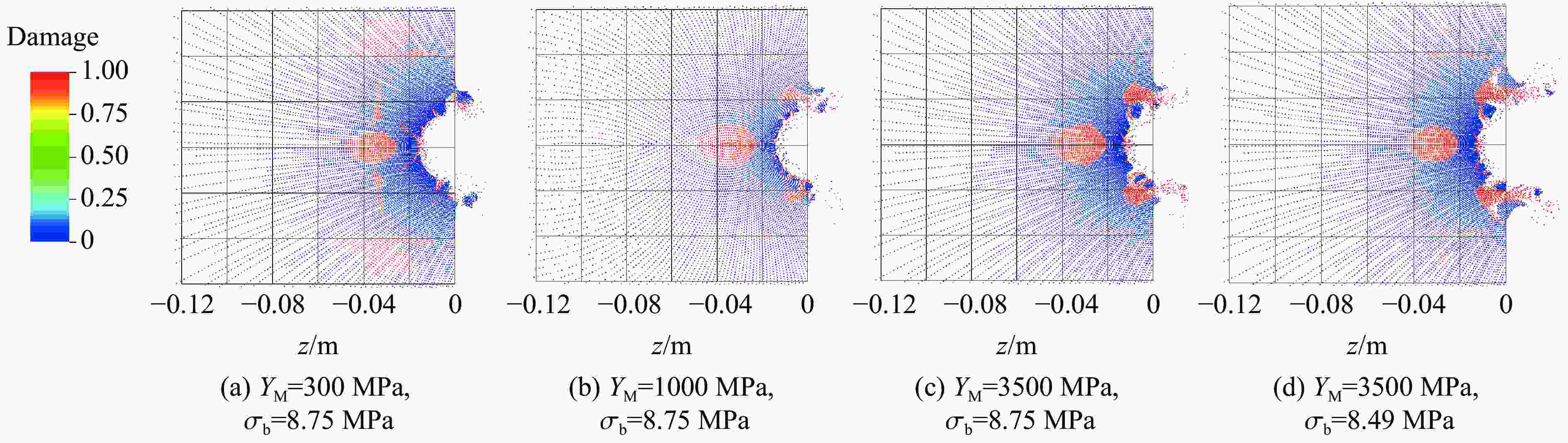
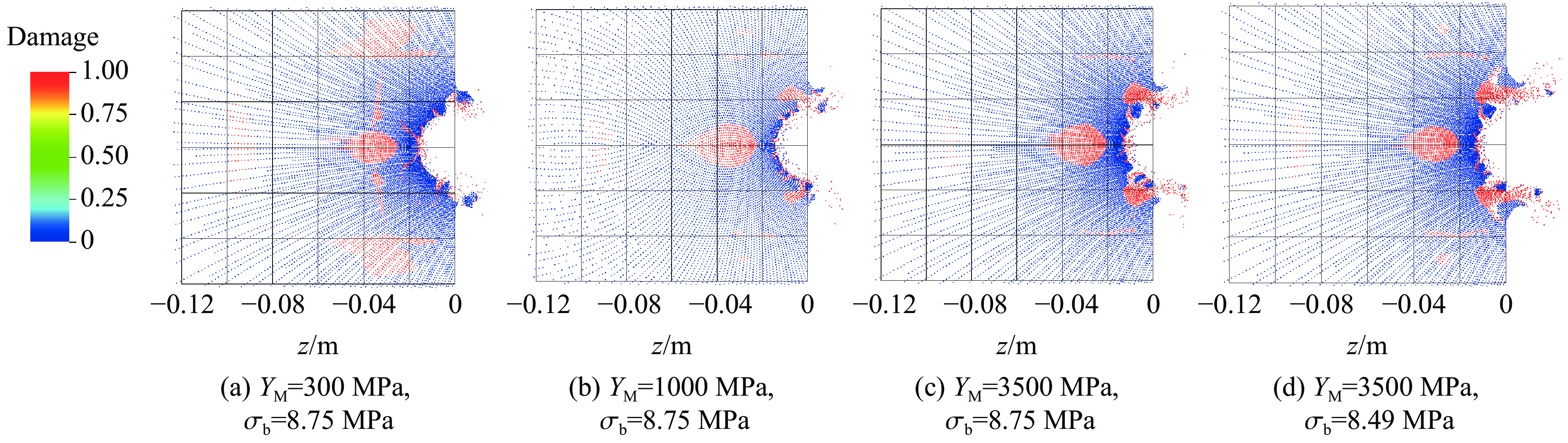
图 11 不同$ {Y}_{\mathrm{M}} $的靶体剖面
Figure 11. Cross-sectional views of the target body with different $ {Y}_{\mathrm{M}} $
表 1 仿真参数
Table 1. Numerical simulation parameters
材料 用途 密度/(kg·m−3) 形状尺寸/mm 速度/(km·s−1) Ares/mm q 状态方程 强度模型 铝 弹丸 2785 球体,d = 6 2.30/3.47/3.90 0.5 1 Tillotson[45] Johnson-Cook[36] 玄武岩 靶体 2876 圆柱,$\varnothing $123.3×123.3 − 0.5 1.01 Tillotson[45] Lundborg 材料 剪切模量/GPa Y0/MPa μ YM/MPa 损伤模型 m k/m−3 σb/MPa 铝 26.5 最大拉应力损伤模型 2 500[39] 玄武岩 22.7 26.5[47] 0.6[48] 300[47] Benz-Asphaug概率损伤模型 10.0 2.7×1041 9.62  下载: 导出CSV
表 2 不同撞击速度的仿真与实验对比
Table 2. Comparison of simulation and experimental results at different impact velocities
下载: 导出CSV
表 3 变分辨率粒子分布法测试结果
Table 3. Test results of the variable resolution particle distribution method
Ares q 总粒子数 总质量 粒子数占比/% 总质量误差/% 1 1.00 1 000 000 1 000 000 100 0 1 1.01 89 859 994 575 8.96 −0.54 1 1.03 10 323 982 158 1.03 −1.78 2 1.00 125 000 1 000 000 100 0 2 1.01 29 714 993 986 23.77 −0.60 2 1.03 5 762 979 872 4.61 −2.01
下载: 导出CSV
表 4 相似结果时的不同工况参数
Table 4. Different case parameters for similar results
工况 强度模型 Y0/MPa 损伤模型 σbs/MPa 坑直径/mm 坑深度/mm β 1 Lundborg 26.5 Benz-Asphaug概率 9.62 48 15 2.19 2 恒定强度 66.0 Benz-Asphaug概率 9.85 38 16 2.20 3 Lundborg 26.5 最大拉应力 33.0 50 15 2.20 4 Drucker-Prager 146.0 最大拉应力 50.0 84 12 2.22
下载: 导出CSV
表 5 不同极限强度下的仿真结果
Table 5. Simulation results under different ultimate strengths
YM/MPa m k/m−3 σbs/MPa 坑直径/mm 坑深度/mm β ɛd/% 300 9.5 9.0×1039 8.75 49 16 2.21 4.35 1 000 9.5 9.0×1039 8.75 49 15 2.15 33.84 3 500 9.5 9.0×1039 8.75 48 13 2.20 48.04 3 500 9.5 1.2×1040 8.49 68 14 2.58 44.69
下载: 导出CSV
表 6 不同$ {Y}_{0} $的$ m $、$ k $参数
Table 6. $m $ and $k $ for different $ {Y}_{0} $
Y0/MPa m k/m−3 σbs误差/% 坑直径误差/% 坑深度误差/% β误差/% 20.0 9.5 9.0×1039 −10.7 −10.9 18.5 −12.0 26.5 10.0 2.7×1041 −1.7 −12.7 11.1 −12.7 30.0 9.75 2.5×1040 0.5 −16.4 11.3 −15.1 35.0 9.0 5.0×1037 −2.0 −18.2 7.4 −16.3
下载: 导出CSV
-
[1] DALY R T, ERNST C M, BARNOUIN O S, et al. Successful kinetic impact into an asteroid for planetary defence [J]. Nature, 2023, 616(7957): 443–447. DOI: 10.1038/s41586-023-05810-5. [2] 吴伟仁, 唐玉华, 李明涛. 小行星防御在轨处置技术研究进展 [J]. 深空探测学报(中英文), 2023, 10(4): 345–356. DOI: 10.15982/j.issn.2096-9287.2023.20230111.WU W R, TANG Y H, LI M T. Research progress in asteroid defense on-orbit disposal technology [J]. Journal of Deep Space Exploration, 2023, 10(4): 345–356. DOI: 10.15982/j.issn.2096-9287.2023.20230111. [3] CHOCRON S, WALKER J D, GROSCH D J, et al. Momentum enhancement simulations for hypervelocity impacts on sandstone [J]. International Journal of Impact Engineering, 2021, 151: 103832. DOI: 10.1016/j.ijimpeng.2021.103832. [4] RADUCAN S D, JUTZI M, MERRILL C C, et al. Lessons learned from NASA's DART impact about disrupting rubble-pile asteroids [J]. The Planetary Science Journal, 2024, 5(3): 79. DOI: 10.3847/PSJ/ad29f6. [5] JIAO Y F, YAN X R, CHENG B, et al. SPH-DEM modelling of hypervelocity impacts on rubble-pile asteroids [J]. Monthly Notices of the Royal Astronomical Society, 2024, 527(4): 10348–10357. DOI: 10.1093/mnras/stad3888. [6] PEARL J M, RASKIN C D, OWEN J M. FSISPH: an SPH formulation for impacts between dissimilar materials [J]. Journal of Computational Physics, 2022, 469: 111533. DOI: 10.1016/j.jcp.2022.111533. [7] LUTHER R, RADUCAN S D, BURGER C, et al. Momentum enhancement during kinetic impacts in the low-intermediate-strength regime: benchmarking and validation of impact shock physics codes [J]. The Planetary Science Journal, 2022, 3(10): 227. DOI: 10.3847/PSJ/ac8b89. [8] STICKLE A M, DECOSTER M E, BURGER C, et al. Effects of impact and target parameters on the results of a kinetic impactor: predictions for the Double Asteroid Redirection Test (DART) mission [J]. The Planetary Science Journal, 2022, 3(11): 248. DOI: 10.3847/PSJ/ac91cc. [9] REMINGTON T P, OWEN J M, NAKAMURA A M, et al. Numerical simulations of laboratory-scale, hypervelocity-impact experiments for asteroid-deflection code validation [J]. Earth and Space Science, 2020, 7(4): e2018EA000474. DOI: 10.1029/2018EA000474. [10] NAKAMURA A, FUJIWARA A. Velocity distribution of fragments formed in a simulated collisional disruption [J]. Icarus, 1991, 92(1): 132–146. DOI: 10.1016/0019-1035(91)90040-Z. [11] RADUCAN S D, JUTZI M. Global-scale reshaping and resurfacing of asteroids by small-scale impacts, with applications to the DART and Hera missions [J]. The Planetary Science Journal, 2022, 3(6): 128. DOI: 10.3847/PSJ/ac67a7. [12] RADUCAN S D, JUTZI M, ZHANG Y, et al. Reshaping and ejection processes on rubble-pile asteroids from impacts [J]. Astronomy & Astrophysics, 2022, 665: L10. DOI: 10.1051/0004-6361/202244807. [13] RADUCAN S D, JUTZI M, CHENG A F, et al. Physical properties of asteroid Dimorphos as derived from the DART impact [J]. Nature Astronomy, 2024, 8(4): 445–455. DOI: 10.1038/s41550-024-02200-3. [14] 焦艺菲, 程彬, 陈诗雨, 等. 小天体防御高速撞击数值仿真研究 [J]. 中国科学: 技术科学, 2023, 53(12): 2039–2052. DOI: 10.1360/SST-2022-0274.JIAO Y F, CHENG B, CHEN S Y, et al. Numerical simulations of hypervelocity impacts to defend against small bodies [J]. SCIENTIA SINICA Technologica, 2023, 53(12): 2039–2052. DOI: 10.1360/SST-2022-0274. [15] 刘文近, 张庆明, 龙仁荣, 等. 超高速动能撞击密实小行星的动量传递规律 [J]. 深空探测学报(中英文), 2023, 10(4): 420–427. DOI: 10.15982/j.issn.2096-9287.2023.20230042.LIU W J, ZHANG Q M, LONG R R, et al. Momentum transfer law of hypervelocity kinetic impacting dense asteroids [J]. Journal of Deep Space Exploration, 2023, 10(4): 420–427. DOI: 10.15982/j.issn.2096-9287.2023.20230042. [16] 张鸿宇, 迟润强, 孙淼, 等. 砾石堆结构超高速撞击溅射物特性 [J]. 深空探测学报(中英文), 2023, 10(4): 428–435. DOI: 10.15982/j.issn.2096-9287.2023.20230021.ZHANG H Y, CHI R Q, SUN M, et al. Research on characteristics of hypervelocity impact induced ejecta in rubble-pile targets [J]. Journal of Deep Space Exploration, 2023, 10(4): 428–435. DOI: 10.15982/j.issn.2096-9287.2023.20230021. [17] YAN X R, LIU Y, ZHANG Y, et al. Hypervelocity impact simulation on asteroids with MPM framework [C]//Proceedings of the 16th Europlanet Science Congress. Granada, 2022: 18–23. DOI: 10.5194/epsc2022-1064. [18] 陈鸿, 李毅, 邹胜宇, 等. 动能撞击偏转小行星的动量传递效率数值仿真研究 [J]. 空间碎片研究, 2022, 22(3): 19–25. DOI: 10.19963/j.cnki.2096-4099.2022.03.003.CHEN H, LI Y, ZOU S Y, et al. Numerical simulation study on momentum transfer efficiency of kinetic impact deflection of asteroid [J]. Space Debris Research, 2022, 22(3): 19–25. DOI: 10.19963/j.cnki.2096-4099.2022.03.003. [19] MONAGHAN J J, GINGOLD R A. Shock simulation by the particle method SPH [J]. Journal of Computational Physics, 1983, 52(2): 374–389. DOI: 10.1016/0021-9991(83)90036-0. [20] 傅学金, 强洪夫, 杨月诚. 固体介质中SPH方法的拉伸不稳定性问题研究进展 [J]. 力学进展, 2007, 37(3): 375–388. DOI: 10.3321/j.issn:1000-0992.2007.03.005.FU X J, QIANG H F, YANG Y C. Advances in the tensile instability of smoothed particle hydrodynamics applied to solid dynamics [J]. Advances in Mechanics, 2007, 37(3): 375–388. DOI: 10.3321/j.issn:1000-0992.2007.03.005. [21] DEHNEN W, ALY H. Improving convergence in smoothed particle hydrodynamics simulations without pairing instability [J]. Monthly Notices of the Royal Astronomical Society, 2012, 425(2): 1068–1082. DOI: 10.1111/j.1365-2966.2012.21439.x. [22] GINGOLD R A, MONAGHAN J J. Kernel estimates as a basis for general particle methods in hydrodynamics [J]. Journal of Computational Physics, 1982, 46(3): 429–453. DOI: 10.1016/0021-9991(82)90025-0. [23] OWEN J M. ASPH modeling of material damage and failure: LLNL-PROC-430616 [R]. Manchester: Lawrence Livermore National Laboratory , 2010. [24] TILLOTSON J H. Metallic equations of state for hypervelocity impact: GA-3216 [R]San Diego: General Atomic, 1962. [25] DRUCKER D C, PRAGER W. Soil mechanics and plastic analysis or limit design [J]. Quarterly of Applied Mathematics, 1952, 10(2): 157–165. DOI: 10.1090/qam/48291. [26] LUNDBORG N. Strength of rock-like materials [J]. International Journal of Rock Mechanics and Mining Sciences & Geomechanics Abstracts, 1968, 5(5): 427–454. DOI: 10.1016/0148-9062(68)90046-6. [27] 季节, 王晓光, 肖俊孝, 等. 月球冻土模拟与剪切强度试验分析 [J]. 深空探测学报(中英文), 2023, 10(2): 199–210. DOI: 10.15982/j.issn.2096-9287.2023.20230006.JI J, WANG X G, XIAO J X, et al. Simulation of icy lunar regolith and experiment on its shear strength [J]. Journal of Deep Space Exploration, 2023, 10(2): 199–210. DOI: 10.15982/j.issn.2096-9287.2023.20230006. [28] DECOSTER M E, RAINEY E S G, ROSCH T W, et al. Statistical significance of mission parameters on the deflection efficiency of kinetic impacts: applications for the next-generation kinetic impactor [J]. The Planetary Science Journal, 2022, 3(8): 186. DOI: 10.3847/PSJ/ac7b2a. [29] CALDWELL W K, HUNTER A, PLESKO C S. Exploring density and strength variations in asteroid 16 Psyche’s composition with 3D hydrocode modeling of its deepest impact structure [J]. Icarus, 2024, 408: 115780. DOI: 10.1016/j.icarus.2023.115780. [30] OWEN J M, DECOSTER M E, GRANINGER D M, et al. Spacecraft geometry effects on kinetic impactor missions [J]. The Planetary Science Journal, 2022, 3(9): 218. DOI: 10.3847/PSJ/ac8932. [31] RADUCAN S D, DAVISON T M, COLLINS G S. Ejecta distribution and momentum transfer from oblique impacts on asteroid surfaces [J]. Icarus, 2022, 374: 114793. DOI: 10.1016/j.icarus.2021.114793. [32] SENFT L E, STEWART S T. Modeling impact cratering in layered surfaces [J]. Journal of Geophysical Research: Planets, 2007, 112(E11): E11002. DOI: 10.1029/2007JE002894. [33] RAINEY E S G, STICKLE A M, CHENG A F, et al. Impact modeling for the Double Asteroid Redirection Test (DART) mission [J]. International Journal of Impact Engineering, 2020, 142: 103528. DOI: 10.1016/j.ijimpeng.2020.103528. [34] 田世轩, 郭保华, 孙杰豪, 等. 不同边界条件下剪切速率对类岩石节理剪切力学特性的影响 [J]. 岩土力学, 2023, 44(2): 541–551. DOI: 10.16285/j.rsm.2022.0102.TIAN S X, GUO B H, SUN J H, et al. Effect of shear rate on shear mechanical properties of rock-like joints under different boundary conditions [J]. Rock and Soil Mechanics, 2023, 44(2): 541–551. DOI: 10.16285/j.rsm.2022.0102. [35] 袁伟, 李建春, 李星. 非充填岩石节理的动态剪切力学行为实验研究进展 [J]. 力学与实践, 2023, 45(5): 960–971. DOI: 10.6052/1000-0879-23-315.YUAN W, LI J C, LI X. Progress of experimental study on dynamic shear behaviors of unfilled rock joints [J]. Mechanics in Engineering, 2023, 45(5): 960–971. DOI: 10.6052/1000-0879-23-315. [36] JOHNSON G R, COOK W H. A constitutive model and data for metals subjected to large strains, high strain rates and high temperatures [J]. Engineering Fracture Mechanics, 1983, 21: 541–548. [37] STEINBERG D J, COCHRAN S G, GUINAN M W. A constitutive model for metals applicable at high-strain rate [J]. Journal of Applied Physics, 1980, 51(3): 1498–1504. DOI: 10.1063/1.327799. [38] COLLINS G S, MELOSH H J, IVANOV B A. Modeling damage and deformation in impact simulations [J]. Meteoritics & Planetary Science, 2004, 39(2): 217–231. DOI: 10.1111/j.1945-5100.2004.tb00337.x. [39] 张伟, 庞宝君, 贾斌, 等. 弹丸超高速撞击防护屏碎片云数值模拟 [J]. 高压物理学报, 2004, 18(1): 47–52. DOI: 10.11858/gywlxb.2004.01.009.ZHANG W, PANG B J, JIA B, et al. Numerical simulation of debris cloud produced by hypervelocity impact of projectile on bumper [J]. Chinese Journal of High Pressure Physics, 2004, 18(1): 47–52. DOI: 10.11858/gywlxb.2004.01.009. [40] LIU W J, ZHANG Q M, LONG R R, et al. Effects of projectile parameters on the momentum transfer and projectile melting during hypervelocity impact [J]. Defence Technology, 2024, 32: 89–103. DOI: 10.1016/j.dt.2023.06.012. [41] 宫凤强, 陆道辉, 李夕兵, 等. 不同应变率下砂岩动态强度准则的试验研究 [J]. 岩土力学, 2013, 34(9): 2433–2441. DOI: 10.16285/j.rsm.2013.09.007.GONG F Q, LU D H, LI X B, et al. Experimental research of sandstone dynamic strength criterion under different strain rates [J]. Rock and Soil Mechanics, 2013, 34(9): 2433–2441. DOI: 10.16285/j.rsm.2013.09.007. [42] BENZ W, ASPHAUG E. Simulations of brittle solids using smooth particle hydrodynamics [J]. Computer Physics Communications, 1995, 87(1/2): 253–265. DOI: 10.1016/0010-4655(94)00176-3. [43] GRADY D E, KIPP M E. Continuum modelling of explosive fracture in oil shale [J]. International Journal of Rock Mechanics and Mining Sciences & Geomechanics Abstracts, 1980, 17(3): 147–157. DOI: 10.1016/0148-9062(80)91361-3. [44] MICHEL P, BENZ W, TANGA P, et al. Collisions and gravitational reaccumulation: forming asteroid families and satellites [J]. Science, 2001, 294(5547): 1696–1700. DOI: 10.1126/science.1065189. [45] STICKLE A M, SYAL M B, CHENG A F, et al. Benchmarking impact hydrocodes in the strength regime: implications for modeling deflection by a kinetic impactor [J]. Icarus, 2020, 338: 113446. DOI: 10.1016/j.icarus.2019.113446. [46] CHENG A F, AGRUSA H F, BARBEE B W, et al. Momentum transfer from the DART mission kinetic impact on asteroid Dimorphos [J]. Nature, 2023, 616(7957): 457–460. DOI: 10.1038/s41586-023-05878-z. [47] STOWE R L. Strength and deformation properties of granite, basalt, limestone, and tuff at various loading rates: Miscellaneous Paper C69-1 [R]. Vicksburg: U. S. Army Engineer Waterways Experiment Station, 1969. [48] RADUCAN S D, DAVISON T M, LUTHER R, et al. The role of asteroid strength, porosity and internal friction in impact momentum transfer [J]. Icarus, 2019, 329: 282–295. DOI: 10.1016/j.icarus.2019.03.040. [49] HOERTH T, SCHÄFER F, THOMA K, et al. Hypervelocity impacts on dry and wet sandstone: observations of ejecta dynamics and crater growth [J]. Meteoritics & Planetary Science, 2013, 48(1): 23–32. DOI: 10.1111/maps.12044. [50] PEARL J M, RASKIN C D, OWEN J M, et al. Insights into the failure mode of the Chelyabinsk meteor from high-fidelity simulation [J]. Icarus, 2023, 404: 115686. DOI: 10.1016/j.icarus.2023.115686. [51] PIERAZZO E, ARTEMIEVA N A, IVANOV B A. Starting conditions for hydrothermal systems underneath Martian craters: hydrocode modeling [M]//KENKMANN T, HÖRZ F, DEUTSCH A. Large Meteorite Impacts Ⅲ. Boulder: Geological Society of American, 2005: 443–457. DOI: 10.1130/0-8137-2384-1.443. [52] PRIEUR N C, ROLF T, LUTHER R, et al. The effect of target properties on transient crater scaling for simple craters [J]. Journal of Geophysical Research: Planets, 2017, 122(8): 1704–1726. DOI: 10.1002/2017JE005283. [53] JUTZI M, MICHEL P, HIRAOKA K, et al. Numerical simulations of impacts involving porous bodies Ⅱ. comparison with laboratory experiments [J]. Icarus, 2009, 201(2): 802–813. DOI: 10.1016/j.icarus.2009.01.018. -







计量
- 文章访问数: 520
- HTML全文浏览量: 216
- PDF下载量: 172
- 被引次数: 0