



Coupling effects of initial temperature and pressure on the explosion limits of propylene-air mixture
-
摘要: 为有效预防丙烯在生产、储存及使用过程中的燃爆风险,利用12 L爆炸极限测试仪测定了丙烯-空气混合物在不同初始温度(20~180 ℃)和初始压力(0.1~0.9 MPa)条件下的爆炸极限。实验结果表明:随初始温度、初始压力的升高丙烯爆炸上限显著上升,爆炸下限轻微下降,爆炸极限明显变宽。在初始温度为180 ℃时,随着压力的升高,丙烯爆炸上限测试中碳粉生成量显著增加,同时丙烯爆炸下限下降趋势由直线变为滑梯状曲线。通过CHETAH 11.0软件分析发现,碳粉含量升高与高温高压条件下的热力学特性密切相关,当压力从0.1 MPa升至0.9 MPa时,爆炸产物中碳含量从3.82%急剧增加至25.88%,这种显著增长主要源于两个方面:一是高压条件促进了Boudouard反应向碳生成方向进行,二是高压环境下反应物总量提升,导致产物总量成倍增加。利用CHEMKIN软件分析了丙烯爆炸下限条件下燃烧特性规律:在贫燃料区,丙烯通过自由基链式反应最终生成CO2,使计算绝热火焰温度(calculated adiabatic flame temperature,CAFT)维持在
1400 K以上;随着压力升高CAFT逐渐降低;随着温度升高CAFT呈现压力依赖性转变,低压(低于0.5 MPa)时CAFT上升,高压时则下降,0.5 MPa为关键转变阈值。研究还发现初始温度、初始压力的耦合影响明显高于单因素的影响且对爆炸上限的影响明显高于爆炸下限:在初始温度单因素影响下,爆炸上限上升4.2%,爆炸下限下降3.41%;在初始压力单因素的影响下,爆炸上限上升51.3%,爆炸下限下降2.44%;在初始温度和初始压力的耦合影响下,爆炸上限上升了108%,爆炸下限下降了18.05%。Abstract: To effectively prevent explosion hazards during propylene production, storage, and utilization, the explosion limits of propylene in air under varying initial temperatures (20 ℃–180 ℃) and initial pressures (0.1 MPa–0.9 MPa) were measured using 12L explosion limit tester. The study revealed that as the initial temperature and pressure increase, the upper explosion limit (UEL) of propylene rises significantly, while the lower explosion limit (LEL) decreases slightly, resulting in a marked broadening of the explosion limit range. At an initial temperature of 180 ℃, with the pressure increases, the carbon powder content in the explosive products significantly increases during the UEL test, and the LEL decline transitions from a linear to a sliding-curve pattern. Analysis using CHETAH 11.0 software revealed that the increase in carbon powder content is closely related to thermodynamic properties under high-temperature and high-pressure conditions. When the pressure rises from 0.1 MPa to 0.9 MPa, the carbon powder content in the explosion products surges from 3.82% to 25.88%. This significant growth primarily stems from two factors: first, high-pressure conditions promote the Boudouard reaction toward carbon formation; second, the increased total amount of reactants under high pressure leads to a multiplicative rise in product quantities.Using CHEMKIN software, the combustion characteristics of propylene under lower explosion limit conditions were investigated. In the fuel-lean region, propylene undergoes free radical chain reactions, ultimately generating CO2, which maintains the calculated adiabatic flame temperature (CAFT) above1400 K. As pressure increases, CAFT gradually decreases. Meanwhile, with rising temperature, CAFT exhibits a pressure-dependent transition: at low pressures (<0.5 MPa), CAFT increases, whereas at high pressures, it decreases, with 0.5 MPa serving as the critical transition threshold. The coupling effects of initial temperature and pressure on explosion limits are far more pronounced than those of individual factors, with a stronger impact on the UEL than the LEL. The coupling effects caused a 108% increase in the UEL and an 18.05% decrease in the LEL. For individual factors, initial temperature alone led to a 3.8% UEL increase and a 3.41% LEL decrease, while initial pressure alone resulted in a 51.3% UEL increase and 2.44% LEL reduction.-
Key words:
- propylene /
- explosion limits /
- initial temperature /
- initial pressure
-
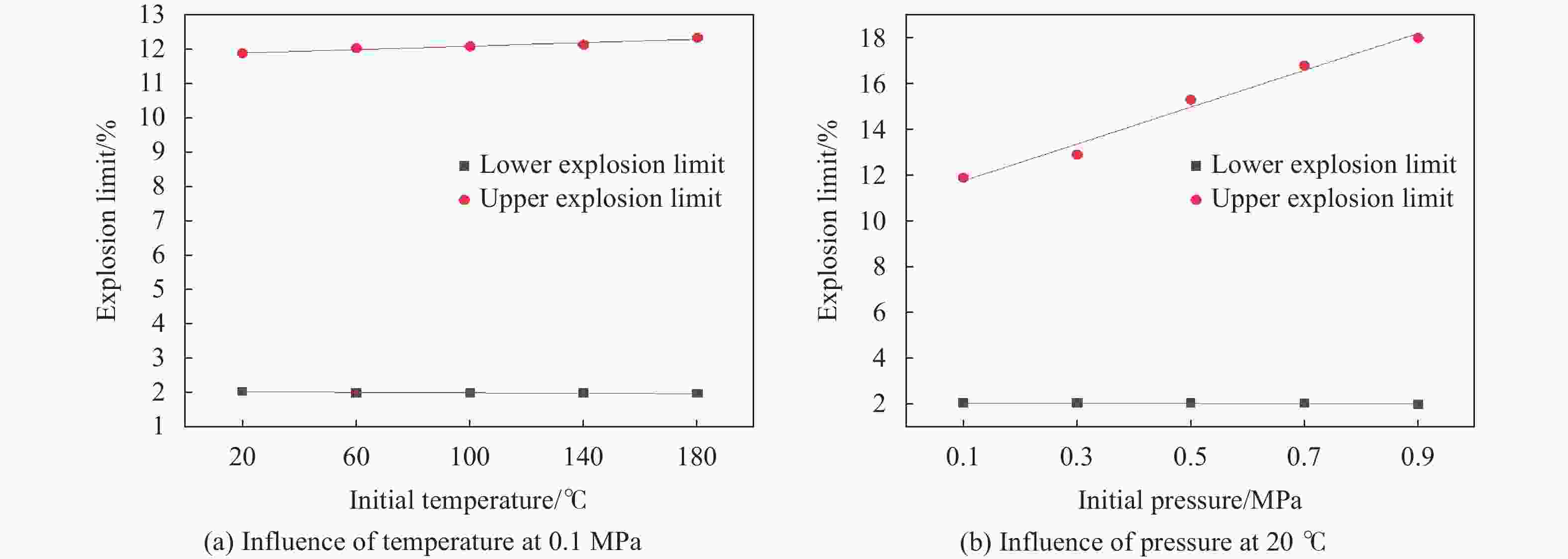
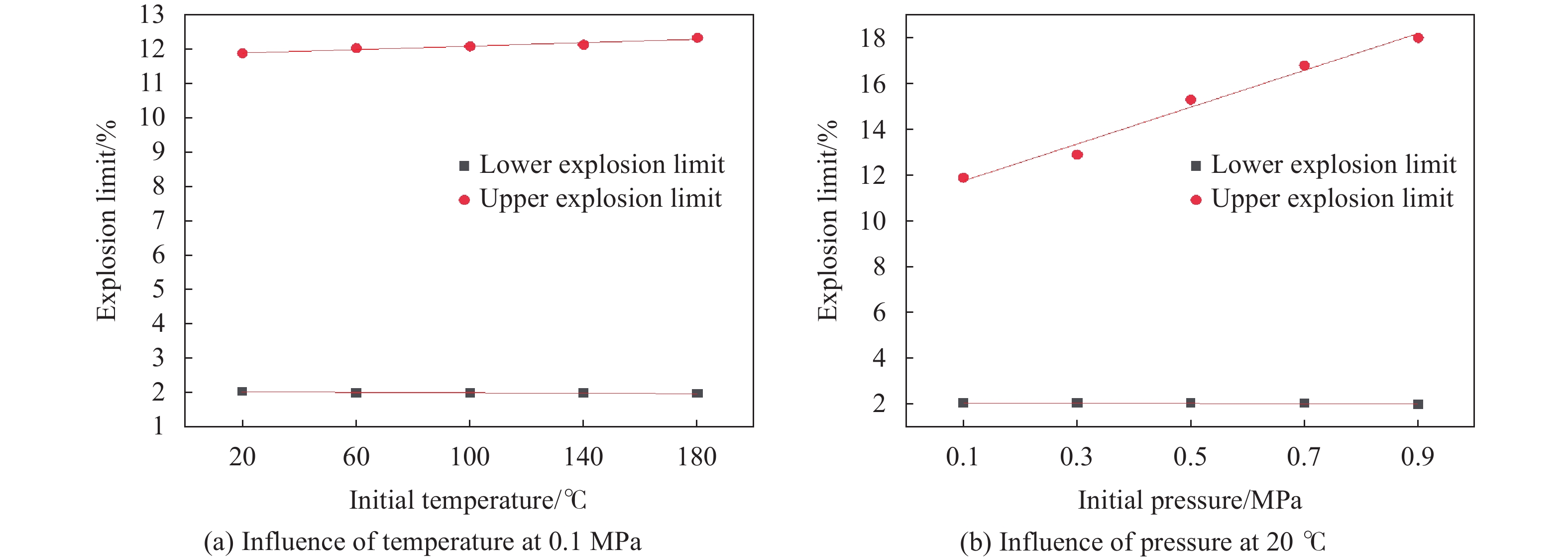
图 2 典型温度和压力条件下单因素对丙烯爆炸极限的影响
Figure 2. Individual effect of single factor on the explosion limits of propylene at typical temperature or pressure
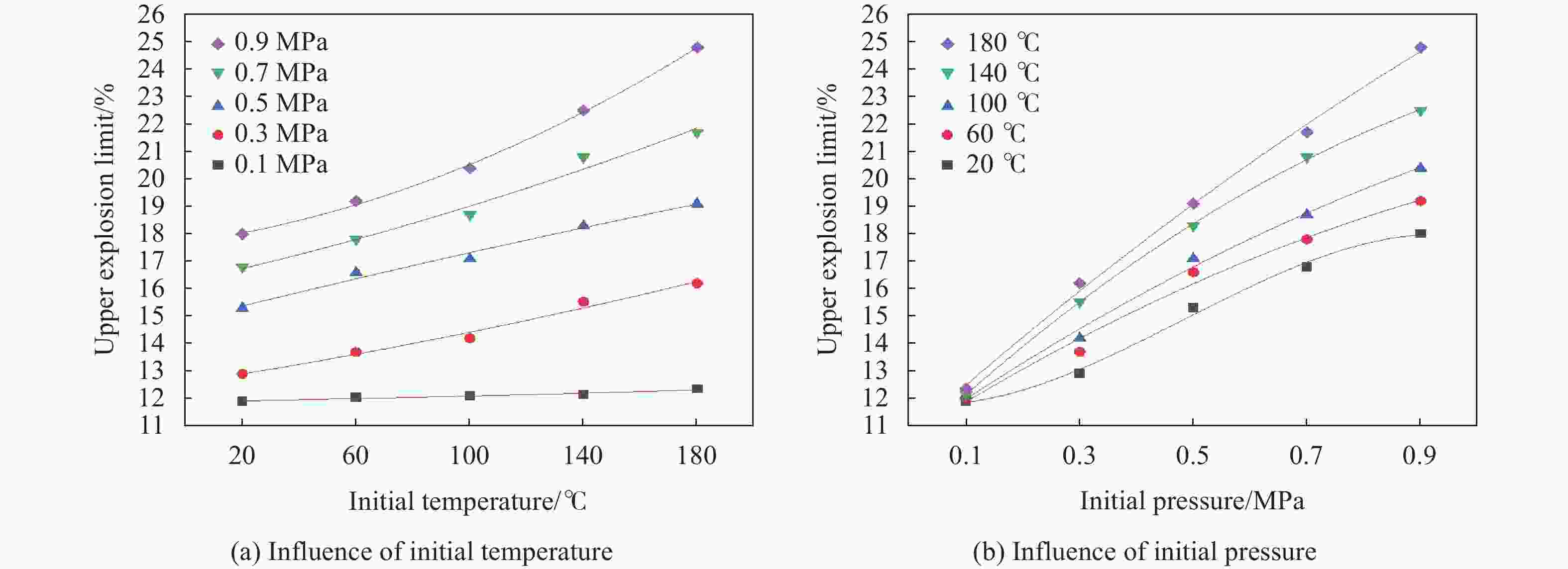
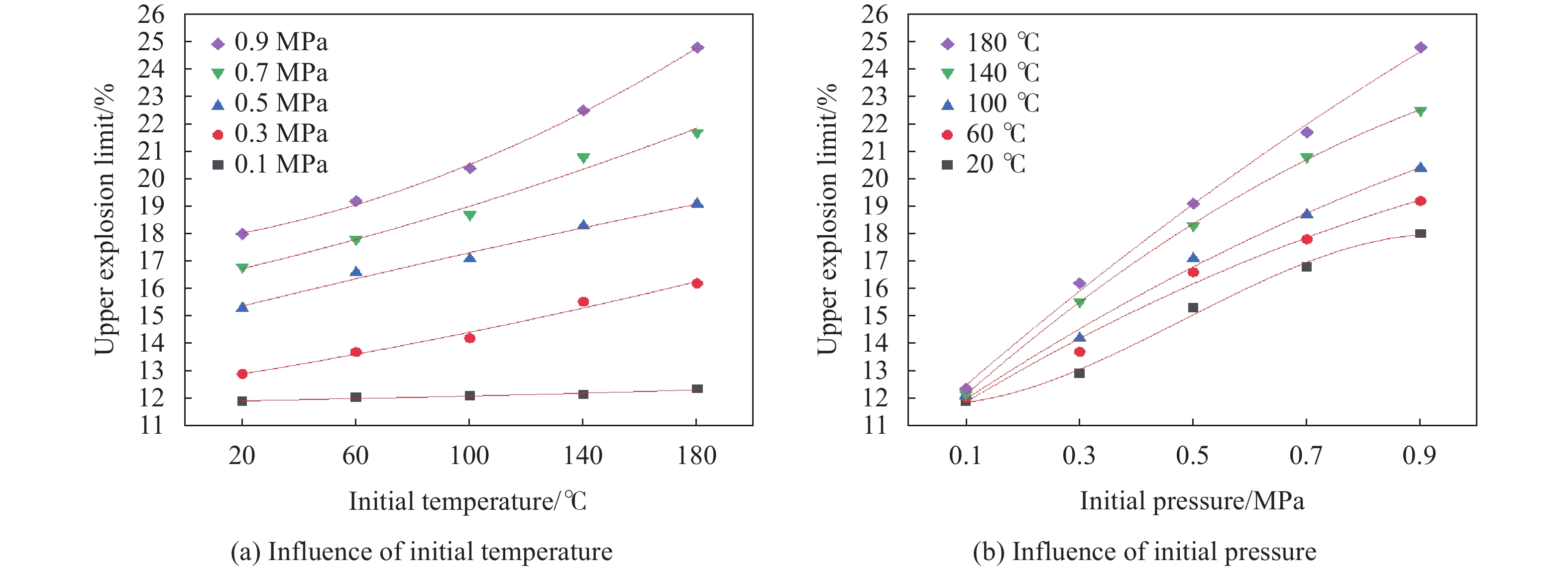
图 3 温度、压力对丙烯爆炸上限的影响
Figure 3. Propylene upper explosion limit varied with initial temperature or pressure
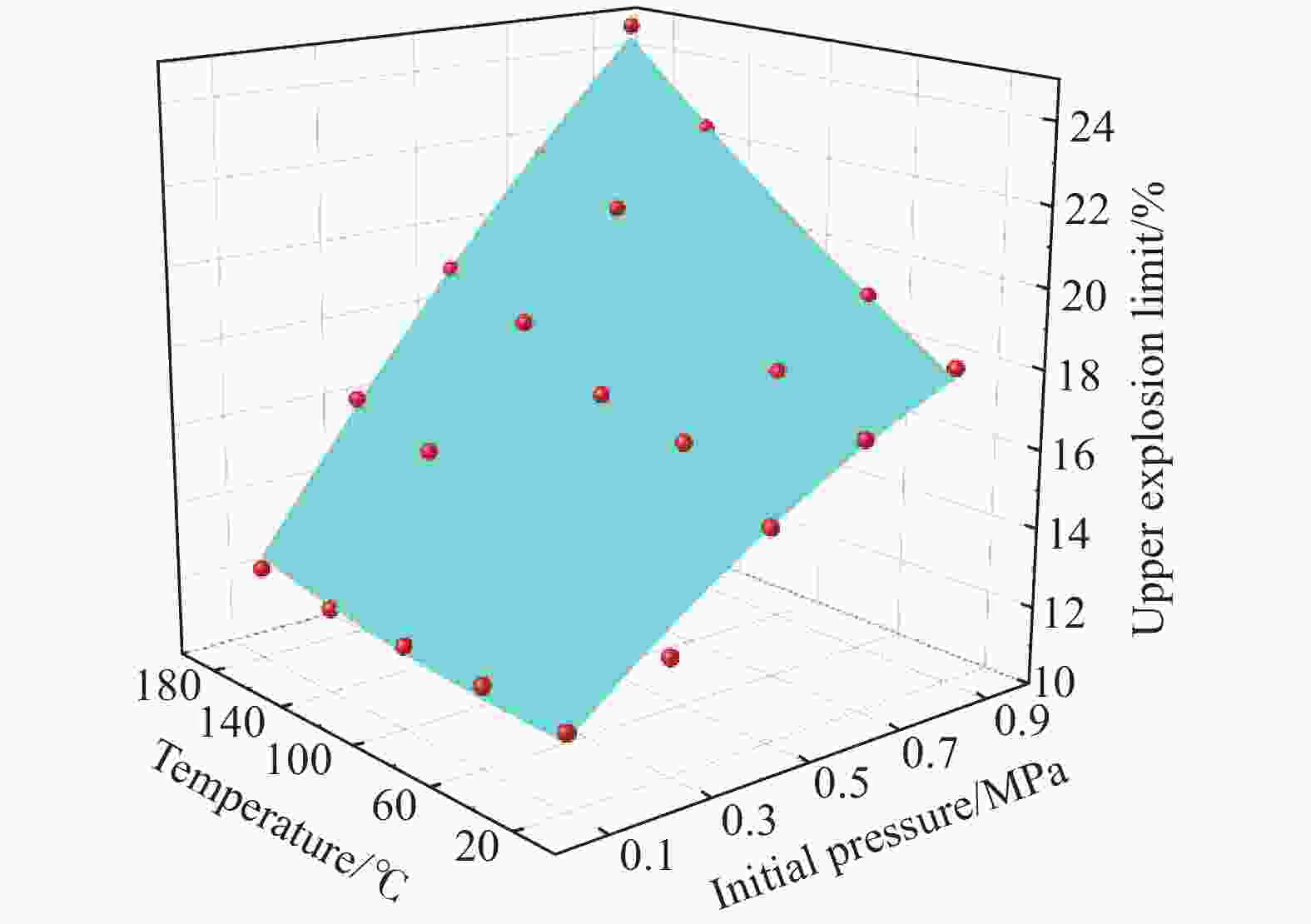
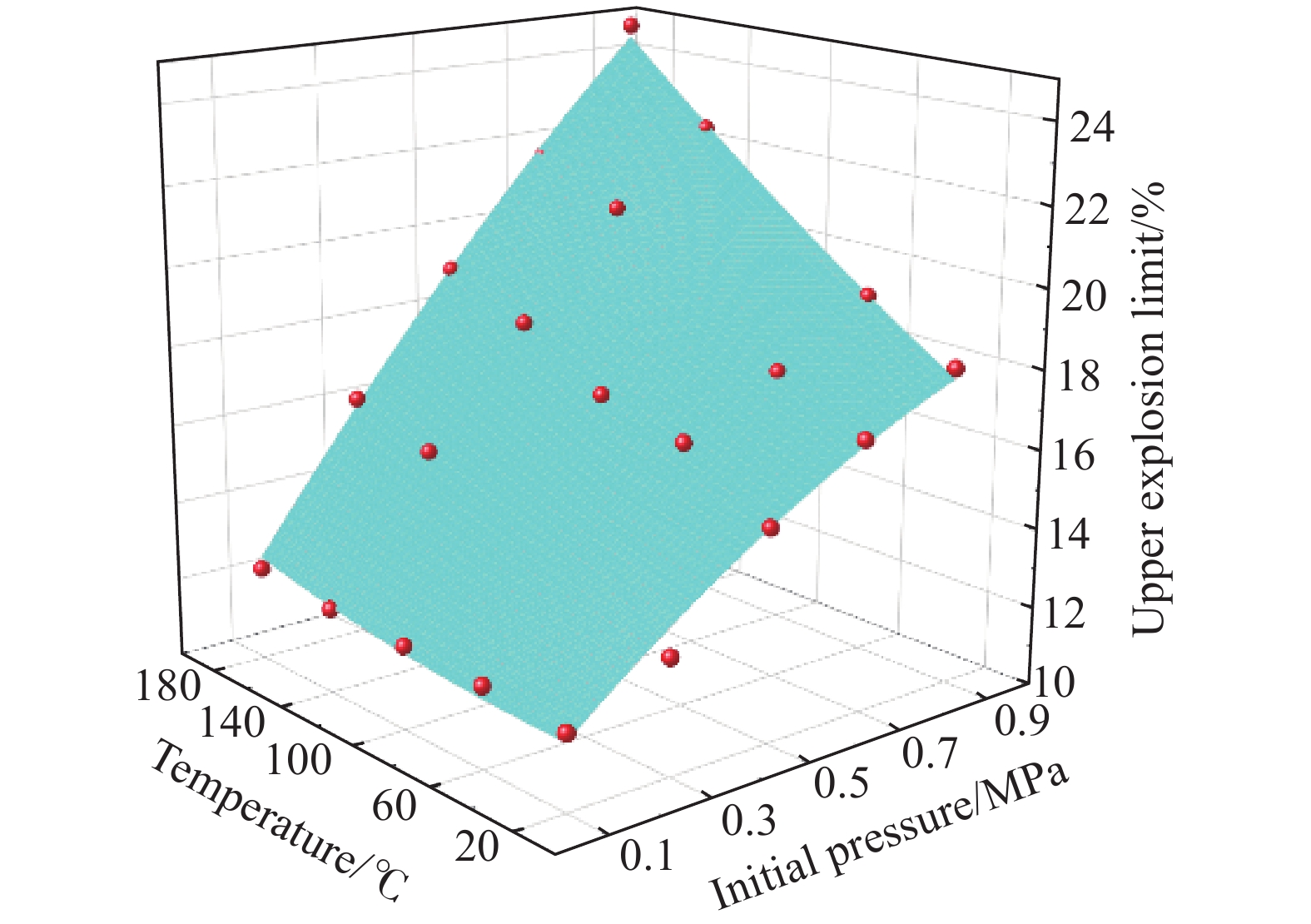
图 4 初始温度、压力对丙烯爆炸上限的耦合影响
Figure 4. Propylene UEL curve with initial temperature and pressure
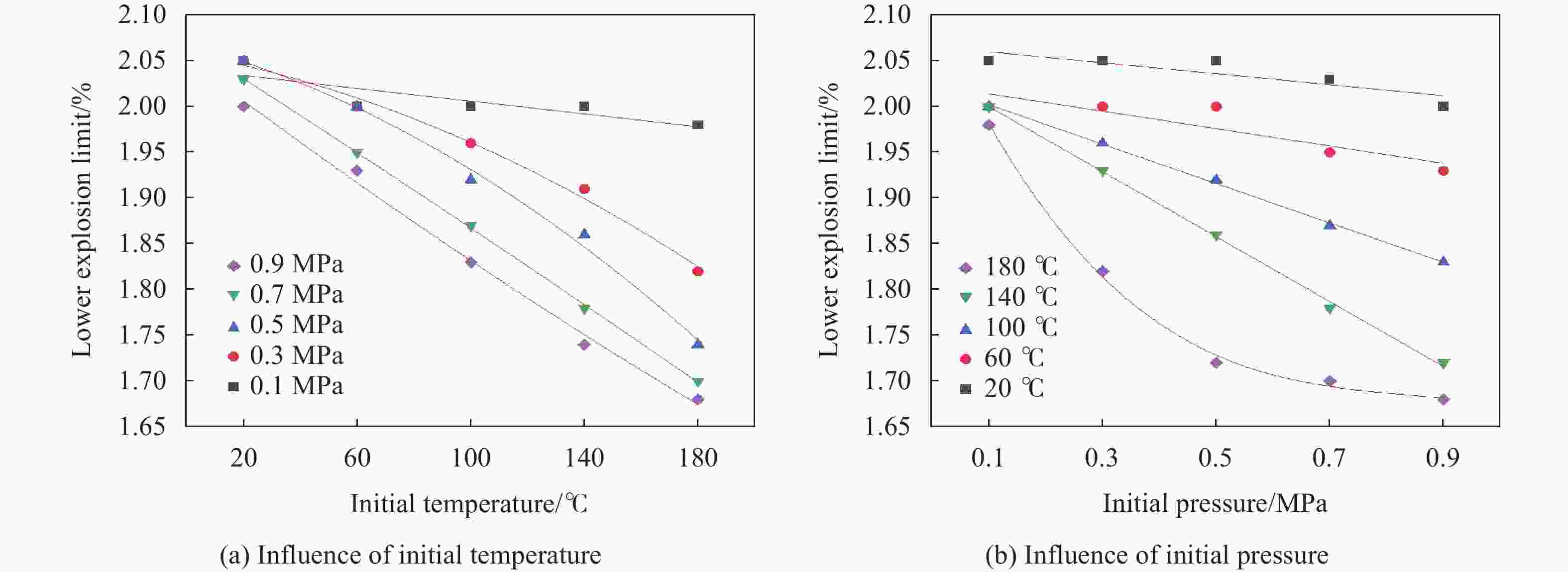
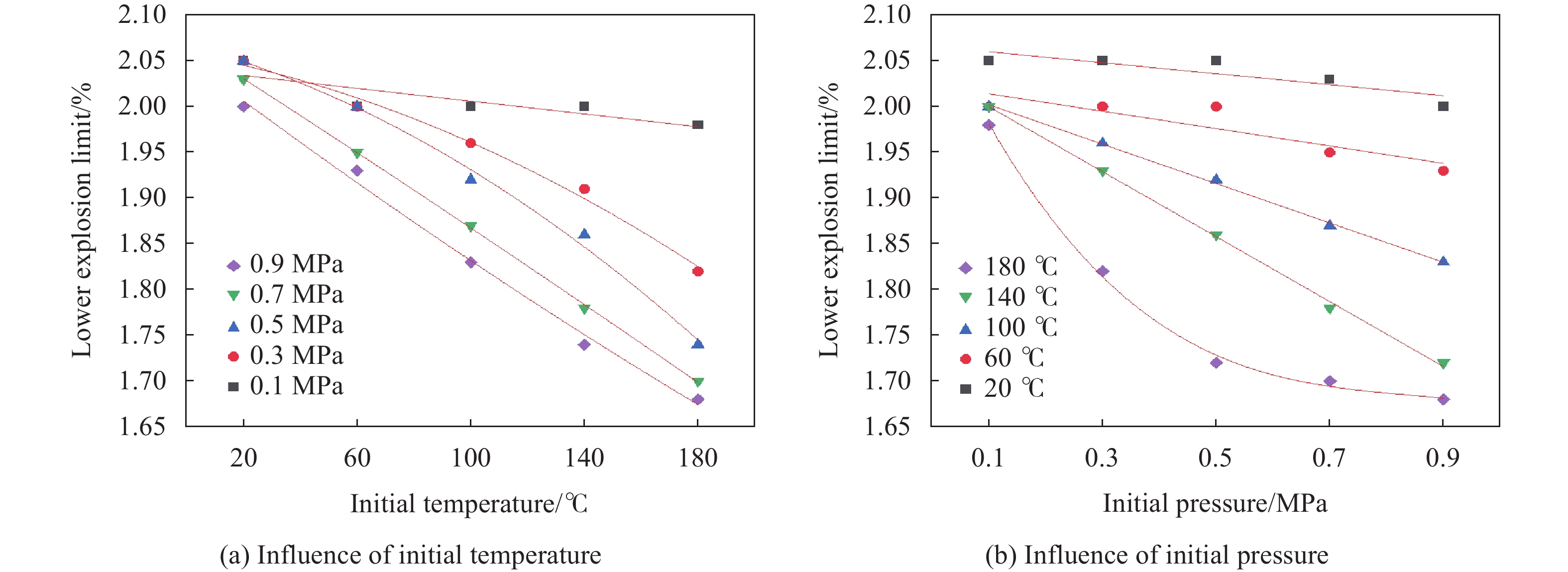
图 5 温度、压力对丙烯爆炸下限的影响
Figure 5. Propylene LEL varied with initial temperature or pressure
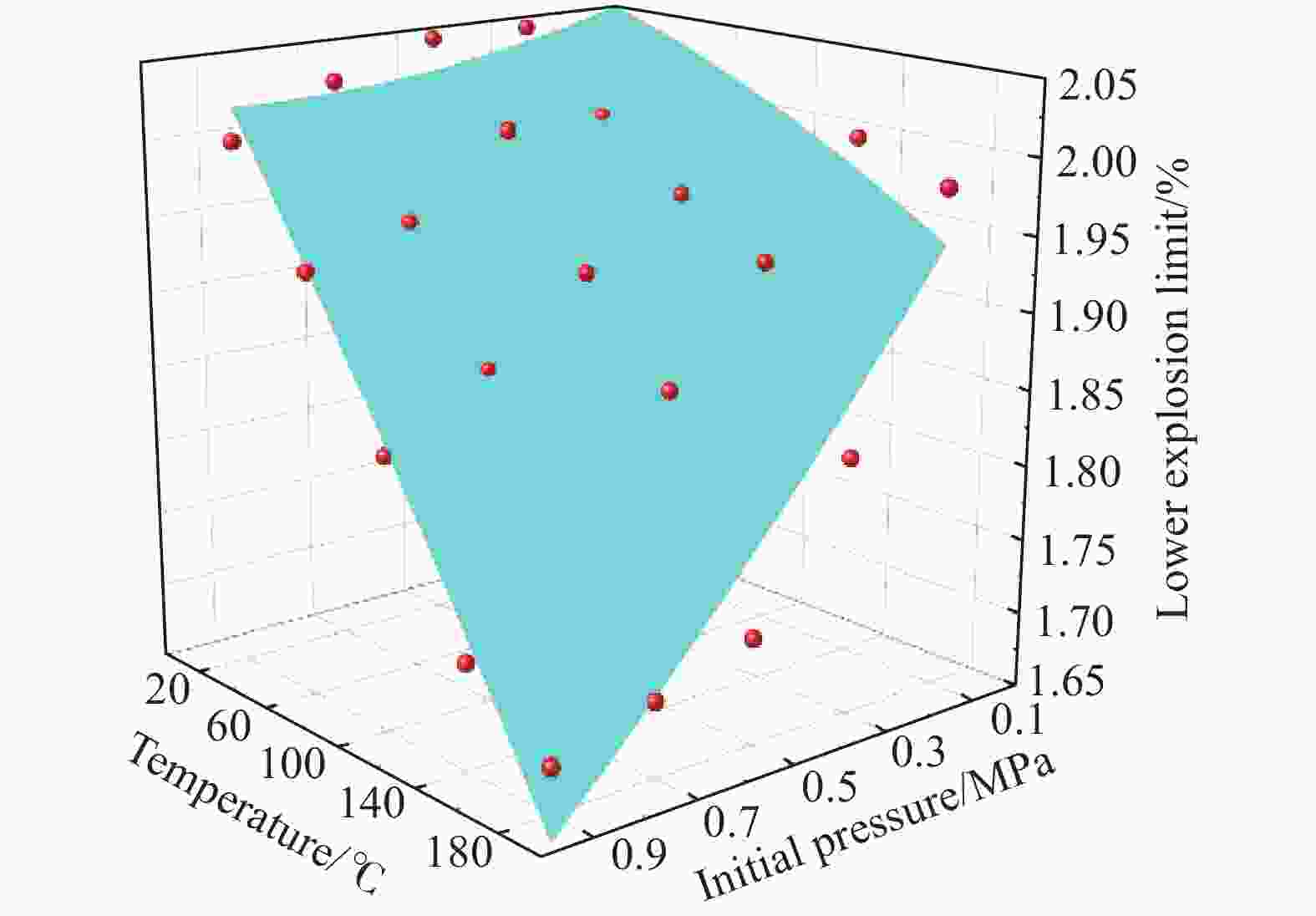
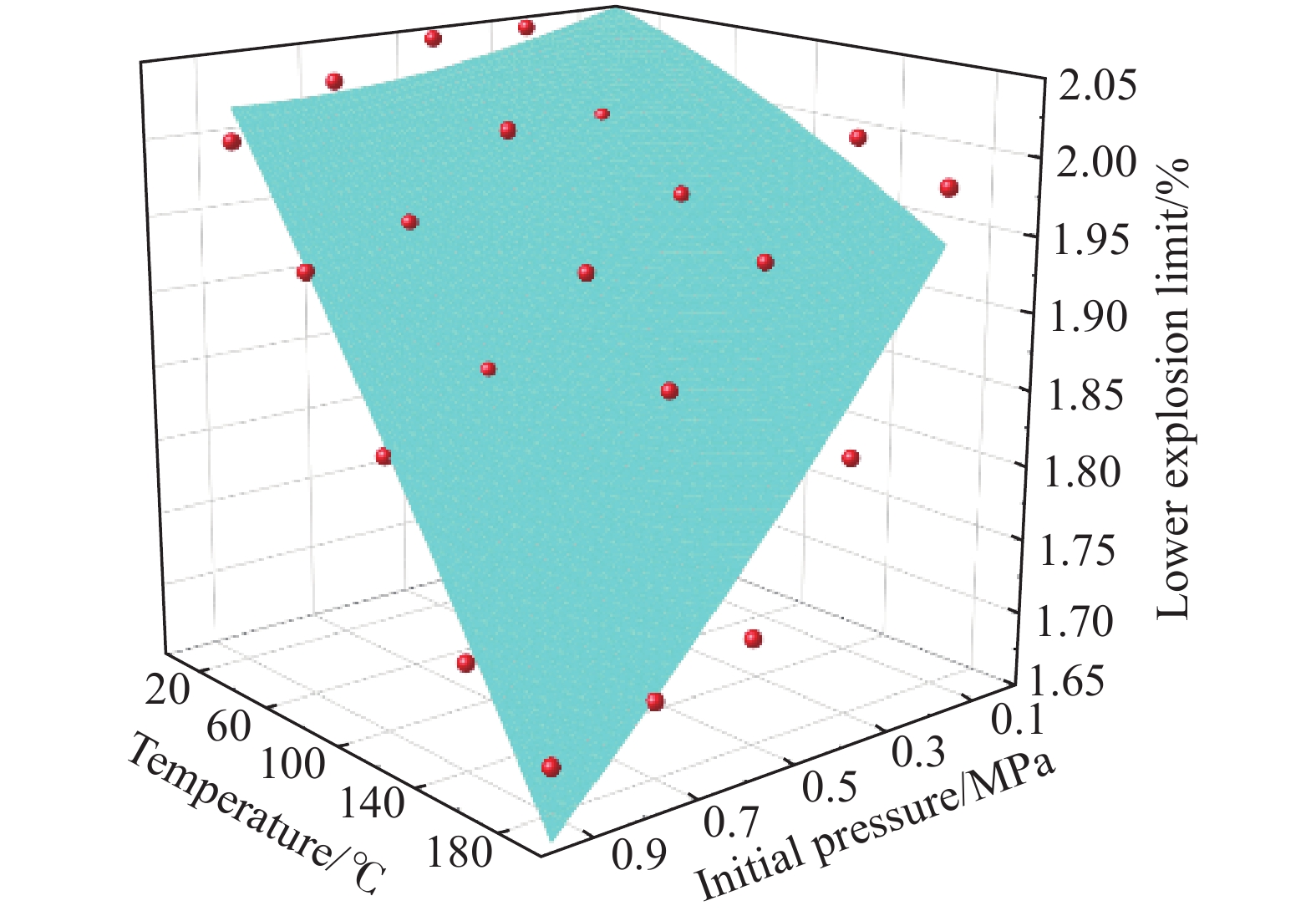
图 6 初始温度、压力对丙烯爆炸下限的耦合影响
Figure 6. Propylene LEL curve with initial temperature and pressure
表 1 拟合函数的参数
Table 1. Parameters for fitting function
y x A/% B/% R2 UEL T/℃ 11.86±0.04 (2.5±0.4)×10−3 0.93 UEL p/MPa 10.96±0.34 8.05±0.60 0.98 LEL T/℃ 2.04±0.02 (−3.5±1.26)×10−4 0.72 LEL p/MPa 2.07±0.01 −0.06±0.02 0.75  下载: 导出CSV
表 2 丙烯180 °C、不同初始压力下燃烧产物的摩尔分数
Table 2. Mole fraction of propylene combustion products at 180 °C under various pressures
产物 Mole fraction/% 0.1 MPa 0.3 MPa 0.5 MPa 0.7 MPa 0.9 MPa Ar 0.579 0.497 0.451 0.415 0.377 CH4 0.542 1.818 3.096 4.348 5.734 CO 19.500 12.289 9.139 7.264 5.848 CO2 2.273 3.018 2.960 2.740 2.387 H2 23.148 23.190 22.724 22.248 22.035 H2O 1.882 3.972 5.133 5.852 6.273 NH3 0.005 0.015 0.024 0.033 0.042 N2 48.248 41.489 37.566 34.590 31.421 C 3.824 13.711 18.906 22.509 25.882
下载: 导出CSV
表 3 丙烯在不同温度、压力下的绝热火焰温度结果
Table 3. Calculated adiabatic flame temperature results of propylene under varying temperature and pressure conditions
环境温度/K 火焰温度/K 0.1 MPa 0.3 MPa 0.5 MPa 0.7 MPa 0.9 MPa 293 1457 1457 1457 1447 1433 333 1465 1465 1465 1440 1431 373 1497 1477 1458 1433 1414 413 1529 1495 1461 1422 1405 453 1552 1474 1425 1415 1392
下载: 导出CSV
-
[1] LIU Y J, ZHAO C Y, SUN B, et al. TS-1 with abundant micropore channel-supported Au catalysts toward improved performance in gas-phase epoxidation of propylene [J]. ACS Sustainable Chemistry & Engineering, 2023, 11(18): 7042–7052. DOI: 10.1021/acssuschemeng.3c00018. [2] ZHAO C Y, ZHU H W, LIU Y J, et al. Micropore blocking strategy for mitigating adsorption and diffusion limitations in the direct epoxidation of propylene [J]. Chemical Engineering Science, 2022, 253: 117574. DOI: 10.1016/j.ces.2022.117574. [3] LIU Y J, ZHAO C Y, SUN B, et al. Preparation and modification of Au/TS-1 catalyst in the direct epoxidation of propylene with H2 and O2 [J]. Applied Catalysis A: General, 2021, 624: 118329. DOI: 10.1016/j.apcata.2021.118329. [4] 葛安卡. 台塑集团丙烯泄漏火灾爆炸事故 [J]. 现代职业安全, 2014(3): 87–89. DOI: 10.3969/j.issn.1671-4156.2014.03.040. [5] 张圣柱, 多英全, 石超, 等. 由“7·28”南京丙烯管道爆燃事故探讨我国地下管道存在的安全问题 [J]. 中国安全生产科学技术, 2011, 7(2): 46–49. DOI: 10.3969/j.issn.1673-193X.2011.02.008.ZHANG S Z, DUO Y Q, SHI C, et al. Investigation of the problems in Chinese underground pipeline from“7·28”propylene pipeline deflagration accident in Nanjing [J]. Journal of Safety Science and Technology, 2011, 7(2): 46–49. DOI: 10.3969/j.issn.1673-193X.2011.02.008. [6] 赵磊, 文松, 冯俊杰, 等. 丙烯氨氧化制丙烯腈反应器开车过程尾气燃爆危险性研究 [J]. 安全与环境学报, 2019, 19(1): 173–179. DOI: 10.13637/j.issn.1009-6094.2019.01.027.ZHAO L, WEN S, FENG J J, et al. On the explosion hazards of the exhaust gases in the reactor of propylene ammoxidation to the acrylonitrile process [J]. Journal of Safety and Environment, 2019, 19(1): 173–179. DOI: 10.13637/j.issn.1009-6094.2019.01.027. [7] 陈战涛. 共氧化法环氧丙烷生产工艺综述 [J]. 河南化工, 2022, 39(1): 5–8. DOI: 10.14173/j.cnki.hnhg.2022.01.022.CHEN Z T. Summary of propylene oxide production process by co-oxidation [J]. Henan Chemical Industry, 2022, 39(1): 5–8. DOI: 10.14173/j.cnki.hnhg.2022.01.022. [8] 王玲玲, 周贤太, 纪红兵. 催化丙烯选择性环氧化制备环氧丙烷研究进展 [J]. 工业催化, 2023, 31(9): 1–15. DOI: 10.3969/j.issn.1008-1143.2023.09.001.WANG L L, ZHOU X T, JI H B. Progress on the selective catalytic epoxidation of propylene to propylene oxide [J]. Industrial Catalysis, 2023, 31(9): 1–15. DOI: 10.3969/j.issn.1008-1143.2023.09.001. [9] 胡立峰, 陈彬, 王凤. 我国环氧丙烷生产工艺现状分析及进展 [J]. 山东化工, 2018, 47(4): 39–42. DOI: 10.19319/j.cnki.issn.1008-021x.2018.04.015.HU L F, CHEN B, WANG F. Analysis and progress of propylene oxide production process status in China [J]. Shandong Chemical Industry, 2018, 47(4): 39–42. DOI: 10.19319/j.cnki.issn.1008-021x.2018.04.015. [10] 罗振敏, 杨勇, 程方明, 等. N2和CO2惰化丙烯爆炸极限参数实验研究 [J]. CIESC Journal, 2020, 71(4): 1922–1928. DOI: 10.11949/0438-1157.20191167.LUO Z M, YANG Y, CHENG F M, et al. Experimental study on explosion limits parameters of propylene with dilution of nitrogen and carbon dioxide [J]. CIESC Journal, 2020, 71(4): 1922–1928. DOI: 10.11949/0438-1157.20191167. [11] 罗振敏, 邓婕, 林峰, 等. N2/CO2混合气体对丙烯爆炸特性的影响 [J]. 安全与环境学报, 2023, 23(10): 3568–3574. DOI: 10.13637/j.issn.1009-6094.2022.1199.LUO Z M, DENG J, LIN F, et al. Effect of N2/CO2 mixture on explosion characteristics of propylene [J]. Journal of Safety and Environment, 2023, 23(10): 3568–3574. DOI: 10.13637/j.issn.1009-6094.2022.1199. [12] 高娜, 张延松, 胡毅亭. 温度、压力对甲烷-空气混合物爆炸极限耦合影响的实验研究 [J]. 爆炸与冲击, 2017, 37(3): 453–458. DOI: 10.11883/1001-1455(2017)03-0453-06.GAO N, ZHANG Y S, HU Y T. Experimental study on methane-air mixtures explosion limits at normal and elevated initial temperatures and pressures [J]. Explosion and Shock Waves, 2017, 37(3): 453–458. DOI: 10.11883/1001-1455(2017)03-0453-06. [13] 刘可心, 刘炜, 孙亚松. 多因素耦合作用对甲烷爆炸特性的影响 [J]. 爆炸与冲击, 2023, 43(3): 032101. DOI: 10.11883/bzycj-2022-0352.LIU K X, LIU W, SUN Y S. Influence of multi-factor coupling on methane explosion characteristics [J]. Explosion and Shock Waves, 2023, 43(3): 032101. DOI: 10.11883/bzycj-2022-0352. [14] 王康, 郭璐, 曹居正. 氧含量对甲烷及丙烯爆炸特性的影响 [J]. 安全、健康和环境, 2014, 14(12): 37–40. DOI: 10.3969/j.issn.1672-7932.2014.12.011.WANG K, GUO L, CAO J Z. Influence of oxygen content on the explosive characteristics of methane and propylene [J]. Safety Health & Environment, 2014, 14(12): 37–40. DOI: 10.3969/j.issn.1672-7932.2014.12.011. [15] 王振刚, 黄飞, 孙峰, 等. 丙烯燃爆危险性分析 [J]. 中国安全科学学报, 2012, 22(4): 59–63. DOI: 10.16265/j.cnki.issn1003-3033.2012.04.014.WANG Z G, HUANG F, SUN F, et al. Analysis of propylene explosive hazard [J]. China Safety Science Journal, 2012, 22(4): 59–63. DOI: 10.16265/j.cnki.issn1003-3033.2012.04.014. [16] 刘姝廷, 高宪文. 基于KPLS的丙烯爆炸极限非线性预测研究 [J]. 东北大学学报(自然科学版), 2017, 38(11): 1521–1523,1563. DOI: 10.12068/j.issn.1005-3026.2017.11.001.LIU S T, GAO X W. Nonlinear prediction research on explosion limits of propylene based on kernel partial least squares [J]. Journal of Northeastern University (Natural Science), 2017, 38(11): 1521–1523,1563. DOI: 10.12068/j.issn.1005-3026.2017.11.001. [17] 宋来臣. 极低浓度甲烷气体爆炸后固体产物研究 [J]. 煤炭技术, 2025, 44(1): 194–197. DOI: 10.13301/j.cnki.ct.2025.01.039.SONG L C. Research on solid products after explosion of extremely low concentration methane gas [J]. Coal Technology, 2025, 44(1): 194–197. DOI: 10.13301/j.cnki.ct.2025.01.039. [18] 闫侠, 郑日有, 辛明亮, 等. 可燃气体及蒸气爆炸特性测试研究进展 [J]. 安全, 2024, 45(12): 82–87. DOI: 10.19737/j.cnki.issn1002-3631.2024.12.013.YAN X, ZHENG R Y, XIN M L, et al. Research progress on testing the explosion characteristics of combustible gases and vapors [J]. Safety & Security, 2024, 45(12): 82–87. DOI: 10.19737/j.cnki.issn1002-3631.2024.12.013. [19] 任常兴, 蒋乐章, 王玥, 等. 高温高压条件下可燃气体爆炸极限测定标准对比研究 [J]. 标准科学, 2023(2): 73–77. DOI: 10.3969/j.issn.1674-5698.2023.02.012.REN C X, JIANG Y Z, WANG Y, et al. Comparative study on determination standards for the explosion limits of the combustible gas at high temperature and pressure [J]. Standard Science, 2023(2): 73–77. DOI: 10.3969/j.issn.1674-5698.2023.02.012. [20] ASTM International. ASTM E681-09(2023) Standard test method for concentration limits of flammability of chemicals (vapors and gases) [S]. West Conshohocken: ASTM International, 2023. [21] British Standards Institution. BS EN 1839: 2017 Determination of the explosion limits and the limiting oxygen concentration (LOC) for flammable gases and vapours [S]. London: British Standards Institution, 2017. [22] ASTM International. ASTM E2079-07 Standard test methods for limiting Oxygen (oxidant) concentration in gases and vapors [S]. West Conshohocken: American Society for Testing and Materials, 2014: 1–2. [23] ASTM International. ASTM E918-83 Standard practice for determining limits of flammability of chemicals at elevated temperature and pressure [S]. West Conshohocken: ASTM International, 2011. [24] 中华人民共和国国家质量监督检验检疫总局, 中国国家标准化管理委员会. GB/T 12474-2008 空气中可燃气体爆炸极限测定方法 [S]. 北京: 中国标准出版社, 2009.General Administration of Quality Supervision, Inspection and Quarantine of the People’s Republic of China, Standardization Administration of the People’s Republic of China. GB/T 12474-2008 Method of test for explosion limits of combustible gases in air [S]. Beijing: China Standard Press, 2009. [25] 国家市场监督管理总局, 国家标准化管理委员会. GB/T 42368-2023 高温高压条件下可燃气体(蒸气)爆炸极限测定方法 [S]. 北京: 中国标准出版社, 2023.State Administration for Market Regulation, National Standardization Administration. GB/T 42368-2023 Determination of explosion limits of combustible vapors and gases at elevated temperature and pressure [S]. Beijing: China Standard Press, 2023. [26] LU M K, TANG Y Q, CHEN W Y, et al. Explosion limits estimation and process optimization of direct propylene epoxidation with H2 and O2 [J]. Chinese Journal of Chemical Engineering, 2019, 27(12): 2968–2978. DOI: 10.1016/j.cjche.2019.01.015. [27] VAN DEN SCHOOR F, VERPLAETSEN F. The upper explosion limit of lower alkanes and alkenes in air at elevated pressures and temperatures [J]. Journal of Hazardous Materials, 2006, 128(1): 1–9. DOI: 10.1016/j.jhazamat.2005.06.043. [28] ZABETAKIS M G. Flammability characteristics of combustible gases and vapors [M]. Pittsburgh: Bureau of Mines, 1964. DOI: 10.2172/7328370. [29] 金满平, 张帆, 孙峰, 等. 温度对烃类物质爆炸极限的影响及其预测模型研究 [J]. 中国安全生产科学技术, 2013, 9(9): 5–10. DOI: 10.11731/j.issn.1673-193x.2013.09.001.JIN M P, ZHANG F, SUN F, et al. Influence of temperature on explosion limits of hydro carbons and its prediction model [J]. Journal of Safety Science and Technology, 2013, 9(9): 5–10. DOI: 10.11731/j.issn.1673-193x.2013.09.001. [30] CHOI Y J, CHOI J W. Effects of inert gas addition, oxygen concentration, and pressure on explosion characteristics of propylene [J]. Korean Journal of Chemical Engineering, 2021, 38(2): 337–341. DOI: 10.1007/s11814-020-0699-7. [31] SCHILDBERG H P. The course of the explosions of combustible/O2/N2 mixtures in vessel-like geometry [J]. Forschung im Ingenieurwesen, 2009, 73(1): 33–65. DOI: 10.1007/s10010-009-0091-6. [32] CICCARELLI G, JACKSON D, VERREAULT J. Flammability limits of NH3-H2-N2-air mixtures at elevated initial temperatures [J]. Combustion and Flame, 2006, 144(1/2): 53–63. DOI: 10.1016/j.combustflame.2005.06.010. -


计量
- 文章访问数: 1027
- HTML全文浏览量: 245
- PDF下载量: 120
- 被引次数: 0