



Modeling and prediction of blast-Induced response in RC columns using graph neural networks
-
摘要: 爆炸冲击下钢筋混凝土构件结构响应的高效准确预测对抢修决策、结构加固与防护设计具有关键意义。现有结构响应快速计算方法,例如解析模型、轻量级数据驱动方法,虽具备较高计算效率,但在三维结构响应场计算方面精度受限。提出了一种基于图神经网络(graph neural networks,GNN)的钢筋混凝土柱毁伤快速预测模型,通过GNN中的领域节点聚合机制高效传递结构内部的力学关联信息,从而在爆炸荷载输入与三维构件结构响应之间建立端到端映射,实现对柱体毁伤状态的快速预测。进一步引入多工况特征耦合训练策略,使模型具备适应不同配筋率、爆炸当量和起爆位置等工况的预测能力,显著提升了模型的跨工况泛用性能。结果表明,该模型单次预测耗时仅55 ms,较传统方法速度提升4个数量级,预测误差低于3.33%,在多种爆炸工况下均实现高精度毁伤预测。该研究展示了GNN方法在爆炸毁伤预测中的应用潜力,为爆炸冲击结构毁伤的快速评估与防护优化提供创新技术路径。Abstract: The efficient and accurate prediction of structural responses in reinforced concrete components under blast loading plays a critical role in emergency repair decision, structural strengthening, and protective design. Existing rapid methods for calculating structural response, such as analytical models and lightweight data-driven approaches, are computationally efficient. However, they are limited in accurately resolving three-dimensional structural response fields. A Graph Neural Network (GNN)-based model for the rapid prediction of damage in reinforced concrete (RC) columns was proposed in this paper. By leveraging the neighborhood node aggregation mechanism of GNNs, the model efficiently transmits mechanical correlation information within the structure. This allows the model to establish an end-to-end mapping between blast load inputs and the 3D structural response of the component, enabling rapid prediction of the column’s damage state. Furthermore, a multi-scenario feature coupling training strategy is introduced to significantly enhance the model’s generalization capability. This strategy enables the GNN model to effectively adapt to variations in key design and loading parameters, including reinforcement ratios, explosive charge weights, and blast locations. The results demonstrate that the proposed model achieves a prediction time of merely 55 milliseconds per instance, representing a computational speed improvement of four orders of magnitude over conventional methods; meanwhile, the prediction error remains below 3.33%. Furthermore, it delivers high-precision damage predictions across various blast scenarios. The proposed study successfully highlights the significant potential of GNN-based approaches in predicting blast-induced damage and offers an innovative, data-driven solution for rapid structural assessment and protective design in the field of blast engineering.
-
Key words:
- explosive load /
- RC member /
- damage effect /
- deep learning /
- graph neural networks
-
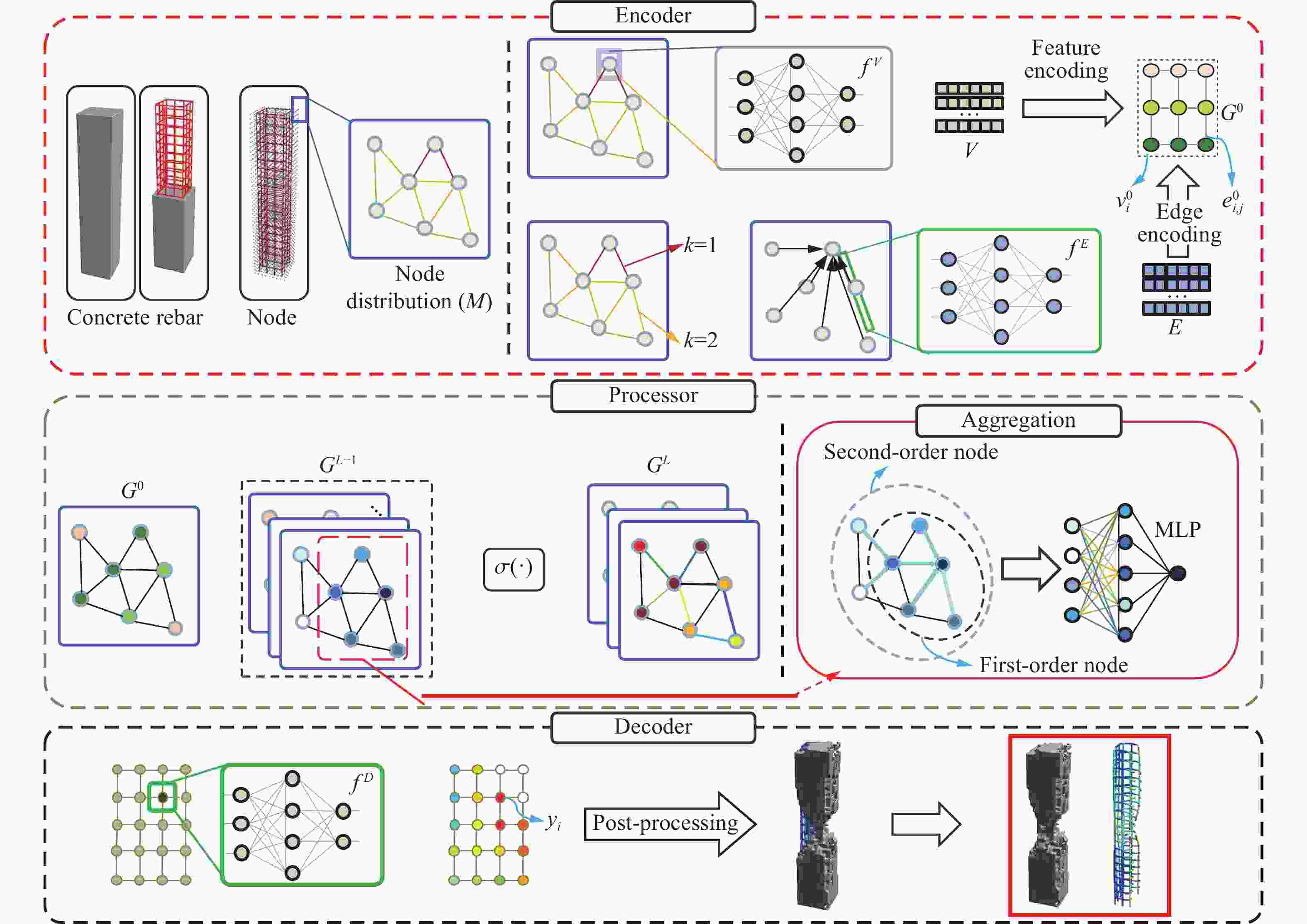
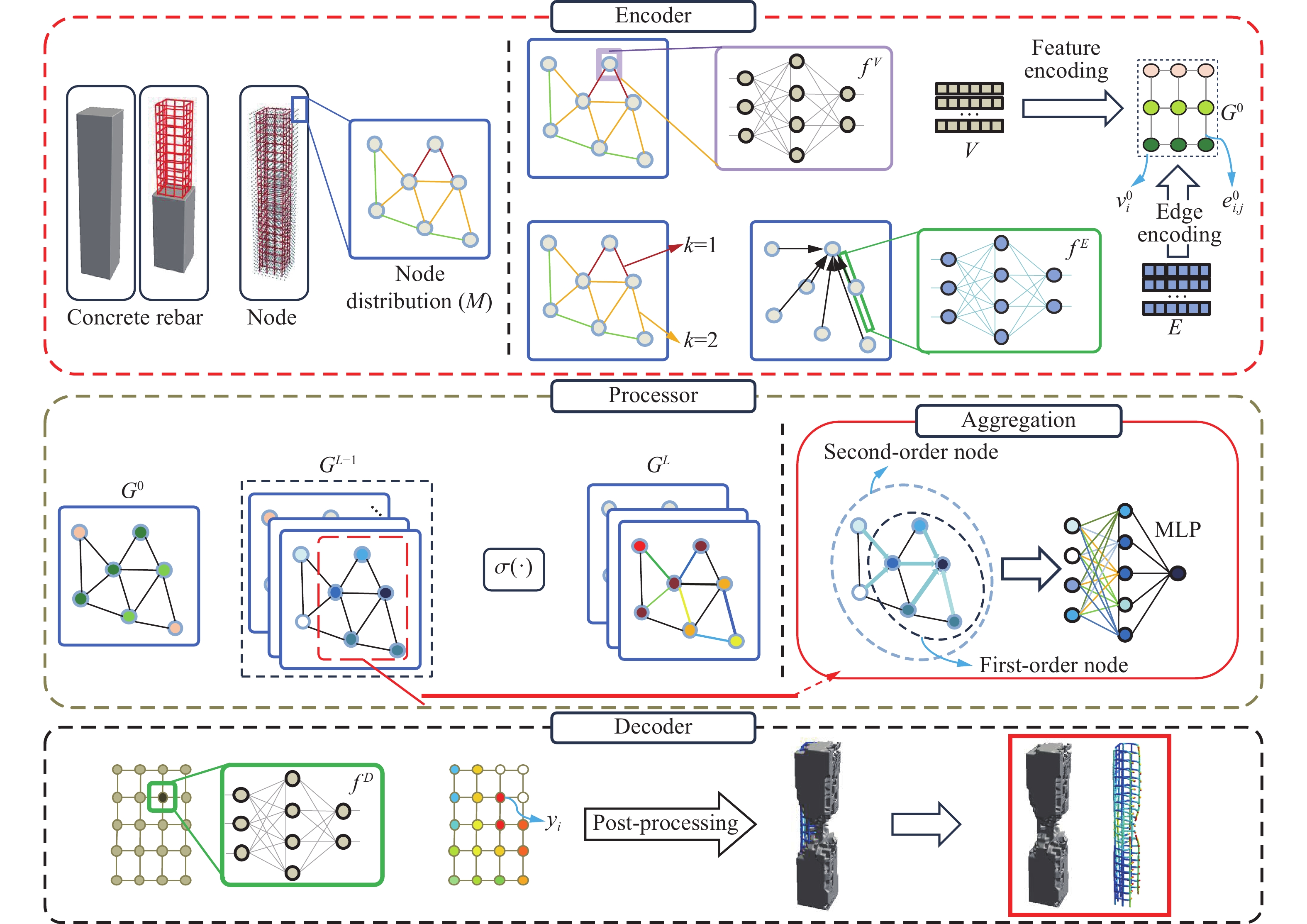
图 4 代理模型的框架图.
Figure 4. The framework diagram of the GNN-based RC column damage prediction model
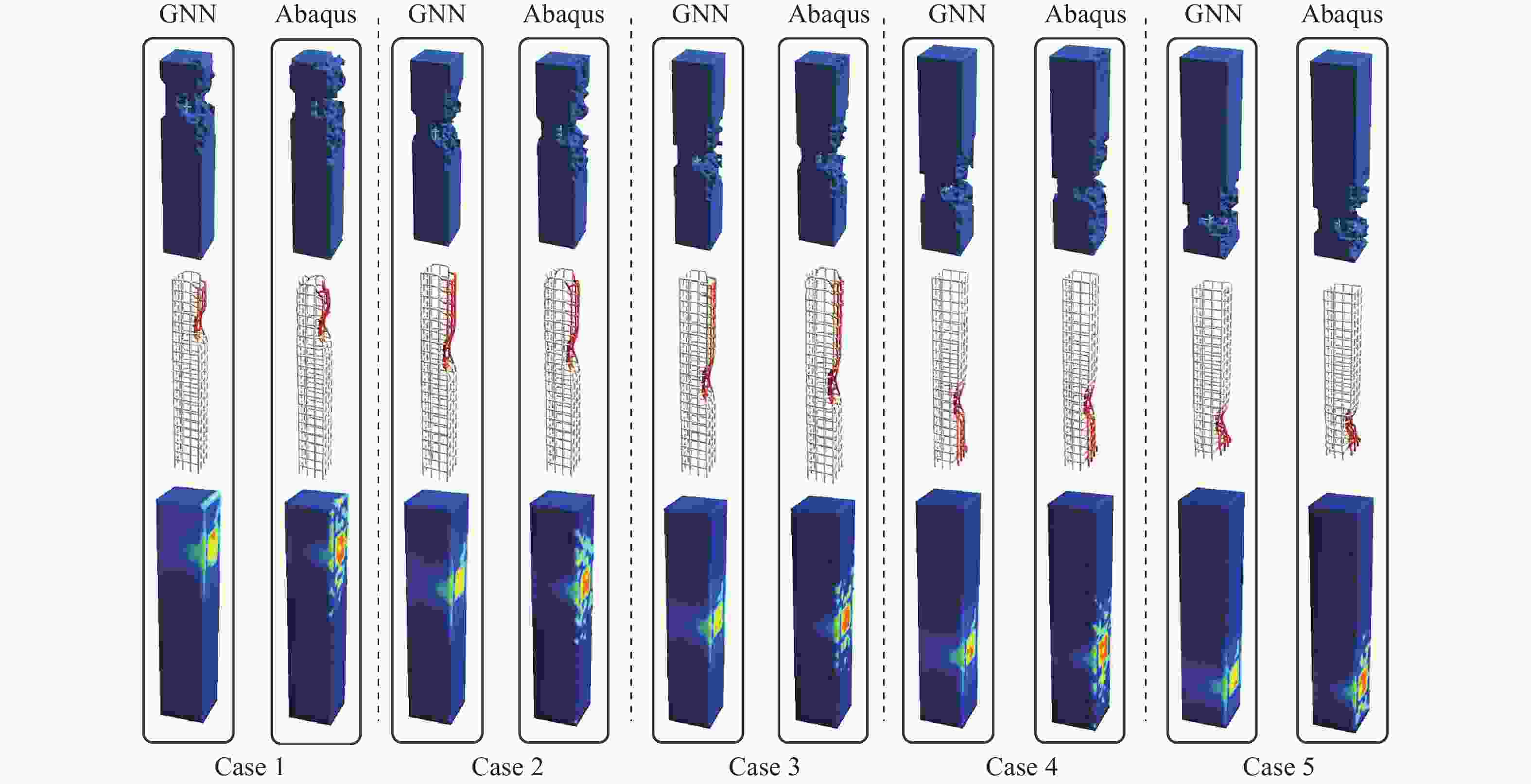
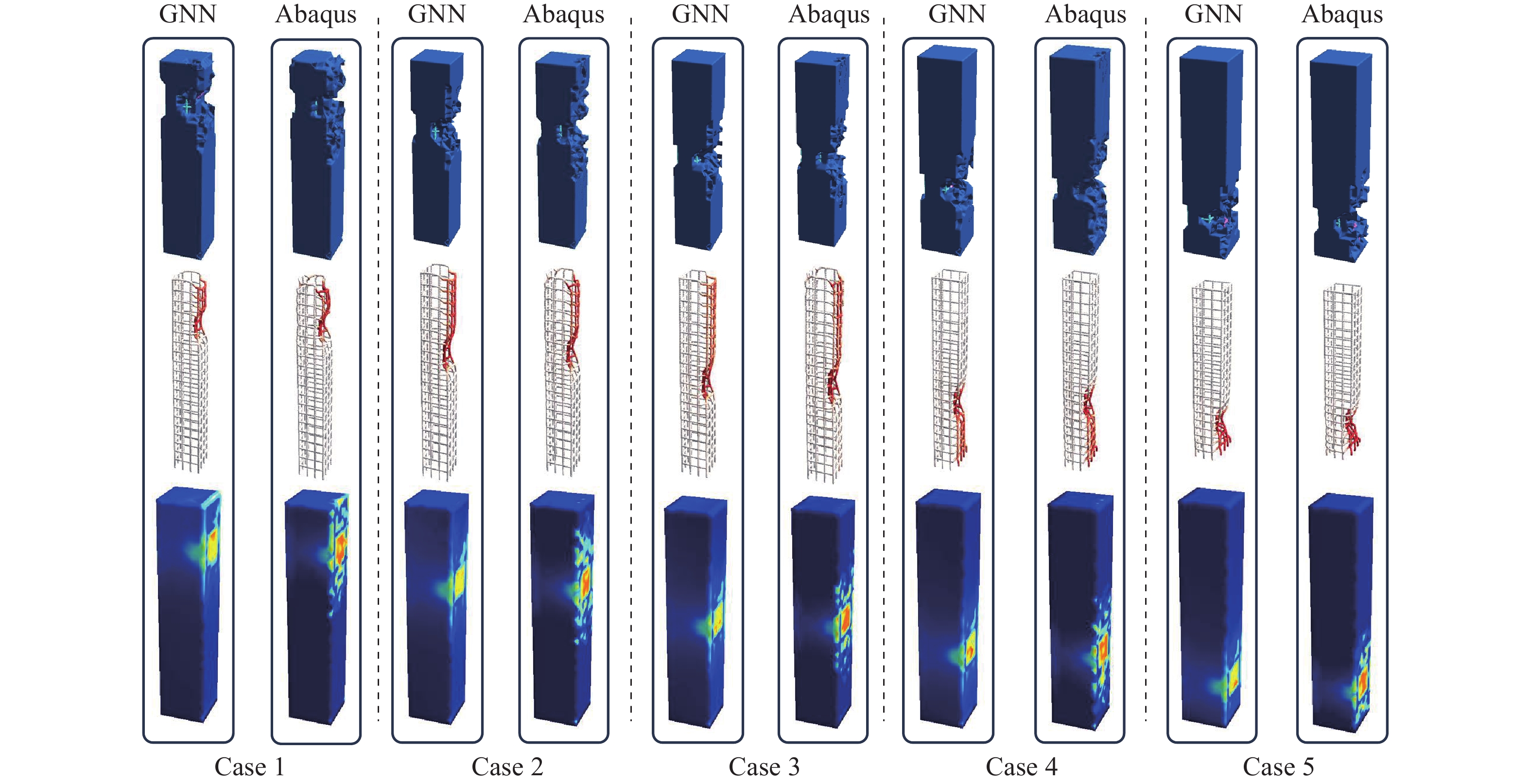
图 7 接触爆炸下GNN模型与Abaqus仿真可视化结果对比
Figure 7. Visualization comparison between GNN model and Abaqus simulation under contact explosion conditions
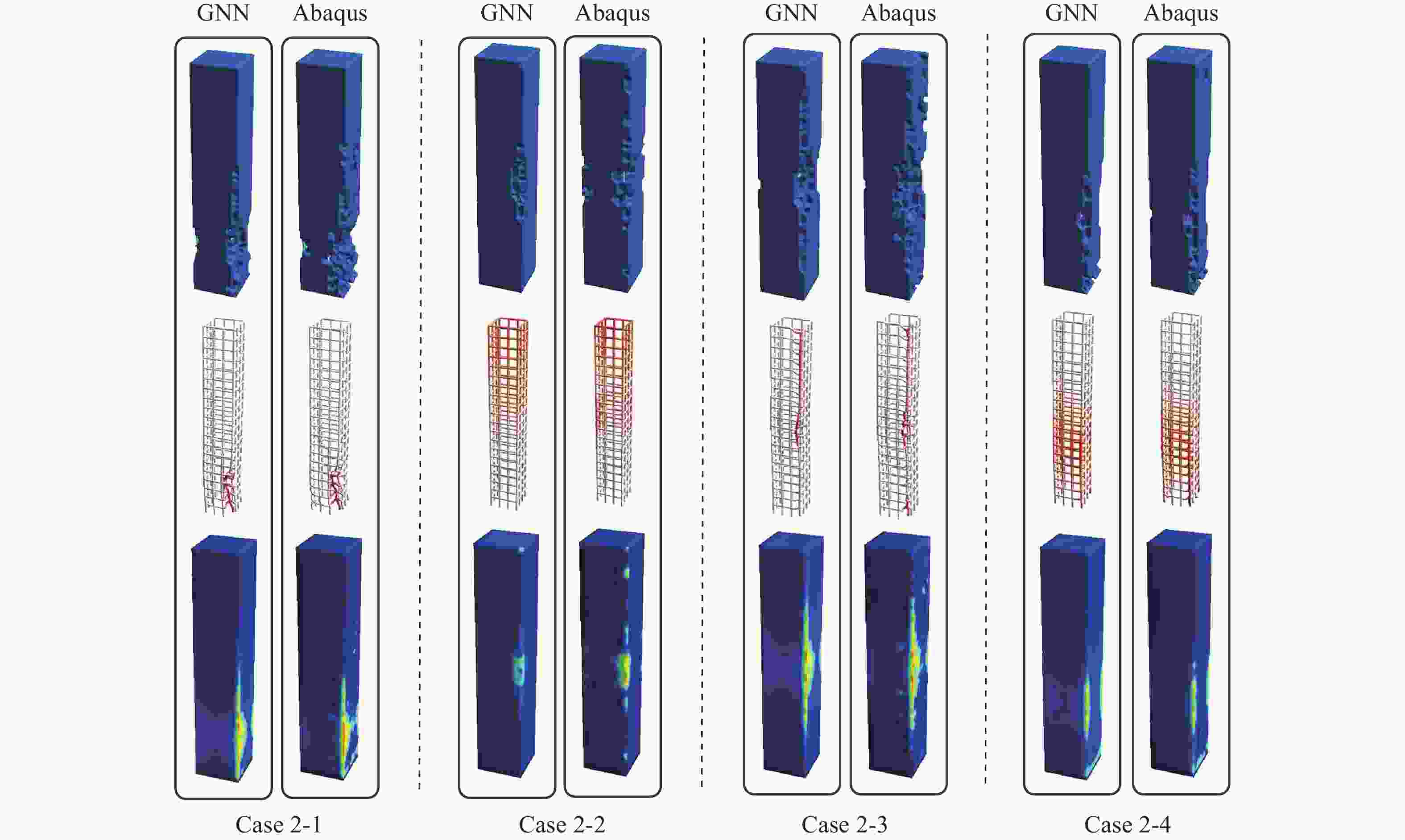
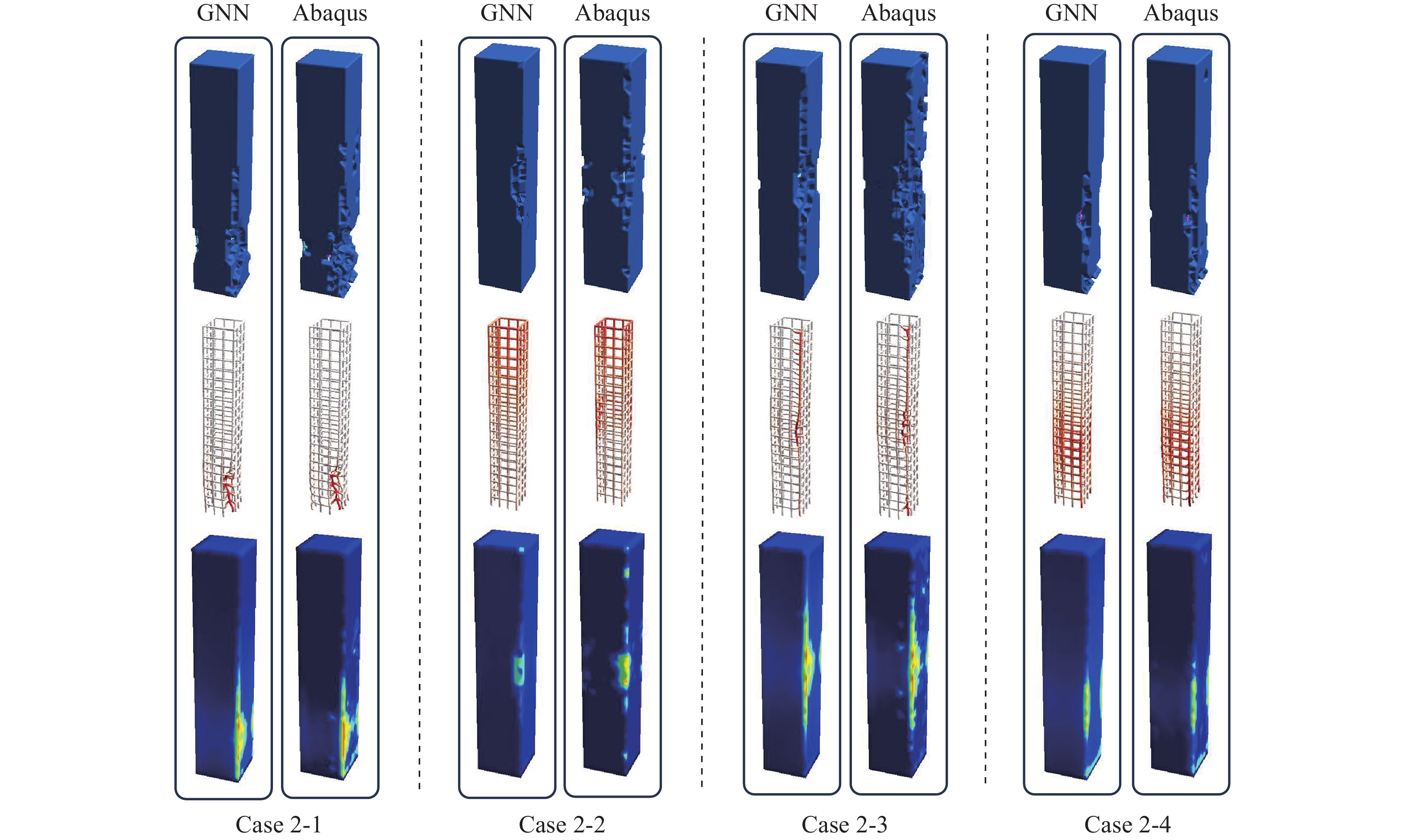
图 8 非接触爆炸下GNN模型与Abaqus仿真可视化结果对比
Figure 8. Visualization comparison between GNN model and Abaqus simulation under non-contact explosion
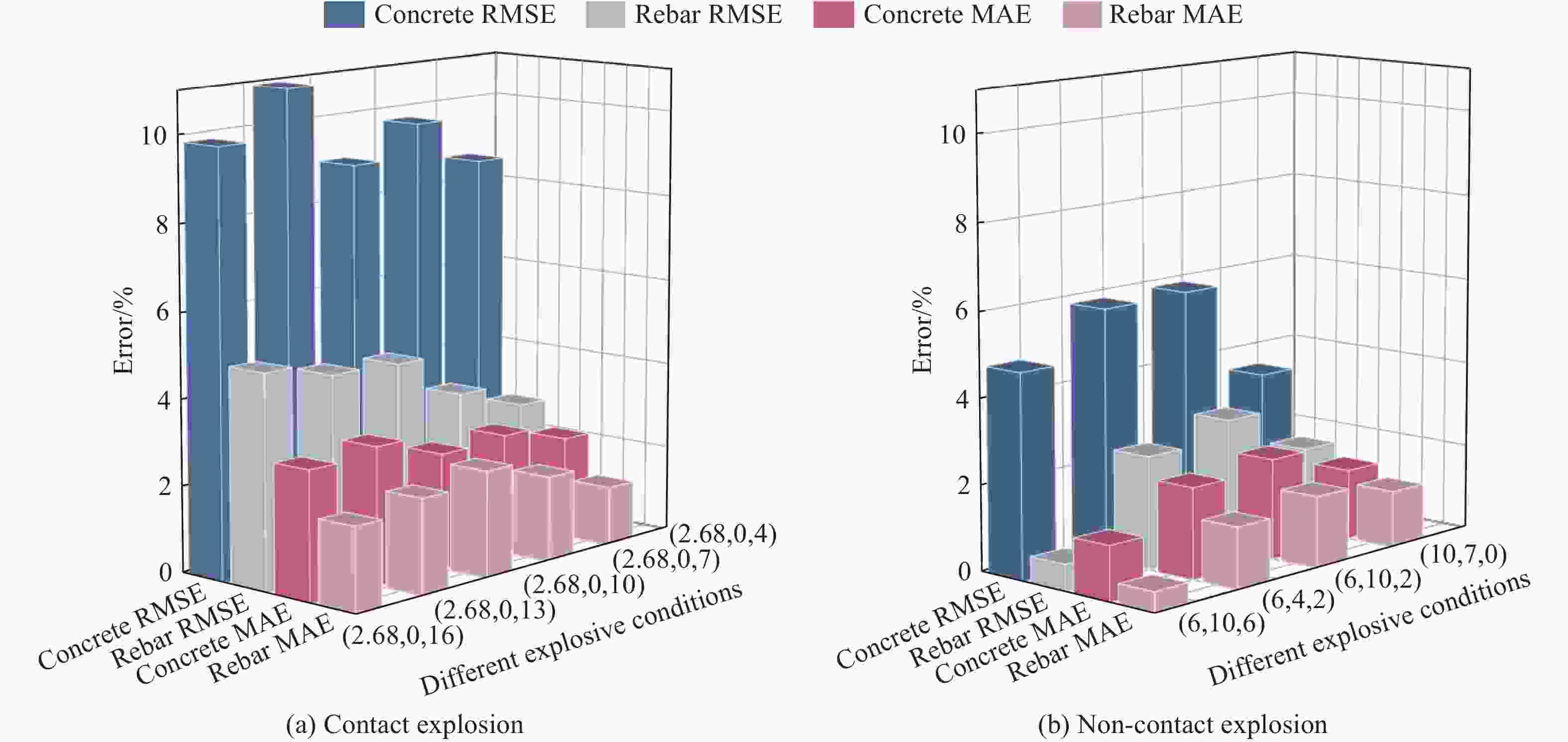
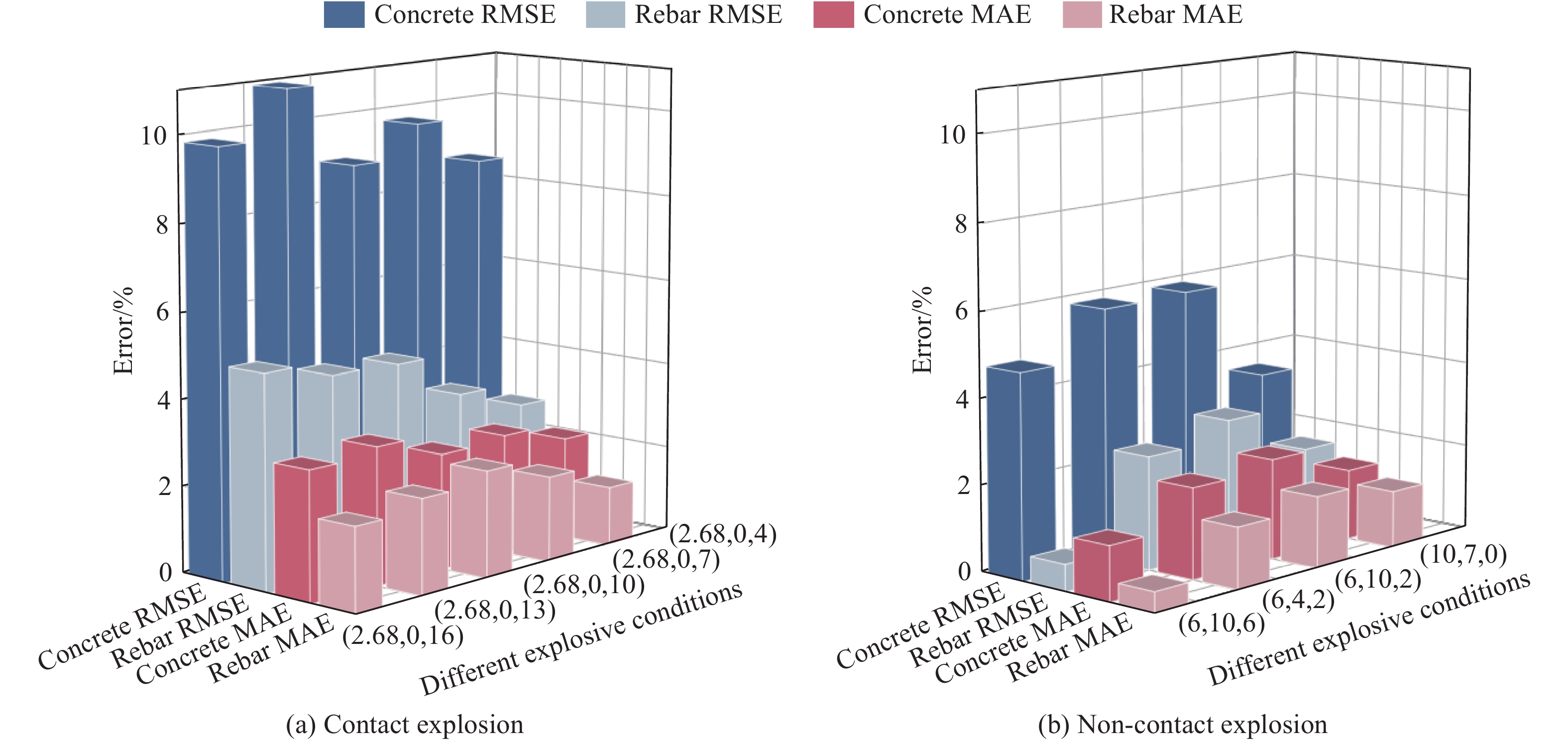
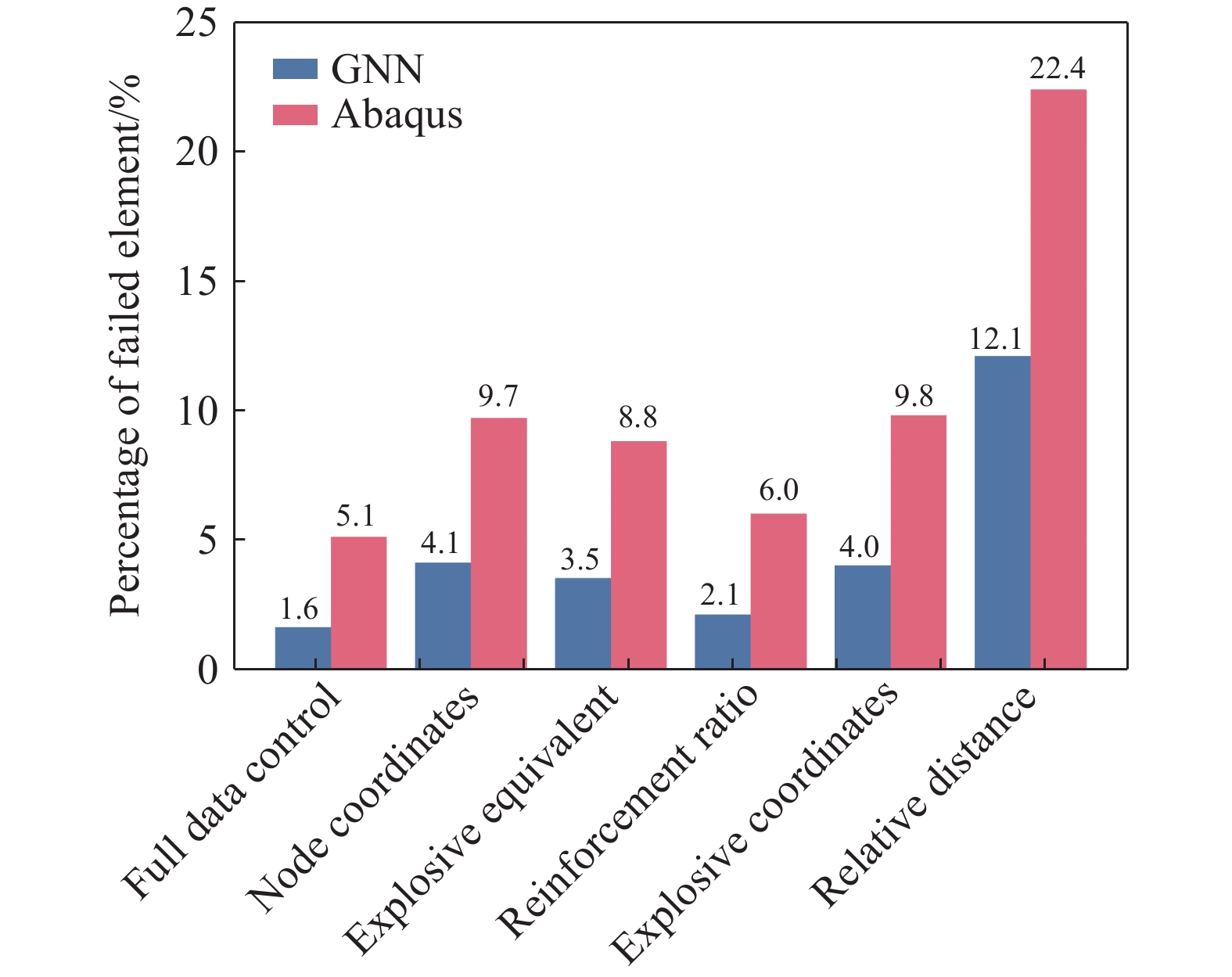
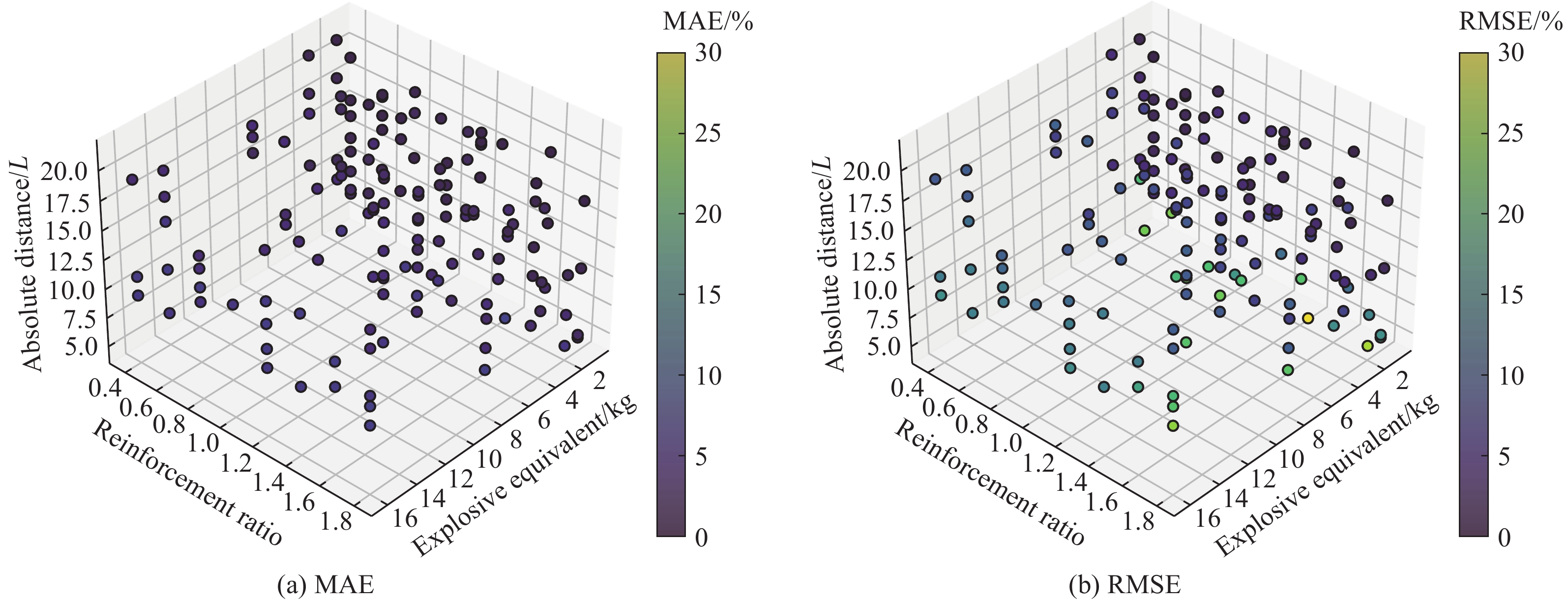
图 9 接触爆炸与非接触爆炸误差指标柱状图
Figure 9. Contact explosion and non-contact explosion error index histograms
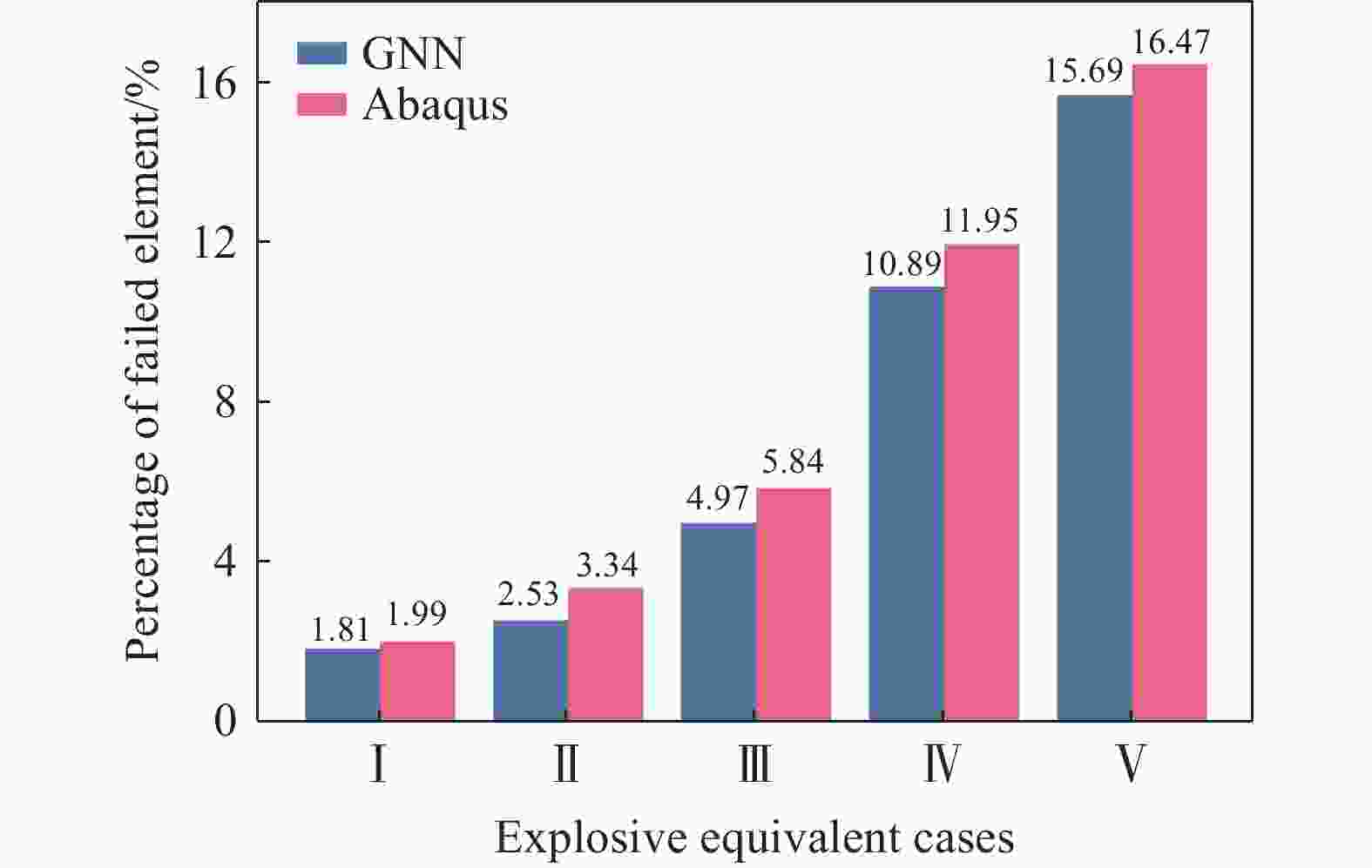
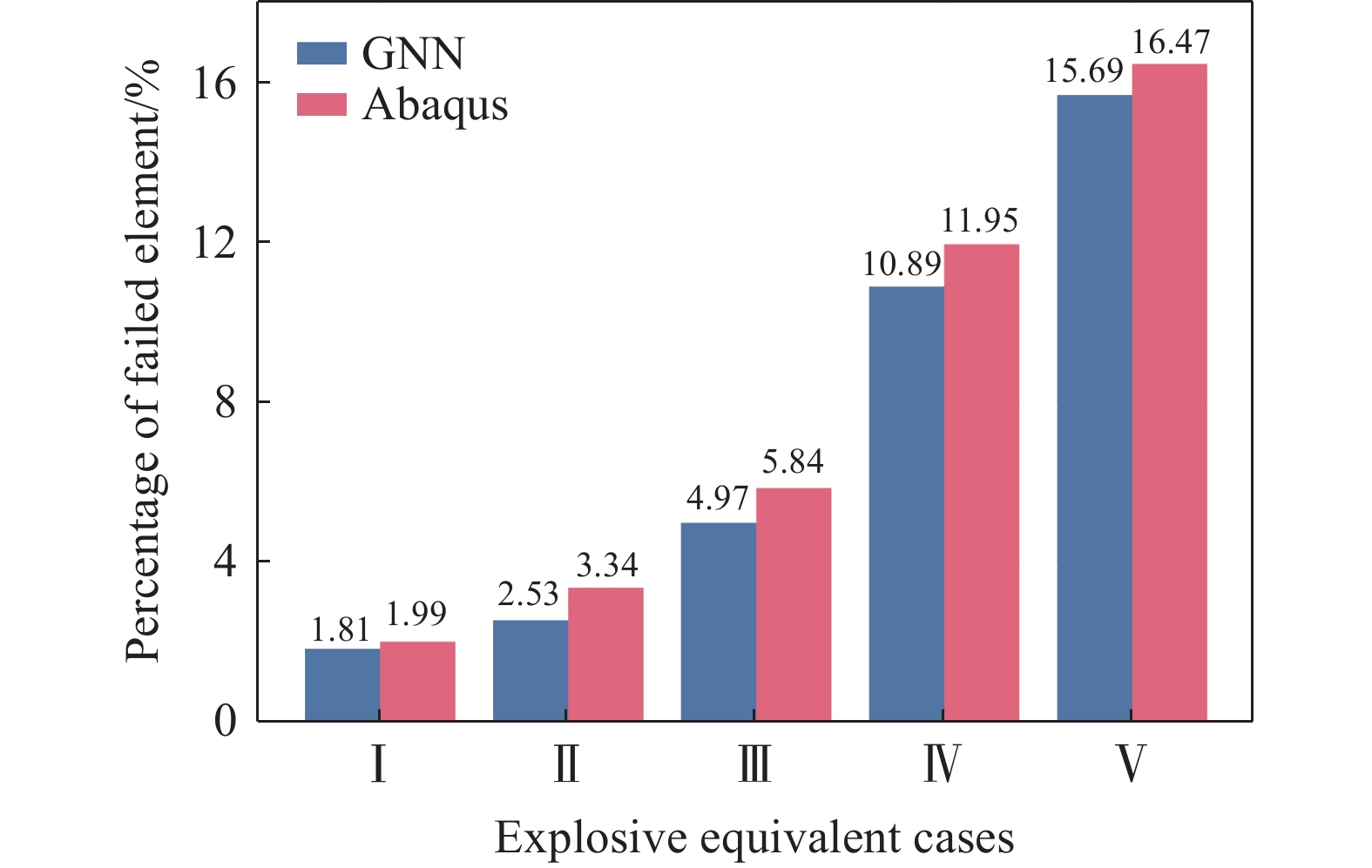
图 10 RC柱单元损失百分比随当量的变化趋势
Figure 10. Change trend of RC column element percentage with equivalent change
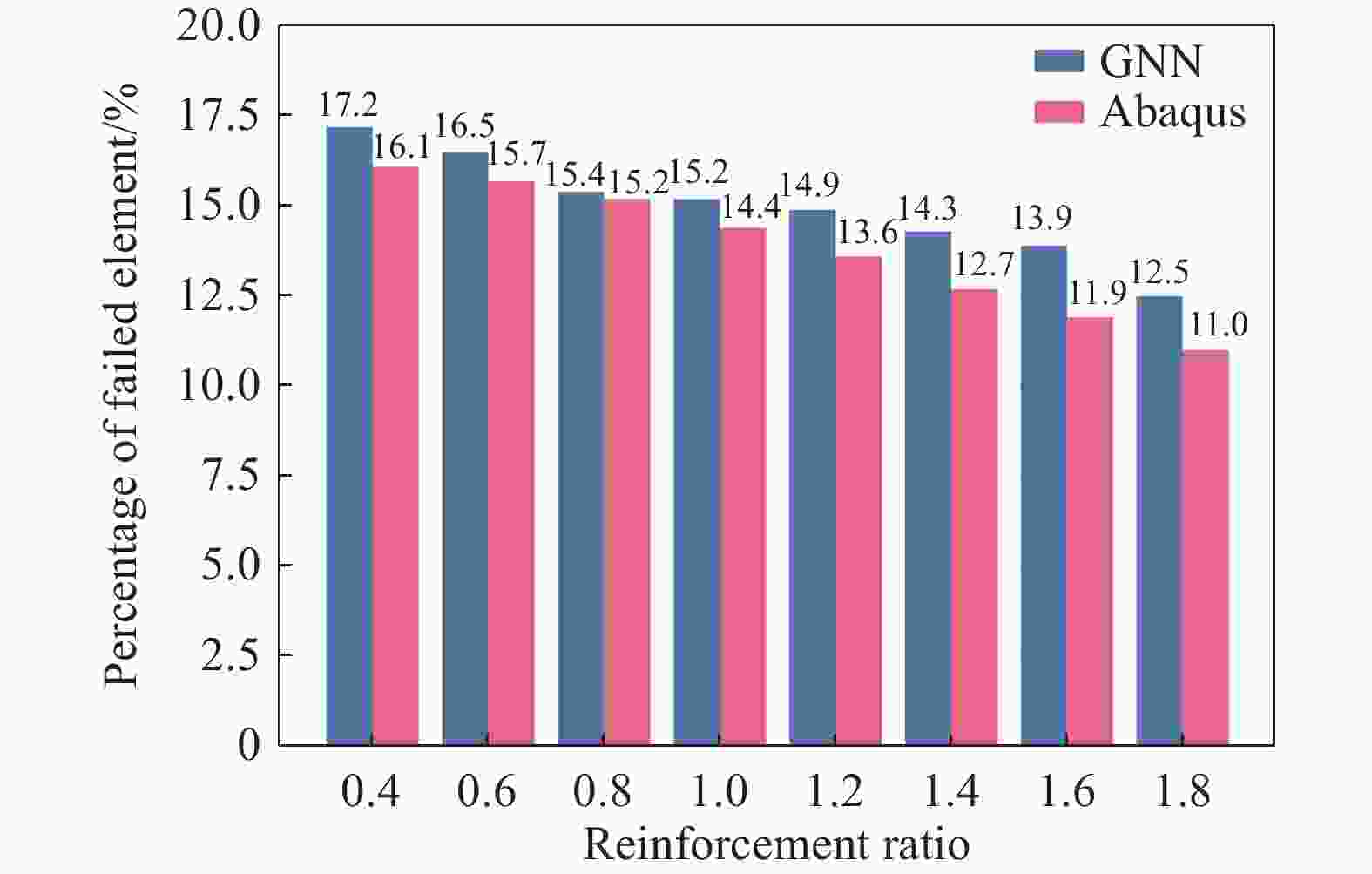
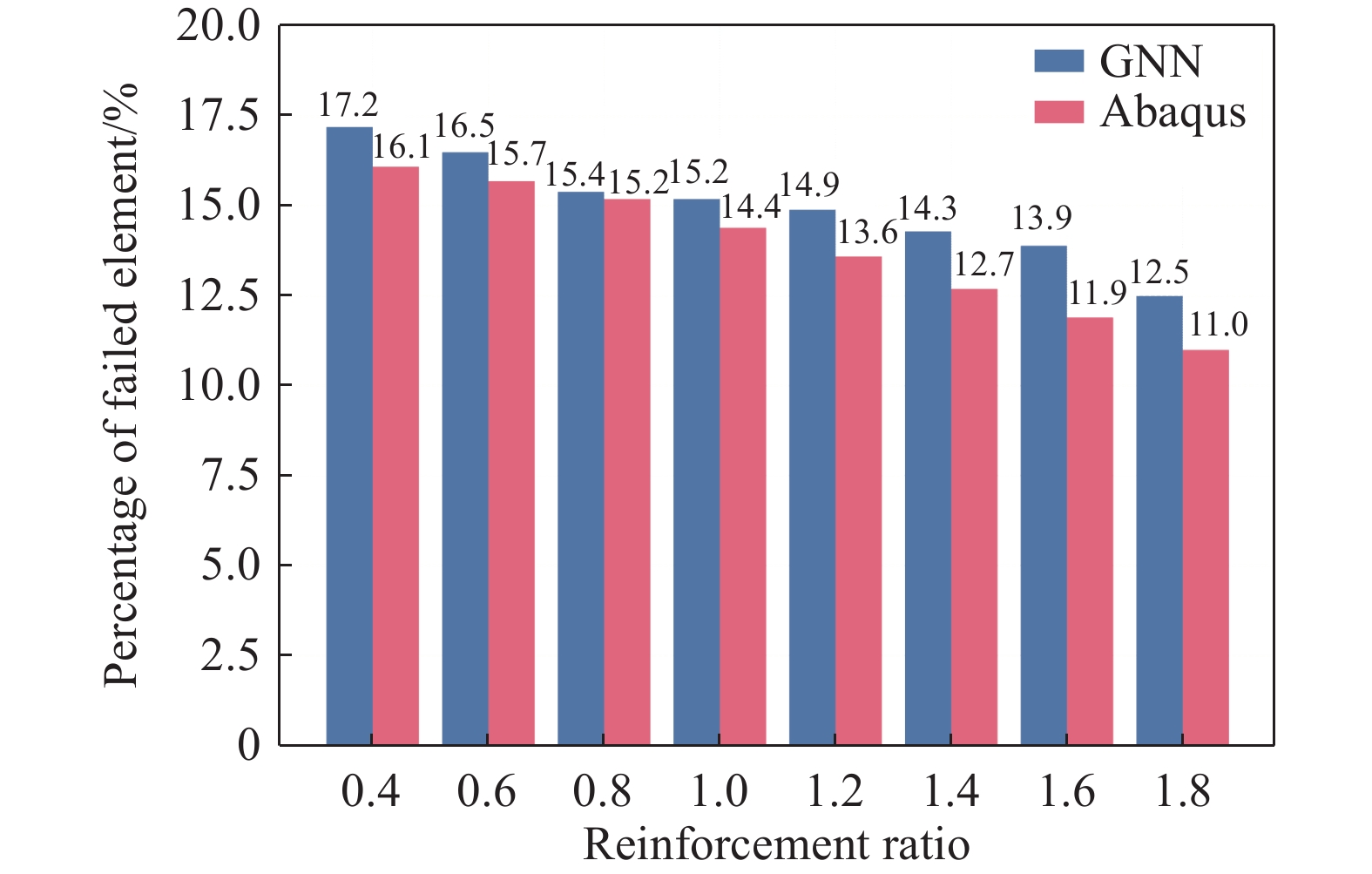
图 11 RC柱单元损失百分比随配筋率的变化趋势
Figure 11. Change trend of RC column unit percentage with reinforcement ratio
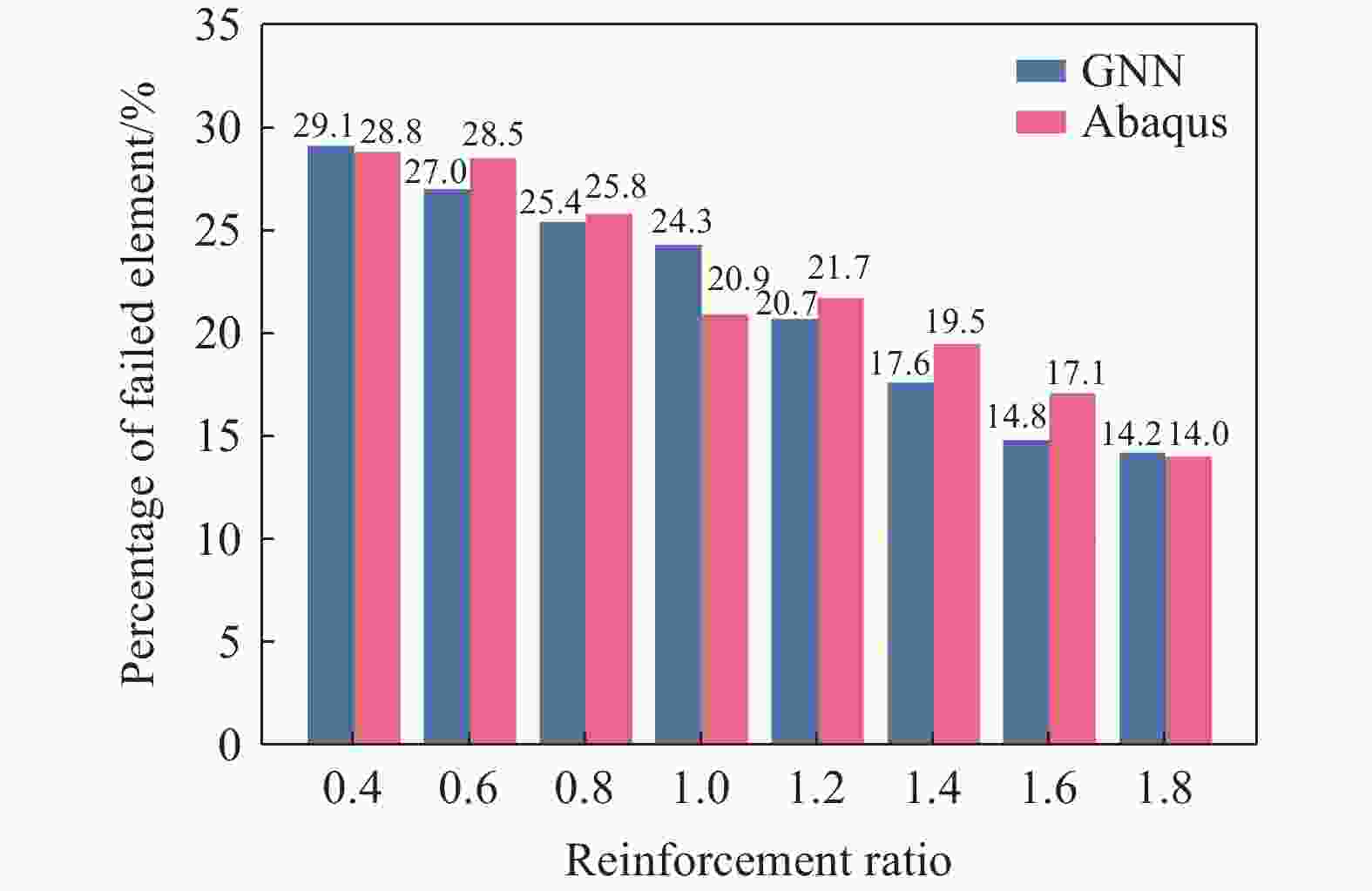
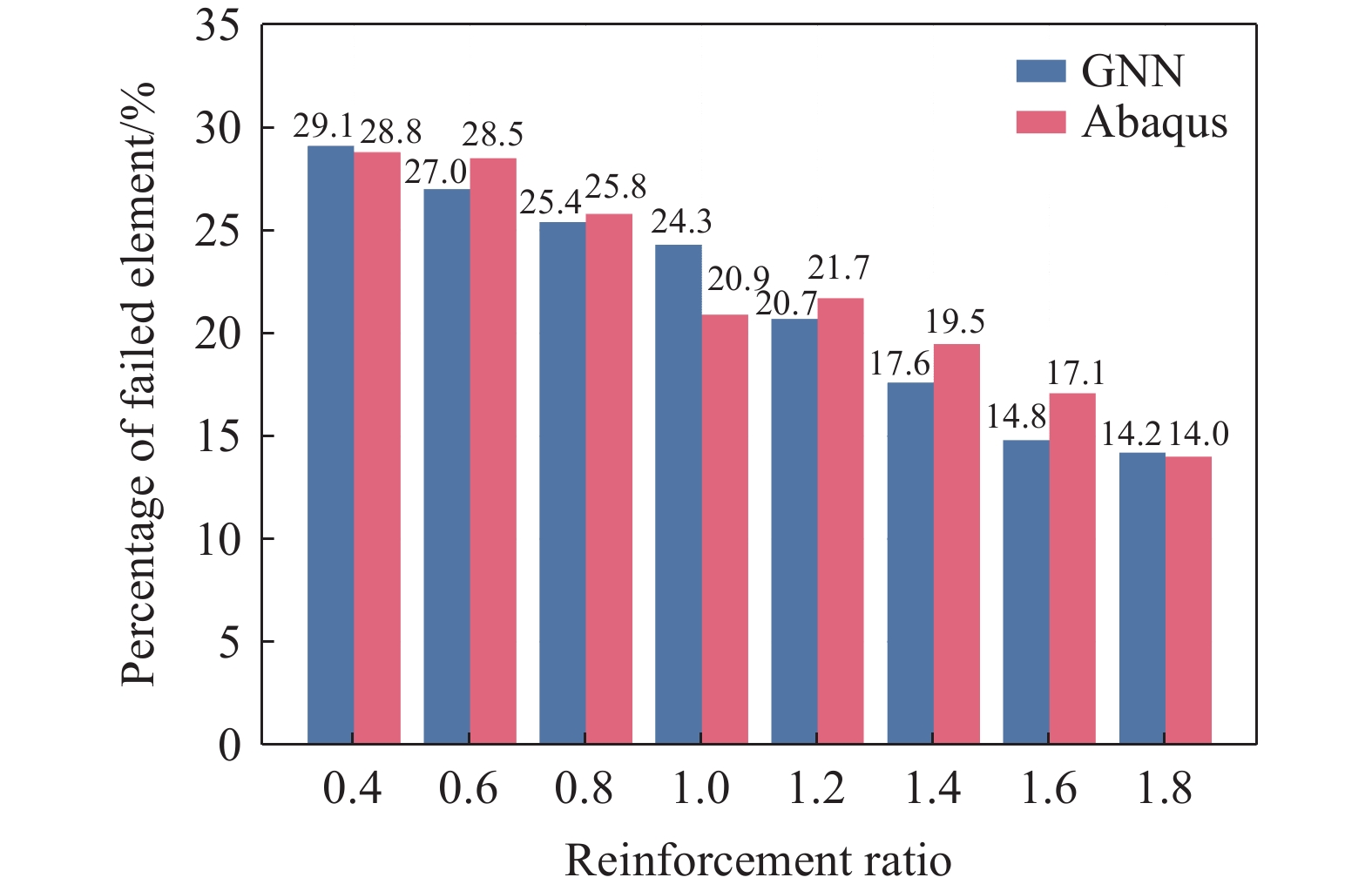
图 12 钢筋单元损失百分比随配筋率的变化趋势
Figure 12. Change trend of reinforcement unit percentage with reinforcement ratio
表 1 混凝土材料参数
Table 1. Material parameters for concrete
密度/(kg·m−3) 杨氏模量/GPa 泊松比 膨胀角 偏心率 初始等双向压缩屈服应力与初
始单向压缩屈服应力的比值拉伸子午线与压缩子午线上
第二应力不变量的比值2500 30 0.2 30 0.1 1.16 0.6667 压缩屈服应力/
MPa压缩强度/
MPa压缩断裂
应变拉伸屈服
应力/MPa拉伸强度/
MPa拉伸断裂应变 1.71 20.13 0.007 0.24 2.01 0.0005  下载: 导出CSV
表 2 钢筋材料参数
Table 2. Material parameters for steel
密度/(kg·m−3) 杨氏模量/GPa 泊松比 屈服应力/MPa 极限强度/MPa 极限强度对应的应变 7850 205 0.3 450 600 0.5
下载: 导出CSV
表 3 炸药材料参数
Table 3. Material parameters for the explosive
密度/
(kg·m−3)爆轰波速度/
(m·s−1)爆炸物常数A/
GPa爆炸物常数B/
MPa爆炸物
常数ω爆炸物
常数R1爆炸物
常数R2爆轰能量密度/
(MJ·g−1)爆轰前体积
模量/MPa1 630 6 930 373.77 3 747.1 0.37 4.15 0.95 4.29 1 290
下载: 导出CSV
表 4 训练超参数与代理模型结构
Table 4. The structure of the GNN model and training hyperparameters
MLP隐藏层层数 隐藏层大小 消息传递步数 连接半径 节点特征数 激活函数 批量大小 pbeta 学习率 2 128 8 7 3 ReLU 2 1 1×10⁻⁴
下载: 导出CSV
表 5 接触爆炸下GNN模型预测与Abaqus仿真结果的误差
Table 5. The error between GNN model prediction and Abaqus simulation results under contact explosion
工况 爆炸位置
(x, y, z)MAE/% RMSE/% 混凝土 钢筋 混凝土 钢筋 1 (2.68, 0, 16) 3.02 1.97 9.87 4.98 2 (2.68, 0, 13) 3.18 2.22 10.96 4.62 3 (2.68, 0, 10) 2.66 2.48 9.01 4.56 4 (2.68, 0, 7) 2.75 1.98 9.75 3.54 5 (2.68, 0, 4) 2.33 1.37 8.67 2.96 方差 0.0870 0.1354 0.6289 0.5729
下载: 导出CSV
表 6 非接触爆炸下GNN模型预测与Abaqus仿真结果误差
Table 6. Error between GNN model prediction and Abaqus simulation results under non-contact explosion
工况 爆炸位置
(x, y, z)MAE/% RMSE/% 混凝土 钢筋 混凝土 钢筋 2-1 (6, 4, 2) 2.13 1.44 5.87 2.63 2-2 (6, 10, 6) 1.29 0.47 4.79 0.64 2-3 (6, 10, 2) 2.32 1.67 5.91 3.05 2-4 (10, 7, 0) 1.62 1.33 3.55 1.93 方差 0.1664 0.2063 0.9320 0.8346
下载: 导出CSV
表 7 GNN模型与Abaqus数值仿真耗时对比
Table 7. Comparison of time-consuming between GNN model and Abaqus numerical simulation
模型 仿真耗时/s 工况1 工况2 工况3 工况4 工况5 GNN 0.055 0.054 0.055 0.054 0.054 Abaqus 2100 2220 2160 2220 2520
下载: 导出CSV
-
[1] 马春茂, 孙卫平, 李炎, 等. 武器装备毁伤评估研究进展 [J]. 火炮发射与控制学报, 2019, 40(4): 96–101. DOI: 10.19323/j.issn.1673-6524.2019.04.020.MA C M, SUN W P, LI Y, et al. Research progress in damage assessment of weapon equipment [J]. Journal of Gun Launch & Control, 2019, 40(4): 96–101. DOI: 10.19323/j.issn.1673-6524.2019.04.020. [2] CHAI C X, REN C X, YIN C C, et al. A multifeature fusion short-term traffic flow prediction model based on deep learnings [J]. Journal of Advanced Transportation, 2022, 2022(1): 1702766. DOI: 10.1155/2022/1702766. [3] WEYN J A, DURRAN D R, CARUANA R. Improving data-driven global weather prediction using deep convolutional neural networks on a cubed sphere [J]. Journal of Advances in Modeling Earth Systems, 2020, 12(9): e2020MS002109. DOI: 10.1029/2020MS002109. [4] 张帆, 张恒, 李卓越, 等. 基于深度学习方法的圆柱绕流实验缺失数据重构 [J]. 物理学报, 2025, 74(7): 074701. DOI: 10.7498/aps.74.20241689.ZHANG F, ZHANG H, LI Z Y, et al. Reconstruction of gappy data in cylindrical flow experiments based on deep learning method [J]. Acta Physica Sinica, 2025, 74(7): 074701. DOI: 10.7498/aps.74.20241689. [5] LIU H, ZHANG G H. Enhancing efficiency and energy optimization: data-driven solutions in process industrial manufacturing [J]. EAI Endorsed Transactions on Energy Web, 2024, 11(1): 1–11. DOI: 10.4108/ew.6098. [6] UNNO K, MIKAMI A, SHIMIZU M. Damage detection of truss structures by applying machine learning algorithms [J]. International Journal of GEOMATE, 2019, 16(54): 62–67. DOI: 10.21660/2019.54.4840. [7] BANG H, LEE T H, LEE G C, et al. Strain-based fault detection of bolted truss structures using machine learning [J]. Advances in Mechanical Engineering, 2020, 12(11): 1–8. DOI: 10.1177/1687814020971890. [8] MAI H T, KANG J, LEE J. A machine learning-based surrogate model for optimization of truss structures with geometrically nonlinear behavior [J]. Finite Elements in Analysis and Design, 2021, 196: 103572. DOI: 10.1016/j.finel.2021.103572. [9] ALMUSTAFA M K, NEHDI M L. Machine learning model for predicting structural response of RC columns subjected to blast loading [J]. International Journal of Impact Engineering, 2022, 162: 104145. DOI: 10.1016/j.ijimpeng.2021.104145. [10] ALMUSTAFA M K, NEHDI M L. Novel hybrid machine learning approach for predicting structural response of RC beams under blast loading [J]. Structures, 2022, 39: 1092–1106. DOI: 10.1016/j.istruc.2022.04.007. [11] ALMUSTAFA M K, NEHDI M L. Machine learning prediction of structural response of steel fiber-reinforced concrete beams subjected to far-field blast loading [J]. Cement and Concrete Composites, 2022, 126: 104378. DOI: 10.1016/j.cemconcomp.2021.104378. [12] ALMUSTAFA M K, NEHDI M L. Machine learning prediction of structural response for FRP retrofitted RC slabs subjected to blast loading [J]. Engineering Structures, 2021, 244: 112752. DOI: 10.1016/j.engstruct.2021.112752. [13] ALMUSTAFA M K, BALOMENOS G P, NEHDI M L. Data-driven reliability framework for qualitative damage states of reinforced concrete beams under blast loading [J]. Engineering Structures, 2023, 294: 116803. DOI: 10.1016/j.engstruct.2023.116803. [14] ZHOU X Q, HUANG B G, WANG X Y, et al. Deep learning-based rapid damage assessment of RC columns under blast loading [J]. Engineering Structures, 2022, 271: 114949. DOI: 10.1016/j.engstruct.2022.114949. [15] ABD-ELHAMED A, ALKHATIB S, ABDELFATTAH A M H. Prediction of blast-induced structural response and associated damage using machine learning [J]. Buildings, 2022, 12(12): 2093. DOI: 10.3390/buildings12122093. [16] TRAN P L, TRAN V L, KIM J K. Mid-span displacement and damage degree predictions of RC beams under blast loading using machine learning-based models [J]. Structures, 2024, 65: 106702. DOI: 10.1016/j.istruc.2024.106702. [17] AHMED B, PARK T, JEON J S. Blast response and damage assessment of reinforced concrete slabs using convolutional neural networks [J]. International Journal of Damage Mechanics, 2025, 34(5): 771–797. DOI: 10.1177/10567895231204640. [18] LUBLINER J, OLIVER J, OLLER S, et al. A plastic-damage model for concrete [J]. International Journal of solids and structures, 1989, 25(3): 299–326. DOI: 10.1016/0020-7683(89)90050-4. [19] LEE J, FENVES G L. Plastic-damage model for cyclic loading of concrete structures [J]. Journal of Engineering Mechanics, 1998, 124(8): 892–900. DOI: 10.1061/(ASCE)0733-9399(1998)124:8(892). [20] HILLERBORG A, MODÉER M, PETERSSON P E. Analysis of crack formation and crack growth in concrete by means of fracture mechanics and finite elements [J]. Cement and Concrete Research, 1976, 6(6): 773–781. DOI: 10.1016/0008-8846(76)90007-7. [21] 武伟超, 夏柳, 潘艾刚, 等. 多点同时爆炸对钢筋混凝土方柱构件的毁伤特性 [J]. 爆炸与冲击, 2023, 43(12): 125101. DOI: 10.11883/bzycj-2023-0025.WU W C, XIA L, PAN A G, et al. Damage characteristics of reinforced concrete square column components under multi-point simultaneous initiating [J]. Explosion and Shock Waves, 2023, 43(12): 125101. DOI: 10.11883/bzycj-2023-0025. [22] WU Z H, PAN S R, CHEN F W, et al. A comprehensive survey on graph neural networks [J]. IEEE Transactions on Neural Networks and Learning Systems, 2021, 32(1): 4–24. DOI: 10.1109/TNNLS.2020.2978386. [23] SUJON K M, HASSAN R B, TOWSHI Z T, et al. When to use standardization and normalization: empirical evidence from machine learning models and XAI [J]. IEEE Access, 2024, 12: 135300–135314. DOI: 10.1109/ACCESS.2024.3462434. [24] GAL M S, RUBINFELD D L. Data standardization [J]. New York University Law Review, 2019, 94: 737–770. DOI: 10.1007/springerreference_64724. [25] NGOC T T, VAN DAI L, MINH L B. Effects of data standardization on hyperparameter optimization with the grid search algorithm based on deep learning: a case study of electric load forecasting [J]. Advances in Technology Innovation, 2022, 7(4): 258–269. DOI: 10.46604/aiti.2022.9227. [26] KINGMA D P, BA J. Adam: a method for stochastic optimization [C]//Proceedings of the 3rd International Conference on Learning Representations. San Diego: ICLR, 2015: 1–15. -

计量
- 文章访问数: 599
- HTML全文浏览量: 177
- PDF下载量: 294
- 被引次数: 0