



Design and impact response analysis of a novel thoracic physical model
-
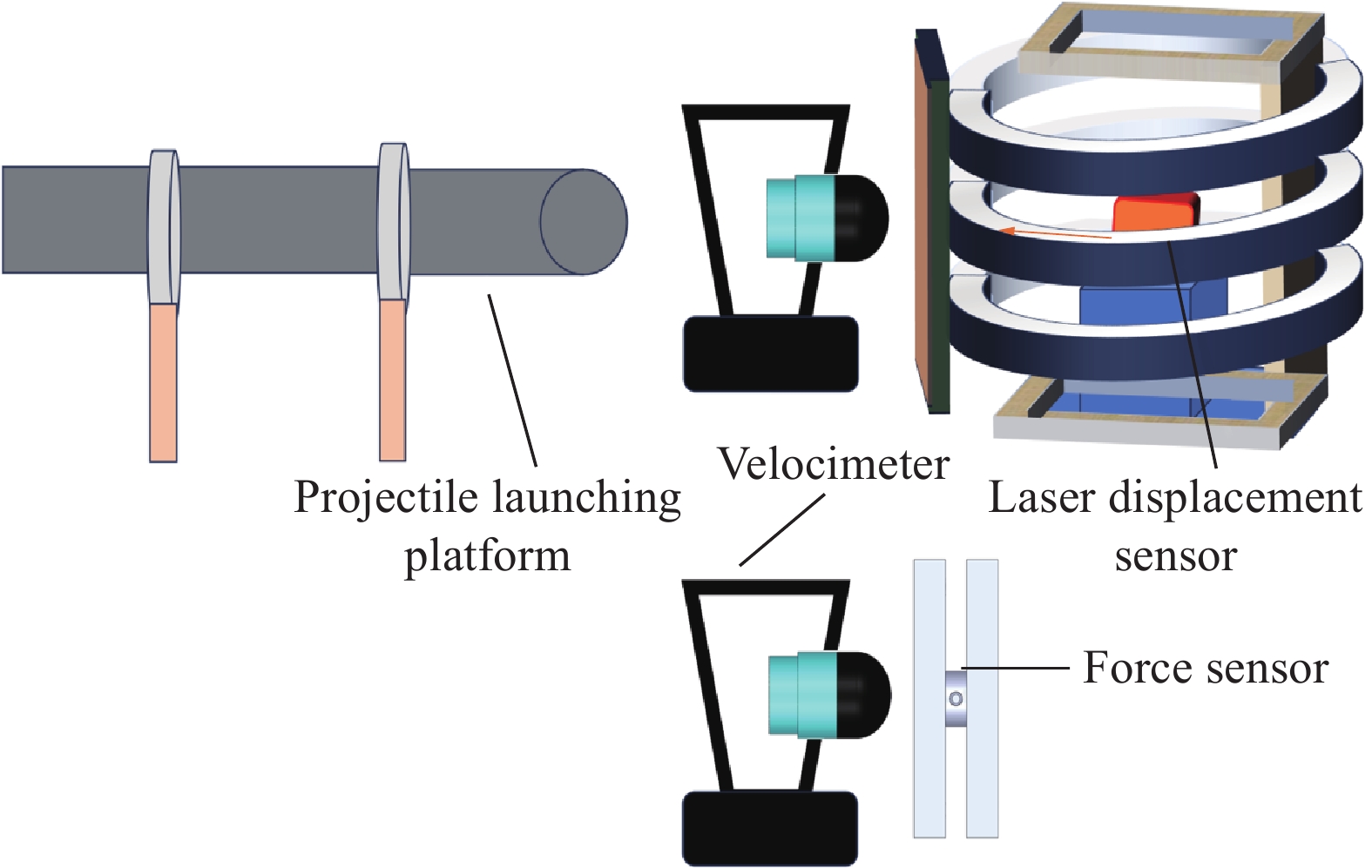
摘要: 为系统评估非致命动能弹丸对人体胸部的冲击安全性,设计并制备了一种结构可调、兼容仿真实验的一体化三肋胸部物理模型。首先通过弹体发射平台,在29.0和61.0 m/s速度下对SIR-X弹丸模型进行了刚性壁动力学验证,获得的力-时间曲线与北约AEP-99标准走廊吻合良好,证明了弹丸模型的可靠性。进一步使用该弹丸进行了56.0和86.5 m/s速度下的胸部冲击实验,测得胸壁位移及黏性准则的最大值(maximum viscosity criterion,VCmax,βvc,max)均落入AEP-99标准验证走廊范围内,表明该模型在中低速冲击(≤90.0 m/s)条件下具有良好的动态响应一致性和预测精度。其中56和86.5 m/s速度下的仿真与试验胸壁位移最大相对误差分别为16%和21%。提高弹丸硬度(从软到硬)在56.0和86.5 m/s工况下分别使VCmax由0.298 m/s升至0.336 m/s、由0.765 m/s升至0.856 m/s,高能工况放大效应更显著。肋间距在基准肋间距的80%~120%范围内变化时,对峰值位移和接触力的影响约±6%,VCmax波动范围为5.7%~6.2%,整体处于工程可接受范围内。与SHTIM(surrogate human thorax for impact model)对比,本文模型在56.0、86.5 m/s工况下的位移-时间响应更贴合走廊中线(βvc,max=0.308, 0.803 m/s,均在推荐区间),SHTIM在高能工况略低于下限,验证了本模型在响应精度与伤害判据一致性上的优势。针对NS、CONDOR、SIR-X和RB1FS等4种典型弹丸,在60.0~90.0 m/s速度范围内开展系统仿真,揭示了不同弹丸结构和材料对胸部损伤风险的影响机制。高速冲击(100.0~120.0 m/s)下,模型软组织层主导能量吸收与耗散,肋骨层的峰值应力随冲击速度的升高显著增大并超过屈服极限,存在严重骨折风险。厚度敏感性分析显示,软组织层的厚度对吸能和变形的调控作用最突出。Abstract: In order to systematically evaluate the impact safety of human chest impacted by non-lethal kinetic projectiles (NLKP), an integrated three-rib thoracic physical model with a configurable structure was developed, which was compatible with both simulation and experimental testing. The projectile representation was first validated through rigid-wall impacts at 29.0 and 61.0 m/s on a controllable gas-launch platform. The measured force–time histories agreed well with the NATO Allied Engineering Publication-99 (AEP-99), corridors, confirming the fidelity of the projectile model. Impact experiments on chest were then conducted using the validated projectile model at 56.0 and 86.5 m/s. The measured chest-wall displacements and the maximum value of the viscous criterion (VCmax, βvc,max) fell within the validation corridors specified in the AEP-99, demonstrating that the proposed model exhibits dynamic-response consistency and predictive accuracy under medium- and low-velocity impacts at or below 90.0 m/s. Among them, the maximum relative errors between simulated and experimental displacements at 56.0 and 86.5 m/s are 16% and 21%, respectively. A projectile hardness scan (soft/medium/hard) showed that VCmax increased from 0.298 m/s to 0.336 m/s at 56.0 m/s and from 0.765 m/s to 0.856 m/s at 86.5 m/s, indicating a more pronounced risk amplification at higher energies. When the rib spacing varies within the range of 80%−120% of the baseline rib spacing, its effect on the peak displacement and contact force is approximately ±6%, and VCmax fluctuates within 5.7%−6.2%, which is generally within the engineering acceptable range. Compared with the surrogate human thorax for impact model (SHTIM), the proposed model adhered more closely to the corridor mid-line at 56.0, 86.5 m/s, and yielded VCmax values of 0.308, 0.803 m/s (both within the recommended ranges), whereas the SHTIM slightly underestimated the high-energy case, confirming the model advantage in response fidelity and criterion consistency. A systematic simulation was conducted for impact responses by four typical projectiles (NS, CONDOR, SIR-X, and RB1FS) within the velocity range of 60.0–90.0 m/s, elucidating the influence mechanisms of projectile structure and material on thoracic injury risk. Under higher speed impact (100.0–120.0 m/s), the soft tissue layer of the model dominates energy absorption and dissipation, while the peak stress in the rib layer increases significantly with velocity and exceeds the yield limit, indicating a high risk of fracture. Thickness sensitivity analysis reveals that the thickness of the soft tissue layer plays the most prominent role in regulating energy absorption and deformation. These findings provide important theoretical and technical support for NLKP impact injury assessment and the optimization of protective equipment.
-
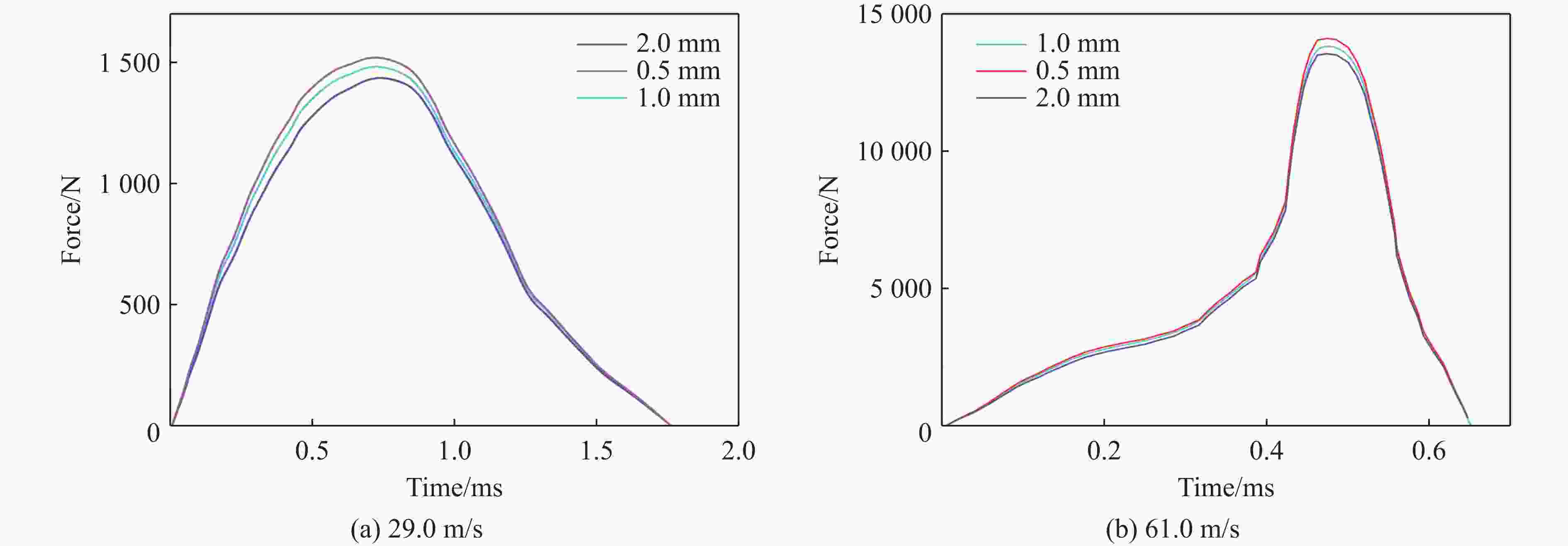
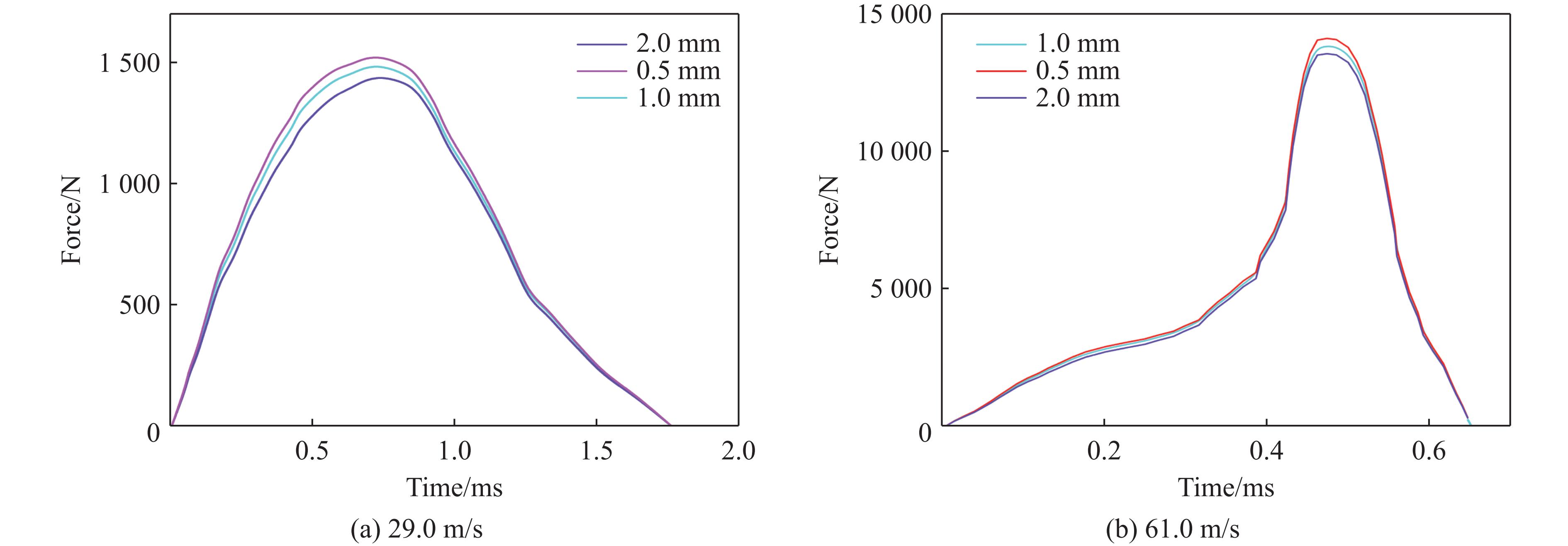
图 5 不同网格尺寸下SIR-X弹丸刚性壁冲击的力-时间曲线对比
Figure 5. Comparison of force-time curves of SIR-X projectiles impacting a rigid wall with different mesh sizes
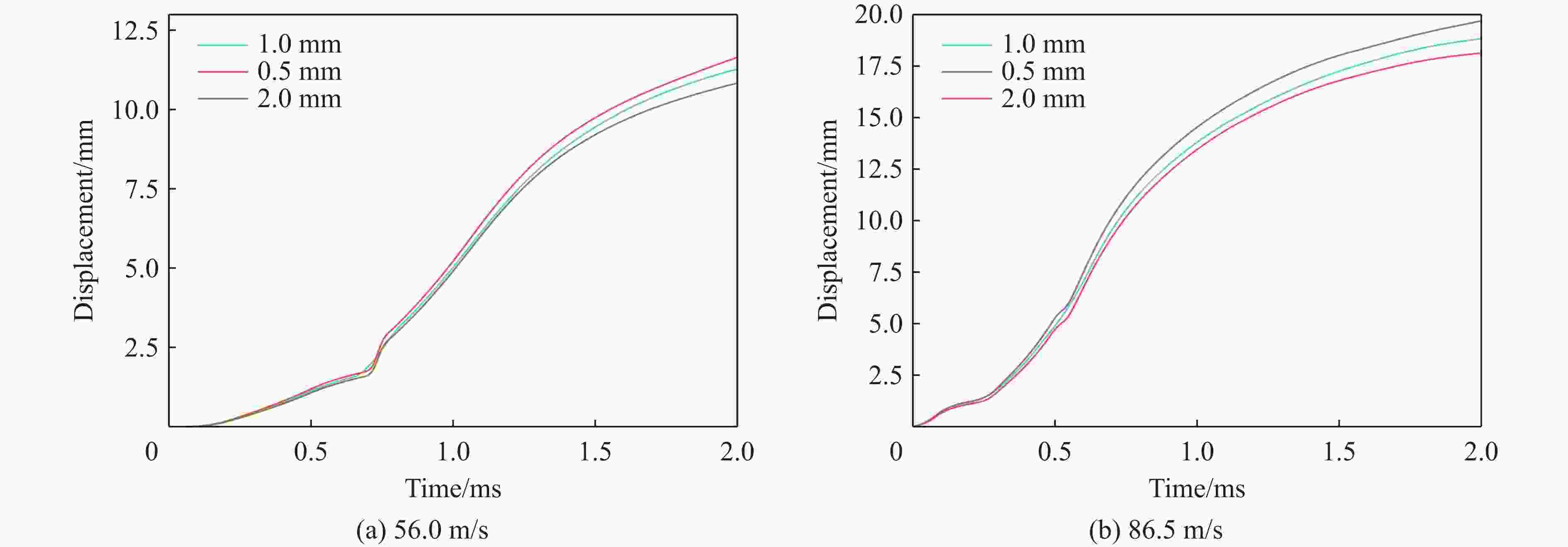
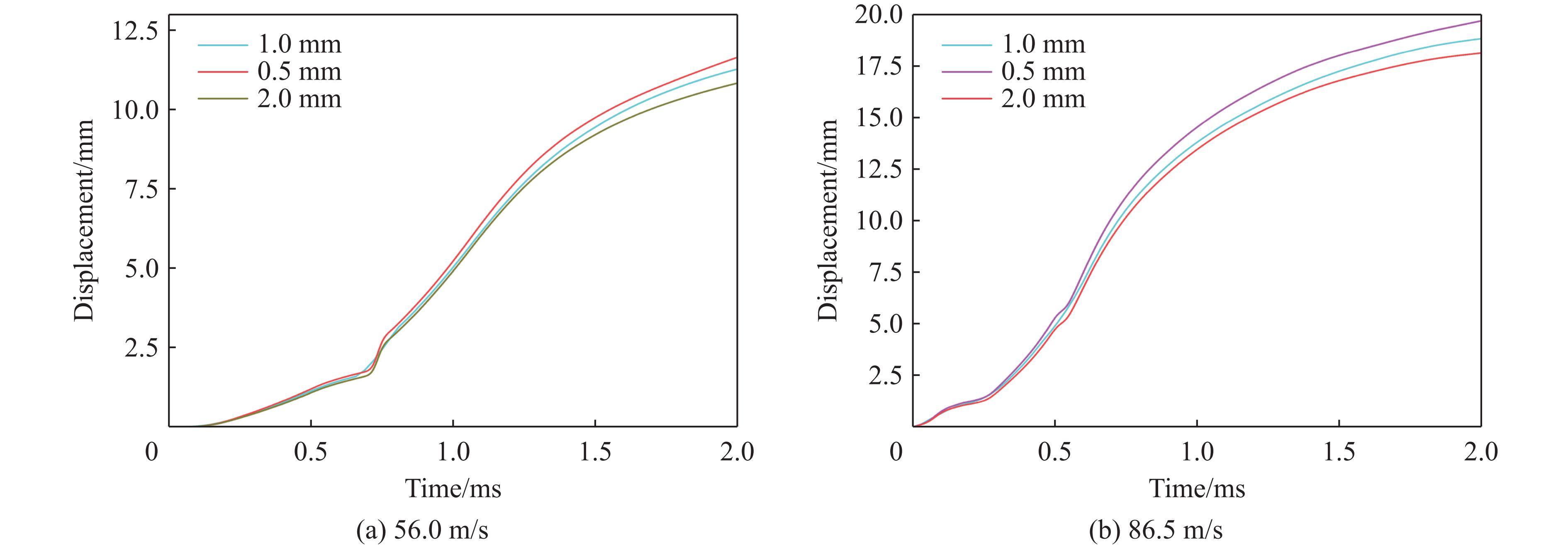
图 6 56.0、86.5 m/s冲击速度下不同网格尺寸的胸壁位移-时间曲线
Figure 6. Chest wall displacement-time histories at the impact velocities of 56.0 and 86.5 m/s for different mesh sizes
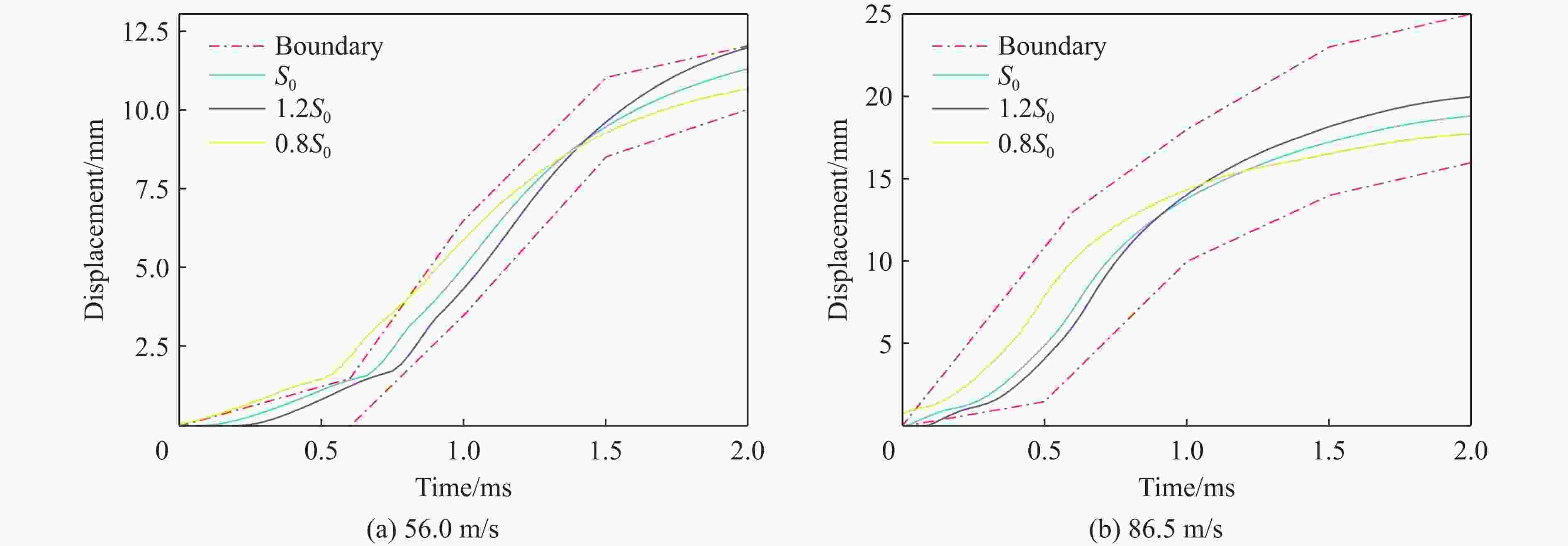
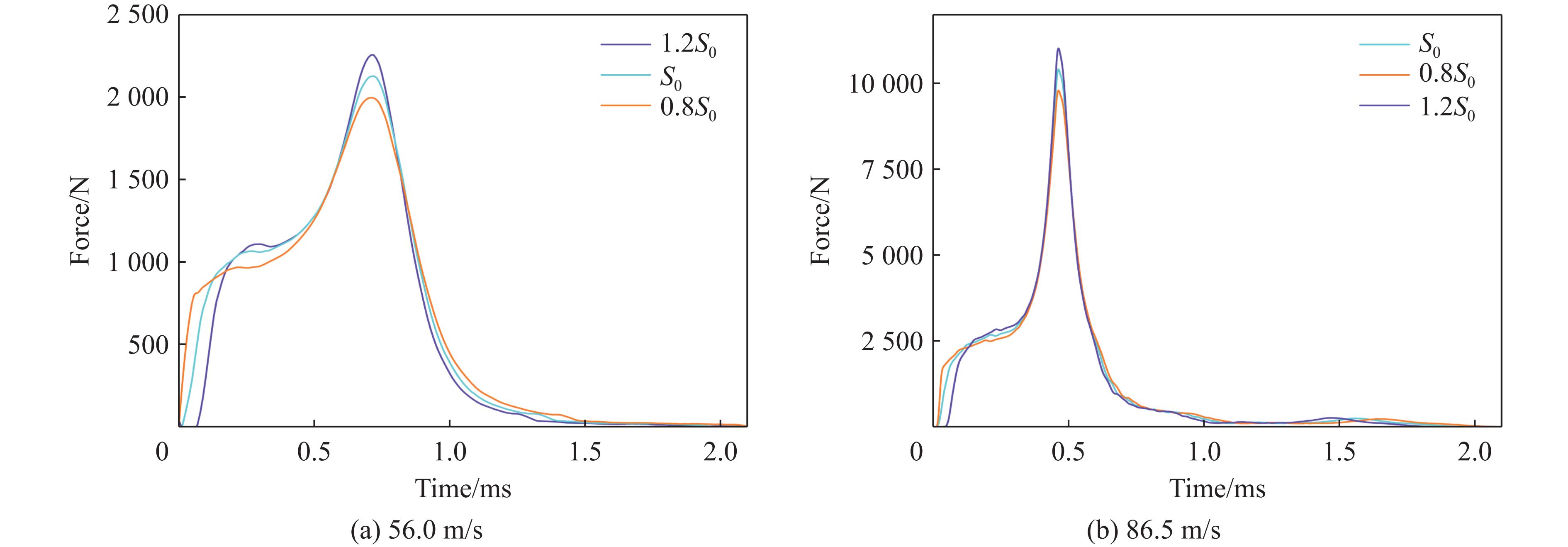
图 8 不同肋间距下的胸壁位移-时间曲线
Figure 8. Chest wall displacement-time curves at different rib spacings
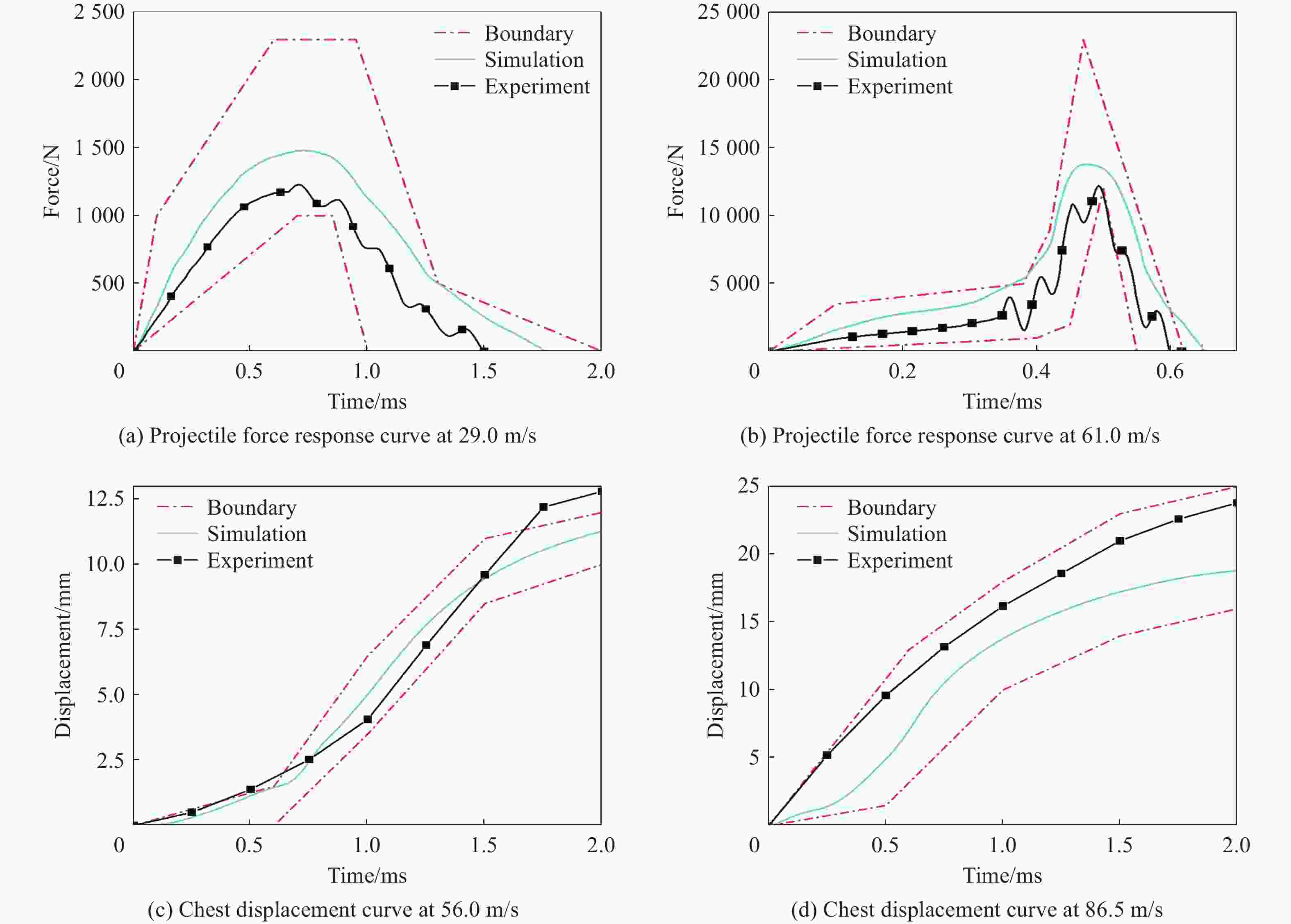
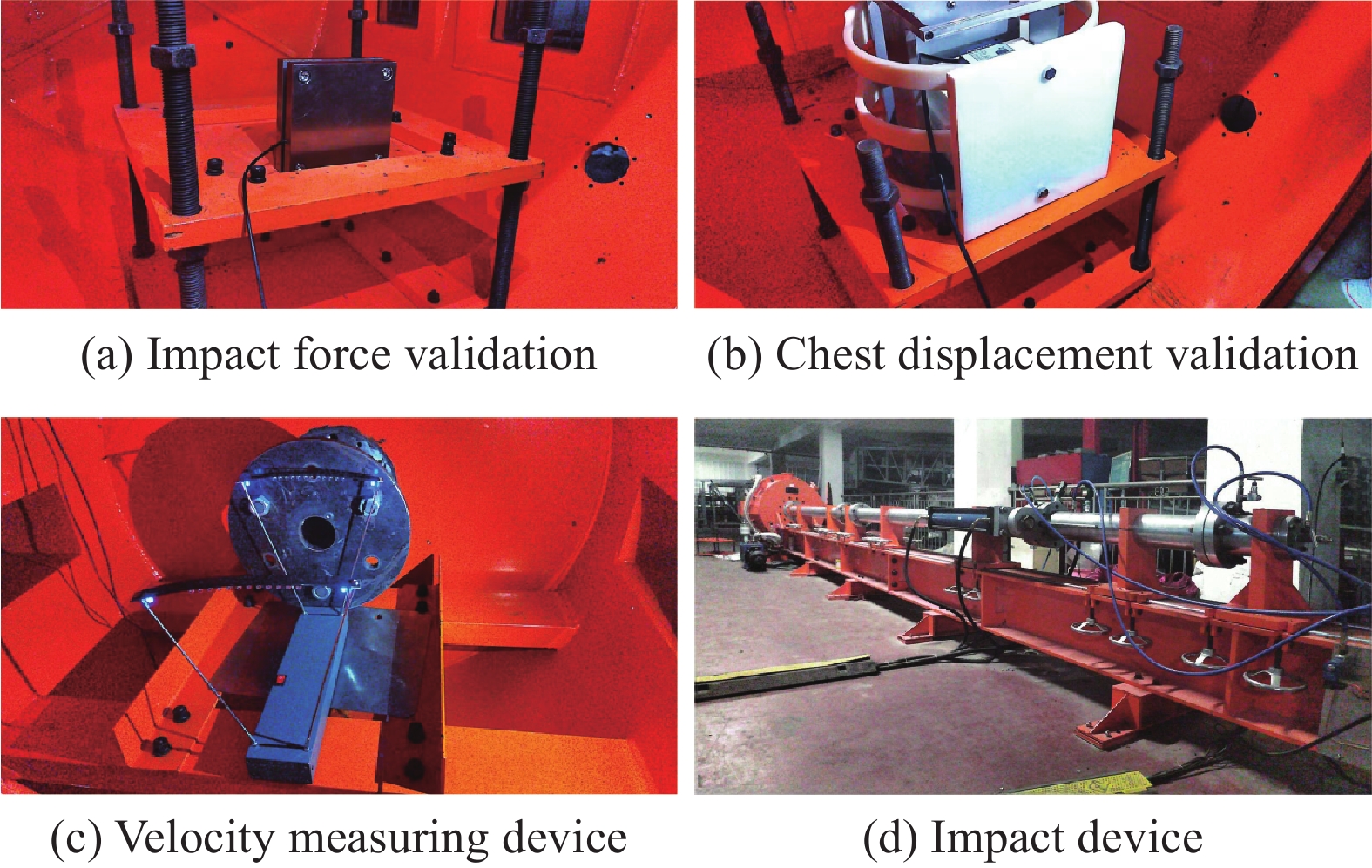
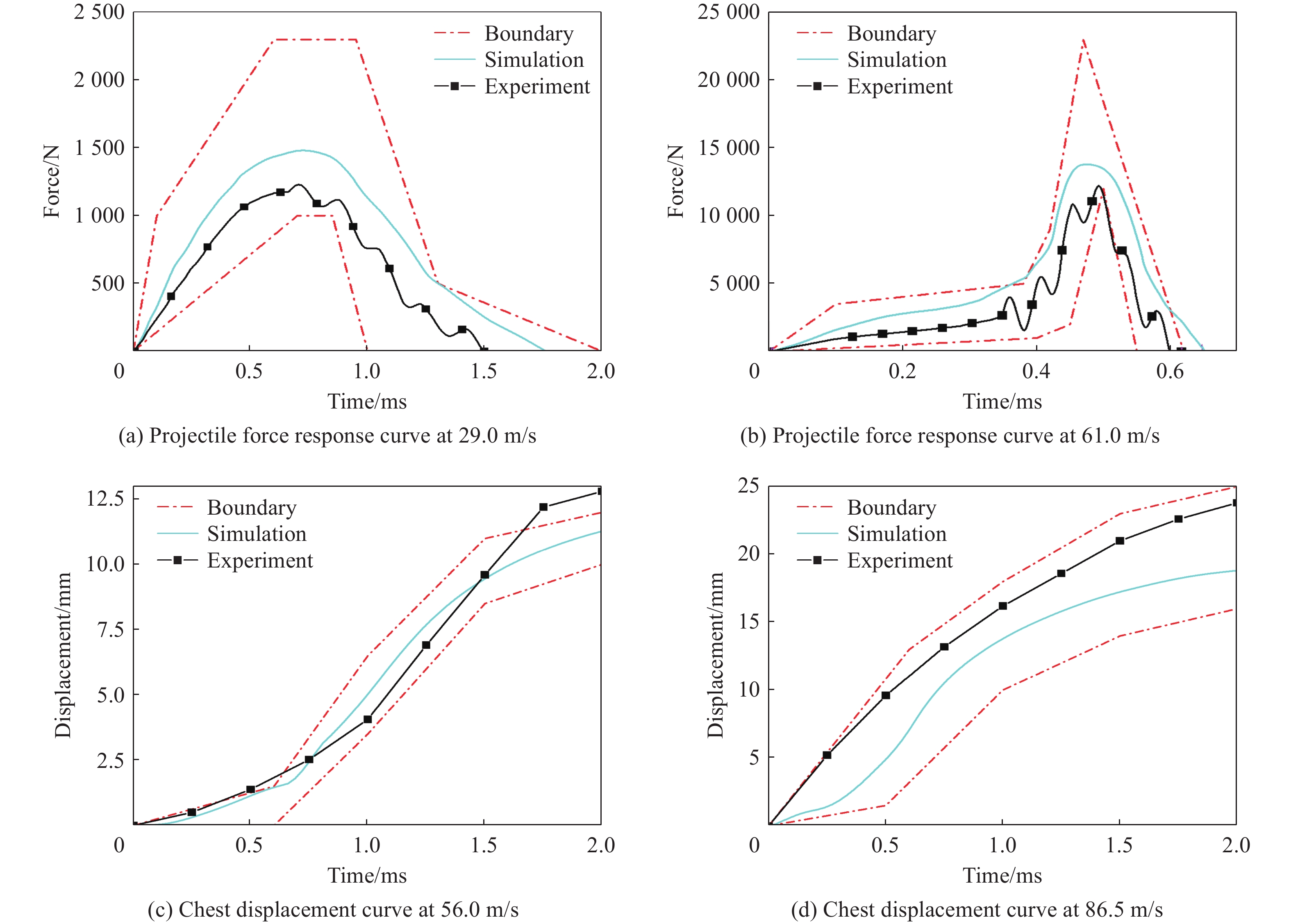
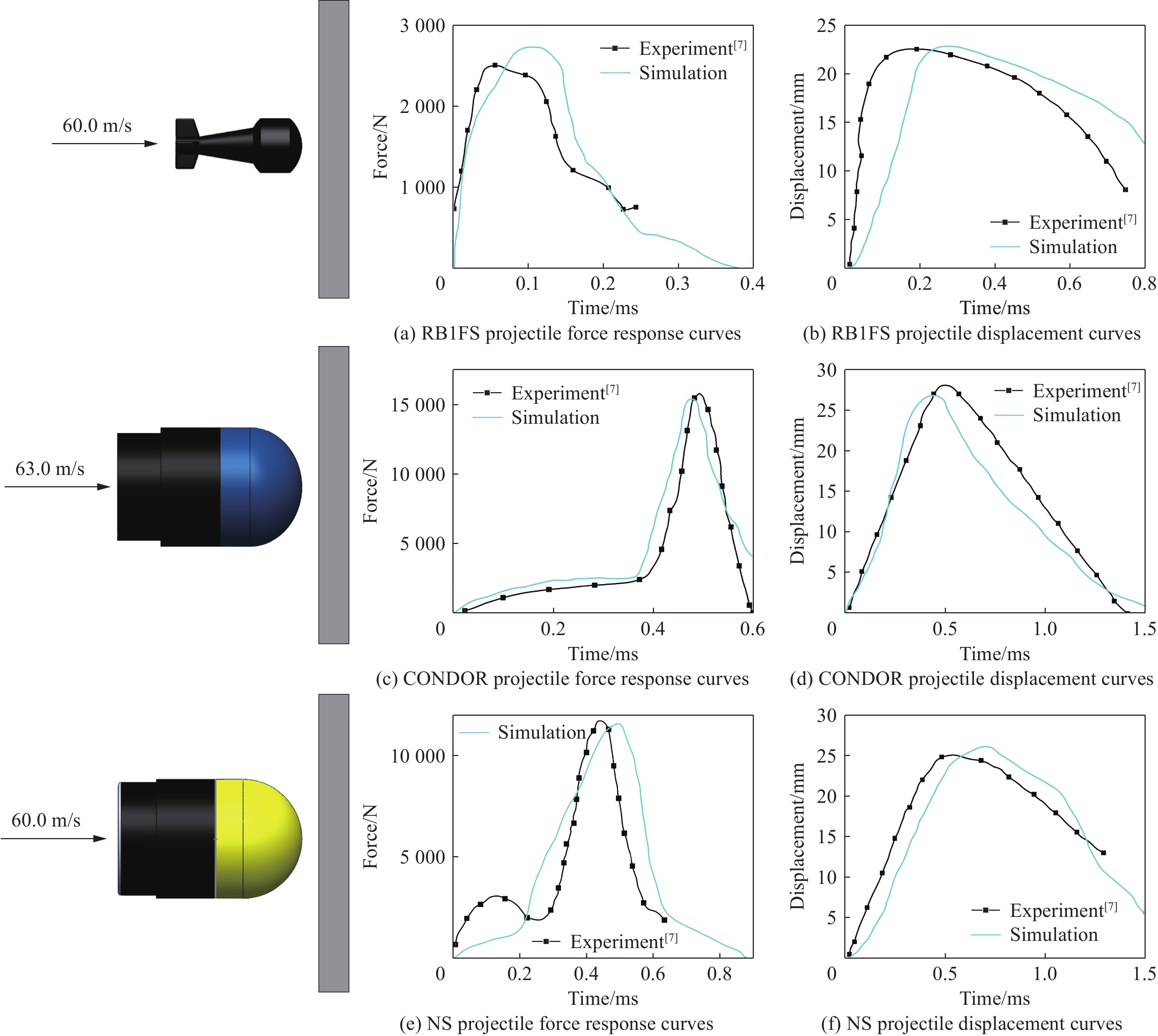
图 9 弹丸冲击力与胸部位移响应的模型验证
Figure 9. Model verification using projectile impact force and chest wall displacement responses
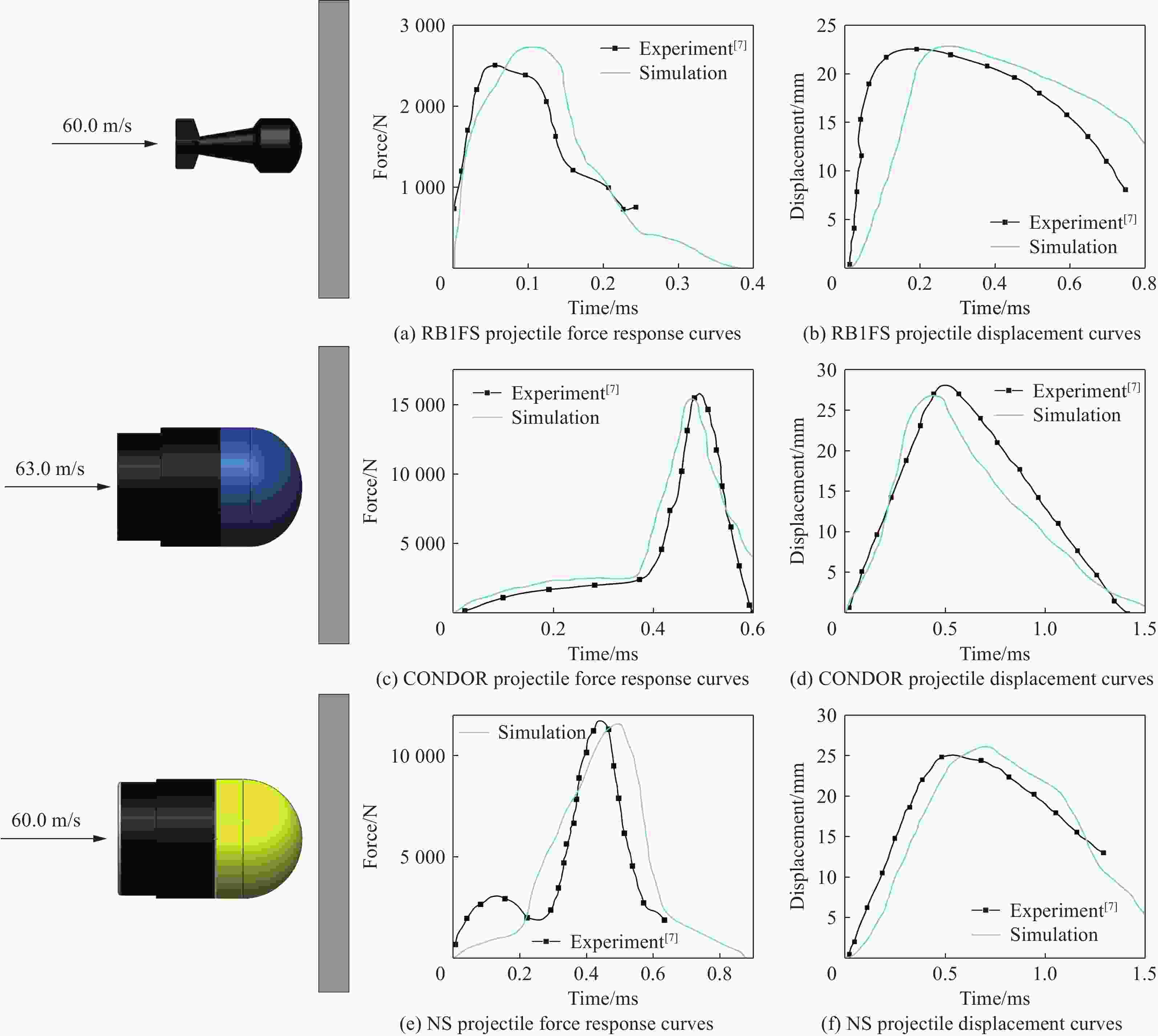
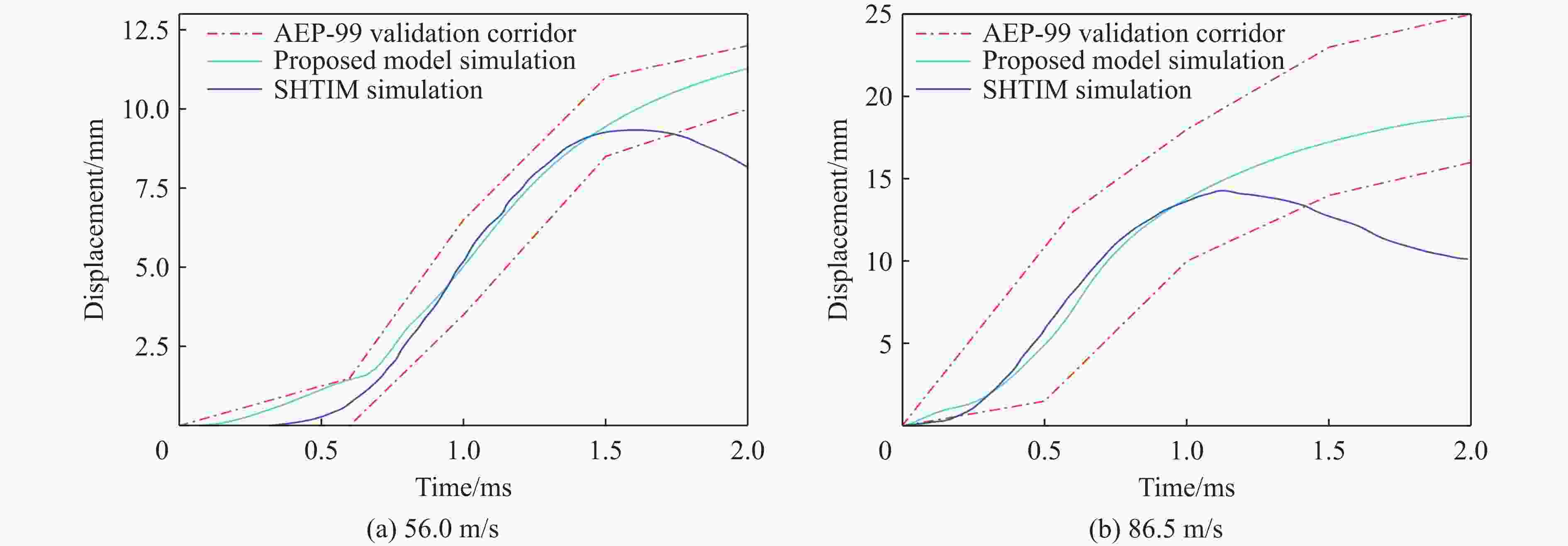
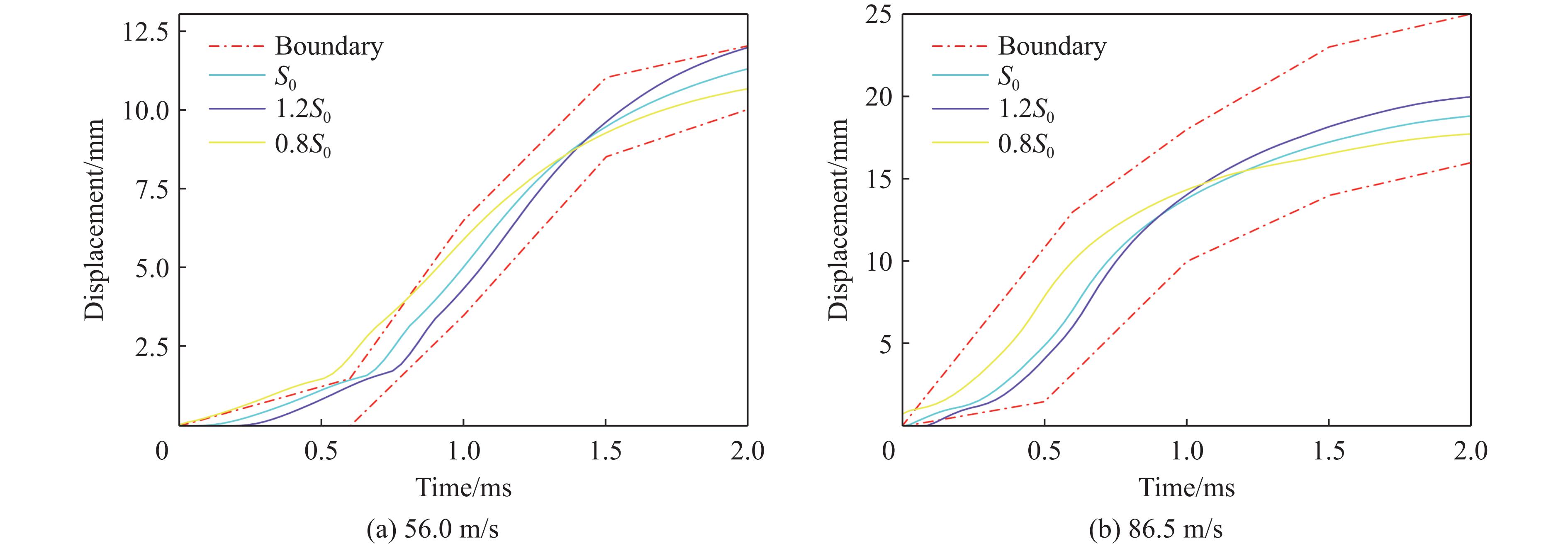
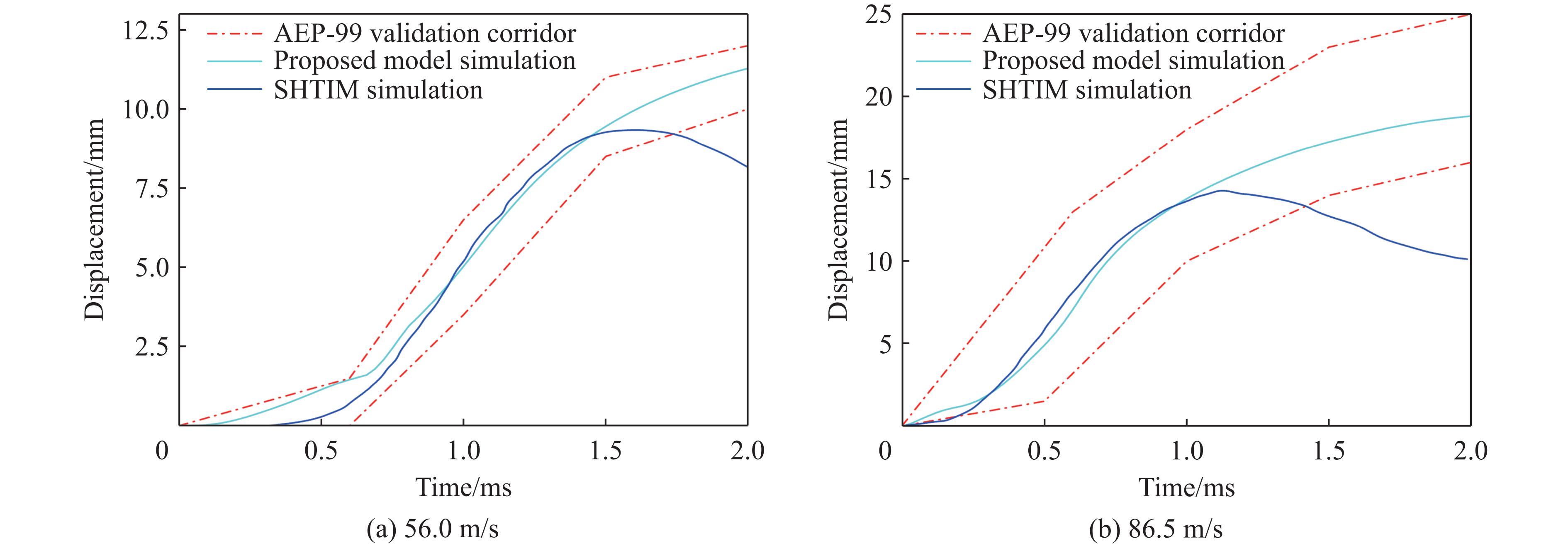
图 11 三肋胸部模型与SHTIM在56.0、86.5 m/s冲击速度下的胸壁位移-时间曲线对比
Figure 11. Comparison of chest wall displacement-time curves between the proposed three-rib model and the SHTIM at the impact velocities of 56.0 and 86.5 m/s
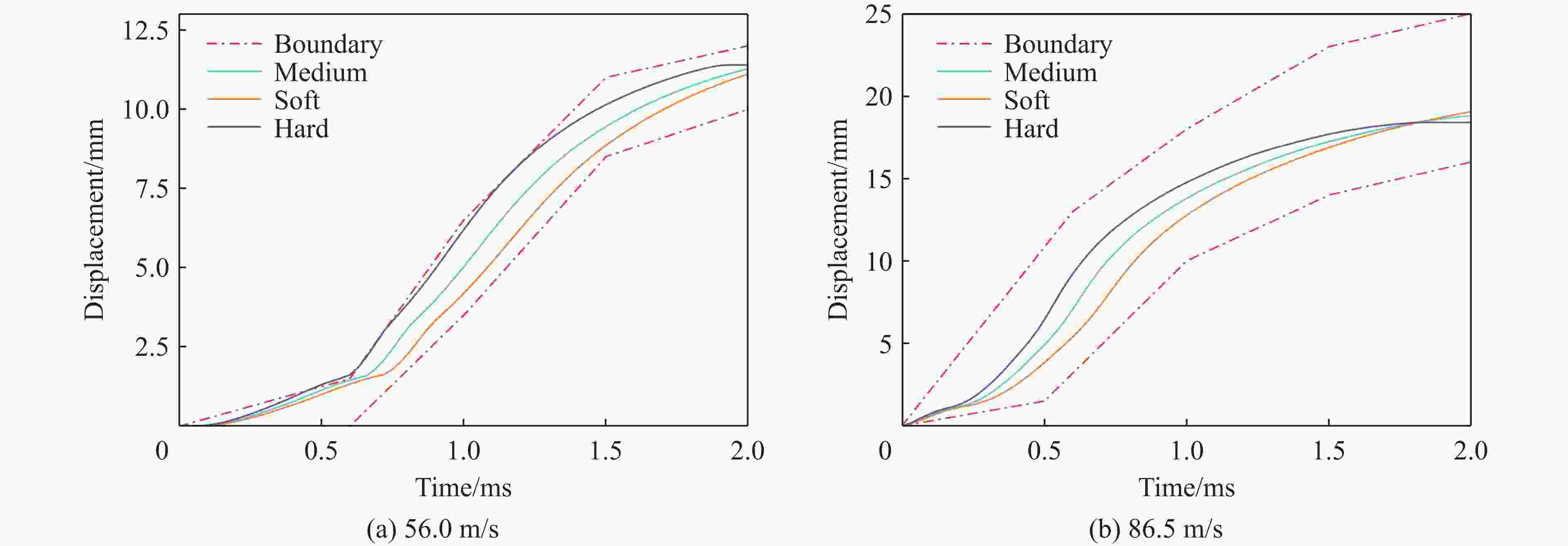
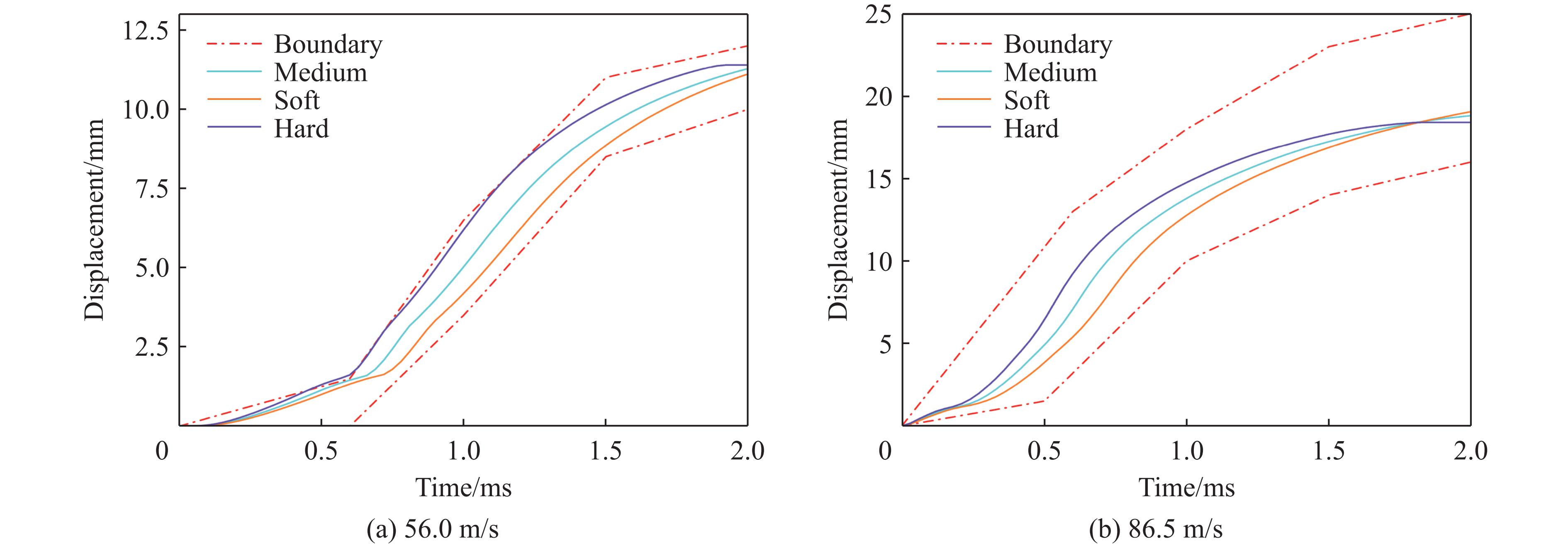
图 12 在不同硬度弹丸冲击下的胸壁位移-时间曲线与AEP-99边界走廊对比
Figure 12. Comparison of chest wall displacement-time curves under impact by projectiles with different hardness levels against the AEP-99 validation corridor
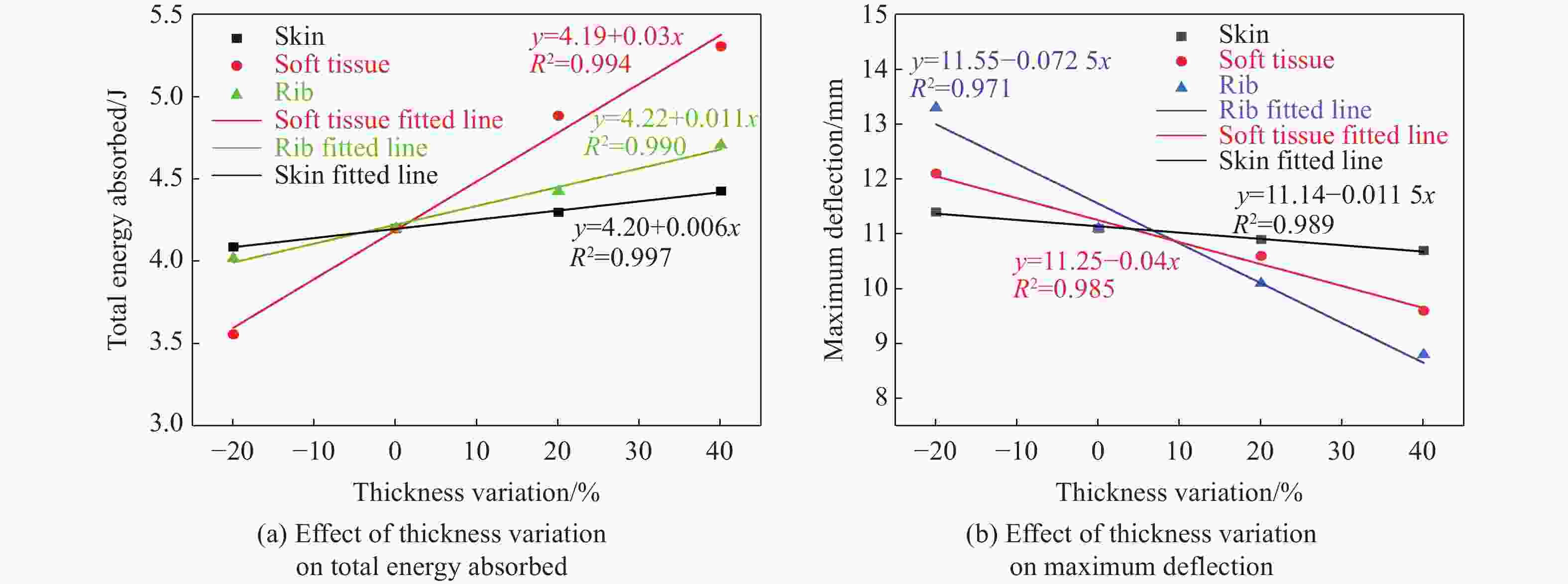
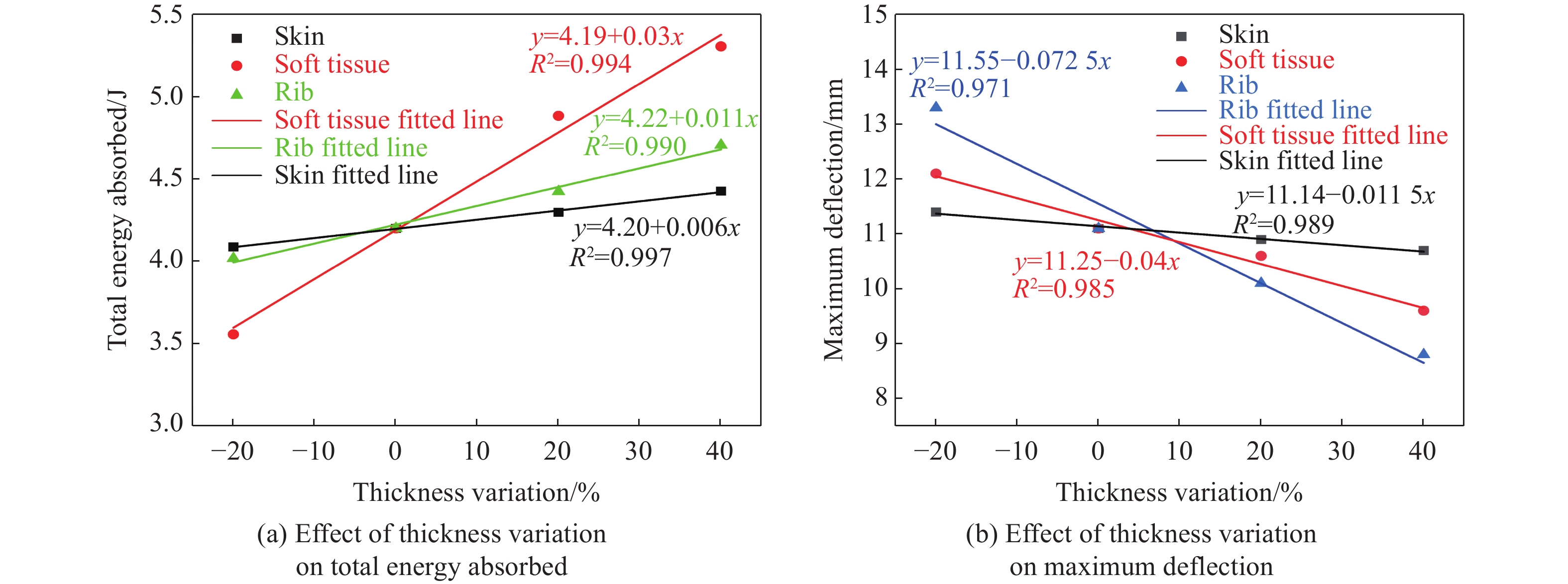
图 13 三层胸部替代模型吸能和最大挠度对层厚度变化的敏感性
Figure 13. Sensitivity of total absorbed energy and maximum deflection to layer thickness variation in the three-layer chest surrogate model
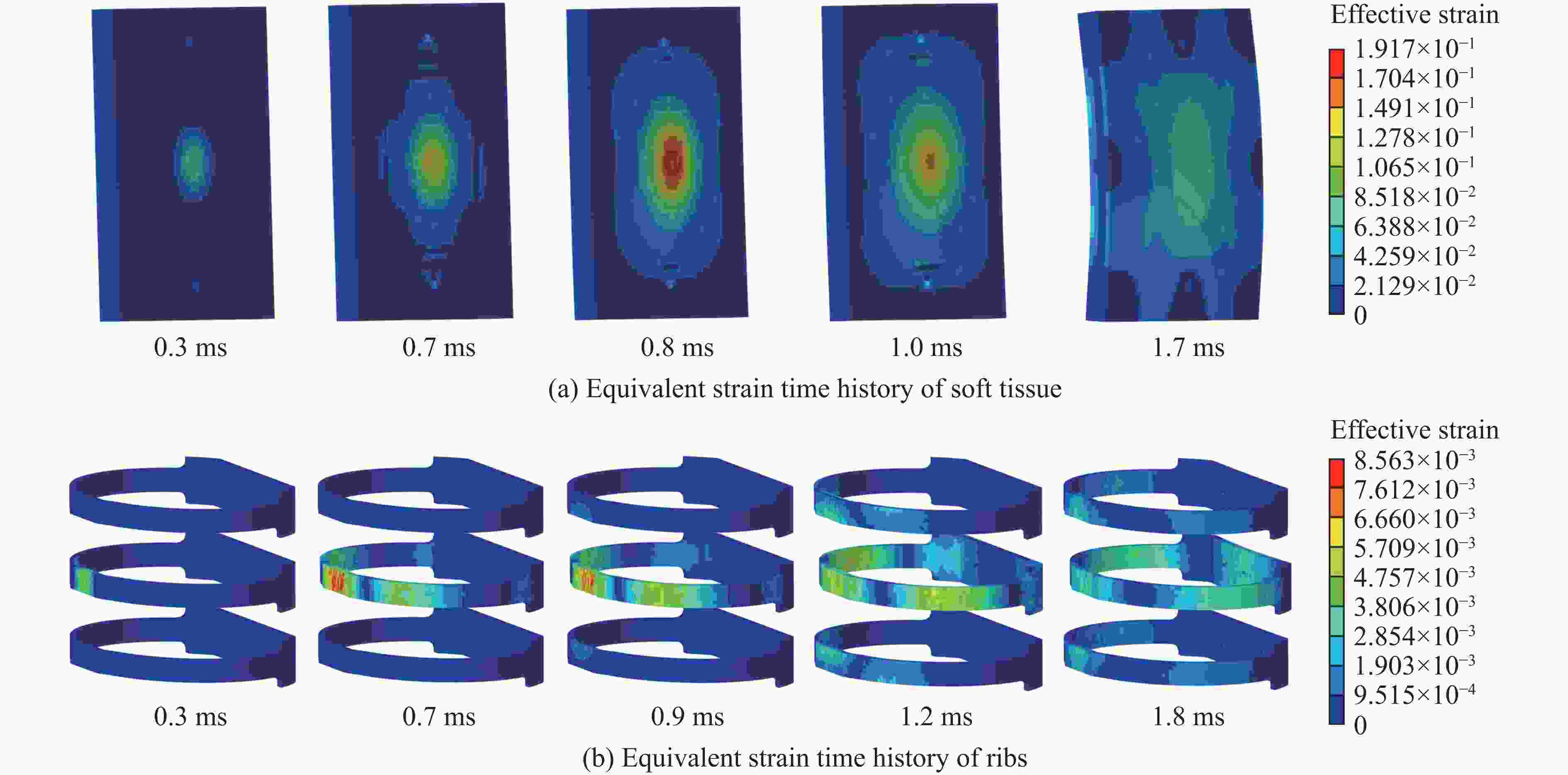
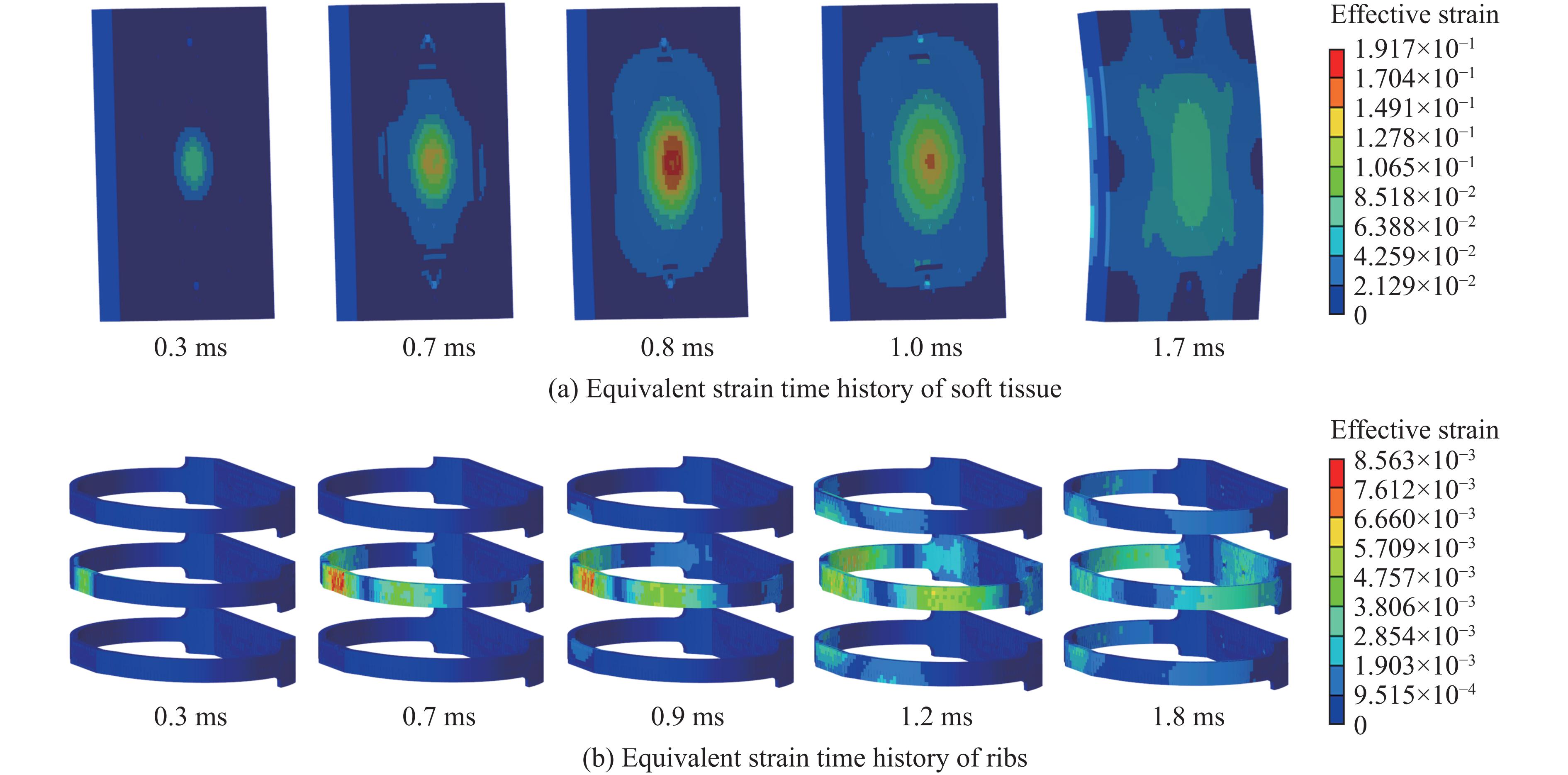
图 14 100 m/s冲击速度下各层结构等效应变分布演化过程
Figure 14. Evolution of equivalent strain distributions of each layer under a 100 m/s impact
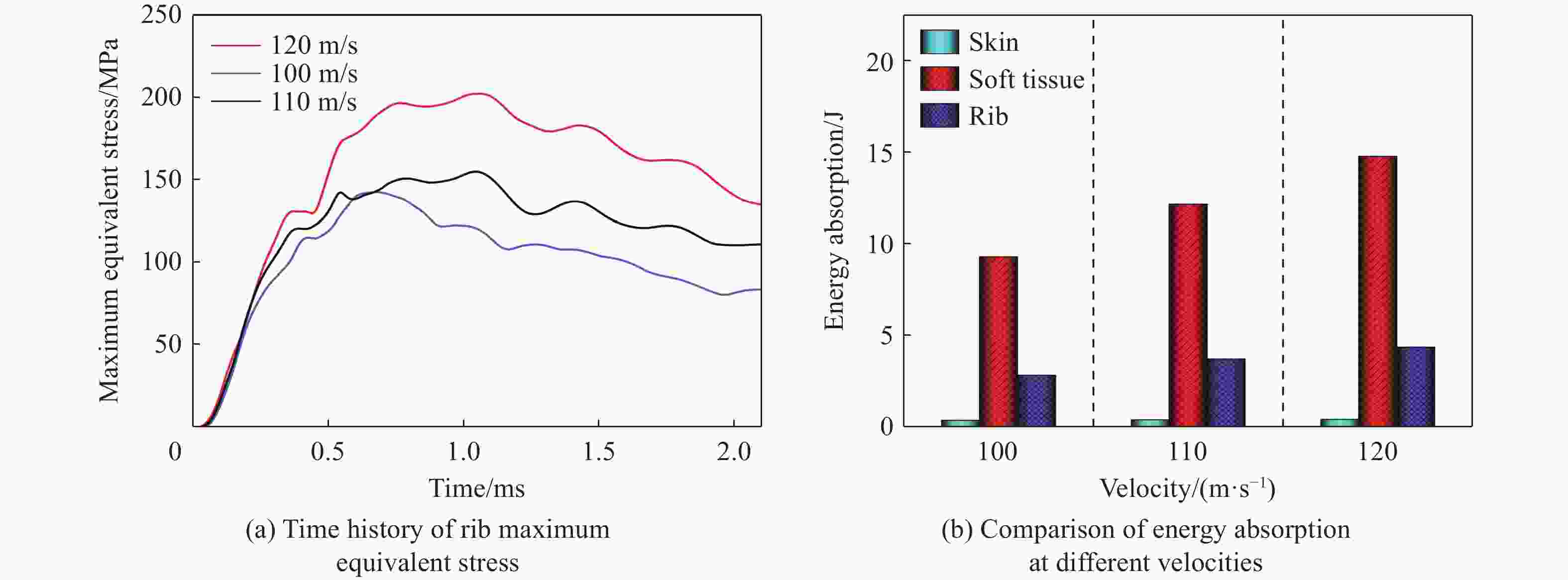
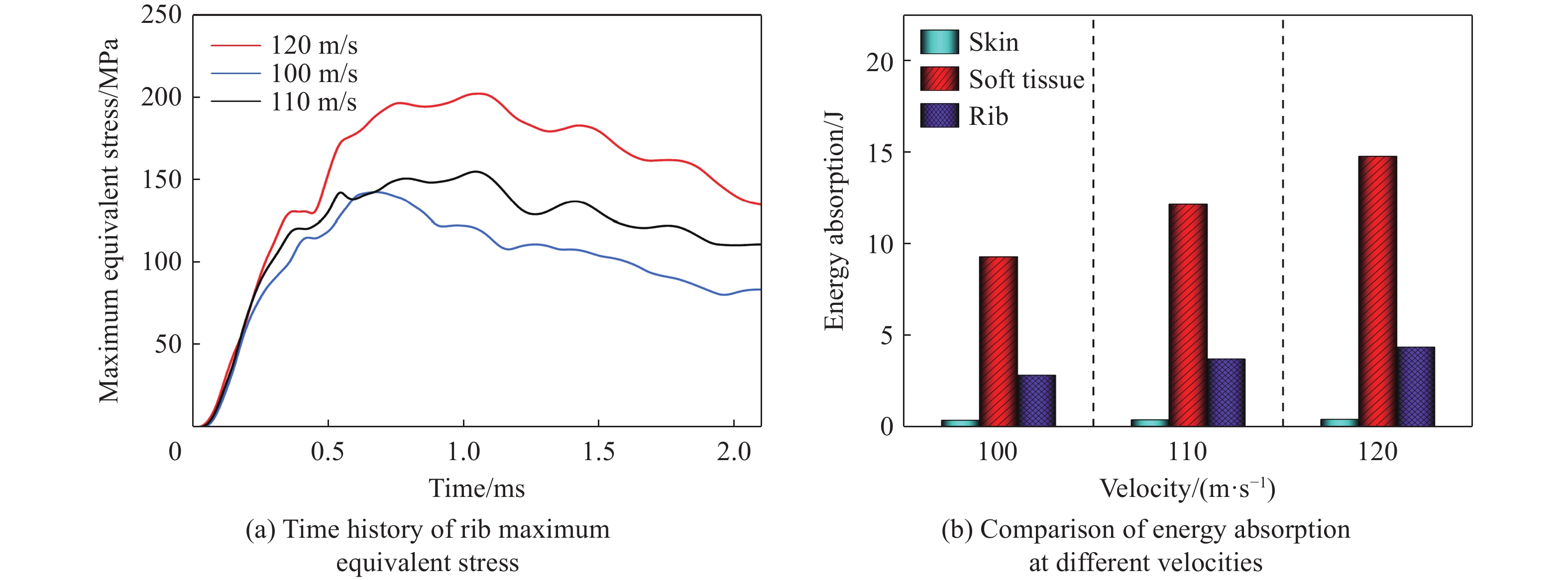
图 15 高速冲击下最大等效应力曲线与吸能柱状图
Figure 15. Maximum equivalent stress curves and energy absorption bar chart under high-velocity impact
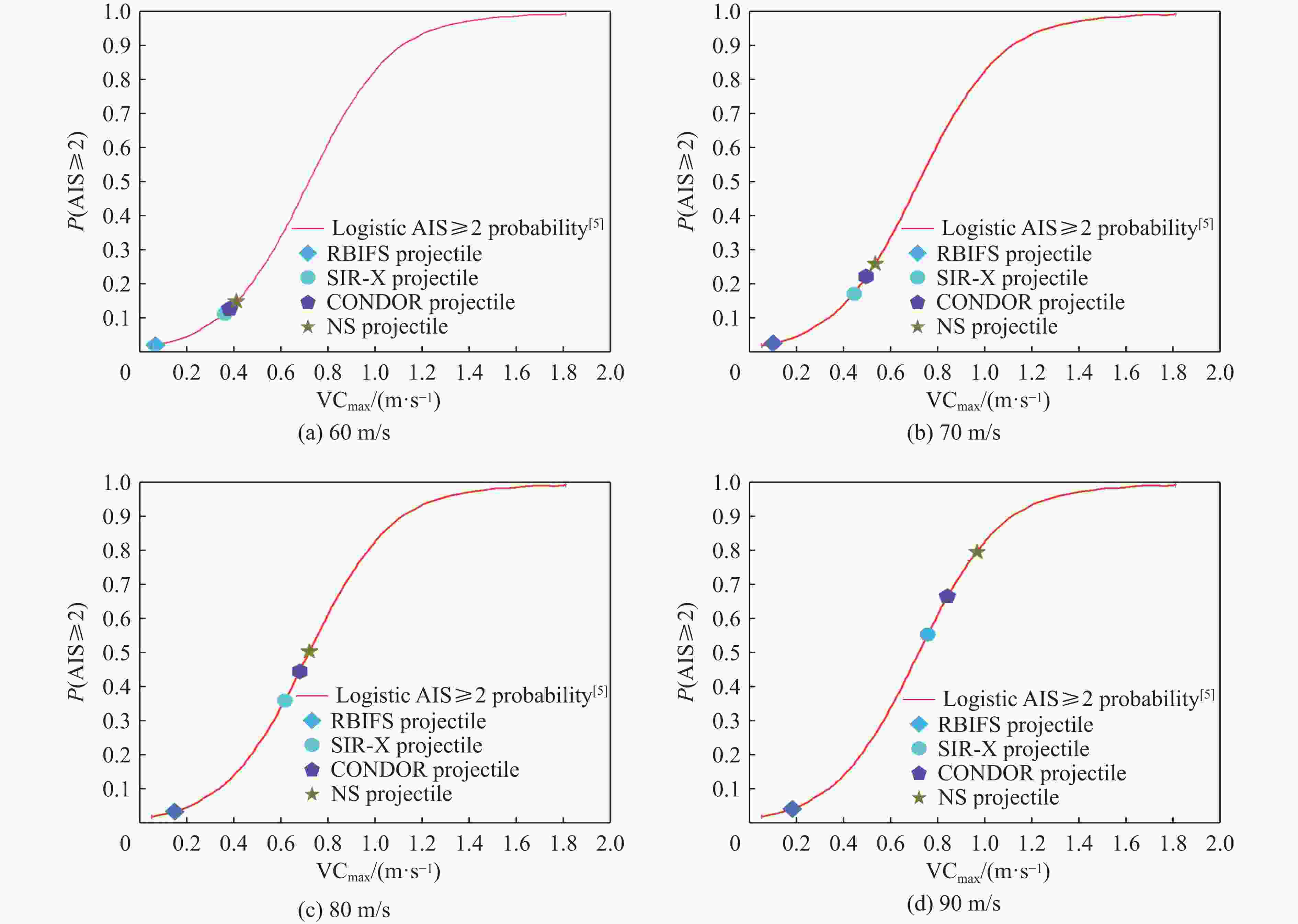
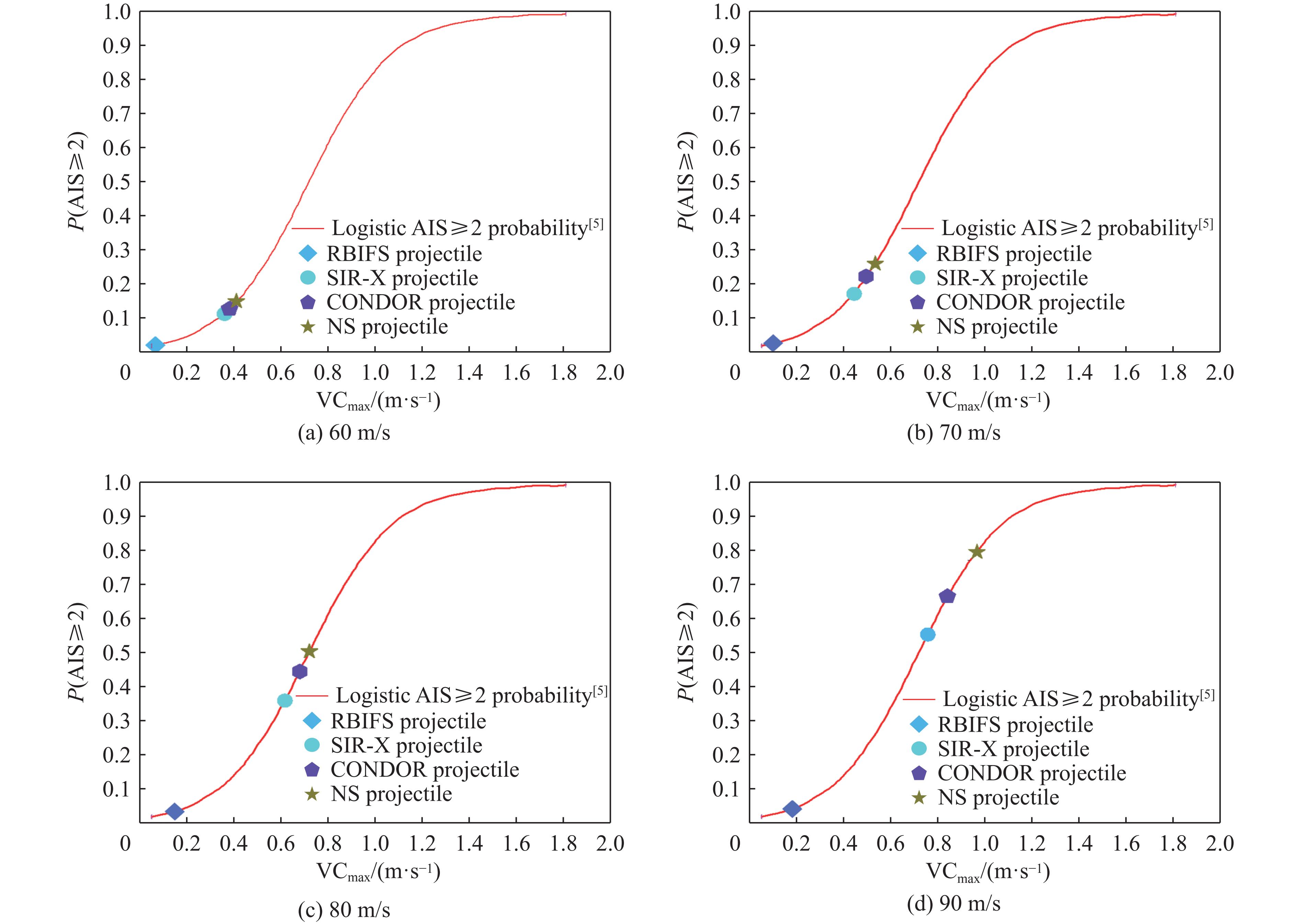
图 16 不同弹丸冲击下基于VCmax的胸部AIS≥2损伤概率
Figure 16. AIS≥2 injury probability based on VCmax for different projectiles impacting the chest
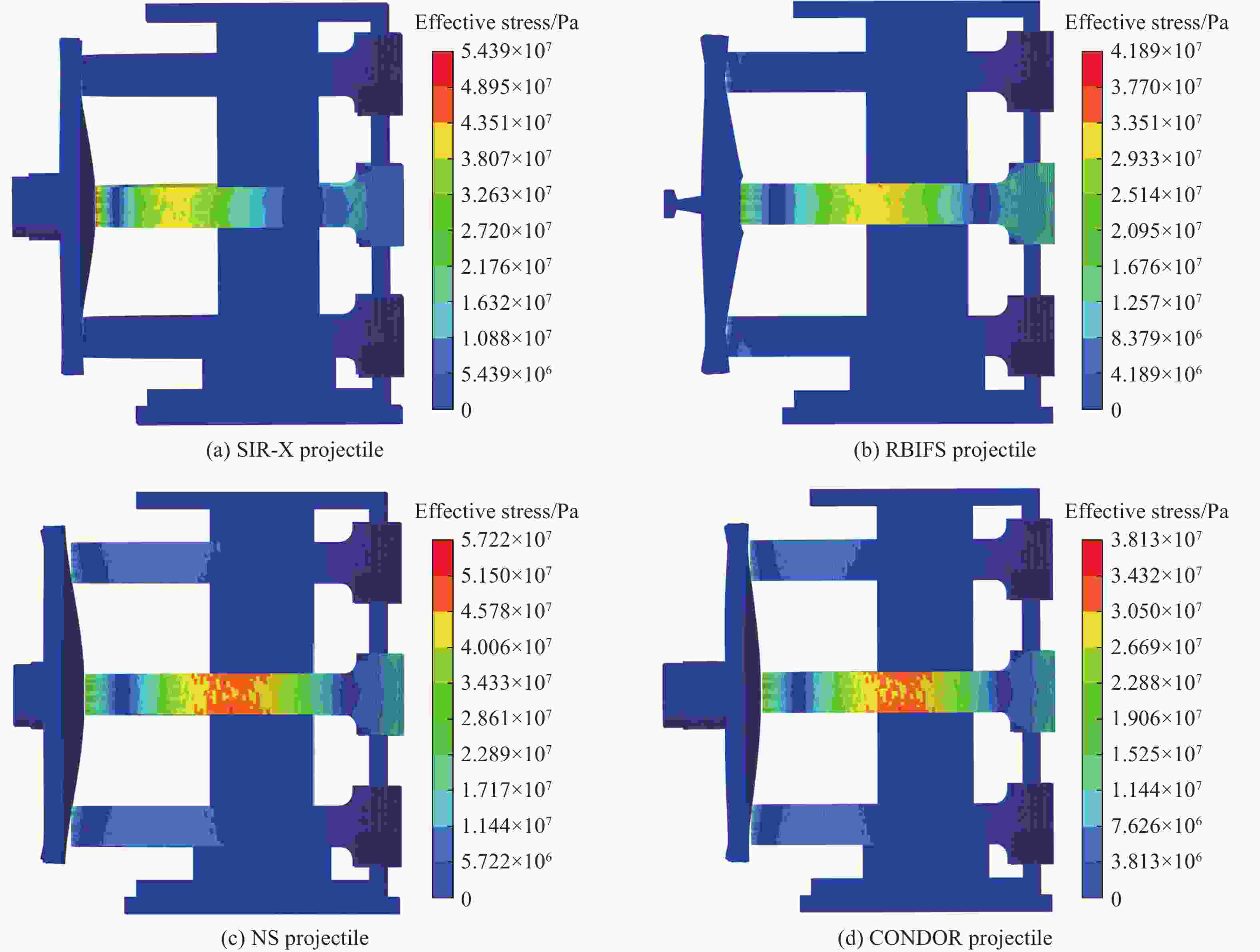
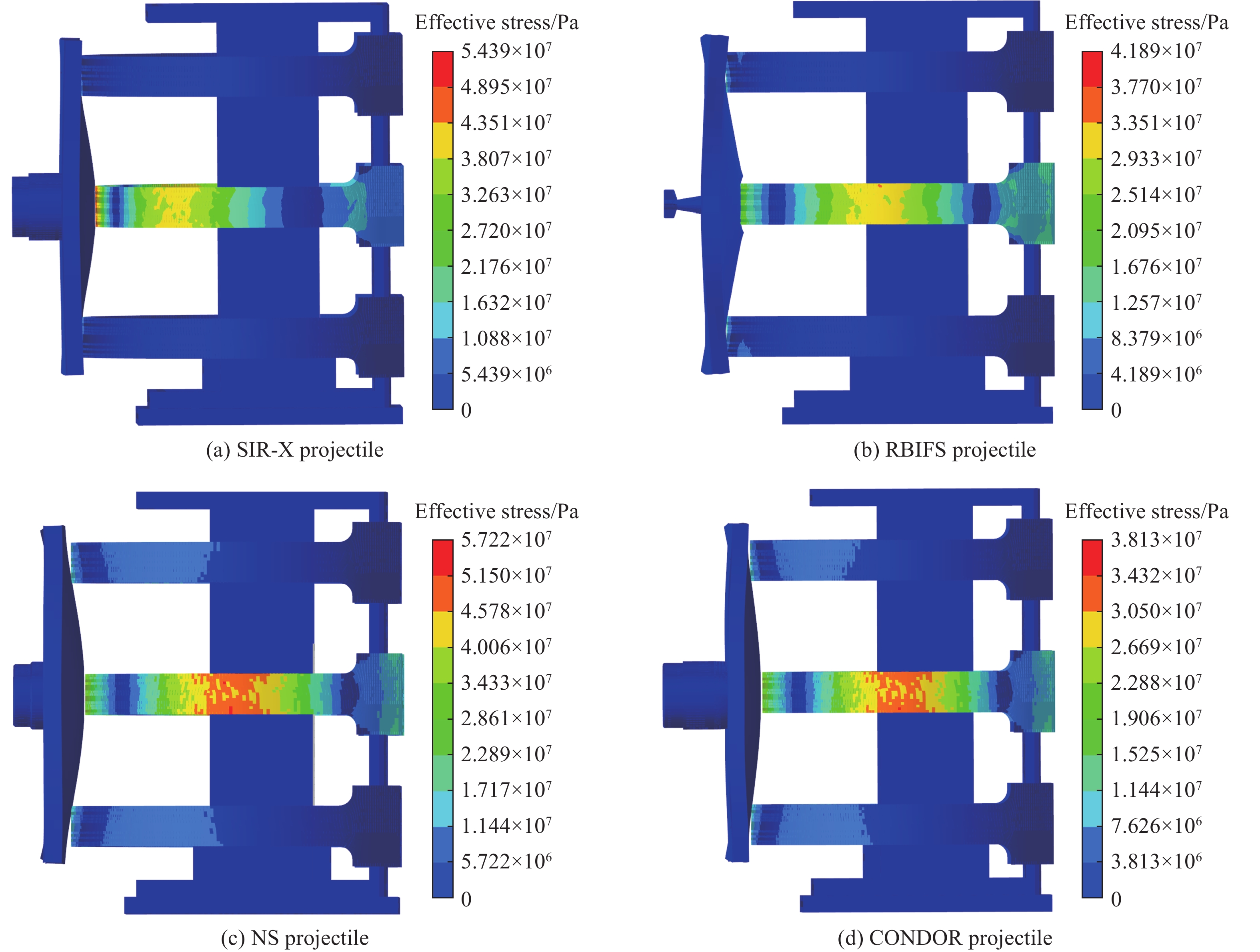
图 17 不同弹丸在60 m/s速度冲击下肋骨最大等效应力分布云图
Figure 17. Distribution of the maximum equivalent stress in ribs under 60 m/s impacts of different projectiles
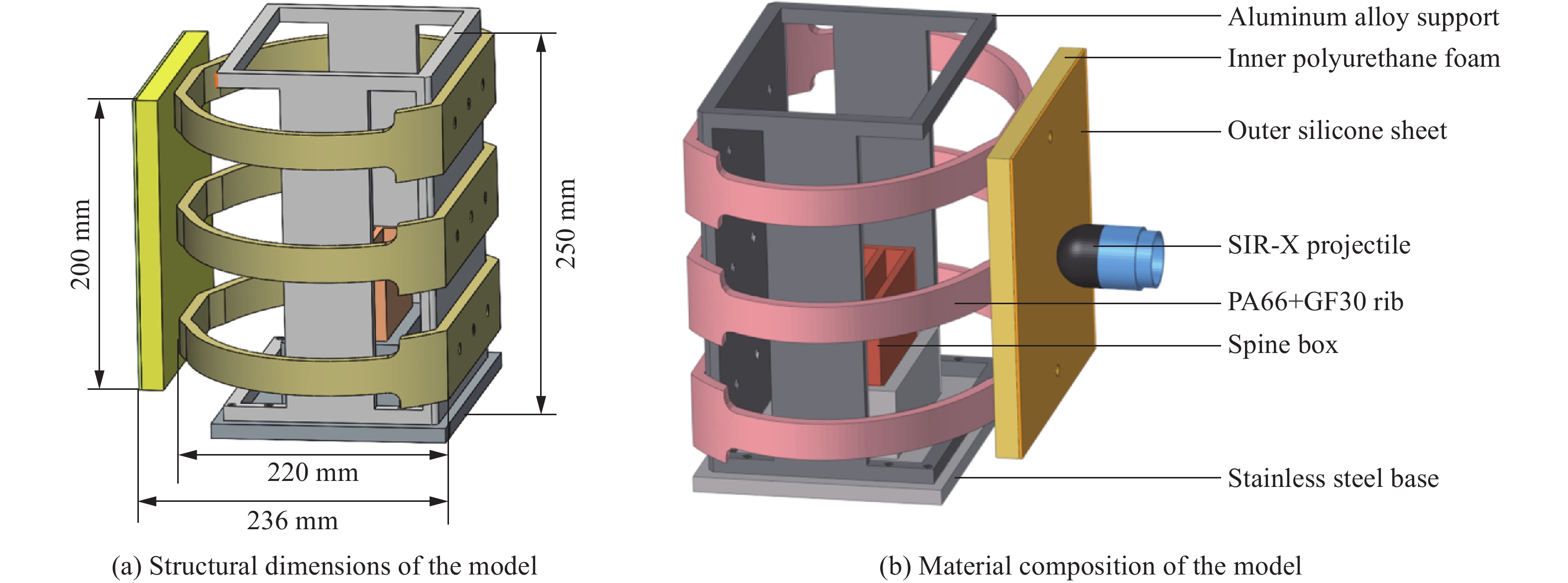
部件 材料 密度/(kg·m−3) 泊松比 杨氏模量/GPa 皮肤层 硅胶 1100 0.48 0.001 软组织层 聚氨酯泡沫 250 0.47 0.0015 肋骨 PA66+GF30 1650 0.35 15 支架 铝合金 2700 0.33 69 底座 不锈钢 8000 0.3 190 脊柱箱 ABS 1240 0.4 2.4  下载: 导出CSV
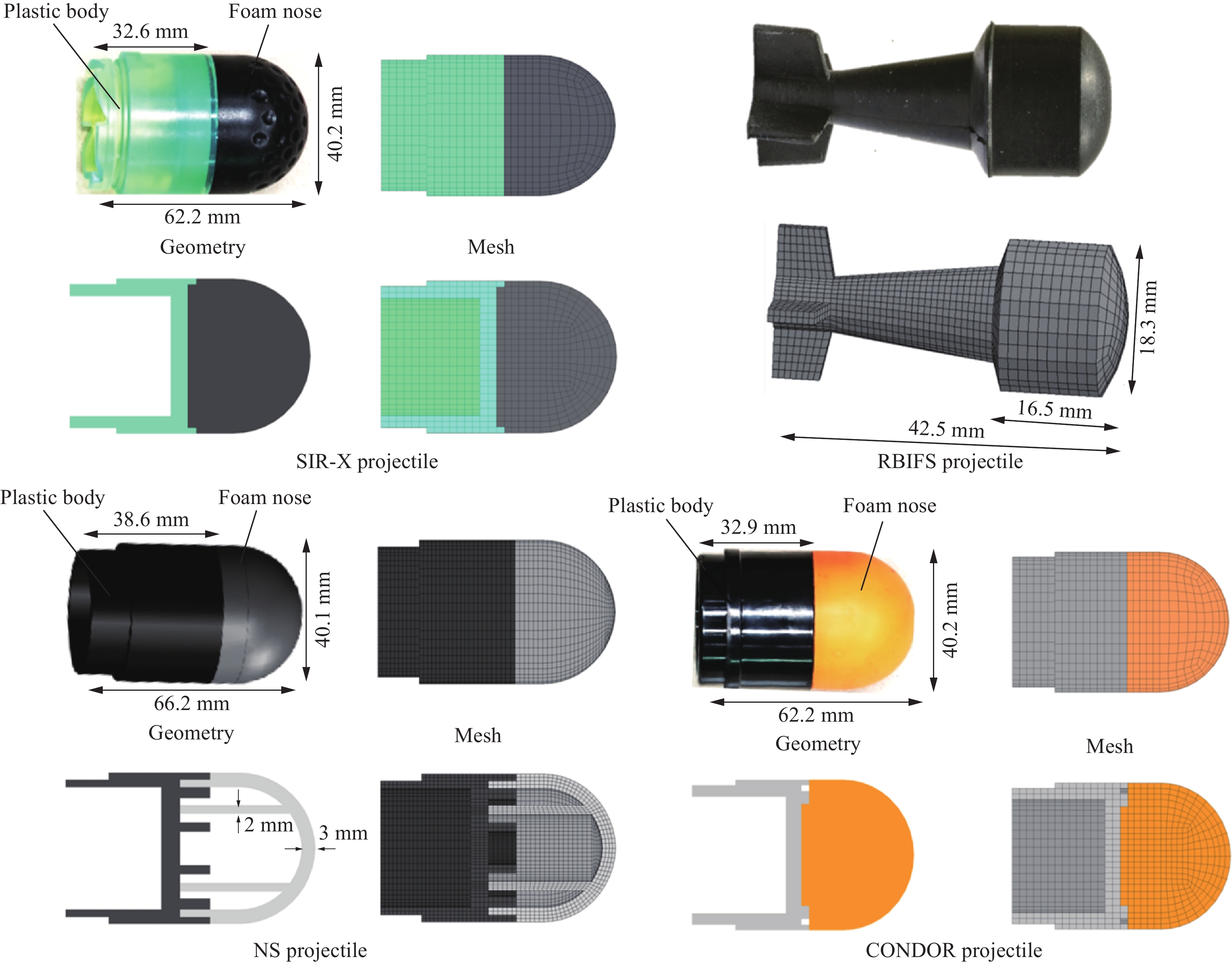
表 2 3种直径为40 mm的典型弹丸的材料参数[7]
Table 2. Material parameters of three typical projectiles with a diameter of 40 mm[7]
弹丸类型 部件 密度/(kg·m−3) 杨氏模量/GPa 体积模量/GPa 泊松比 控制参数 硬化 曲线形状 SIR-X 弹尾 1354 23 0.387 弹头 231 2 0.2 0.1 15 NS 弹尾 1206 23 0.387 弹头 1000 5 0.495 1 0 CONDOR 弹尾 1030 23 0.33 弹头 328 5 0.1 0.5
下载: 导出CSV
弹丸类型 密度/(kg·m−3) 泊松比 C10/GPa C20/MPa C30/GPa RB1FS 1000 0.498 5 −0.2 0.2
下载: 导出CSV
表 4 胸部模型网格划分及单元设置参数
Table 4. Settings for the mesh and unit parameters of the chest model
部件 单元类型 网格尺寸/mm 单元数 皮肤层 Shell4 1.0 124622 软组织层 Hex8-R1 2.0 328211 肋骨层 Tetra4 1.0 1120013 支架 Hex8 5.0 247786 底座 Hex8 10.0 127851 脊柱箱 Hex8 5.0 118385
下载: 导出CSV
表 5 4类典型弹丸模型网格划分与单元设置参数
Table 5. Mesh discretization and element settings for four typical projectile models
弹体类型 部件 单元类型 网格尺寸/mm SIR-X 弹头 Hex8 1.0 SIR-X 弹托 Hex8 2.0 NS 弹头 Hex8 1.0 NS 弹托 Hex8 2.0 CONDOR 弹头 Hex8 1.0 CONDOR 弹托 Hex8 2.0 RB1FS 弹体 Hex8 1.0
下载: 导出CSV
表 6 三肋胸部模型仿真材料参数设置
Table 6. Material parameters of the three-rib chest model used in finite element simulations
部件 密度/(kg·m−3) 弹性模量/GPa 体积模量/GPa 泊松比 部件 密度/(kg·m−3) 弹性模量/GPa 体积模量/GPa 泊松比 皮肤层 1100 0.001 0.48 SIR-X弹托 1354 23 0.387 软组织层 250 0.0015 0.47 NS弹头 1000 5 0.495 肋骨层 1650 15 0.35 NS弹托 1206 23 0.387 支架 2700 69 0.33 CONDOR弹头 328 5 0.1 底座 8000 190 0.3 CONDOR弹托 1030 23 0.33 脊柱箱 1240 2.4 0.4 RB1FS弹头 1000 0.498 SIR-X弹头 231 2 0.2
下载: 导出CSV
表 7 4种典型非致命弹丸刚性壁冲击验证工况与判定依据
Table 7. Four typical verification conditions and determination basis for the impact of non-lethal projectiles on rigid walls
下载: 导出CSV
表 8 4种典型弹丸在不同冲击速度下的实验与仿真工况
Table 8. Experiment and simulation conditions at different impact velocities for four typical projectiles
序号 弹丸类型 质量/g 冲击速度/(m·s−1) 备注 1 SIR-X 32.0 56.0, 86.5 胸部验证 2 SIR-X 32.0 60.0, 70.0, 80.0, 90.0 损伤分析 3 RBIFS 6.7 60.0, 70.0, 80.0, 90.0 损伤分析 4 NS 41.9 60.0, 70.0, 80.0, 90.0 损伤分析 5 CONDOR 27.8 60.0, 70.0, 80.0, 90.0 损伤分析 6 SIR-X 32.0 100.0, 110.0, 120.0 高速冲击响应
下载: 导出CSV
表 9 3种关键材料厚度参数的敏感性分析工况
Table 9. Sensitivity analysis cases for thickness parameters of three key materials
序号 硅胶厚度/mm 聚氨酯泡沫厚度/mm 肋骨厚度/mm 冲击速度/(m·s−1) C1 0.8, 1.0, 1.2, 1.4 15 10 56.0 C2 1.0 12, 15, 18, 21 10 56.0 C3 1.0 15 8, 10, 12, 14 56.0
下载: 导出CSV
表 10 不同网格尺寸下SIR-X弹丸刚性墙冲击的峰值力及相对差异
Table 10. Peak force and relative difference of SIR-X projectile impacting a rigid wall with different mesh sizes
冲击速度/(m·s−1) 网格尺寸/mm 峰值载荷/N 相对差异/% 29.0 2.0 1441.067 −3.12 1.0 1485.636 0 0.5 1522.777 2.51 61.0 2.0 13545.99 −2.14 1.0 13822.44 0 0.5 14098.89 2.03 注:相对差异以1.0 mm网格尺寸对应的峰值载荷为基准计算。
下载: 导出CSV
表 11 不同网格尺寸下胸壁位移峰值的对比
Table 11. Comparison of peak chest wall displacements under different mesh sizes
冲击速度/(m·s−1) 网格尺寸/mm 峰值位移/mm 与基准网格的差异/% 56.0 2.0 11.03 −4.0 1.0 11.49 0 0.5 11.94 3.9 86.5 2.0 18.23 −3.8 1.0 18.95 0 0.5 19.93 5.2 注:相对差异以1.0 mm网格尺寸对应的峰值位移为基准计算。
下载: 导出CSV
表 12 不同肋间距条件下关键冲击响应指标汇总
Table 12. Summary of key impact response indicators under different rib spacings
冲击速度/(m·s−1) 肋间距 接触力 位移 黏性准则 峰值/N 差异/% 峰值/mm 差异/% 峰值/(m·s−1) 差异/% 56.0 0.8S0 2045 −5.3 10.5 −5.3 0.290 −5.8 S0 2160 0 11.5 0 0.308 0 1.2S0 2285 5.8 12.2 6.1 0.327 6.2 86.5 0.8S0 9980 −5.9 17.9 −5.2 0.757 −5.7 S0 10615 0 18.9 0 0.803 0 1.2S0 11250 6.0 20.1 5.8 0.850 5.9 注:各差异百分比均以基准肋间距S0工况对应结果为基准计算。
下载: 导出CSV
表 13 SIR-X弹丸冲击下仿真与试验VCmax结果及AEP-99标准对比
Table 13. Comparison of simulated and experimental VCmax values under SIR-X projectile impact based on NATO AEP-99
冲击速度/(m·s−1) VCmax/(m·s−1) AEP-99 仿真 试验 56.0 0.28~0.33 0.308 0.312 86.5 0.78~0.85 0.803 0.844
下载: 导出CSV
表 14 三肋胸部模型与SHTIM在典型工况下的${\mathrm{VC}}_{\max} $对比
Table 14. Comparison of ${\mathrm{VC}}_{\max} $ values between the proposed model and the SHTIM under typical impact conditions
冲击速度/(m·s−1) VCmax/(m·s−1) AEP-99 SHTIM 三肋胸部模型 56.0 [0.28,0.32] 0.32 0.308 86.5 [0.78,0.85] 0.77 0.803
下载: 导出CSV
表 15 弹丸硬度等级划分
Table 15. Classification of bullet hardness levels
硬度档位 相对刚度设置 泊松比 弹性模量/GPa 体积模量/GPa 软 减半 0.20 1.8 1 中 基线 0.20 3.6 2 硬 加倍 0.20 7.2 4
下载: 导出CSV
表 16 不同硬度弹丸在2种冲击速度下的${\mathrm{VC}}_{\max} $与AEP-99区间对比
Table 16. Comparison of ${\mathrm{VC}}_{\max} $ under different projectile hardness levels at two impact velocities with respect to the AEP-99 validation ranges
冲击速度/(m·s−1) 硬度档位 VCmax/(m·s−1) AEP-99区间/(m·s−1) AEP-99合规性 软 0.298 [0.28, 0.32] 是(区间内) 56.0 中 0.308 [0.28, 0.32] 是(基线) 硬 0.336 [0.28, 0.32] 否(高于上限) 软 0.765 [0.78, 0.85] 否(低于下限) 86.5 中 0.803 [0.78, 0.85] 是(基线) 硬 0.856 [0.78, 0.85] 否(高于上限)
下载: 导出CSV
表 17 不同层厚度变化对胸部替代模型总吸能和最大挠度的影响
Table 17. Effects of layer thickness variation on total absorbed energy and maximum deflection of the three-layer chest surrogate model
部件 厚度变化/% 吸能总量/J 最大挠度/mm 皮肤层 −20 4.088 11.4 20 4.298 10.9 40 4.426 10.7 软组织层 −20 3.556 12.1 20 4.884 10.6 40 5.306 9.6 肋骨层 −20 4.018 13.3 20 4.424 10.1 40 4.706 8.8 注:基准模型层厚度分别为1.0 mm(皮肤层)、15 mm(软组织层)、10 mm(肋骨层)。表中厚度变化为在保持其余2层厚度不变条件下,对单一层厚度进行±20%和+40%扰动的分析结果。
下载: 导出CSV
-
[1] 张昭晖, 汪送, 陈颖. 非致命动能弹测试靶标发展现状及趋势分析 [J]. 兵器装备工程学报, 2024, 45(12): 109–121. DOI: 10.11809/bqzbgcxb2024.12.015.ZHANG Z H, WANG S, CHEN Y. Analysis on the development status and trend of non-lethal kinetic energy projectile test targets [J]. Journal of Ordnance Equipment Engineering, 2024, 45(12): 109–121. DOI: 10.11809/bqzbgcxb2024.12.015. [2] 汪送. 防暴动能弹发展现状及趋势分析 [J]. 兵器装备工程学报, 2021, 42(4): 6–11. DOI: 10.11809/bqzbgcxb2021.04.002.WANG S. Analysis of development status and trend of anti-riot kinetic energy projectile [J]. Journal of Ordnance Equipment Engineering, 2021, 42(4): 6–11. DOI: 10.11809/bqzbgcxb2021.04.002. [3] BIR C, VIANO D C. Design and injury assessment criteria for blunt ballistic impacts [J]. Journal of Trauma: Injury, Infection, and Critical Care, 2004, 57(6): 1218–1224. DOI: 10.1097/01.TA.0000114066.77967.DE. [4] ATO-AEP-99 Thorax injury risk assessment of non-lethal projectiles [S]. [5] ROBBE C, PAPY A, NSIAMPA N. Toward a reference non-lethal projectile to validate blunt trauma injury evaluation models [J]. Human Factors and Mechanical Engineering for Defense and Safety, 2019, 3(1): 3. DOI: 10.1007/s41314-019-0026-4. [6] KAPELES J A, BIR C A. Human effects assessment of 40-mm nonlethal impact munitions [J]. Human Factors and Mechanical Engineering for Defense and Safety, 2019, 3(1): 2. DOI: 10.1007/s41314-019-0017-5. [7] NDOMPETELO N. Numerical assessment of non-lethal projectile thoracic impacts [D]. Liège: Université de Liège, 2016. [8] 赵法栋, 陈超明, 暴洪涛, 等. 非致命动能弹钝性冲击假人胸部的数值模拟 [J]. 弹道学报, 2022, 34(4): 30–37. DOI: 10.12115/j.issn.1004-499X(2022)04-005.ZHAO F D, CHEN C M, BAO H T, et al. Numerical simulation of non-lethal kinetic projectiles blunt impact on dummy chest [J]. Journal of Ballistics, 2022, 34(4): 30–37. DOI: 10.12115/j.issn.1004-499X(2022)04-005. [9] XIONG M M, QIN B, WANG S, et al. Experimental impacts of less lethal rubber spheres on a skin-fat-muscle model [J]. Journal of Forensic and Legal Medicine, 2019, 67: 7–14. DOI: 10.1016/j.jflm.2019.07.009. [10] 曾鑫, 周克栋, 赫雷, 等. 非侵彻条件下猪体和明胶靶内压力衰减试验研究 [J]. 振动与冲击, 2014, 33(8): 96–99, 114. DOI: 10.13465/j.cnki.jvs.2014.08.017.ZENG X, ZHOU K D, HE L, et al. Test for pressure attenuation in targets of landrace and gelatin under non-penetration condition [J]. Journal of Vibration and Shock, 2014, 33(8): 96–99, 114. DOI: 10.13465/j.cnki.jvs.2014.08.017. [11] PAPY A, ROBBE C, NSIAMPA N, et al. Definition of a standardized skin penetration surrogate for blunt impacts [C]//IRCOBI Conference. Dublin, 2012. [12] 王智, 常利军, 黄星源, 等. 爆炸冲击波与破片联合作用下防弹衣复合结构防护效果的数值模拟 [J]. 爆炸与冲击, 2023, 43(6): 063202. DOI: 10.11883/bzycj-2022-0515.WANG Z, CHANG L J, HUANG X Y, et al. Simulation on the defending effect of composite structure of body armor under the combined action of blast wave and fragments [J]. Explosion and Shock Waves, 2023, 43(6): 063202. DOI: 10.11883/bzycj-2022-0515. [13] 刘迪, 陈菁, 张安强, 等. 爆炸冲击波作用下聚脲材料对肺冲击伤防护作用的数值模拟研究 [J]. 爆炸与冲击, 2024, 44(12): 121423. DOI: 10.11883/bzycj-2024-0205.LIU D, CHEN J, ZHANG A Q, et al. Numerical simulation study on the protective effects of polyurea materials against lung blast injuries under blast wave loading [J]. Explosion and Shock Waves, 2024, 44(12): 121423. DOI: 10.11883/bzycj-2024-0205. [14] 张佃元, 于晨, 郝文勇, 等. 爆炸冲击载荷下猪肺部的损伤特性 [J]. 爆炸与冲击, 2024, 44(12): 121433. DOI: 10.11883/bzycj-2024-0262.ZHANG D Y, YU C, HAO W Y, et al. Injury properties of porcine lung under blast load [J]. Explosion and Shock Waves, 2024, 44(12): 121433. DOI: 10.11883/bzycj-2024-0262. [15] BODO M, BRACQ A, DELILLE R, et al. Thorax injury criteria assessment through non-lethal impact using an enhanced biomechanical model [J]. Journal of Mechanics in Medicine and Biology, 2017, 17(7): 1740027. DOI: 10.1142/S0219519417400279. [16] LAAN D V, VU T D N, THIELS C A, et al. Chest wall thickness and decompression failure: a systematic review and meta-analysis comparing anatomic locations in needle thoracostomy [J]. Injury, 2016, 47(4): 797–804. DOI: 10.1016/j.injury.2015.11.045. [17] SMERECZYŃSKI A, KOŁACZYK K, BERNATOWICZ E. Chest wall-underappreciated structure in sonography. Part Ⅰ: examination methodology and ultrasound anatomy [J]. Journal of Ultrasonography, 2017, 17(70): 197–205. DOI: 10.15557/jou.2017.0029. [18] OUKARA A, NSIAMPA N, ROBBE C, et al. Assessment of non-lethal projectile head impacts [J]. Human Factors and Mechanical Engineering for Defense and Safety, 2017, 1(1): 3. DOI: 10.1007/s41314-016-0001-2. [19] JOODAKI H, PANZER M B. Skin mechanical properties and modeling: a review [J]. Proceedings of the Institution of Mechanical Engineers, Part H: Journal of Engineering in Medicine, 2018, 232(4): 323–343. DOI: 10.1177/0954411918759801. [20] TIAN J, FU C H, LI W H, et al. Biomimetic tri-layered artificial skin comprising silica gel-collagen membrane-collagen porous scaffold for enhanced full-thickness wound healing [J]. International Journal of Biological Macromolecules, 2024, 266: 131233. DOI: 10.1016/j.ijbiomac.2024.131233. [21] ALKHOULI N, MANSFIELD J, GREEN E, et al. The mechanical properties of human adipose tissues and their relationships to the structure and composition of the extracellular matrix [J]. American Journal of Physiology: Endocrinology and Metabolism, 2013, 305(12): E1427–E1435. DOI: 10.1152/ajpendo.00111.2013. [22] CZERNER M, FASCE L A, MARTUCCI J F, et al. Deformation and fracture behavior of physical gelatin gel systems [J]. Food Hydrocolloids, 2016, 60: 299–307. DOI: 10.1016/j.foodhyd.2016.04.007. [23] 王家涛, 姜维胜, 靳萌萌, 等. 返回再入过载下座椅倾角对航天员胸腹部损伤的影响 [J/OL]. 北京航空航天大学学报, 2025: 1–12(2025-04-24)[2025-05-30]. https://doi.org/10.13700/j.bh.1001-5965.2024.0892.WANG J T, JIANG W S, JIN M M, et al. Effect of seatback inclination on thoracoabdominal injuries of taikonauts under reentry return loads [J/OL]. Journal of Beijing University of Aeronautics and Astronautics, 2025: 1–12(2025-04-24)[2025-05-30]. https://doi.org/10.13700/j.bh.1001-5965.2024.0892. [24] ROBBE C, PAPY A, NSIAMPA N, et al. NATO standardized method for assessing the thoracic impact of kinetic energy non-lethal weapons [J]. Human Factors and Mechanical Engineering for Defense and Safety, 2023, 7(1): 7. DOI: 10.1007/s41314-023-00060-9. [25] MASHHADI M M, LOPES C, LLORCA J. High fidelity simulation of the mechanical behavior of closed-cell polyurethane foams [J]. Journal of the Mechanics and Physics of Solids, 2020, 135: 103814. DOI: 10.1016/j.jmps.2019.103814. -

计量
- 文章访问数: 604
- HTML全文浏览量: 260
- PDF下载量: 581
- 被引次数: 0