



Dynamic response analysis of buried pipelines under rockfall impact
-
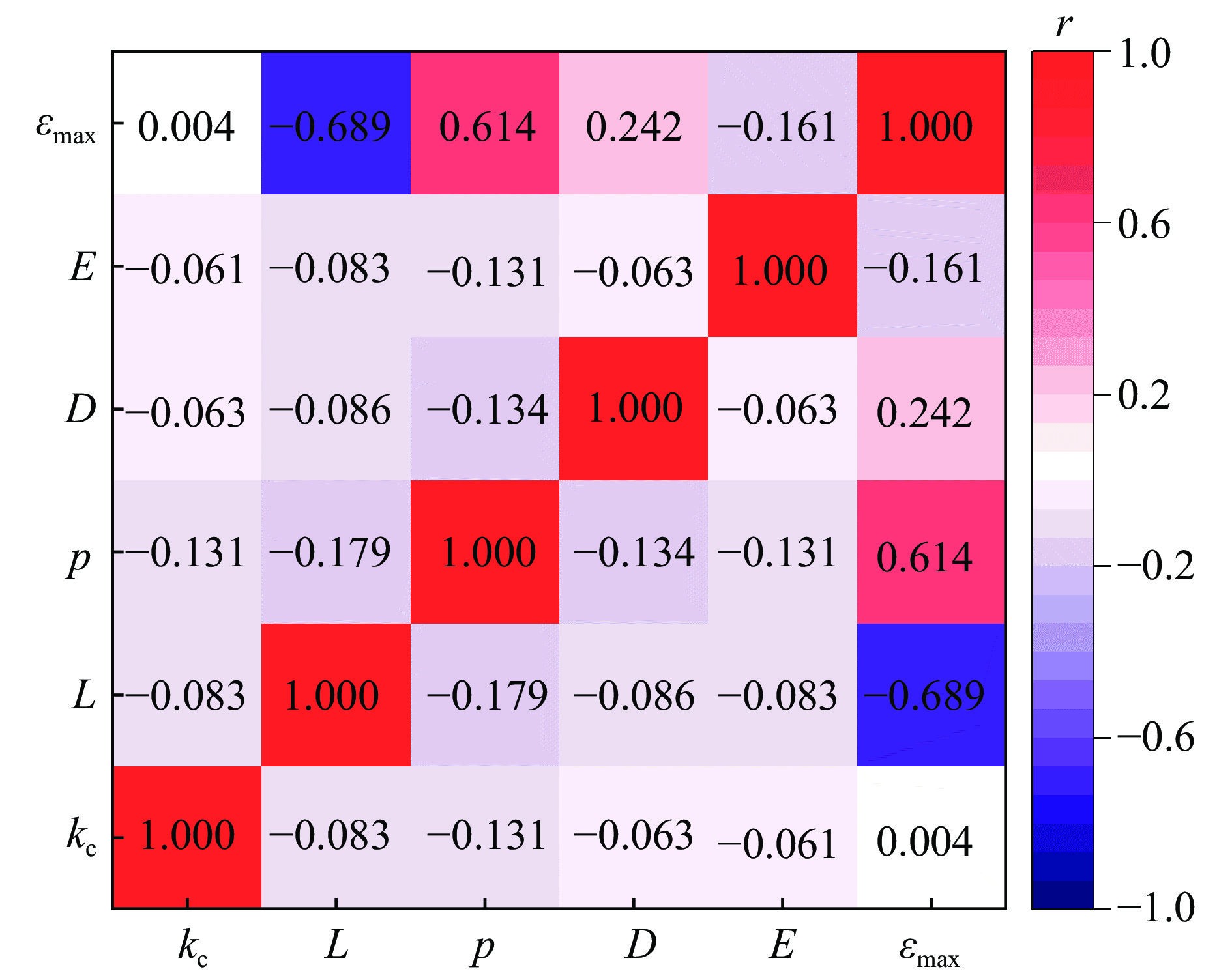
摘要: 针对地质灾害高风险区段埋地管道所面临的落石冲击威胁,为深入探究其动力响应特性,采用缩尺模型试验与数值模拟相结合的方法,系统研究了埋地管道的动力响应特性。建立的试验模型缩尺比例为1∶10,利用落锤冲击试验装置,结合LS-DYNA有限元分析,探讨了管道埋深、壁厚、冲击参数、管道参数和土体特性(土体弹性模量和管土摩擦因数)对埋地管道的影响。试验结果表明:同一冲击高度下,管道埋深和壁厚越大,应变峰值越小;落锤偏心冲击时,冲击点偏离管道中心后,对管道上下截面的影响降低;冲击高度越高,管道中部应变峰值越大。数值模拟结果表明:管道最大应力和应变与管道直径、内压和冲击速度正相关,与冲击偏距、土体弹性模量和管道埋深负相关;管土摩擦因数增大对管道应力、的应变影响有限,超过0.3后影响甚微。基于Pearson相关性分析可知,冲击偏距、管道内压、管道直径、土体弹性模量和管土摩擦系数的影响程度依次降低,管道应变与管道内压、管径和管土摩擦因数呈正相关,与土体弹性模量和落石冲击偏距呈负相关;其中落石冲击偏距和管道内压对埋地管道力学响应的影响为中等偏强相关。Abstract: In view of the rockfall impact threat faced by buried pipelines in high-risk areas of geological disasters, this study systematically investigated the dynamic response characteristics of buried pipelines through a combination of scale model test and numerical simulation to further explore its dynamic response characteristics and dig deep into their intrinsic mechanisms. A test model with a geometric scale ratio of 1:10 was constructed. Meanwhile, a drop hammer impact test device combined with LS-DYNA finite element analysis was used. Based on these above, the influence laws of pipeline burial depth, wall thickness, impact parameters, pipeline parameters, and soil properties (including soil elastic modulus and pipe-soil friction coefficient) on buried pipelines were explored. The test results show that at the same impact height, the peak strain decreases as the pipeline’s burial depth and wall thickness increase. Under eccentric drop hammer impacts, the influence on the upper and lower cross-sections of the pipeline diminishes as the impact point deviates from the pipeline center. Additionally, a higher impact height corresponds to a greater peak strain in the middle section of the pipeline.The numerical simulation results indicate that the maximum stress and strain of the pipeline are positively correlated with pipeline diameter, internal pressure, and impact velocity, while negatively correlated with impact eccentricity, soil elastic modulus, and pipeline burial depth. Moreover, the increase in the pipe-soil friction coefficient has a limited impact on pipeline stress and strain, and this effect becomes negligible when it exceeds 0.3.Based on Pearson correlation analysis, the order of influence degree of each parameter is impact eccentricity, pipeline internal pressure, pipeline diameter, ,soil elastic modulus,, and pipe-soil friction coefficient,. Among them, pipeline internal pressure, pipeline diameter, and pipe-soil friction coefficient are positively correlated with strain, while soil elastic modulus and impact eccentricity are negatively correlated with strain. The rockfall impact eccentricity and pipeline internal pressure have a moderate to strong correlation with the impact response of buried pipelines.The research results can provide a basis for the safety design of buried pipelines in high-risk areas.
-
Key words:
- rockfall impact /
- buried pipeline /
- dynamic response /
- scaled model
-
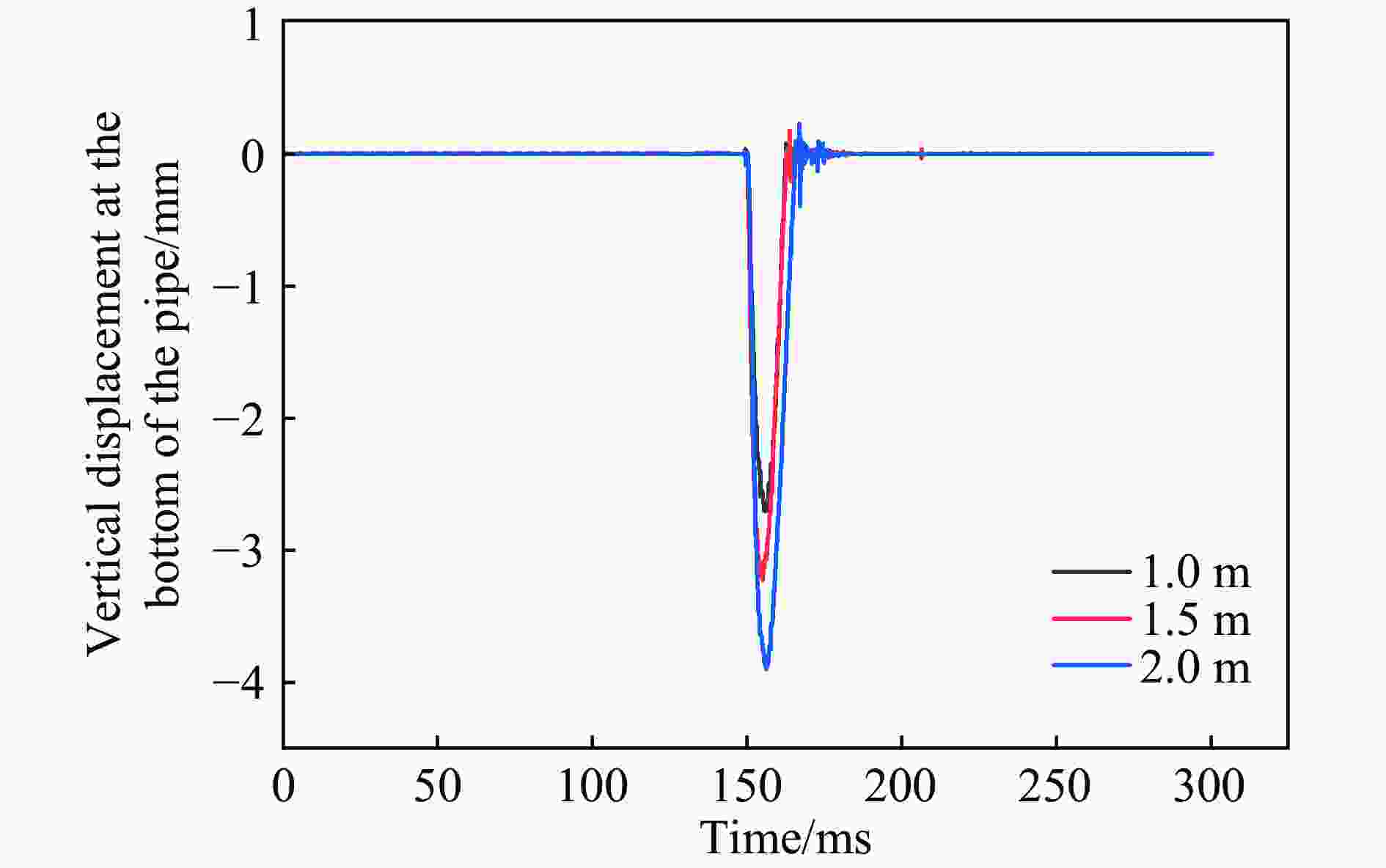
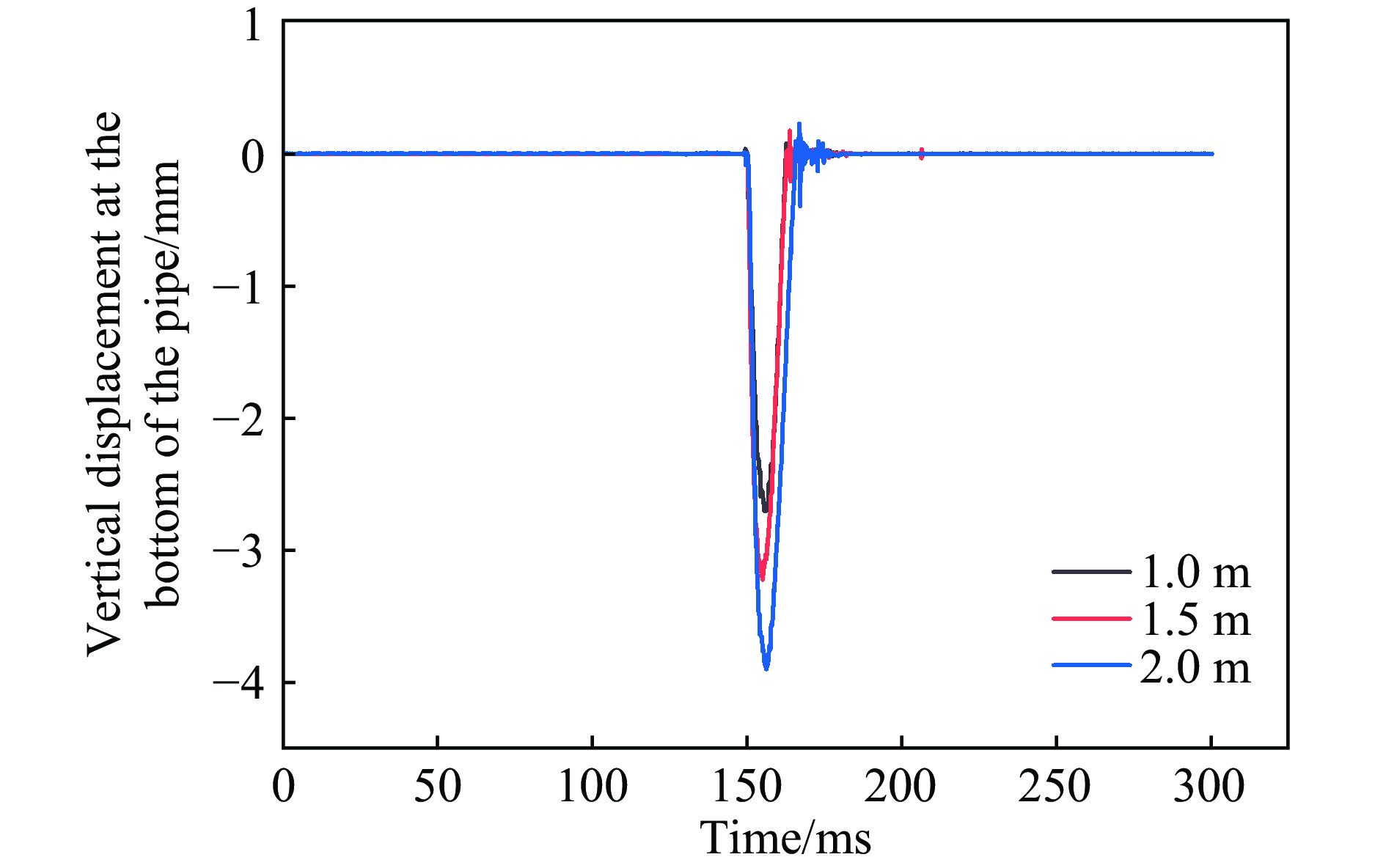
图 5 管道埋深0.2 m球形落锤不同高度冲击管道位移时程曲线
Figure 5. Displacement-time history curves of pipelines with a burial depth of 0.2 m under impact of spherical hammers at different drop heights
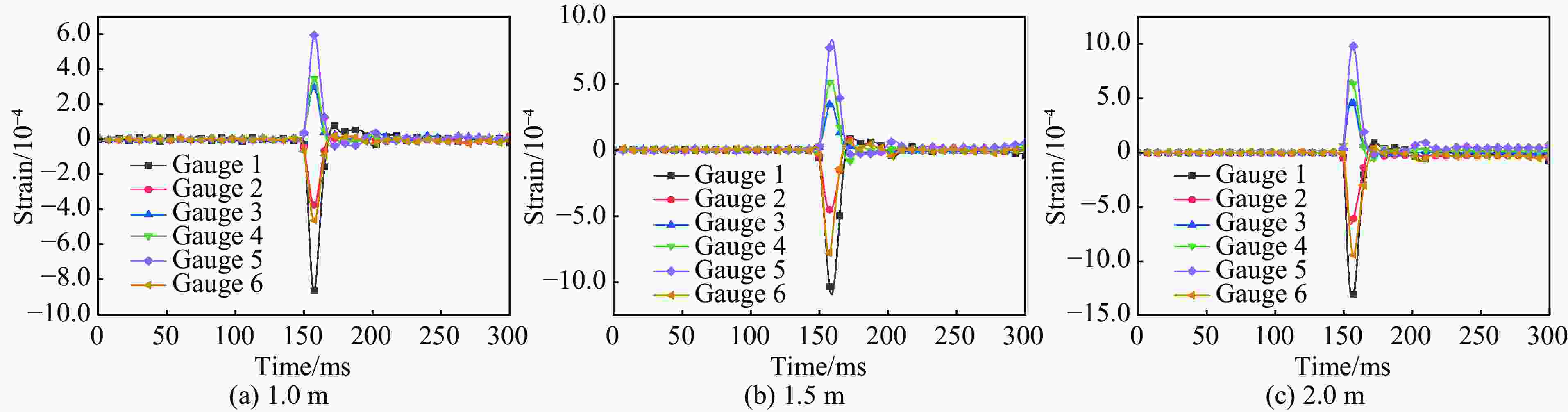
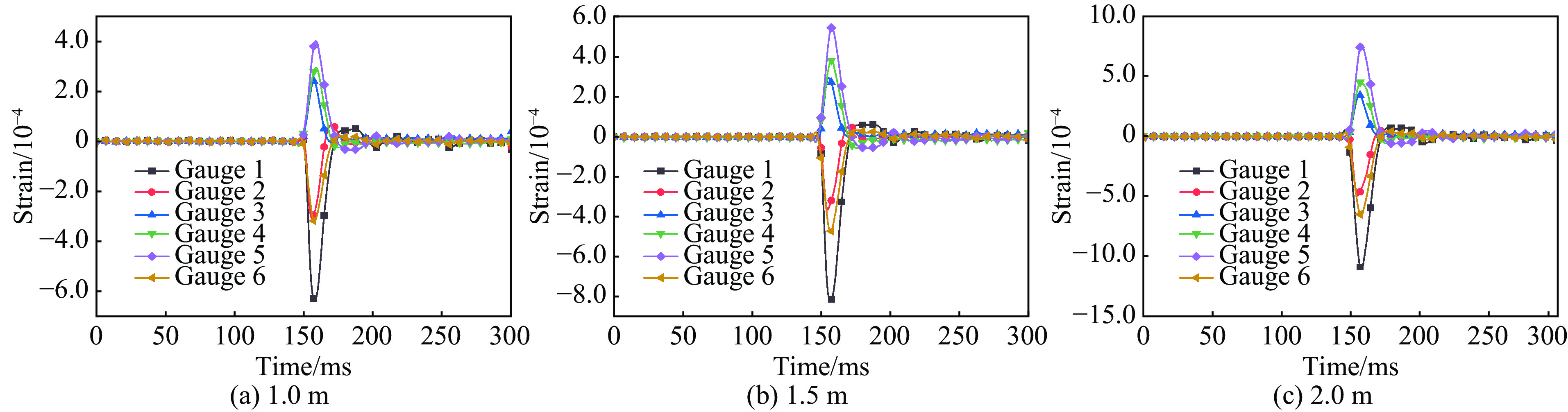
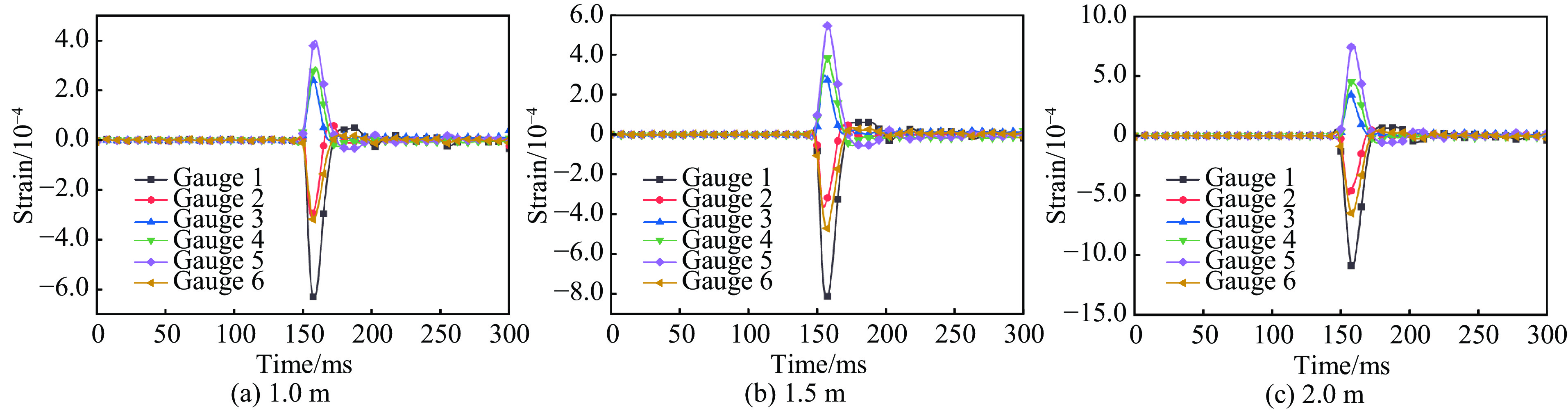
图 6 在不同下落高度的球形落锤冲击下0.15 m埋深管道的应变时程曲线
Figure 6. Strain-time history curves of pipelines buried at 0.15 m depth impacted by spherical drop hammers with different drop heights
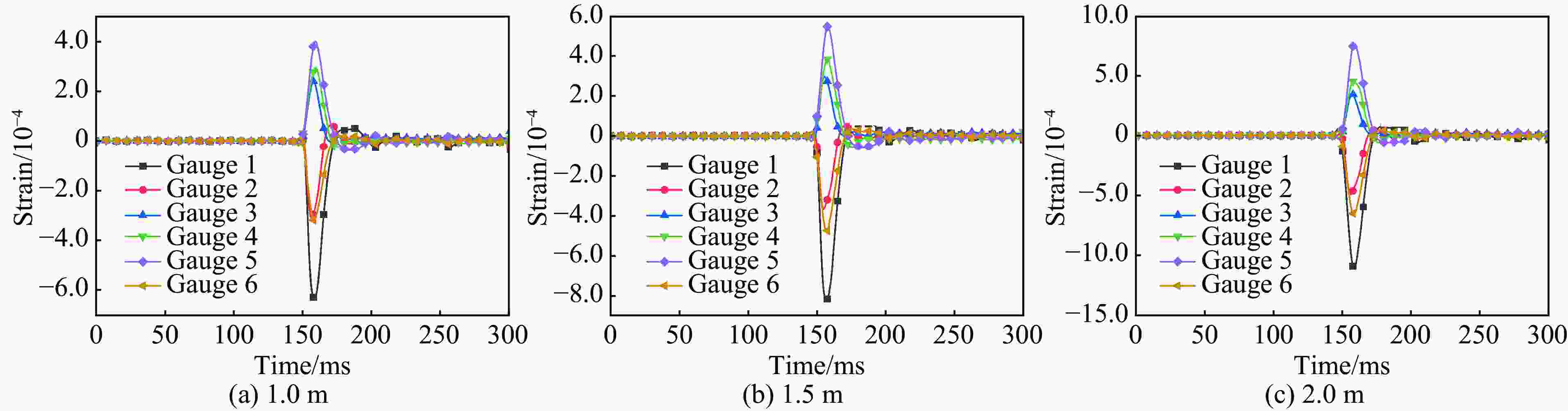
图 7 球形落锤对心冲击管道应变时程曲线
Figure 7. Strain-time history curves of pipeline subjected to a central impact of spherical drop hammer
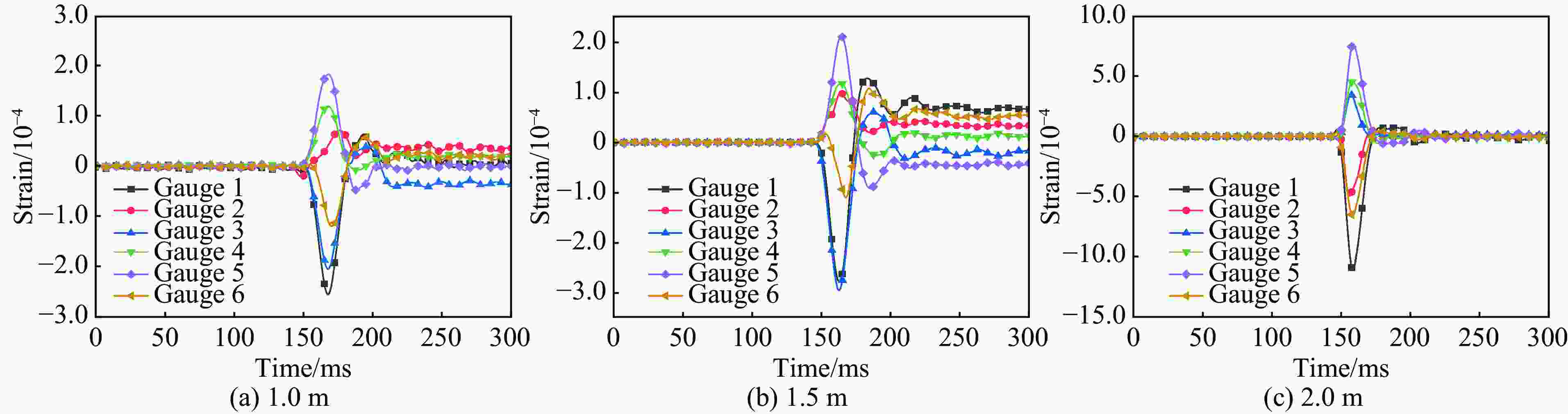
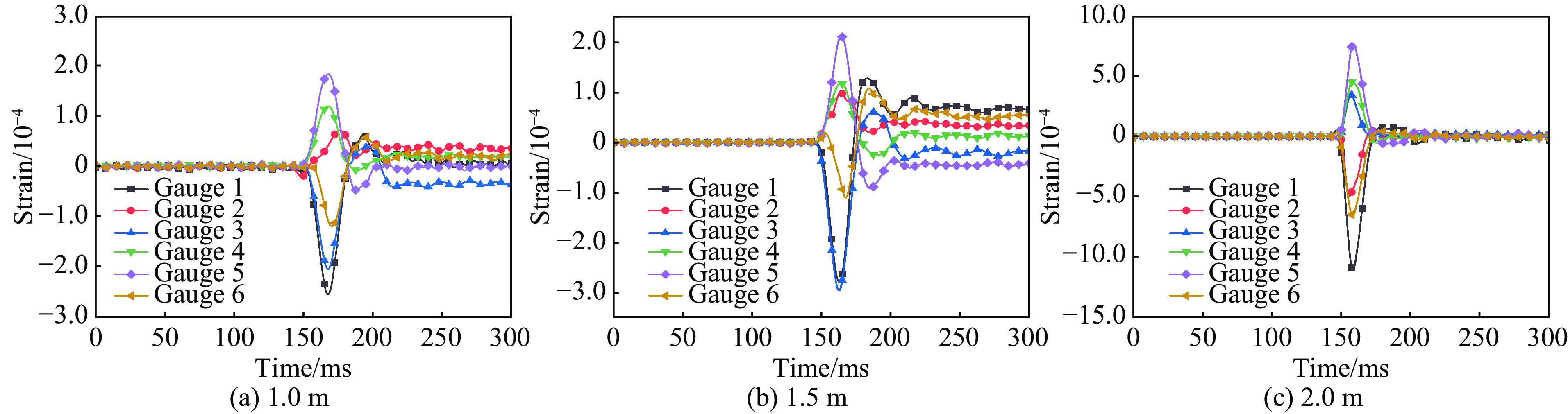
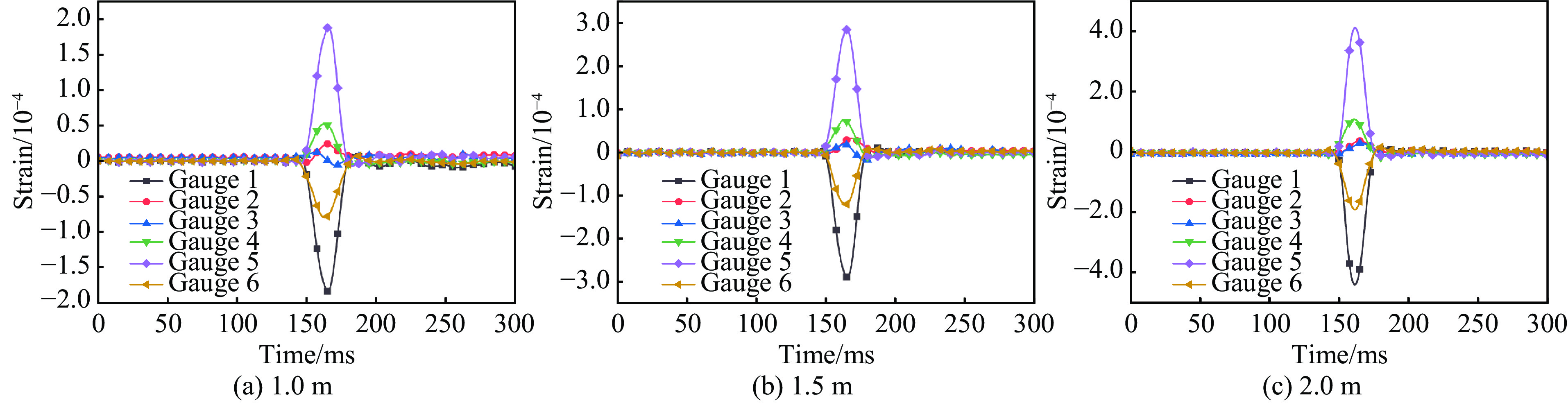
图 8 球形落锤偏心0.1 m冲击管道应变时程曲线
Figure 8. Strain-time history curves of pipeline subjected to spherical drop hammer impact with 0.1 m eccentricityon
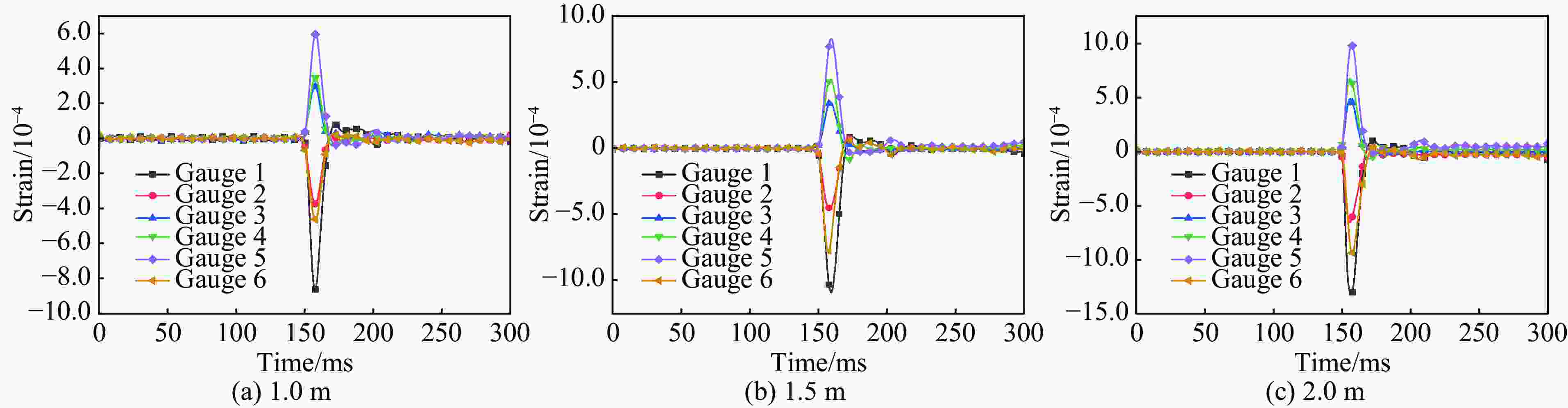
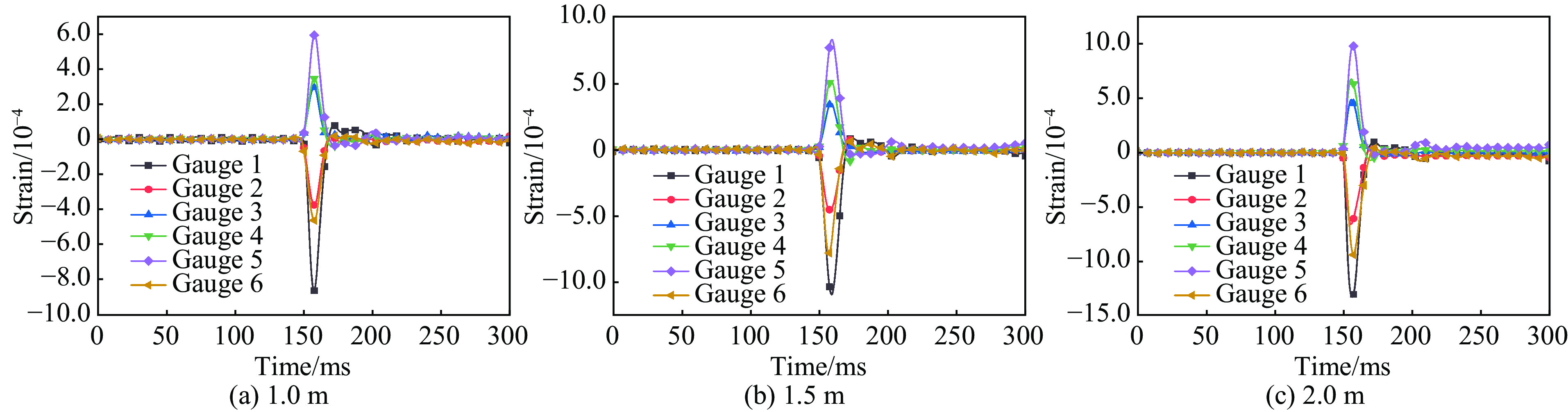
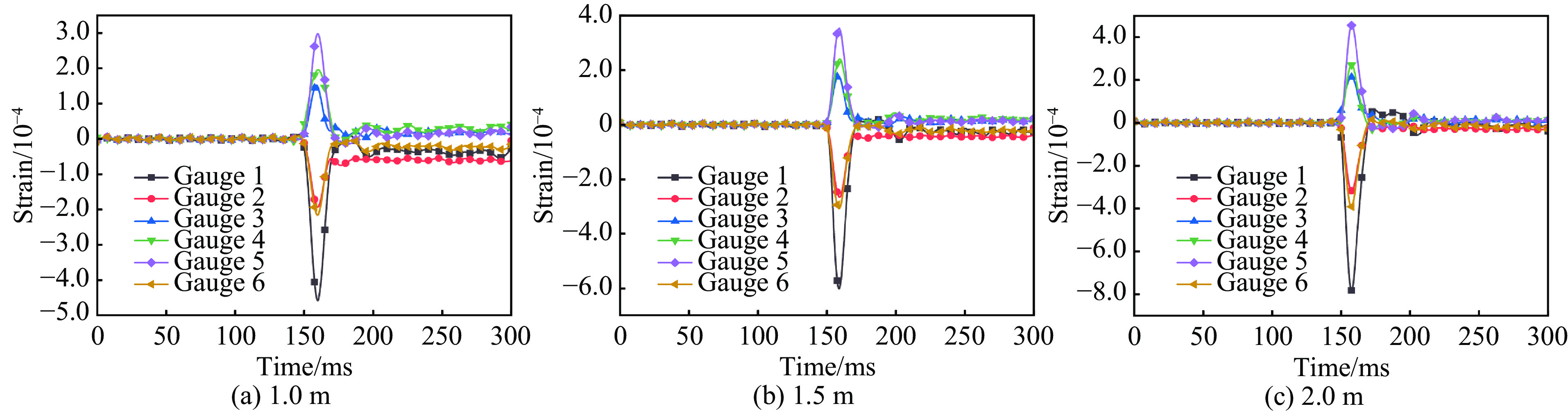
图 9 球形落锤冲击0.15 m埋深管道应变时程曲线
Figure 9. Strain-time history curves of pipeline buried at 0.15 m depth subjected to spherical drop hammer impact
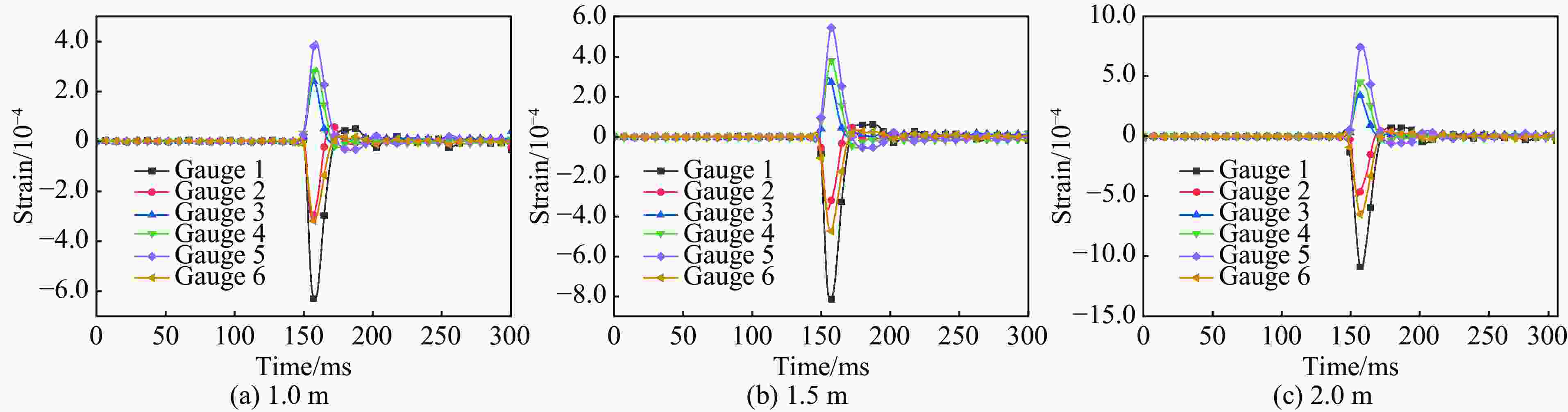
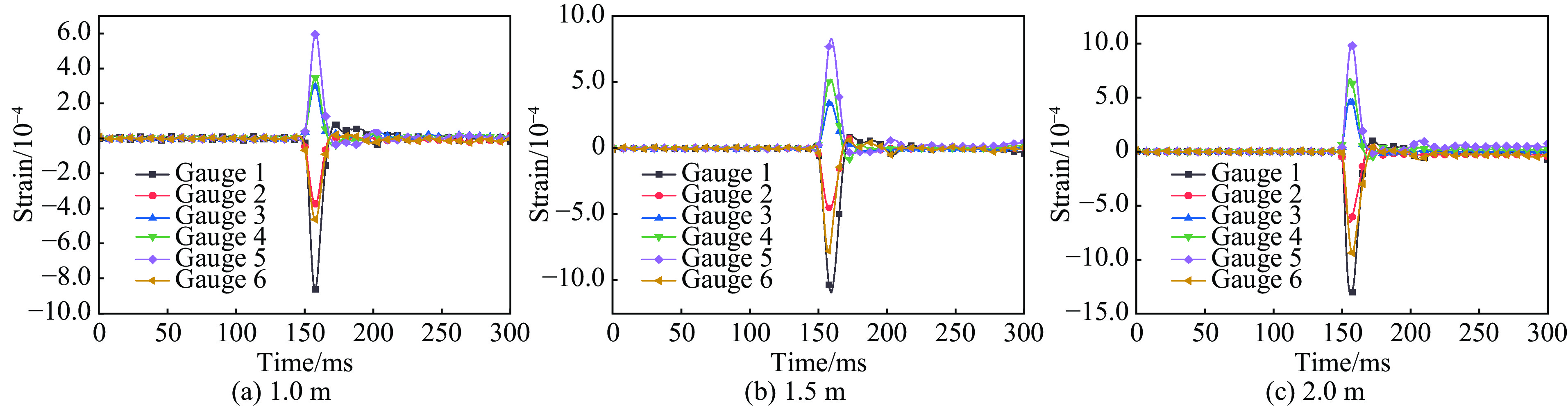
图 10 球形落锤冲击0.20 m埋深管道应变时程曲线
Figure 10. Strain-time history curve of pipeline buried at 0.20 m depth subjected to spherical drop hammer impact
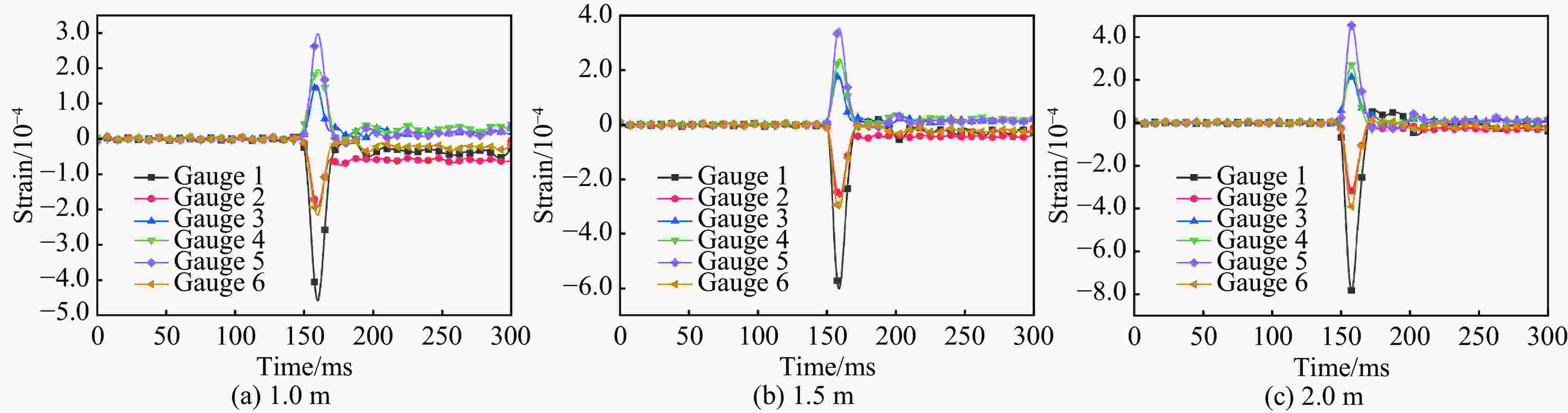
图 11 球形落锤冲击0.25 m埋深管道应变时程曲线
Figure 11. Strain-time history curves of pipeline buried at 0.25 m depth subjected to spherical drop hammer impact
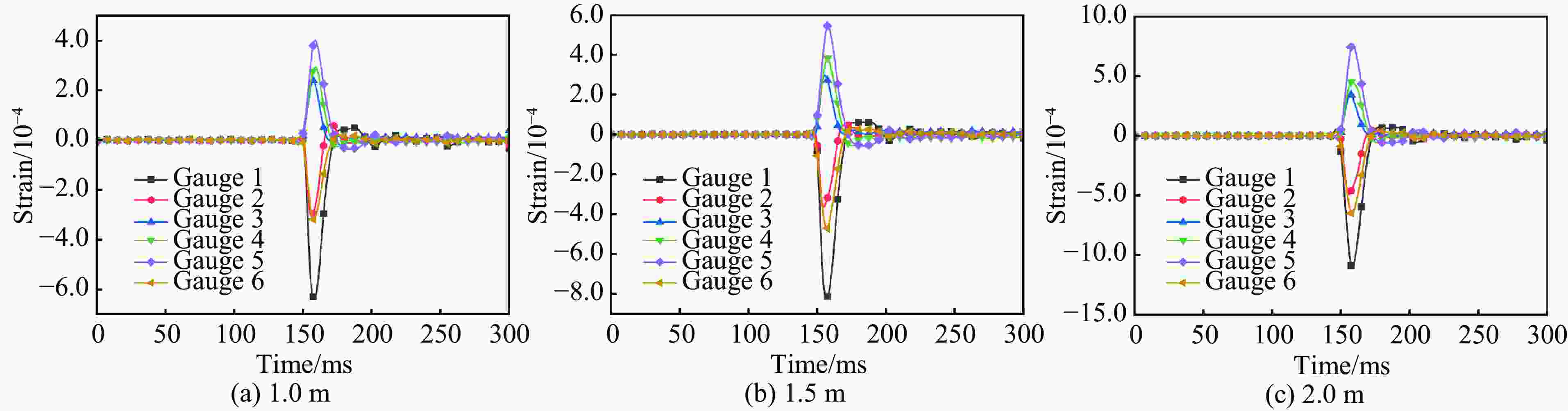
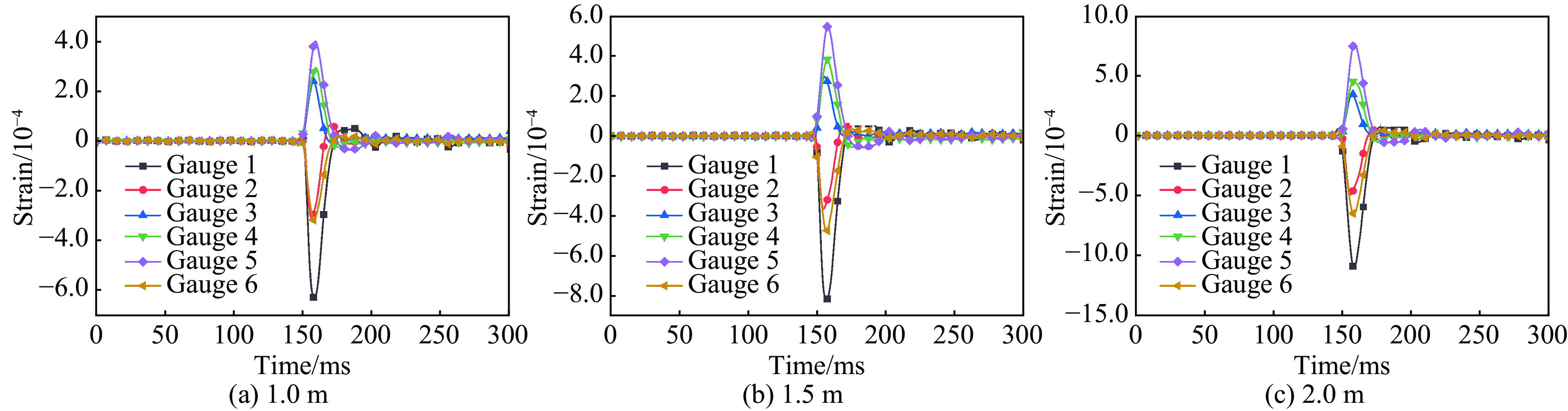
图 12 球形落锤冲击壁厚1.0 mm管道应变时程曲线
Figure 12. Strain-time history curves of pipeline with 1.0 mm wall thickness subjected to spherical drop hammer impact
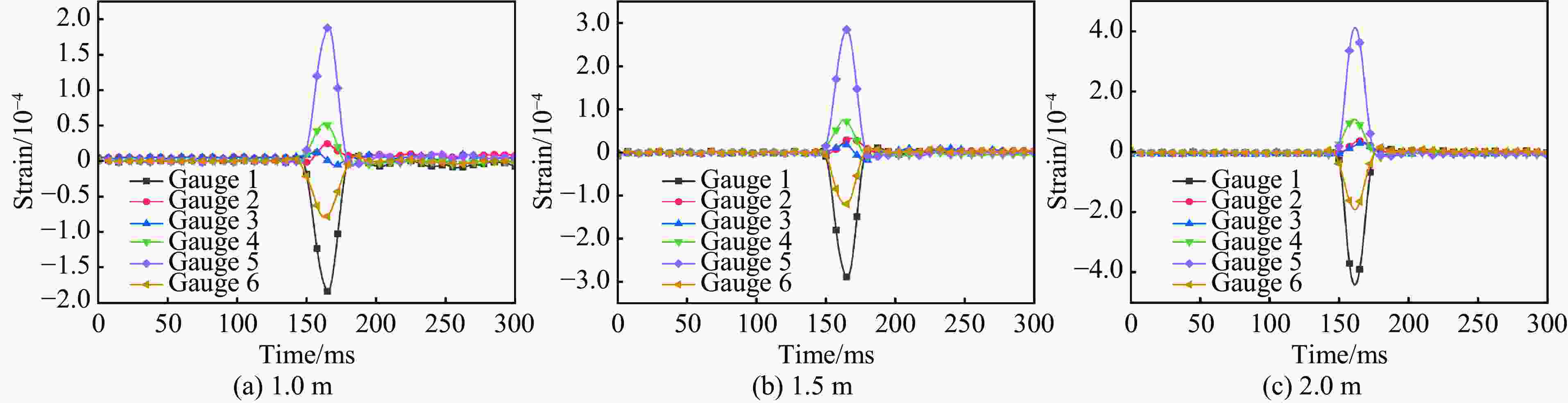
图 13 球形落锤冲击壁厚2.0 mm管道应变时程曲线
Figure 13. Strain-time history curves of pipeline with 2.0mm wall thickness subjected to spherical drop hammer impact
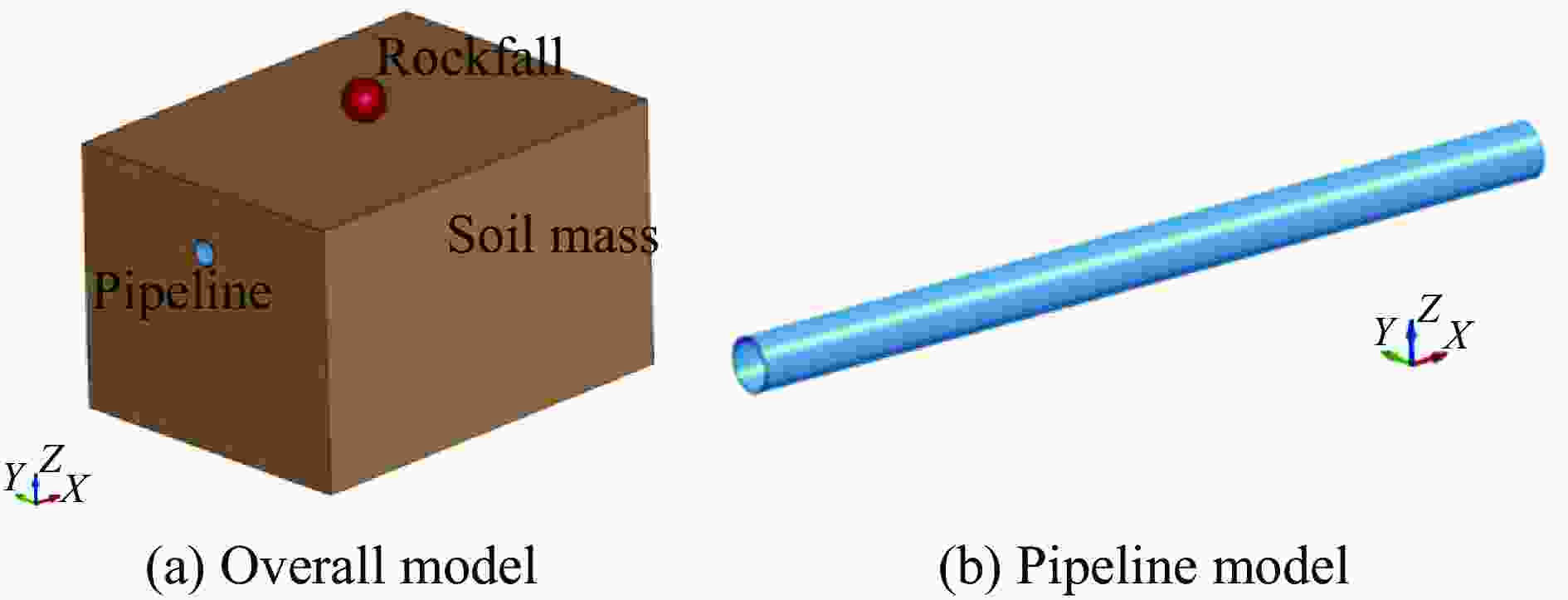
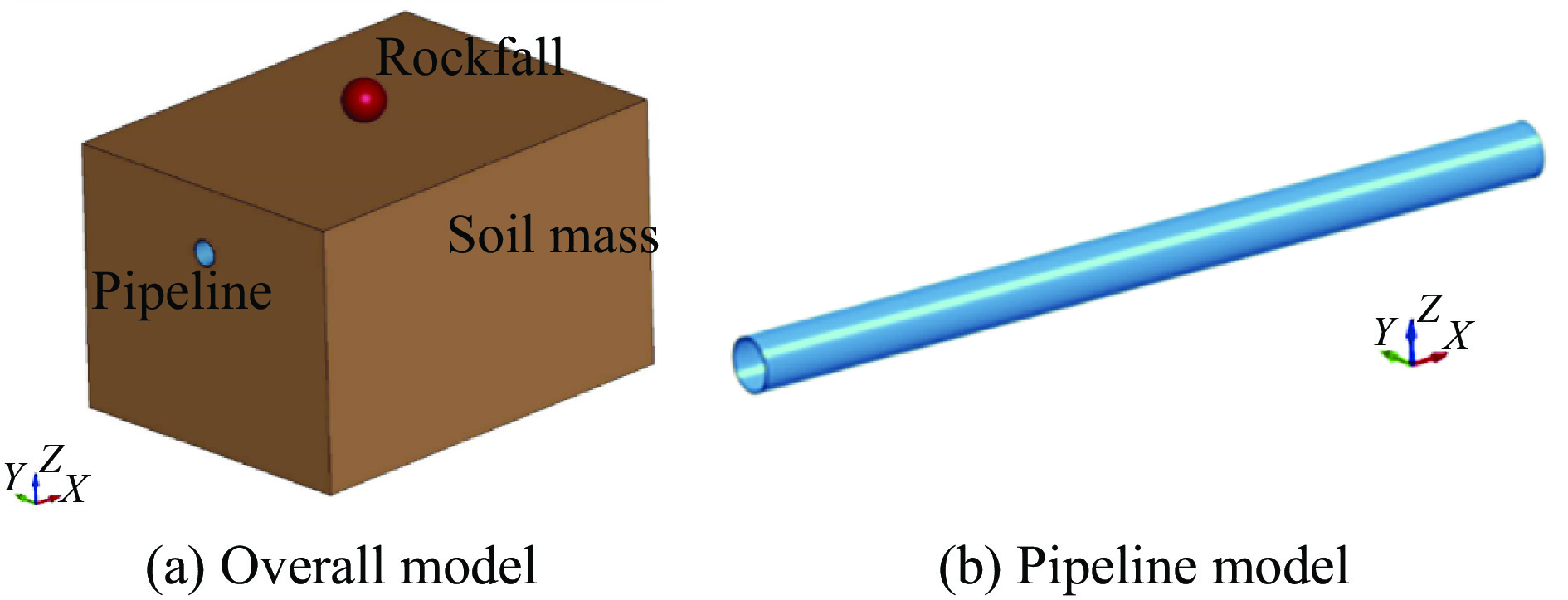
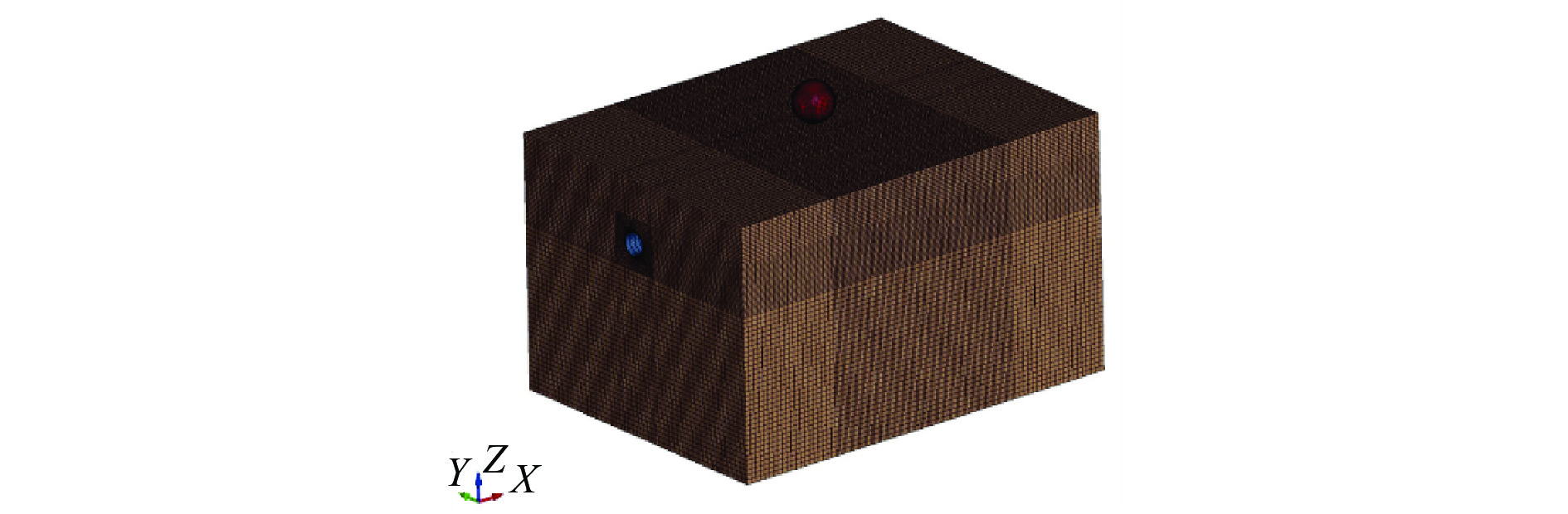
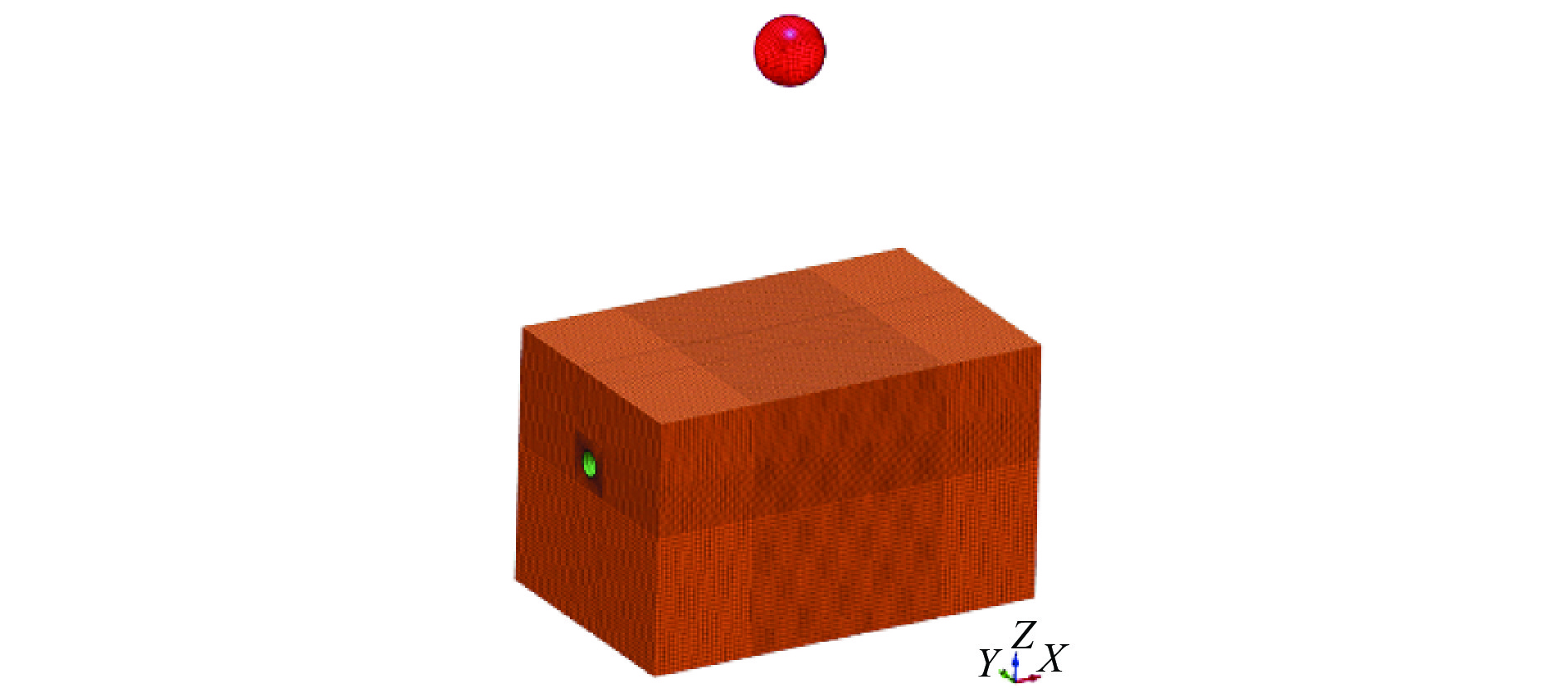
图 14 落石冲击埋地管道有限元模型
Figure 14. Finite element model of rockfall impact on buried pipeline
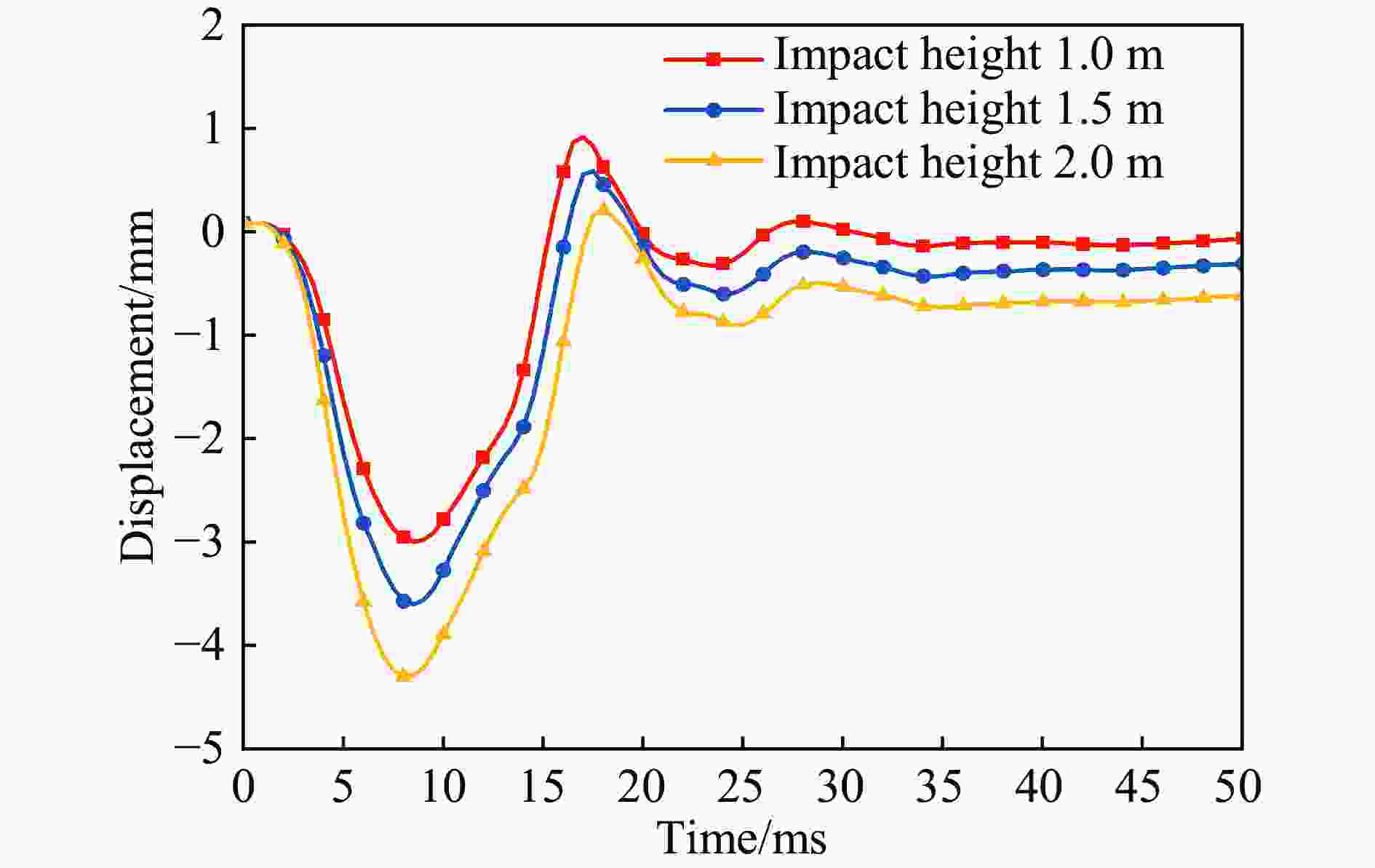
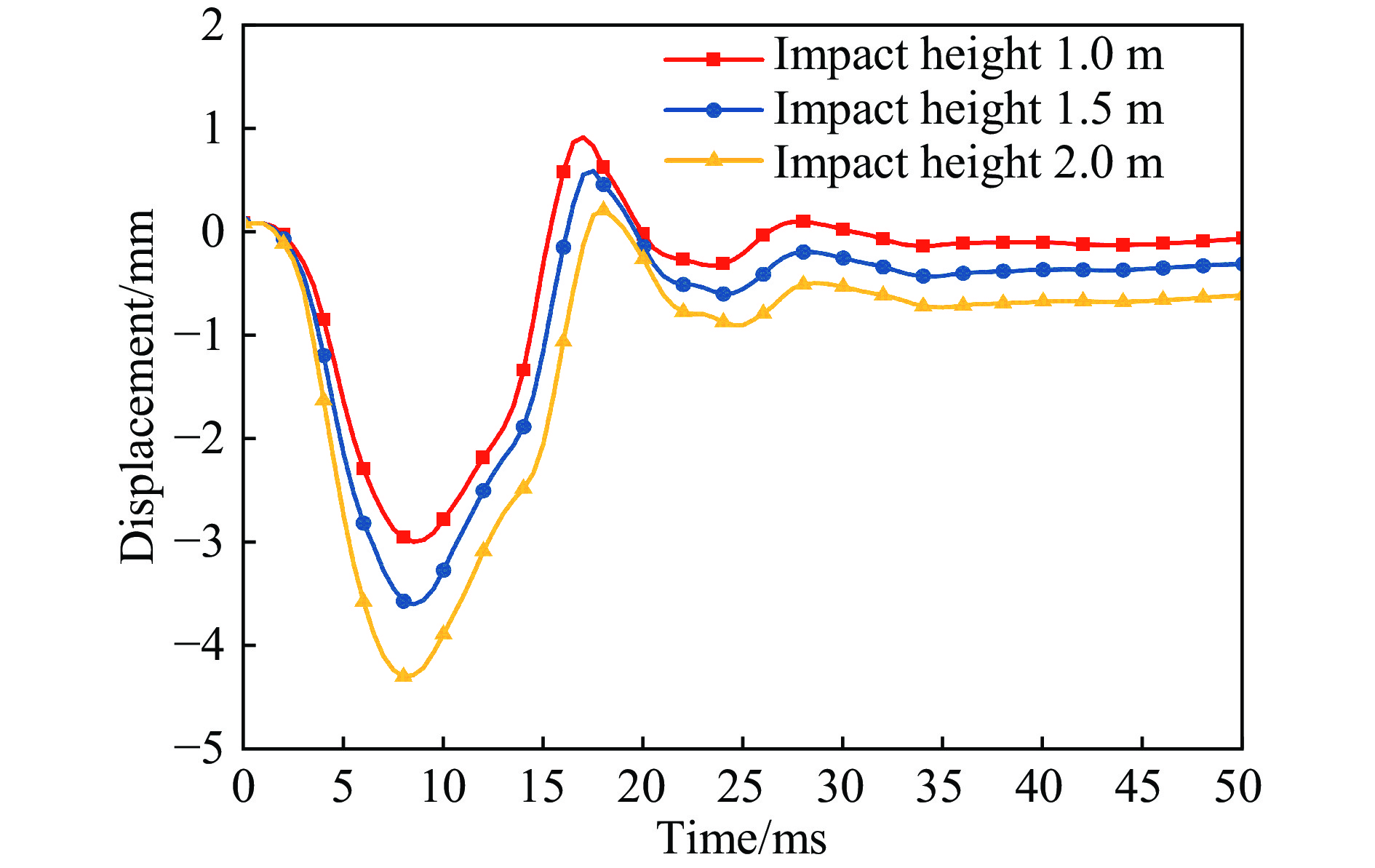
图 17 不同高度球形冲击0.2 m埋深管道数值模拟底部位移时程曲线
Figure 17. Numerical results of displacement-time history curves at the bottom of pipeline buried at 0.2 m subjected to spherical hammer impact with different heights

图 18 不同落石冲击偏距下管道最大Mises应力云图
Figure 18. Maximum Mises stress contour of pipelines under different rockfall impact offsets
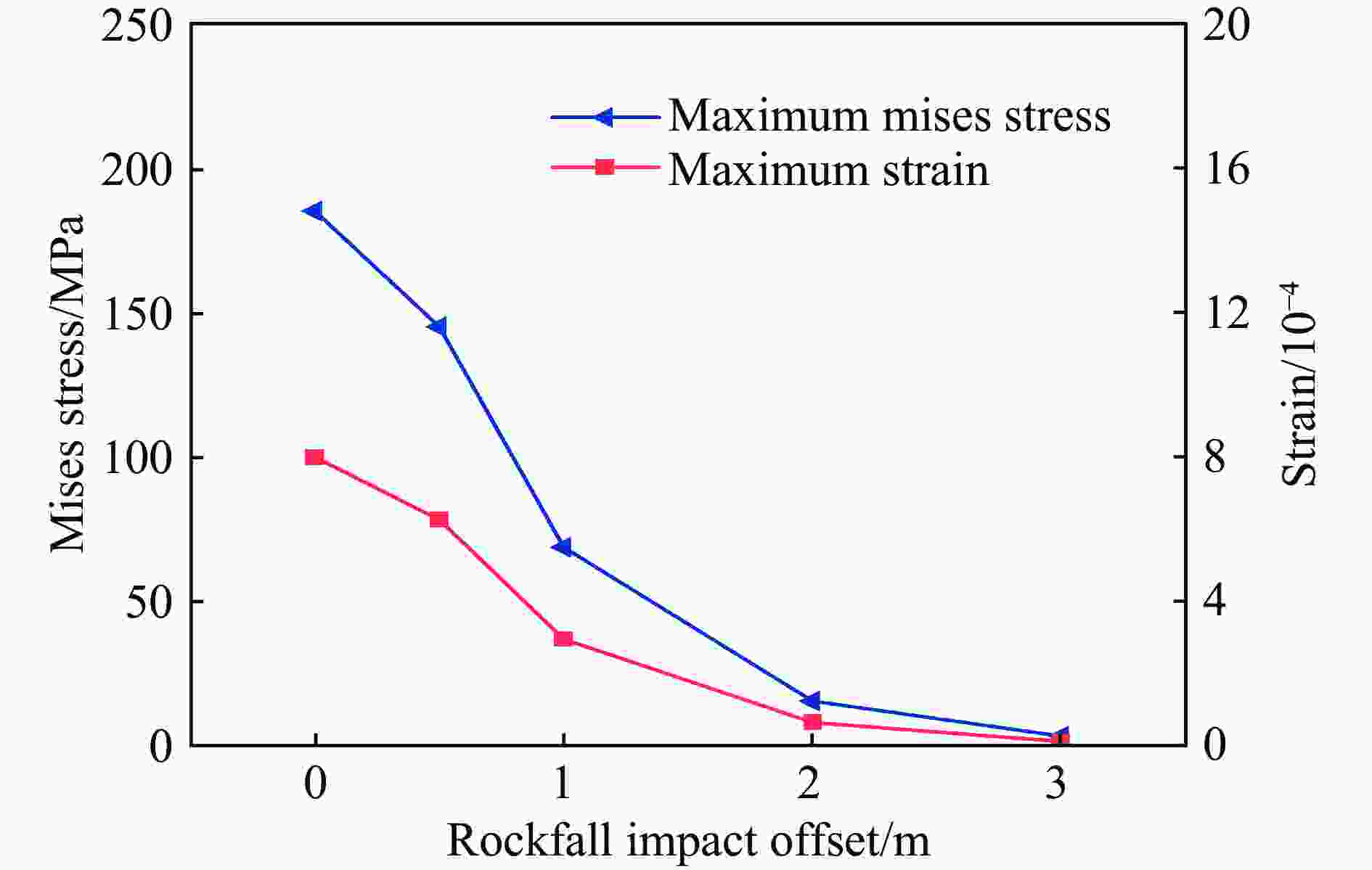
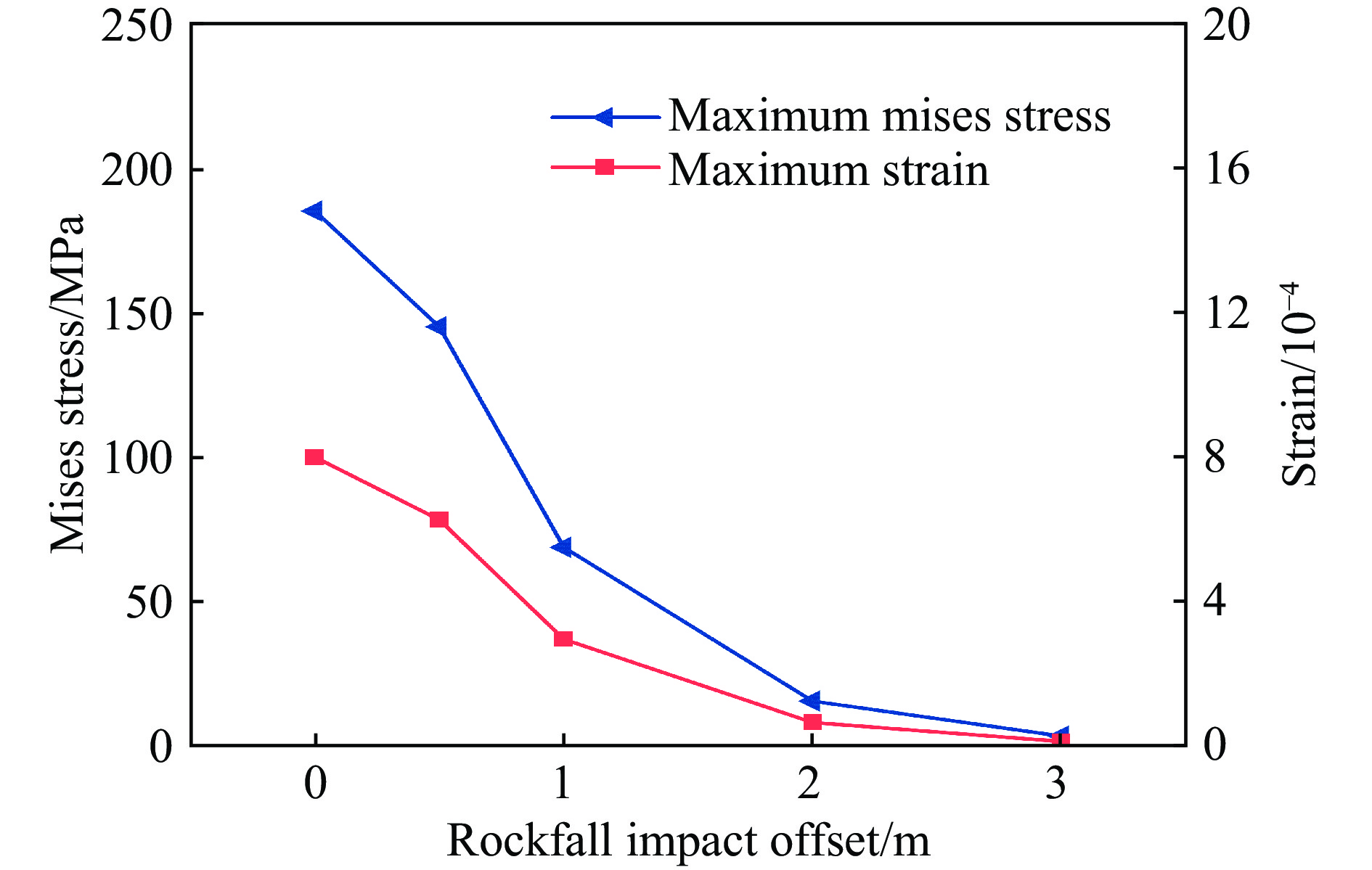
图 19 最大Mises应力和最大应变随落石冲击偏距的变化
Figure 19. Variation of maximum Mises stress and strain with rockfall impact offset

图 20 落石冲击不同直径管道最大Mises应力云图
Figure 20. Maximum Mises stress contour of pipelines with different diameters subjected to rockfall impact
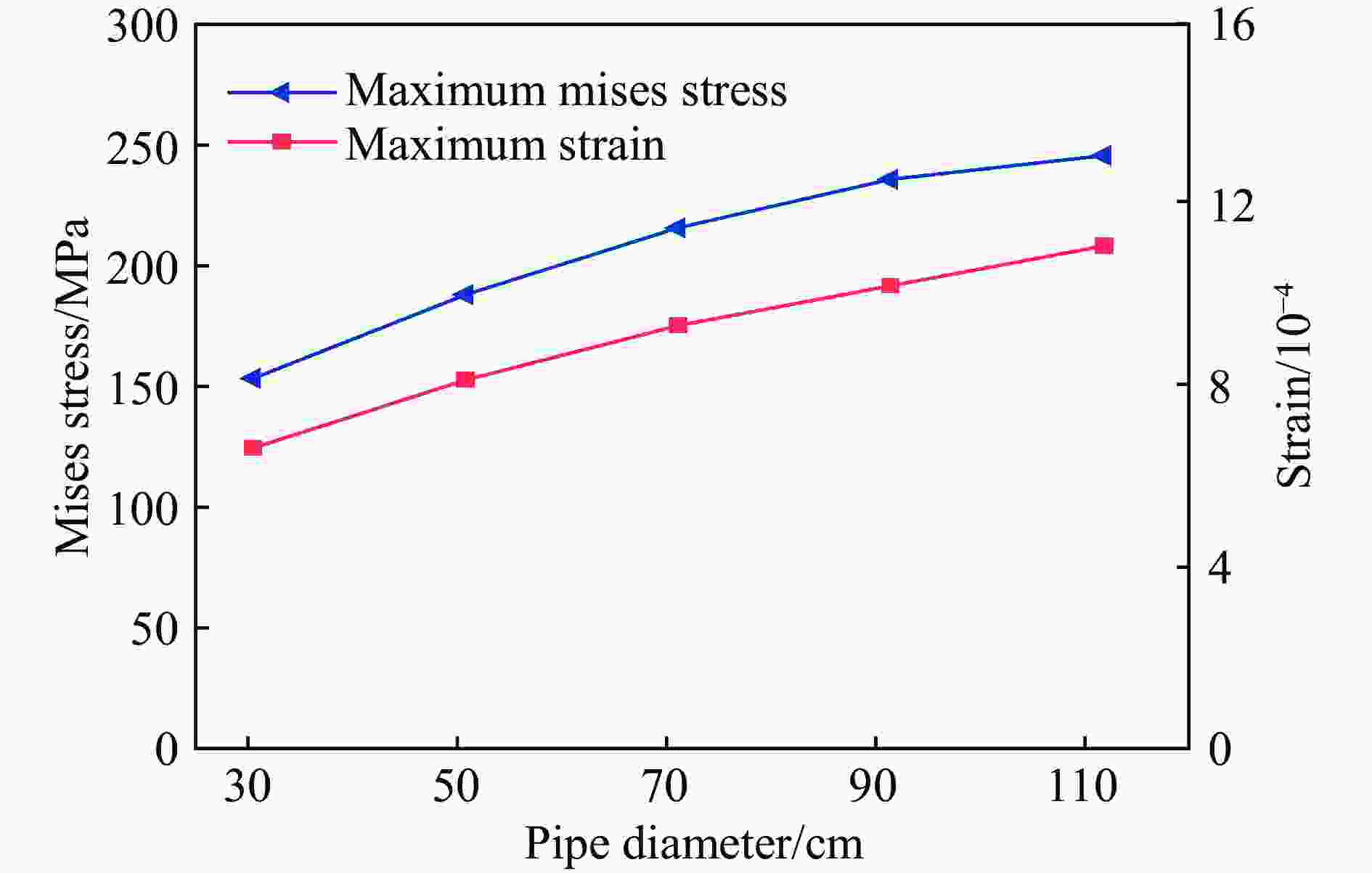
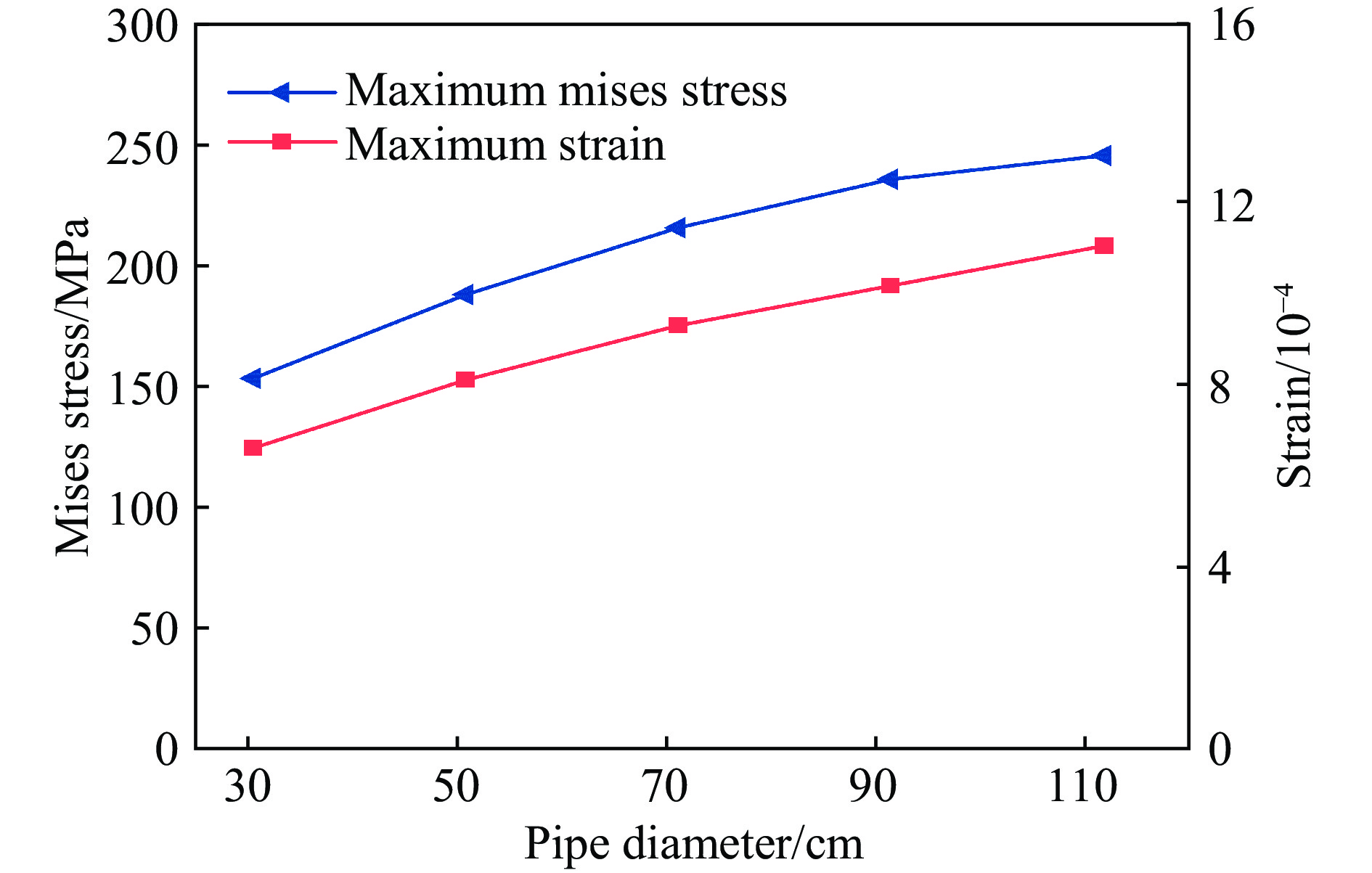
图 21 最大Mises应力和最大应变随管道直径变化
Figure 21. Variation of maximum Mises stress and strain with pipeline diameter
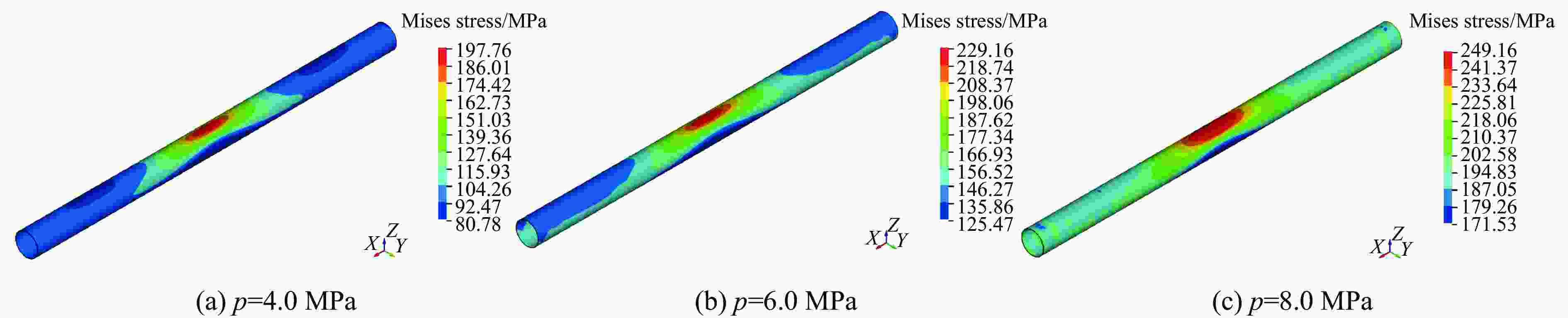
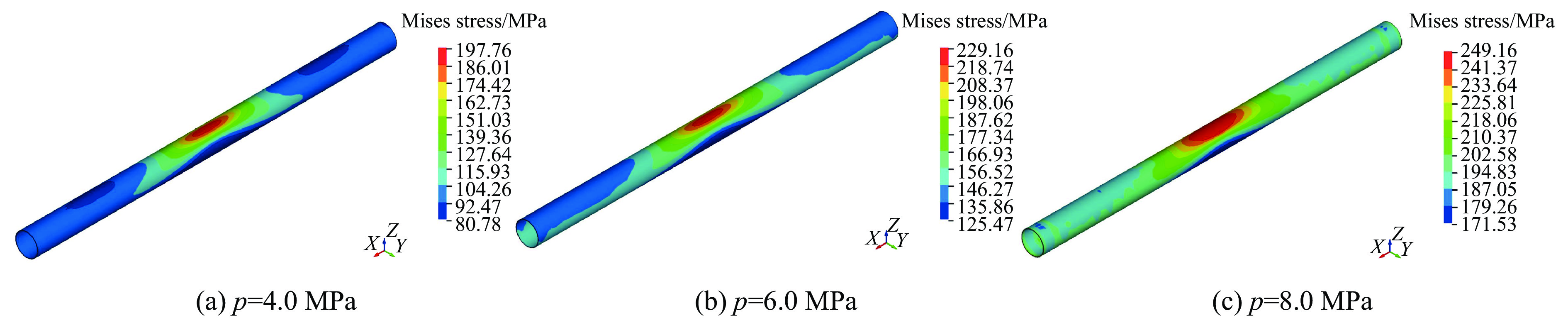
图 22 落石冲击不同内压下的管道最大Mises应力云图
Figure 22. Maximum Mises stress contour of pipeline under different internal pressures subjected to rockfall impact
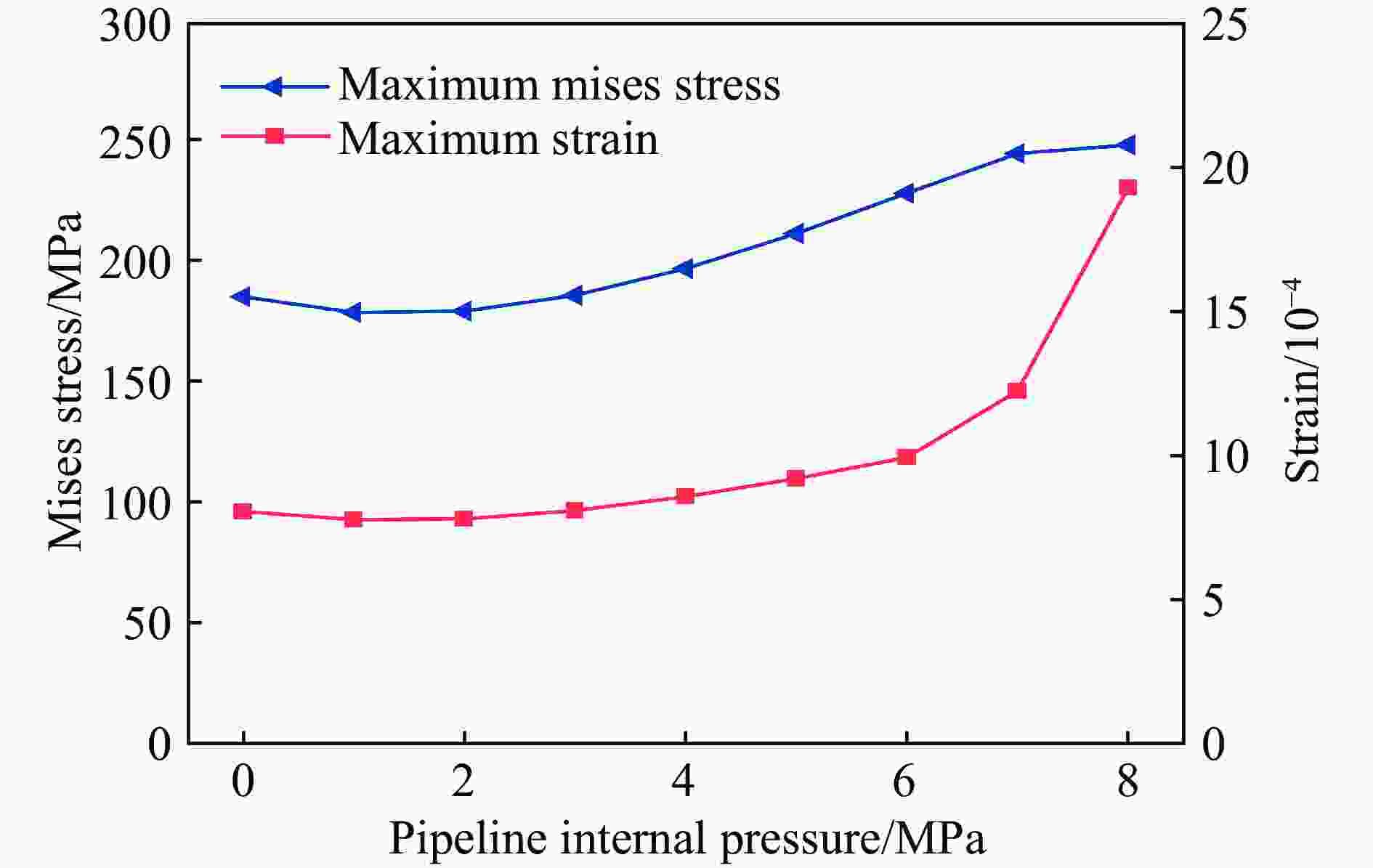
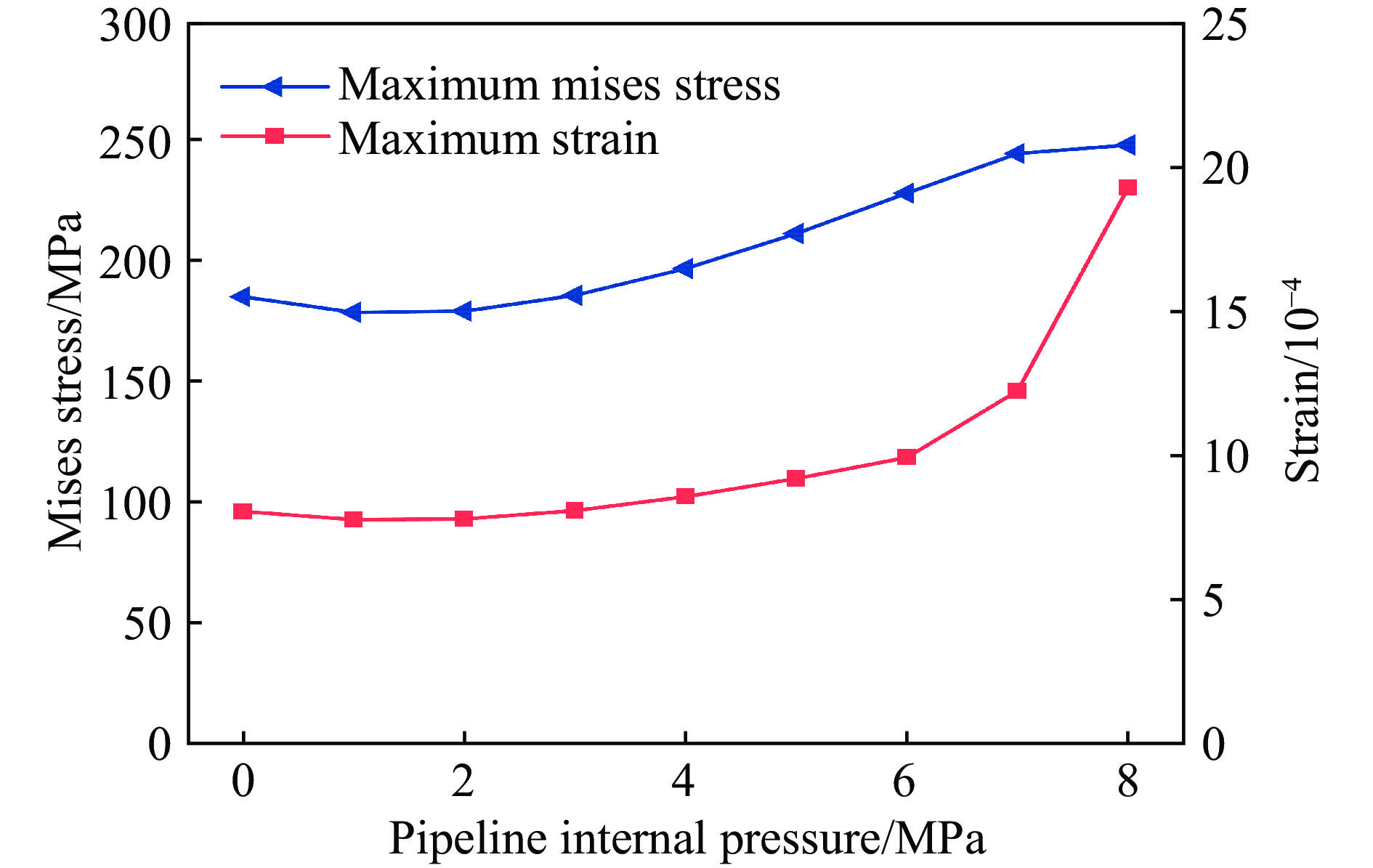
图 23 最大Mises应力和最大应变随管道内压变化
Figure 23. Variation of maximum Mises stress and strain with internal pressure of pipeline

图 24 落石冲击不同土体弹性模量下的管道最大Mises应力云图
Figure 24. Maximum Mises stress contour of pipeline under different soil elastic modulus subjected to rockfall impact
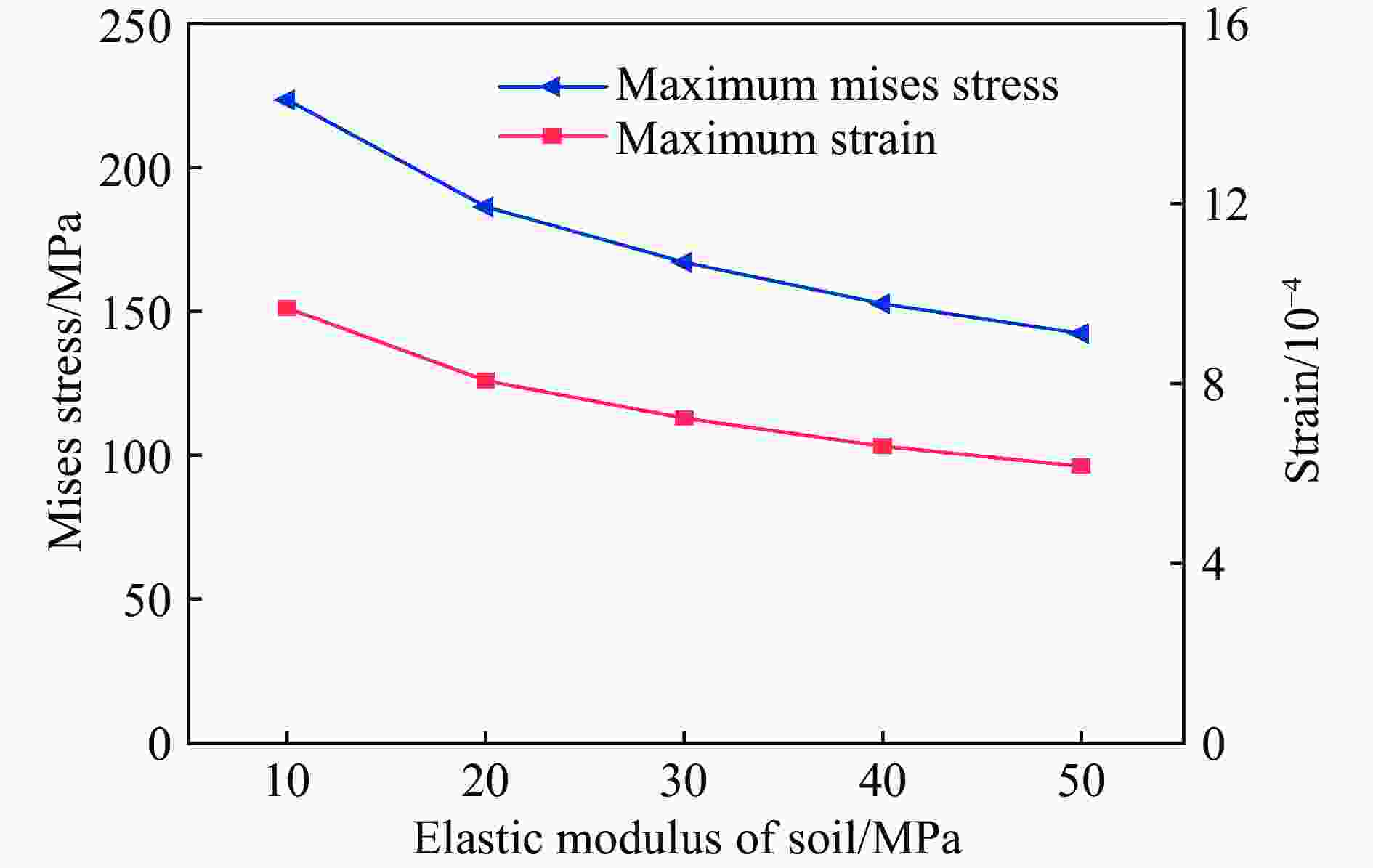
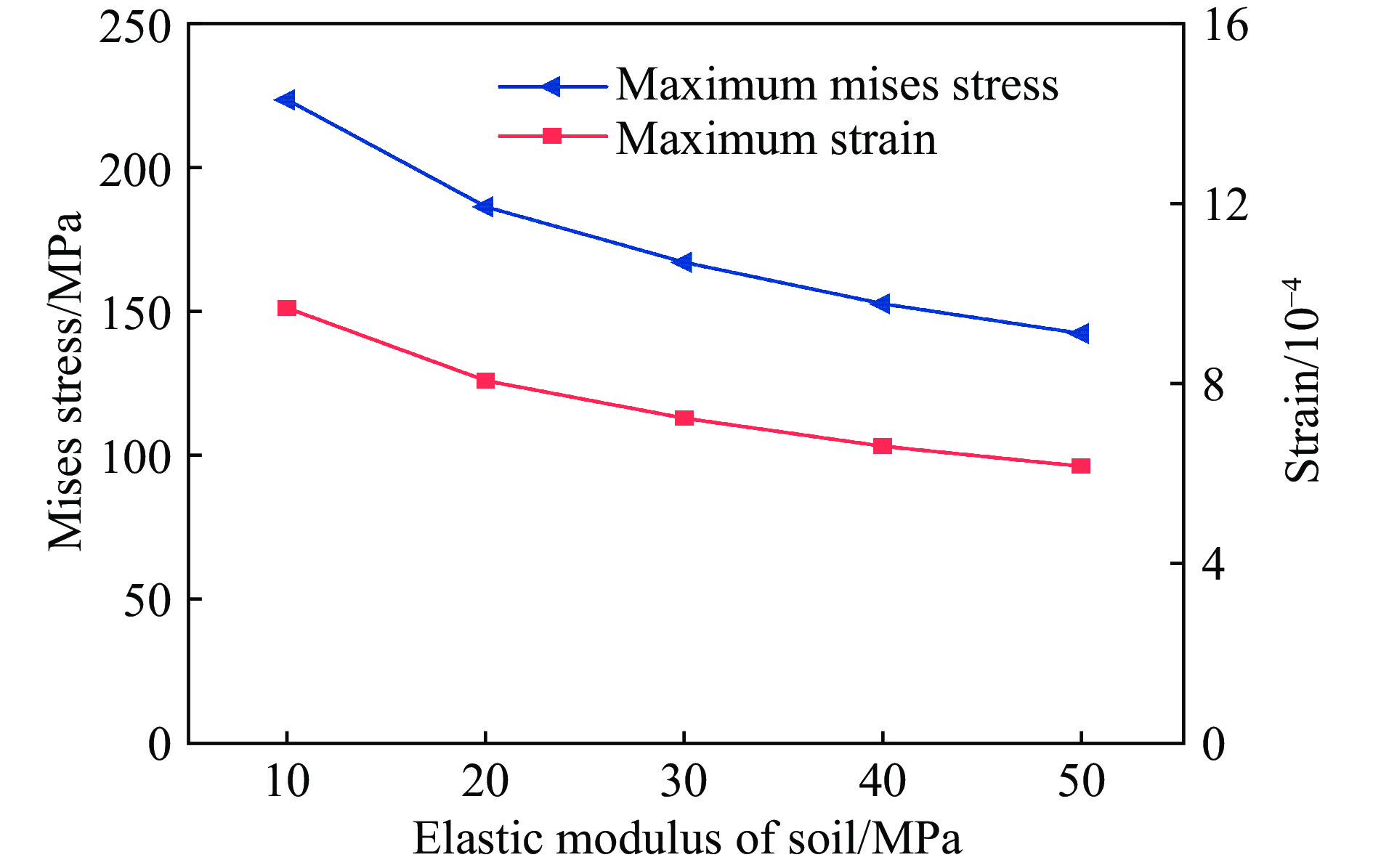
图 25 最大Mises应力和最大应变随土体弹性模量变化
Figure 25. Variation of maximum Mises stress and maximum strain with soil elastic modulus

图 26 落石冲击不同管土摩擦因数下的管道最大Mises应力云图
Figure 26. Maximum Mises stress contour of pipeline under different pipe-soil friction coefficients subjected to rockfall impact
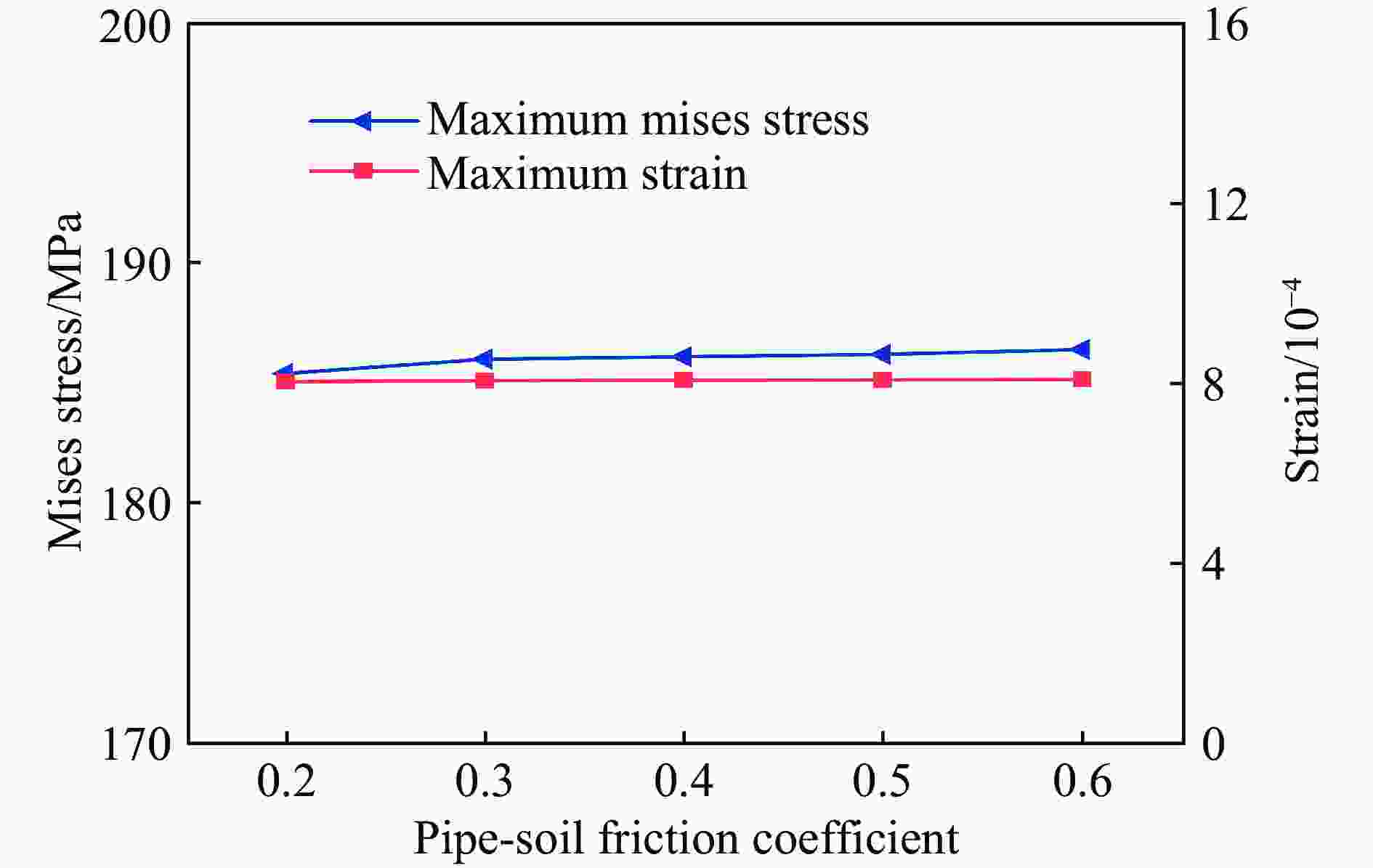
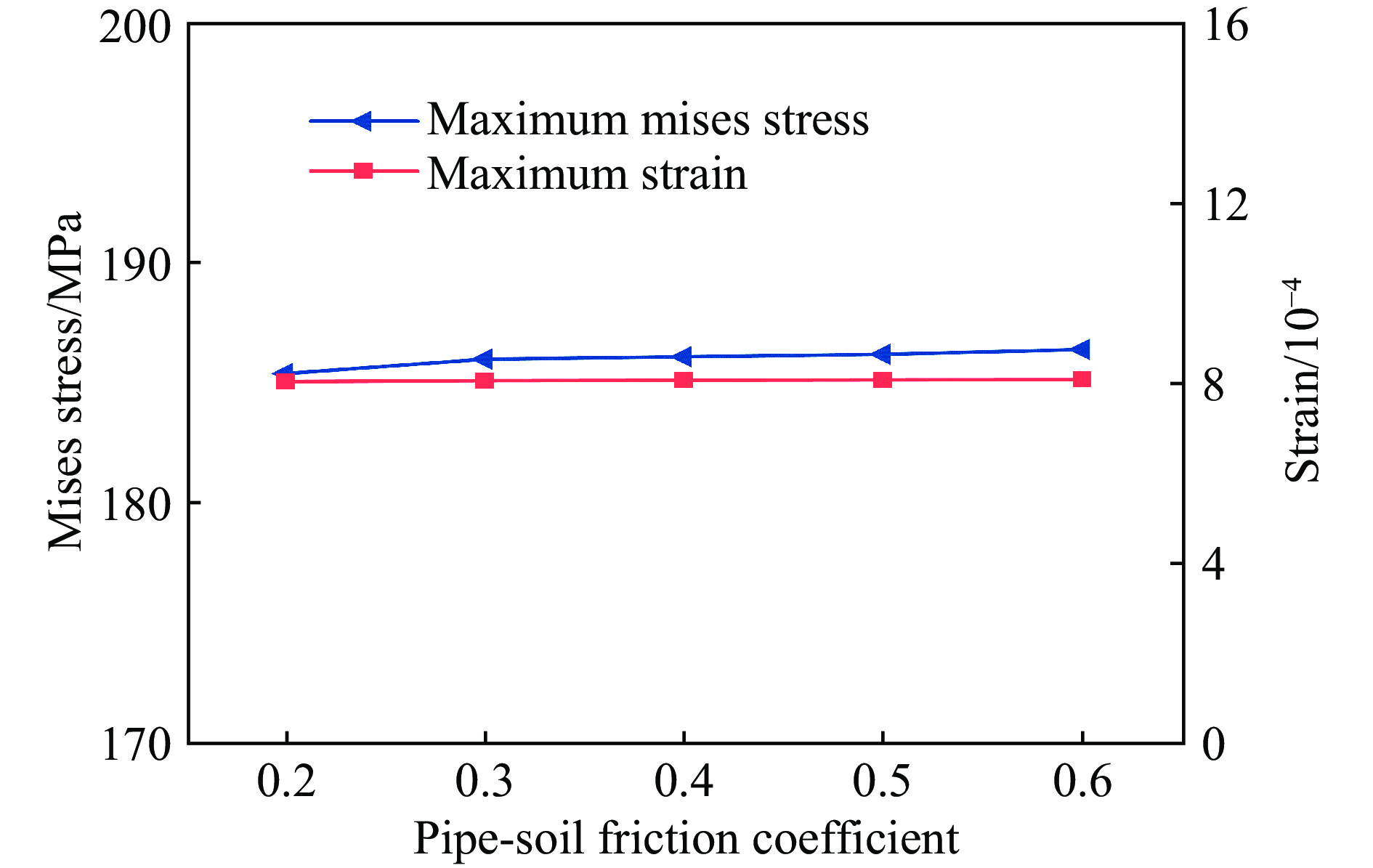
图 27 最大Mises应力和最大应变随管土摩擦系数变化
Figure 27. Variation of maximum Mises stress and maximum strain with the pipe-soil friction coefficient

图 28 不同落石冲击速度下的管道最大Mises应力云图
Figure 28. Maximum Mises stress contour in the pipeline under different rockfall impact velocities
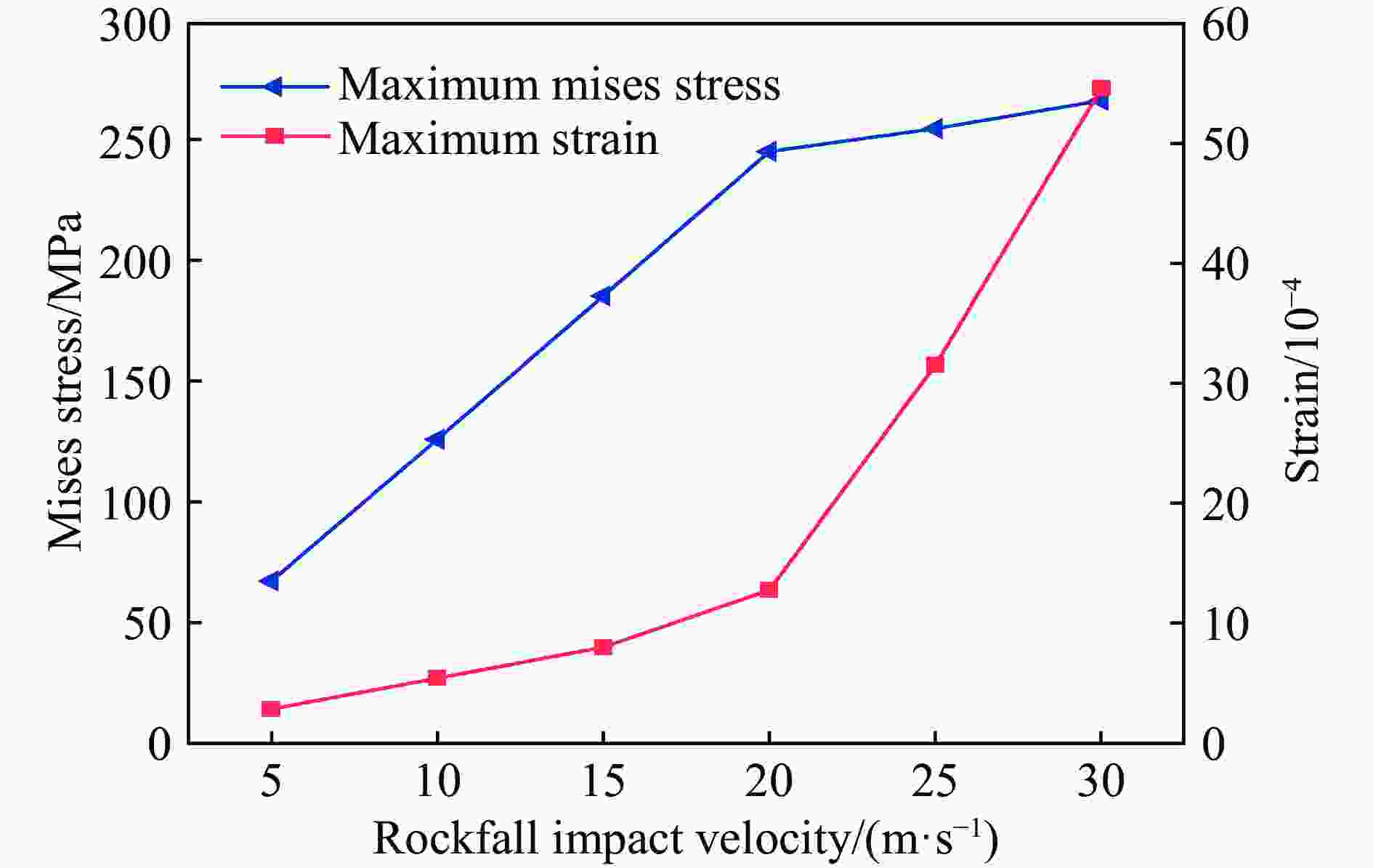
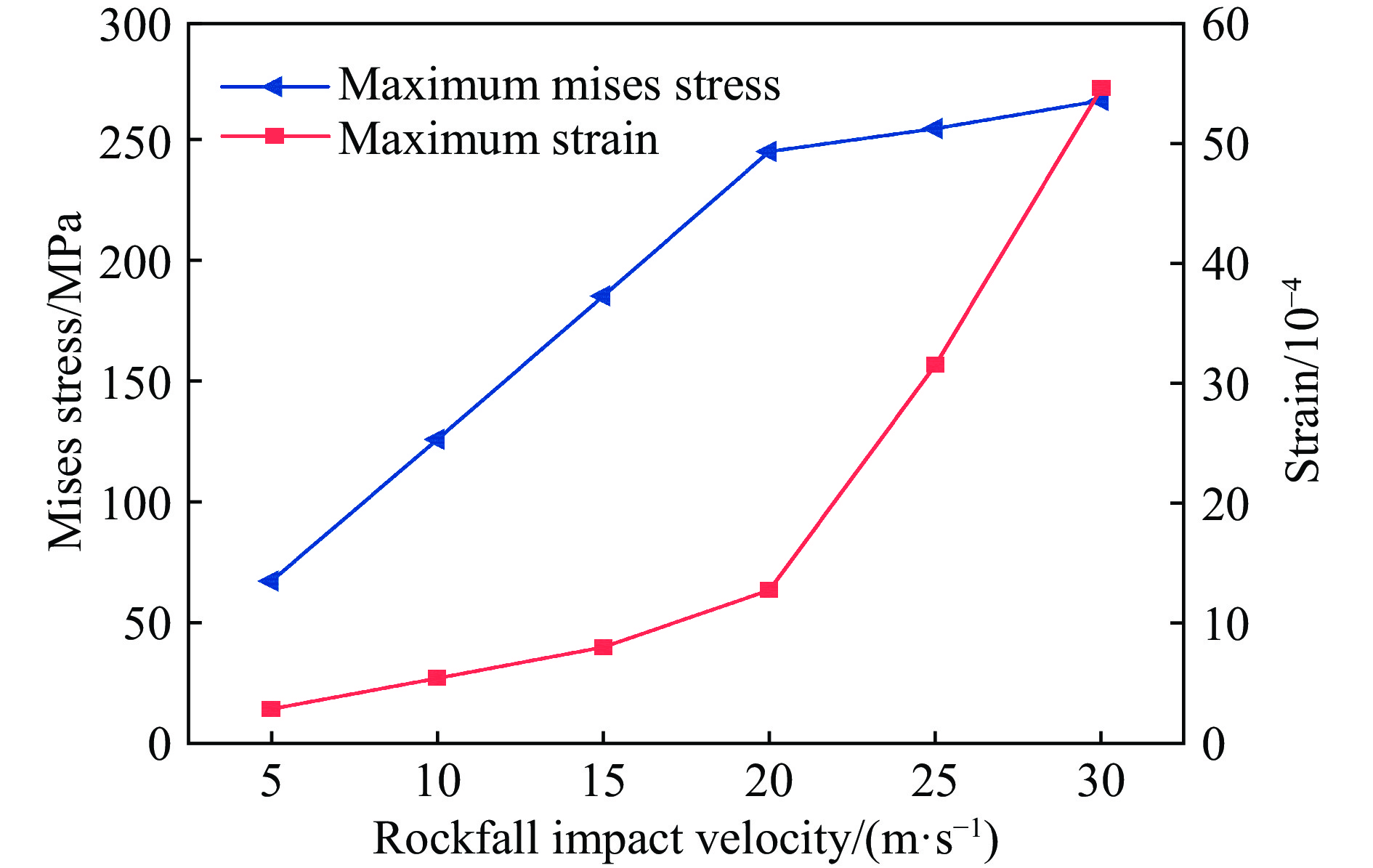
图 29 最大Mises应力和应变随落石冲击速度变化
Figure 29. Variation of maximum Mises stress and strain of pipeline with rockfall impact velocity
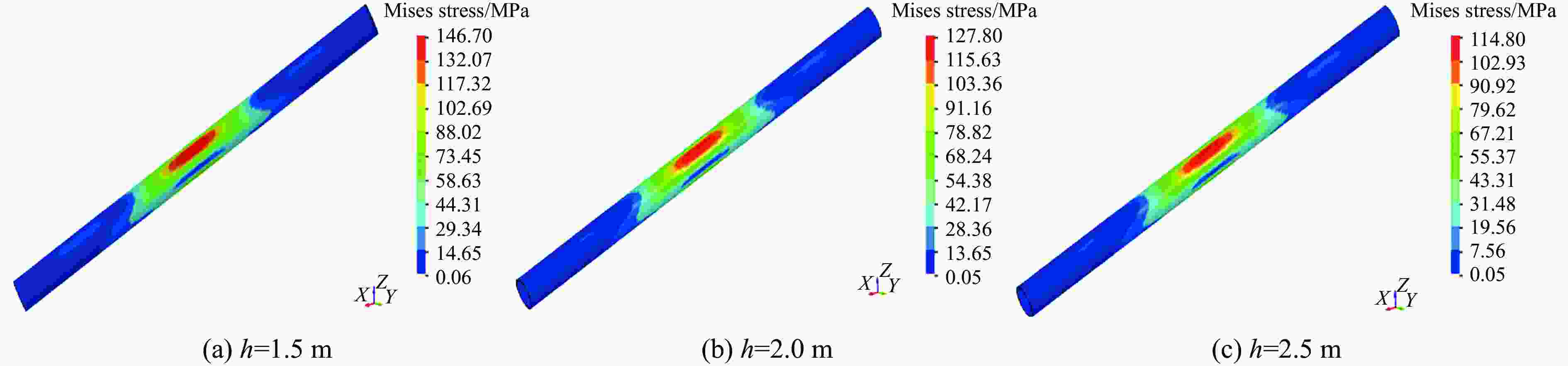
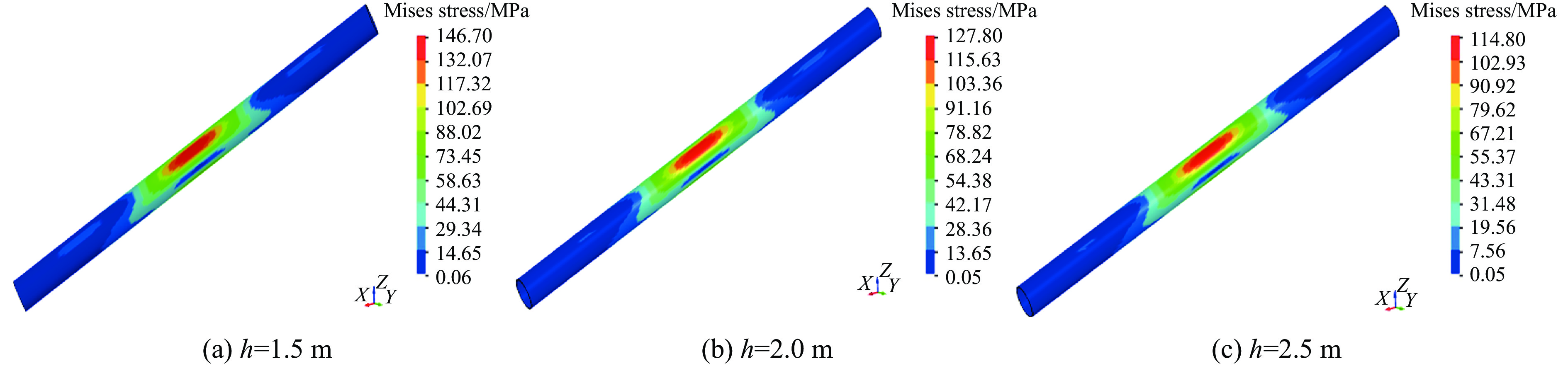
图 30 不同管道埋深下的管道最大Mises应力云图
Figure 30. Maximum Mises stress contour of pipelines at different buried depths
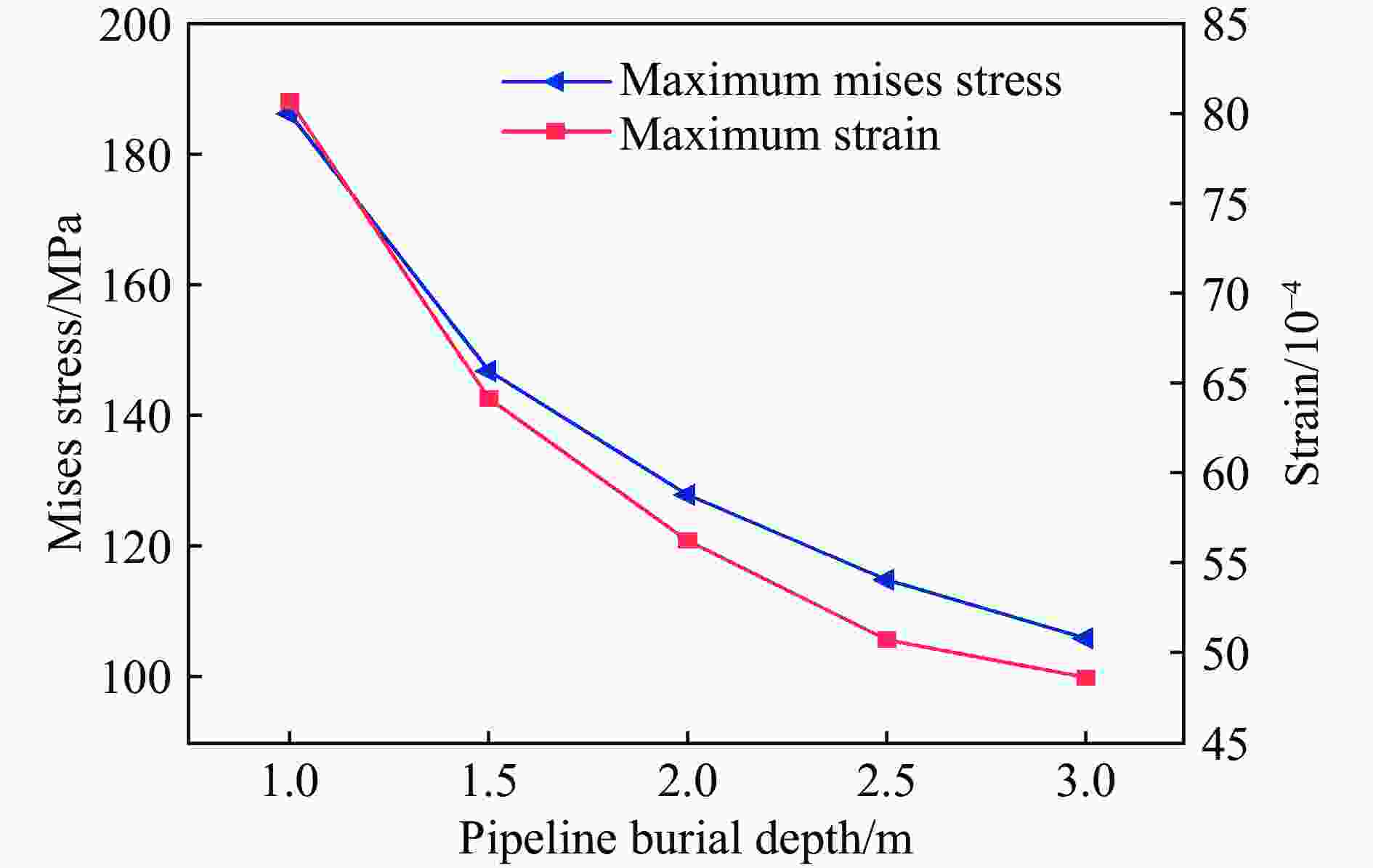
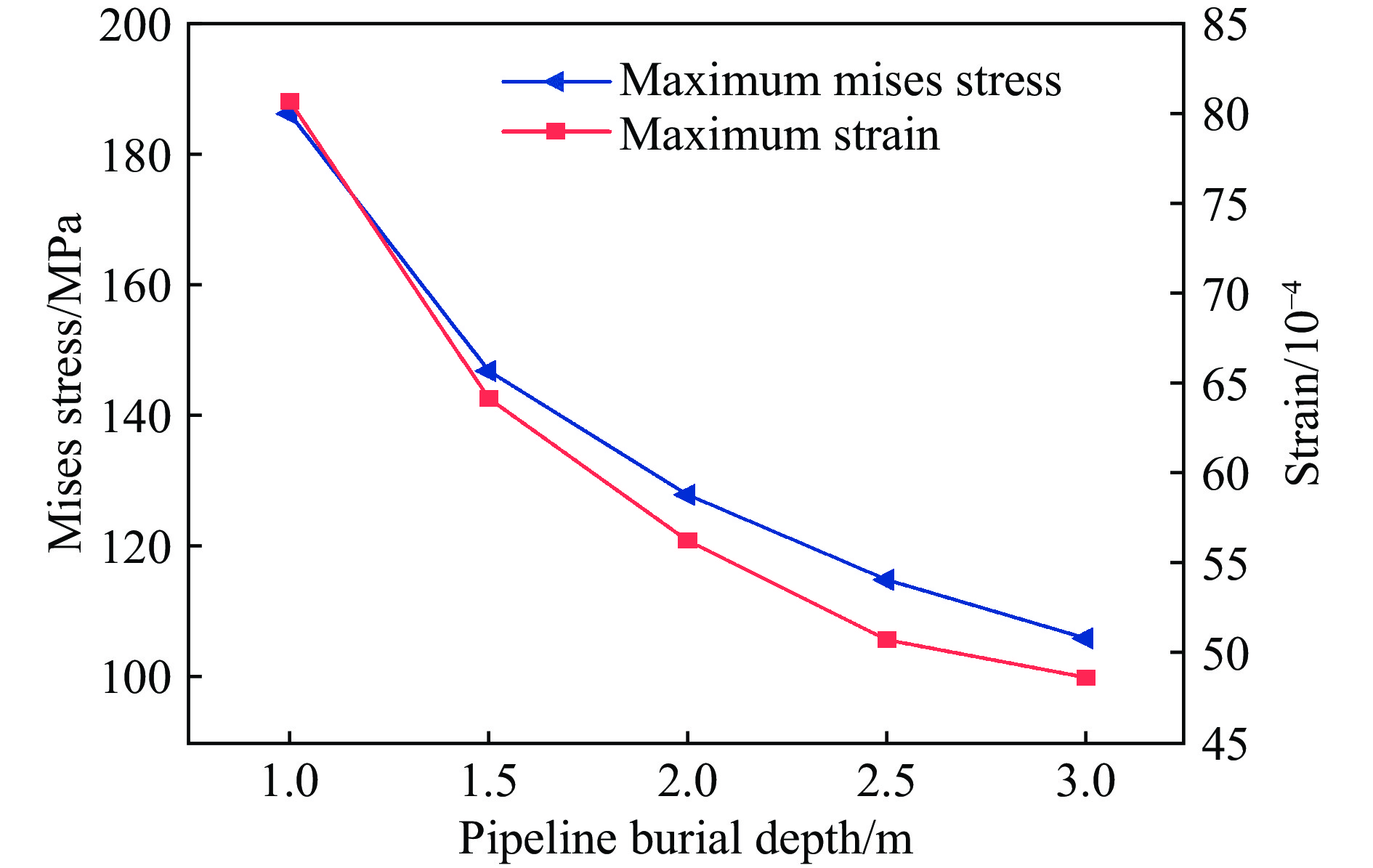
图 31 最大Mises应力和应变随管道埋深变化
Figure 31. Variation of maximum Mises stress and strain with the buried depth of the pipeline
表 1 试件编号及具体参数
Table 1. Specimen number and specific parameters
试验组号 试件编号 冲击高度/m 管道埋深/m 管道壁厚/mm 冲击偏距/m 1 1-1 1.0 0.15 1 0 1-2 1.5 0.15 1 0 1-3 2.0 0.15 1 0 2 2-1 1.0 0.20 1 0 2-2 1.5 0.20 1 0 2-3 2.0 0.20 1 0 3 3-1 1.0 0.25 1 0 3-2 1.5 0.25 1 0 3-3 2.0 0.25 1 0 4 4-1 1.0 0.20 1 0.10 4-2 1.5 0.20 1 0.10 4-3 2.0 0.20 1 0.10 5 5-1 1.0 0.20 2 0 5-2 1.5 0.20 2 0 5-3 2.0 0.20 2 0  下载: 导出CSV
表 2 管体沉降位移模拟结果与试验结果的对比
Table 2. Comparison of pipeline settlement displacements between simulation and test
冲击高度/m 管体沉降位移/mm 相对误差/% 试验 模拟 1.0 2.7 3.0 11.1 1.5 3.2 3.6 12.5 2.0 3.9 4.3 10.2
下载: 导出CSV
-
[1] 吴彬, 刘晓宇. 埋地悬空管道弹塑性受力分析与计算 [J]. 三峡大学学报(自然科学版), 2020, 42(5): 42–48. DOI: 10.13393/j.cnki.issn.1672-948x.2020.05.008.WU B, LIU X Y. Elastoplastic analysis and simulation of buried and suspended pipeline [J]. Journal of China Three Gorges University (Natural Sciences), 2020, 42(5): 42–48. DOI: 10.13393/j.cnki.issn.1672-948x.2020.05.008. [2] PENG Y, YIN Z Y, GAO F P. Micromechanical analysis of pipeline-soil interaction in unsaturated granular soil undergoing lateral ground movement [J]. Computers and Geotechnics, 2024, 169: 106181. DOI: 10.1016/j.compgeo.2024.106181. [3] 徐涛龙, 邵常宁, 兰旭彬, 等. 粒子法和离散元法在管土耦合分析中的应用 [J]. 工程力学, 2022, 39(S1): 239–249. DOI: 10.6052/j.issn.1000-4750.2021.06.S048.XU T L, SHAO C N, LAN X B, et al. Application of particle method and discrete element method in pipe-soil coupling analysis [J]. Engineering Mechanics, 2022, 39(S1): 239–249. DOI: 10.6052/j.issn.1000-4750.2021.06.S048. [4] 刘鹏, 张宇, 李玉星, 等. 连续沉降过程中管土相互作用规律 [J]. 油气储运, 2024, 43(3): 332–341. DOI: 10.6047/j.issn.1000-8241.2024.03.010.LIU P, ZHANG Y, LI Y X, et al. Pipe-soil interaction during continuous settlement [J]. Oil & Gas Storage and Transportation, 2024, 43(3): 332–341. DOI: 10.6047/j.issn.1000-8241.2024.03.010. [5] SULTANOV K, KHUSANOV B, RIKHSIEVA B. Underground pipeline reliability under longitudinal impact load [C]//IOP Conference Series: Materials Science and Engineering. IOP Publishing, 2020: 052008. DOI 10.1088/1757-899X/869/5/052008. [6] 杨辉, 王婷, 雷铮强, 等. 管土接触作用下埋地管道力学分析 [J]. 石油矿场机械, 2015, 44(7): 44–47. DOI: 10.3969/j.issn.1001-3482.2015.07.011.YANG H, WANG T, LEI Z Q, et al. Analysis on mechanical characteristics of buried pipeline under pipe-soil contact [J]. Oil Field Equipment, 2015, 44(7): 44–47. DOI: 10.3969/j.issn.1001-3482.2015.07.011. [7] 吴锴, 张宏. 基于有限元的局部突变位移载荷下埋地管道力学分析 [J]. 中国安全生产科学技术, 2019, 15(4): 59–64. DOI: 10.11731/j.issn.1673-193x.2019.04.009.WU K, ZAHNG H. Finite element analysis of the buried pipelines subjected to abrupt displacement load locally [J]. Journal of Safety Science and Technology, 2019, 15(4): 59–64. DOI: 10.11731/j.issn.1673-193x.2019.04.009. [8] 吴禹含, 亓戈平, 汤宇腾. 矩形管廊上浮过程管土相互作用透明土模型试验研究 [J/OL]. 土木与环境工程学报(中英文), 1-11(2025-01-17)[2025-07-01]. https://link.cnki.net/urlid/50.1218.TU.20250116.1552.004.WU Y H, QI G P, TANG Y T. Experimental study of transparent soil modelling of pipe-soil interaction during uplift of rectangular pipe gallery [J/OL]. Journal of Civil and Environmental Engineering, 1-11(2025-01-17)[2025-06-24]. https://link.cnki.net/urlid/50.1218.TU.20250116.1552.004. [9] 马越超. 埋地弯管地震反应特点与管土相互作用 [D]. 哈尔滨: 哈尔滨工业大学, 2019: 45–61. DOI: 10.27061/d.cnki.ghgdu.2019.005672.MA Y C. Seismic response characteristics of buried elbow pipeline and pipe-soil interaction [D]. Harbin: Harbin Institute of Technology, 2019: 45–61. DOI: 10.27061/d.cnki.ghgdu.2019.005672. [10] 王飞, 李效民, 马芳俊, 等. 向量式有限元法在管土相互作用中的应用 [J]. 船舶力学, 2019, 23(4): 467–475. DOI: 10.3969/j.issn.1007-7294.2019.04.011.WANG F, LI X M, MA F J, et al. Application of vector form intrinsic finite element method on riser/seafloor interaction [J] Journal of Ship Mechanics, 2019, 23(4): 467–475. DOI: 10.3969/j.issn.1007-7294.2019.04.011. [11] WANG C, LIU L H, KANG Y W, et al. Numerical method of lateral pipe-soil interaction and sensitivity analysis investigation [J]. Alexandria Engineering Journal, 2024, 105: 360–369. DOI: 10.1016/j.aej.2024.06.102. [12] XIE T C, ZHU H H, TAN D Y, et al. Modeling pipe-soil interaction under surface loading using material point method [J]. Tunnelling and Underground Space Technology, 2024, 147: 105709. DOI: 10.1016/j.tust.2024.105709. [13] 马文江, 李海胜. 埋地输气管道落石冲击响应的试验研究 [J]. 中国测试, 2018, 44(9): 23–28. DOI: 10.11857/j.issn.1674-5124.2018.09.005.MA W J, LI H S. Experimental study on rockfall impact response of buried gas pipeline [J]. China Measurement & Test, 2018, 44(9): 23–28. DOI: 10.11857/j.issn.1674-5124.2018.09.005. [14] 刘天豪, 蒋楠, 周传波, 等. 落石冲击下地面混凝土垫层对埋地管道的防护作用 [J]. 爆炸与冲击, 2026, 46(4): 045103. DOI: 10.11883/bzycj-2024-0474.LIU T H, JIANG N, ZHOU C B, et al. Study on the protective effect of ground concrete bedding layer on buried pipelines under the rockfall impact [J]. Explosion and Shock Waves, 2026, 46(4): 045103. DOI: 10.11883/bzycj-2024-0474. [15] 张虎, 邵磊, 余成, 等. 冲击荷载对埋地管道影响的试验与数值模拟研究 [J]. 地震工程与工程振动, 2022, 42(3): 243–252. DOI: 10.13197/j.eeed.2022.0326.ZHANG H, SHAO L, YU C, et al. Experimental and numerical simulation study of impact loading on buried pipeline [J]. Earthquake Engineering and Engineering Dynamics, 2022, 42(3): 243–252. DOI: 10.13197/j.eeed.2022.0326. [16] 白冰洁, 黄子川, 杜国峰. 冲击载荷作用下埋地管道的破坏形态研究 [J]. 石油机械, 2020, 48(12): 146–152. DOI: 10.16082/j.cnki.issn.1001-4578.2020.12.021.BAI B J, HUANG Z C, DU G F. Research on the failure mode of buried pipeline under impact load [J]. China Petroleum Machinery, 2020, 48(12): 146–152. DOI: 10.16082/j.cnki.issn.1001-4578.2020.12.021. [17] 方迎潮, 汤明高, 葛华, 等. 崩塌落石冲击埋地油气管道的动力响应机理研究 [J]. 工程地质学报, 2022, 30(2): 589–598. DOI: 10.13544/j.cnki.jeg.2021-0603.FANG Y C, TANG M G, GE H, et al. Study on dynamic response mechanism of rockfall impacting buried oil and gas pipeline [J]. Journal of Engineering Geology, 2022, 30(2): 589–598. DOI: 10.13544/j.cnki.jeg.2021-0603. [18] 滕振超, 赵誉翔, 滕云超, 等. 冲击荷载作用下冻土区埋地管道动力响应试验研究 [J]. 地震工程与工程振动, 2021, 41(6): 168–176. DOI: 10.13197/j.eeev.2021.06.168.tengzc.016.TENG Z C, ZHAO Y X, TENG Y C, et al. Dynamic response test of buried pipeline in frozen soil area under impact load [J]. Earthquake Engineering and Engineering Dynamics, 2021, 41(6): 168–176. DOI: 10.13197/j.eeev.2021.06.168.tengzc.016. [19] RAO P P, WU Z L, CUI J F. Analysis of deformation of adjacent buried pipeline under rockfall impact load [J]. Geotechnical and Geological Engineering, 2022, 40(3): 1463–1474. DOI: 10.1007/s10706-021-01975-w. [20] AMINI M, WILSON P, RAHMAN M. Evaluating the penetration depth of rock falls on buried pipelines [C]//International Pipeline Conference. Calgary: American Society of Mechanical Engineers, 2024: V004T06A001. DOI: 10.1115/IPC2024-131073. [21] 张杰, 梁政, 韩传军, 等. 落石冲击作用下架设油气管道响应分析? [J]. 中国安全生产科学技术, 2015, 11(7): 11–17. DOI: 10.11731/j.issn.1673-193x.2015.07.002.ZHANG J, LIANG Z, HAN C J, et al. Analysis on response of overhead oil and gas pipeline impacted by rock-fall [J]. Journal of Safety Science and Technology, 2015, 11(7): 11–17. DOI: 10.11731/j.issn.1673-193x.2015.07.002. [22] 黄文, 谢锐, 陈小华. 落石冲击载荷下埋地油气管道力学分析 [J]. 石油机械, 2019, 47(9): 138–144. DOI: 10.16082/j.cnki.issn.1001-4578.2019.09.021.HUANG W, XIE R, CHEN X H. Mechanical analysis of buried oil and gas pipeline under rock fall impact [J]. China Petroleum Machinery, 2019, 47(9): 138–144. DOI: 10.16082/j.cnki.issn.1001-4578.2019.09.021. [23] 崔毅, 麻宏强. 岩石坍塌作用下埋地集输管道应力变化规律 [J]. 兰州理工大学学报, 2021, 47(2): 60–64. DOI: 10.3969/j.issn.1673-5196.2021.02.010.CUI Y, MA H Q. Stress variation law of buried collecting and transporting pipeline under rock collapse [J]. Journal of Lanzhou University of Technology, 2021, 47(2): 60–64. DOI: 10.3969/j.issn.1673-5196.2021.02.010. [24] FEI H L, DUAN G Y, ZHANG Z Q, et al. Investigation of the mechanical characteristics of hollow reinforced concrete columns under impact loading [J]. Structural Concrete, 2025, 26(4): 4302–4318. DOI: 10.1002/suco.202300841. [25] 熊健, 邓清禄, 张宏亮, 等. 崩塌落石冲击荷载作用下埋地管道的安全评价 [J]. 安全与环境工程, 2013, 20(1): 108–114. DOI: 10.3969/j.issn.1671-1556.2013.01.025.XIONG J, DENG Q L, ZHANG H L, et al. Safety assessment on the response of buried pipeline caused by rockfall impact load [J]. Safety and Environmental Engineering, 2013, 20(1): 108–114. DOI: 10.3969/j.issn.1671-1556.2013.01.025. [26] 费鸿禄, 李文焱, 魏世众, 等. 承载立柱爆破破坏特征及应变演化规律研究 [J]. 爆破, 2023, 40(1): 10–20. DOI: 10.3963/j.issn.1001-487X.2023.01.002.FEI H L, LI W Y, WEI S Z, et al. Research on blasting failure characteristics and strain evolution law of bearing column [J]. Blasting, 2023, 40(1): 10–20. DOI: 10.3963/j.issn.1001-487X.2023.01.002. [27] 孙乾, 吴娟, 肖民, 等. 基于MA-BP分析机制砂形貌对砂浆流动性的影响 [J]. 建筑材料学报, 2025, 28(7): 646–654. DOI: 10.3969/j.issn.1007-9629.2025.07.007.SUN Q, WU J, XIAO M, et al. Effect of manufactured sand morphology on mortar fluidity based on MA-BP analysis mechanism [J]. Journal of Building Materials, 2025, 28(7): 646–654. DOI: 10.3969/j.issn.1007-9629.2025.07.007. -






计量
- 文章访问数: 454
- HTML全文浏览量: 74
- PDF下载量: 235
- 被引次数: 0