



Parameter inversion of rock RHT constitutive model using PAWN global sensitivity analysis and intelligent optimization algorithm
-
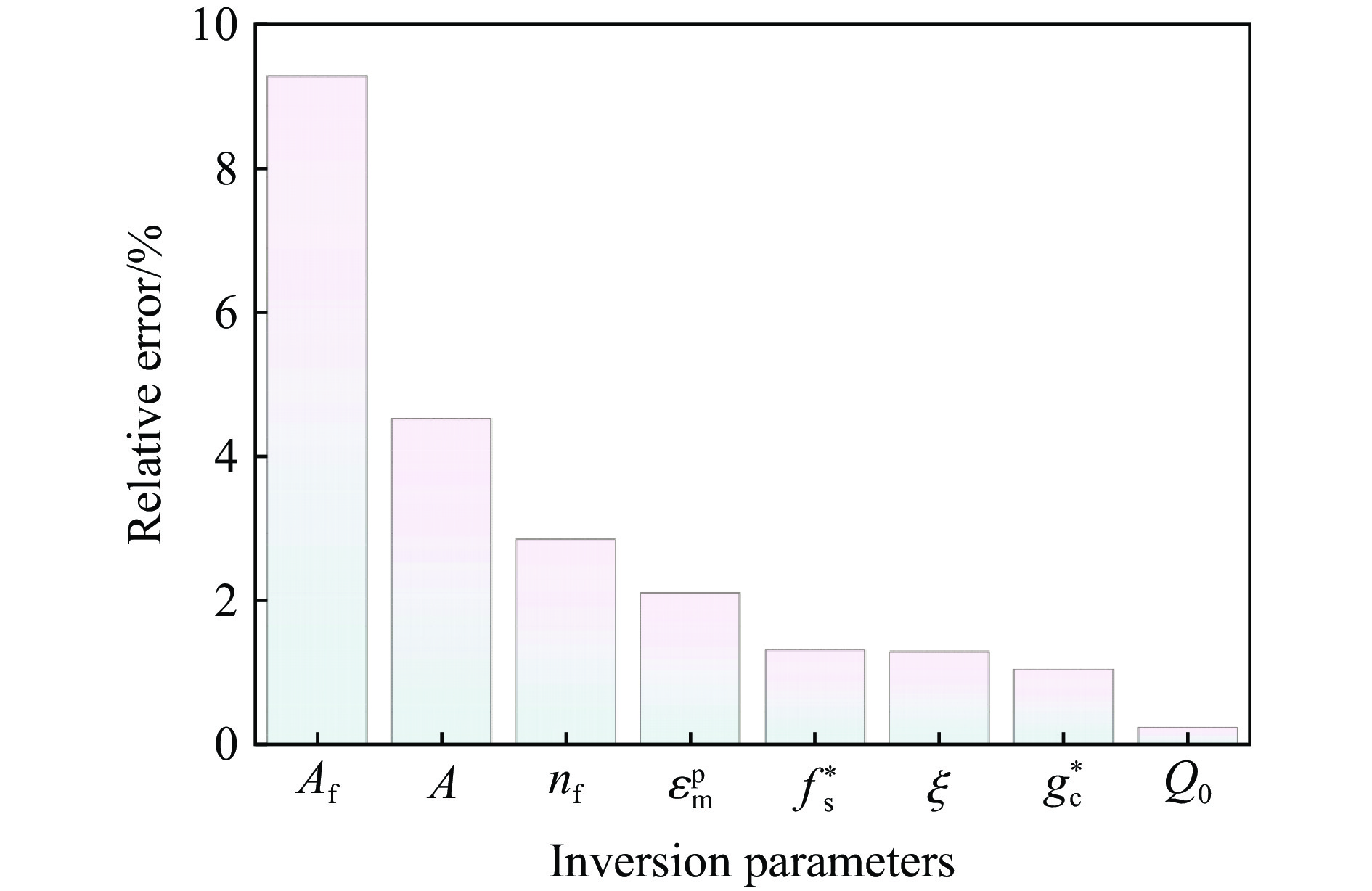
摘要: 针对Riedel-Hiermaier-Thoma (RHT)本构模型中16个难以标定的参数,基于Pianosi-Wagener (PAWN)全局敏感性分析方法与智能优化算法,联合MATLAB与ANSYS/LS-DYNA仿真计算平台,引入应力-应变曲线面积差作为核心评价指标,开发了计算结果的批量提取与自动化三波对齐技术,构建了一套高效、可靠的RHT本构参数反演体系,首次实现了RHT模型关键参数的全局敏感性分析与自动化反演。结果表明,在16个难以标定的参数中,仅有8个参数对模型响应具有显著的影响。基于智能优化算法的参数反演相对误差控制在0.23%~9.28%之间,并通过半圆盘三点弯试验和缩尺爆破试验验证了其可靠性。该方法显著提升了RHT本构参数的标定效率和准确性,其不依赖于构建庞大的样本数据集,适用于多种荷载工况下的参数标定。相较于传统方法,该方法仅需不到15次迭代即可满足反演精度,能满足计算效率和精度的双重需求,具有良好的工程适用性。Abstract: The Riedel-Hiermaier-Thoma (RHT) constitutive model has been widely applied in tunnel blasting, impact-resistant structural design, and underground protective engineering due to its strong capability to describe the mechanical behavior of brittle materials such as rock and concrete under high-strain-rate and high-pressure conditions. However, the model involves a large number of nonlinear parameters, some of which are difficult to determine experimentally because of the high cost of testing. These key parameters are often adjusted through trial-and-error methods, which limit both modeling efficiency and simulation accuracy. To overcome these limitations, a comprehensive parameter inversion framework was developed for 16 difficult-to-calibrate parameters of the RHT model. The framework integrated the PAWN (Pianosi-Wagener) global sensitivity analysis method with intelligent optimization algorithms and coupled MATLAB with the ANSYS/LS-DYNA simulation platform. The area difference of the stress-strain curve was introduced as the core evaluation metric, and a batch result-extraction and automated three-wave alignment technique was developed. Based on these developments, an efficient and reliable RHT parameter inversion system was established, achieving, for the first time, a global sensitivity analysis (GSA) and automated inversion of key parameters in the RHT model. The results show that, among the 16 parameters analyzed, only eight exert a significant influence on the model response. The intelligent optimization–based inversion achieved relative errors ranging from 0.23% to 9.28%, and the reliability of the calibrated parameters was verified through Semicircular Bend Split Hopkinson Pressure Bar (SCB-SHPB) tests and scaled blasting experiments. The proposed method significantly enhances both the efficiency and accuracy of RHT parameter calibration without the need to construct large sample datasets, and it is applicable to a wide range of loading conditions. Compared with traditional calibration approaches, the required inversion accuracy was achieved in fewer than 15 iterations, meeting the dual demands of computational efficiency and precision. Overall, the proposed framework provides a new and effective approach for sensitivity analysis and parameter calibration of dynamic constitutive models, demonstrating strong engineering applicability and practical value.
-
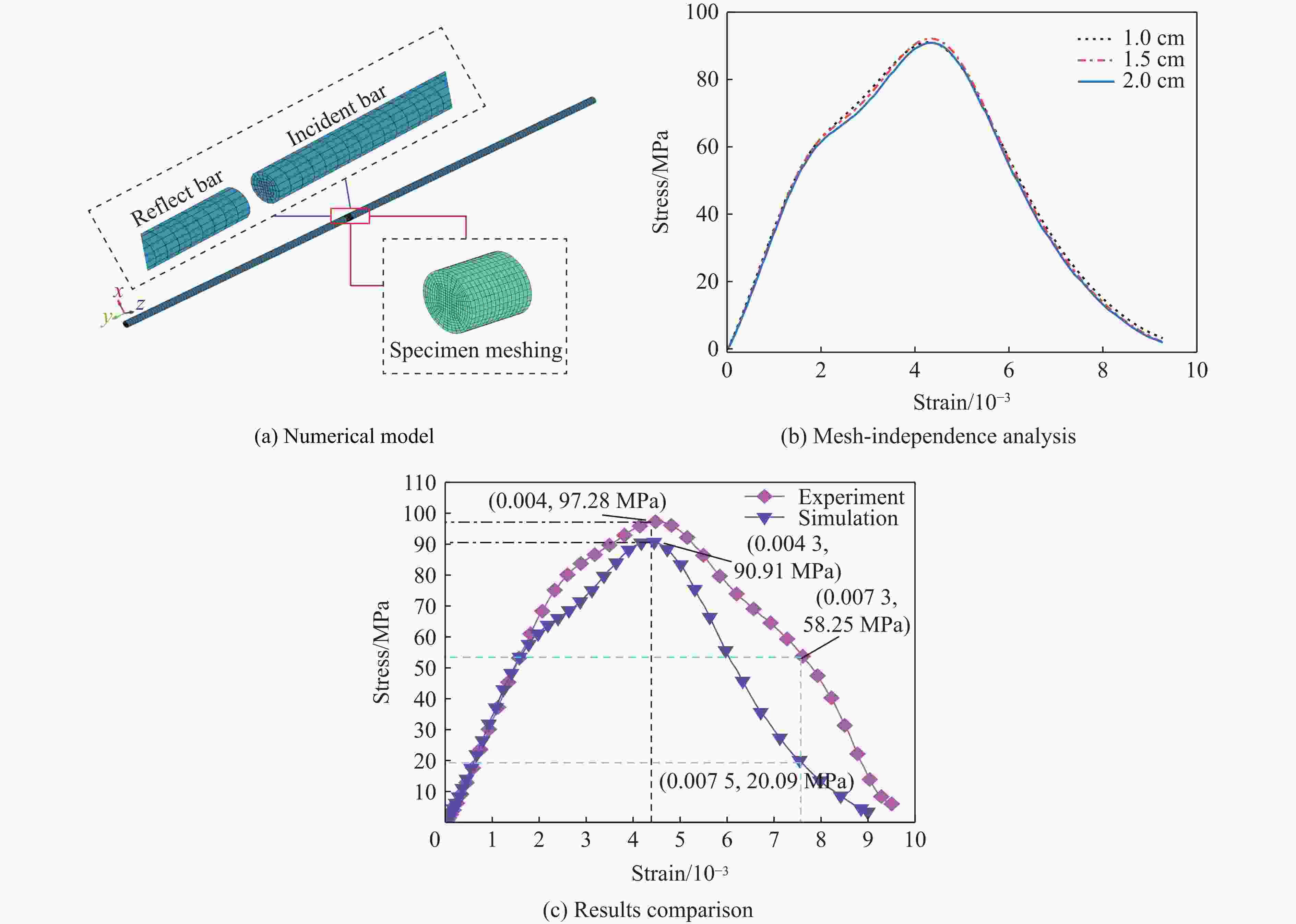
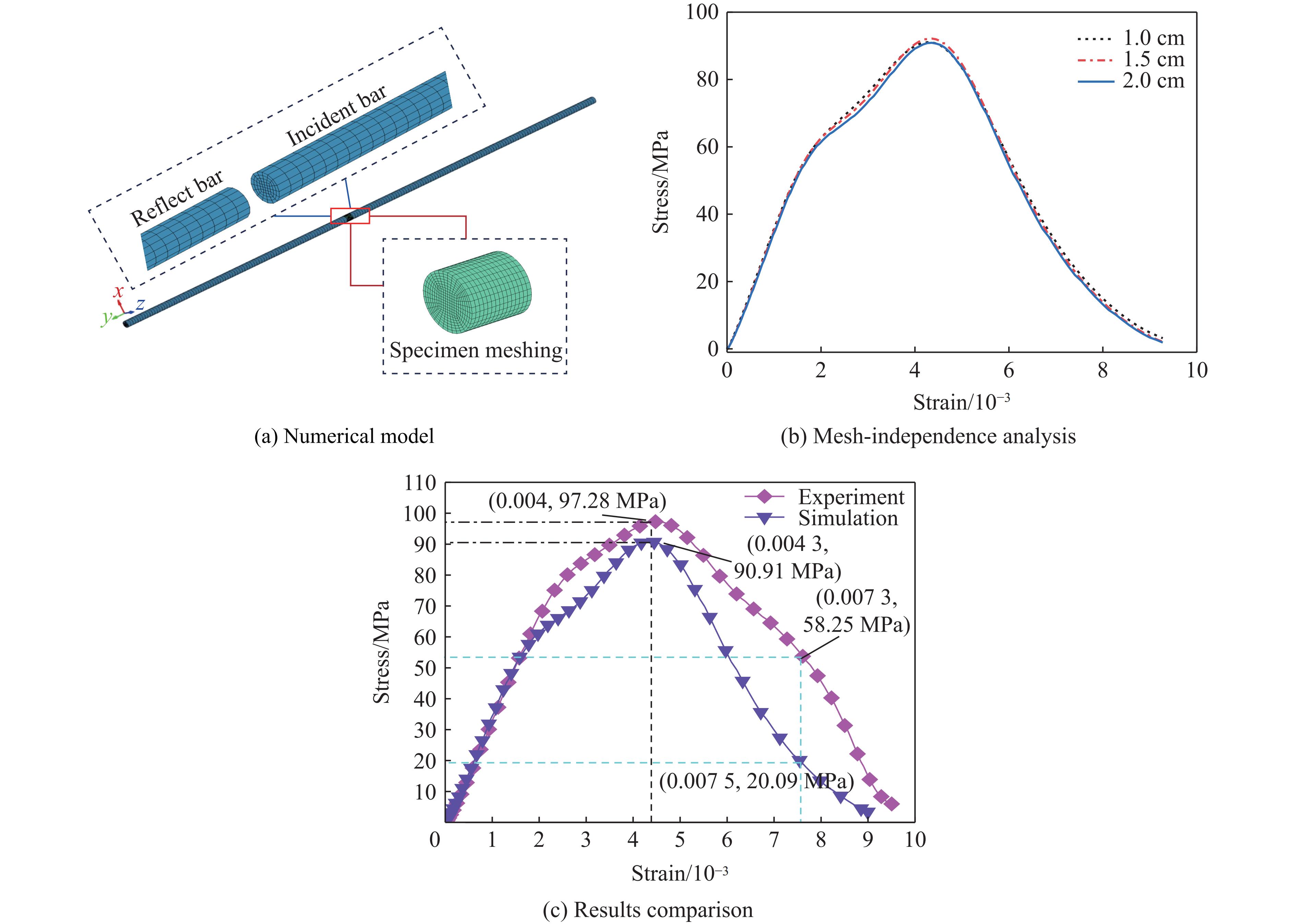
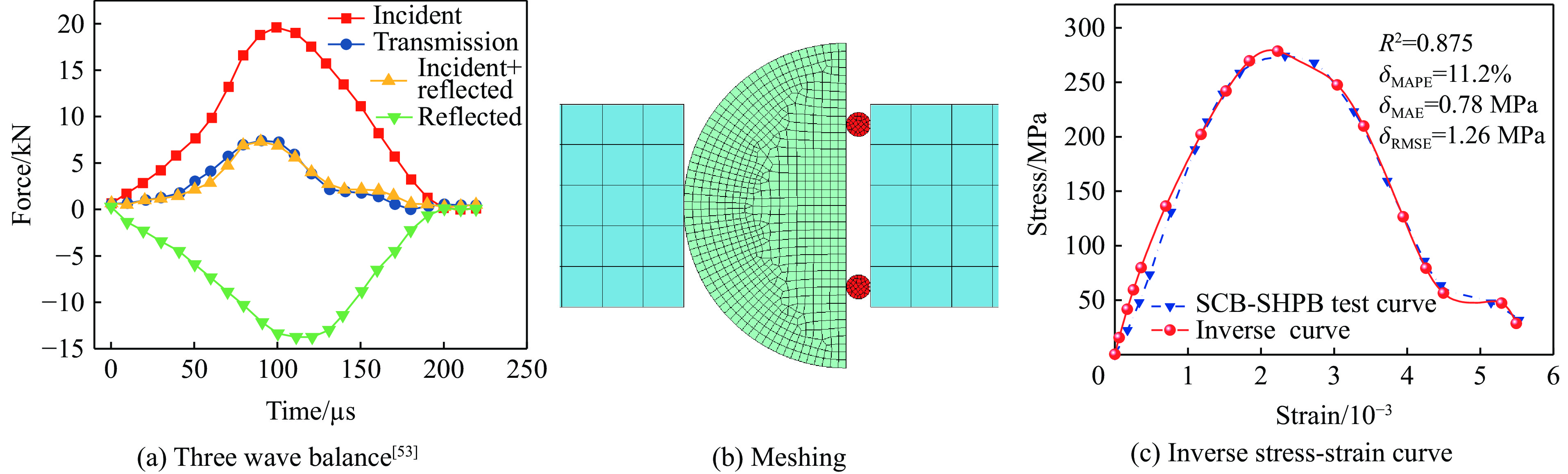
图 5 网格划分与数值模拟结果对比
Figure 5. Comparison of mesh generation and numerical simulation results
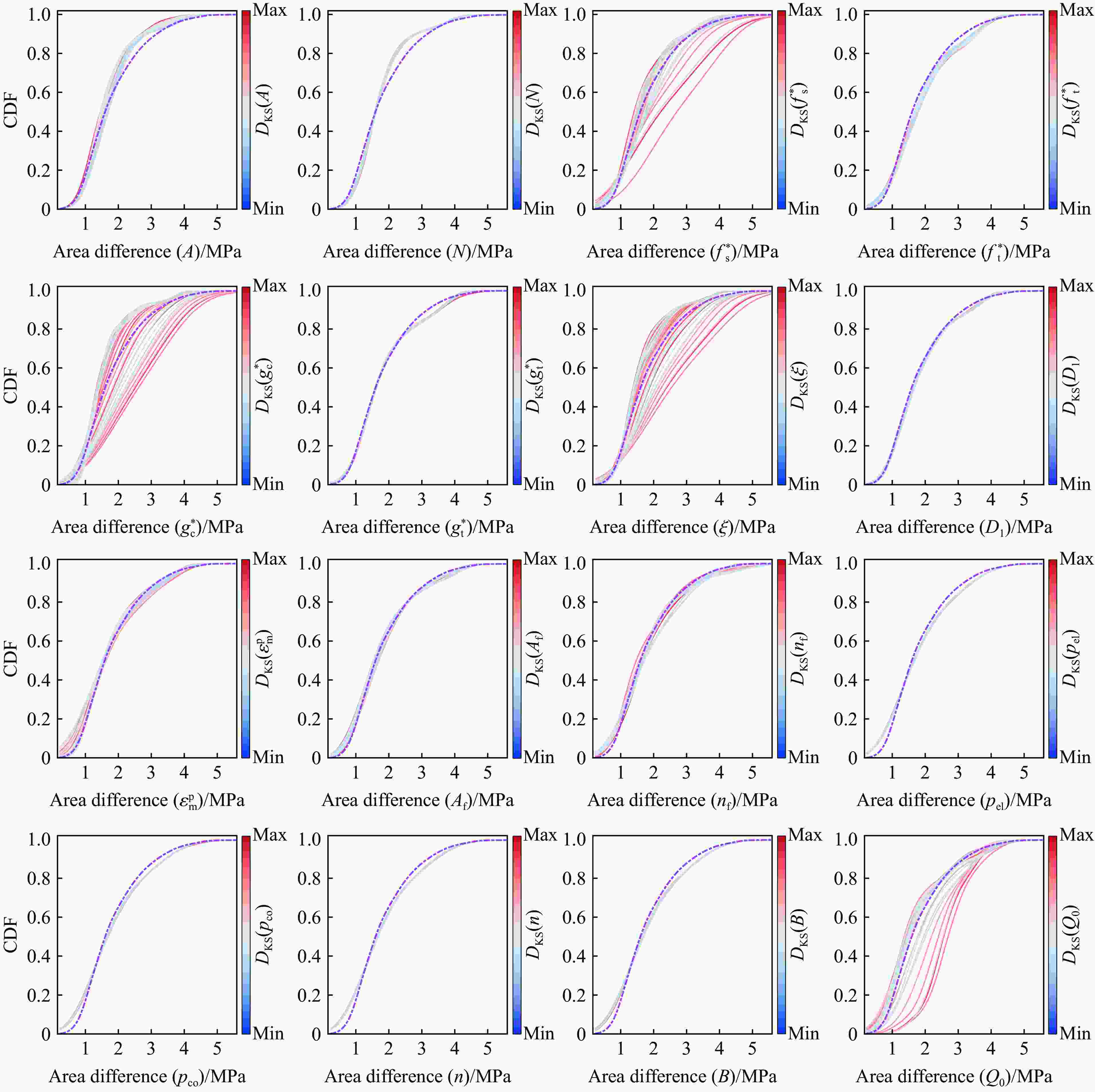
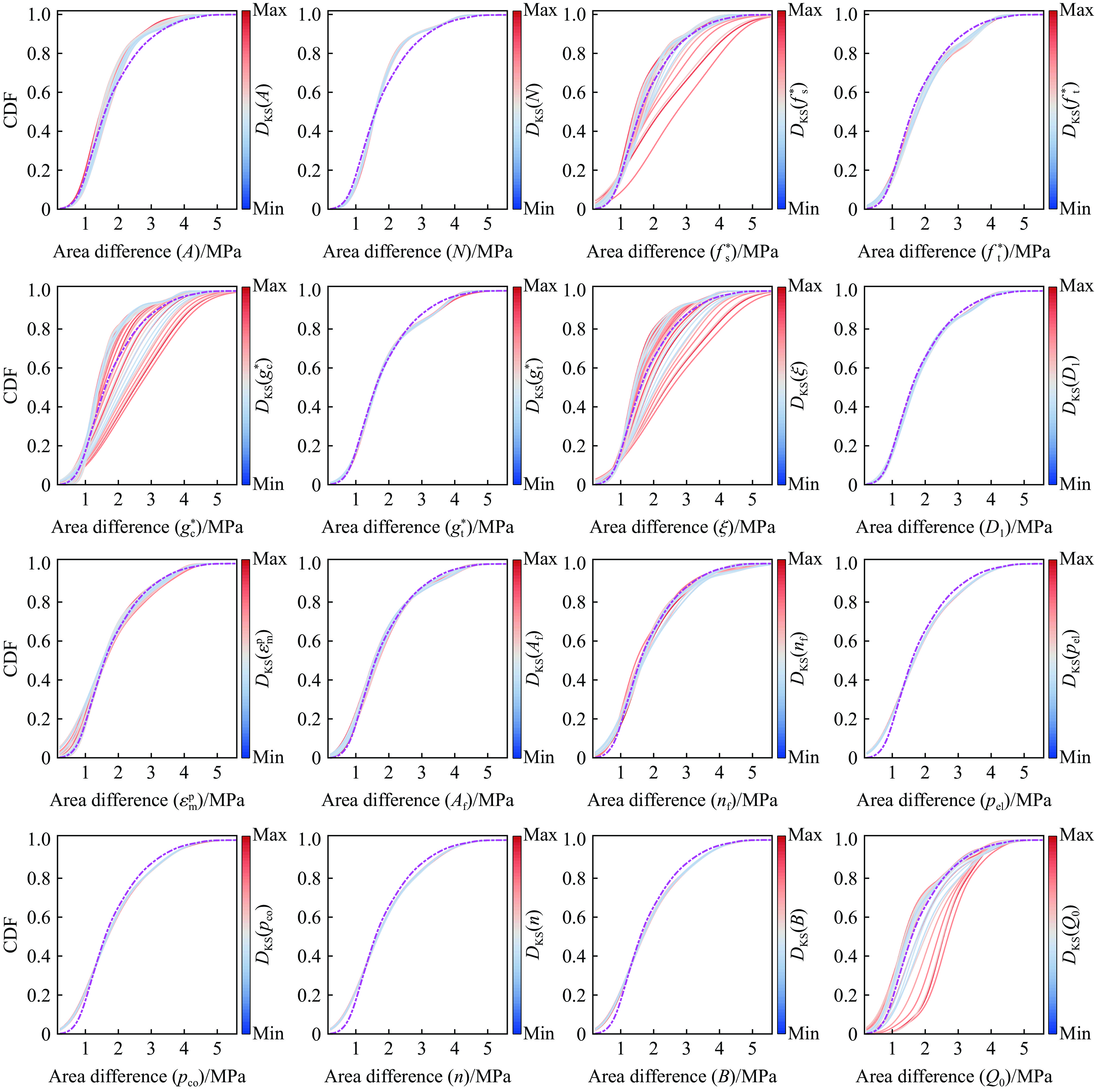
图 8 不同参数的条件CDF曲线与CDF曲线比较
Figure 8. Comparison of conditional CDF curves with different parameters and CDF curves
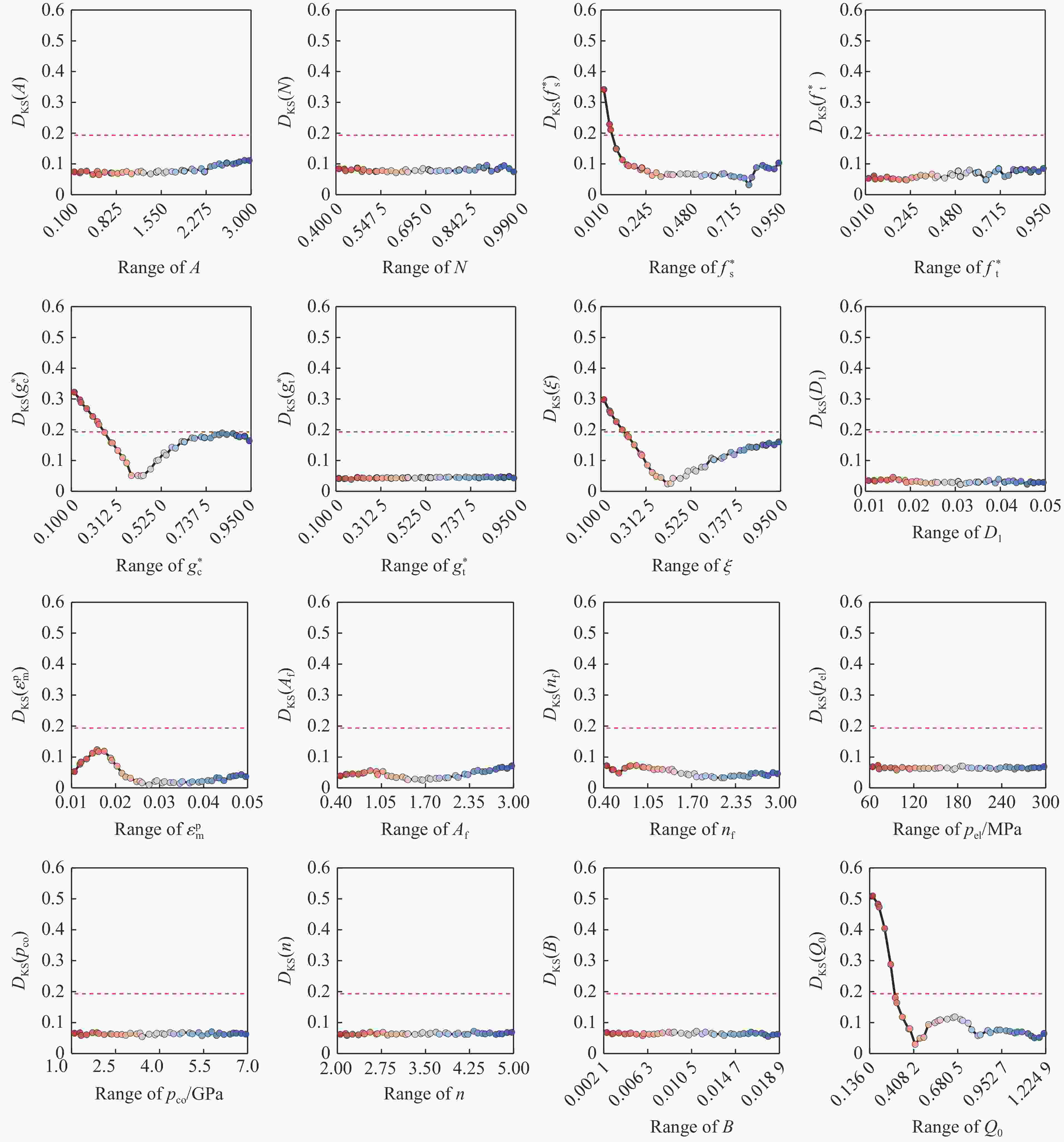
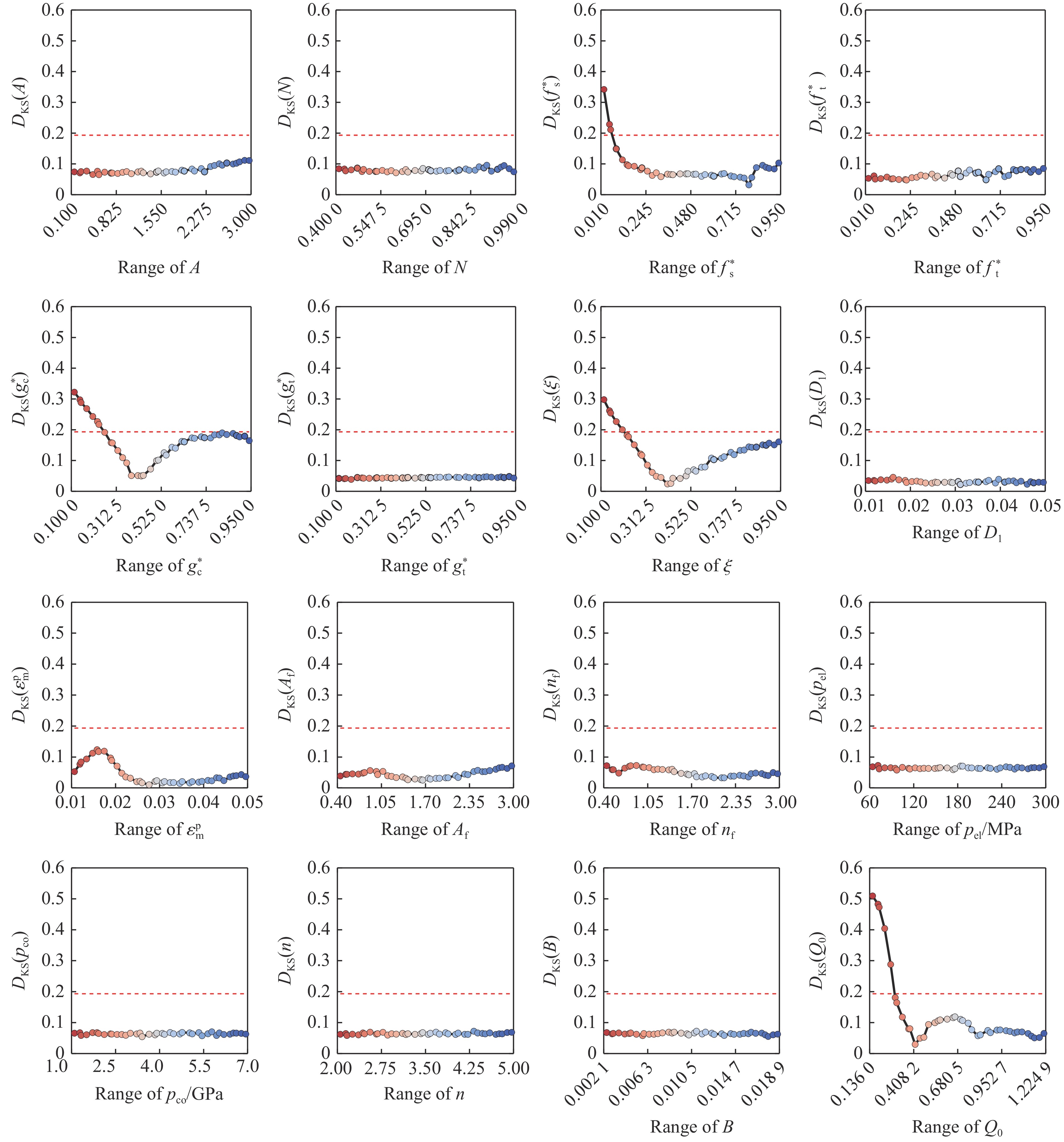
图 9 区间内各参数的KS统计量
Figure 9. KS statistics for each parameter under different conditions
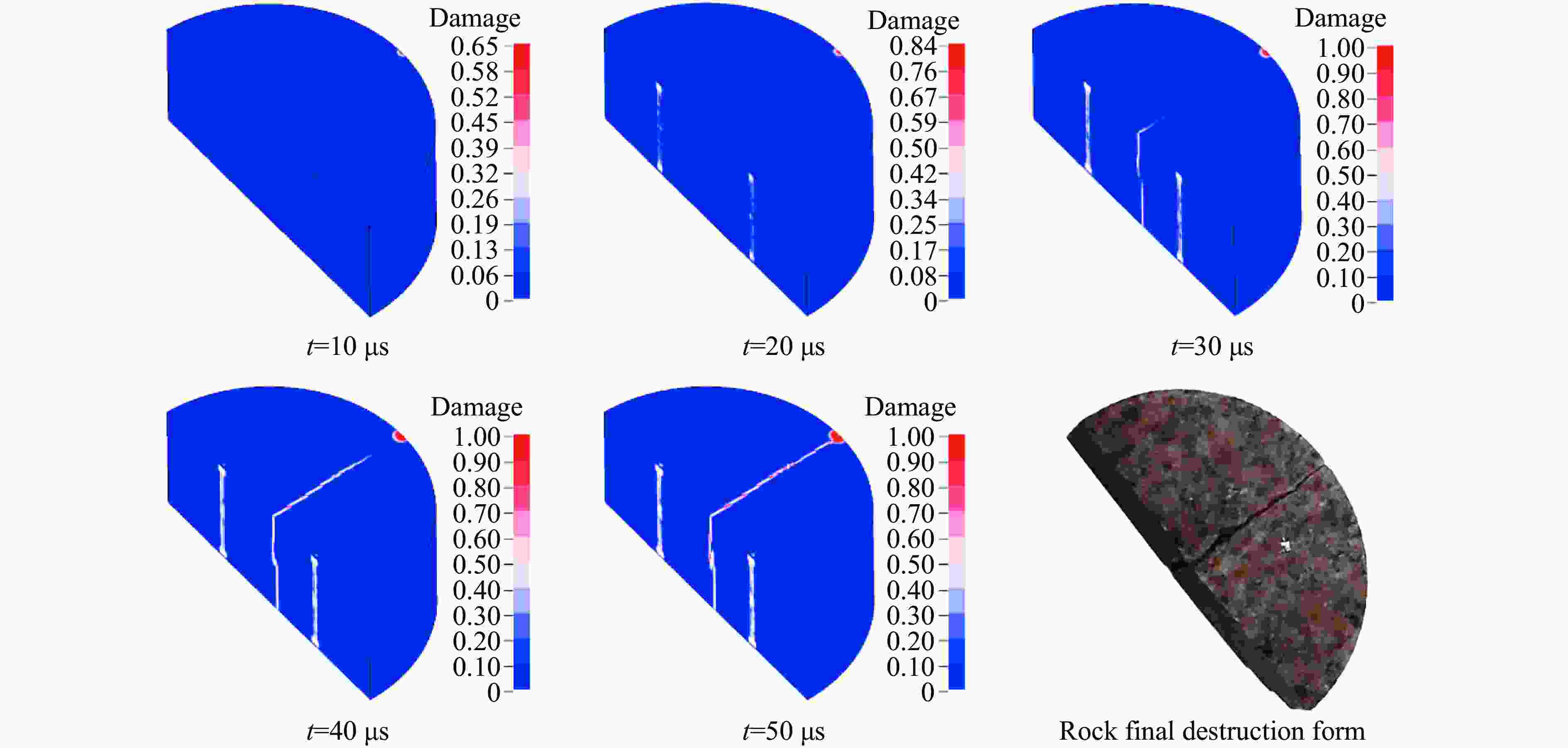
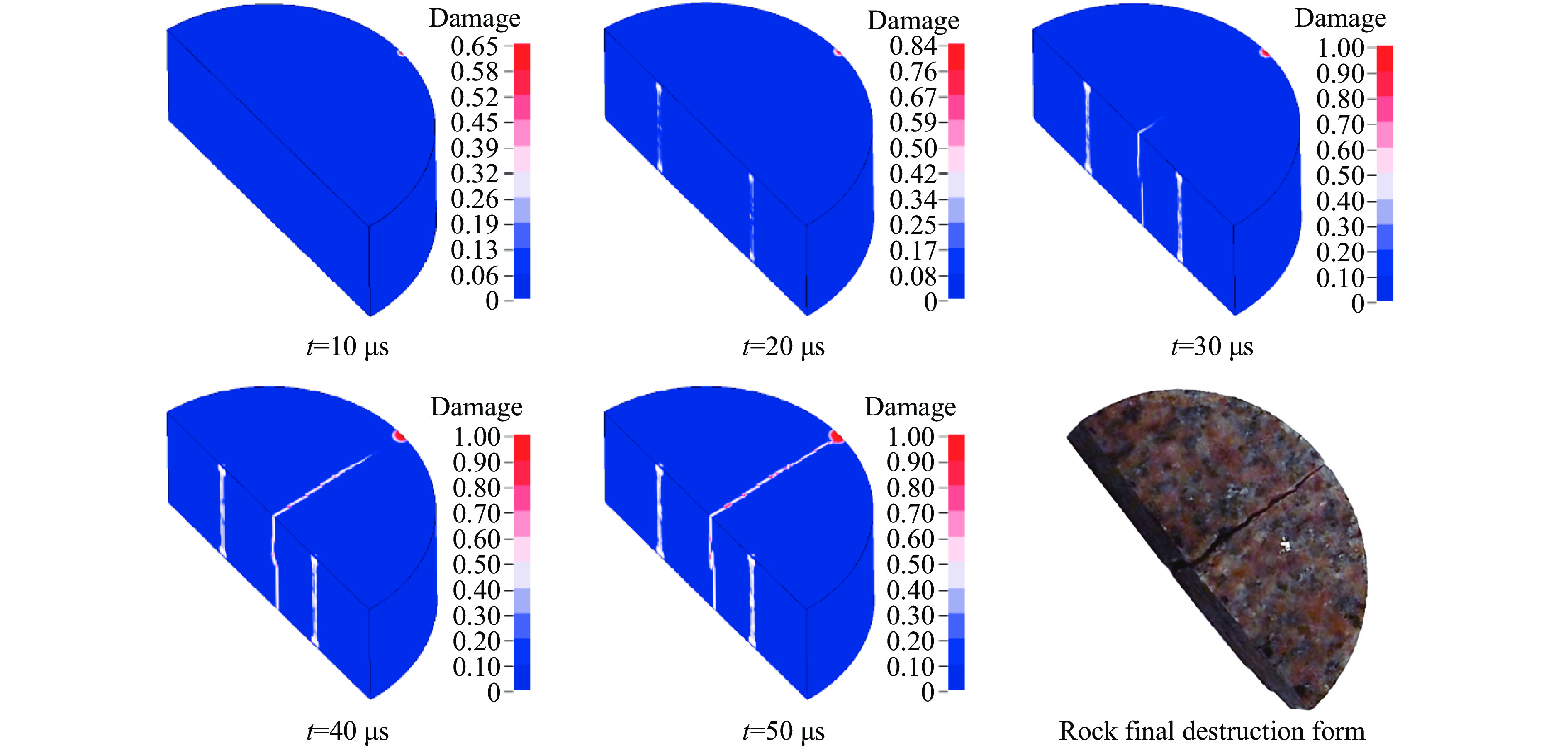
图 19 基于反演参数模拟的岩石损伤模式对比
Figure 19. Comparison of rock damage patterns based on inversion parameter simulation
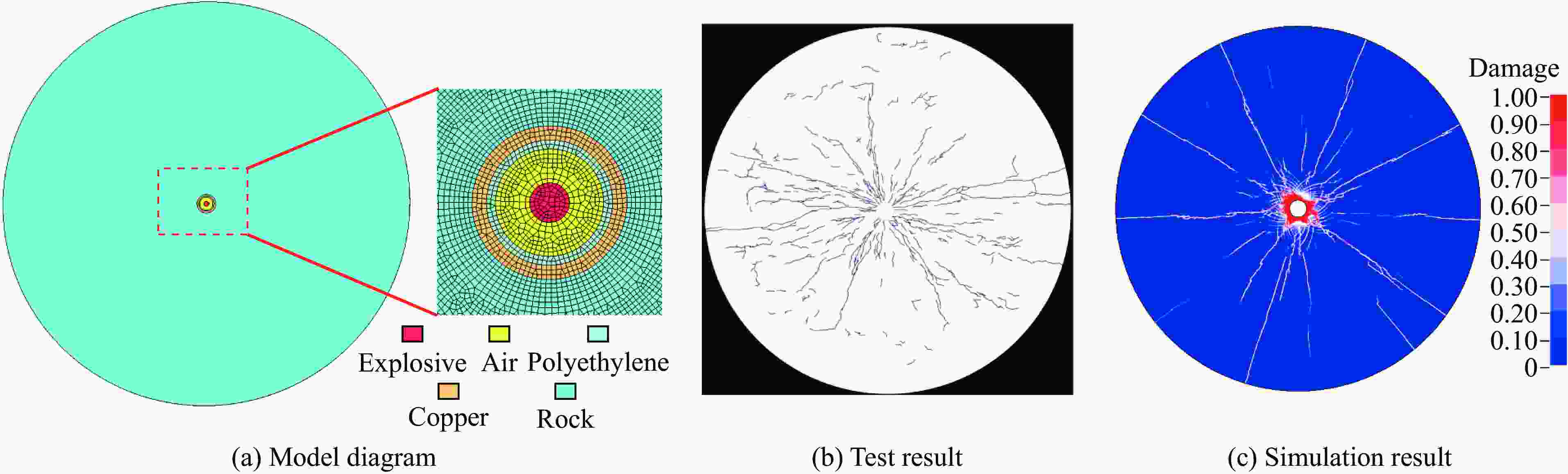
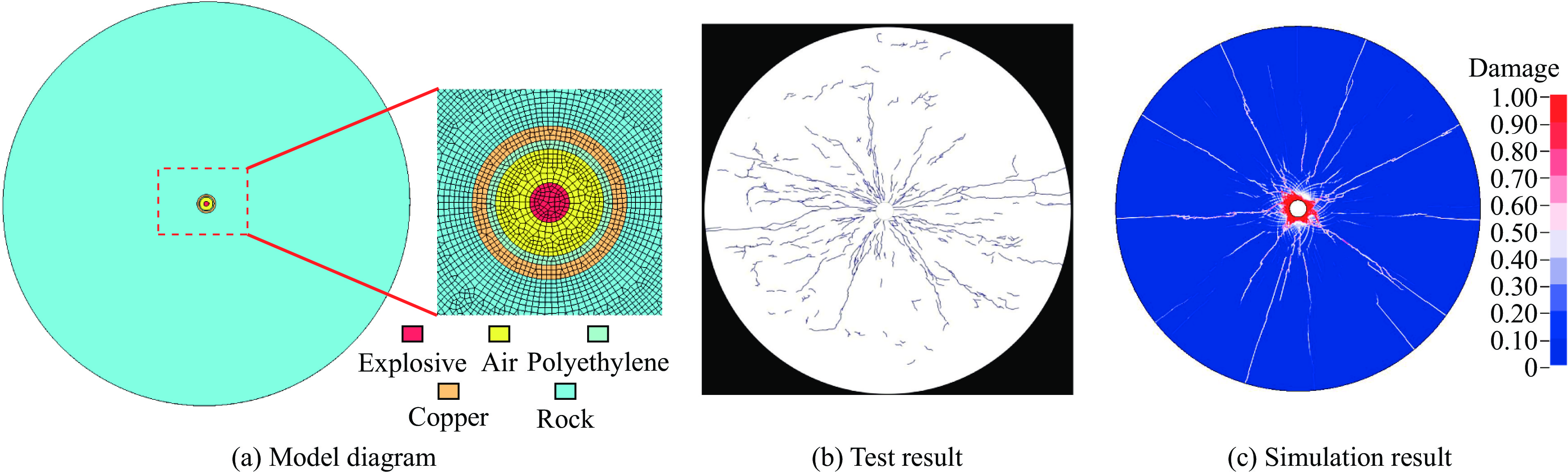
图 20 二维平面裂纹扩展对比
Figure 20. Comparison of expanded two-dimensional plane crack diagrams
表 1 RHT本构模型参数
Table 1. Parameters for RHT constitutive model
参数(单位) 符号 参数(单位) 符号 密度(g/cm3) ρ0 压缩屈服面参数 $ g_{\text{c}}^{\text{*}} $ 抗压强度(MPa) fc 拉伸屈服面参数 $ g_{\text{t}}^{\text{*}} $ 孔隙压缩压力(MPa) pel 压缩应变率指数 βc 孔隙压实压力(GPa) pco 拉伸应变率指数 βt 初始孔隙度 α0 相对抗剪强度 $ f_{\text{s}}^{*} $ 孔隙度指数 n 相对抗拉强度 $ f_{\text{t}}^{*} $ 罗德角相关参数 Q0, B0 剪切模量缩减系数 $ \xi $ 失效面参数 A, N 剪切模量(GPa) G 残余面参数 Af, nf 状态方程参数 B0, B1, T1, T2 损伤参数 D1, D2 Hugoniot多项式系数(GPa) A1, A2, A3 最小等效塑性应变 $ \varepsilon _{\text{m}}^{\text{p}} $ 参考压缩和拉伸应变率 $ {\dot{\varepsilon }}^{\text{c}}_{\text{0}} $,$ {\dot{\varepsilon }}^{\text{t}}_{\text{0}} $ 压缩应变率 $ {\dot{\varepsilon }}^{\text{c}} $ 拉伸应变率 $ {\dot{\varepsilon }}^{\text{t}} $  下载: 导出CSV
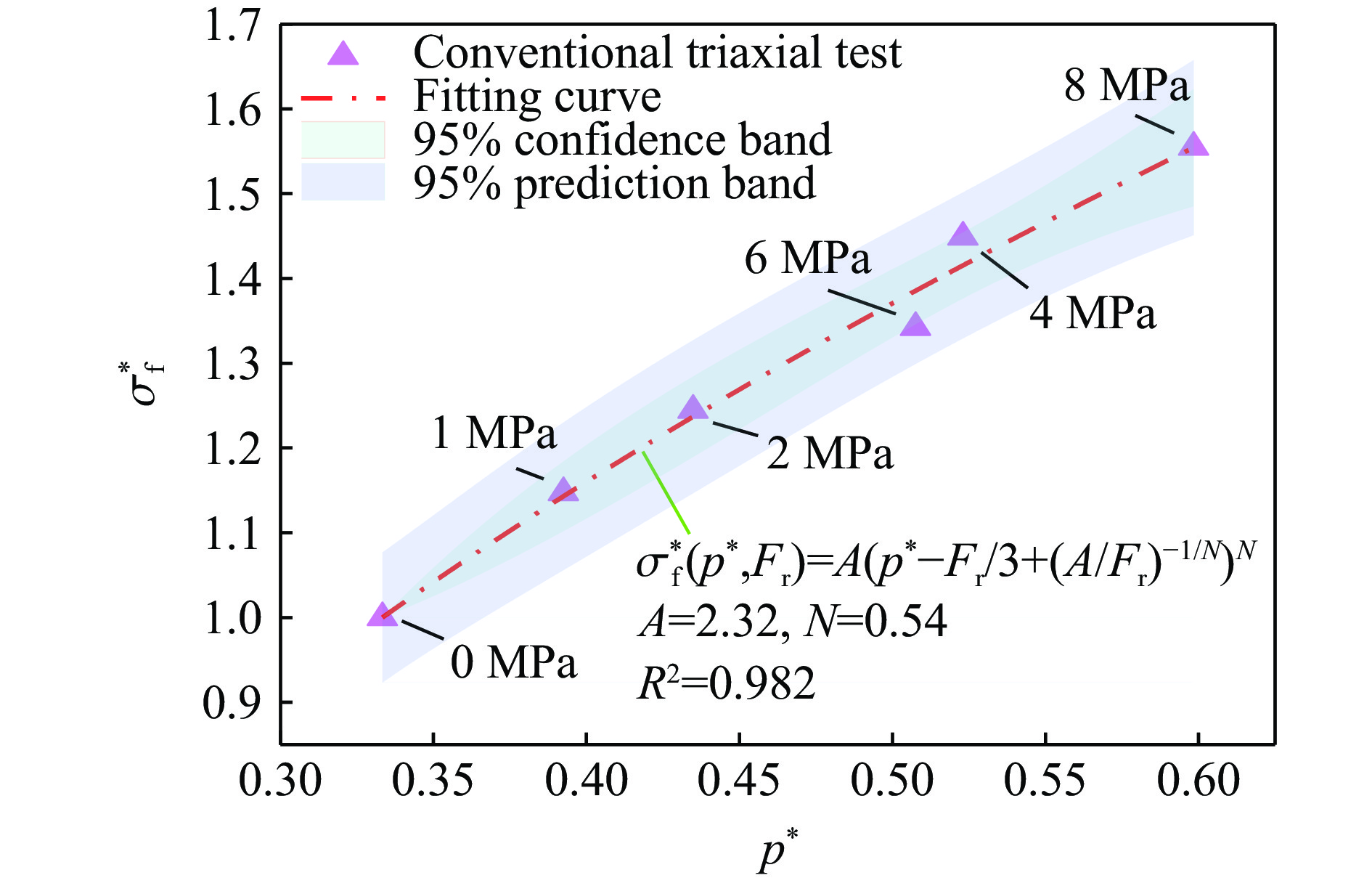
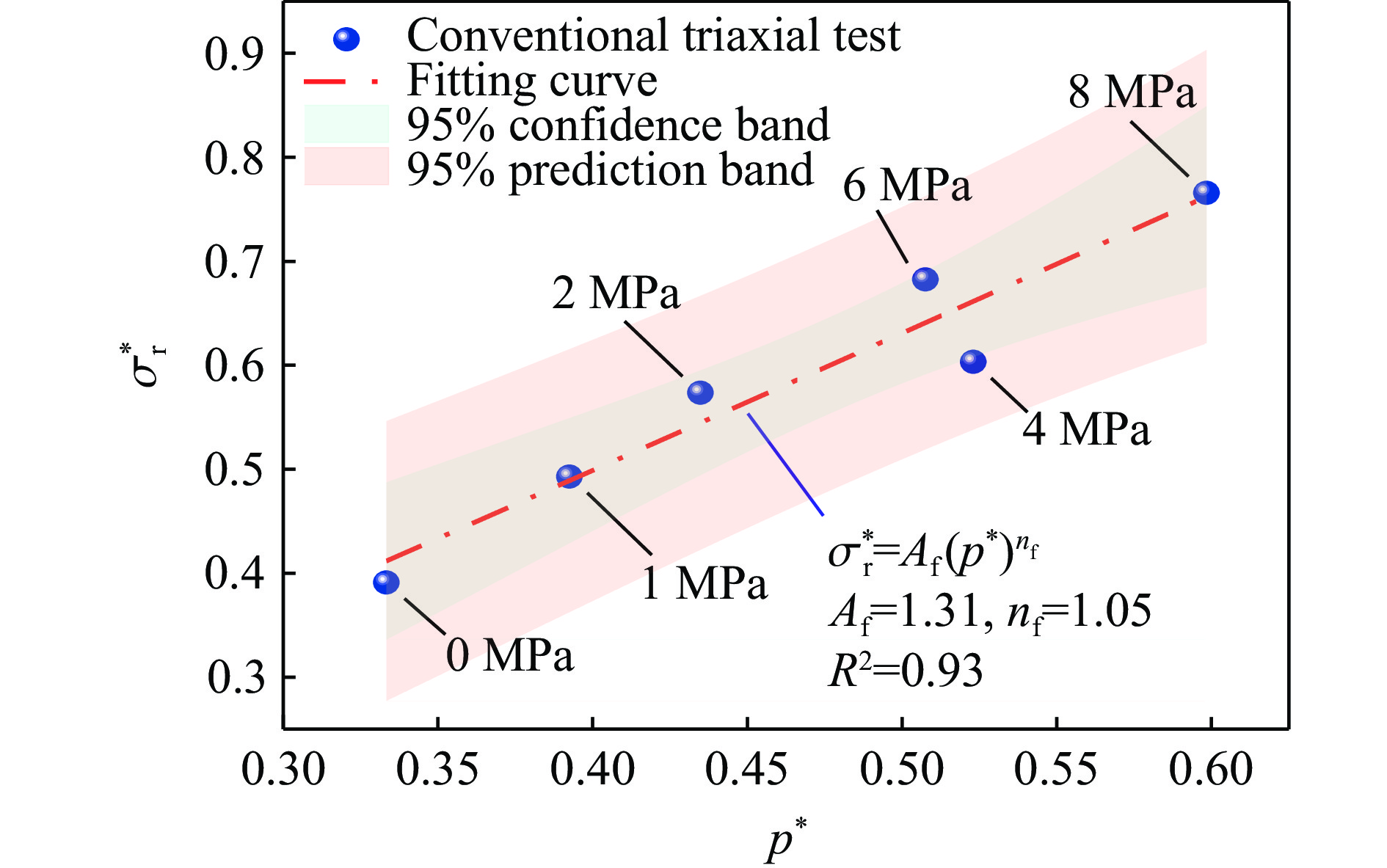
表 2 三轴压缩试验结果
Table 2. Triaxial compression test results
σ2 (= σ3)/MPa σ1/MPa p/MPa σf/MPa σr/MPa 0 99.80 39.16 99.80 24.50 1 115.50 43.40 114.50 39.02 2 126.20 52.20 124.20 49.19 4 148.60 49.65 144.60 57.24 6 136.96 69.72 133.96 60.20 8 133.17 209.56 155.17 68.11
下载: 导出CSV
表 3 参数敏感性分析范围
Table 3. Parameter sensitivity analysis range
参数 范围 参数 范围 A [0.1, 3] Af [0.2, 3] N [0.4, 1] nf [0.2, 3] $ f_{\text{s}}^{\text{*}} $ [0.01, 0.95] $ \varepsilon _{\text{m}}^{\text{p}} $ [0.01, 0.05] $ f_{\text{t}}^{\text{*}} $ [0.01, 0.95] D1 [0.01, 0.05] $ g_{\text{c}}^{\text{*}} $ [0.1, 0.95] B [ 0.0021 ,0.0189 ]$ g_{\rm t}^{\text{*}} $ [0.1, 0.95] Q0 [0.136, 1.224] $ \xi $ [0.1, 0.95] pco/GPa [1, 7] n [2, 5] pel/MPa [60, 300]
下载: 导出CSV
表 4 待反演参数的上下限
Table 4. Upper and lower limits of inversion parameters
反演参数 Q0 $ f_{\text{s}}^{\text{*}} $ $ g_{\text{c}}^{\text{*}} $ $ \xi $ A $ \varepsilon _{\text{m}}^{\text{p}} $ Af nf 上限 1.10 0.55 0.85 0.2 3.0 0.016 2.1 1.68 初始值 0.685 0.346 0.53 0.5 2.32 0.01 1.31 1.05 下限 0.27 0.14 0.21 0.8 0.91 0.004 0.524 0.42
下载: 导出CSV
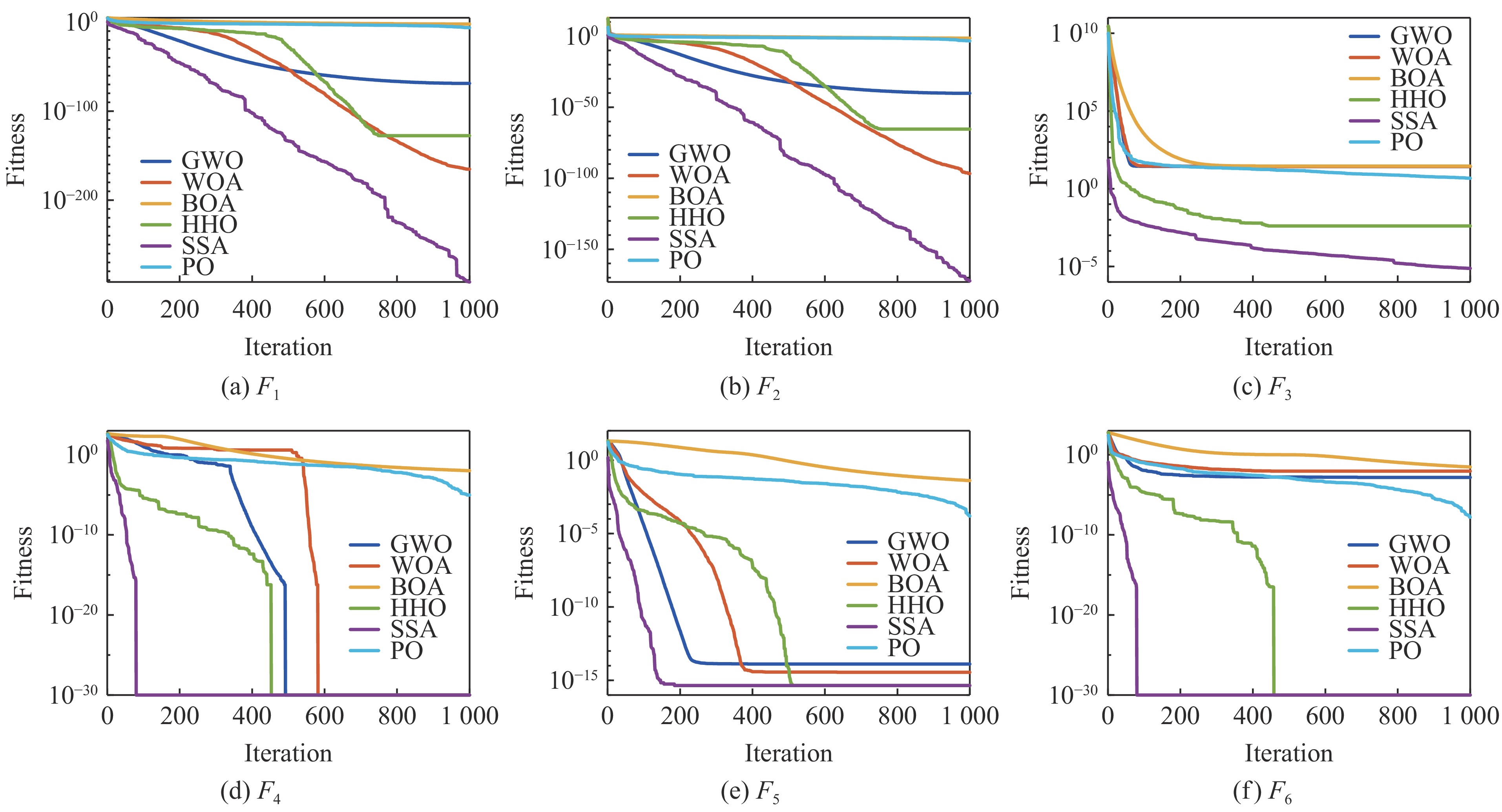
表 5 不同类型测试函数
Table 5. Different types of test functions
函数类型 测试函数 x取值范围 Fmin 单模态 $ {F}_{1}\left(x\right)=\displaystyle\sum\limits_{i=1}^{n}x_{i}^{2} $ [−100, 100] 0 $ {F}_{2}\left(x\right)=\displaystyle\sum\limits_{i=1}^{n}\left| {x}_{i}\right| +\prod\limits_{i=1}^{n}\left| {x}_{i}\right| $ [−10, 10] 0 $ {F}_{3}\left(x\right)=\displaystyle\sum\limits_{i=1}^{n-1}\left[100{({{x}_{i+1}}-{x_{i}^{2}})}^{2}+{({{x}_{i}}-1)}^{2}\right] $ [−30, 30] 0 多模态 $ {F}_{4}\left(x\right)=\displaystyle\sum\limits_{i=1}^{n}\left[x_{i}^{2}-10\cos (2\text{π}{x}_{i})+10\right] $ [−5.12, 5.12] 0 $ {F}_{5}\left(x\right)=-20\exp \left(-0.2\sqrt{\dfrac{1}{n}\displaystyle\sum\limits_{i=1}^{n}\mathrm{x}_{i}^{2}}\right)-\exp \left(\dfrac{1}{n}\displaystyle\sum\limits_{i=1}^{n}\text{cos}\left(2\text{π}{x}_{i}\right)\right) +20+ e$ [−32, 32] 0 $ {F}_{6}\left(x\right)=\displaystyle\frac{1}{4\;000}\sum\limits_{i=1}^{n}x_{i}^{2}-\prod\limits_{i=1}^{n}\text{cos}\left(\frac{{x}_{i}}{\sqrt{i}}\right)+1 $ [−600, 600] 0
下载: 导出CSV
表 6 各算法初始值
Table 6. Each algorithm parameter control initial value
算法 参数 参数取值 算法 参数 参数取值 GWO 收敛因子τ 从2到0 HHO 搜索开发切换参数ε 2.0 协同系数向量(u) [−u, u] 围攻策略参数γ 1.5 协同系数向量(w) [0, 2]区间随机取值 随机跳跃强度J 0.3 WOA 搜索因子g 从2到0 SSA 发现者比例 20% 螺旋形态参数k 1 警戒者比例 10% 随机向量M、N $ M\in[-a,\mathrm{ }a] $;$ N\in $[0, 2] 安全阈值 0.8 PO 社交权重ωs 0.5 BOA 感知概率$ \psi $ 0.7 探索概率η 0.7 扰动系数β 0.05 气味强度系数c 0.03 学习因子λ 0.3
下载: 导出CSV
表 7 各算法性能比较
Table 7. Performance comparison of various algorithms
算法 指标 F1 F2 F3 F4 F5 F6 GWO Opt 2.8×10−72 4.8×10−42 2.5×101 1.0×10−300 7.5×10⁻¹⁵ 1.0×10−300 Std 9.8×10−69 7.0×10−41 8.2×10⁻¹ 3.7×10⁻¹ 3.0×10⁻¹⁵ 6.1×10⁻³ Ave 2.2×10−69 7.1×10−41 2.7×101 6.8×10⁻² 1.3×10⁻¹⁴ 2.6×10⁻³ WOA Opt 6.4×10−182 2.6×10−110 2.6×101 1.0×10−300 4.4×10⁻¹⁶ 1.0×10−300 Std 1.0×10−300 5.3×10−98 2.5×10⁻¹ 1.0×10−300 2.6×10⁻¹⁵ 4.5×10⁻³ Ave 1.4×10−165 1.1×10−98 2.7×101 1.0×10−300 3.5×10⁻¹⁵ 8.3×10⁻⁴ BOA Opt 7.0×10⁻³ 3.5×10⁻² 2.9×101 8.2×10⁻³ 3.9×10⁻² 2.7×10⁻² Std 2.6×10⁻⁴ 8.7×10⁻³ 3.6×10⁻² 5.6×10⁻³ 1.3×10⁻³ 1.5×10⁻³ Ave 7.4×10⁻³ 4.3×10⁻² 2.9×101 1.1×10⁻² 4.1×10⁻² 3.0×10⁻² HHO Opt 6.3×10−145 2.8×10−75 2.1×10⁻⁴ 1.0×10−300 4.4×10⁻¹⁶ 1.0×10−300 Std 4.9×10−123 4.1×10−65 1.5×10⁻² 1.0×10−300 1.0×10−300 1.0×10−300 Ave 9.0×10−124 8.7×10−66 7.8×10⁻³ 1.0×10−300 4.4×10⁻¹⁶ 1.0×10−300 SSA opt 1.0×10−300 1.0×10−300 3.6×10⁻¹¹ 1.0×10−300 4.4×10⁻¹⁶ 1.0×10−300 Std 1.0×10−300 1.0×10−300 4.1×10⁻⁶ 1.0×10−300 1.0×10−300 1.0×10−300 Ave 1.2×10−297 3.9×10−178 2.5×10⁻⁶ 1.0×10−300 4.4×10⁻¹⁶ 1.0×10−300 PO Opt 6.2×10⁻⁷ 2.8×10⁻⁷ 1.0×100 4.4×10⁻⁵ 2.7×10⁻⁸ 3.2×10⁻⁸ Std 8.1×10⁻⁷ 1.1×10⁻³ 8.6×100 5.6×10⁻⁵ 2.0×10⁻⁴ 3.5×10⁻⁸ Ave 3.0×10⁻⁷ 5.4×10⁻⁴ 7.3×100 1.8×10⁻⁵ 1.2×10⁻⁴ 1.4×10⁻⁸
下载: 导出CSV
表 8 中高敏感性参数最终反演值
Table 8. Final inversion values of medium and high sensitivity parameters
反演参数 Q0 $ f_{\rm s}^{*} $ $ g_{\rm c}^{*} $ $ \xi $ A $ \varepsilon _{\text{m}}^{\text{p}} $ Af nf 试验标定值 0.6805 0.34 0.53 0.5 2.32 0.01 1.31 1.05 反演值 0.62 0.42 0.72 0.65 2.52 0.016 1.45 0.81
下载: 导出CSV
表 9 花岗岩RHT本构参数的反演值
Table 9. Inverse values of RHT constitutive parameters of granite
参数 取值 参数 取值 参数 取值 fc/MPa 259 Af 2.01 A1/GPa 32.95 ρ0/(g·cm−3) 2.63 nf 1.11 A2/GPa 47.45 A 2.09 $ \varepsilon _{\text{m}}^{\text{p}} $ 0.0138 A3/GPa 19.28 N 0.76 D1 0.048 B0 1.44 $ f_{\text{s}}^{\text{*}} $ 0.24 D2 1 B1 1.44 $ f_{\text{t}}^{\text{*}} $ 0.049 B 0.0105 βc 0.0072 $ g_{\text{c}}^{\text{*}} $ 0.647 Q0 0.272 βt 0.005 $ g_{\text{t}}^{\text{*}} $ 0.7 pel/MPa 172.6 pco/GPa 6 $ \xi $ 0.7 α0 1.06 n 3
下载: 导出CSV
-
[1] CHEN C, ZHANG X H, HAO H, et al. Discussion on the suitability of dynamic constitutive models for prediction of geopolymer concrete structural responses under blast and impact loading [J]. International Journal of Impact Engineering, 2022, 160: 104064. DOI: 10.1016/j.ijimpeng.2021.104064. [2] YAN L, CHEN L, CHEN B Y, et al. Analysis and evaluation of suitability of high-pressure dynamic constitutive model for concrete under blast and impact loading [J]. International Journal of Impact Engineering, 2025, 195: 105145. DOI: 10.1016/j.ijimpeng.2024.105145. [3] RIEDEL W, THOMA K, HIERMAIER S, et al. Penetration of reinforced concrete by BETA-B-500 numerical analysis using a new macroscopic concrete model for hydrocodes [C]//Proceedings of the 9th International Symposium on the Effects of Munitions with Structures: Vol. 315. Berlin-Strausberg Germany, 1999: 315–322. [4] BANADAKI M M D. Stress-wave induced fracture in rock due to explosive action [D]. Toronto: University of Toronto, 2010. [5] XIE L X, LU W B, ZHANG Q B, et al. Damage evolution mechanisms of rock in deep tunnels induced by cut blasting [J]. Tunnelling and Underground Space Technology, 2016, 58: 257–270. DOI: 10.1016/j.tust.2016.06.004. [6] PAN C, XIE L X, LI X, et al. Numerical investigation of effect of eccentric decoupled charge structure on blasting-induced rock damage [J]. Journal of Central South University, 2022, 29(2): 663–679. DOI: 10.1007/s11771-022-4947-3. [7] TIAN H F, BAO T, LI Z, et al. Determination of constitutive parameters of crystalline limestone based on improved RHT model [J]. Advances in Materials Science and Engineering, 2022, 2022: 3794898. DOI: 10.1155/2022/3794898. [8] LI S L, LING T L, LIU D S, et al. Determination of rock mass parameters for the RHT model based on the Hoek–Brown criterion [J]. Rock Mechanics and Rock Engineering, 2023, 56(4): 2861–2877. DOI: 10.1007/s00603-022-03189-9. [9] WANG H C, WANG Z L, WANG J G, et al. Effect of confining pressure on damage accumulation of rock under repeated blast loading [J]. International Journal of Impact Engineering, 2021, 156: 103961. DOI: 10.1016/j.ijimpeng.2021.103961. [10] NI Y, WANG Z L, LI S Y, et al. Numerical study on the dynamic fragmentation of rock under cyclic blasting and different in-situ stresses [J]. Computers and Geotechnics, 2024, 172: 106404. DOI: 10.1016/j.compgeo.2024.106404. [11] 李洪超, 刘殿书, 赵磊, 等. 大理岩RHT模型参数确定研究 [J]. 北京理工大学学报, 2017, 37(8): 801–806. DOI: 10.15918/j.tbit1001-0645.2017.08.006.LI H C, LIU D S, ZHAO L, et al. Study on parameters determination of marble RHT model [J]. Transactions of Beijing Institute of Technology, 2017, 37(8): 801–806. DOI: 10.15918/j.tbit1001-0645.2017.08.006. [12] LEVASSEUR S, MALÉCOT Y, BOULON M, et al. Soil parameter identification using a genetic algorithm [J]. International Journal for Numerical and Analytical Methods in Geomechanics, 2008, 32(2): 189–213. DOI: 10.1002/nag.614. [13] ROKONUZZAMAN M, SAKAI T. Calibration of the parameters for a hardening–softening constitutive model using genetic algorithms [J]. Computers and Geotechnics, 2010, 37(4): 573–579. DOI: 10.1016/j.compgeo.2010.02.007. [14] PARK D, PARK E S. Inverse parameter fitting of tunnels using a response surface approach [J]. International Journal of Rock Mechanics and Mining Sciences, 2015, 77: 11–18. DOI: 10.1016/j.ijrmms.2015.03.026. [15] SUN J L, WU S C, WANG H, et al. Inversion of surrounding rock mechanical parameters in a soft rock tunnel based on a hybrid model EO-LightGBM [J]. Rock Mechanics and Rock Engineering, 2023, 56(9): 6691–6707. DOI: 10.1007/s00603-023-03387-z. [16] CUI J Q, WU S C, CHENG H Y, et al. Composite interpretability optimization ensemble learning inversion surrounding rock mechanical parameters and support optimization in soft rock tunnels [J]. Computers and Geotechnics, 2024, 165: 105877. DOI: 10.1016/j.compgeo.2023.105877. [17] ZHOU C J, GAO B, YAN B, et al. A combined machine learning/search algorithm-based method for the identification of constitutive parameters from laboratory tests and in-situ tests [J]. Computers and Geotechnics, 2024, 170: 106268. DOI: 10.1016/j.compgeo.2024.106268. [18] ÖZEL T, KARPAT Y. Identification of constitutive material model parameters for high-strain rate metal cutting conditions using evolutionary computational algorithms [J]. Materials and Manufacturing Processes, 2007, 22(5): 659–667. DOI: 10.1080/10426910701323631. [19] ANDRADE-CAMPOS A, THUILLIER S, PILVIN P, et al. On the determination of material parameters for internal variable thermoelastic–viscoplastic constitutive models [J]. International Journal of Plasticity, 2007, 23(8): 1349–1379. DOI: 10.1016/j.ijplas.2006.09.002. [20] ZHAI Y, ZHAO R F, LI Y B, et al. Stochastic inversion method for dynamic constitutive model of rock materials based on improved DREAM [J]. International Journal of Impact Engineering, 2021, 147: 103739. DOI: 10.1016/j.ijimpeng.2020.103739. [21] MENG K, YE G G. An inversion study of constitutive parameters for powder liner and hard rock based on finite element simulation [J]. Applied Sciences, 2025, 15(6): 3065. DOI: 10.3390/app15063065. [22] 宋力, 胡时胜. SHPB数据处理中的二波法与三波法 [J]. 爆炸与冲击, 2005, 25(4): 368–373. DOI: 10.11883/1001-1455(2005)04-0368-06.SONG L, HU S S. Two-wave and three-wave method in SHPB data processing [J]. Explosion and Shock Waves, 2005, 25(4): 368–373. DOI: 10.11883/1001-1455(2005)04-0368-06. [23] WANG Z L, HUANG Y P, LI S Y, et al. SPH-FEM coupling simulation of rock blast damage based on the determination and optimization of the RHT model parameters [J]. IOP Conference Series: Earth and Environmental Science, 2020, 570(4): 042035. DOI: 10.1088/1755-1315/570/4/042035. [24] 刘殿柱, 刘娜, 高天赐, 等. 应用正交试验法的RHT模型参数敏感性研究 [J]. 北京理工大学学报, 2019, 39(6): 558–564. DOI: 10.15918/j.tbit1001-0645.2019.06.002.LIU D Z, LIU N, GAO T C, et al. Study on the parameter sensitivity of RHT concrete model by orthogonal test technique [J]. Transactions of Beijing Institute of Technology, 2019, 39(6): 558–564. DOI: 10.15918/j.tbit1001-0645.2019.06.002. [25] ROUHANI H, FARROKH E. Failure analysis of Nehbandan granite under various stress states and strain rates using a calibrated Riedel–Hiermaier–Thoma constitutive model [J]. Geomechanics and Geophysics for Geo-Energy and Geo-Resources, 2024, 10(1): 157. DOI: 10.1007/s40948-024-00876-5. [26] 马凯, 任高峰, 葛永翔, 等. 硬石膏矿RHT动力学模型参数研究 [J]. 爆破, 2024, 41(4): 35–44. DOI: 10.3963/j.issn.1001-487X.2024.04.005.MA K, REN G F, GE Y X, et al. Study on parameters of anhydrite RHT dynamic model [J]. Blasting, 2024, 41(4): 35–44. DOI: 10.3963/j.issn.1001-487X.2024.04.005. [27] 李洪超, 陈勇, 刘殿书, 等. 岩石RHT模型主要参数敏感性及确定方法研究 [J]. 北京理工大学学报, 2018, 38(8): 779–785. DOI: 10.15918/j.tbit1001-0645.2018.08.002.LI H C, CHEN Y, LIU D S, et al. Sensitivity analysis determination and optimization of rock RHT parameters [J]. Transactions of Beijing Institute of Technology, 2018, 38(8): 779–785. DOI: 10.15918/j.tbit1001-0645.2018.08.002. [28] LIU W L, DING L Y. Global sensitivity analysis of influential parameters for excavation stability of metro tunnel [J]. Automation in Construction, 2020, 113: 103080. DOI: 10.1016/j.autcon.2020.103080. [29] WANG Y K, HUANG J S, TANG H M. Global sensitivity analysis of the hydraulic parameters of the reservoir colluvial landslides in the Three Gorges Reservoir area, China [J]. Landslides, 2020, 17(2): 483–494. DOI: 10.1007/s10346-019-01290-9. [30] ZHOU S T, ZHANG Z X, LUO X D, et al. Predicting dynamic compressive strength of frozen-thawed rocks by characteristic impedance and data-driven methods [J]. Journal of Rock Mechanics and Geotechnical Engineering, 2024, 16(7): 2591–2606. DOI: 10.1016/j.jrmge.2023.09.017. [31] SALTELLI A, ANNONI P, AZZINI I, et al. Variance based sensitivity analysis of model output. Design and estimator for the total sensitivity index [J]. Computer Physics Communications, 2010, 181(2): 259–270. DOI: 10.1016/j.cpc.2009.09.018. [32] PIANOSI F, WAGENER T. A simple and efficient method for global sensitivity analysis based on cumulative distribution functions [J]. Environmental Modelling and Software, 2015, 67: 1–11. DOI: 10.1016/j.envsoft.2015.01.004. [33] HERRMANN W. Constitutive equation for the dynamic compaction of ductile porous materials [J]. Journal of Applied Physics, 1969, 40(6): 2490–2499. DOI: 10.1063/1.1658021. [34] MEYERS M A. Dynamic behavior of materials [M]. New York: John Wiley & Sons, Inc. , 1994. DOI: 10.1002/9780470172278. [35] 辛春亮, 薛再清, 涂建, 等. 有限元分析常用材料参数手册 [M]. 北京: 机械工业出版社, 2020. [36] 汪大为, 王志亮, 汪书敏. 基于RHT本构的隧道爆破参数优化与振动损伤数值研究 [J]. 水文地质工程地质, 2023, 50(6): 129–136. DOI: 10.16030/j.cnki.issn.1000-3665.202210009.WANG D W, WANG Z L, WANG S M. Numerical study of tunnel blasting parameter optimization and vibration damage based on the RHT constitutive model [J]. Hydrogeology and Engineering Geology, 2023, 50(6): 129–136. DOI: 10.16030/j.cnki.issn.1000-3665.202210009. [37] PATTAJOSHI S, RAY S. Dynamic fracture analysis of multi-layer composites using an improved RHT model [J]. Engineering Fracture Mechanics, 2025, 325: 111220. DOI: 10.1016/j.engfracmech.2025.111220. [38] SONG S, XU X Y, REN W J, et al. Determination and application of the RHT constitutive model parameters for ultra-high-performance concrete [J]. Structures, 2024, 69: 107488. DOI: 10.1016/j.istruc.2024.107488. [39] WANG Z L, NI Y, WANG J G, et al. Improvement and performance analysis of constitutive model for rock blasting damage simulation [J]. Simulation Modelling Practice and Theory, 2025, 138: 103043. DOI: 10.1016/j.simpat.2024.103043. [40] WANG Z X, HUANG J H, CHEN Y L, et al. Dynamic mechanical properties of different types of rocks under impact loading [J]. Scientific Reports, 2023, 13(1): 19147. DOI: 10.1038/s41598-023-46444-x. [41] WANG Z L, WANG H C, WANG J G, et al. Finite element analyses of constitutive models performance in the simulation of blast-induced rock cracks [J]. Computers and Geotechnics, 2021, 135: 104172. DOI: 10.1016/j.compgeo.2021.104172. [42] 邱薛, 刘晓辉, 胡安奎, 等. 煤岩动态RHT本构模型数值模拟研究 [J]. 煤炭学报, 2024, 49(S1): 261–273. DOI: 10.13225/j.cnki.jccs.2023.0540.QIU X, LIU X H, HU A K, et al. Research on numerical simulation of coal dynamic RHT constitutive model [J]. Journal of China Coal Society, 2024, 49(S1): 261–273. DOI: 10.13225/j.cnki.jccs.2023.0540. [43] ZHANG J W, CHEN Z W, SHAO K. Numerical investigation on optimal blasting parameters of tunnel face in granite rock [J]. Simulation Modelling Practice and Theory, 2024, 130: 102854. DOI: 10.1016/j.simpat.2023.102854. [44] ALTMAN D G, BLAND J M. Statistics notes: quartiles, quintiles, centiles, and other quantiles [J]. BMJ, 1994, 309(6960): 996–996. DOI: 10.1136/bmj.309.6960.996. [45] LUO D H, WAN X, LIU J M, et al. Optimally estimating the sample mean from the sample size, median, mid-range, and/or mid-quartile range [J]. Statistical Methods in Medical Research, 2018, 27(6): 1785–1805. DOI: 10.1177/0962280216669183. [46] 聂铮玥, 彭永, 陈荣, 等. 侵彻条件下岩石类材料RHT模型参数敏感性分析 [J]. 振动与冲击, 2021, 40(14): 108–116. DOI: 10.13465/j.cnki.jvs.2021.14.015.NIE Z Y, PENG Y, CHEN R, et al. Sensitivity analysis of RHT model parameters for rock materials under penetrating condition [J]. Journal of Vibration and Shock, 2021, 40(14): 108–116. DOI: 10.13465/j.cnki.jvs.2021.14.015. [47] XUE J K, SHEN B. A novel swarm intelligence optimization approach: sparrow search algorithm [J]. Systems Science and Control Engineering, 2020, 8(1): 22–34. DOI: 10.1080/21642583.2019.1708830. [48] MIRJALILI S, MIRJALILI S M, LEWIS A. Grey wolf optimizer [J]. Advances in Engineering Software, 2014, 69: 46–61. DOI: 10.1016/j.advengsoft.2013.12.007. [49] MIRJALILI S, LEWIS A. The whale optimization algorithm [J]. Advances in Engineering Software, 2016, 95: 51–67. DOI: 10.1016/j.advengsoft.2016.01.008. [50] ARORA S, SINGH S. Butterfly optimization algorithm: a novel approach for global optimization [J]. Soft Computing, 2019, 23(3): 715–734. DOI: 10.1007/s00500-018-3102-4. [51] HEIDARI A A, MIRJALILI S, FARIS H, et al. Harris hawks optimization: algorithm and applications [J]. Future Generation Computer Systems, 2019, 97: 849–872. DOI: 10.1016/j.future.2019.02.028. [52] LIAN J B, HUI G H, MA L, et al. Parrot optimizer: algorithm and applications to medical problems [J]. Computers in Biology and Medicine, 2024, 172: 108064. DOI: 10.1016/j.compbiomed.2024.108064. [53] DAI F, XIA K W, TANG L Z. Rate dependence of the flexural tensile strength of Laurentian granite [J]. International Journal of Rock Mechanics and Mining Sciences, 2010, 47(3): 469–475. DOI: 10.1016/j.ijrmms.2009.05.001. -


计量
- 文章访问数: 725
- HTML全文浏览量: 233
- PDF下载量: 182
- 被引次数: 0