



Mesoscopic numerical simulation and stress wave propagation mechanism of reinforced concrete slabs under contact explosion loading
-
摘要: 传统均质化模型难以准确描述混凝土中骨料分布、骨料粒径和钢筋配置对应力波传播路径及能量耗散机制的细观影响,限制了对钢筋混凝土靶板抗爆破坏机理的深入理解。针对这一问题,联合MATLAB与LS-DYNA建立了包含钢筋、骨料和基体的钢筋混凝土靶板三维细观有限元模型,并通过接触爆炸试验对模型进行了对比验证。结果表明,该模型可以较准确地预测钢筋混凝土板在接触爆炸荷载作用下的破坏模式和开坑尺寸。在此基础上,通过细观数值模拟参数分析,研究了骨料(分布模式、粒径)和钢筋布置对钢筋混凝土抗爆性能及应力波传播的影响。对于骨料参数,骨料的粒径分布特征和粒径大小确定了应力波的演化规律及能量耗散特征,进而影响混凝土迎爆面开坑和背爆面层裂坑的几何尺寸。当骨料粒径沿迎爆面至背爆面方向呈递减分布时,可有效抑制迎爆面开坑扩展及背爆面层裂发展,呈递增分布则会加剧表面开坑和内部层裂损伤。粒径方面,小粒径骨料靶板背爆面层裂坑呈现浅而广特征,大粒径骨料靶板则表现为深而小形态。相较于骨料,钢筋对靶板整体破坏模式及应力波传播的影响弱,低配筋率下钢筋几乎不影响压应力峰值的动态传递过程,而在高爆炸荷载下钢筋抑制了靶板的碎裂进程并缓解了弯曲破坏,提升了靶板的结构完整性和抗毁伤能力。Abstract: Traditional homogenization models have difficulty accurately capturing the mesoscale effects of aggregate distribution, aggregate particle size, and reinforcement configuration on stress-wave propagation paths and energy-dissipation mechanisms in concrete, thereby limiting an in-depth understanding of the blast-induced failure mechanisms of reinforced concrete slabs. To address this issue, a three-dimensional mesoscale finite element model of reinforced concrete slabs incorporating reinforcement, aggregates, and mortar matrix was established through the combined use of MATLAB and LS-DYNA. The aggregates were modeled according to actual aggregate gradation characteristics, the reinforcing bars were accurately arranged based on practical engineering layout parameters, and appropriate contact algorithms were adopted among the matrix, aggregates, and reinforcing bars to simulate interfacial effects. The model was validated against contact explosion tests, and the results show that it can predict the failure modes and crater dimensions of reinforced concrete slabs subjected to contact explosion loads with reasonable accuracy. On this basis, the effects of aggregate characteristics, including distribution pattern and particle size, and reinforcement arrangement on the blast resistance and stress-wave propagation behavior of reinforced concrete were investigated through parametric mesoscale numerical simulations. Regarding the aggregate parameters, the particle-size distribution pattern and aggregate size govern the evolution of stress waves and energy-dissipation characteristics, thereby affecting the geometric dimensions of the craters on the top surface and the spalling craters on the bottom surface of the concrete slab. When the aggregate particle size decreases from the top surface to the bottom surface, the expansion of the top-surface crater and the development of bottom-surface spalling can be effectively suppressed; in contrast, an increasing particle-size distribution aggravates surface cratering and internal spalling damage. In terms of aggregate size, the bottom-surface spalling craters of slabs containing small aggregates exhibit shallow and wide characteristics, whereas those containing large aggregates exhibit deep and narrow morphologies. Compared with aggregates, reinforcing bars exert a weaker influence on the overall failure mode and stress-wave propagation behavior of the slab. At a low reinforcement ratio, the reinforcing bars have little effect on the dynamic transmission of compressive stress peaks, whereas under high explosion loads, they suppress slab fragmentation, mitigate flexural damage, and improve the structural integrity and damage resistance of the slab.
-
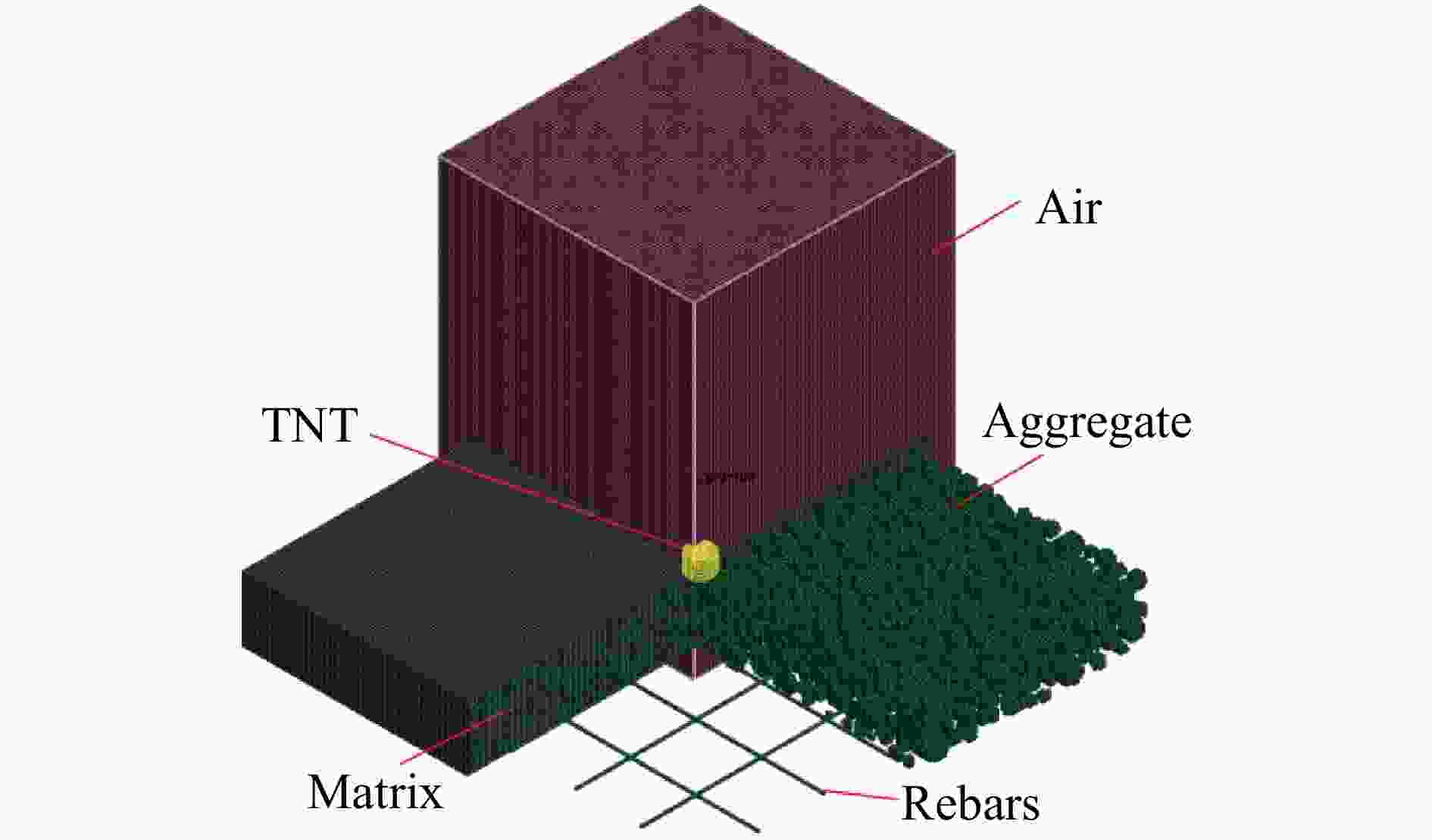
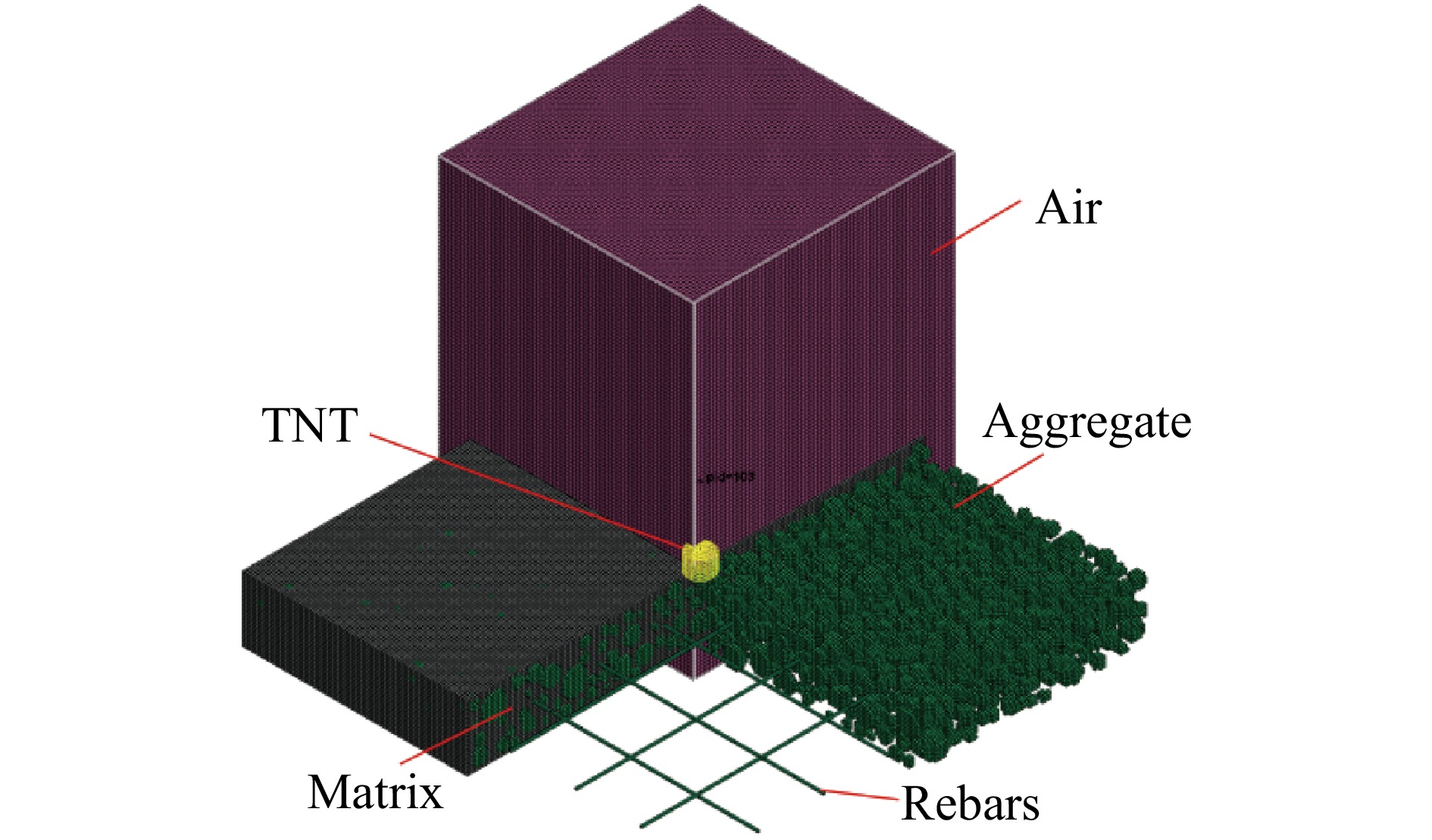
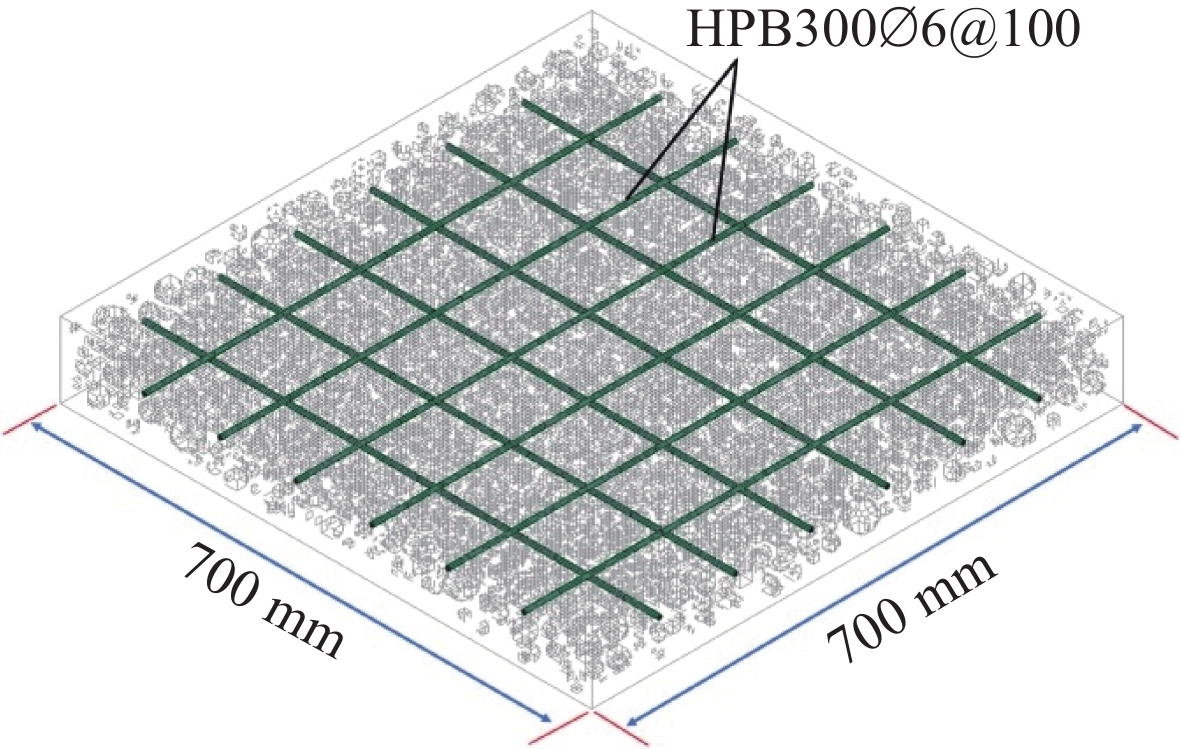
图 6 钢筋混凝土板抗爆有限元模型
Figure 6. Blast-resistant finite element model for the reinforced concrete slab
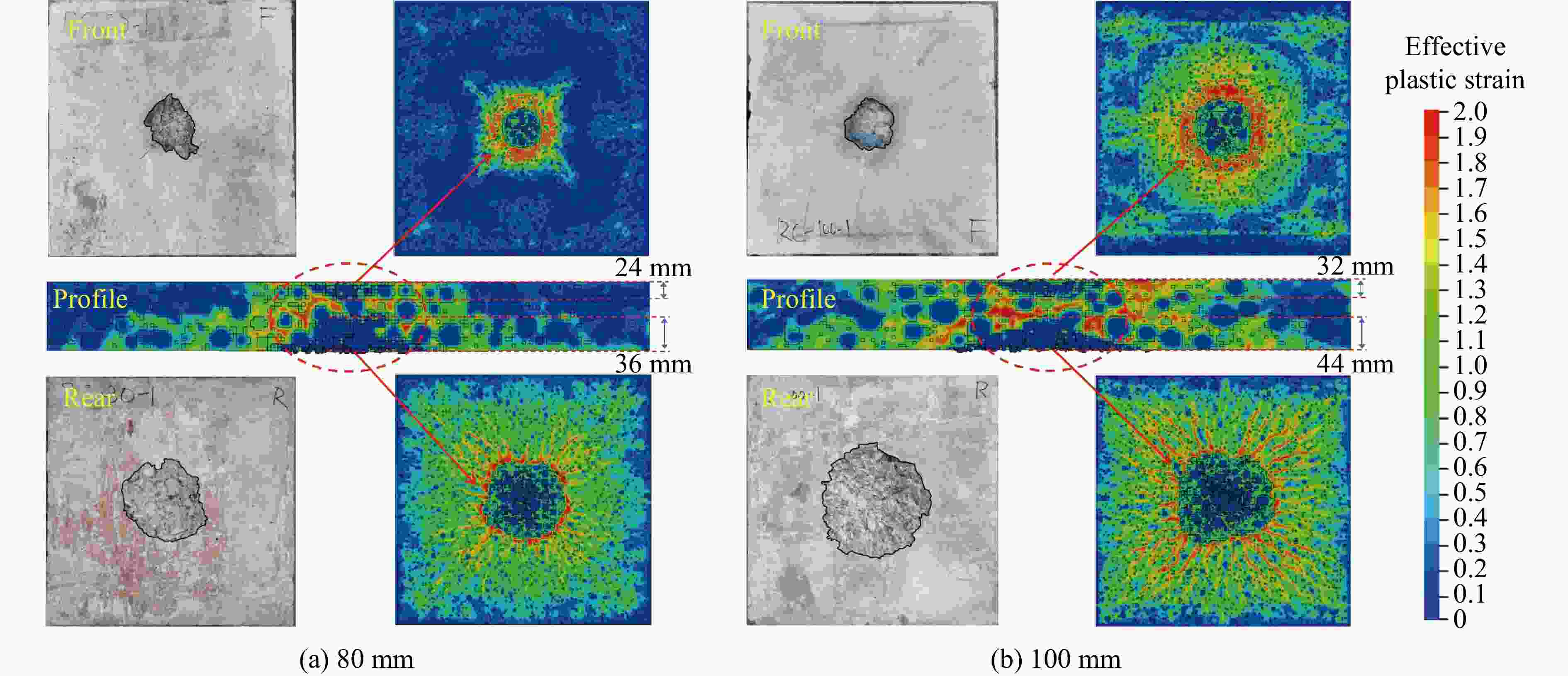
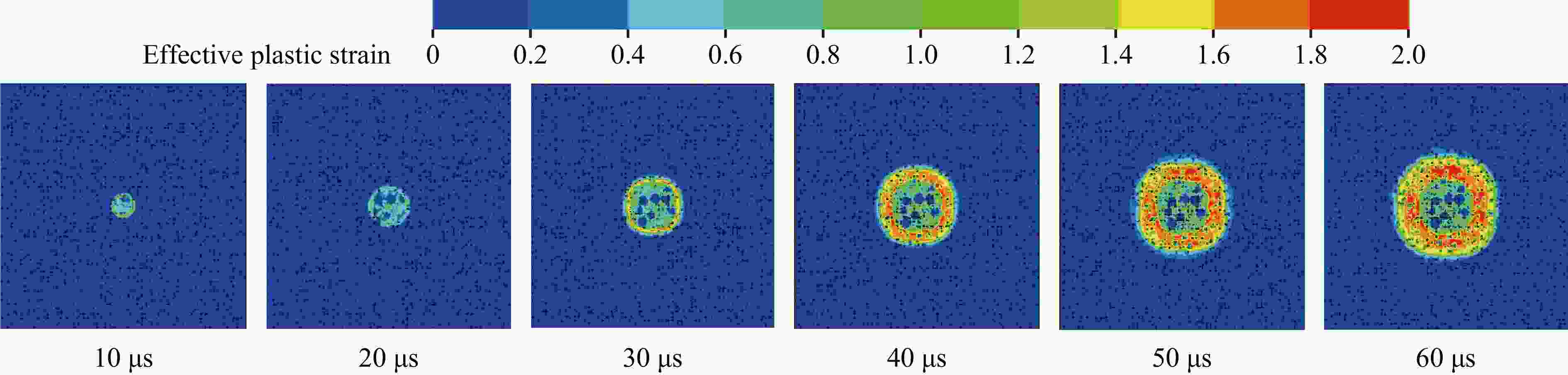
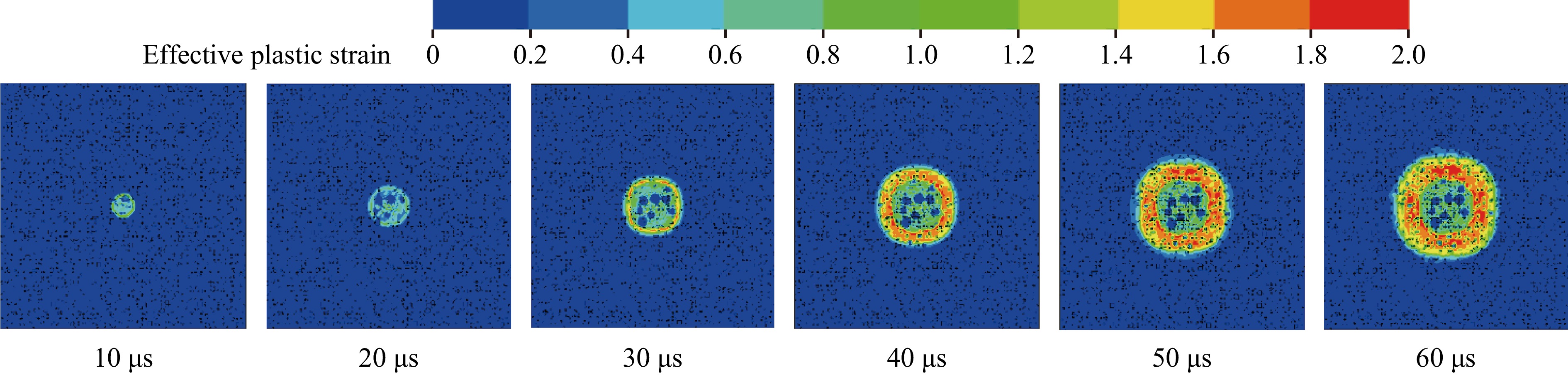
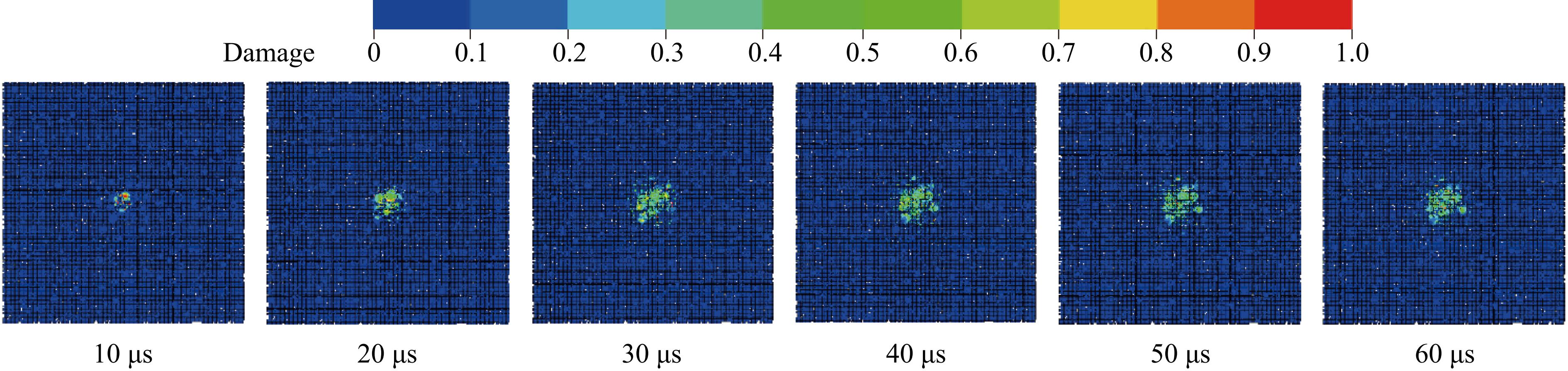
图 9 砂浆基体损伤随时间变化云图
Figure 9. Contour plots of damage evolution in mortar matrix with time
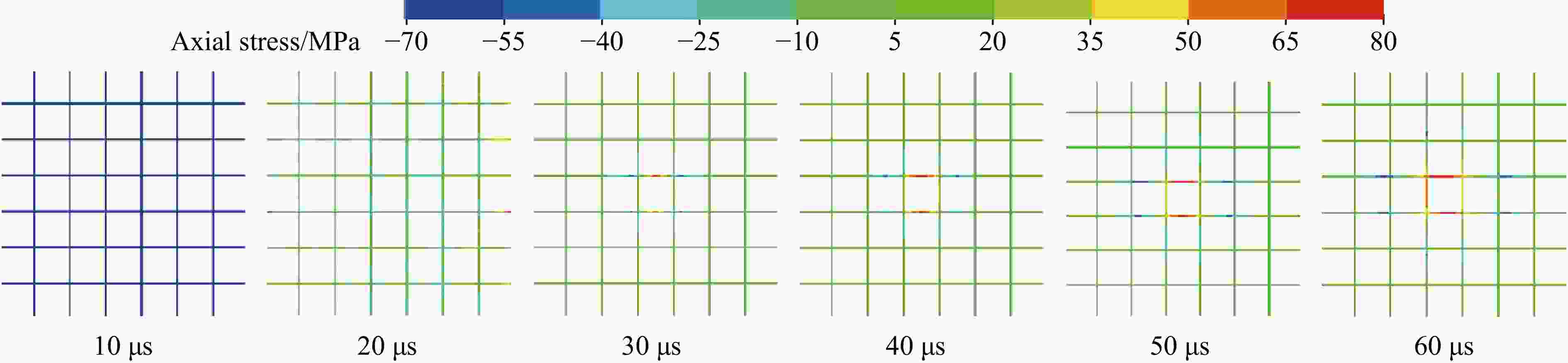
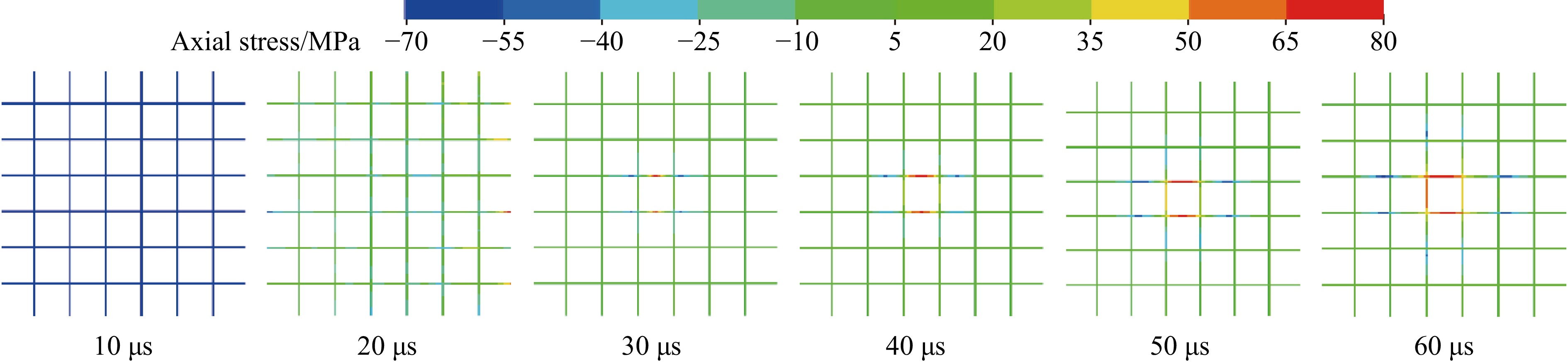
图 10 钢筋轴向应力随时间变化云图
Figure 10. Contour plots of axial stress evolution in rebar with time
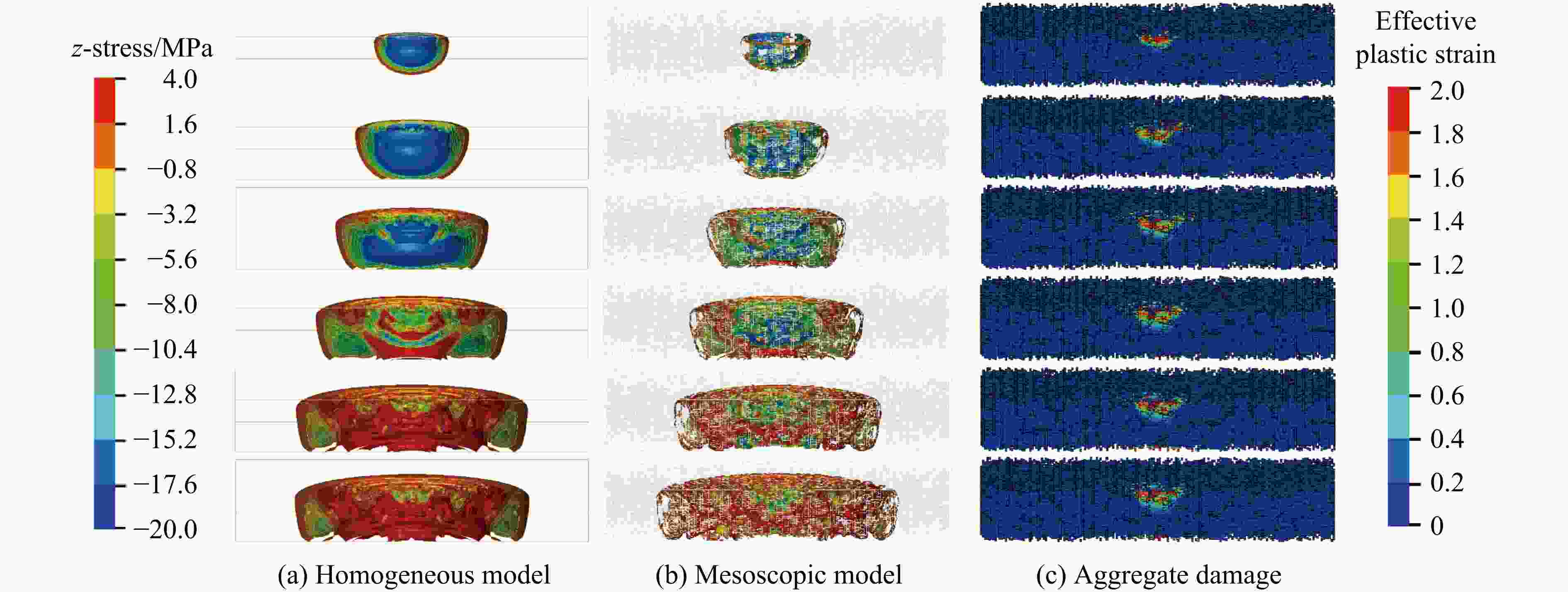
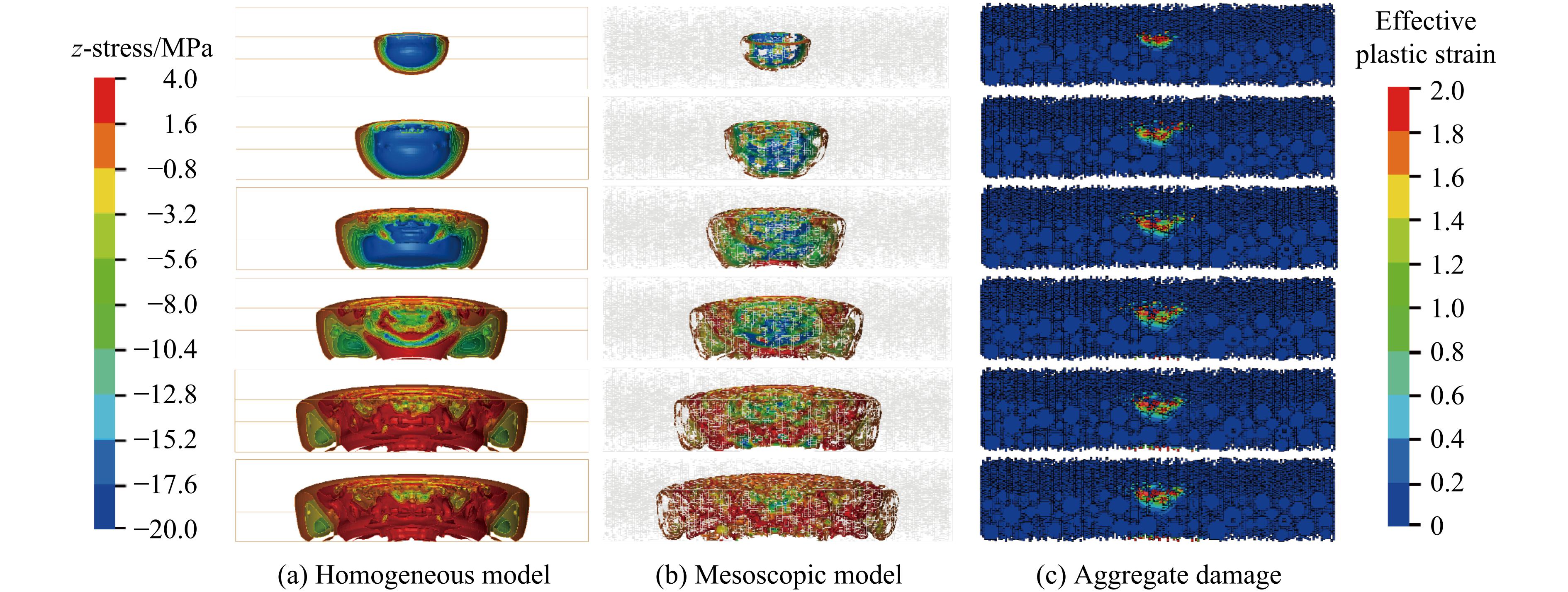
图 12 均质模型和细观模型混凝土靶内的应力波传播及骨料损伤对比
Figure 12. Stress wave propagation obtained by the homogeneous model and mesoscopic models, respectively, and aggregate damage in the concrete slab
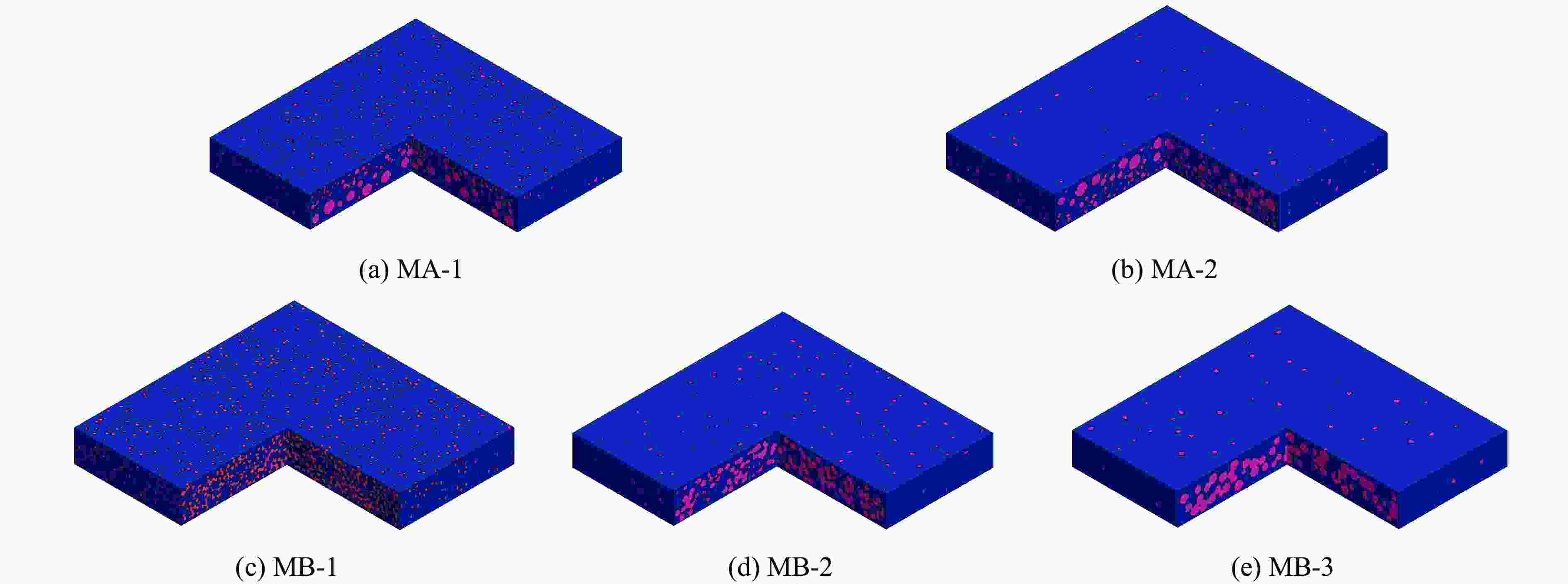
图 13 不同骨料分布和粒径的靶板有限元模型
Figure 13. Finite element models for slabs with different aggregate distributions and particle sizes
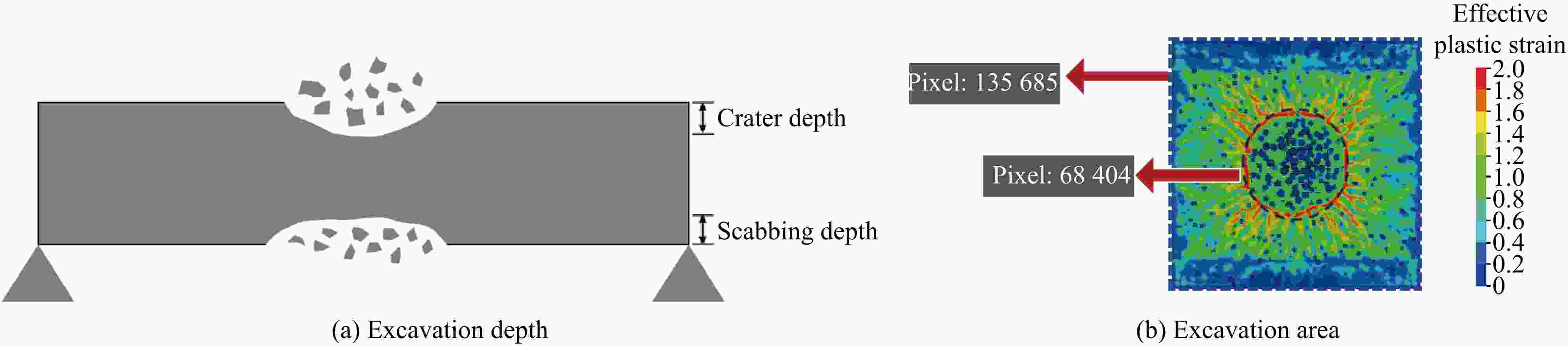
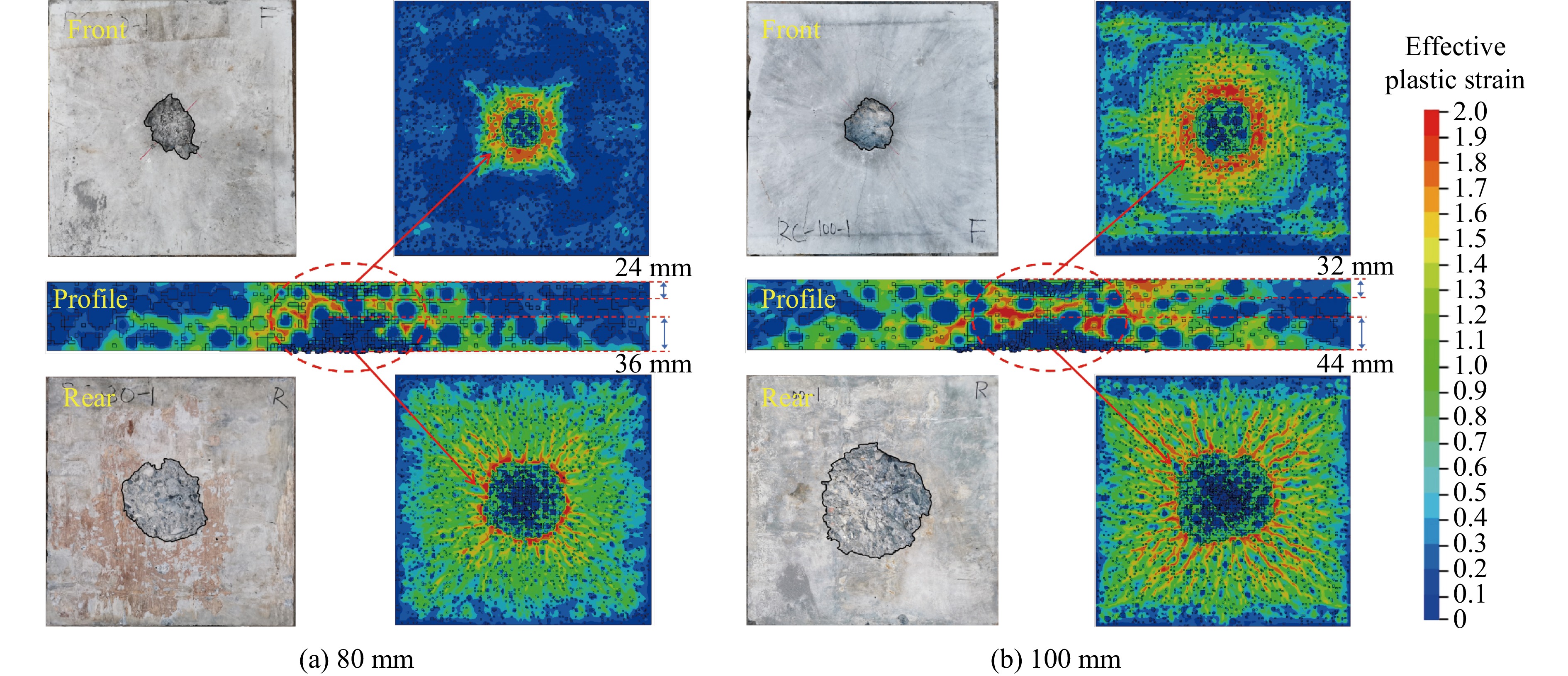
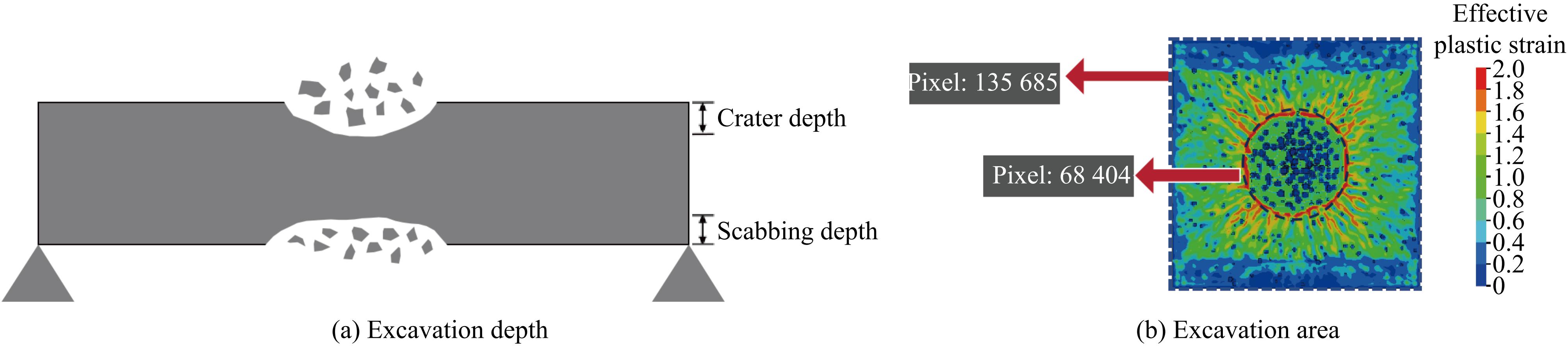
图 14 接触爆炸下混凝土损伤范围的测量
Figure 14. Measurement of concrete damage range under contact blast
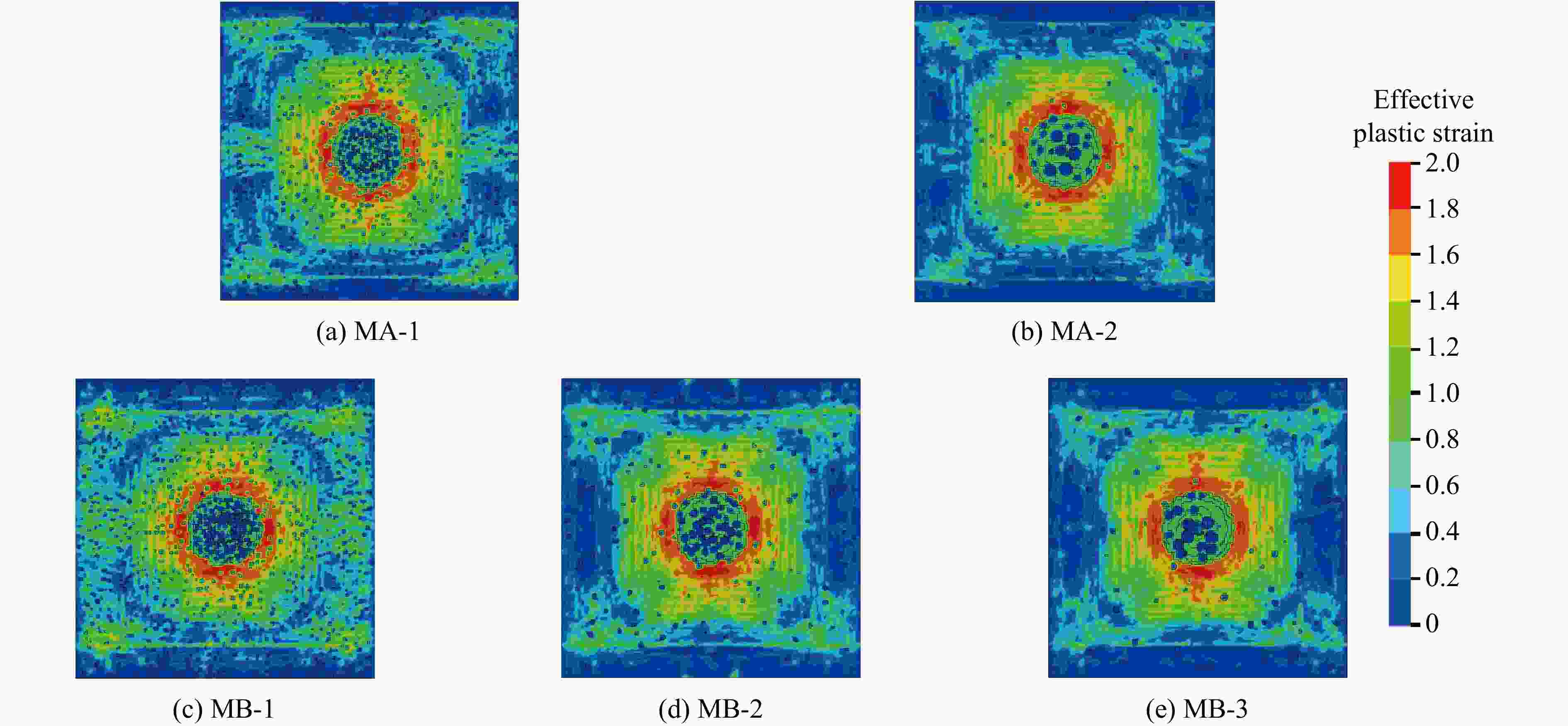
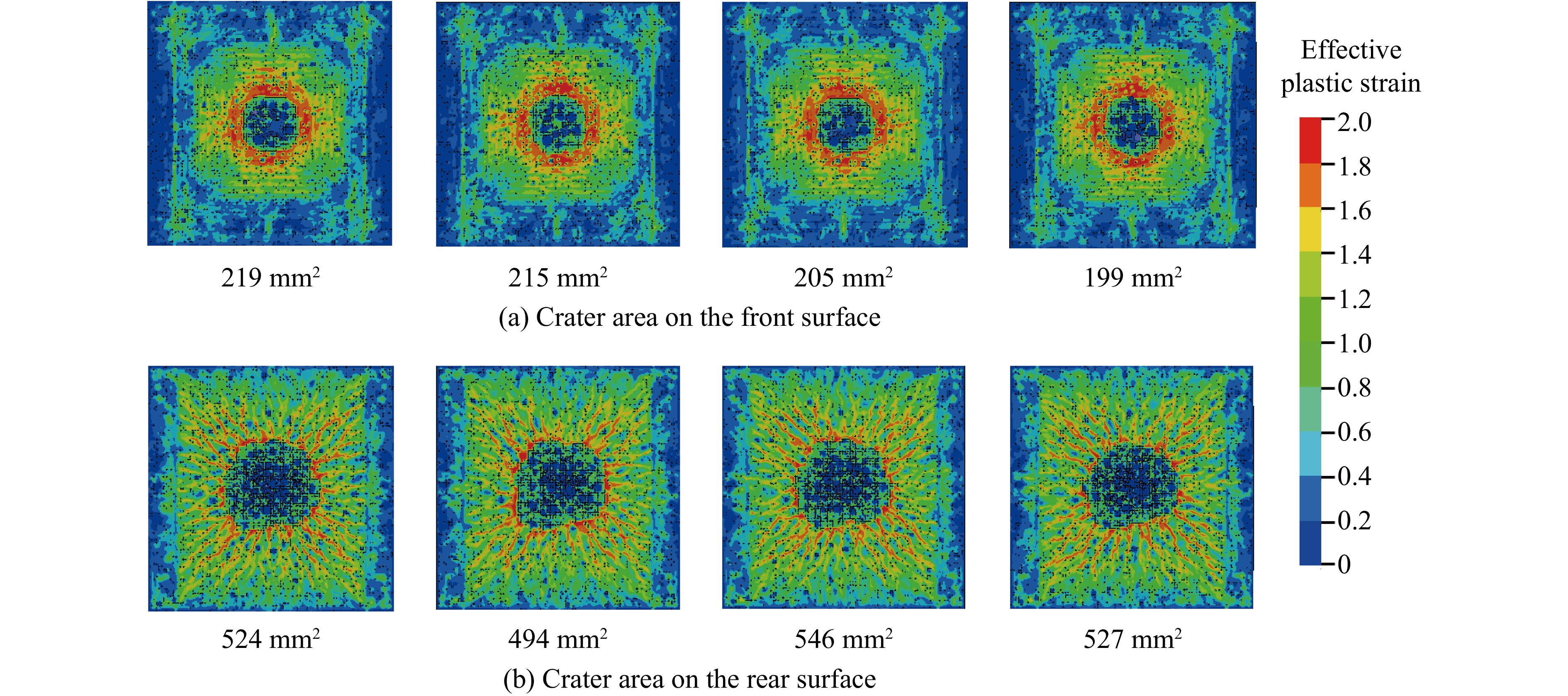
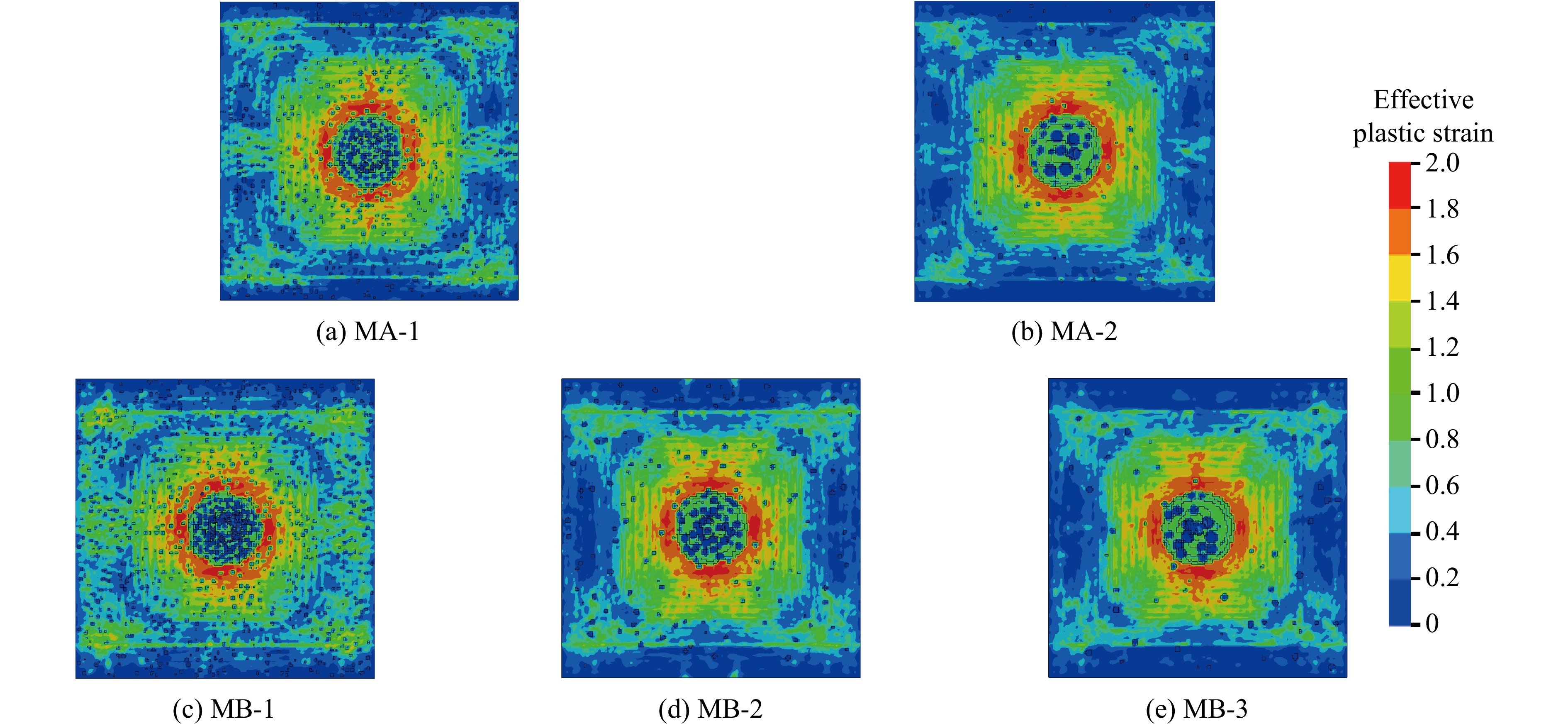
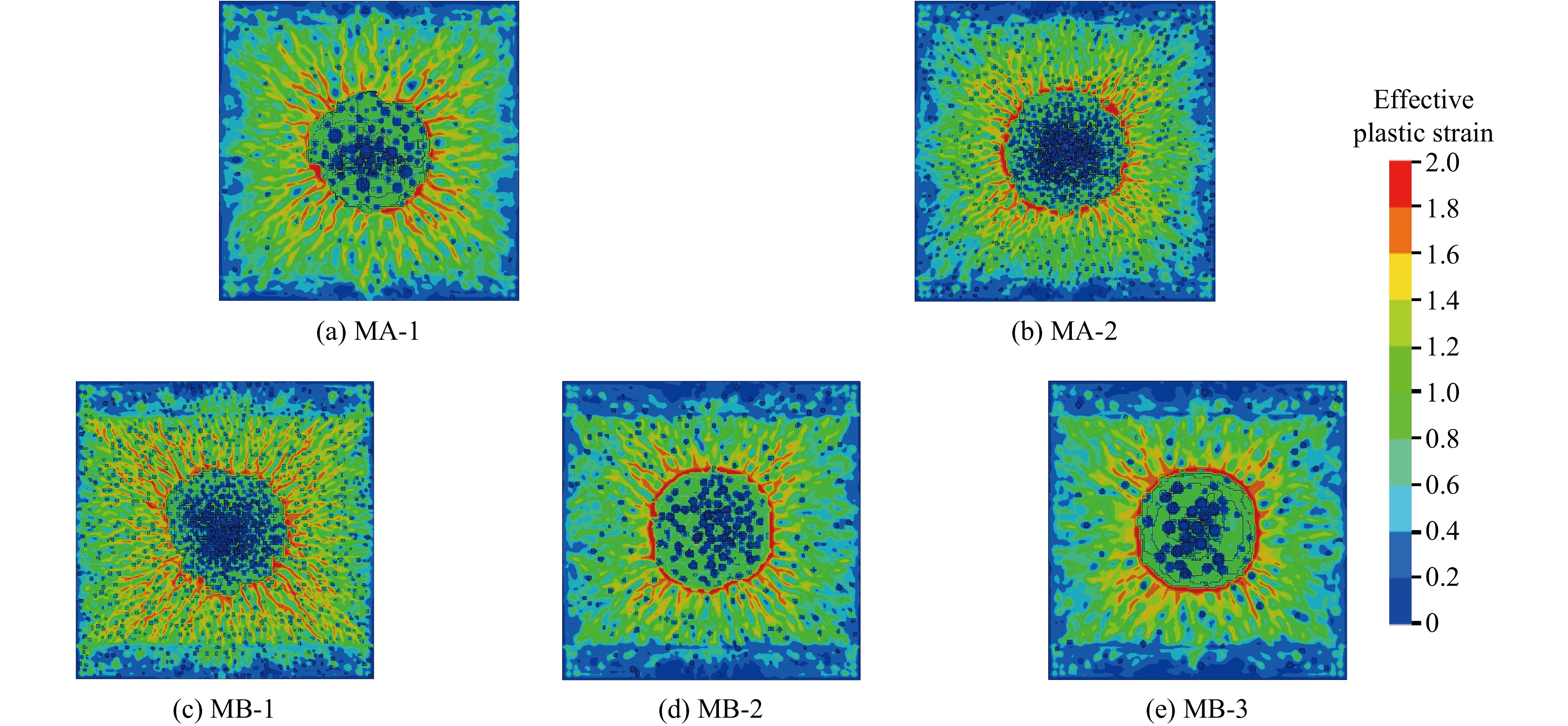
图 15 测试靶板迎爆面损伤分布
Figure 15. Damage distributions on the top surfaces of the test slabs
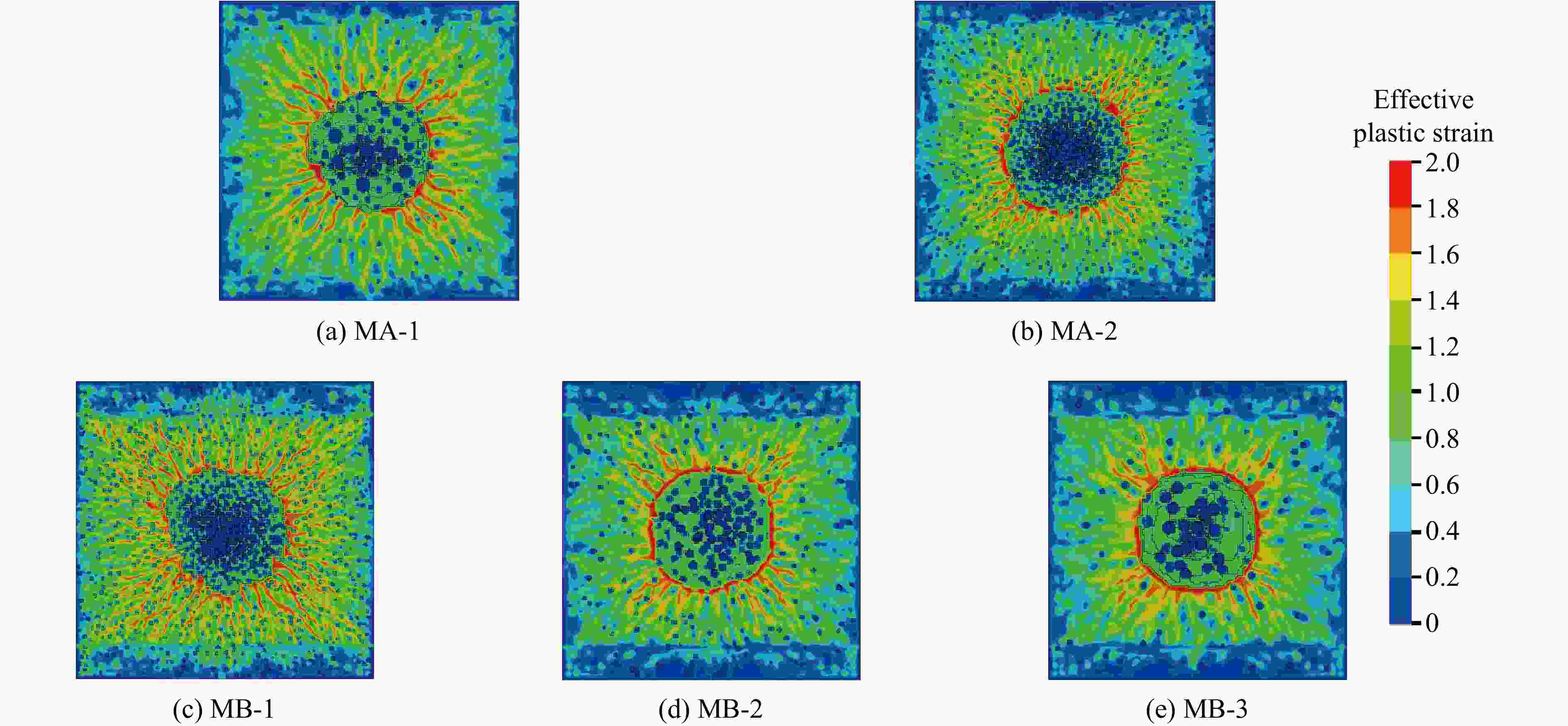
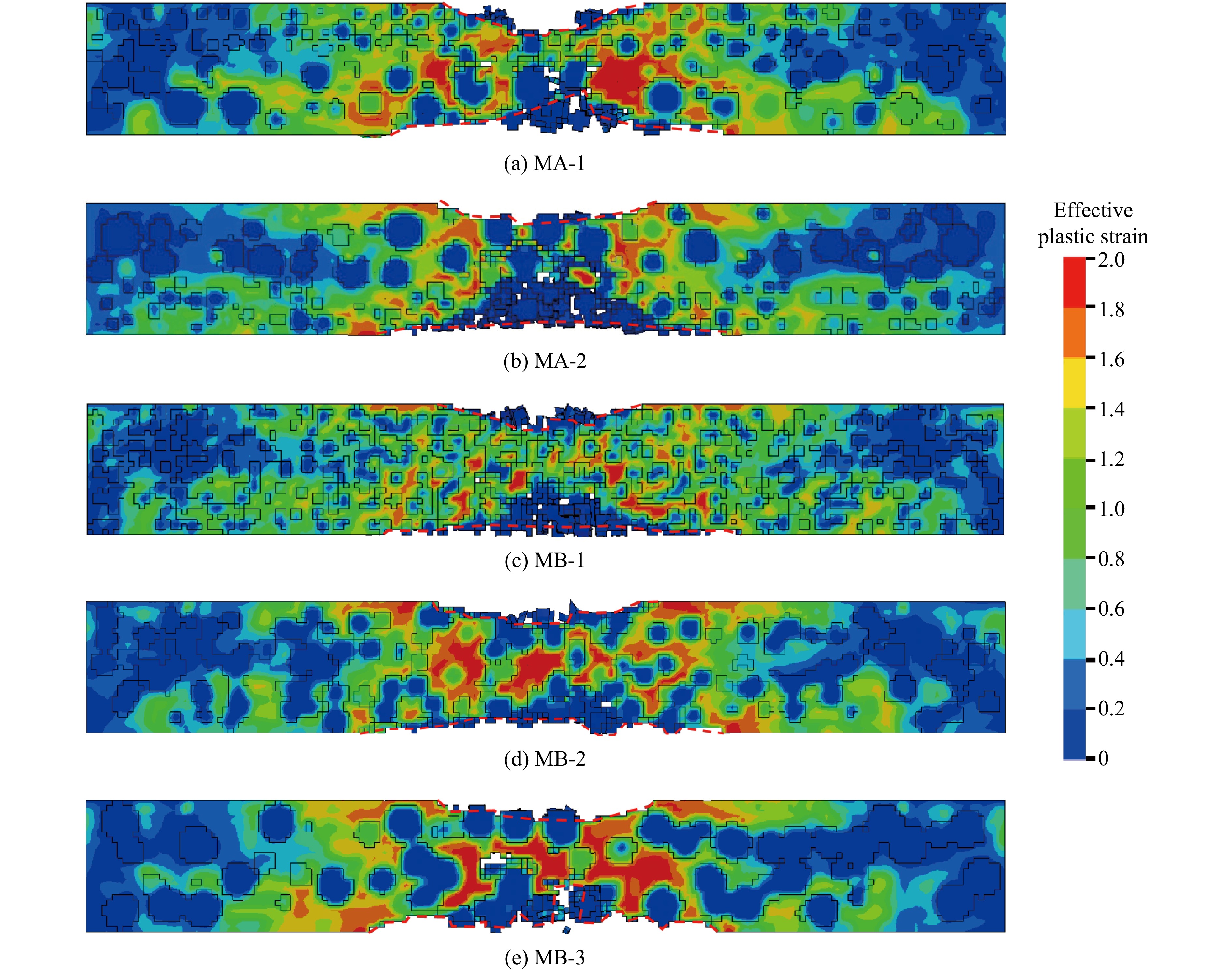
图 16 测试靶板背爆面损伤分布
Figure 16. Damage distributions on the bottom surfaces of the test slabs
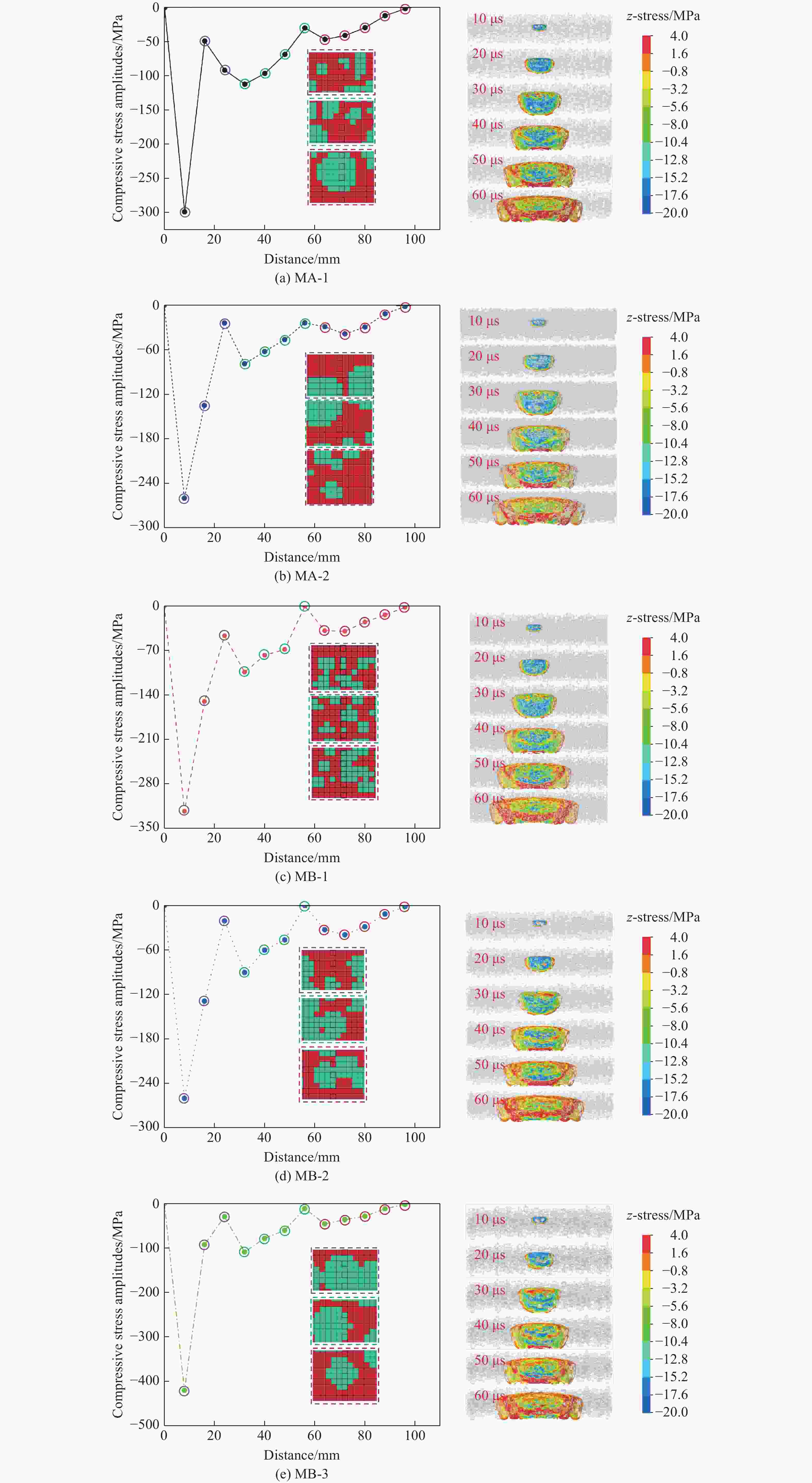
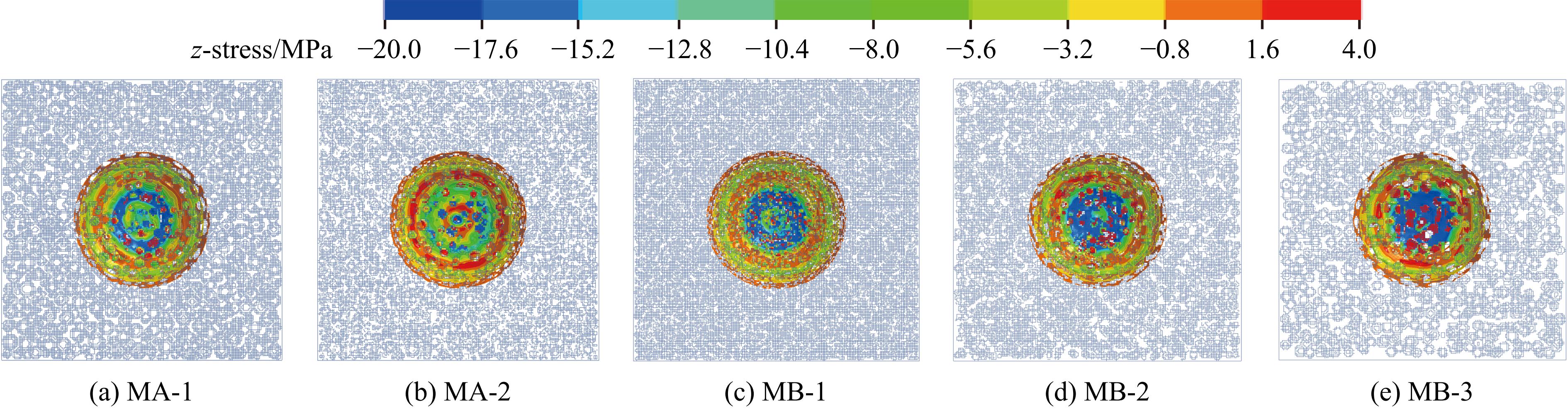
图 19 测试靶板垂直方向压应力幅值与应力波传播
Figure 19. Stress wave propagation and amplitude of vertical compressive stress of the test slab
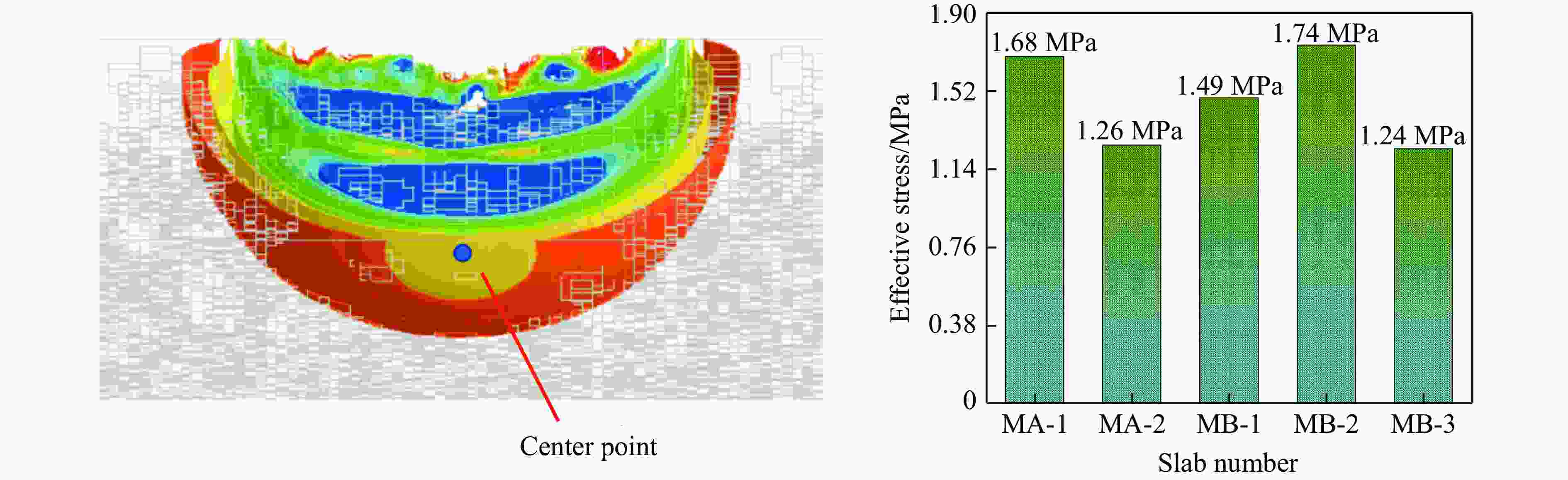
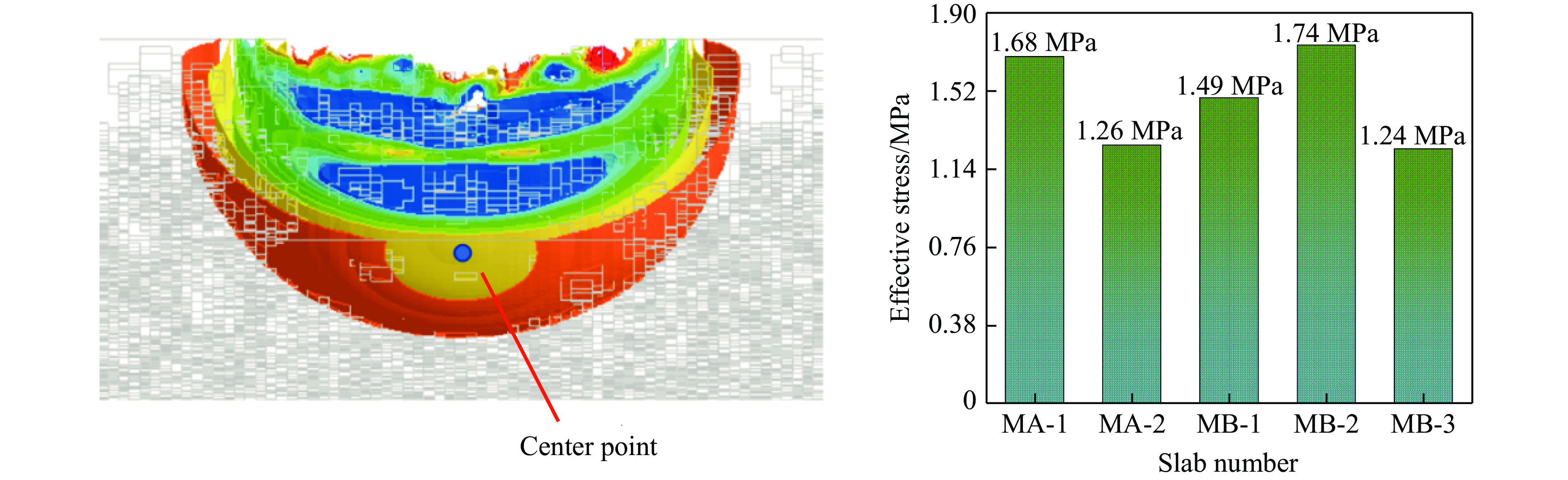
图 20 测试靶板背爆面中心点等效应力
Figure 20. Equivalent stress at the center point on the bottom surface of the test slab
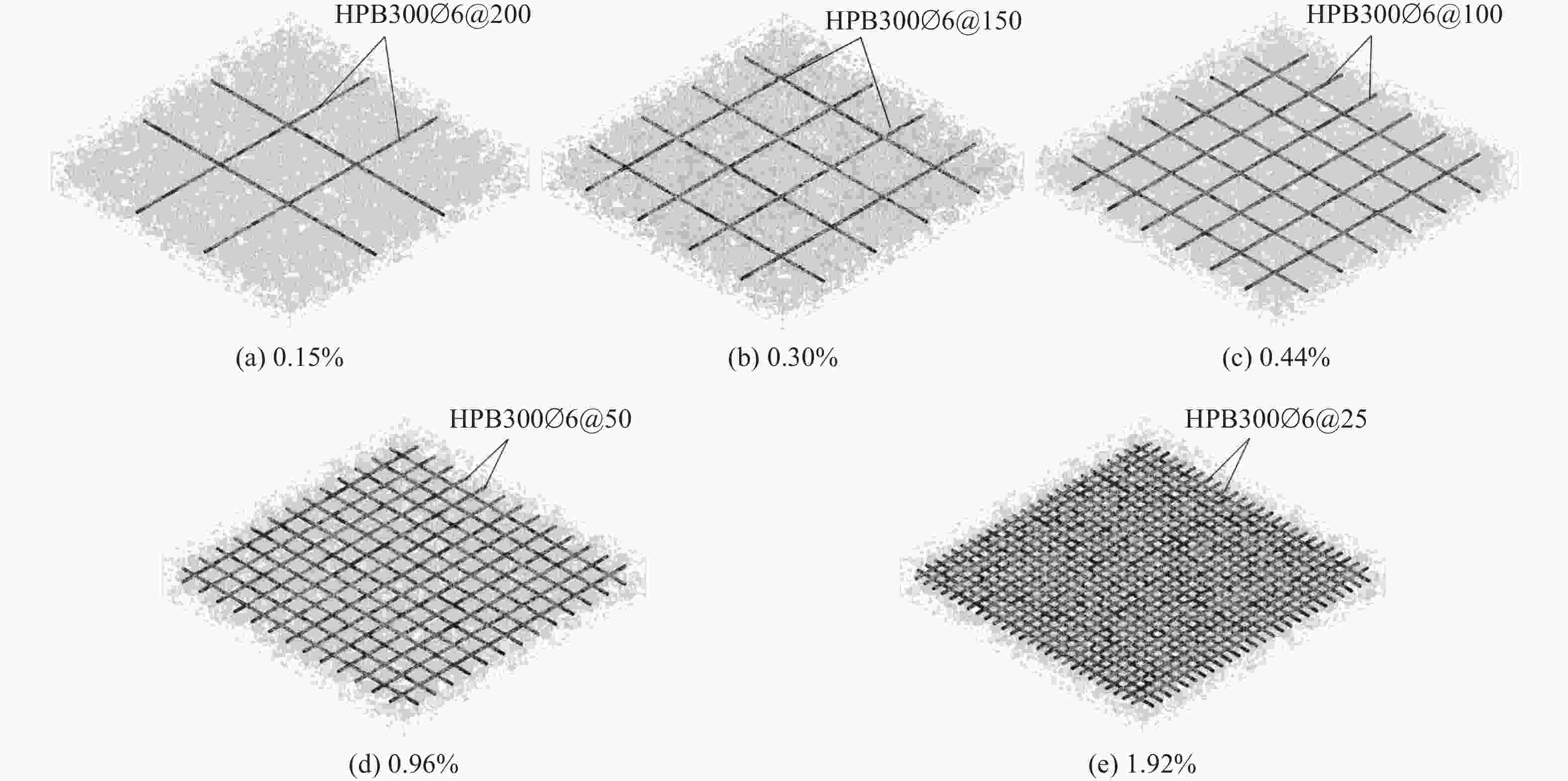
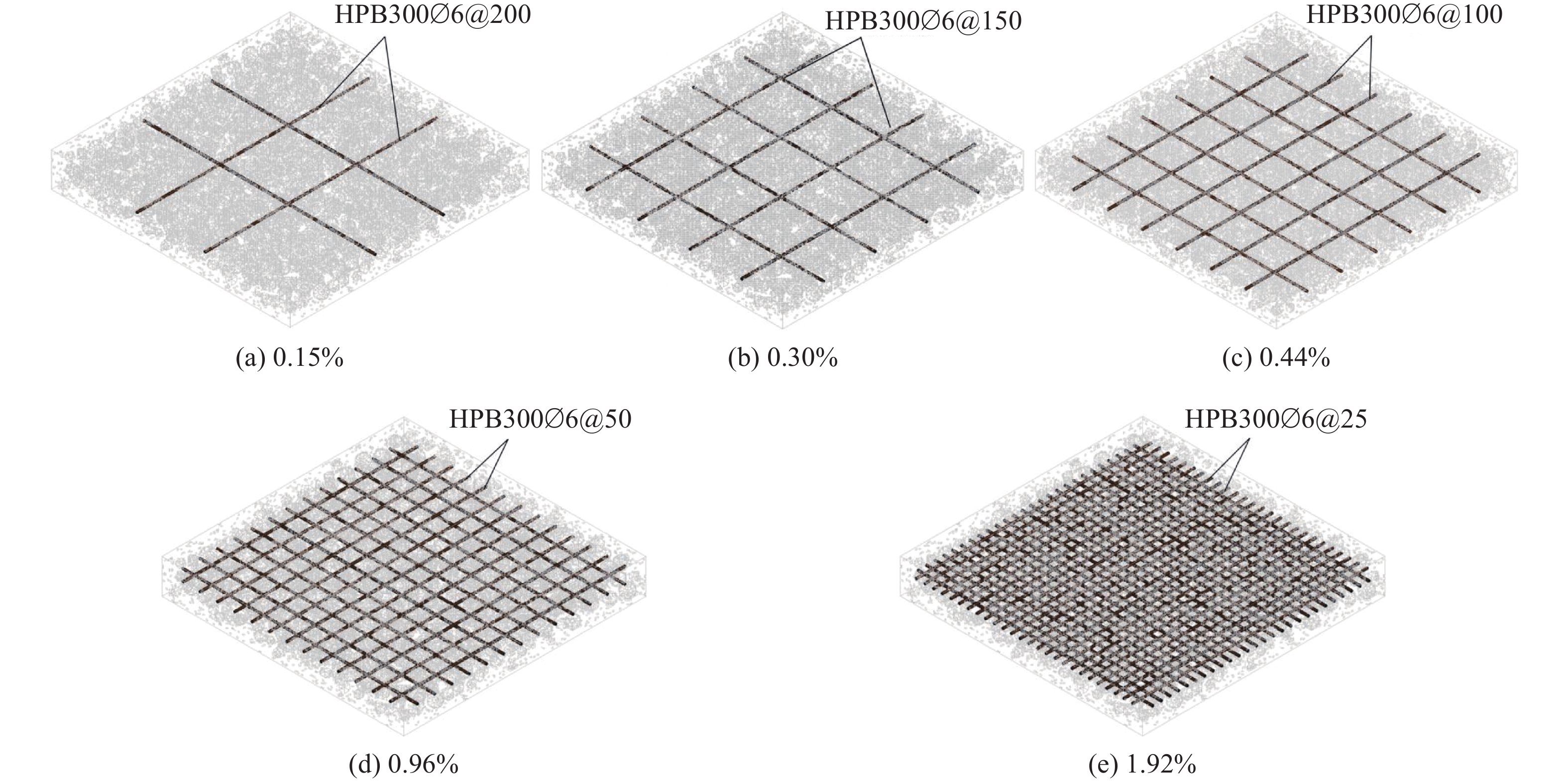
图 21 不同配筋率下靶板中钢筋的布置
Figure 21. Rebar layout of slabs at different reinforcement ratios
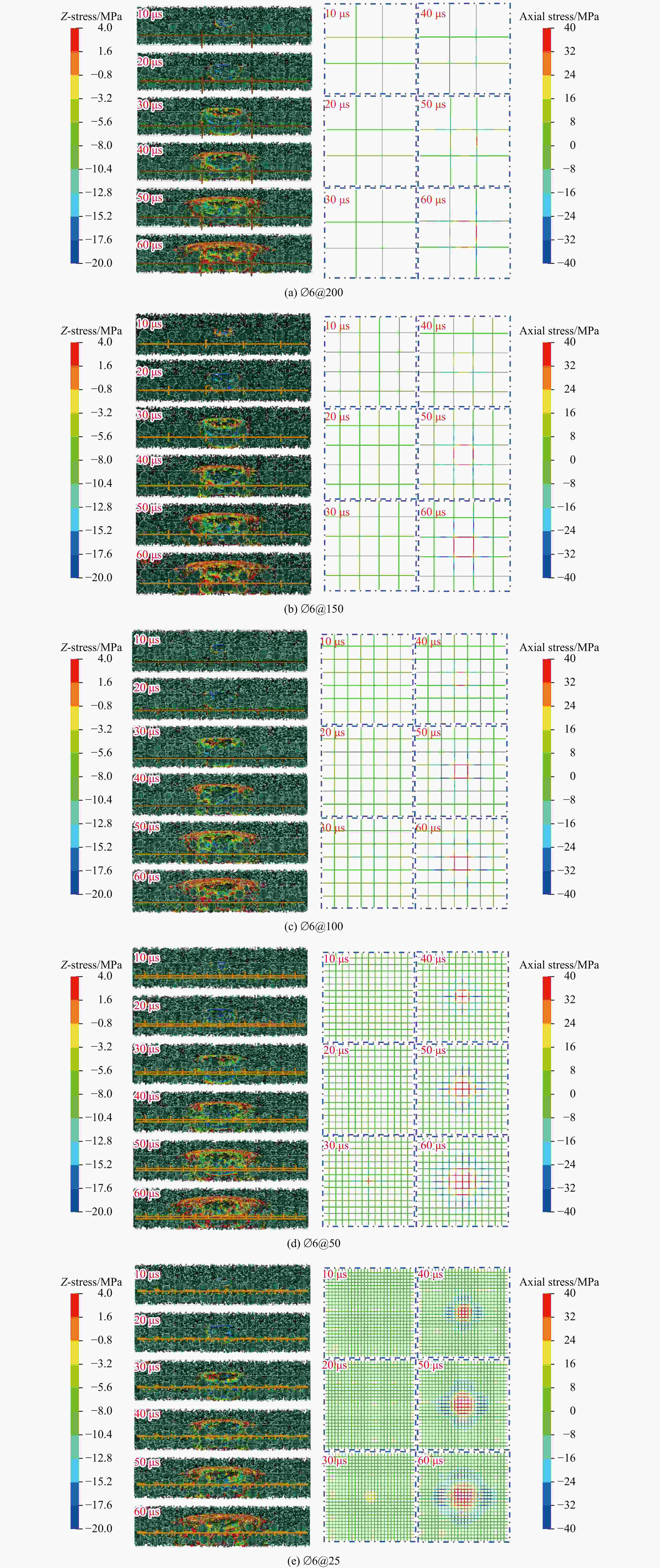
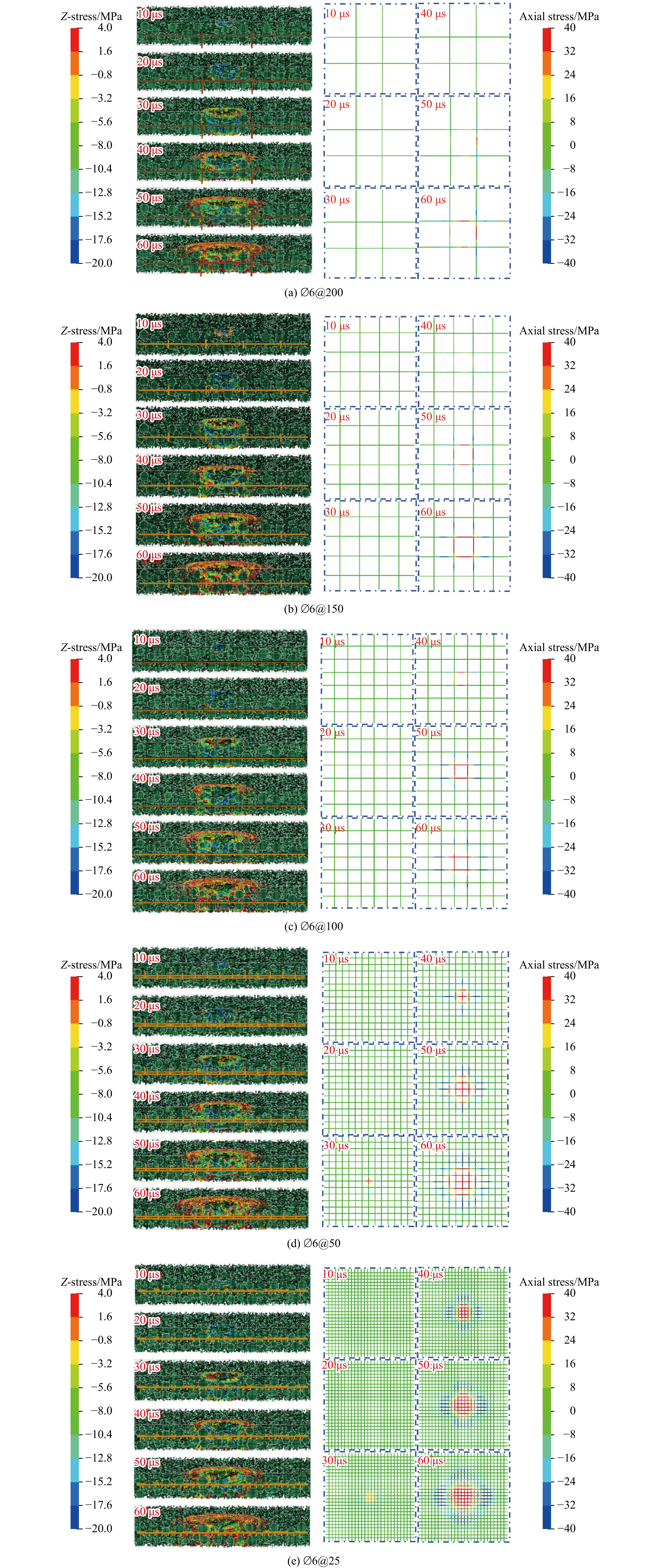
图 22 不同钢筋配置下板内应力传播及钢筋应力分布
Figure 22. Stress propagation in the slab and stress distribution of reinforcement under different reinforcement configurations
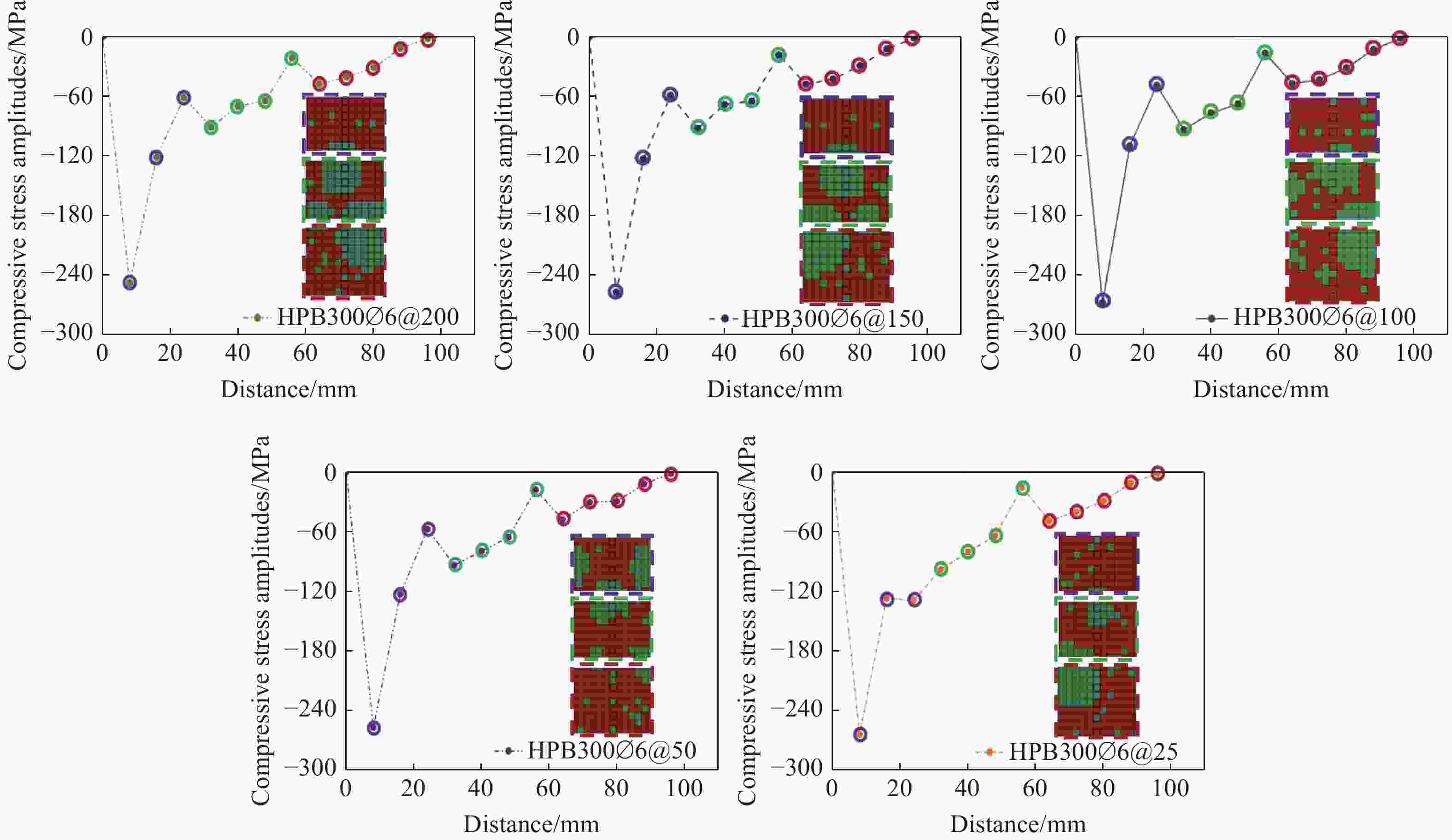
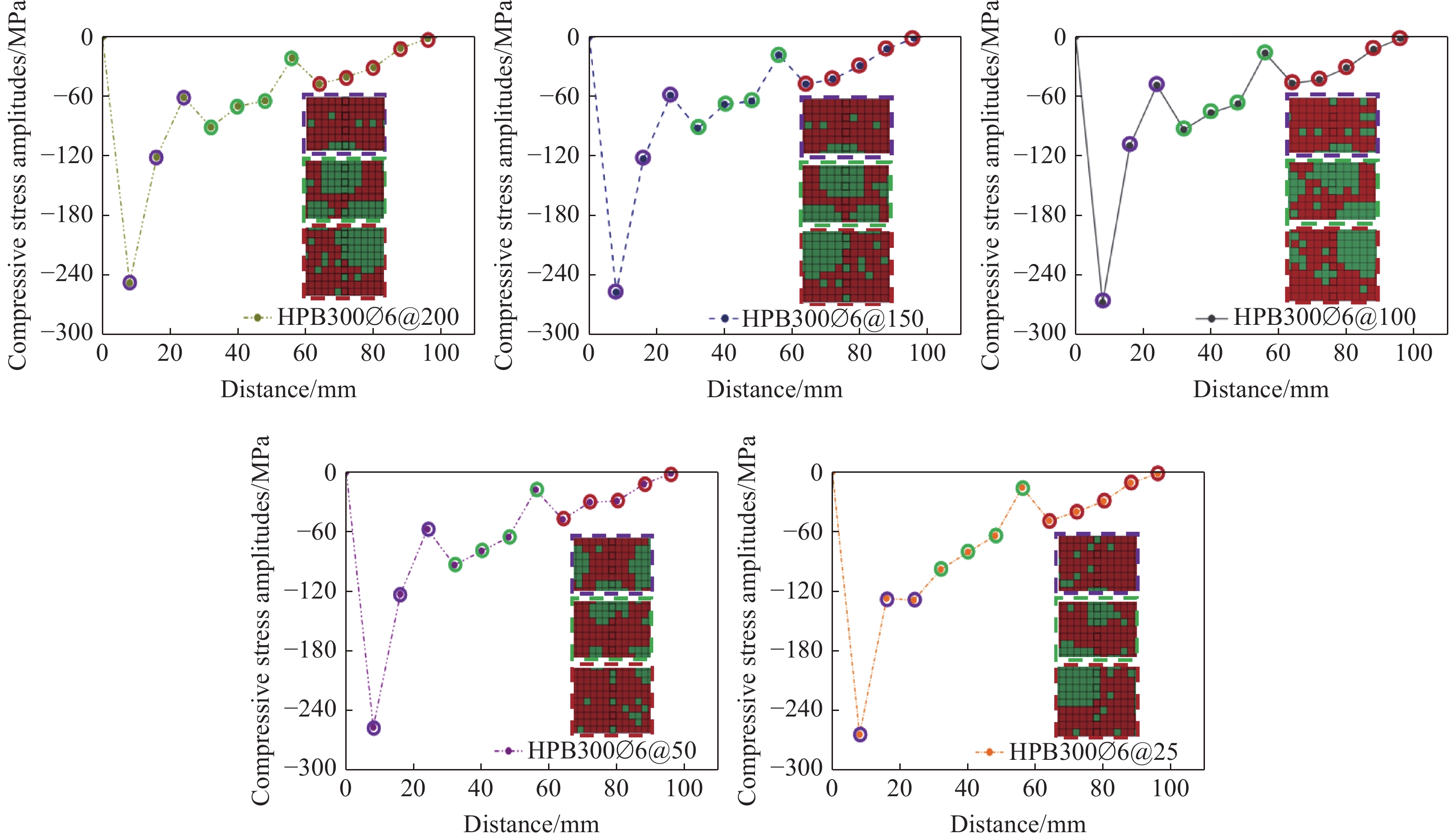
图 23 不同钢筋配置下板内垂直方向压应力幅值
Figure 23. Amplitude of vertical compressive stress in the slab under different reinforcement configurations
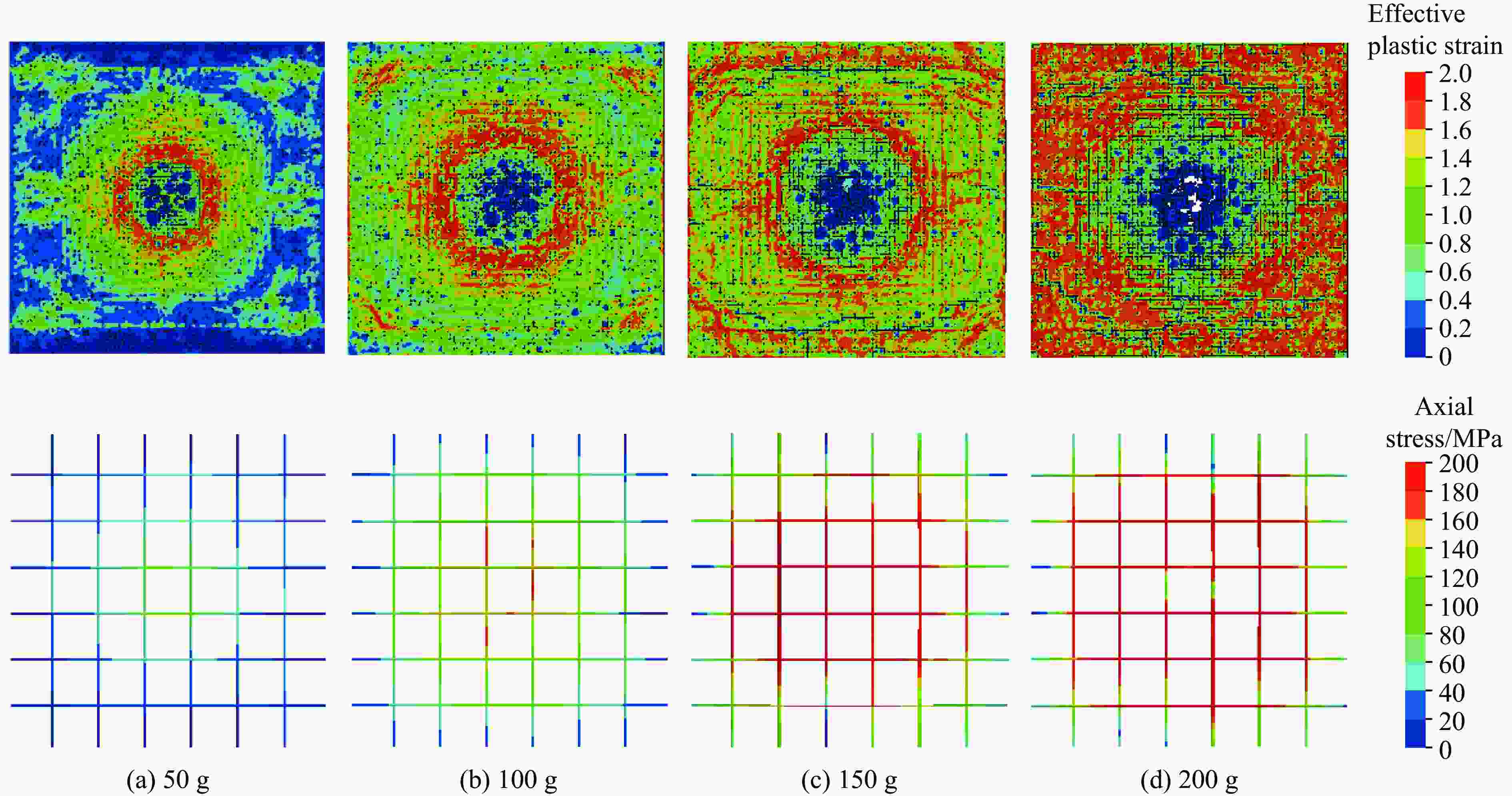
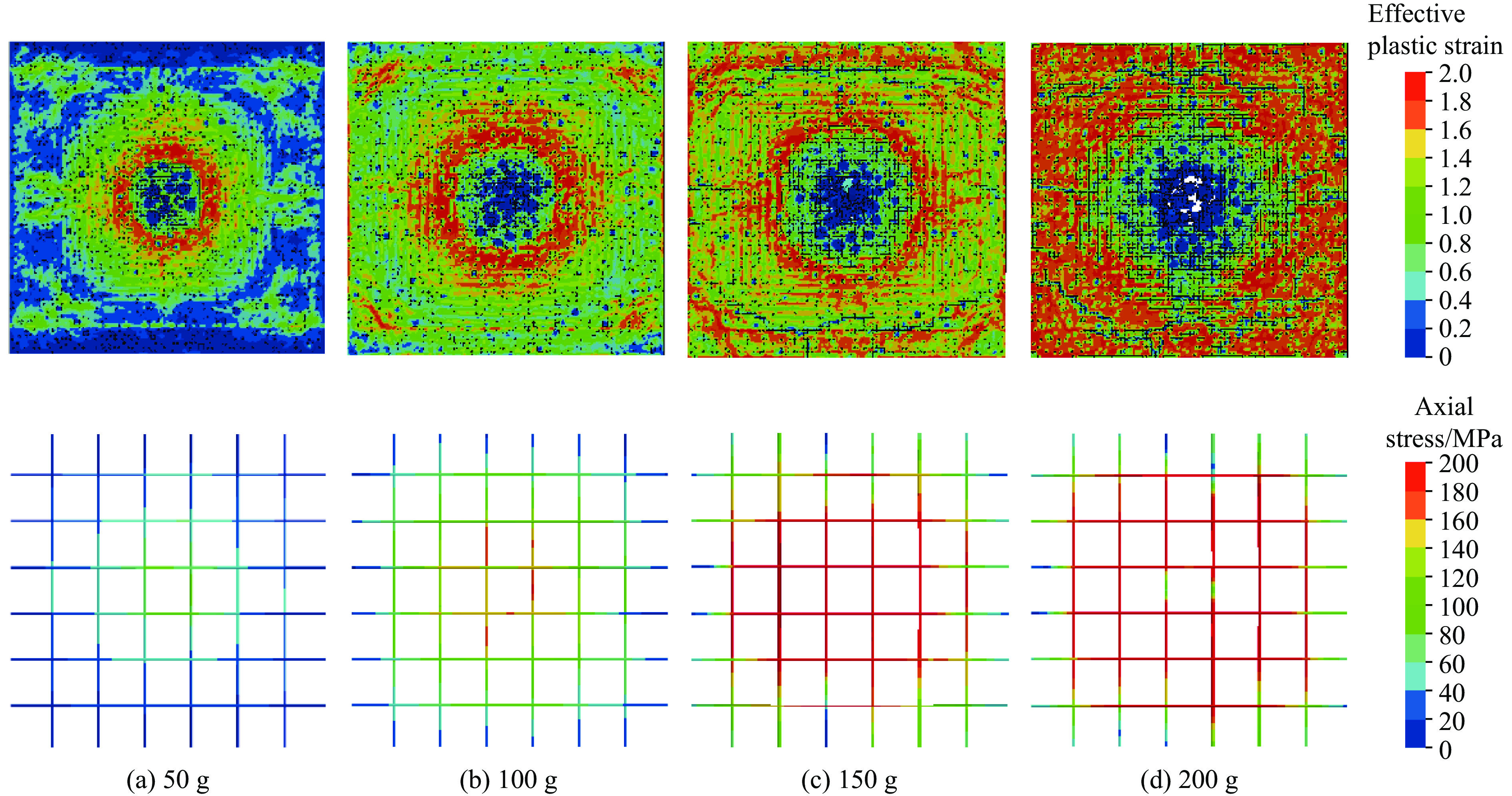
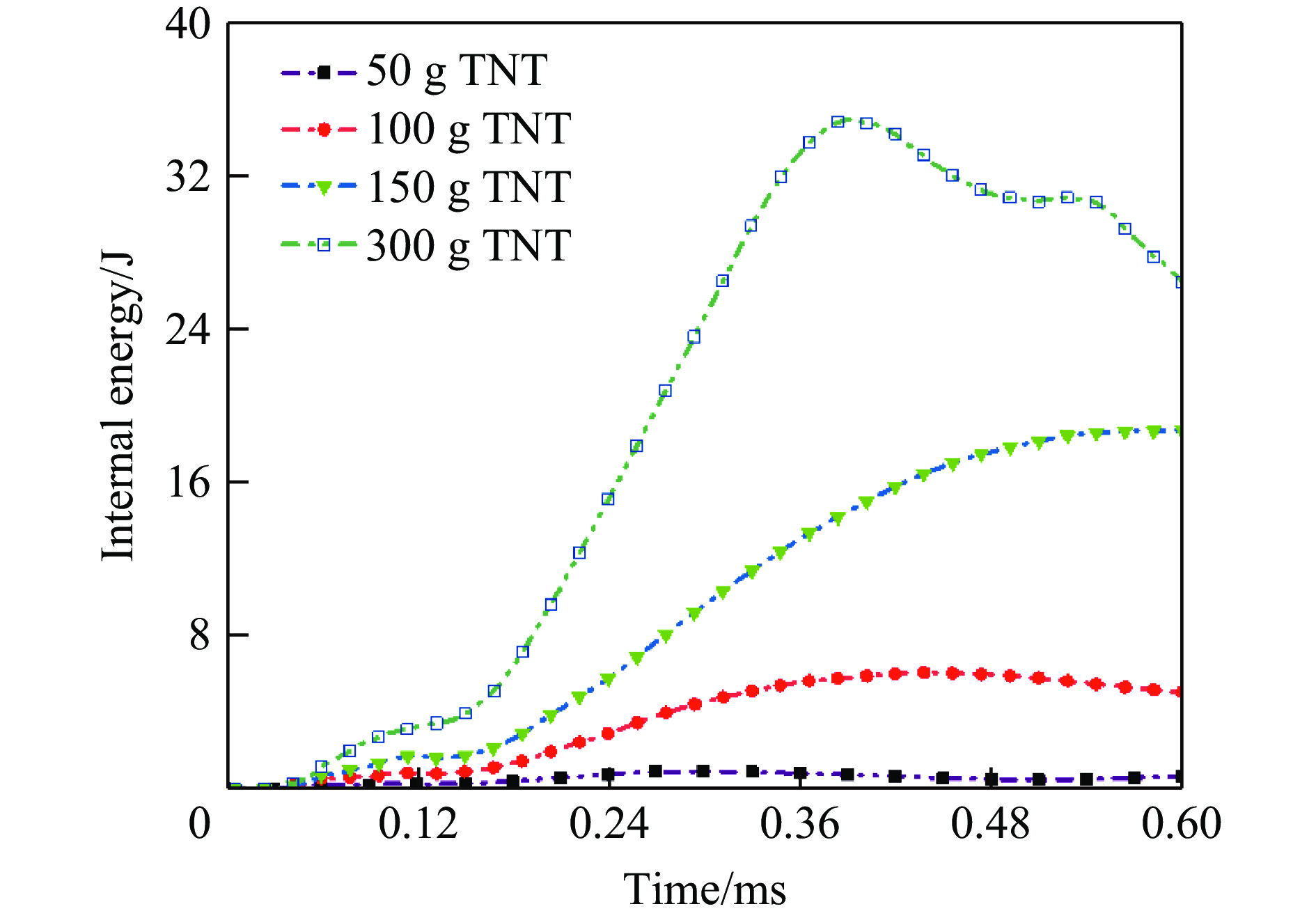
图 24 不同炸药量下靶板损伤及钢筋轴向应力变化
Figure 24. Slab damage and axial stress variation of reinforcing steel bars under different explosive charges
表 1 混凝土基本力学性能
Table 1. Basic mechanical properties of concrete
材料 抗压强度/MPa 抗拉强度/MPa 抗弯强度/MPa 弹性模量/GPa 泊松比 最大塑性应变 密度/(kg·m−3) C45 43 3.9 6.36 26 0.20 0.00015 2500  下载: 导出CSV
表 2 试验工况
Table 2. Test conditions
试验编号 靶板编号 TNT质量/g 炸药高度/mm 炸药直径/mm 1 RC-80-1 30 15 39 2 RC-100-1 50 27 39
下载: 导出CSV
材料 密度/
(kg∙m−3)杨氏模量/
GPa泊松比 屈服强度/
MPa切线模量/
GPa钢筋 7850 206 0.3 300 2.06
下载: 导出CSV
$ \rho $0/(g∙cm−3) G/GPa A B C N fc/MPa ft,max/MPa ε0/s−1 Ef, min 2.3 10 0.55 1.23 0.0097 0.98 60 4 1 0.01 Smax pcrush/MPa μcrush plock/GPa μlock D1 D2 K1/GPa K2/GPa K3/GPa 20 20 0.00125 2 0.174 0.04 1.0 39 −223 550
下载: 导出CSV
Ae/GPa Be/GPa R1 R2 ω 3.74 3.25 4.10 0.95 0.35
下载: 导出CSV
表 6 接触爆炸荷载下钢筋混凝土靶板试验结果与模拟结果对比
Table 6. Comparison between experimental and simulation results of reinforced concrete slab under contact blast load
靶板编号 迎爆面
开坑面积/cm2误差/% 迎爆面
开坑深度/mm误差/% 背爆面
层裂坑面积/cm2误差/% 背爆面
层裂深坑度/mm误差/% 破坏模式 试验 模拟 试验 模拟 试验 模拟 试验 模拟 试验 模拟 RC-80-1 165.9 102.6 −38.1 32.52 24 −26.1 423.9 385.3 −8.7 40.31 36 −10.6 震塌 震塌 RC-100-1 151.7 208.5 37.4 31.34 32 2.1 714.1 569.5 −20 47.03 44 −6.4 震塌 震塌
下载: 导出CSV
表 7 靶板骨料分布参数
Table 7. Aggregate distribution parameters of target plate
靶板编号 靶板尺寸/mm 骨料分布 骨料级配 骨料粒径/mm MA-1 700×700×100 从迎爆面到背爆面方向递增 连续级配 4~40 MA-2 700×700×100 从迎爆面到背爆面方向递减 连续级配 4~40 MB-1 700×700×100 随机分布 单粒径级配 12 MB-2 700×700×100 随机分布 单粒径级配 24 MB-3 700×700×100 随机分布 单粒径级配 32
下载: 导出CSV
表 8 不同骨料分布与粒径测试靶板结果
Table 8. Results of test slab with different aggregate distributions and particle sizes
靶板
编号开坑面积/
cm2层裂坑
面积/cm2开坑深度/
mm层裂坑深度/
mmMA-1 238.53 609.76 24 36 MA-2 212.55 585.44 16 12 MB-1 227.5 629.42 20 8.9 MB-2 240.74 624.91 16.5 12 MB-3 241.22 606.80 16 36
下载: 导出CSV
-
[1] 马世鑫, 纪杨子燚, 钟明寿, 等. 接触爆炸作用下混凝土墩体的易损性研究 [J]. 爆炸与冲击, 2023, 43(7): 073201. DOI: 10.11883/bzycj-2022-0538.MA S X, JI Y Z Y, ZHONG M S, et al. Study on the vulnerability of concrete obstacle under contact explosion [J]. Explosion and Shock Waves, 2023, 43(7): 073201. DOI: 10.11883/bzycj-2022-0538. [2] CAI R Z, LI Y Z, ZHANG C X, et al. Size effect on reinforced concrete slabs under direct contact explosion [J]. Engineering Structures, 2022, 252: 113656. DOI: 10.1016/j.engstruct.2021.113656. [3] YANG C Z, JIA X, HUANG Z X, et al. Damage of full-scale reinforced concrete beams under contact explosion [J]. International Journal of Impact Engineering, 2022, 163: 104180. DOI: 10.1016/j.ijimpeng.2022.104180. [4] THIAGARAJAN G, KADAMBI A V, ROBERT S, et al. Experimental and finite element analysis of doubly reinforced concrete slabs subjected to blast loads [J]. International Journal of Impact Engineering, 2015, 75: 162–173. DOI: 10.1016/j.ijimpeng.2014.07.018. [5] GAO C Y, YAN J B, LIU Y, et al. Spalling damage on steel reinforced concrete structures under deep embedded explosion [J]. Engineering Structures, 2025, 343: 121093. DOI: 10.1016/j.engstruct.2025.121093. [6] ZHAO C F, YE X, HE K C, et al. Numerical study and theoretical analysis on blast resistance of fabricated concrete slab [J]. Journal of Building Engineering, 2020, 32: 101760. DOI: 10.1016/j.jobe.2020.101760. [7] 王辉明, 刘飞, 晏麓晖, 等. 接触爆炸荷载对钢筋混凝土梁的局部毁伤效应 [J]. 爆炸与冲击, 2020, 40(12): 121404. DOI: 10.11883/bzycj-2020-0171.WANG H M, LIU F, YAN L H, et al. Local damage effects of reinforced concrete beams under contact explosions [J]. Explosion and Shock Waves, 2020, 40(12): 121404. DOI: 10.11883/bzycj-2020-0171. [8] YU S Y, ZHANG G K, WANG Z, et al. Experimental and numerical study of corrugated steel-plain concrete composite structures under contact explosions [J]. Thin-Walled Structures, 2024, 197: 111624. DOI: 10.1016/j.tws.2024.111624. [9] WU P, DENG Y Y, MA C L, et al. Perforation performance study and residual velocity prediction of reactive powder concrete based on mesoscopic numerical simulation and experiments [J]. International Journal of Impact Engineering, 2026, 210: 105596. DOI: 10.1016/j.ijimpeng.2025.105596. [10] CASTEDO R, SANTOS A P, ALAÑÓN A, et al. Numerical study and experimental tests on full-scale RC slabs under close-in explosions [J]. Engineering Structures, 2021, 231: 111774. DOI: 10.1016/j.engstruct.2020.111774. [11] CHEN G Q, WU H, CHENG Y H, et al. Comparative studies on blast resistance of precast concrete composite and cast-in-place slabs [J]. Journal of Building Engineering, 2025, 110: 113077. DOI: 10.1016/j.jobe.2025.113077. [12] WU P, MA C L, ZHANG Y N. Experimental and numerical investigations on the performance of reactive powder concrete slabs subjected to contact explosion [J]. Journal of Building Engineering, 2026, 119: 115235. DOI: 10.1016/j.jobe.2026.115235. [13] WU Z Y, ZHANG J H, FANG Q, et al. 3D mesoscopic modelling on the dynamic properties of coral aggregate concrete under direct tension [J]. Engineering Fracture Mechanics, 2021, 247: 107636. DOI: 10.1016/j.engfracmech.2021.107636. [14] NADERI S, TU W L, ZHANG M Z. Meso-scale modelling of compressive fracture in concrete with irregularly shaped aggregates [J]. Cement and Concrete Research, 2021, 140: 106317. DOI: 10.1016/j.cemconres.2020.106317. [15] ZHANG Y H, CHEN Q Q, WANG Z Y, et al. 3D mesoscale fracture analysis of concrete under complex loading [J]. Engineering Fracture Mechanics, 2019, 220: 106646. DOI: 10.1016/j.engfracmech.2019.106646. [16] QIN X N, WANG X, GUO J J, et al. Parameter investigation and efficiency evaluation of unified phase-field theory in mesoscale fracture analysis of fully-graded concrete under uniaxial tension [J]. Engineering Fracture Mechanics, 2025, 314: 110696. DOI: 10.1016/j.engfracmech.2024.110696. [17] YU K L, QING L B, HU Y. The effects of specimen size and aggregate on the evolution of the fracture process zone in concrete: a mesoscale investigation [J]. Composite Structures, 2025, 355: 118852. DOI: 10.1016/j.compstruct.2025.118852. [18] LIU Q C, WEI D H, GAN Y X. Mesoscale modelling of triaxial concrete fracture: the role of aggregate shapes [J]. International Journal of Mechanical Sciences, 2025, 302: 110570. DOI: 10.1016/j.ijmecsci.2025.110570. [19] 岳松林, 王明洋, 张宁, 等. 混凝土板在接触爆炸作用下的震塌和贯穿临界厚度计算方法 [J]. 爆炸与冲击, 2016, 36(4): 472–482. DOI: 10.11883/1001-1455(2016)04-0472-11.YUE S L, WANG M Y, ZHANG N, et al. A method for calculating critical spalling and perforating thicknesses of concrete slabs subjected to contact explosion [J]. Explosion and Shock Waves, 2016, 36(4): 472–482. DOI: 10.11883/1001-1455(2016)04-0472-11. [20] SONG Z H, LU Y. Mesoscopic analysis of concrete under excessively high strain rate compression and implications on interpretation of test data [J]. International Journal of Impact Engineering, 2012, 46: 41–55. DOI: 10.1016/j.ijimpeng.2012.01.010. [21] QI X P, ZHANG J, RAJEEV A, et al. Effect of coarse aggregates on contact explosion resistance of concrete: a mesoscopic investigation [J]. Engineering Fracture Mechanics, 2024, 311: 110576. DOI: 10.1016/j.engfracmech.2024.110576. [22] ALMUSTAFA M K, BALOMENOS G P, NEHDI M L. Data-driven reliability framework for qualitative damage states of reinforced concrete beams under blast loading [J]. Engineering Structures, 2023, 294: 116803. DOI: 10.1016/j.engstruct.2023.116803. [23] XU Y L, HUANG F L, LIU Y, et al. Effect of close-in successive explosions on the blast behaviors of reinforced concrete beams: an experimental study [J]. Structures, 2023, 53: 29–46. DOI: 10.1016/j.istruc.2023.04.043. [24] 吕辰旭, 闫秋实, 李亮. 近爆荷载作用下装配式钢筋混凝土柱抗爆性能及受损加固试验研究 [J]. 爆炸与冲击, 2023, 43(6): 063301. DOI: 10.11883/bzycj-2022-0225.LYU C X, YAN Q S, LI L. Experimental study on blast resistance performance and damage repair of precast concrete column under close-in explosion [J]. Explosion and Shock Waves, 2023, 43(6): 063301. DOI: 10.11883/bzycj-2022-0225. [25] ZHU W Q, YANG C, YIN T Y, et al. Blast resistant performance and damage mechanism of steel reinforced concrete beams under contact explosion [J]. Engineering Structures, 2024, 315: 118472. DOI: 10.1016/j.engstruct.2024.118472. [26] GUO B, LIANG W Y, XU X Y, et al. Study on the damage characteristics and dynamic response of masonry-infilled reinforced concrete frame structure under internal blast load [J]. Journal of Building Engineering, 2025, 112: 113948. DOI: 10.1016/j.jobe.2025.113948. [27] GAO Z, WANG Z Q, CHEN Y Q, et al. Study on the damage effect of 12.7 mm armour piercing incendiary projectile penetrating aramid reinforced concrete slab [J]. Computers & Structures, 2025, 312: 107706. DOI: 10.1016/j.compstruc.2025.107706. [28] HEIBGES L, SADEGH-AZAR H. Inclined projectile impact on reinforced concrete structures [J]. Nuclear Engineering and Design, 2025, 438: 114043. DOI: 10.1016/j.nucengdes.2025.114043. [29] LIU K, GAO C Q, YUAN J, et al. Experimental and numerical investigations on impact response of reinforced concrete beams with a sandwich panel protective layer [J]. Engineering Structures, 2024, 316: 118543. DOI: 10.1016/j.engstruct.2024.118543. [30] 陈龙明, 李述涛, 陈叶青, 等. 配筋对超高性能混凝土抗爆性能的影响 [J]. 工程力学, 2023, 40(S1): 98–107. DOI: 10.6052/j.issn.1000-4750.2022.06.S042.CHEN L M, LI S T, CHEN Y Q, et al. Influence of reinforcement diameter and spacing on implosion resistance of ultra-high performance concrete [J]. Engineering Mechanics, 2023, 40(S1): 98–107. DOI: 10.6052/j.issn.1000-4750.2022.06.S042. [31] ORTIZ J D, HUSSAIN Z, HOSSEINI S A, et al. Lap splice assessment of GFRP rebars in reinforced concrete beams under flexure [J]. Construction and Building Materials, 2024, 419: 135408. DOI: 10.1016/j.conbuildmat.2024.135408. [32] ZOU D L, LIU Y F, TENG Z C. Study on the impact resistance of reinforced concrete protective structures for energy facilities subjected to tube-type missile impacts [J]. Structures, 2025, 79: 109445. DOI: 10.1016/j.istruc.2025.109445. [33] WANG J Y, XU Y H, WANG S B, et al. Effect of high-strength rebar and ultra-high-performance concrete on blast resistance of slabs under contact explosion loads [J]. International Journal of Impact Engineering, 2025, 198: 105230. DOI: 10.1016/j.ijimpeng.2025.105230. [34] 李治, 祝捷, 原小兰, 等. 高温下钢筋混凝土梁抗爆性能研究 [J]. 建筑结构学报, 2023, 44(S1): 203–211. DOI: 10.14006/j.jzjgxb.2023.S1.0023. [35] KYEI C, BRAIMAH A. Effects of transverse reinforcement spacing on the response of reinforced concrete columns subjected to blast loading [J]. Engineering Structures, 2017, 142: 148–164. DOI: 10.1016/j.engstruct.2017.03.044. [36] ASTM International. ASTM C469-11 Standard test method for static modulus of elasticity and Poisson’s ratio of concrete in compression[S]. 2011. [37] YI N H, KIM J H J, HAN T S, et al. Blast-resistant characteristics of ultra-high strength concrete and reactive powder concrete [J]. Construction and Building Materials, 2012, 28(1): 694–707. DOI: 10.1016/j.conbuildmat.2011.09.014. [38] LI J, HAO H, WU C Q. Numerical study of precast segmental column under blast loads [J]. Engineering Structures, 2017, 134: 125–137. DOI: 10.1016/j.engstruct.2016.12.028. [39] HUANG L, YUAN M, WEI B D, et al. Experimental investigation on sing fiber pullout behaviour on steel fiber-matrix of reactive powder concrete (RPC) [J]. Construction and Building Materials, 2022, 318: 125899. DOI: 10.1016/j.conbuildmat.2021.125899. [40] HAO Y F, HAO H. Influence of the concrete DIF model on the numerical predictions of RC wall responses to blast loadings [J]. Engineering Structures, 2014, 73: 24–38. DOI: 10.1016/j.engstruct.2014.04.042. [41] MALVAR L J, CRAWFORD J E, WESEVICH J W, et al. A plasticity concrete material model for DYNA3D [J]. International Journal of Impact Engineering, 1997, 19(9/10): 847–873. DOI: 10.1016/S0734-743X(97)00023-7. [42] WU P, XU S L, LI Q H, et al. A plasticity-based dynamic constitutive model for ultra high toughness cementitious composites [J]. International Journal of Impact Engineering, 2022, 161: 104086. DOI: 10.1016/j.ijimpeng.2021.104086. [43] WANG S S, LE H T N, POH L H, et al. Resistance of high-performance fiber-reinforced cement composites against high-velocity projectile impact [J]. International Journal of Impact Engineering, 2016, 95: 89–104. DOI: 10.1016/j.ijimpeng.2016.04.013. [44] 方秦, 孔祥振, 吴昊, 等. 岩石Holmquist-Johnson-Cook模型参数的确定方法 [J]. 工程力学, 2014, 31(3): 197–204. DOI: 10.6052/j.issn.1000-4750.2012.10.0780.FANG Q, KONG X Z, WU H, et al. Determination of Holmquist-Johnson-Cook consitiutive model parameters of rock [J]. Engineering Mechanics, 2014, 31(3): 197–204. DOI: 10.6052/j.issn.1000-4750.2012.10.0780. [45] 吴平. 超高韧性水泥基复合材料在强动载作用下的动力响应及动态本构模型[D]. 杭州: 浙江大学, 2022.WU P. Dynamic response and dynamic constitutive model of ultra high toughess cementitious composites subjected to intense dynamic loadings [D]. Hangzhou: Zhejiang University, 2022. -



计量
- 文章访问数: 739
- HTML全文浏览量: 296
- PDF下载量: 293
- 被引次数: 0