



Research on the knowledge graph of accidental explosion damage
-
摘要: 利用具有多源、异构、重叠等特征的爆炸事故调查报告建立意外爆炸毁伤知识图谱,对进行数据驱动的爆炸评估以及溯源具有重要作用。针对意外爆炸事故调查数据中存在重叠和嵌套事件的特点,采用以事件联合抽取为核心的知识图谱构建方法以及爆炸调查报告构建了意外爆炸毁伤知识图谱;通过余弦相似度在知识图谱中检索类似爆炸事件并采用贝叶斯分类方法进行分类,较准确地实现了对贝鲁特港口爆炸事故爆炸源物资种类的确定。知识图谱构建结果表明,在意外爆炸毁伤语料库上的事件分类以及事件元素分类分析表明,相较于现有抽取模型,提出的基于动态掩码的事件联合抽取方法的F1值分别提高至少2%和5.4%。溯源分析表明,基于知识图谱的溯源与传统的人工溯源相比,其速度和准确性都有较大的提高。Abstract: Constructing a knowledge graph for accidental explosion damage using investigation reports of explosion accident characterized by multi-source, heterogeneous, and overlapping information plays a significant role in data-driven explosion assessment and traceability analysis. To address the overlapping and nested events in accidental explosion investigation data, a knowledge graph construction method centered on event joint extraction was employed, utilizing explosion investigation reports to build the accidental explosion damage knowledge graph. By retrieving similar explosion events within the knowledge graph using cosine similarity and applying a Bayesian classification method, the type of explosive materials involved in the Beirut port explosion incident was identified with relatively high accuracy. The knowledge graph construction results demonstrate that on the accidental explosion damage corpus, the proposed dynamic masking-based event joint extraction method improved the F1 scores for event classification and event element classification by at least 2% and 5.4%, respectively, compared to existing extraction models. Traceability analysis indicates that knowledge graph-based traceability offers significant improvements in both speed and accuracy compared to traditional manual traceability methods.
-
Key words:
- accidental explosion /
- knowledge graph /
- event extraction /
- explosion traceability
-
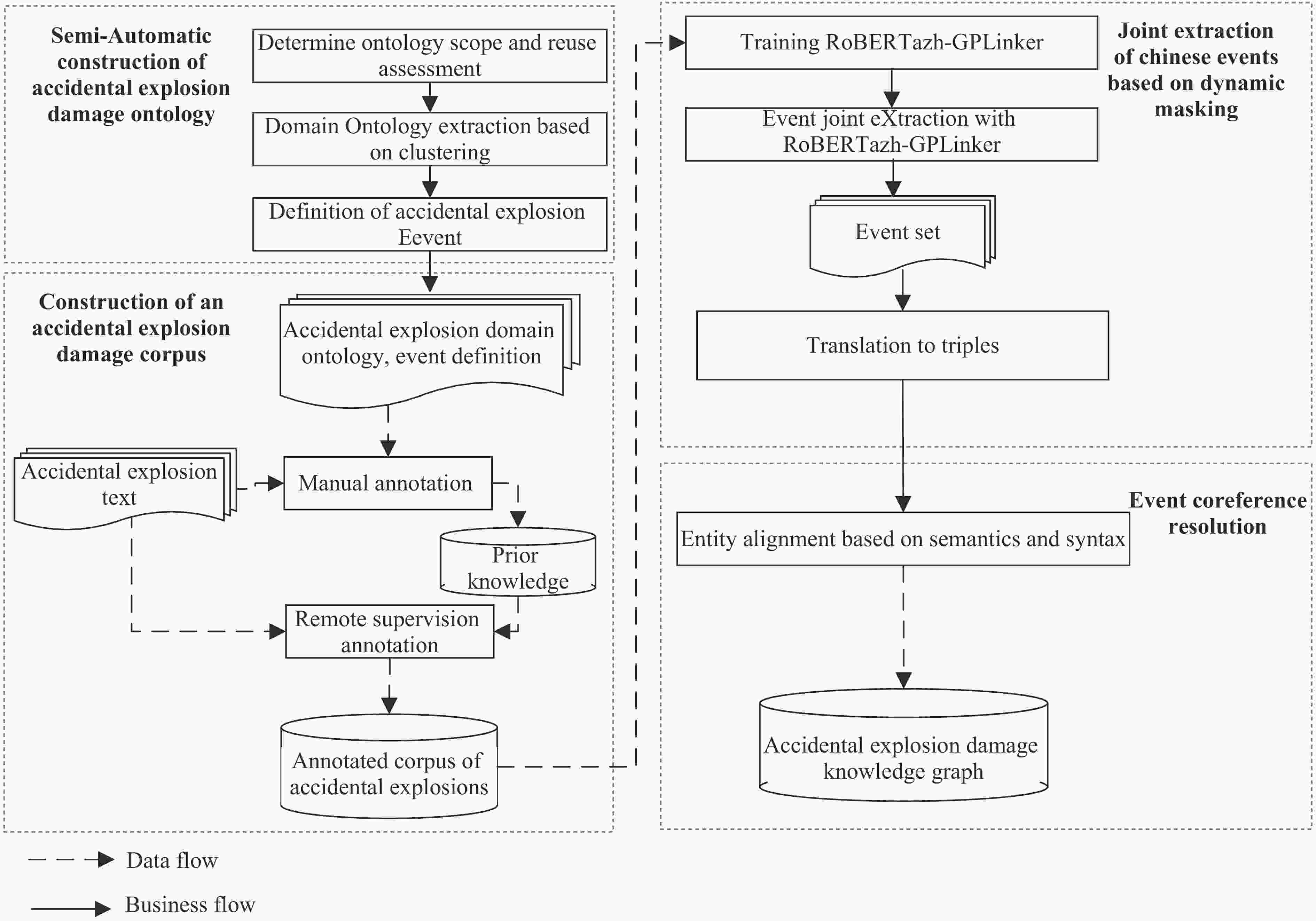
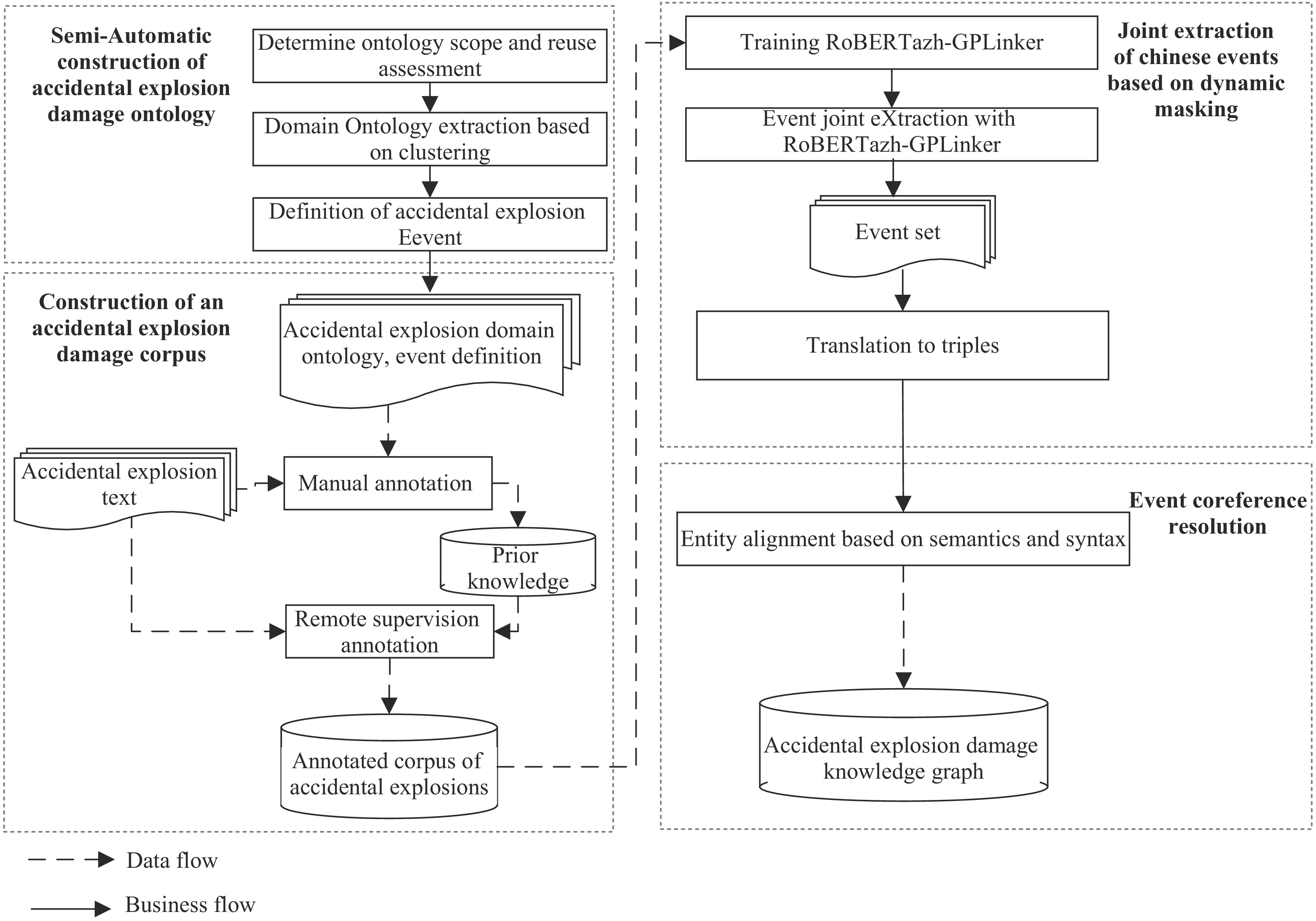
图 1 意外爆炸毁伤知识图谱构建流程
Figure 1. Construction process of knowledge graph for accidental explosion damage
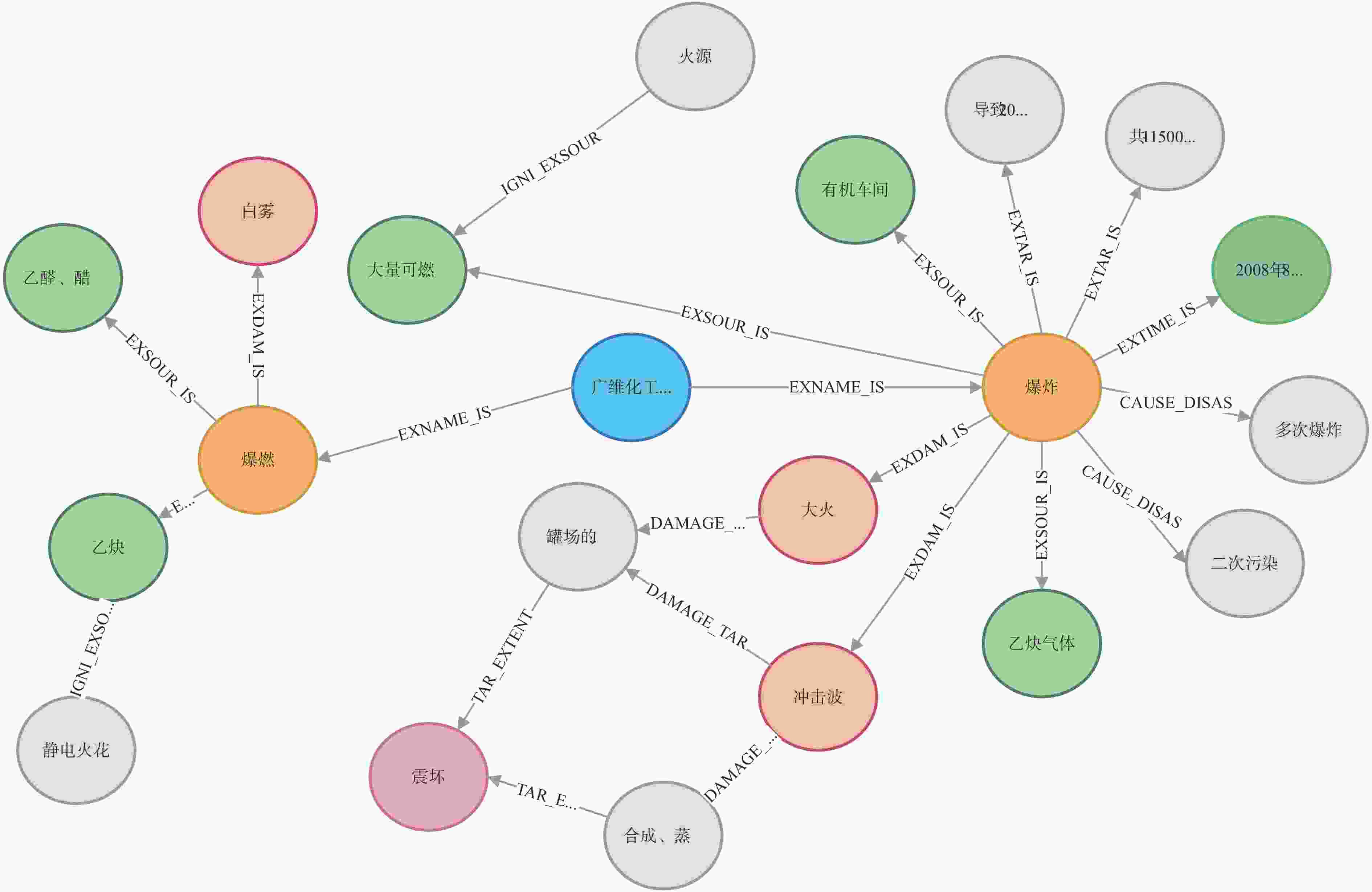
图 3 意外爆炸毁伤知识图谱实例
Figure 3. Instance of knowledge graph for accidental explosion damage
表 1 意外爆炸毁伤事件嵌套和重叠示例
Table 1. Examples of nested and overlapping events in accidental explosion damage
问题 事例 说明 重叠事件 爆炸导致小轿车燃烧 事件类型:爆炸事件、毁伤事件 嵌套事件 爆炸抛出的碎石砸毁了附近的房屋 事件类型:爆炸事件、毁伤事件  下载: 导出CSV
表 2 意外爆炸毁伤领域中的事件类型、触发词、论元角色和论元
Table 2. Event types, trigger words, ontological roles and ontological elements in accidental explosive damage
事件类型 触发词 论元角色 论元 爆炸事件 爆炸、爆燃、炸、
闪爆、爆裂事件名称 天津大爆炸、清水河大爆炸 时间 凌晨5点30分、2017年8月 地点 工厂、车间 爆炸源 化学制剂类、火药类、粉尘、混合物 环境 潮湿、高温、雷击、阵雨、风、封闭 TNT当量 1000 t、0.05 t次生灾害 二次爆炸、水污染等。 毁伤元 冲击波、破片、火焰、深坑等 目标 建筑、设施和人 损失金额 人民币 1000 多万元引爆事件 点燃、引燃、
点着、起火、爆燃爆炸源 化学制剂、火药类、粉尘、混合物等 点火方式 明火、阴燃、火星、摩擦引热、热表面 反应事件 氧化、硝化 爆炸源 化学制剂、火药类、粉尘、混合物等 产物 氮气、水蒸气、一氧化碳、二氧化碳、氨气 毁伤事件 砸毁、冲击、砸、
震碎、死亡、受伤、
震飞、燃烧毁伤元 冲击波、破片、火焰、炸坑等 目标 建筑、设施和人 响应程度 飞出100 m、位移7 m 毁伤描述 重度变形、坑深8 m 环境 潮湿、高温、雷击、阵雨、风、封闭
下载: 导出CSV
表 3 基于语义和语法相似度的实体对齐算法
Table 3. Entity alignment algorithm based on semantic and syntactic similarity
输入:待对齐的实体e1和e2,其上下文s1和s2,相似度阈值τ 输出:e1和e2对齐结果 1. 将所有抽取出的实体加入分词词典w_dict 2. 按照w_dict对s1和s2进行分词 3. 预训练BERT模型分别计算e1在s1的表示vec1,e2在s2中的表示vec2 4. //1. 计算语义相似度 5. 对vec1和vec2扁平化处理 6. if vec1.shape[0] > vec1.shape[0]: 7. 对vec2进行零填充操作 8. else 9. 对vec1进行零填充操作 10. sim = 1- cos(vec2, vec1) //计算e1和e2之间的余弦相似度 11. //2. 计算语法相似度 12. 利用NTLK库分别判断e1在s1中的词性pos1,e2在s2中的词性pos2 13. if pos1 == pos2: 14. flag = 1 15. else 16. flag = 0 17. if flag * sim <τ: 18. return NULL 19. return len(e1)>len(e2)? e1:e2
下载: 导出CSV
表 4 基于语义和语法进行实体对齐的示例
Table 4. Example of entity alignment based on semantics and syntax
序号 样例 语法 语义相似度 是否对齐 1 电路老化产生火星点燃氧气和空气的混合物
空气氧气混合物被点燃,导致A地发生爆炸名词
名词0.78 是 2 导致这次爆炸发生的原因是设施老化
10月11日在A工厂B楼锅炉突然爆炸了名词
动词1.00 否
下载: 导出CSV
表 5 从报告1中提取的三元组
Table 5. Triples extracted from Report 1
头实体 关系 尾实体 爆炸 EXTIME_IS 2008年8月26日凌晨 爆炸 EXLOC_IS 广西维尼纶集团公司 爆炸 EXSOUR_IS 有机车间 爆炸 EXTIME_IS 2008年8月26日6时45分 爆炸 EXLOC_IS 广西维尼纶集团有限责任公司 爆炸 EXSOUR_IS 乙炔气体
下载: 导出CSV
表 6 从报告2中提取的三元组
Table 6. Triples extracted from Report 2
头实体 关系 尾实体 爆炸 EXTIME_IS 2008年8月26日6时40分 爆炸 EXTARIS 20人死亡、60受伤 爆炸 EXTAR_IS 厂区附近3km范围18个村屯及工厂职工、家属共 11500 多名群众大火 EXLOC_IS 广西维尼纶集团有限责任公司所属广西广维化工股份有限公司 爆燃 EXDAM_IS 白雾 爆燃 EXSOUR_IS 乙炔、乙醛、醋酸乙烯等易燃易爆气体 静电火花 IGNIEXSOUR 乙炔、乙醛、醋酸乙烯等易燃易爆气体 爆炸 EXSOUR_IS 大量可燃液体和乙炔 火源 IGNI_EXSOUR 大量可燃液体和乙炔
下载: 导出CSV
表 7 从报告3中提取的三元组
Table 7. Triples extracted from Report 3
头实体 关系 尾实体 爆炸 EXTIME_IS 2008年8月26日6时 40分 爆炸 EXLOC_IS 广西维尼纶集团有限责任公司所属广西广维化工股份有限公司 爆炸 EXTAR_IS 共 11500 多名群众疏散爆炸 EXTAR_IS 导致20人死亡、60人受伤 爆炸 EXTAR_IS 共 11500 多名群众疏散爆炸 EXDAM_IS 冲击波 爆炸 EXDAM_IS 大火 冲击波 DAMAGE_TAR 合成、蒸憎、醇解、聚合等工段的部分建筑物和设备、管道 冲击波 DAMAGE_TAR 罐场的储罐 大火 DAMAGE_TAR 罐场的储罐 合成、蒸憎、醇解、聚合等工段的部分建筑物和设备、管道 TAREXTENT 震坏 罐场的储罐 TAREXTENT 震坏
下载: 导出CSV
表 8 事件分类比较
Table 8. Comparison of event classification
模型 P/% R/% F1/% BERT-BiLSTM-CRF 71.4 49 57.0 BiLSTM-CRF 52.1 44 47.7 DMCNN 66.5 53 58.0 RoBERTa-GPLinker 69.2 55 61.0
下载: 导出CSV
表 9 事件元素分类比较
Table 9. Comparison of event element classification
模型 P/% R/% F1/% C-BiLSTM 47.3 46.6 46.9 BERT-QA 56.2 50.7 53.3 DMCNN 55.3 52.2 53.7 RoBERTa-GPLinker 63.4 55.4 59.1
下载: 导出CSV
表 10 不同数据下事件分类精确率比较
Table 10. Comparison of the precision of event type classification under different datasets
模型 P/% 混合数据 无嵌套和
重叠事件完全嵌套和
重叠事件BERT-BiLSTM-CRF 71.4 82.2 64.7 BiLSTM-CRF 52.1 68.3 43.2 DMCNN 66.5 78.6 60.5 RoBERTa-GPLinker 69.2 81.0 66.8
下载: 导出CSV
表 11 爆源类型和说明
Table 11. Type and description of explosion source
编号 爆源类型 说明 A 石油、煤油、汽油、酒精或其他液体易燃易爆品 无毒无异味 B 天然气、煤气、酒精蒸汽、混合气体等气体爆炸 无毒无异味 C 烷、苯、油漆等液态石化产品 有毒有异味 D 烷、苯、烯类固态化工产品 有毒有异味 E 烷、苯、烯类气态化工产品 有毒有异味 F 炸药、火药、烟火药、推进剂等 含C、H、硝基固态材料 G 金属粉尘 铝、镁、硅等 H 其他粉尘 面粉、木屑等 I 压力容器 物理爆炸 J 静电、雷电、电火花等 物理爆炸 K 其他爆炸源 占比极少、不常见
下载: 导出CSV
表 12 爆炸现象与毁伤分类
Table 12. Classification of explosion phenomena and damage
爆炸现象 毁伤等级/现象分类 标号 爆炸成坑 坑深 < 0.5 m 1 0.5 m≤ 坑深 <1 m 2 1 m≤ 坑深 <3 m 3 3 m≤ 坑深 <5 m 4 坑深 ≥ 5 m 5 破片抛掷 破片最大飞行距离 < 10 m 1 10 m ≤ 破片最大飞行距离 <30 m 2 30 m ≤ 破片最大飞行距离 <50 m 3 50 m ≤ 破片最大飞行距离 <100 m 4 破片最大飞行距离 ≥100 m 5 普通窗玻璃被破坏 窗户与爆源的距离< 10 km 1 10 km ≤ 窗户与爆源的距离< 50 km 2 50 km ≤ 窗户与爆源的距离< 100 km 3 窗户与爆源的距离 ≥100 km 4 爆炸火球 火球高度 < 10 m 1 10 m≤ 火球高度 <30 m 2 30 m ≤ 火球高度<50 m 3 50 m ≤ 火球高度 <100 m 4 火球高度 ≥100 m 5 爆源物质等效TNT TNT质量 < 0.5t 1 0.5 t ≤ TNT质量 <1 t 2 1 t ≤ TNT质量 <2 t 3 2 t ≤ TNT质量 <10 t 4 10 t ≤ TNT质量 <20 t 5 20 t ≤ TNT质量 <50 t 6 50 t ≤ TNT质量 <100 t 7 100 t ≤ TNT质量 <300 t 8 300 t≤ TNT质量 <500 t 9 TNT质量 ≥500 t 10 爆炸烟雾颜色 白色 1 黑色 2 红色或者粉红色 3 爆炸气味 无刺激性气味 1 有刺激性气味 2
下载: 导出CSV
表 13 相似意外爆炸事件
Table 13. Similar accidental explosion events
序号 c 爆炸现象 爆炸现象描述 1 F 普通窗玻璃破坏;爆炸成坑;烟雾 范围60 km;直径约120 m;红色蘑菇云 2 D 普通窗玻璃破坏;爆炸成坑 范围10 km;深度4.57 m 3 F 普通窗玻璃破坏;爆炸成坑;破片;烟雾和烟 范围2 km;深2 m;飞出400 m;黑色火焰 4 F 普通窗玻璃破坏;破片;爆炸成坑;烟雾 范围5 km;飞出100 m外;直径7 m,深约1 m;白色,红褐色烟雾 5 F 普通窗玻璃破坏;爆炸成坑;烟雾 范围500 m;距离29 m;直径范围15.6 m,深度1.9 m;灰白色蘑菇云 6 E 普通窗玻璃破坏;烟雾 范围5 km;高约15 m;红色 7 F 普通窗玻璃破坏;烟雾 约110 km;约150 m高;红色蘑菇云
下载: 导出CSV
表 14 贝叶斯算法输入
Table 14. Input of Bayesian algorithm
编码 c 冲击波毁伤等级 爆炸成坑等级 烟雾颜色分类 破片毁伤等级 1 F 4 5 3 −1 2 D 2 4 −1 −1 3 F 1 3 2 5 4 F 1 5 1,3 −1 5 F 1 3 1,2 2 6 E 0 −1 3 −1 7 F 3 −1 3 −1
下载: 导出CSV
-
[1] ASHRAF S, GARG H, KOUSAR M. An industrial disaster emergency decision-making based on China’s Tianjin city port explosion under complex probabilistic hesitant fuzzy soft environment [J]. Engineering Applications of Artificial Intelligence, 2023, 123: 106400. DOI: 10.1016/j.engappai.2023.106400. [2] YU G D, DUH Y S, YANG X D, et al. Holistic case study on the explosion of ammonium nitrate in Tianjin port [J]. Sustainability, 2022, 14(6): 3429. DOI: 10.3390/SU14063429. [3] 杭婷婷, 冯钧, 陆佳民. 知识图谱构建技术: 分类、调查和未来方向 [J]. 计算机科学, 2021, 48(2): 175–189. DOI: 10.11896/jsjkx.200700010.HANG T T, FENG J, LU J M. Knowledge graph construction techniques: taxonomy, survey and future directions [J]. Computer Science, 2021, 48(2): 175–189. DOI: 10.11896/jsjkx.200700010. [4] JI S X, PAN S R, CAMBRIA E, et al. A survey on knowledge graphs: representation, acquisition, and applications [J]. IEEE Transactions on Neural Networks and Learning Systems, 2022, 33(2): 494–514. DOI: 10.1109/TNNLS.2021.3070843. [5] GEVA T, ZAHAVI J. Empirical evaluation of an automated intraday stock recommendation system incorporating both market data and textual news [J]. Decision Support Systems, 2014, 57: 212–223. DOI: 10.1016/j.dss.2013.09.013. [6] 李学亮. 基于深度学习及知识图谱的垂直领域问答研究 [D]. 北京: 北京邮电大学, 2021: 4–12. DOI: 10.26969/d.cnki.gbydu.2021.002355.LI X L. Research on vertical domain question answering based on deep learning and knowledge graph [D]. Beijing: Beijing University of Posts and Telecommunications, 2021: 4–12. DOI: 10.26969/d.cnki.gbydu.2021.002355. [7] 刘宝, 车礼东, 黄红花, 等. 基于自然语言处理(NLP)技术建立化学品危险评估知识图谱的研究 [J]. 计算机与应用化学, 2018, 35(7): 605–610. DOI: 10.16866/j.com.app.chem201807010.LIU B, CHE L D, HUANG H H, et al. The research of establishment of knowledge graph of chemical hazard assessment based on natural language processing (NLP) technology [J]. Computers and Applied Chemistry, 2018, 35(7): 605–610. DOI: 10.16866/j.com.app.chem201807010. [8] 李聪, 徐子烜, 王雨情, 等. 城市燃气管网泄漏事故分析知识图谱构建及应用研究 [J]. 中国安全生产科学技术, 2022, 18(10): 5–12. DOI: 10.11731/j.issn.1673-193x.2022.10.001.LI C, XU Z X, WANG Y Q, et al. Construction and application of knowledge graph for leakage accident analysis of urban gas pipeline network [J]. Journal of Safety Science and Technology, 2022, 18(10): 5–12. DOI: 10.11731/j.issn.1673-193x.2022.10.001. [9] 何允. 基于化工案例的事故原因知识图谱构建研究 [D]. 大连: 大连理工大学, 2021: 20–33. DOI: 10.26991/d.cnki.gdllu.2021.001795.HE Y. Accident causes knowledge graph construction based on chemical cases [D]. Dalian: Dalian University of Technology, 2021: 20–33. DOI: 10.26991/d.cnki.gdllu.2021.001795. [10] 杜小勇, 李曼, 王珊. 本体学习研究综述 [J]. 软件学报, 2006, 17(9): 1837–1847. DOI: 10.1360/jos171837.DU X Y, LI M, WANG S. A survey on ontology learning research [J]. Journal of Software, 2006, 17(9): 1837–1847. DOI: 10.1360/jos171837. [11] 徐飞, 彭佳佳, 刘军, 等. 基于多特征融合的TextRank新闻自动摘要模型 [J]. 计算机系统应用, 2023, 32(2): 242–249. DOI: 10.15888/j.cnki.csa.008913.XU F, PENG J J, LIU J, et al. Automatic news summarization model based on multi-feature TextRank [J]. Computer Systems & Applications, 2023, 32(2): 242–249. DOI: 10.15888/j.cnki.csa.008913. [12] YANG B, FU X, SIDIROPOULOS N D, et al. Towards K-means-friendly spaces: simultaneous deep learning and clustering [C]//Proceedings of the 34th International Conference on Machine Learning - Volume 70. Sydney: JMLR. org, 2017: 3861–3870. [13] 席笑文, 郭颖, 宋欣娜, 等. 基于word2vec与LDA主题模型的技术相似性可视化研究 [J]. 情报学报, 2021, 40(9): 974–983. DOI: 10.3772/j.issn.1000-0135.2021.09.007.XI X W, GUO Y, SONG X N, et al. Research on the technical similarity visualization based on word2vec and LDA topic model [J]. Journal of the China Society for Scientific and Technical Information, 2021, 40(9): 974–983. DOI: 10.3772/j.issn.1000-0135.2021.09.007. [14] LIU Y H, OTT M, GOYAL N, et al. RoBERTa: a robustly optimized BERT pretraining approach [OL]. arXiv preprint arXIV: 1907.11692, 2019. DOI: 10.48550/arXiv.1907.11692. [15] SU J L, MURTADHA A, PAN S F, et al. Global pointer: novel efficient span-based approach for named entity recognition [OL]. arXiv preprint arXiv: 2208.03054, 2022. DOI: 10.48550/arXiv.2208.03054. [16] TRISEDYA B D, QI J Z, ZHANG R. Entity alignment between knowledge graphs using attribute embeddings [C]//Proceedings of the Thirty-Third AAAI Conference on Artificial Intelligence. Honolulu: AAAI Press, 2019: 297–304. DOI: 10.1609/aaai.v33i01.3301297. [17] CHEN Y B, XU L H, LIU K, et al. Event extraction via dynamic multi-pooling convolutional neural networks [C]//Proceedings of the 53rd Annual Meeting of the Association for Computational Linguistics and the 7th International Joint Conference on Natural Language Processing (Volume 1: Long Papers). Beijing: Association for Computational Linguistics, 2015: 167–176. DOI: 10.3115/v1/P15-1017. [18] VASHISHTH S, SANYAL S, NITIN V, et al. Composition-based multi-relational graph convolutional networks [C]//8th International Conference on Learning Representations, ICLR 2020. Addis Ababa: ICLR, 2020. [19] 姜子建, 周荣义, 石云霄, 等. 基于贝叶斯网络的危化品爆炸事故隐患关联与溯源分析 [J]. 中国安全科学学报, 2024, 34(6): 173–180. DOI: 10.16265/j.cnki.issn1003-3033.2024.06.1848.JIANG Z J, ZHOU R Y, SHI Y X, et al. Correlation and traceability analysis of hazardous chemical explosion accidents based on Bayesian network [J]. China Safety Science Journal, 2024, 34(6): 173–180. DOI: 10.16265/j.cnki.issn1003-3033.2024.06.1848. [20] KALLAS J, NAPOLITANO R. Understanding critical masonry building attributes shaping vulnerability to blast loads: data-driven insights from the 2020 Beirut explosion [J]. International Journal of Disaster Risk Reduction, 2024, 110: 104640. DOI: 10.1016/j.ijdrr.2024.104640. [21] DENNY J W, FARRIMOND D G, GABRIEL S, et al. The influence of obstacle geometric fidelity on blast wave propagation: a reduced-scale case study examining the role of the grain siloes in the 2020 Beirut explosion [J]. Shock Waves, 2025, 35(6): 673–699. DOI: 10.1007/S00193-025-01241-5. -

计量
- 文章访问数: 191
- HTML全文浏览量: 24
- PDF下载量: 69
- 被引次数: 0