



Analysis of explosion characteristics of mixed biomass explosive initiated by detonator and aluminum thermite detonation
-
摘要: 为探讨纳米铝热剂替代雷管起爆混合生物质爆破剂的可行性和差异性,选取数码电子雷管(S0)、Al/CuO铝热剂(S1)和Al/Bi2O3铝热剂(S2)分别起爆木粉与花生壳粉(质量比为1∶1)混合生物质爆破剂,并基于理论分析及工业炸药性能测试方法探究其爆炸性能规律。结果表明:雷管与铝热剂分属两个完全不同的能量释放功率等级体系,雷管可实现MW量级的瞬时功率输出,而铝热剂仅为kW量级;铝热剂起爆属于典型的高温爆燃型能量释放过程,能量密度高,可在有限约束内实现有效能量耦合,具备可靠的起爆能力;氧气压力是影响爆速与猛度的主导因素,钢管壁厚次之,起爆方式影响较弱,起爆方式具备可替代性,提升氧气压力和优化约束条件,可实现爆速与猛度的协同增强;3种起爆方式的激发效能呈现出一致的排序,即S0最强、S2次之、S1最弱,在冲击波参数与爆坑体积(0.33、0.24和0.21m3)两方面均得到验证。研究可为生物质爆破技术的优化与应用提供实验支撑。Abstract: To explore the feasibility of nano aluminum thermite as a detonator substitute for achieving stable detonation in mixed biomass blasting agent systems, and to clarify the differences in detonation effects relative to detonators, digital electronic detonators (S0), Al/CuO thermite (S1), and Al/Bi2O3 thermite (S2) were selected to detonate a mixed biomass blasting agent composed of wood powder and peanut shell powder (mass ratio 1∶1). Based on theoretical analysis, qualitative analysis and quantitative calculation were conducted for the total energy release and energy release power of different detonation methods to estimate detonation performance. Industrial explosive performance testing methods-including aluminum thermite detonation test, orthogonal tests of detonation velocity and intensity, underwater explosion tests, and blasting funnel tests-were used to systematically test and compare the detonation response characteristics of the mixed biomass blasting agent under different detonation conditions. The evolutionary laws of the explosive performance were explored from perspectives of impact effect, energy release intensity, and spatial damage effect. Results indicate that detonators and thermites belong to two distinct energy release power level systems: detonators enable instantaneous power output in the MW range, while thermites only reach the kW range. Aluminum thermite detonation is a typical high-temperature explosive energy release process with high energy density, which can achieve effective energy coupling under limited constraints and possesses reliable detonation capability. Oxygen pressure is the dominant factor affecting detonation velocity and intensity, followed by steel pipe wall thickness. The impact of detonation methods is relatively weak, and detonation methods are substitutable. Synergistic enhancement of detonation velocity and intensity can be achieved by increasing oxygen pressure and optimizing constraint conditions. The excitation efficiency of the three detonation methods follows a consistent ranking: S0 is the strongest, S2 ranks second, and S1 is slightly weaker. This ranking has been verified by shock wave parameters and crater volumes (0.33 m3, 0.24 m3, 0.21 m3). This research provides experimental support for the optimization and application of biomass blasting technology.
-
Key words:
- biomass /
- detonation method /
- nano-aluminothermic /
- explosive effect /
- underwater explosion /
- blasting funnel
-
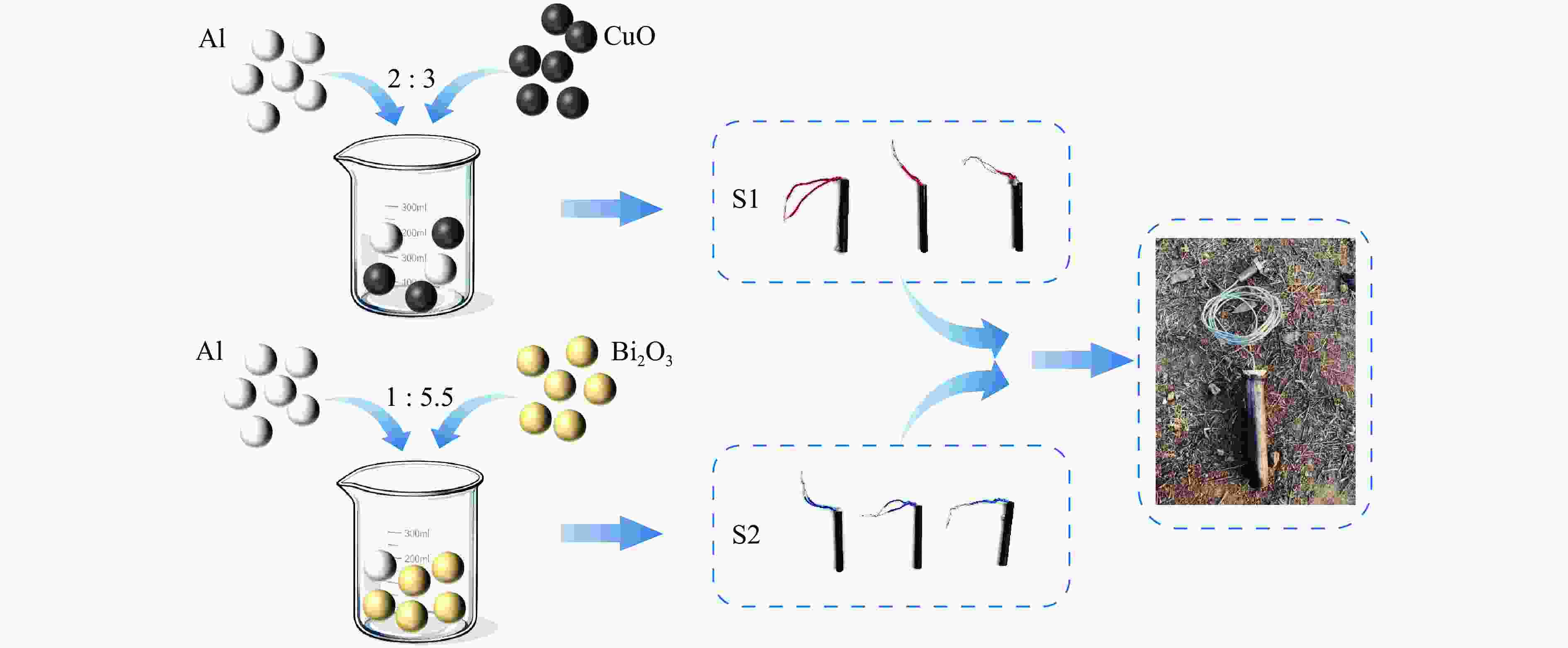
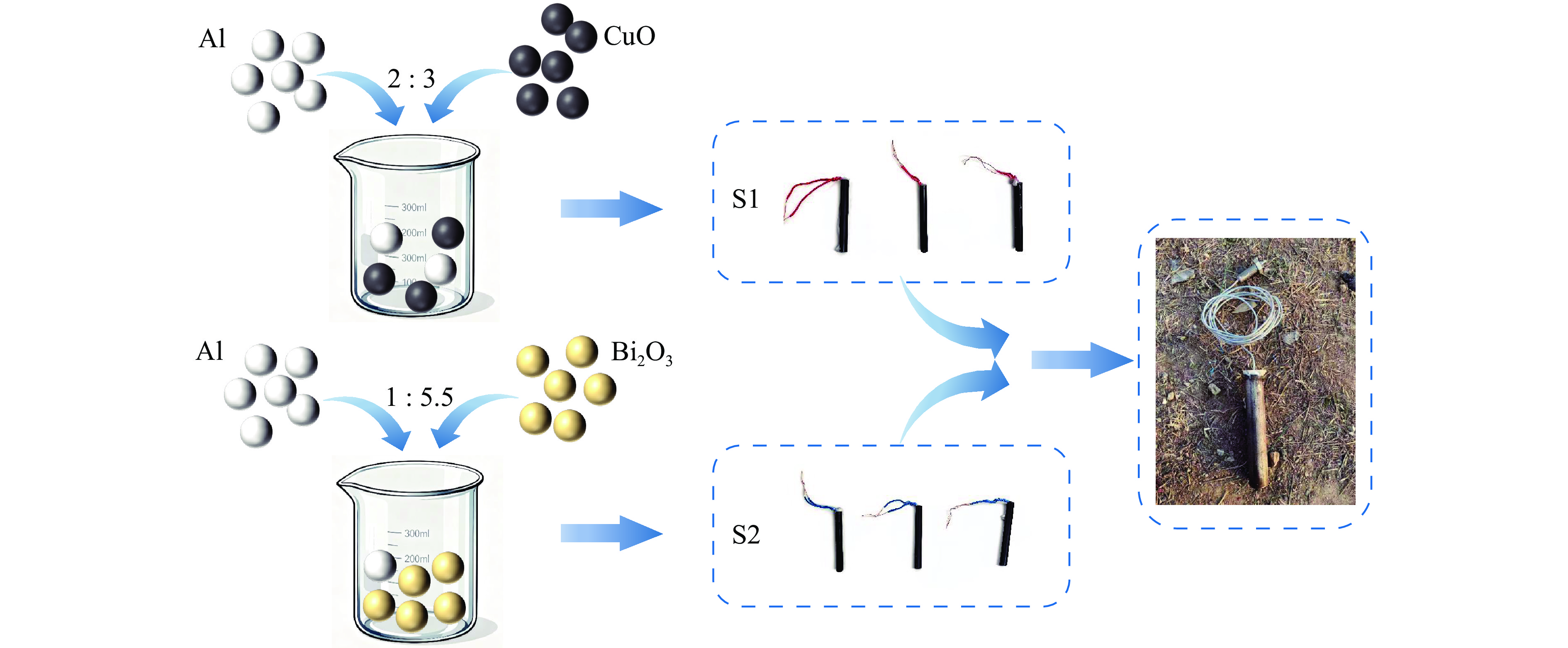
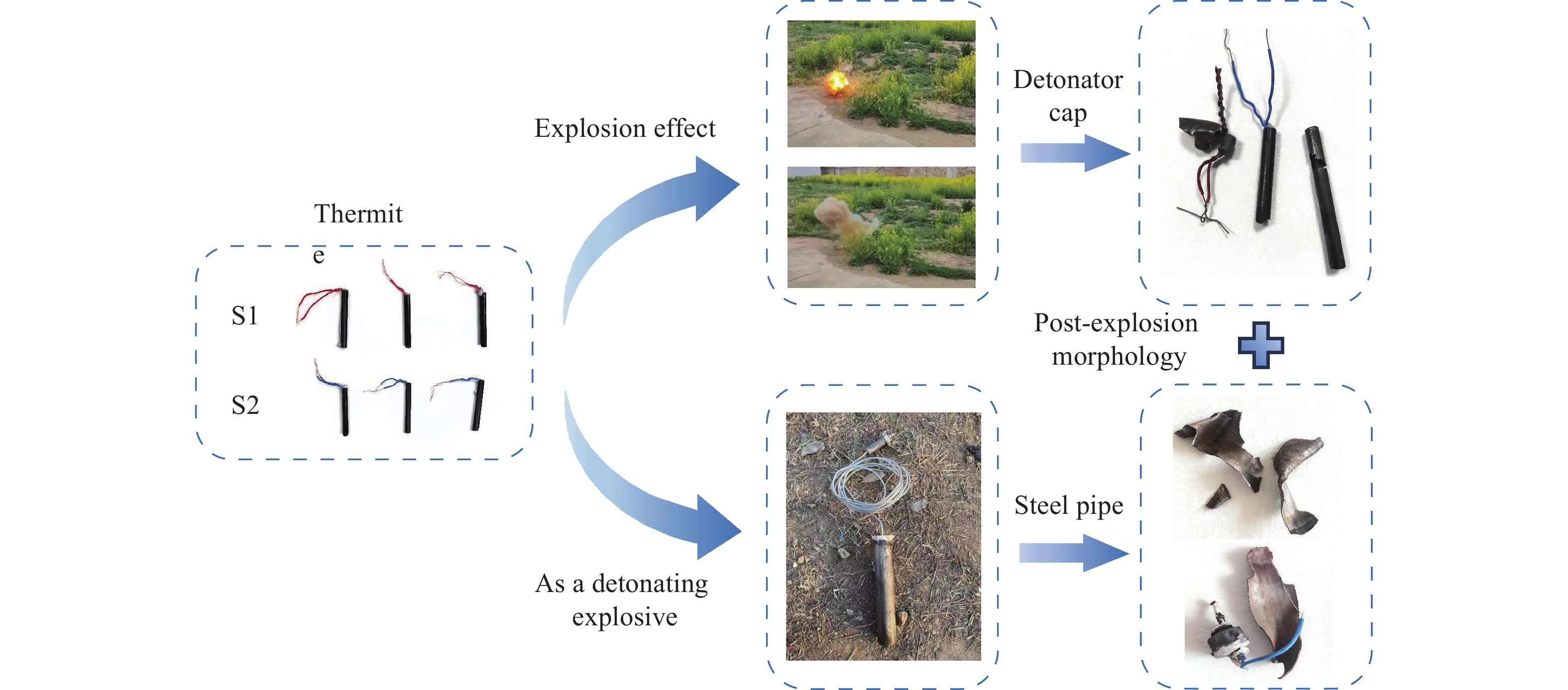
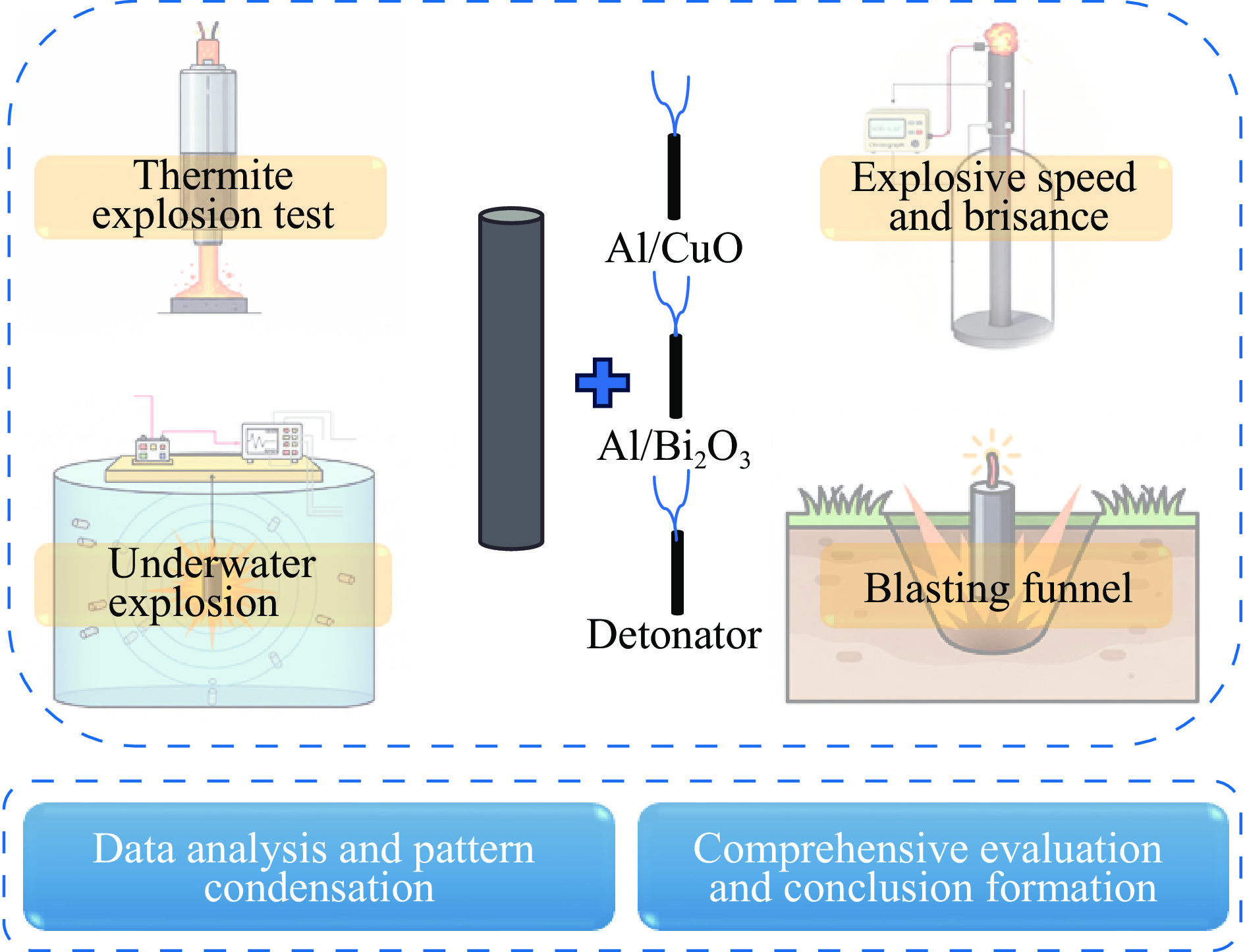
图 2 铝热剂制备示意图及试爆实物
Figure 2. Schematic of thermite preparation and photograph of the preliminary detonation test
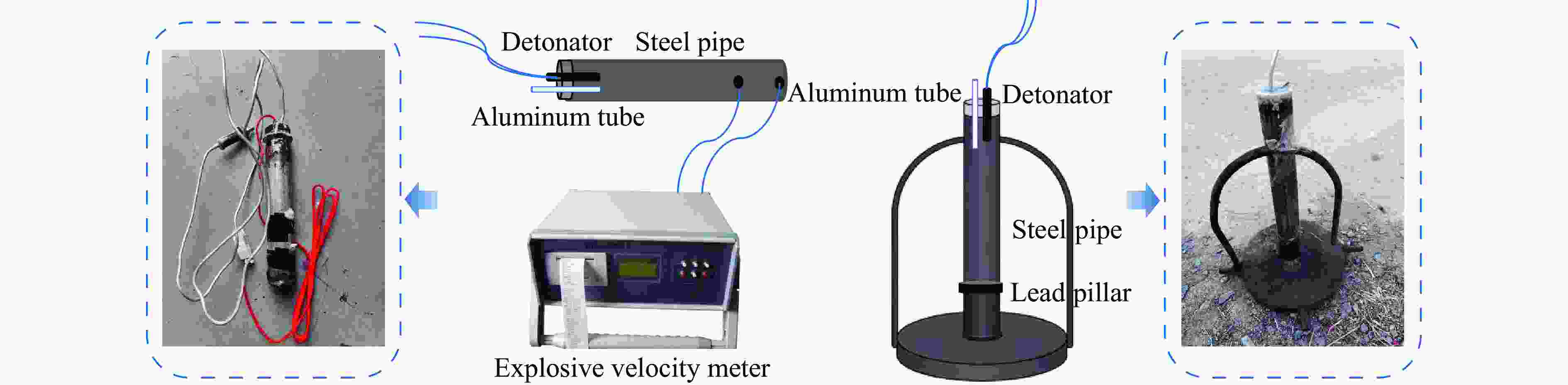
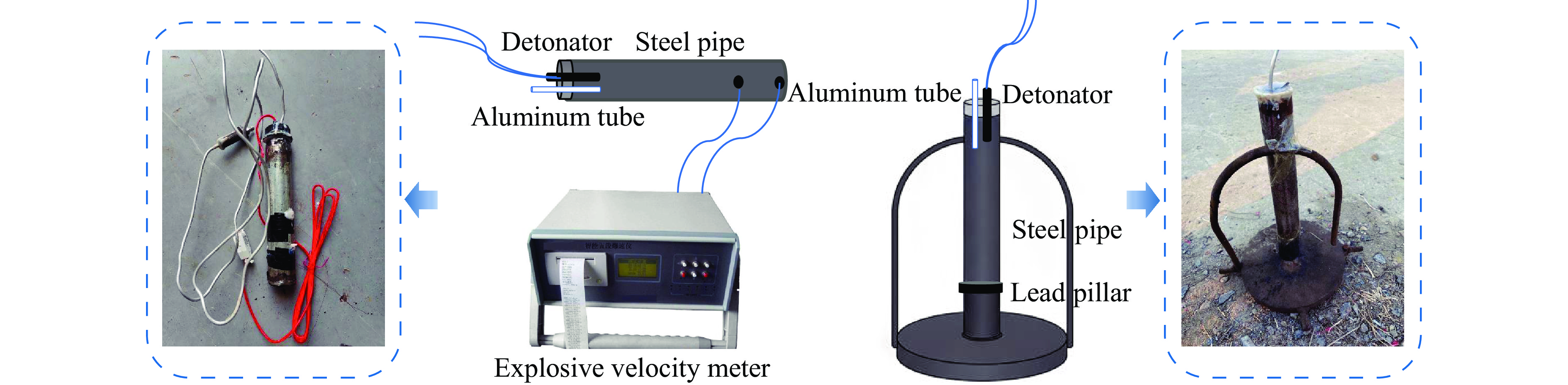
图 3 爆速和猛度测量示意和实物图
Figure 3. Schematic and physical diagram of explosion velocity and brisance measurement
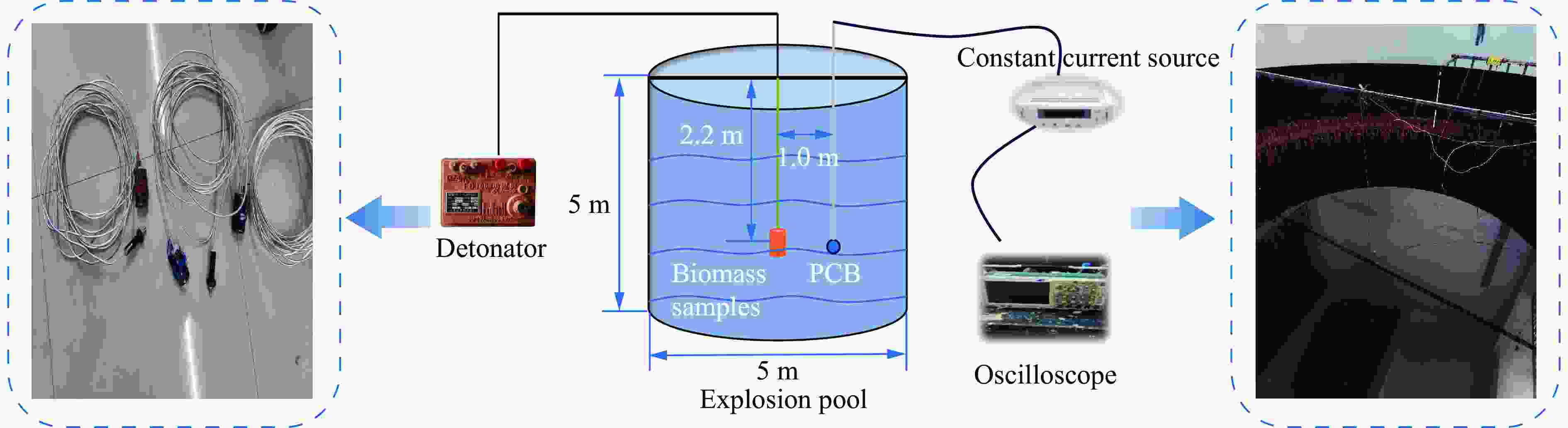
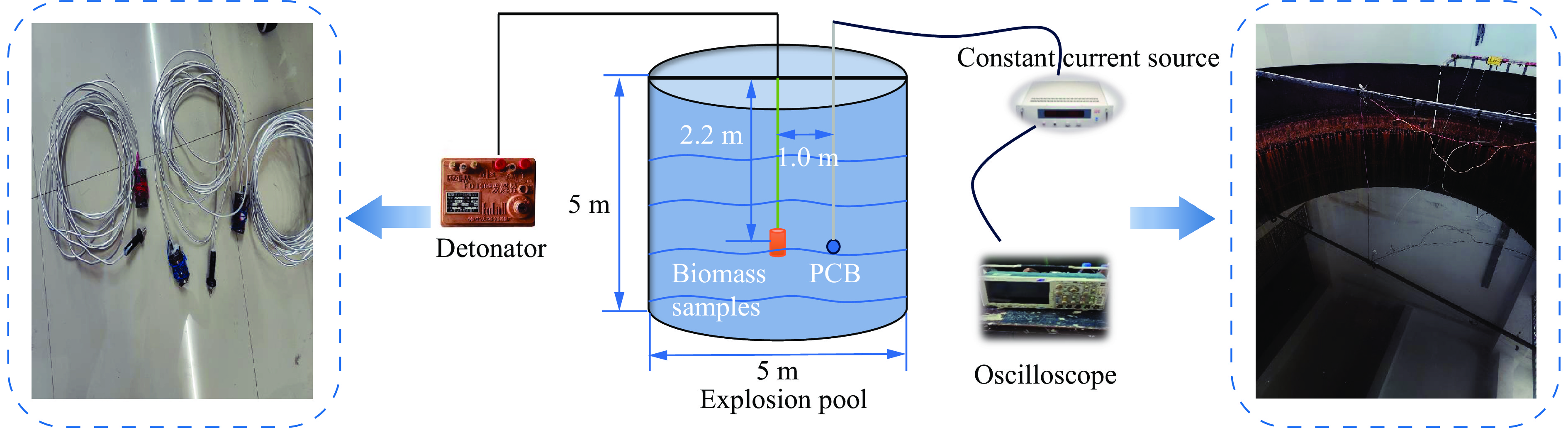
图 4 部分实物及整体水下爆炸示意图
Figure 4. Schematic diagram of partial physical objects and overall underwater explosion
表 1 三因素三水平正交实验表
Table 1. Three-factor, three-level orthogonal experimental design
水平 因素 起爆方式 氧气压力p/MPa 钢管壁厚M/mm 1 S0 5 1.5 2 S1 7 2.0 3 S2 9 2.5  下载: 导出CSV
表 2 生物质爆破剂9组正交实验
Table 2. Orthogonal experiment of 9 groups of biomass blasting agents
NO. 起爆方式 氧气压力p/MPa 钢管壁厚M/mm 1 S0 5 1.5 2 S0 7 2.0 3 S0 9 2.5 4 S1 5 2.0 5 S1 7 2.5 6 S1 9 1.5 7 S2 5 2.5 8 S2 7 1.5 9 S2 9 2.0
下载: 导出CSV
表 3 起爆源理论能量参数对比
Table 3. Comparison of theoretical energy parameters of explosive sources
起爆方式 总能量释放量Q/kJ 反应持续时间t/s 能量释放功率P/W S0 5.46 10−6 5.4600 ×10⁹S1 3.02 6.6×10⁻³ 4.5758 ×10⁵S2 1.95 3.5×10⁻³ 5.5714 ×10⁵
下载: 导出CSV
表 4 爆速及猛度正交实验结果
Table 4. Orthogonal test results of explosion velocity and brisance
NO. 起爆
方式氧气压力p/
MPa钢管壁厚M/
mm爆速D/
(m·s−1)猛度B/
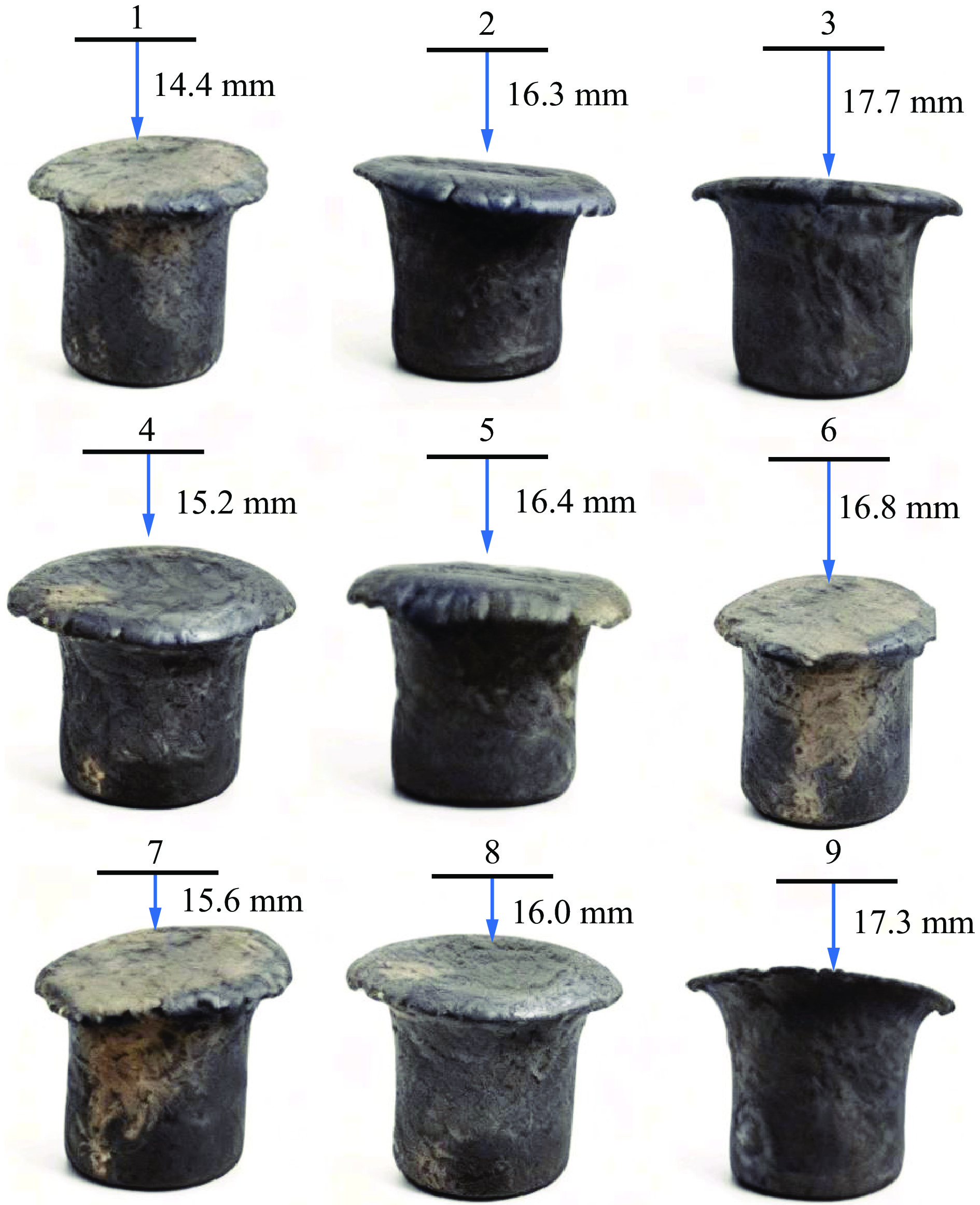
mm1 S0 5 1.5 2624 14.4 2 S0 7 2.0 2731 16.3 3 S0 9 2.5 2976 17.7 4 S1 5 2.0 2657 15.2 5 S1 7 2.5 2766 16.4 6 S1 9 1.5 2897 16.8 7 S2 5 2.5 2682 15.6 8 S2 7 1.5 2712 16.0 9 S2 9 2.0 2923 17.3
下载: 导出CSV
表 5 爆速及猛度极差分析
Table 5. Range analysis of explosion velocity and brisance
平均
类型爆速D/(m·s−1) 猛度B/mm 因素A 因素B 因素C 因素A 因素B 因素C K1v 2777 2654 2744 16.1 15.1 15.7 K2v 2773 2736 2770 16.1 16.2 16.3 K3v 2772 2932 2808 16.3 17.3 16.6 k1v 926 885 915 5.4 5.0 5.2 k2v 924 912 923 5.4 5.4 5.4 k3v 924 977 936 5.4 5.8 5.5 Rv 2 92 21 0 0.8 0.3
下载: 导出CSV
表 6 水下爆炸各参数计算值
Table 6. Calculated values of various parameters for underwater blasting
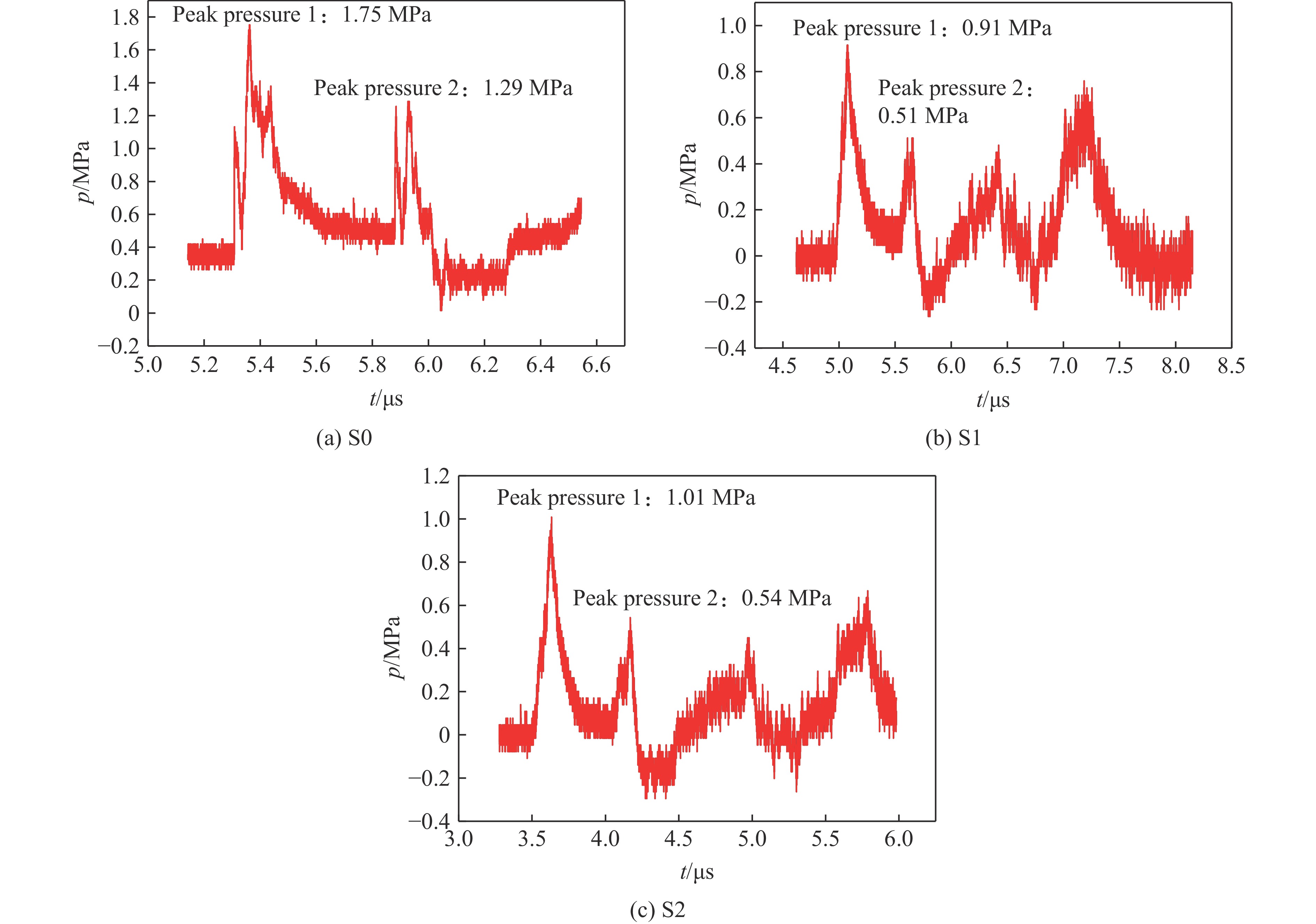
起爆方式 Pm/MPa Es/(kJ·kg−1) S0 1.75 1.503 S1 0.91 0.385 S2 1.01 0.474
下载: 导出CSV
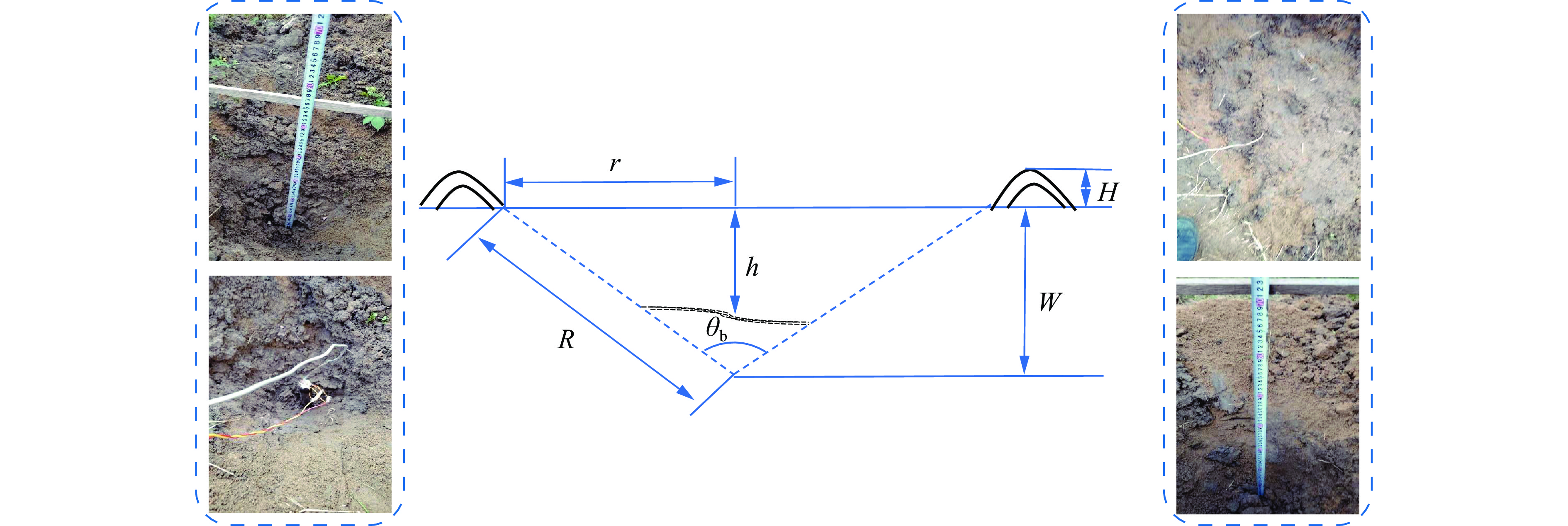
表 7 爆破漏斗参数
Table 7. Parameters of blasting funnel
起爆方式 W/cm r/cm R/cm h/cm H/cm θb/(˚) nb Vb/m3 S0 57 79 87 51 19 116 1.39 0.33 S1 57 65 82 49 13 105 1.14 0.21 S2 57 68 84 49 16 109 1.19 0.24
下载: 导出CSV
-
[1] 张曌, 张瑞新, 付士根, 等. 露天矿抛掷爆破技术发展现状及应用前景 [J]. 振动与冲击, 2025, 44(13): 64–78. DOI: 10.13465/j.cnki.jvs.2025.13.007.ZHAO Z, ZHANG R X, FU S G, et al. Development status and application prospects of open-pit mine cast blasting technology [J]. Vibration and Shock, 2025, 44(13): 64–78. DOI: 10.13465/j.cnki.jvs.2025.13.007. [2] 陈源, 王建国, 王陆洋, 等. 露天水孔爆破技术研究进展 [J]. 采矿技术, 2024, 24(3): 65–69. DOI: 10.13828/j.cnki.ckjs.2024.03.032.CHEN Y, WANG J G, WANG L Y, et al. Research progress on open-pit waterhole blasting technology [J]. Mining Technology, 2024, 24(3): 65–69. DOI: 10.13828/j.cnki.ckjs.2024.03.032. [3] TAN J, GUAN W M, CAO A Y, et al. Global research status and intelligent technology development trend of open-pit mining blasting: visualization analysis based on CiteSpace and VOSviewer [J]. Geomechanics and Geophysics for Geo-energy and Geo-resources, 2025, 11(1): 46. DOI: 10.1007/s40948-025-00953-3. [4] 张小康, 丁亚明. 非炸药爆破破岩展望 [J]. 广东化工, 2017, 44(15): 131–133. DOI: 10.3969/j.issn.1007-1865.2017.15.058.ZHANG X K, DING Y M. Prospect for non-explosive methods of rock crushing [J]. Guangdong Chemical Industry, 2017, 44(15): 131–133. DOI: 10.3969/j.issn.1007-1865.2017.15.058. [5] JAFARI M, KESHAVARZ M H, EBADPOUR R. A Simple approach to assess the performance of non-ideal aluminum/ammonium perchlorate composite explosives as compared to the best available methods [J]. Zeitschrift für anorganische und allgemeine Chemie, 2020, 646(17): 1419–1425. DOI: 10.1002/zaac.202000269. [6] LIU Q W, LIU M M, ZHAO K, et al. Microwave application in biomass conversion: a review [J]. ChemBioEng Reviews, 2024, 11(5): e202400020. DOI: 10.1002/cben.202400020. [7] 韩伟, 韩恒文, 程薇, 等. 碳中和目标驱动下生物质燃料技术研究进展 [J]. 化工进展, 2024, 43(5): 2463–2474. DOI: 10.16085/j.issn.1000-6613.2023-1217.HAN W, HAN H W, CHENG W, et al. Research progress of biomass fuels technology driven by carbon neutrality [J]. Chemical Industry and Engineering Progress, 2024, 43(5): 2463–2474. DOI: 10.16085/j.issn.1000-6613.2023-1217. [8] 王鲁庆, 何泽, 马宏昊, 等. 一种生物质燃料串联爆炸装置及施工工艺: CN115574675A [P]. 2023-01-06.WANG L Q, HE Z, MA H H, et al. Biomass fuel tandem explosion device and construction process: CN115574675A [P]. 2023-01-06. [9] 马宏昊, 张冰原, 王鲁庆, 等. 一种基于生物质燃料的爆轰模型和爆炸复合管关键技术: CN117161535A [P]. 2023-12-05.MA H H, ZHANG B Y, WANG L Q, et al. Biomass fuel-based detonation model and explosion composite tube key technology: CN117161535A [P]. 2023-12-05. [10] 杨光, 徐颖, 杨荣周, 等. 生物质及其混合物的组成性能与爆炸可行性分析 [J]. 火炸药学报, 2024, 47(12): 1114–1123. DOI: 10.14077/j.issn.1007-7812.202405005.YANG G, XU Y, YANG R Z, et al. Composition performance and explosion feasibility analysis of biomass and its mixtures [J]. Chinese Journal of Explosives & Propellants, 2024, 47(12): 1114–1123. DOI: 10.14077/j.issn.1007-7812.202405005. [11] 杨光, 徐颖, 何泽, 等. 混合生物质基爆破剂的爆炸性能及其影响因素 [J]. 火炸药学报, 2025, 48(7): 623–630. DOI: 10.14077/j.issn.1007-7812.202501014.YANG G, XU Y, HE Z, et al. Explosion performance and influencing factors of mixed biomass based blasting agents [J]. Chinese Journal of Explosives & Propellants, 2025, 48(7): 623–630. DOI: 10.14077/j.issn.1007-7812.202501014. [12] ZHANG J, WEI J, GUO C L, et al. The spatial distribution characteristics of the biomass residual potential in China [J]. Journal of Environmental Management, 2023, 338: 117777. DOI: 10.1016/j.jenvman.2023.117777. [13] 李学琴, 王志伟, 刘鹏, 等. “双碳”目标下生物质热化学转化技术路径探讨 [J]. 生物质化学工程, 2024, 58(4): 69–76. DOI: 10.3969/j.issn.1673-5854.2024.04.009.LI X Q, WANG Z W, LIU P, et al. Exploration on the technological path of thermochemical conversion of biomass under the background of carbon peak and carbon neutrality [J]. Biomass Chemical Engineering, 2024, 58(4): 69–76. DOI: 10.3969/j.issn.1673-5854.2024.04.009. [14] ZHUANG J S, LI M, PU Y Q, et al. Observation of potential contaminants in processed biomass using Fourier transform infrared spectroscopy [J]. Applied Sciences, 2020, 10(12): 4345. DOI: 10.3390/app10124345. [15] 鹿伟, 司龙刚, 刘伟. 浅谈工业雷管生产自动化现状及未来趋势 [J]. 甘肃科技纵横, 2017, 46(4): 14–16. DOI: 10.3969/j.issn.1672-6375.2017.04.004.LU W, SI L G, LIU W. A brief discussion on the current status and future trends of industrial detonator production automation [J]. Scientific & Technical Information of Gansu, 2017, 46(4): 14–16. DOI: 10.3969/j.issn.1672-6375.2017.04.004. [16] YIN H J, CHEN H, FENG Y, et al. Time-frequency-energy characteristics analysis of vibration signals in digital electronic detonators and nonel detonators exploders based on the HHT method [J]. Sensors, 2023, 23(12): 5477. DOI: 10.3390/s23125477. [17] COMET M, SCHWARTZ C, SCHNELL F, et al. New detonating compositions from ammonium dinitramide [J]. Propellants, Explosives, Pyrotechnics, 2021, 46(5): 742–750. DOI: 10.1002/prep.202000288. [18] 张梦瑶, 倪德彬, 彭加斌, 等. 耐高温起爆药高氯酸-三乙烯二胺合铵的性能表征 [J]. 火炸药学报, 2024, 47(11): 1010–1015. DOI: 10.14077/j.issn.1007-7812.202405028.ZHANG M Y, NI D B, PENG J B, et al. Performance characterization of high temperature resistant primary explosive perchloric acid-triethylenediamine ammonium [J]. Chinese Journal of Explosives & Propellants, 2024, 47(11): 1010–1015. DOI: 10.14077/j.issn.1007-7812.202405028. [19] LI F W, WANG Q, CHENG J, et al. Mitigating the negative catalytic effect of CuO by FAS-17 coated Al nanopowder: isothermal ageing of Al/CuO nanothermite at 71°C and 60% relative humidity [J]. Defence Technology, 2024, 34: 156–167. DOI: 10.1016/j.dt.2023.11.003. [20] JIANG C L, HU R, ZHANG J B, et al. Shock-induced chemical reaction characteristics of PTFE-Al-Bi2O3 reactive materials [J]. Defence Technology, 2024, 36(6): 1–12. DOI: 10.1016/j.dt.2024.01.008. [21] SHEKHAR H. The applicability of Kamlet's method for the prediction of the velocity of detonation (VOD) of polyurethane (PU) based binary explosive compositions [J]. Central European Journal of Energetic Materials, 2013, 10(2): 217–223. [22] KESHAVARZ M H, SEIF F, SOURY H. Prediction of the brisance of energetic materials [J]. Propellants, Explosives, Pyrotechnics, 2014, 39(2): 284–288. DOI: 10.1002/prep.201300047. [23] 孙宝亮, 黄文尧, 汪泉, 等. 硅藻土为载体的低爆速乳化炸药制备与性能 [J]. 含能材料, 2023, 31(1): 26–34. DOI: 10.11943/CJEM2022092.SUN B L, HUANG W Y, WANG Q, et al. Preparation and performance of diatomite emulsion explosive with low detonation velocity [J]. Chinese Journal of Energetic Materials, 2023, 31(1): 26–34. DOI: 10.11943/CJEM2022092. [24] WAN Y, LI W J, DU H B, et al. Investigation of shock wave pressure transmission patterns and influencing factors caused by underwater drilling blasting [J]. Water, 2022, 14(18): 2837. DOI: 10.3390/w14182837. [25] YANG L H, YANG S J, ZHANG Z X, et al. Dynamic response of gradient double-corrugated sandwich plate subjected to underwater blast loads [J]. Mechanics of Advanced Materials and Structures, 2023, 30(2): 388–399. DOI: 10.1080/15376494.2021.2015021. [26] 徐庆涛, 马宏昊, 周章涛, 等. 基于压力-冲量曲线的水下爆炸压力-时间公式 [J]. 爆炸与冲击, 2024, 44(8): 081445. DOI: 10.11883/bzycj-2023-0442.XU Q T, MA H H, ZHOU Z T, et al. Pressure-time formula for underwater explosion based on pressure-impulse curve [J]. Explosion and Shock Waves, 2024, 44(8): 081445. DOI: 10.11883/bzycj-2023-0442. [27] 张健, 韩新欣, 黄祥宏. 水下爆炸载荷作用下的层冰破坏特性研究 [J]. 舰船科学技术, 2025, 47(15): 12–17. DOI: 10.3404/j.issn.1672-7649.2025.15.003.ZHANG J, HAN X X, HUANG X H. Research on the failure characteristics of layer ice under underwater explosion loads [J]. Ship Science and Technology, 2025, 47(15): 12–17. DOI: 10.3404/j.issn.1672-7649.2025.15.003. [28] 黄谢平. 水下爆炸冲击波与气泡脉动毁伤重力坝理论与超重力试验 [D]. 杭州: 浙江大学, 2023: 34–42. DOI: 10.27461/d.cnki.gzjdx.2023.000665.HUANG X P. Theory and hypergravity experiments on damage to gravity dams by underwater explosion shock waves and bubble pulsations [D]. Hangzhou: Zhejiang University, 2023: 34–42. DOI: 10.27461/d.cnki.gzjdx.2023.000665. [29] 彭建宇. 动静组合加载下岩石爆破漏斗形成机制研究 [D]. 沈阳: 东北大学, 2018: 12–23. DOI: 10.27007/d.cnki.gdbeu.2018.000667.PENG J Y. Study on the formation mechanism of rock explosion crater under combined static and dynamic loading [D]. Shenyang: Northeastern University, 2018: 12–23. DOI: 10.27007/d.cnki.gdbeu.2018.000667. [30] 李波, 周宇, 赵鑫璐, 等. 基于柱状药包爆破漏斗试验的露天台阶爆破参数优化研究 [J]. 矿业研究与开发, 2025, 45(8): 37–44. DOI: 10.13827/j.cnki.kyyk.2025.08.006.LI B, ZHOU Y, ZHAO X L, et al. Optimization of open-pit bench blasting parameters based on cylindrical charge blasting crater test [J]. Mining Research and Development, 2025, 45(8): 37–44. DOI: 10.13827/j.cnki.kyyk.2025.08.006. [31] WU J G, FAN Y, LENG Z D, et al. 2D numerical simulation of blasting crater and breaking fragmentations [J]. Computer Modeling in Engineering & Sciences, 2025, 144(1): 811–839. DOI: 10.32604/cmes.2025.065632. [32] 张金龙, 郭子如, 杜明燃, 等. RDX的爆炸产物组成和爆热的计算与分析 [J]. 煤矿爆破, 2019, 37(4): 24–27. DOI: 10.3969/j.issn.1674-3970.2019.04.007.ZHANG J L, GUO Z R, DU M R, et al. Calculation and analysis of explosive product composition and heat of RDX [J]. Coal Mine Blasting, 2019, 37(4): 24–27. DOI: 10.3969/j.issn.1674-3970.2019.04.007. [33] 田德余, 赵凤起, 刘剑洪. 含能材料及相关物手册 [M]. 北京: 国防工业出版社, 2011: 234–236.TIAN D Y, ZHAO F Q, LIU J H. Handbook of energetic materials and the related compounds [M]. Beijing: National Defense Industry Press, 2011: 234–236. [34] 谢兴华, 崔钿, 谢强, 等. 钝感破岩药剂的激发药配方设计及性能研究 [J]. 安徽理工大学学报(自然科学版), 2023, 43(1): 60–65. DOI: 10.3969/j.issn.1672-1098.2023.01.008.XIE X H, CUI T, XIE Q, et al. The formulation design and performance study of igniter for blasting agent [J]. Journal of Anhui University of Science and Technology (Natural Science), 2023, 43(1): 60–65. DOI: 10.3969/j.issn.1672-1098.2023.01.008. [35] 杨耀勇, 汪泉, 李瑞, 等. 纳米铝热剂与猛炸药制备起爆药的表征及性能研究 [J]. 爆破器材, 2024, 53(1): 23–29,35. DOI: 10.3969/j.issn.1001-8352.2024.01.004.YANG Y Y, WANG Q, LI R, et al. Characterization and performance study on primary explosives prepared from Nano aluminothermal agents and high explosives [J]. Explosive Materials, 2024, 53(1): 23–29,35. DOI: 10.3969/j.issn.1001-8352.2024.01.004. [36] 高嘉林, 智小琦, 王洪伟, 等. 薄壁圆筒结构的炸药装药跌落响应特性研究 [J]. 兵器装备工程学报, 2025, 46(7): 25–36. DOI: 10.11809/bqzbgcxb2025.07.004.GAO J L, ZHI X Q, WANG H W, et al. Research on the drop response characteristics of explosive charges in thin-walled cylindrical structures [J]. Journal of Ordnance Equipment Engineering, 2025, 46(7): 25–36. DOI: 10.11809/bqzbgcxb2025.07.004. [37] 陈智凡. 供风量与层数协同下对水中冲击波衰减效果的实验研究 [D]. 淮南: 安徽理工大学, 2024: 45–52. DOI: 10.26918/d.cnki.ghngc.2024.001302.CHEN Z F. Experimental study on the attenuation effect of shock wave in water under the synergy of air supply volume and number of layers [D]. Huainan: Anhui University of Science and Technology, 2024: 45–52. DOI: 10.26918/d.cnki.ghngc.2024.001302. [38] 王天照. 气泡帷幕和爆源深度对水下冲击波削减作用的数值模拟研究 [D]. 淮南: 安徽理工大学, 2024: 43–51. DOI: 10.26918/d.cnki.ghngc.2024.001202.WANG T Z. Numerical simulation study of the effect of bubble curtain and burst source depth on the reduction of underwater shock waves [D]. Huainan: Anhui University of Science and Technology, 2024: 43–51. DOI: 10.26918/d.cnki.ghngc.2024.001202. -


计量
- 文章访问数: 766
- HTML全文浏览量: 259
- PDF下载量: 335
- 被引次数: 0