



Development of Methane-Air Deflagration-Driven Blast Wave Simulator I: Geometric and Structural Design
-
摘要: 如何高效地实现对试件的平面波加载,是爆炸荷载模拟装置设计的核心技术问题之一。为研发安全、经济、可重复使用的爆炸荷载模拟装置,基于现有试验装置、大尺寸激波管试验数据和LS-DYNA软件,建立了装置内爆炸波传播的数值模型,提出了加载面处超压荷载的均匀性的定量评估方法,数值计算分析了扩大段形状、长度及整形段长度等参数对加载面超压荷载分布均匀性的影响;对扩大段和整形段的壁厚、环向加劲肋间距、高度等关键结构参数进行了数值优化,实现了激波管扩大段与整形段几何与结构的优化设计;开展了爆炸荷载模拟装置的验证试验。研究表明:建立的爆炸波传播数值模型能够准确模拟冲击波的演化过程,计算结果与试验数据吻合良好;基于超压峰值和峰值到达时间误差等指标,实现了对加载面超压荷载均匀性的定量评价;在兼顾经济性的前提下,研发的爆炸荷载模拟装置扩大段采用上下对称的形式,长度为3 m,整形段长度可根据实际投入尽可能延长;以多次重复使用为目标,经数值计算确定扩大段和整形段壁厚为30 mm,环向加劲肋高度和间距均为150 mm。设计方案的有效性通过了试验验证,产生的爆炸荷载及结构抗爆性能均符合要求,研发的装置可用于结构构件的抗爆试验。Abstract: Efficiently achieving plane wave loading on the test specimen is a key technical issue in the design of blast wave simulators. Based on the existing device, testing data of large-scale shock tubes, and LS-DYNA software, numerical models of blast wave propagation in simulators were established. Numerical simulations were conducted to develop a safe, economical, and reusable blast wave simulator. A quantitative method for assessing the uniformity of overpressure load on the loading area was proposed. Numerical analyses were performed to investigate the influence of the shape and length of the expansion section and the length of the conditioning section on the uniformity of overpressure load on the loading area. Key structural parameters, including the wall thickness of the expansion and conditioning sections, as well as the spacing and height of the stiffeners, were numerically optimized. Validation tests were conducted on the blast wave simulator. It is found that the established numerical model can accurately reproduce the blast wave propagation, and the prediction results show good agreement with the testing data. Taking the errors of overpressure peak value and arrival time as indicators, the quantitative evaluation of overpressure load uniformity on the loading area is achieved. Considering the balance between technical and economic factors, the developed blast wave simulator is designed with a symmetrically configured expansion section 3 m in length. The length of the conditioning section can be extended as much as the actual investment allows. Based on the numerical results, the wall thickness of both the expansion and conditioning sections is determined to be 30 mm. The height and spacing of the stiffeners are both recommended to be 150 mm. The results of validation tests confirm that the geometric and structural design meets the requirements of blast loads and structural resistance, and the developed simulator is suitable for component-level tests.
-
Key words:
- blast wave simulator /
- expansion section /
- conditioning section /
- LS-DYNA /
- structural design
-
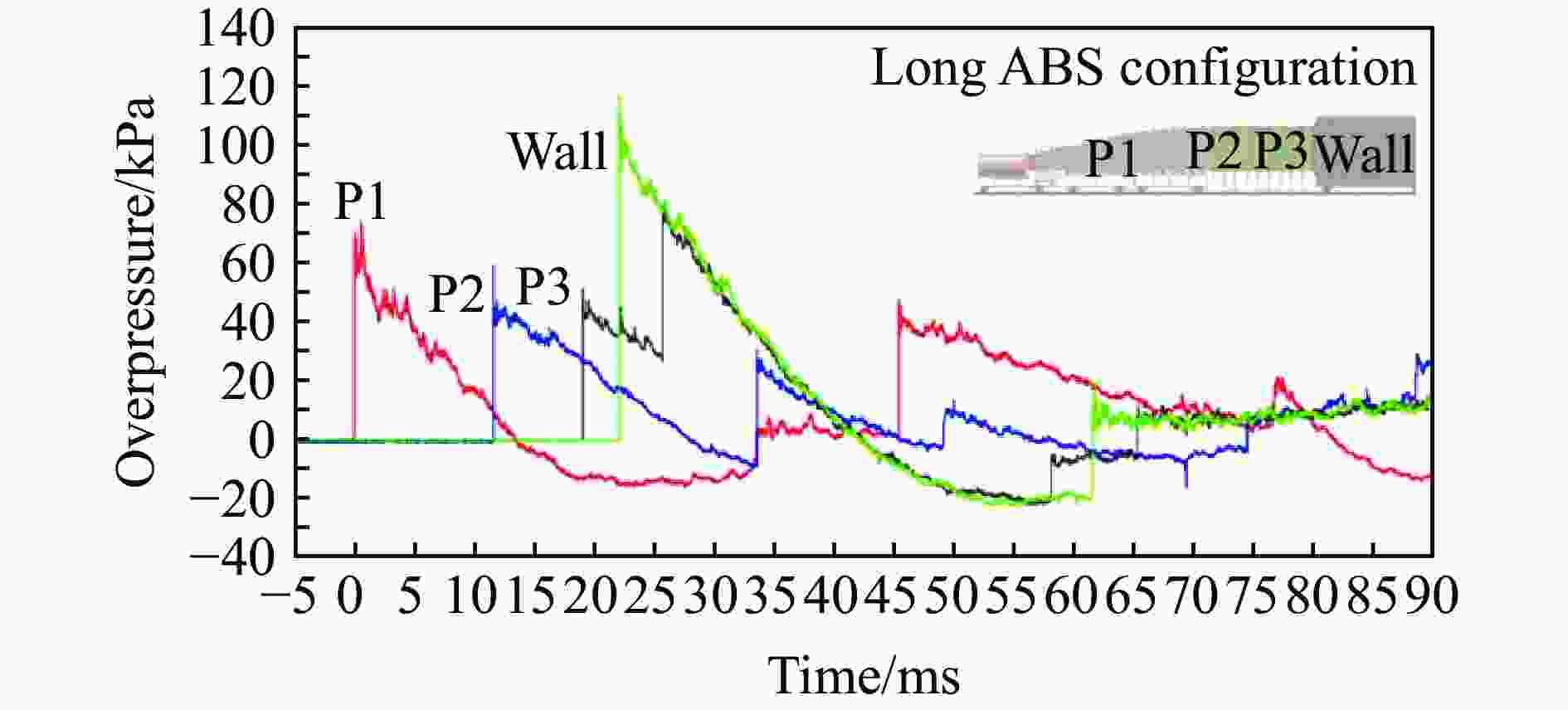
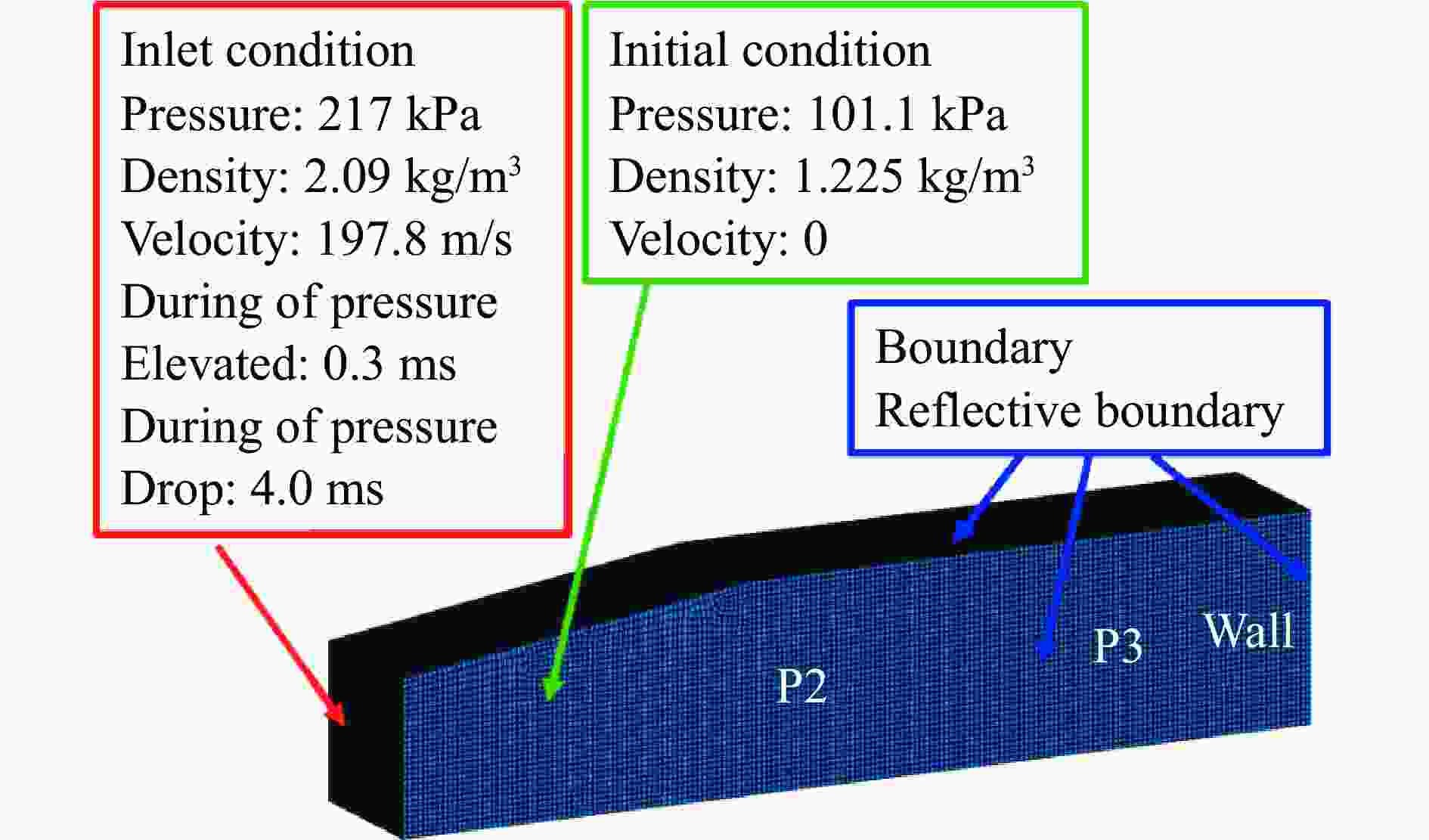
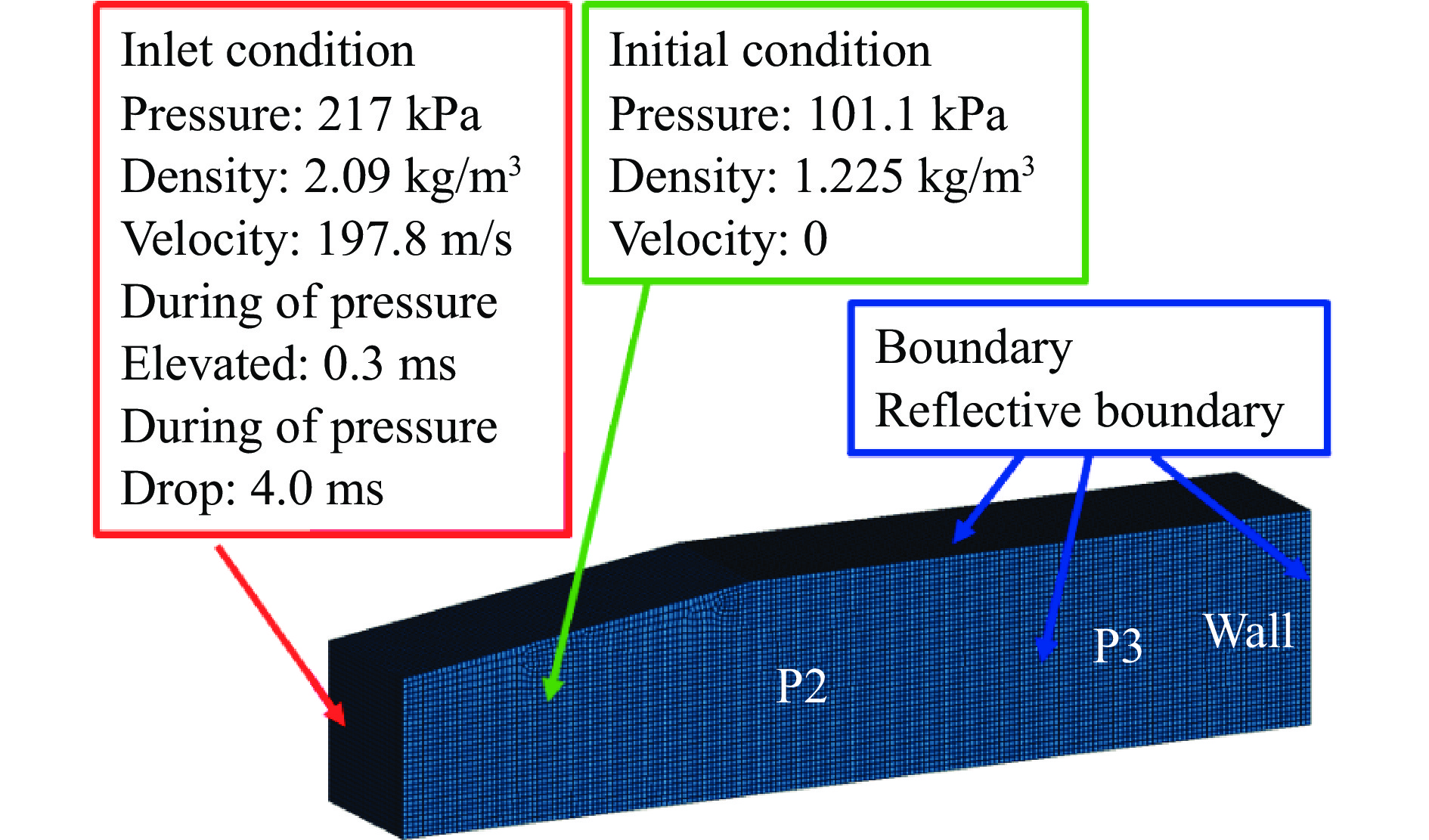
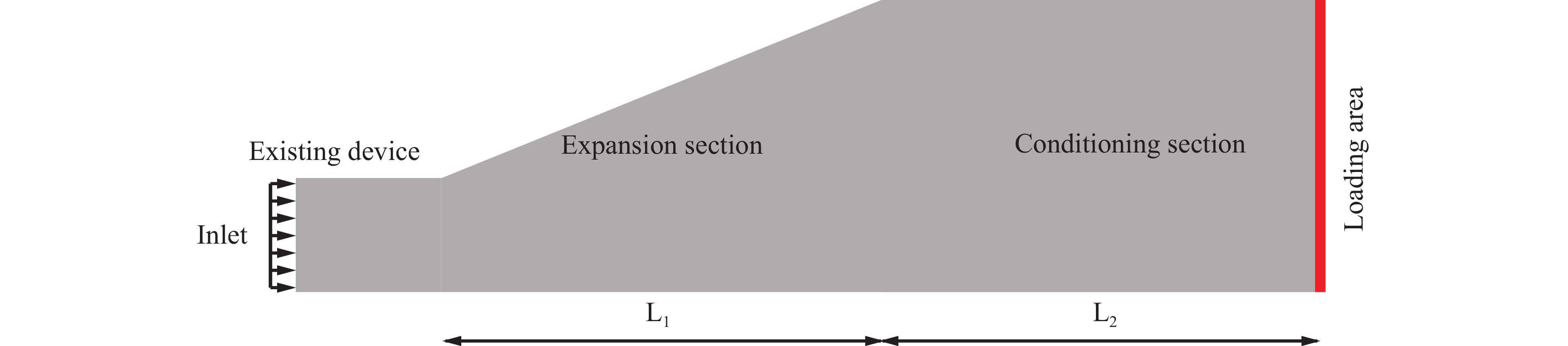
图 4 爆炸荷载模拟装置内爆炸波传播的数值模型
Figure 4. Numerical model of blast wave propagation inside the blast wave simulator
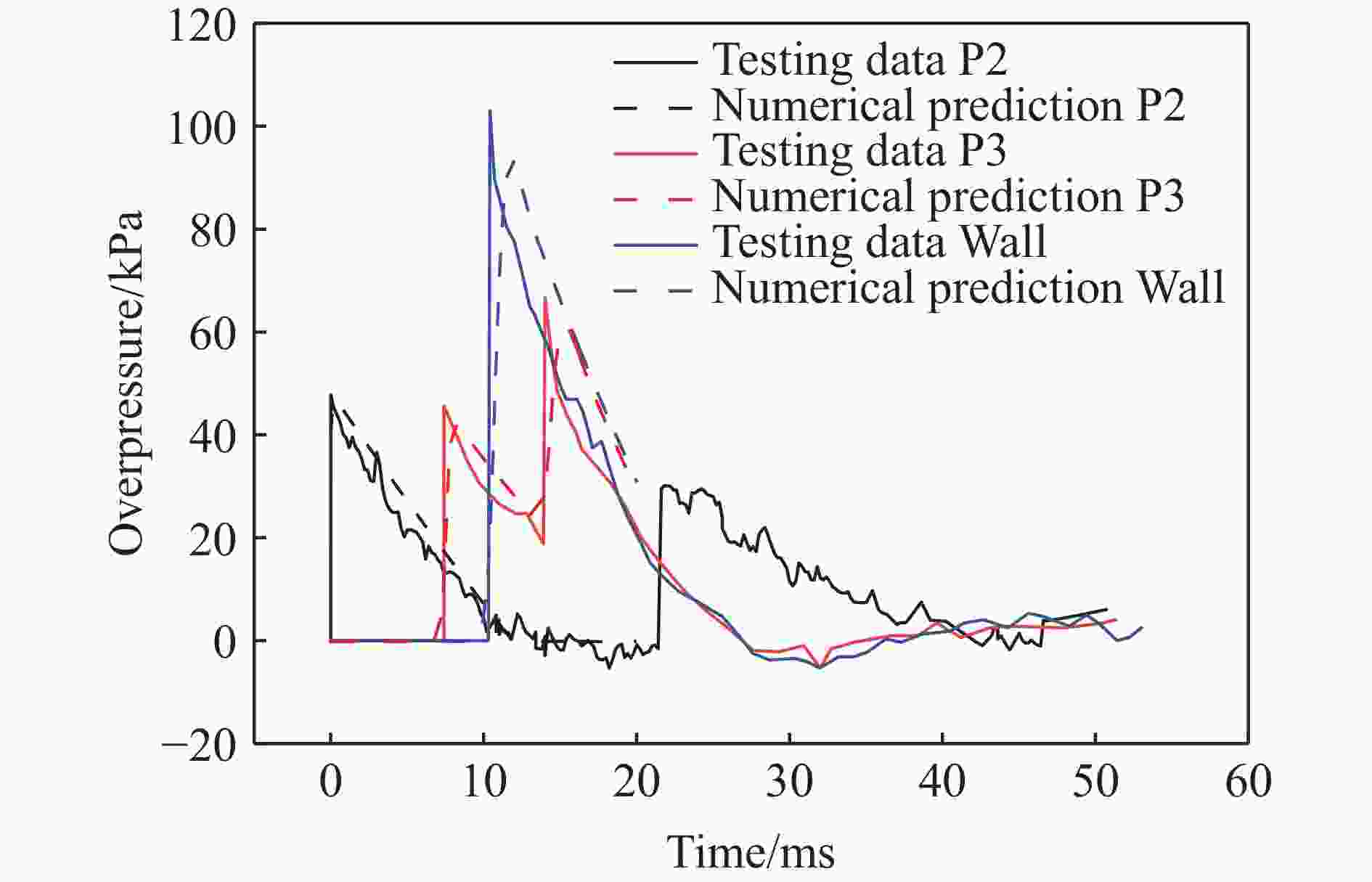
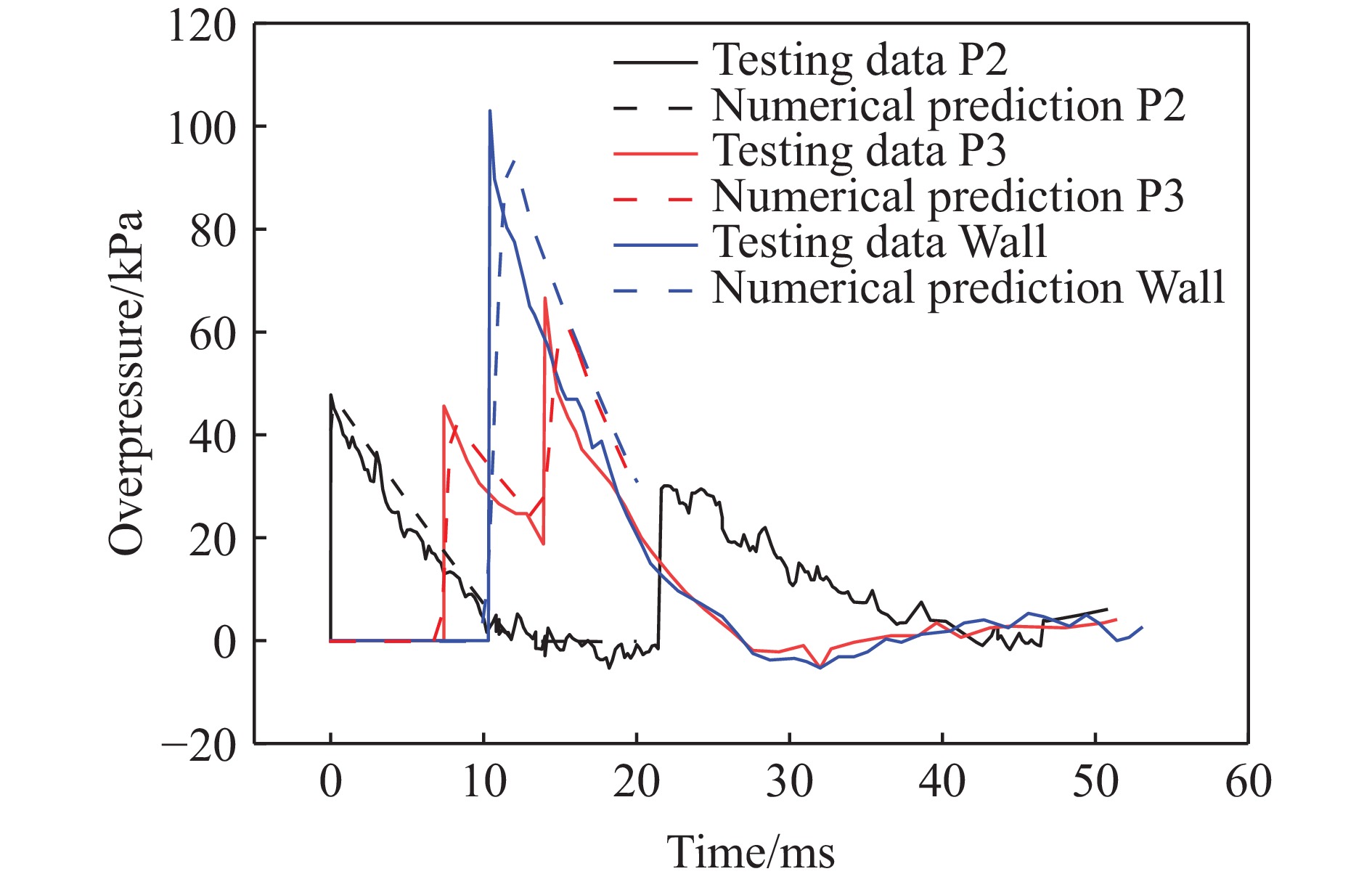
图 6 超压时程曲线的试验数据与数值计算结果对比
Figure 6. Comparison of overpressure-time histories between numerical results and testing data
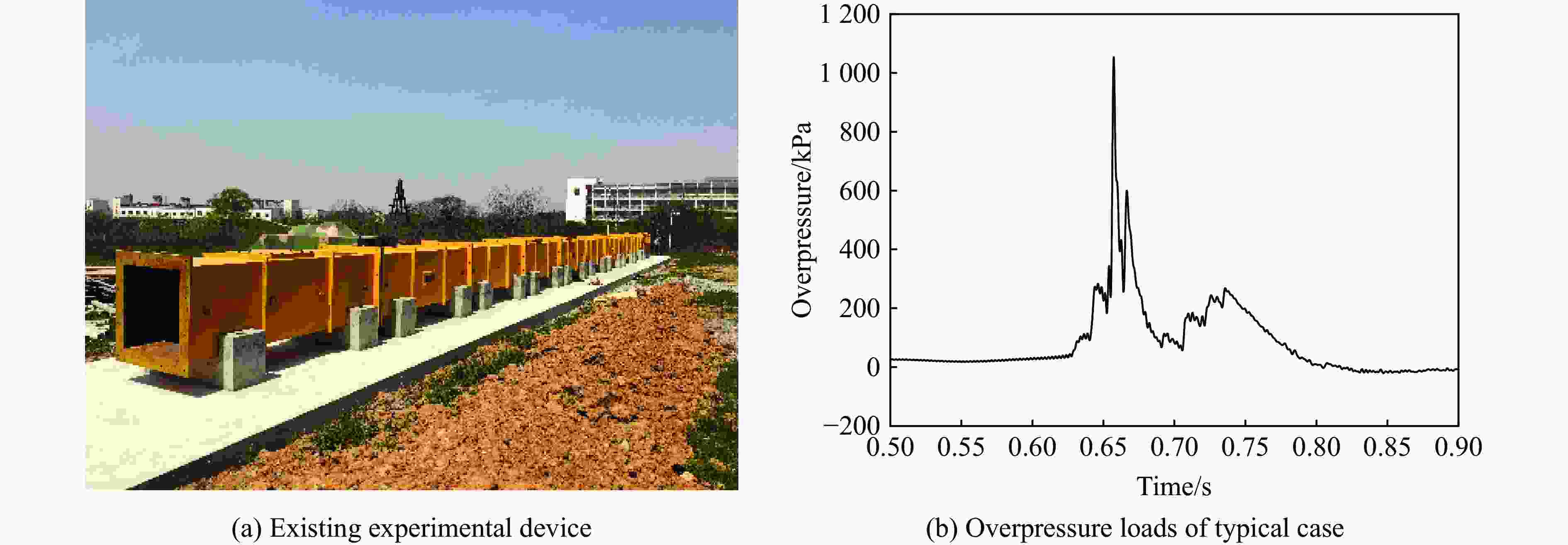
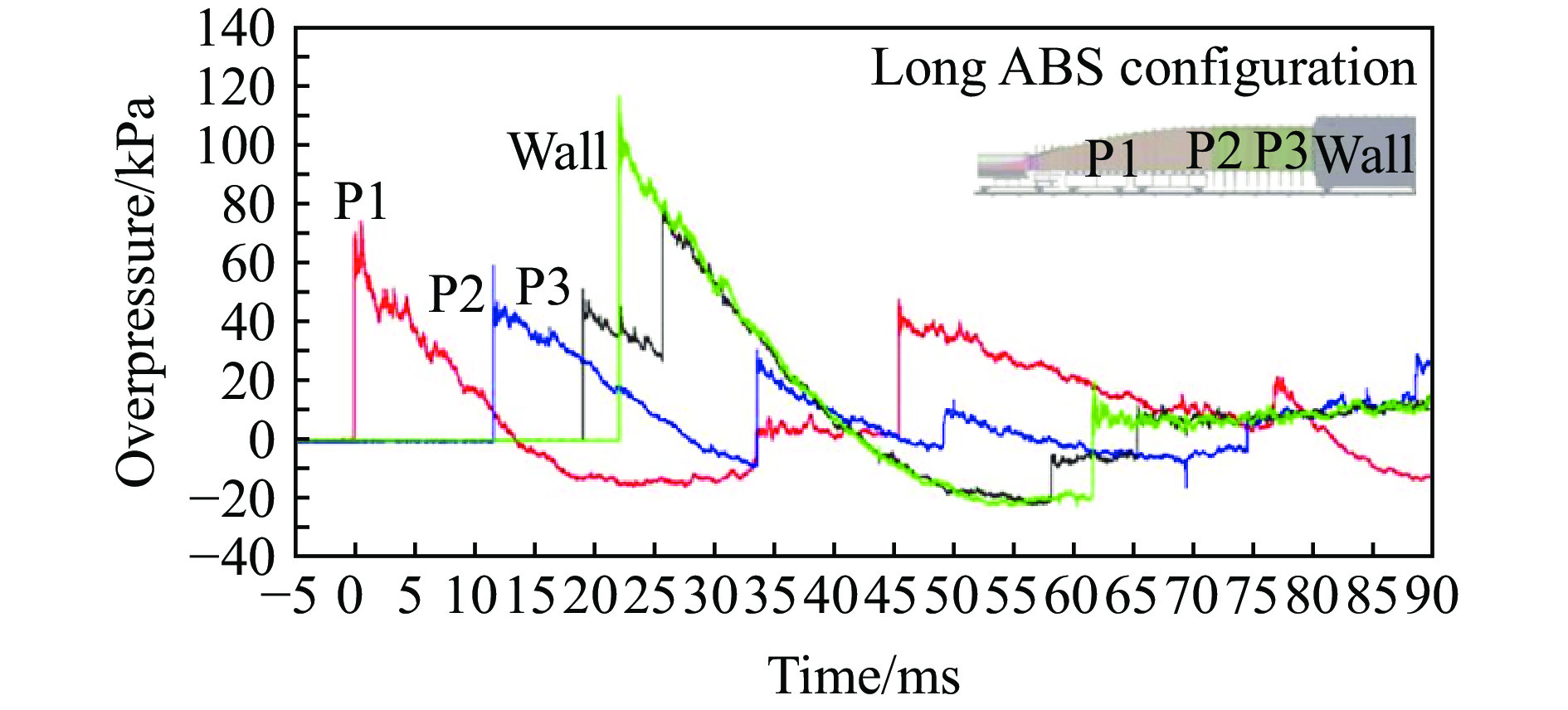
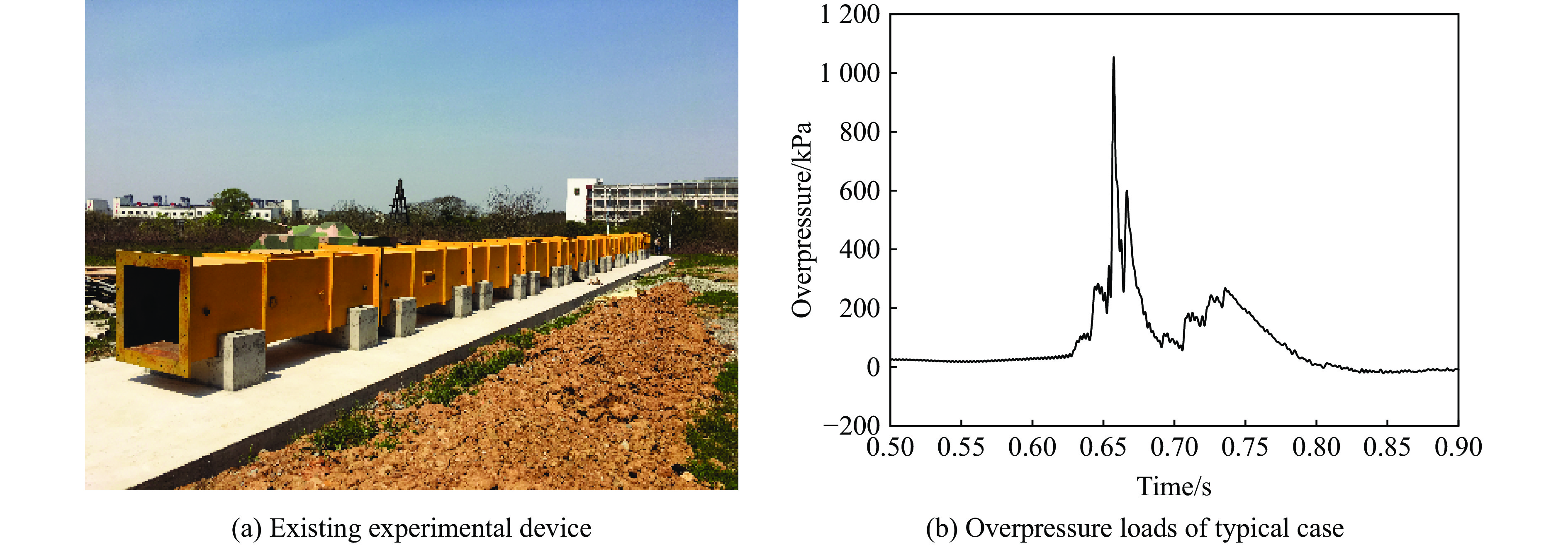
图 7 已有大尺寸管道燃气爆炸试验装置与实测爆炸超压时程曲线
Figure 7. Existing experimental device and overpressure loads of the typical case
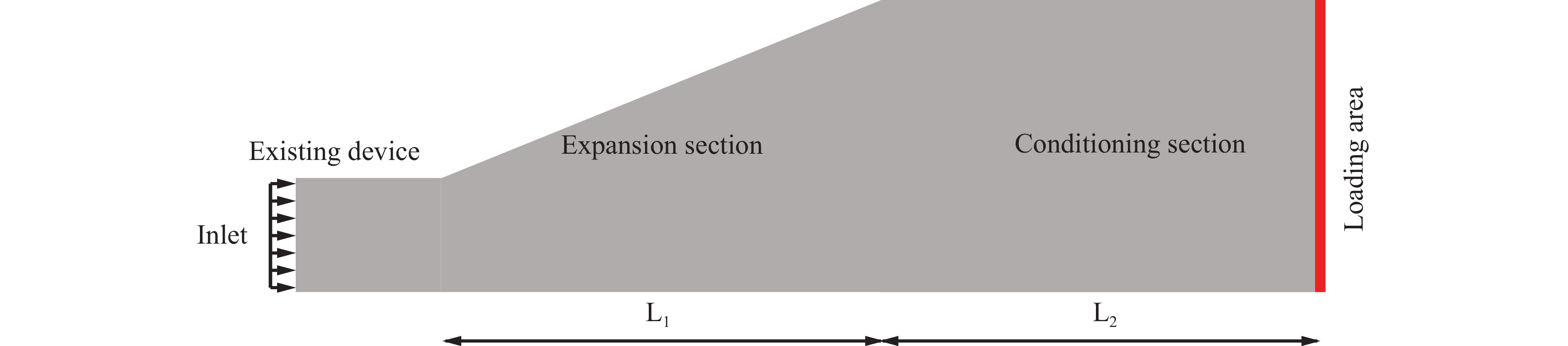
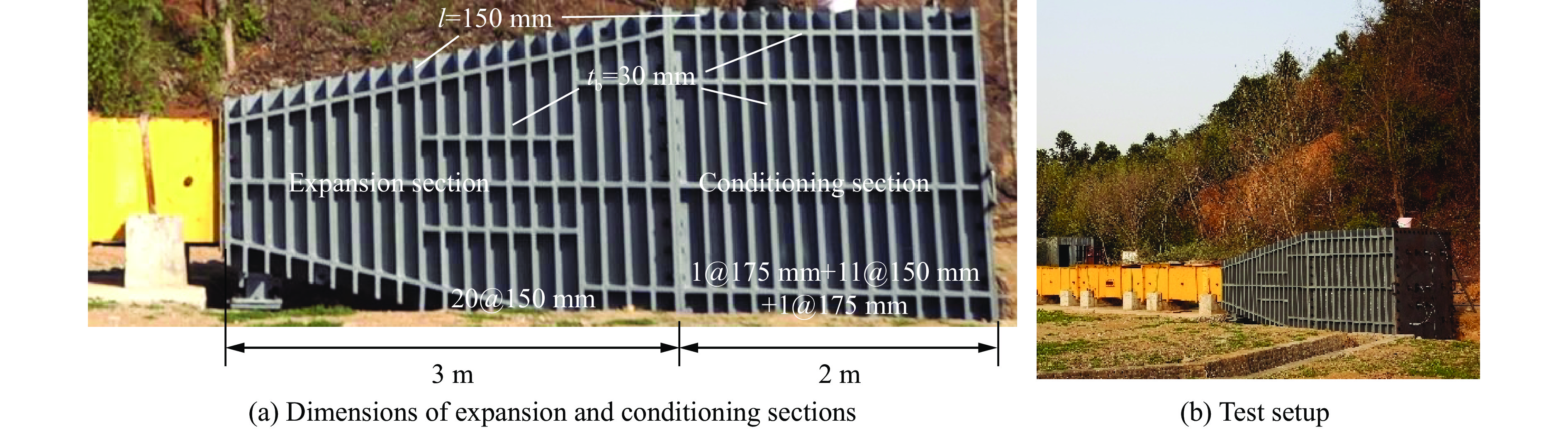
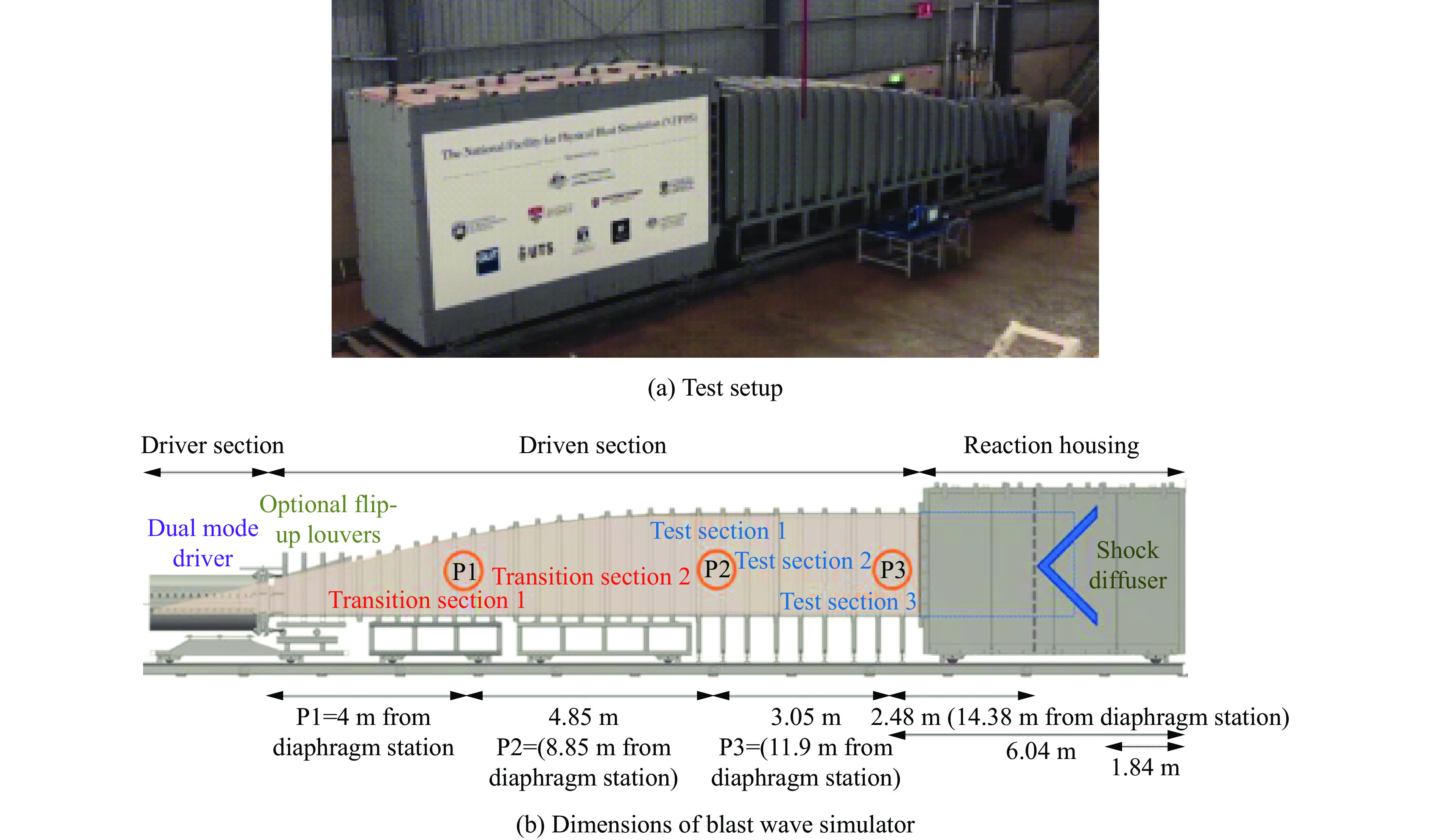
图 8 爆炸荷载模拟装置构成及尺寸示意图
Figure 8. Schematic diagram and dimensions of the blast wave simulator
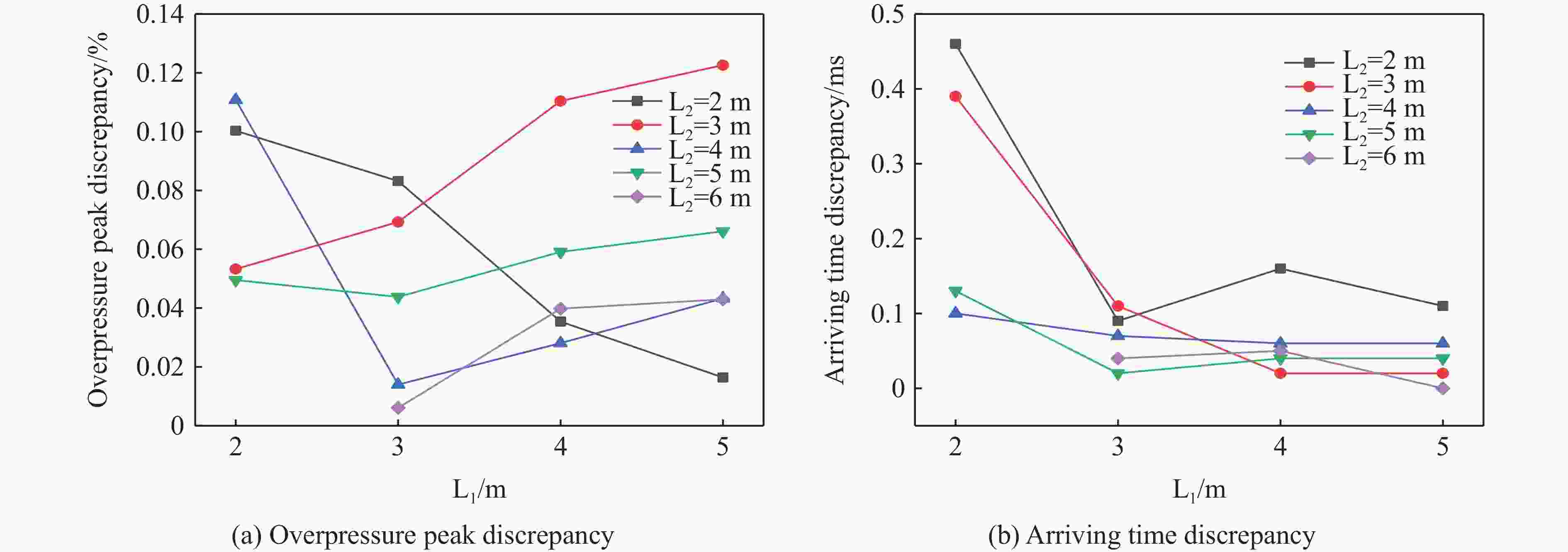
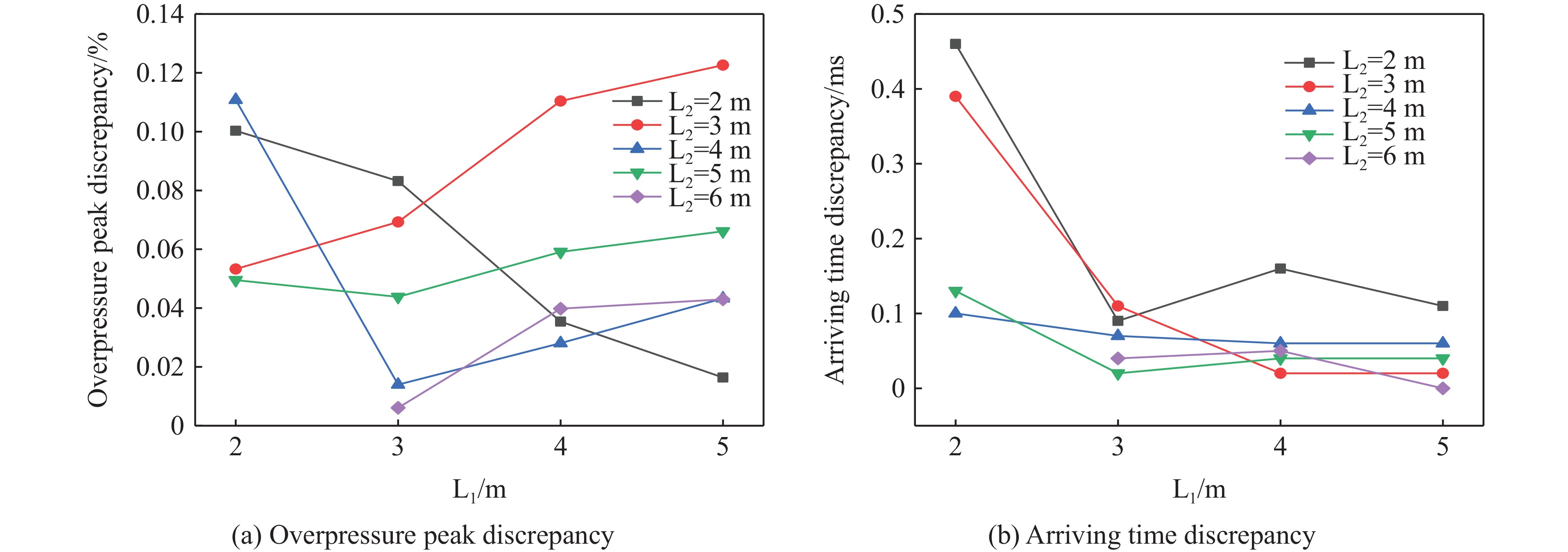
图 11 扩大段长度L1对加载面上荷载分布均匀性的影响
Figure 11. Effect of L1 on the overpressure load distribution
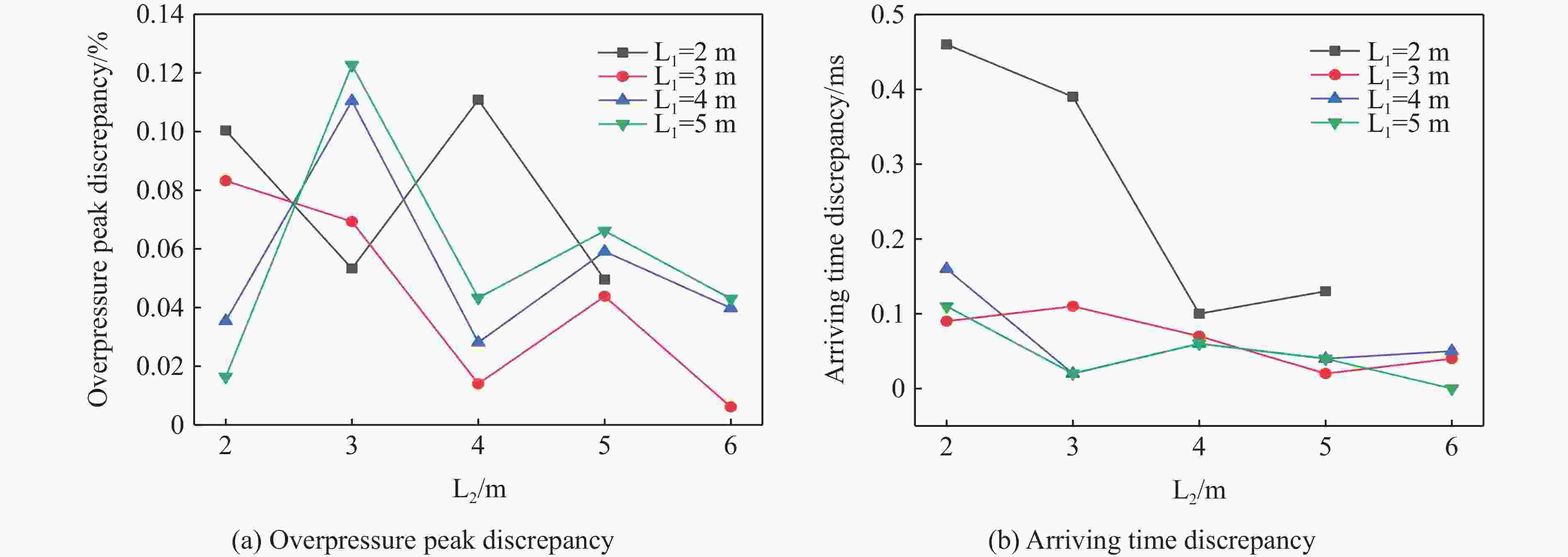
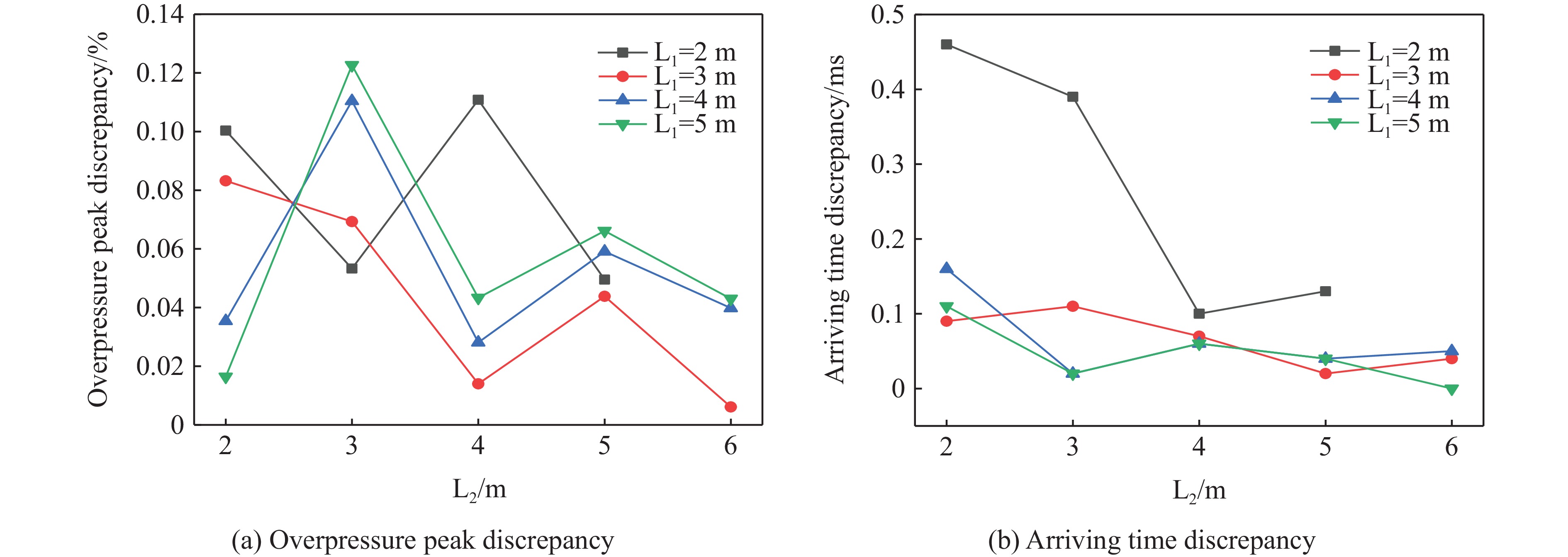
图 12 整形段长度L2对加载面上荷载分布均匀性的影响
Figure 12. Effect of L2 on the overpressure load distribution
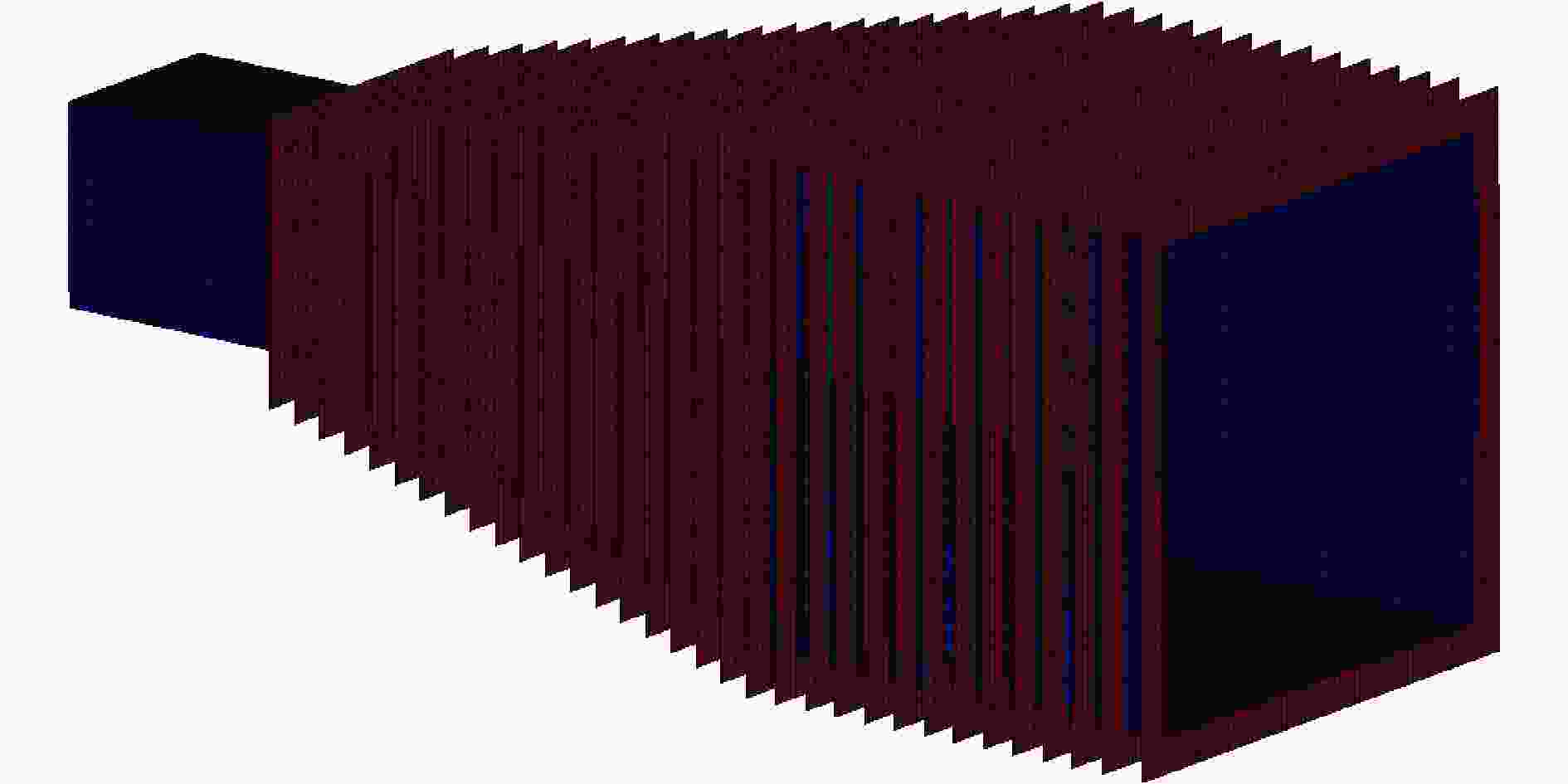
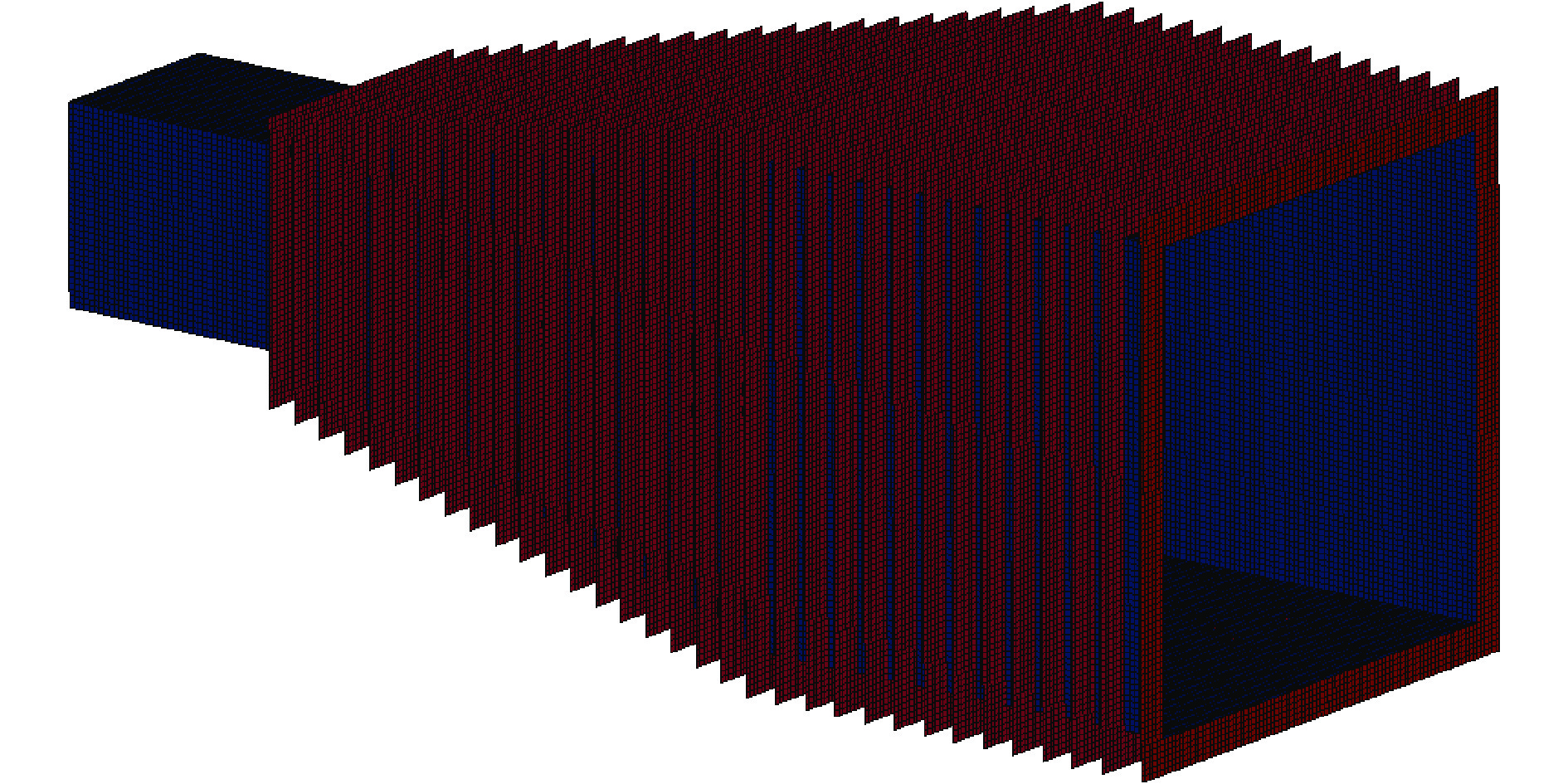
图 13 爆炸荷载模拟装置抗爆的数值模型
Figure 13. Numerical model for explosion resistance of blast wave simulator
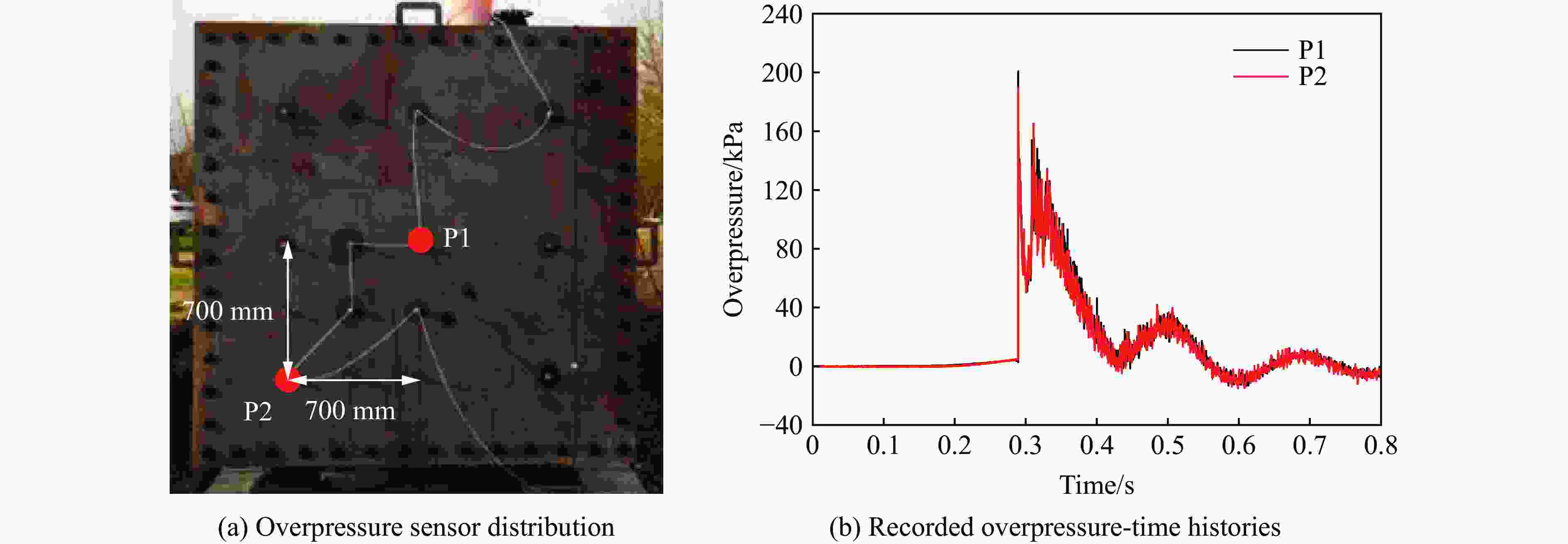
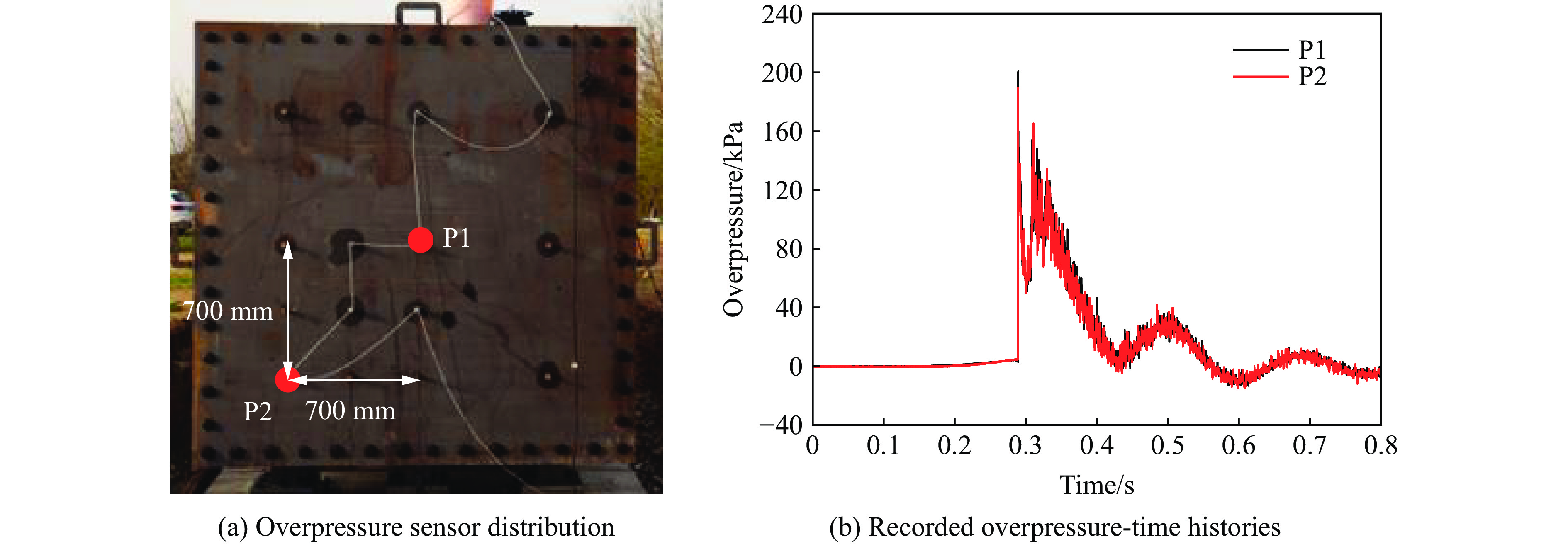
图 15 加载面处测点布置与实测超压时程曲线
Figure 15. Overpressure sensor distribution and recorded overpressure-time histories
表 1 不同扩大段与整形段组合的计算工况
Table 1. Cases with different expansion sections and shaping sections in numerical simulation
扩大段
长度/m整形段长度/m 1 2 3 4 5 6 8 1 H、I 2 H、I S S S S 3 H、I H、I、S H、I、S H、I、S H、I、S S 4 H、I H、S H、S H、I、S S S 5 H、I H、S H、S H、I、S H、S H 6 S S H、I、S H、I、S S  下载: 导出CSV
表 2 底部水平扩大段加载面超压荷载均匀性对比
Table 2. Comparison of overpressure load distribution errors between Horizontal type cases
序号 项目 L1 L2 超压误差/% 时间误差/ms 总体误差 总长度/m 1 H64 6 4 3 0.29 0.28 10 2 H58 5 8 8 0.24 0.35 13 3 H54 5 4 7 0.28 0.36 9 4 H35 3 5 6 0.50 0.50 8 5 H63 6 3 19 0.21 0.56 9 6 H44 4 4 14 0.38 0.60 8 7 H53 5 3 26 0.2 0.71 8 8 H52 5 2 32 0.18 0.83 7 9 H43 4 3 36 0.16 0.89 7 10 H34 3 4 29 0.45 0.96 7 11 H42 4 2 40 0.23 1.04 6 12 H21 2 1 26 0.68 1.08 3 13 H31 3 1 30 0.62 1.12 4 14 H33 3 3 46 0.16 1.12 6 15 H51 5 1 42 0.29 1.13 6 16 H41 4 1 38 0.43 1.15 5 17 H32 3 2 45 0.41 1.28 5 18 H11 1 1 33 1.32 1.71 2
下载: 导出CSV
表 3 对称扩大段加载面超压荷载均匀性对比
Table 3. Comparison of overpressure load distribution errors between symmetrical-type cases
序号 项目 L1 L2 超压误差/% 时间误差/ms 总体误差 总长度/m 1 S36 3 6 0.61 0.04 0.137 9 2 S34 3 4 1.40 0.07 0.266 7 3 S44 4 4 2.81 0.06 0.360 8 4 S52 5 2 1.64 0.11 0.373 7 5 S35 3 5 4.38 0.02 0.401 8 6 S46 4 6 3.98 0.05 0.433 10 7 S54 5 4 4.33 0.06 0.484 9 8 S45 4 5 5.91 0.04 0.569 9 9 S55 5 5 6.61 0.04 0.626 10 10 S42 4 2 3.54 0.16 0.637 6 11 S25 2 5 4.95 0.13 0.686 7 12 S33 3 3 6.93 0.11 0.804 6 13 S32 3 2 8.32 0.09 0.874 5 14 S43 4 3 11.04 0.02 0.944 7 15 S53 5 3 12.26 0.02 1.043 8 16 S24 2 4 11.08 0.10 1.121 6 17 S23 2 3 5.33 0.39 1.283 5 18 S22 2 2 10.03 0.46 1.818 4
下载: 导出CSV
表 4 底部倾斜不对称布置扩大段加载面超压荷载均匀性对比
Table 4. Comparison of overpressure load distribution errors between inclined and asymmetric types
序号 项目 L1 L2 超压误差/% 时间误差/ms 总体误差 总长度/m 1 I64 6 4 2 0.19 0.24 10 2 I54 5 4 4 0.23 0.35 9 3 I35 3 5 3 0.33 0.41 8 4 I44 4 4 9 0.28 0.52 8 5 I63 6 3 14 0.14 0.55 9 6 I34 3 4 17 0.28 0.77 7 7 I33 3 3 27 0.07 0.89 6 8 I21 2 1 15 0.53 0.94 3 9 I31 3 1 19 0.47 1.02 4 10 I41 4 1 28 0.33 1.16 5 11 I51 5 1 33 0.19 1.18 6 12 I32 3 2 29 0.35 1.21 5 13 I11 1 1 19 1.06 1.57 2
下载: 导出CSV
表 5 各工况下结构最大应力对比
Table 5. Comparison of maximum stress
序号 加劲肋高度/mm 荷载峰值/kPa 最大应力/MPa 与屈服强度占比/% 1 100 175 72 20 2 100 260 106 30 3 100 300 121 34 4 100 400 161 45 5 100 500 201 57 6 100 600 240 68 7 100 715 284 80 8 100 800 317 89 9 150 320 72 20 10 150 470 106 30 11 150 600 136 38 12 150 800 170 48 13 150 1000 211 59 14 150 1200 254 72 15 150 1350 284 80 16 150 1500 315 89
下载: 导出CSV
-
[1] 陈德, 吴昊, 徐世林, 等. 单向砌体填充墙激波管试验和动力行为分析 [J]. 爆炸与冲击, 2023, 43(8): 085103. DOI: 10.11883/bzycj-2023-0147.CHEN D, WU H, XU S L, et al. Shock tube tests and dynamic behavior analyses on one-way masonry-infilled walls [J]. Explosion and Shock Waves, 2023, 43(8): 085103. DOI: 10.11883/bzycj-2023-0147. [2] JOHNSON J, XU M, JACQUES E. Predicting the self-centering behavior of hybrid FRP-steel reinforced concrete beams under blast loading [J]. Engineering Structures, 2021, 247: 113117. DOI: 10.1016/j.engstruct.2021.113117. [3] MANDER T J, LOWAK M J, POLCYN M A. Development of blast response limits for load-bearing prestressed concrete panels using full-scale shock tube test data [C]//Structures Congress 2017. Denver: American Society of Civil Engineers, 2017: 197-208. DOI: 10.1061/9780784480397.017. [4] ISMAIL A G, EZZELDIN M, EL-DAKHAKHNI W, et al. Blast load simulation using conical shock tube systems [J]. International Journal of Protective Structures, 2020, 11(2): 135–158. DOI: 10.1177/2041419619858098. [5] 张坤玉, 陈德, 吴昊. 高压气体驱动激波管的数值模拟与参数影响分析 [J]. 高压物理学报, 2023, 37(3): 033301. DOI: 10.11858/gywlxb.20220704.ZHANG K Y, CHEN D, WU H. Numerical simulation and parametric analysis of high-pressure gas-driven shock tube [J]. Chinese Journal of High Pressure Physics, 2023, 37(3): 033301. DOI: 10.11858/gywlxb.20220704. [6] 郭丁, 孙渊博, 葛云心, 等. 基于大型激波管氢氧爆轰驱动方式产生冲击波波形调控的数值模拟 [J]. 爆炸与冲击, 2025, 45(9): 092102. DOI: 10.11883/bzycj-2024-0300.GUO D, SUN Y B, GE Y X, et al. Numerical study of shock wave generated by hydrogen-oxygen detonation in a large shock tube [J]. Explosion and Shock Waves, 2025, 45(9): 092102. DOI: 10.11883/bzycj-2024-0300. [7] GAN E C J. Experimental and numerical investigation of shock wave propagation in an advanced blast simulator [D]; Wollongong: University of Wollongong, 2020. [8] GAN E C J, REMENNIKOV A, RITZEL D, et al. Approximating a far-field blast environment in an advanced blast simulator for explosion resistance testing [J]. International Journal of Protective Structures, 2020, 11(4): 468–493. DOI: 10.1177/2041419620911133. [9] GAN E C J, REMENNIKOV A, RITZEL D. Blast waveform tailoring using controlled venting in blast simulators and shock tubes [J]. Defence Technology, 2024, 37: 14–26. DOI: 10.1016/j.dt.2023.11.026. [10] 刘瑞朝, 任辉启, 徐翔云. 大型爆炸激波管数值模拟 [J]. 防护工程, 2009, 31(1): 31–35.LIU R C, REN H Q, XU X Y. Numerical simulation of large blast simulators [J]. Protective Engineering, 2009, 31(1): 31–35. [11] 刘瑞朝, 周松柏. 大型爆炸激波管出口段爆炸波传播的数值模拟 [C]//第2届全国工程安全与防护学术会议论文集. 第2届全国工程安全与防护学术会议论, 北京: 中国岩石力学与工程学会, 2010: 740–744. [12] JOHNSON C F, O'DANIEL J L, DALLRIVA F D, et al. Blast load simulator experiments for computational model validation: Report 1: ERDC/GSL TR-16-27 [R]. USA: U. S. Army Engineer Research and Development Center, 2016. [13] IRSHIDAT M, AL-OSTAZ A, CHENG A H D, et al. Nanoparticle reinforced polymer for blast protection of unreinforced masonry wall: laboratory blast load simulation and design models [J]. Journal of Structural Engineering, 2011, 137(10): 1193–1204. DOI: 10.1061/(ASCE)ST.1943-541X.0000361. [14] 程帅, 童念雪, 刘文祥, 等. 基于高压气体驱动的爆炸波模拟激波管冲击波衰减历程控制方法 [J]. 爆炸与冲击, 2024, 44(5): 052201. DOI: 10.11883/bzycj-2023-0094.CHENG S, TONG N X, LIU W X, et al. A control method for attenuation history of shock wave generated by blast simulation shock tube based on high pressure gas driving technic [J]. Explosion and Shock Waves, 2024, 44(5): 052201. DOI: 10.11883/bzycj-2023-0094. [15] 张仕忠, 李进平, 康越, 等. 激波管模拟产生近场爆炸冲击波 [J]. 爆炸与冲击, 2024, 44(12): 121434. DOI: 10.11883/bzycj-2024-0204.ZHANG S Z, LI J P, KANG Y, et al. Generation of near-field blast wave by means of shock tube [J]. Explosion And Shock Waves, 2024, 44(12): 121434. DOI: 10.11883/bzycj-2024-0204. [16] 方秦, 李展, 陈力, 等. 地下综合管廊空间内燃气爆炸模拟试验装置和系统: CN202010047344.3 [P]. 2022-06-09.FANG Q, LI Z, CHEN L, et al. Gas explosion simulation test device and system in underground comprehensive pipe gallery space: CN202010047344.3 [P]. 2022-06-09. [17] LI Z, CHEN L, YAN H C, et al. Gas explosions of methane-air mixtures in a large-scale tube [J]. Fuel, 2021, 285: 119239. DOI: 10.1016/j.fuel.2020.119239. [18] KOVAL A, SZABO A. Modified “Rankine-Hugoniot” shock fitting technique: Simultaneous solution for shock normal and speed [J]. Journal of Geophysical Research Space Physics, 2008, 113: A10110. DOI: 10.1029/2008JA013337. [19] YANG S L, LIU Z C, WANG S F, et al. Dynamic response and failure analysis for urban bridges under far-field blast loads [J]. Engineering Structures, 2023, 285: 116043. DOI: 10.1016/j.engstruct.2023.116043. [20] 任辉启, 王世合, 周松柏, 等. 大型爆炸波模拟装置研制及其应用 [C]//第十六届全国激波与激波管学术会议论文集. 洛阳: 中国力学学会激波与激波管专业委员会, 2014: 10–22. -



计量
- 文章访问数: 648
- HTML全文浏览量: 239
- PDF下载量: 223
- 被引次数: 0