



A phase-field and Fourier neural operator-based method for predicting crack evolution in column-shell structures
-
摘要: 为应对传统有限元模拟柱壳结构断裂行为时计算成本高昂的挑战,提出了一种结合相场法与傅里叶神经算子(Fourier neural operator, FNO)的柱壳裂纹演化预测框架。相场法能够自然捕捉裂纹的萌生、扩展与愈合过程,而FNO模型则通过学习临界能量释放率分布、几何和载荷条件与裂纹演化之间的映射关系,实现对裂纹全过程的高效预测。首先,建立了基于有限元的柱壳相场模型,生成裂纹演化数据;随后,构建并训练了用于裂纹萌生与扩展的串联FNO框架。结果表明,该方法不仅在随机临界能量释放率、几何变动和复杂载荷条件下保持了较高的预测精度,而且在计算效率上显著优于传统有限元模拟。Abstract: With the increasing application of engineering structures under extreme conditions, accurately predicting their fracture behavior has become a critical challenge in materials science and fracture mechanics. Column-shell structures, as typical load-bearing components, are highly sensitive to crack initiation and propagation, which directly affect their safety and reliability. Although traditional finite element methods can provide accurate fracture evolution simulations, their high computational cost limits applicability in rapid prediction scenarios. To address this issue, a hybrid framework that integrates the phase-field method with the Fourier neural operator (FNO) is proposed for predicting the fracture evolution of column-shell structures. In the proposed framework, the phase-field method is first employed to describe crack initiation, propagation, and possible coalescence in a continuous manner, avoiding explicit crack tracking and enabling physically consistent simulations. Based on this formulation, a finite element model of the column-shell structure is established to generate high-fidelity fracture evolution data under various conditions, including different critical energy release rates, geometric configurations, and loading scenarios. Subsequently, a data-driven learning framework is developed using the FNO to approximate the nonlinear mapping between input parameters and fracture responses. The input of the model includes the spatial distribution of the critical energy release rate, geometric features, and applied loading conditions, while the output corresponds to the evolving phase-field variable that characterizes crack growth over time. A series of FNO models are constructed and trained in a sequential manner to separately capture crack initiation and propagation stages, forming a coupled prediction framework. The training process is carried out using the generated dataset, with appropriate normalization and validation strategies to ensure model robustness and generalization capability. The results demonstrate that the proposed method achieves high prediction accuracy under random critical energy release rates, varying geometries, and complex loading conditions, while significantly reducing computational cost compared to conventional finite element simulations. Once trained, the model enables near real-time prediction of fracture evolution.
-
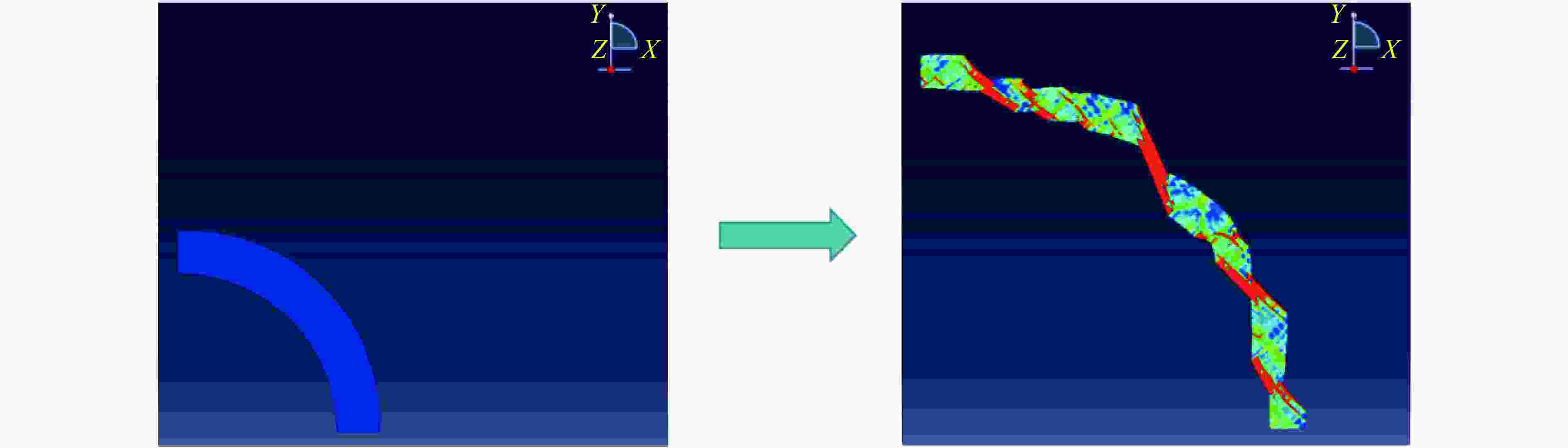
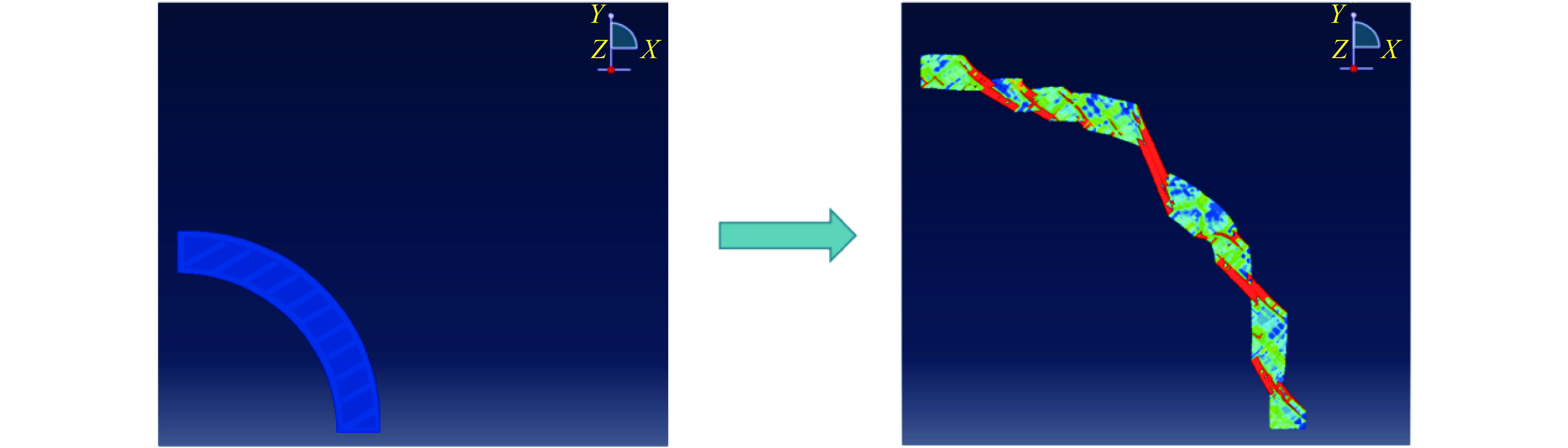
图 2 基于Abaqus的柱壳裂纹演化的有限元模型计算过程示意图
Figure 2. Schematic diagram of the calculation process for the finite element model of crack evolution in cylindrical shells based on Abaqus
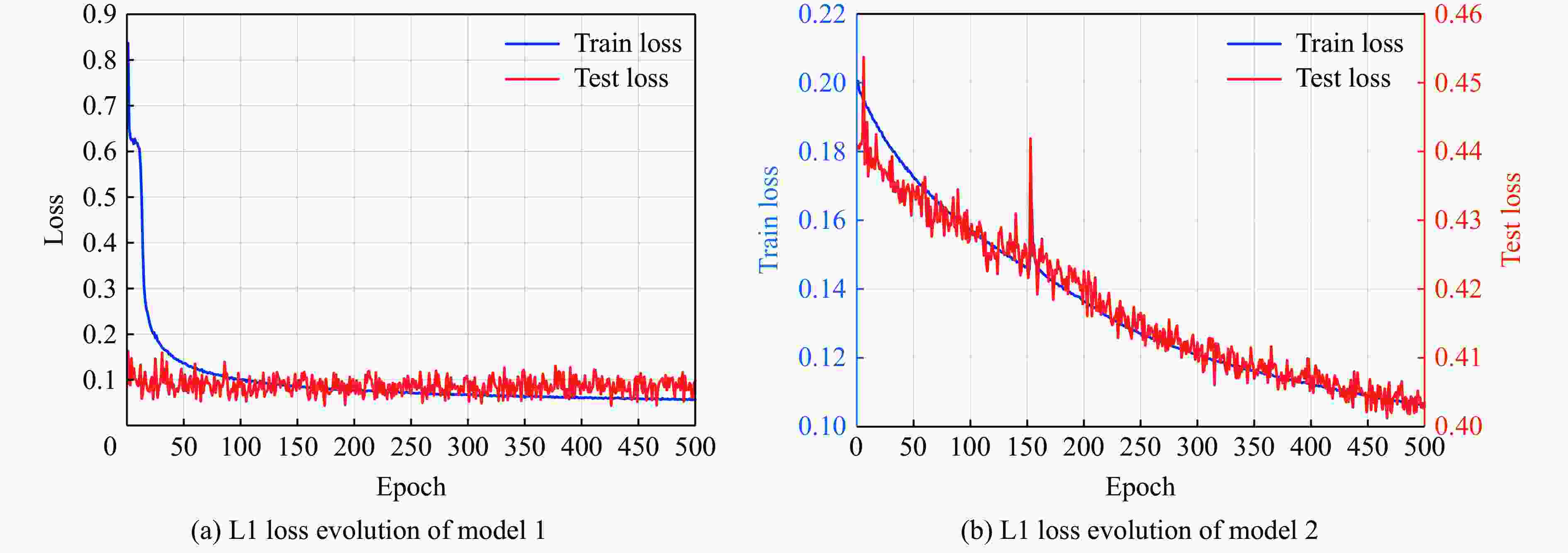
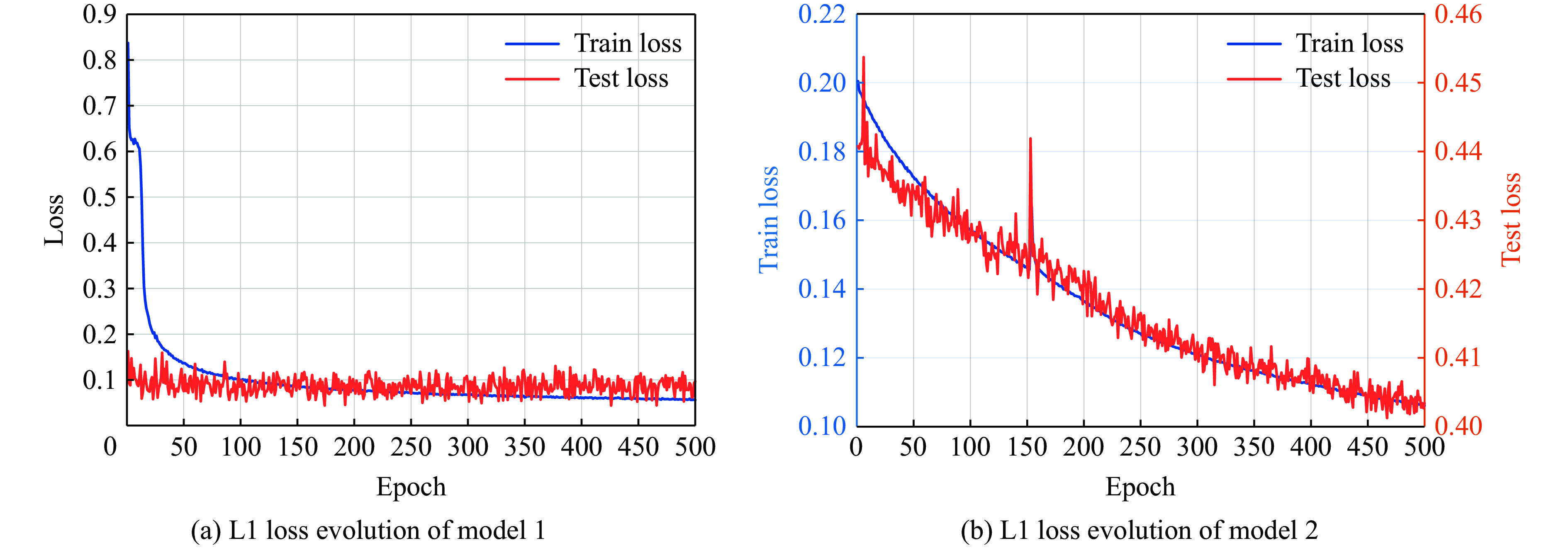
图 3 2个模型的训练和测试误差随迭代轮数的收敛曲线
Figure 3. Convergence curves of training and testing errors of the two models with respect to iteration number
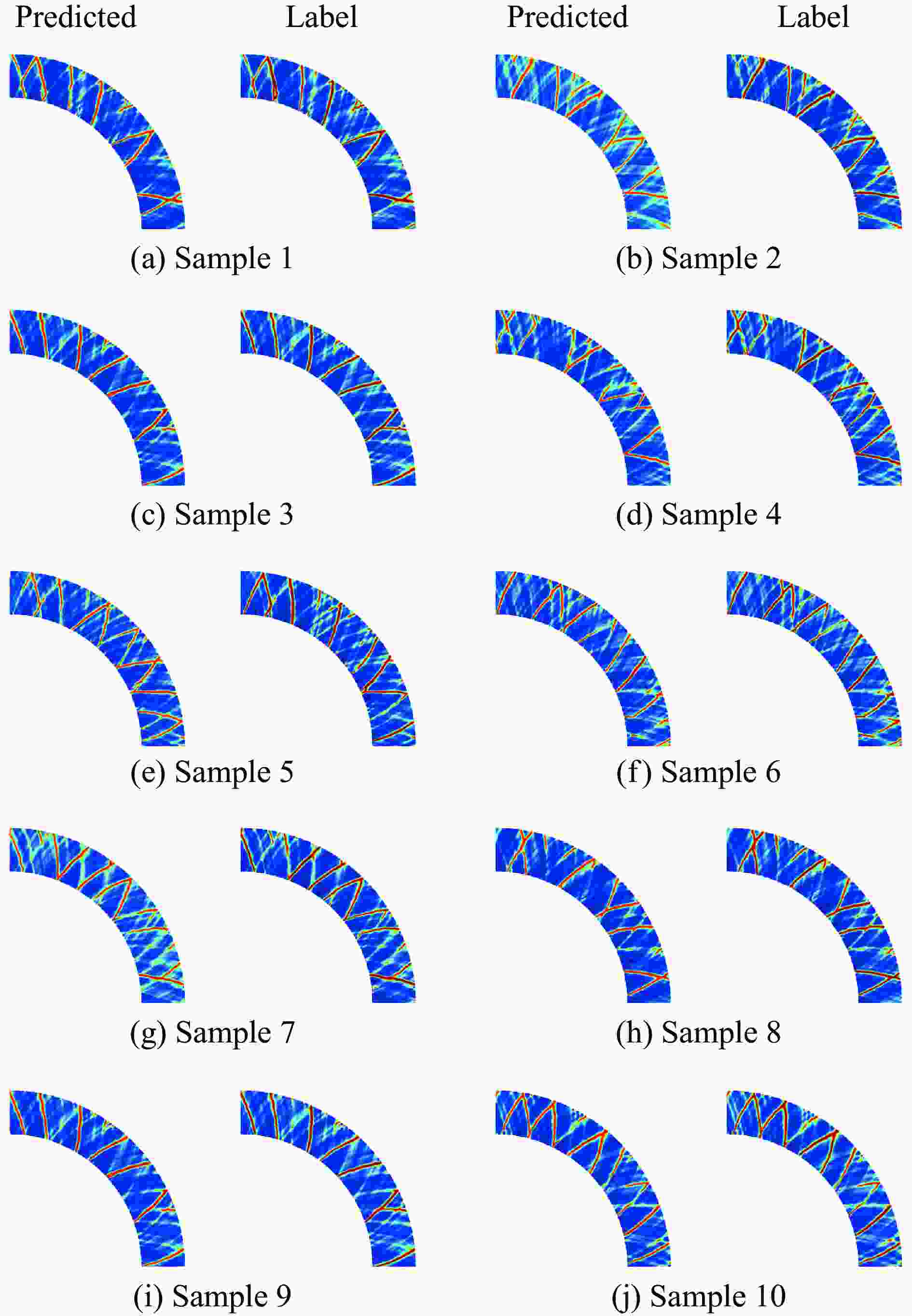
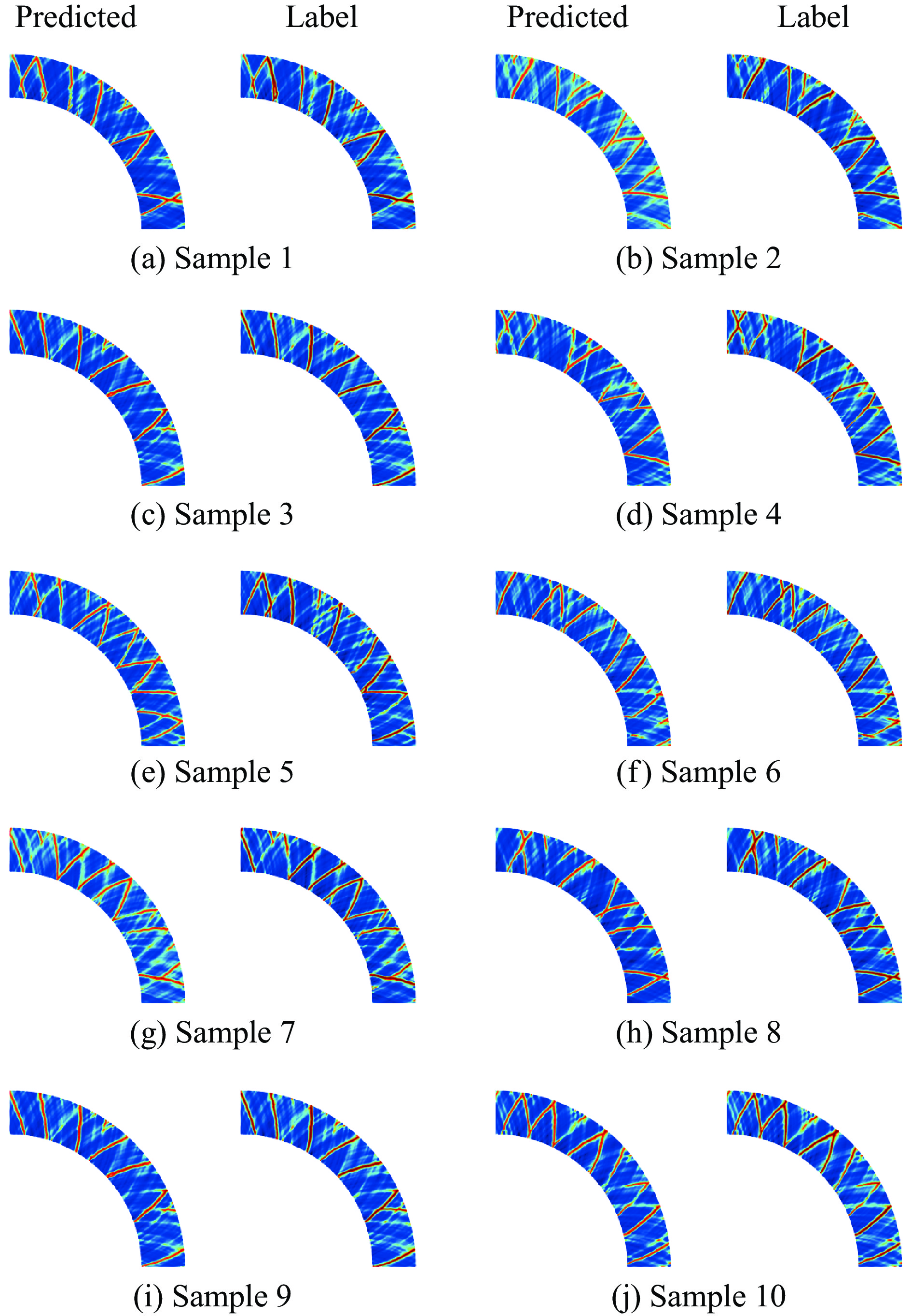
图 4 随机分布能量释放率条件下的相场预测结果与真实结果的对比
Figure 4. Comparison of phase field prediction results and actual results under the condition of randomly distributed energy release rate
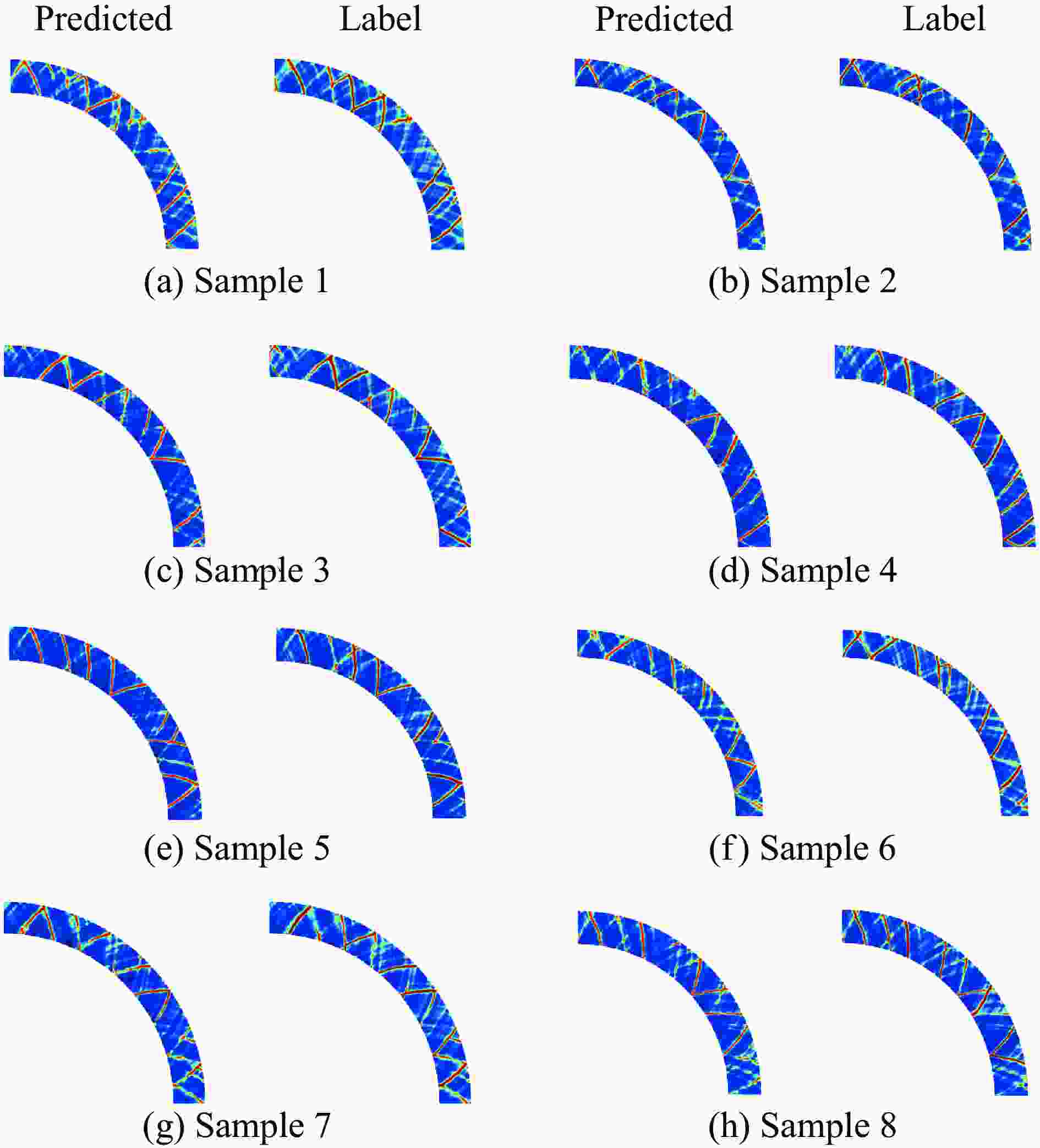
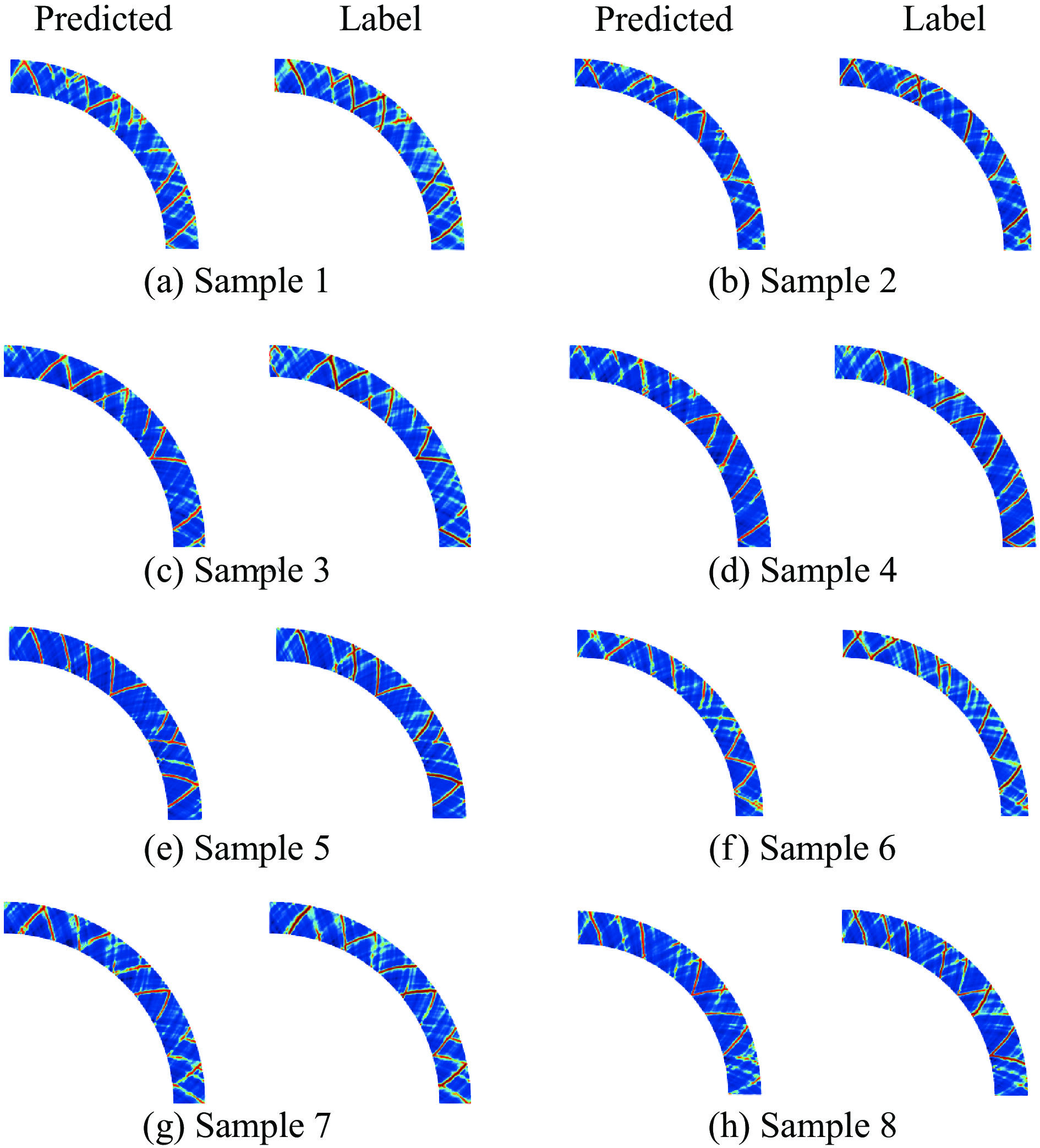
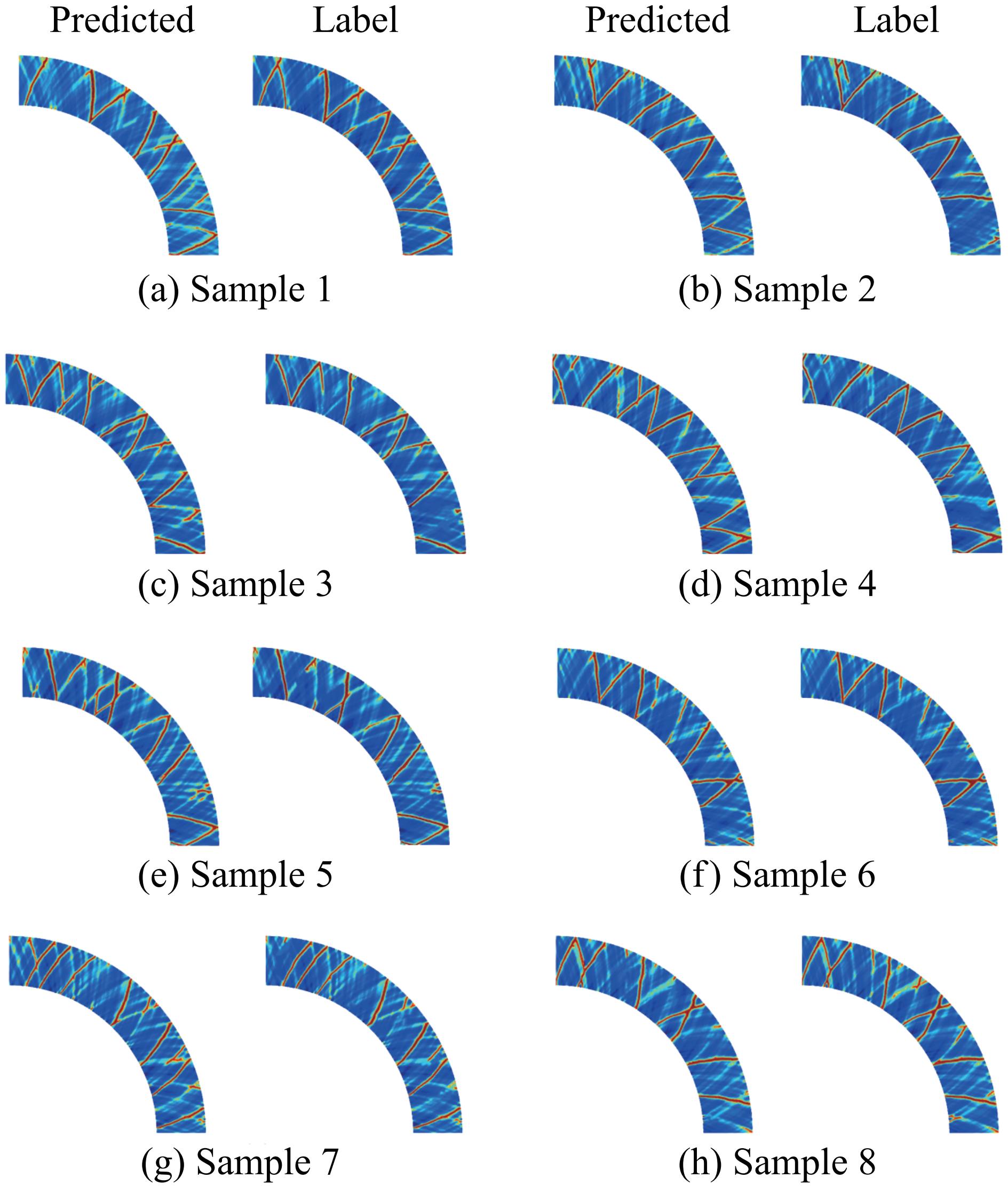
图 5 随机分布临界能量释放率和变几何条件下的相场预测结果与真实结果的对比
Figure 5. Comparison of phase field prediction results and actual results under conditions of randomly distributed critical energy release rate and variable geometry
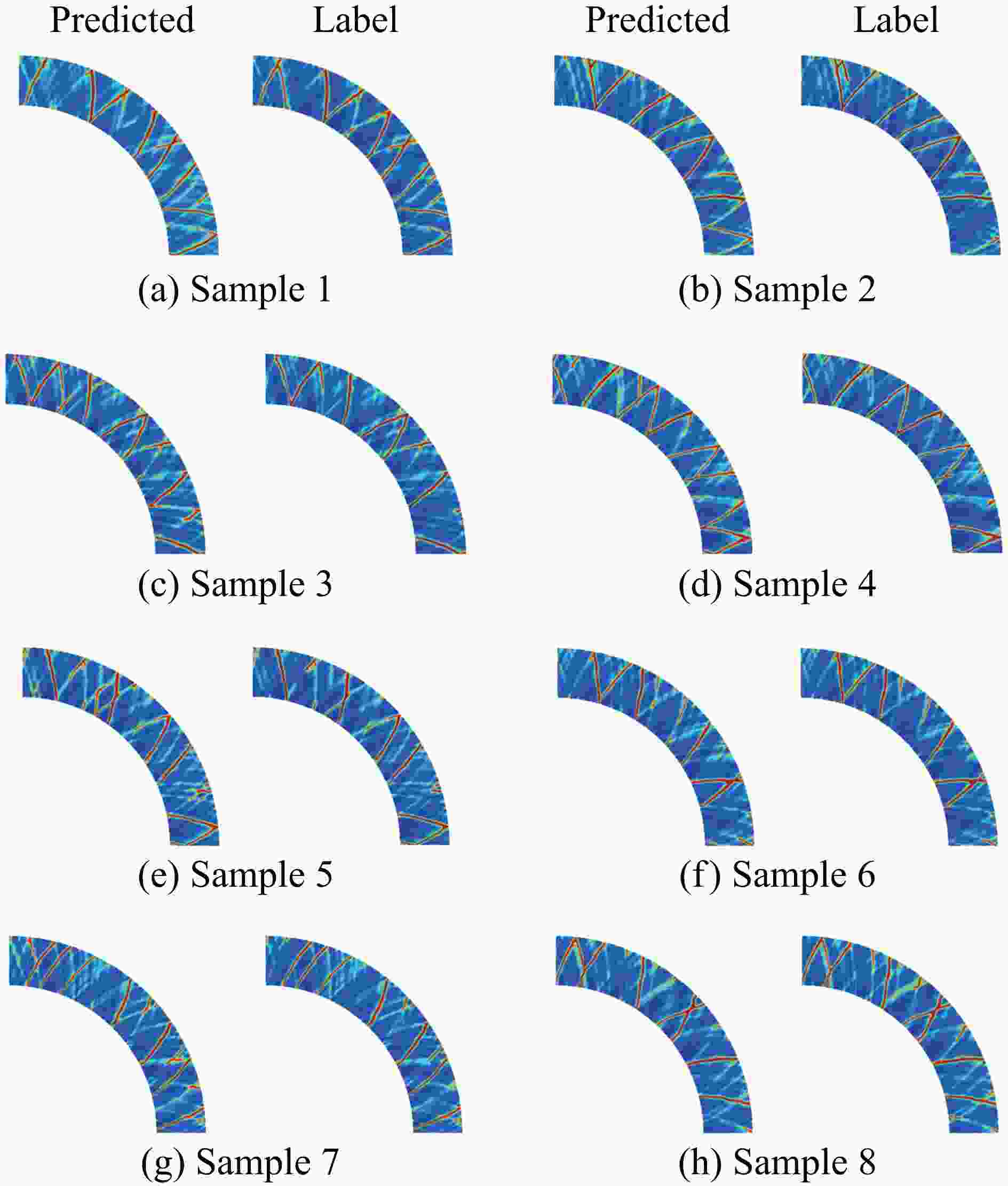
图 6 随机分布临界能量释放率与变载荷条件下的相场预测结果与真实结果的对比
Figure 6. Comparison of phase field prediction results and actual results under conditions of randomly distributed critical energy release rate and variable load
表 1 模型1的结构
Table 1. Structure of model 1
层编号 方程 卷积核 步长 填充 输出形状 输入 2×100×863×15 1 Fc0 1 1 38 2×100×863×38 2 Permute 2×38×100×863 3 Fourier layer 1 2×38×100×863 4 Fourier layer 2 2×38×100×863 5 Fourier layer 3 2×38×100×863 6 Fourier layer 4 2×38×100×863 7 Conv3d 1 1 0 2×38×100×863 ReLU 8 Conv3d 1 1 0 2×38×100×863 ReLU 9 Conv3d 1 1 0 2×38×100×863 ReLU 10 Permute 2×100×863×38 11 Fc1 2×100×863×8 12 GELU 2×100×863×8 13 Fc2 2×100×863×1 14 View 2×100×863×1  下载: 导出CSV
表 2 模型2的结构
Table 2. Structure of model 2
层编号 方程 卷积核 步长 填充 输出形状 输入 2×100×863×1 1 Fc0 1 1 64 2×100×863×64 2 Permute 2×64×100×863 3 Fourier layer 1 2×64×100×863 4 Fourier layer 2 2×64×100×863 5 Fourier layer 3 2×64×100×863 6 Fourier layer 4 2×64×100×863 7 Conv3d 1 1 0 2×64×100×863 ReLU 8 Conv3d 1 1 0 2×64×100×863 ReLU 9 Conv3d 1 1 0 2×64×100×863 ReLU 10 Permute 2×100×863×64 11 Fc1 2×100×863×32 12 GELU 2×100×863×32 13 Fc2 2×100×863×1 14 View 2×100×863×1
下载: 导出CSV
-
[1] RITCHIE R O. The conflicts between strength and toughness [J]. Nature Materials, 2011, 10(11): 817–822. DOI: 10.1038/nmat3115. [2] WANG Y A, OYEN D, GUO W H, et al. StressNet: deep learning to predict stress with fracture propagation in brittle materials [J]. NPJ Materials Degradation, 2021, 5(6): 1–10. DOI: 10.1038/s41529-021-00151-y. [3] XU H, FAN W, RUAN L C, et al. Crack-Net: a deep learning approach to predict crack propagation and stress–strain curves in particulate composites [J]. Engineering, 2025, 49: 149–163. DOI: 10.1016/j.eng.2025.02.022. [4] KUMAR MALLICK R, GHOSH M, BAHRAMI A, et al. Stress relaxation cracking failure in heat exchanger connection pipes in a petrochemical plant [J]. Engineering Failure Analysis, 2023, 147: 107156. DOI: 10.1016/j.engfailanal.2023.107156. [5] HE S T, ZHAO Y. Sanders’ mid-long cylindrical shell theory and its application to ocean engineering structures [J]. Journal of Marine Science and Application, 2012, 11(1): 98–105. DOI: 10.1007/s11804-012-1110-9. [6] GANENDRA B, PRABOWO A R, MUTTAQIE T, et al. Thin-walled cylindrical shells in engineering designs and critical infrastructures: a systematic review based on the loading response [J]. Curved and Layered Structures, 2023, 10(1): 20220202. DOI: 10.1515/cls-2022-0202. [7] PINEAU A, BENZERGA A A, PARDOEN T. Failure of metals Ⅰ: brittle and ductile fracture [J]. Acta Materialia, 2016, 107: 424–483. DOI: 10.1016/j.actamat.2015.12.034. [8] CROOM B P, BERKSON M, MUELLER R K, et al. Deep learning prediction of stress fields in additively manufactured metals with intricate defect networks [J]. Mechanics of Materials, 2022, 165: 104191. DOI: 10.1016/j.mechmat.2021.104191. [9] MAURIZI M, GAO C, BERTO F. Predicting stress, strain and deformation fields in materials and structures with graph neural networks [J]. Scientific Reports, 2022, 12(1): 21834. DOI: 10.1038/s41598-022-26424-3. [10] HUGHES T J R. The finite element method: linear static and dynamic finite element analysis [M]. Mineola: Dover Publications, 2000. [11] PEHERSTORFER B, WILLCOX K, GUNZBURGER M. Survey of multifidelity methods in uncertainty propagation, inference, and optimization [J]. SIAM Review, 2018, 60(3): 550–591. DOI: 10.1137/16M1082469. [12] VAN DER VELDEN A. High-fidelity simulation surrogate models for systems engineering [M]//MADNI A M, BOEHM B, GHANEM R G, et al. Disciplinary Convergence in Systems Engineering Research. Cham: Springer, 2018: 327–339. DOI: 10.1007/978-3-319-62217-0_23. [13] ZHUANG X, ZHOU S, HUYNH G D, et al. Phase field modeling and computer implementation: a review [J]. Engineering Fracture Mechanics, 2022, 262: 108234. DOI: 10.1016/j.engfracmech.2022.108234. [14] FEI F, CHOO J. Double-phase-field formulation for mixed-mode fracture in rocks [J]. Computer Methods in Applied Mechanics and Engineering, 2021, 376: 113655. DOI: 10.1016/j.cma.2020.113655. [15] HANSEN-DÖRR A C, DE BORST R, HENNIG P, et al. Phase-field modelling of interface failure in brittle materials [J]. Computer Methods in Applied Mechanics and Engineering, 2019, 346: 25–42. DOI: 10.1016/j.cma.2018.11.020. [16] WAMBACQ J, ULLOA J, LOMBAERT G, et al. Interior-point methods for the phase-field approach to brittle and ductile fracture [J]. Computer Methods in Applied Mechanics and Engineering, 2021, 375: 113612. DOI: 10.1016/j.cma.2020.113612. [17] GAO J, BAI Y L, HE X D, et al. A phase field and machining-learning approach for rapid and accurate prediction of composites failure [J]. Journal of Reinforced Plastics and Composites, 2025, 44(13/14): 743–755. DOI: 10.1177/07316844241228182. [18] AMBATI M, GERASIMOV T, DE LORENZIS L. A review on phase-field models of brittle fracture and a new fast hybrid formulation [J]. Computational Mechanics, 2015, 55(2): 383–405. DOI: 10.1007/s00466-014-1109-y. [19] ZHANG X, VIGNOLLET J, MOËS N. A phase-field model for mixed-mode fracture [J]. Computer Methods in Applied Mechanics and Engineering, 2018, 328: 471–493. [20] NGUYEN T T, YVONNET J, ZHU Q Z, et al. A phase-field method for computational modeling of interfacial damage interacting with crack propagation in realistic microstructures obtained by microtomography [J]. Computer Methods in Applied Mechanics and Engineering, 2016, 312: 567–595. DOI: 10.1016/j.cma.2015.10.007. [21] FARRELL P E, MAURINI C, BOURDIN B. Splitting schemes for phase-field fracture problems [J]. Journal of Computational Physics, 2019, 375: 145–173. [22] LI Z Y, KOVACHKI N B, AZIZZADENESHELI K, et al. Fourier neural operator for parametric partial differential equations [C]//Proceedings of the 9th International Conference on Learning Representations. OpenReview. net, 2021. [23] KOVACHKI N, LI Z Y, LIU B, et al. Neural operator: learning maps between function spaces with applications to PDEs [J]. The Journal of Machine Learning Research, 2023, 24(1): 89. [24] JIANG P S, YANG Z, WANG J L, et al. Efficient super-resolution of near-surface climate modeling using the Fourier neural operator [J]. Journal of Advances in Modeling Earth Systems, 2023, 15(7): e2023MS003800. DOI: 10.1029/2023MS003800. [25] LI Z J, PENG W H, YUAN Z L, et al. Long-term predictions of turbulence by implicit U-Net enhanced Fourier neural operator [J]. Physics of Fluids, 2023, 35(7): 075145. DOI: 10.1063/5.0158830. [26] YOU H Q, ZHANG Q, ROSS C J, et al. Learning deep implicit Fourier neural operators (IFNOs) with applications to heterogeneous material modeling [J]. Computer Methods in Applied Mechanics and Engineering, 2022, 398: 115296. DOI: 10.1016/j.cma.2022.115296. [27] ZHANG H, PEI X Y, PENG H, et al. Phase-field modeling of spontaneous shear bands in collapsing thick-walled cylinders [J]. Engineering Fracture Mechanics, 2021, 249: 107706. DOI: 10.1016/j.engfracmech.2021.107706. -

计量
- 文章访问数: 230
- HTML全文浏览量: 130
- PDF下载量: 34
- 被引次数: 0