



Unified solution for plastic radius of local damage in gas pipeline under projectile penetration based on the unified strength theory
-
摘要: 为揭示弹体高速侵彻下天然气管道的局部损伤机理,基于侵彻试验、数值模拟与理论推导,建立了一种基于统一强度理论的管道损伤塑性半径统一解。通过开展L415M管道钢的弹体侵彻试验,获取了管道着弹面撞击形态、塑性区范围及塑性半径等关键参数。基于试验结果和ANSYS/Workbench建立动力学模型,对管道的局部应力场和应变分布进行了数值模拟,并引入统一强度理论对中间主应力参数b的敏感性进行了系统分析,进而结合有限柱形空腔膨胀模型,推导建立了管道损伤塑性半径的解析表达式,并提出了弹体侵彻天然气管道局部损伤失效准则,当侵彻荷载下测量得到的塑性半径超过由材料单向拉伸断裂应变εf与模型参数A(含中间主应力参数b)所限定的临界值rmax时,可判定管道发生局部损伤失效。结果表明:当b=0.2时,理论预测与试验结果吻合最佳,相对误差小于10%,能较准确描述管道局部塑性变形及损伤规律。本研究为长输天然气管道在高速冲击载荷下的安全评估与防护设计提供理论依据和工程参考。
-
关键词:
- 统一强度理论 /
- 有限柱形空腔膨胀理论 /
- 侵彻荷载 /
- 天然气管道 /
- 损伤统一解
Abstract: To reveal the local damage mechanism of natural gas pipelines subjected to high-velocity projectile penetration, a unified solution for the plastic radius of pipeline damage was established based on the unified strength theory, integrating penetration tests, numerical simulations, and theoretical analysis. Through projectile penetration tests on L415M pipeline steel, key parameters including impact feature on the impacted surface of the pipeline, plastic zone and plastic radius were obtained. Based on the experimental results and ANSYS/Workbench, a dynamic model was developed to numerically simulate the distribution of local stress fields and strains in the pipeline. Sensitivity analysis of the intermediate principal stress parameter $ b $ was conducted using unified strength theory. Furthermore, in conjunction with a finite cylindrical cavity expansion model, an analytical expression for the plastic radius of pipeline damage was derived, and a failure criterion for local damage of natural gas pipelines under projectile penetration was proposed. According to the criterion, when the plastic radius measured under penetration loading exceeds the critical value $ {r}_{\max } $ defined by the uniaxial tensile fracture strain $ {\varepsilon }_{f} $ of the material and the model parameter $ A $ (which incorporates the intermediate principal stress parameter $ b $), local damage failure of the pipeline can be determined. The results indicate that the theoretical predictions are in best agreement with experimental data when $ b=0.2 $, with a relative error of less than 10%. This approach accurately describes the local plastic deformation and damage behavior of the pipeline, providing a theoretical basis and engineering reference for the safety assessment and protection design of long-distance natural gas pipelines under high-velocity impact loading. -
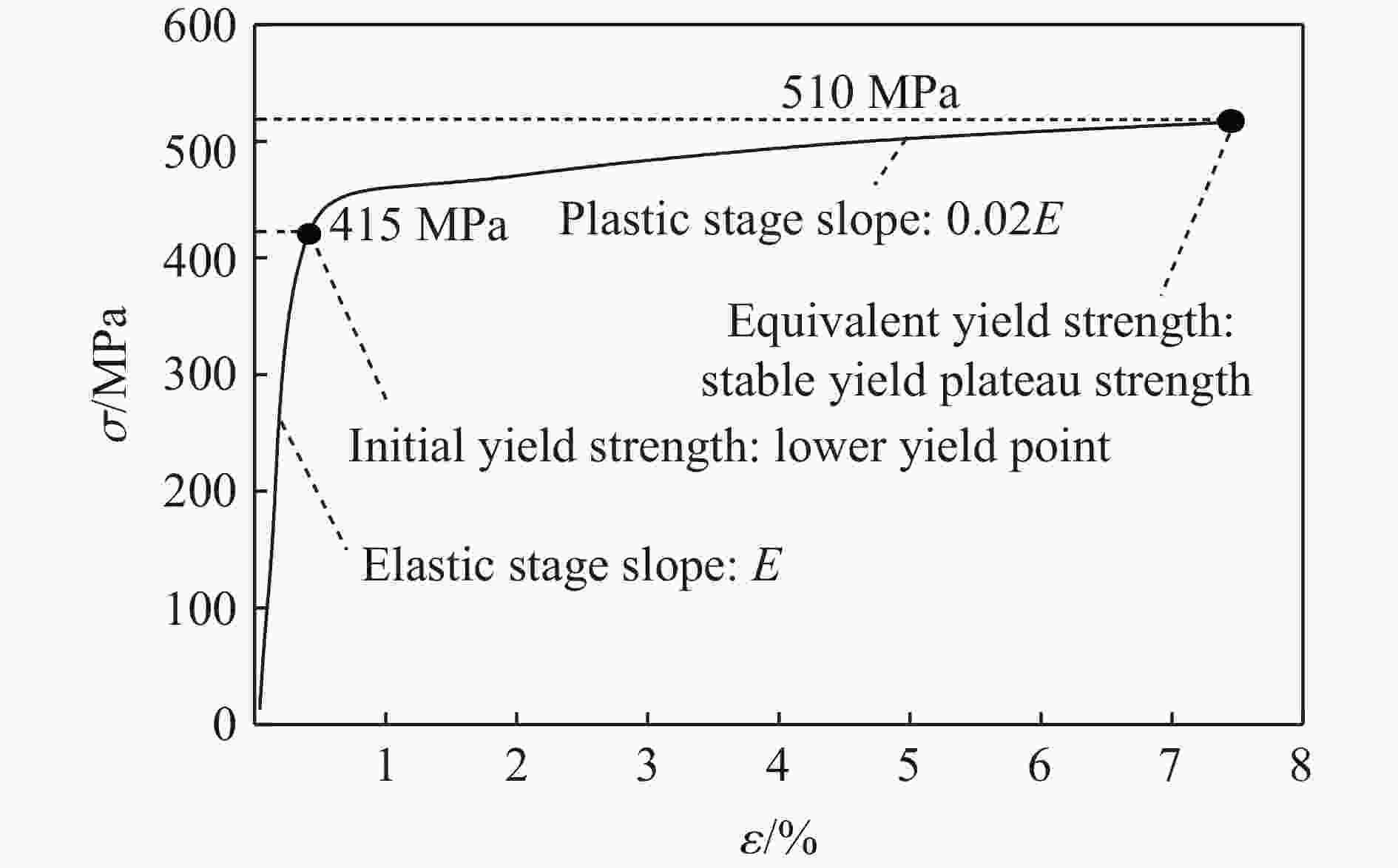
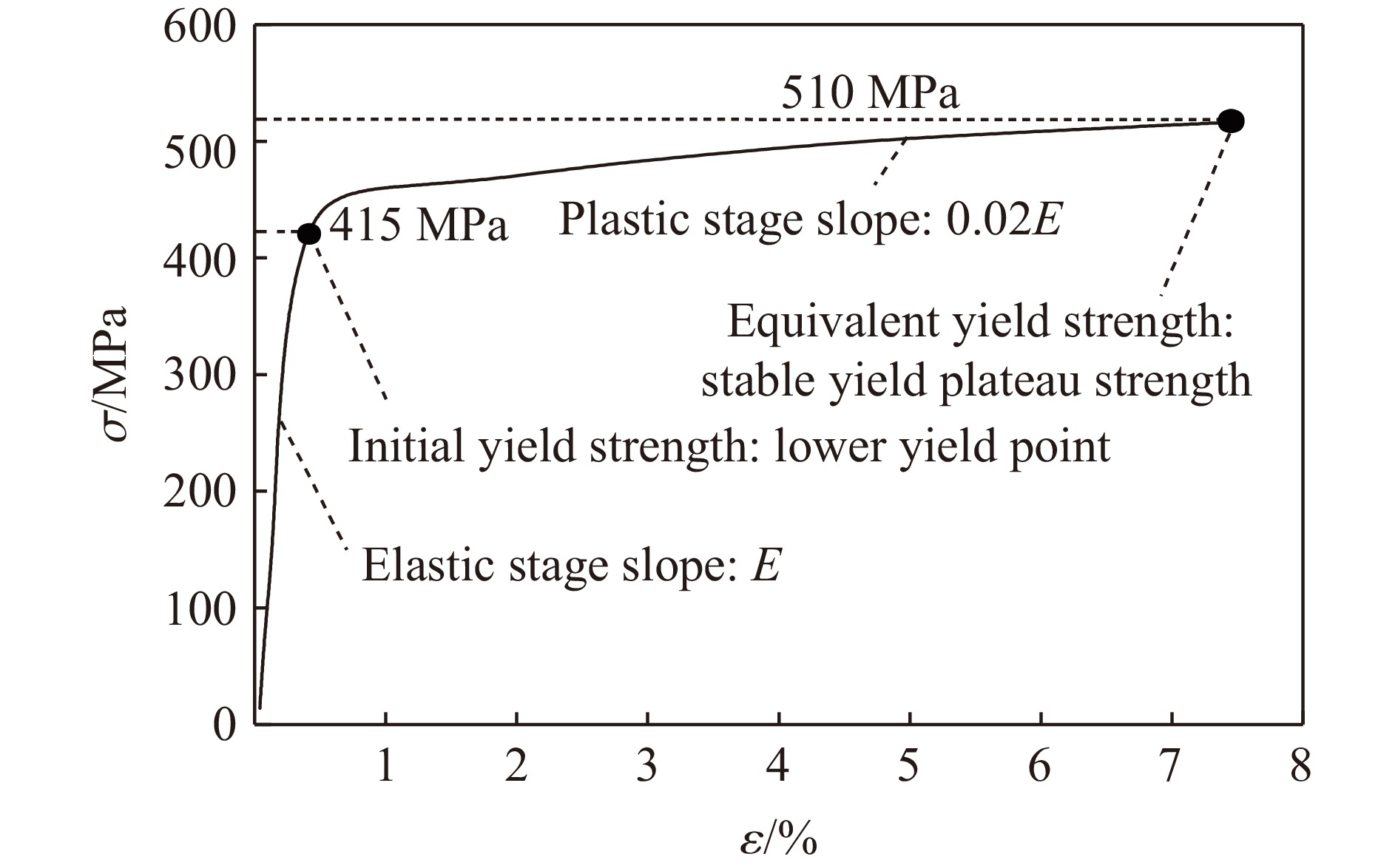
图 7 L415M管道材料的拉伸实验应力-应变曲线
Figure 7. Stress-strain curve of the L415M pipeline material during the tensile test
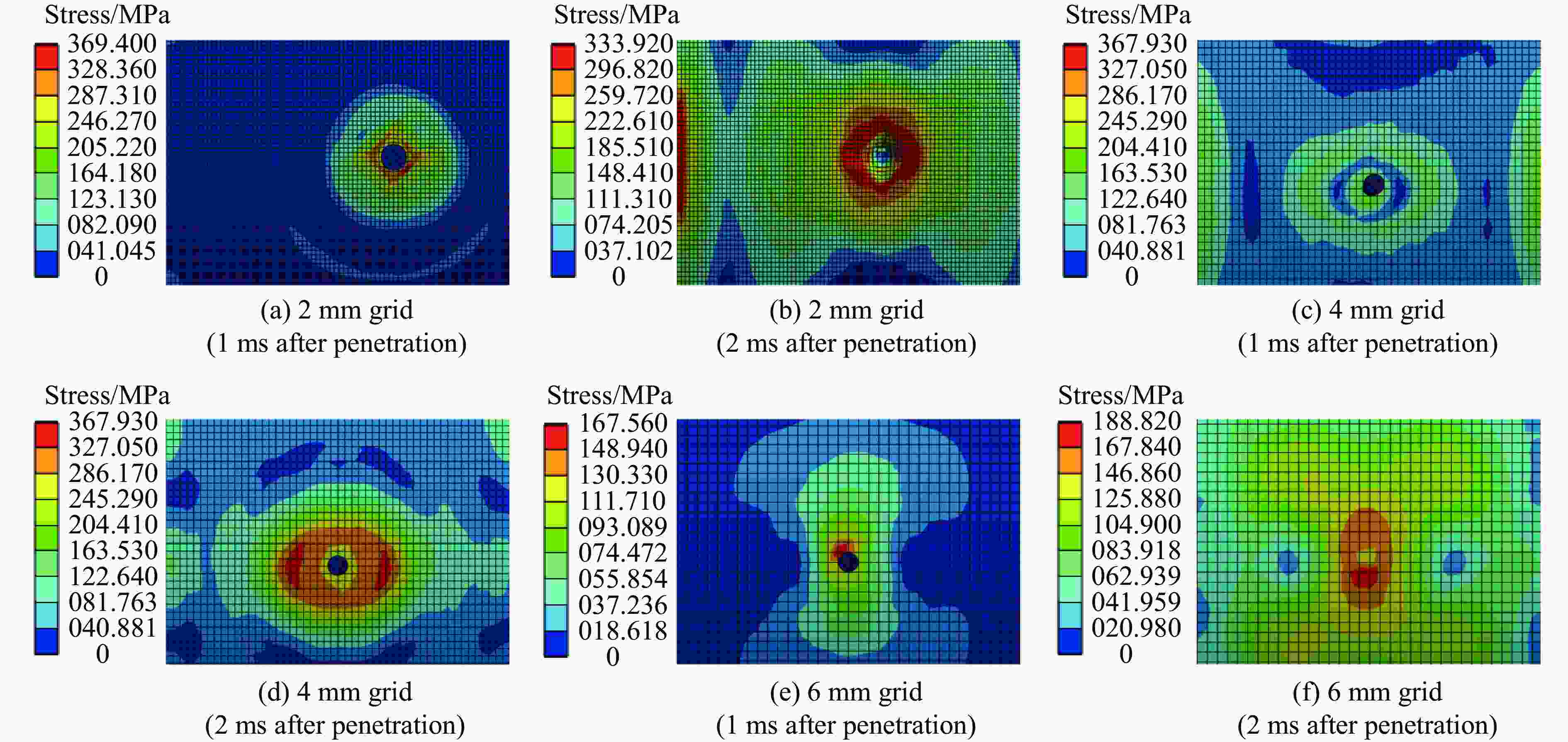
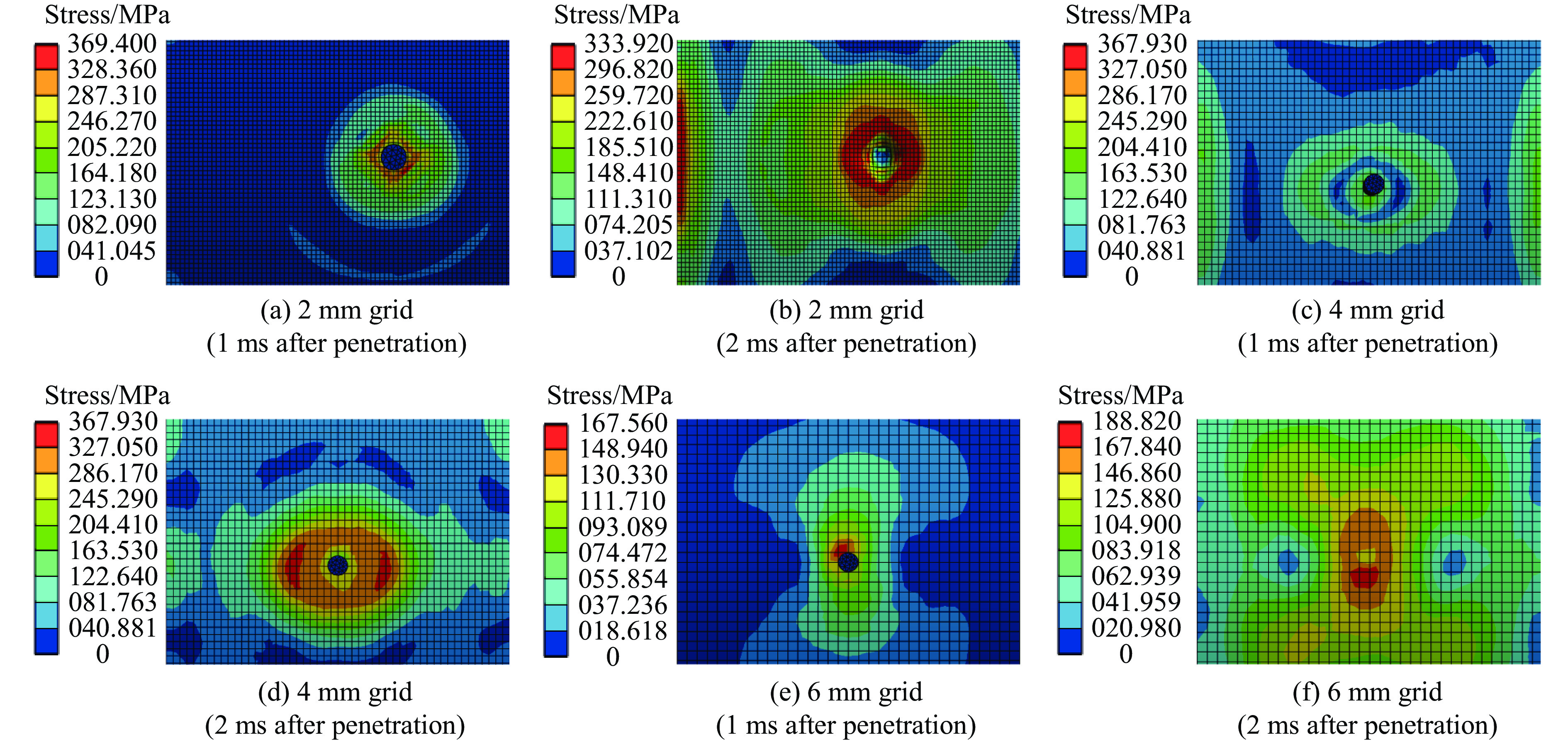
图 8 不同网格尺寸和不同时刻的弹体侵彻区局部应力云图
Figure 8. Stress contour maps of different grid sizes and at different times
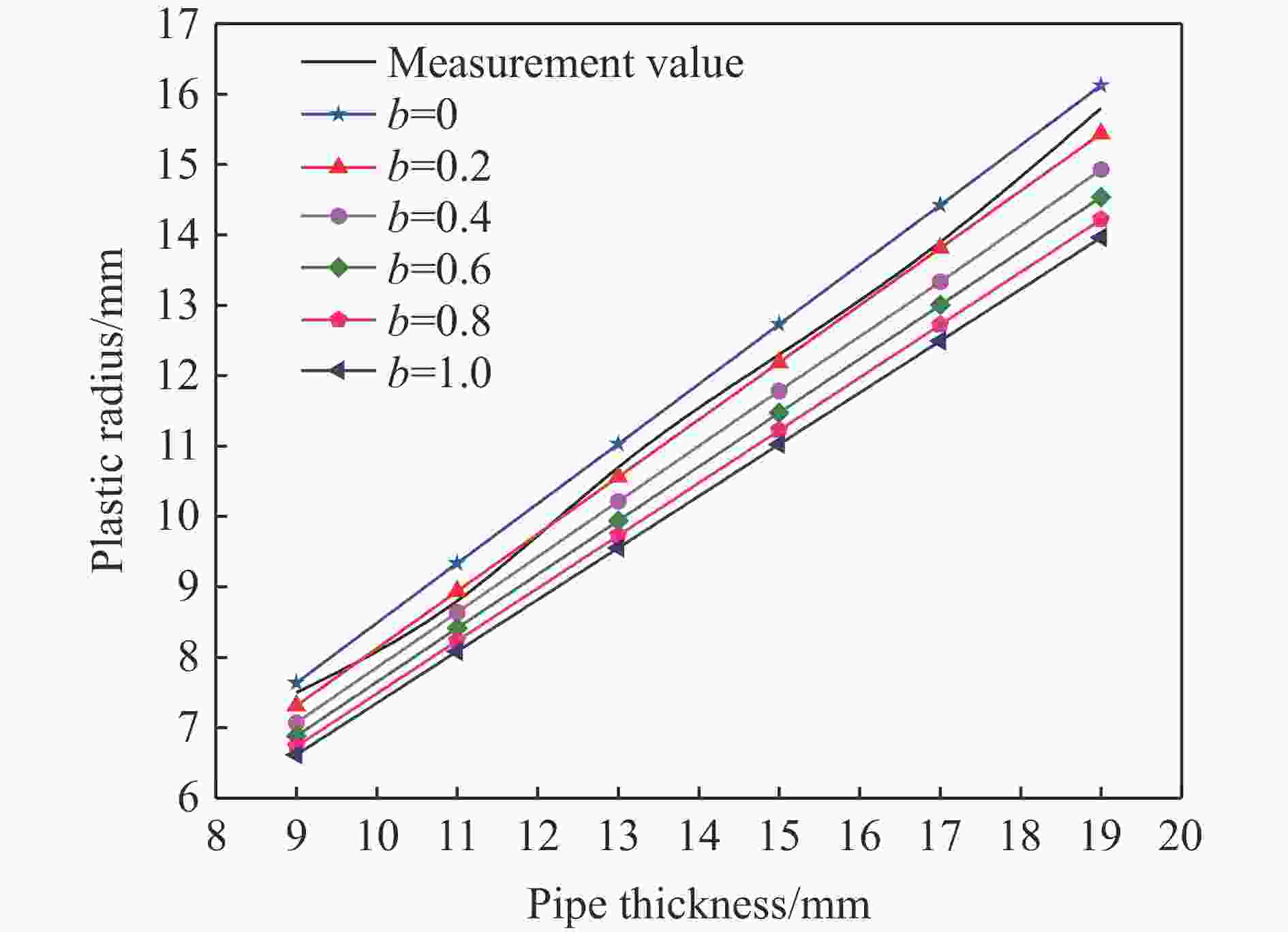
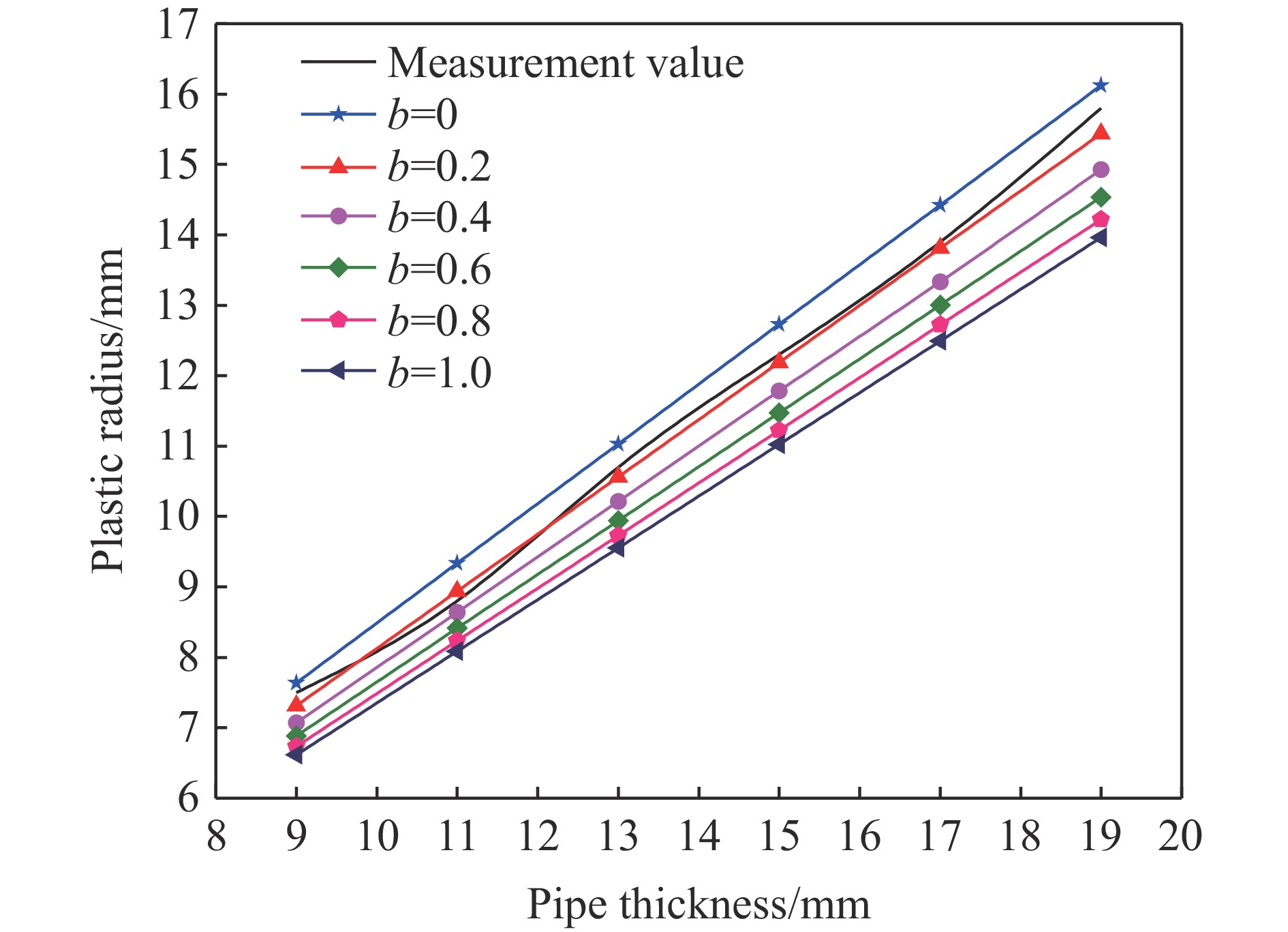
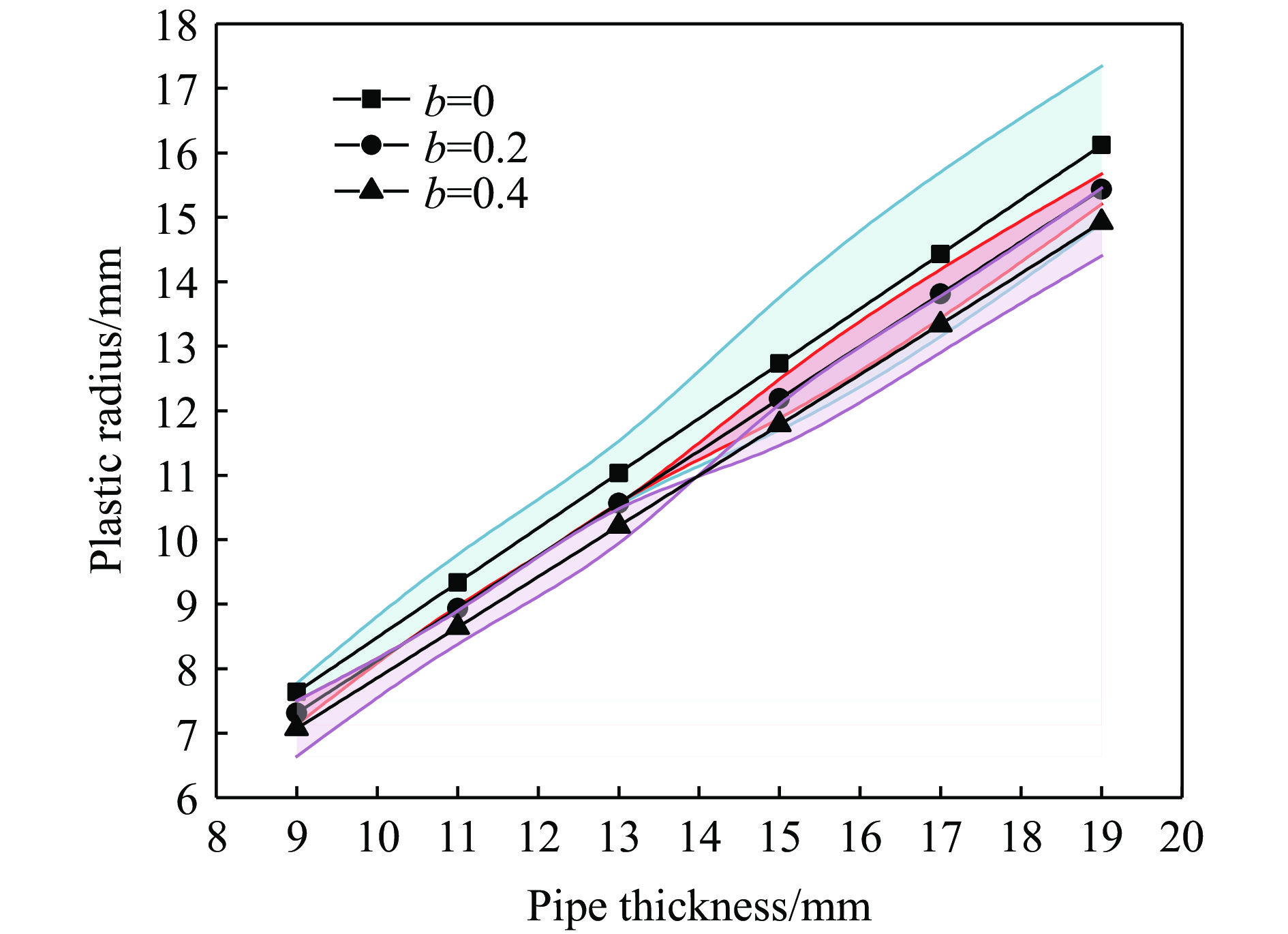
图 13 不同b时塑性半径理论值和测量值对比
Figure 13. Comparison of theoretical and measured values of plastic radius at different b
表 1 L415M管道的基本参数
Table 1. Basic parameters of L415M pipeline
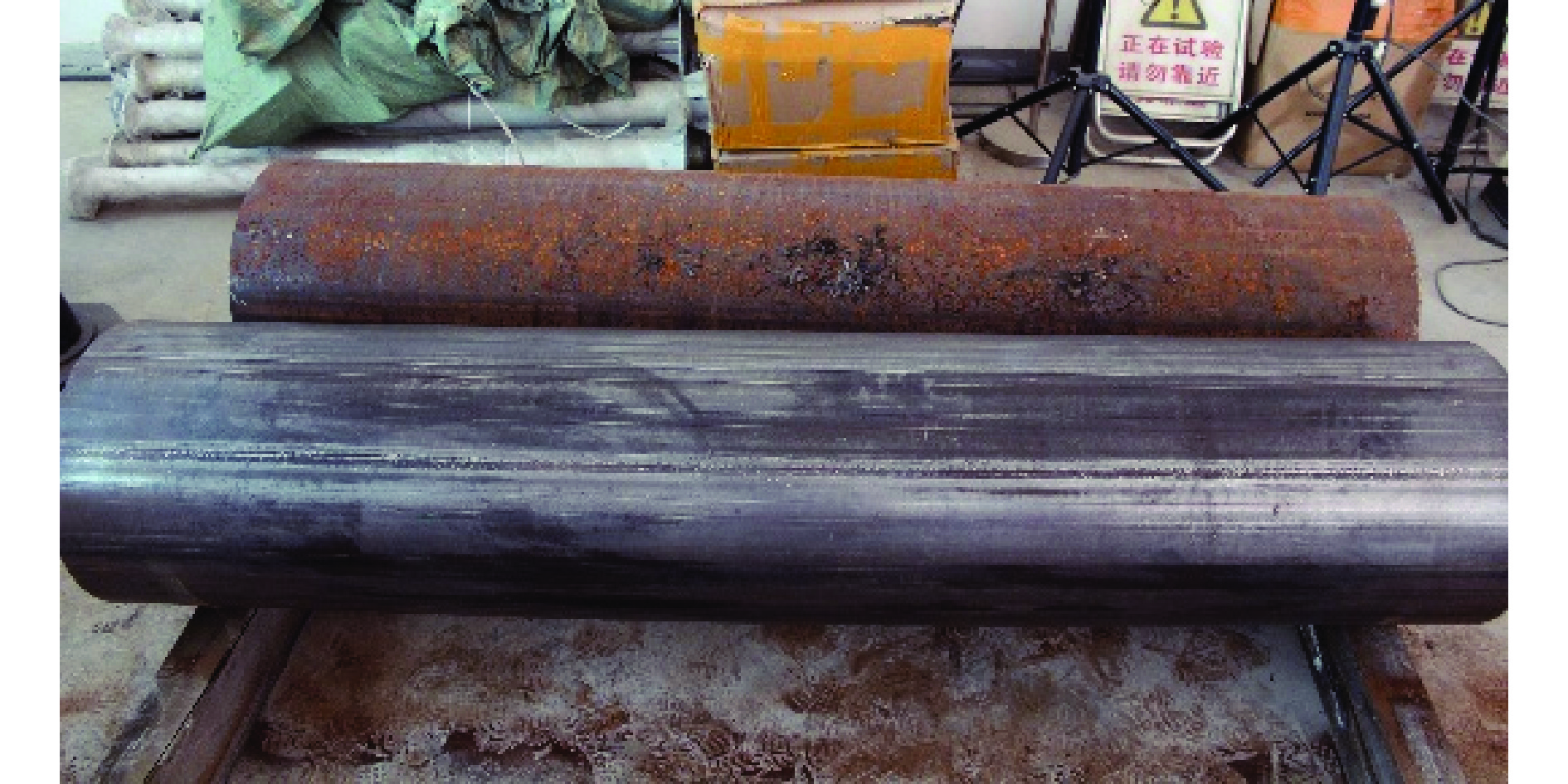
屈服强度/MPa 外径/mm 壁厚/mm 长度/mm 单向拉伸断裂应变$ {\varepsilon }_{\text{f}} $[28] 415 457 9 2150 0.36  下载: 导出CSV
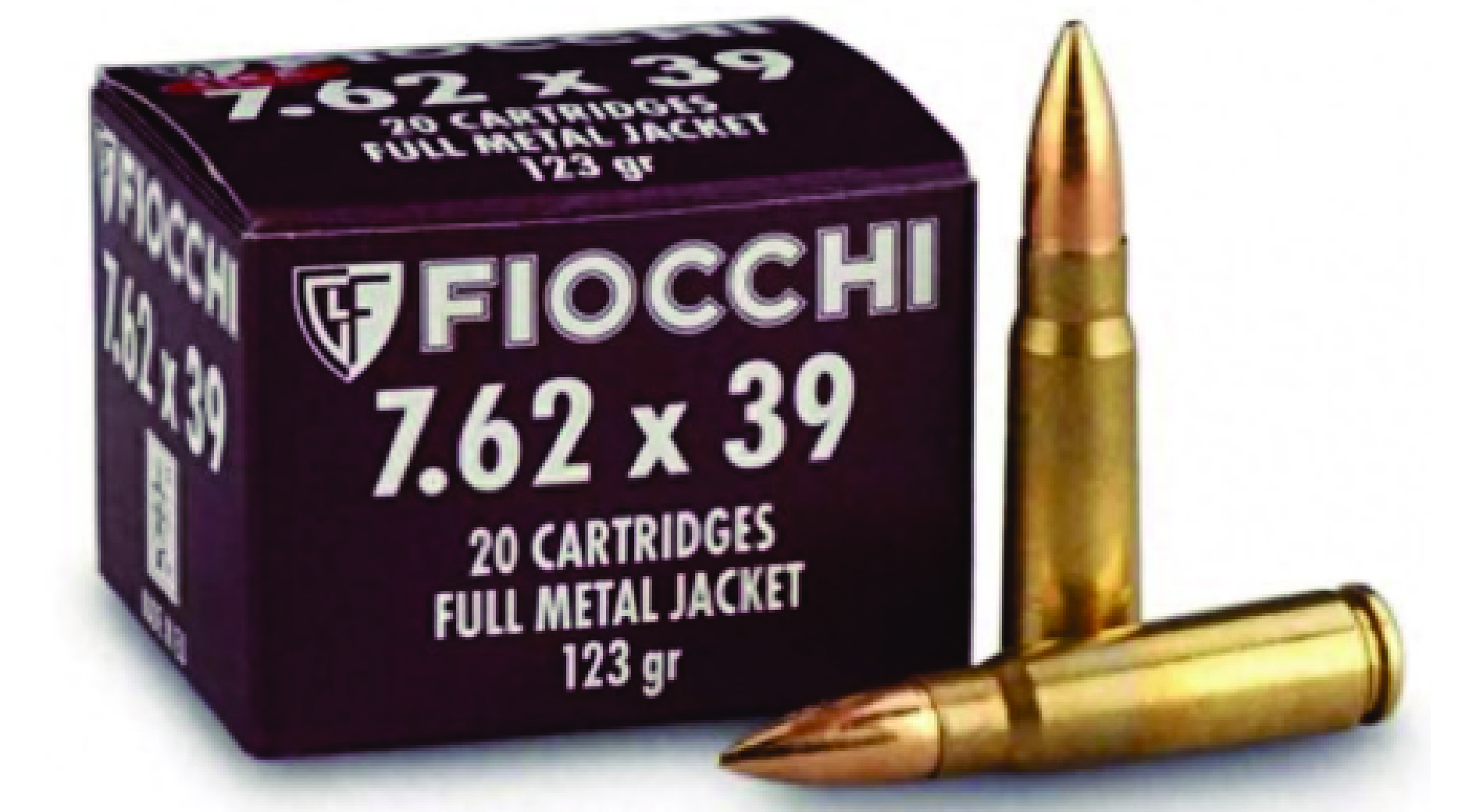
表 2 56式7.62 mm×39 mm步枪弹基本参数
Table 2. Basic parameters of 7.62 mm×39 mm ordinary round bullet of type 56
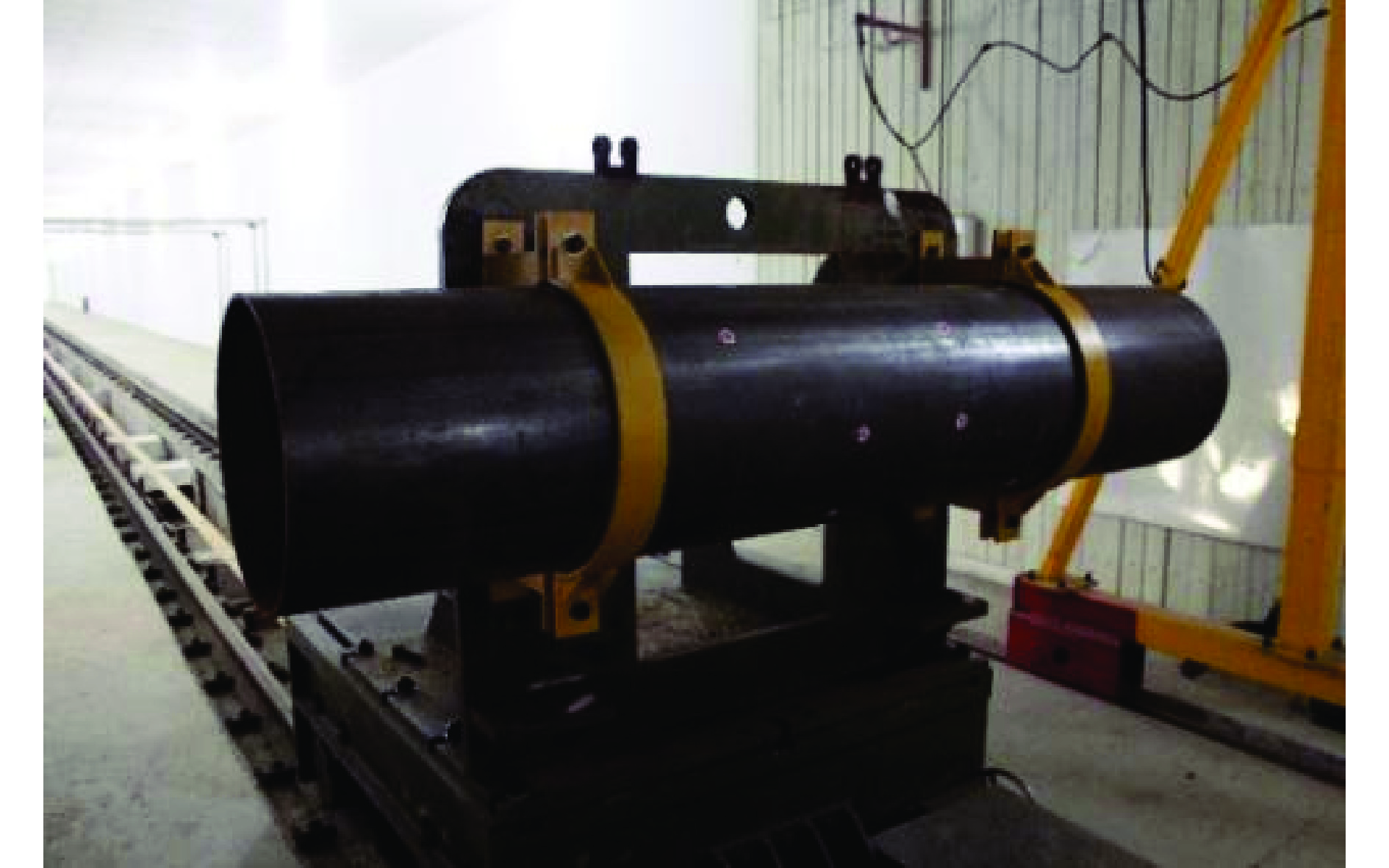
战斗部直径d1/mm 底缘直径d0/mm 弹头长度l1/mm 全长l0/mm 弹体质量m/g 战斗部(钢芯)强度/MPa 7.62 11.3 26.8 55.8 8.1 900
下载: 导出CSV
表 3 56式步枪弹侵彻天然气管道试验数据
Table 3. Penetration test data of type 56 rifle ammunition on natural gas pipelines
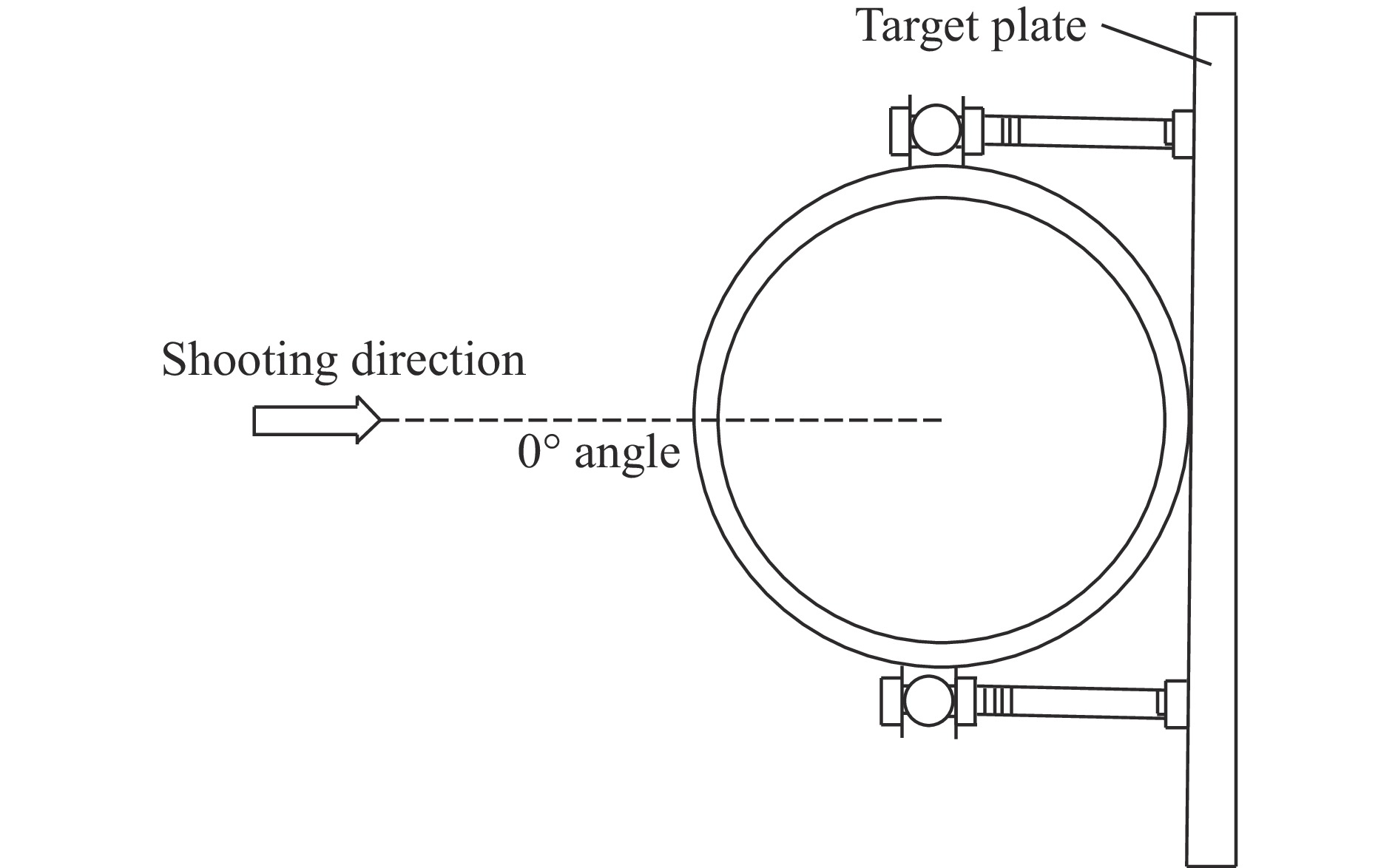
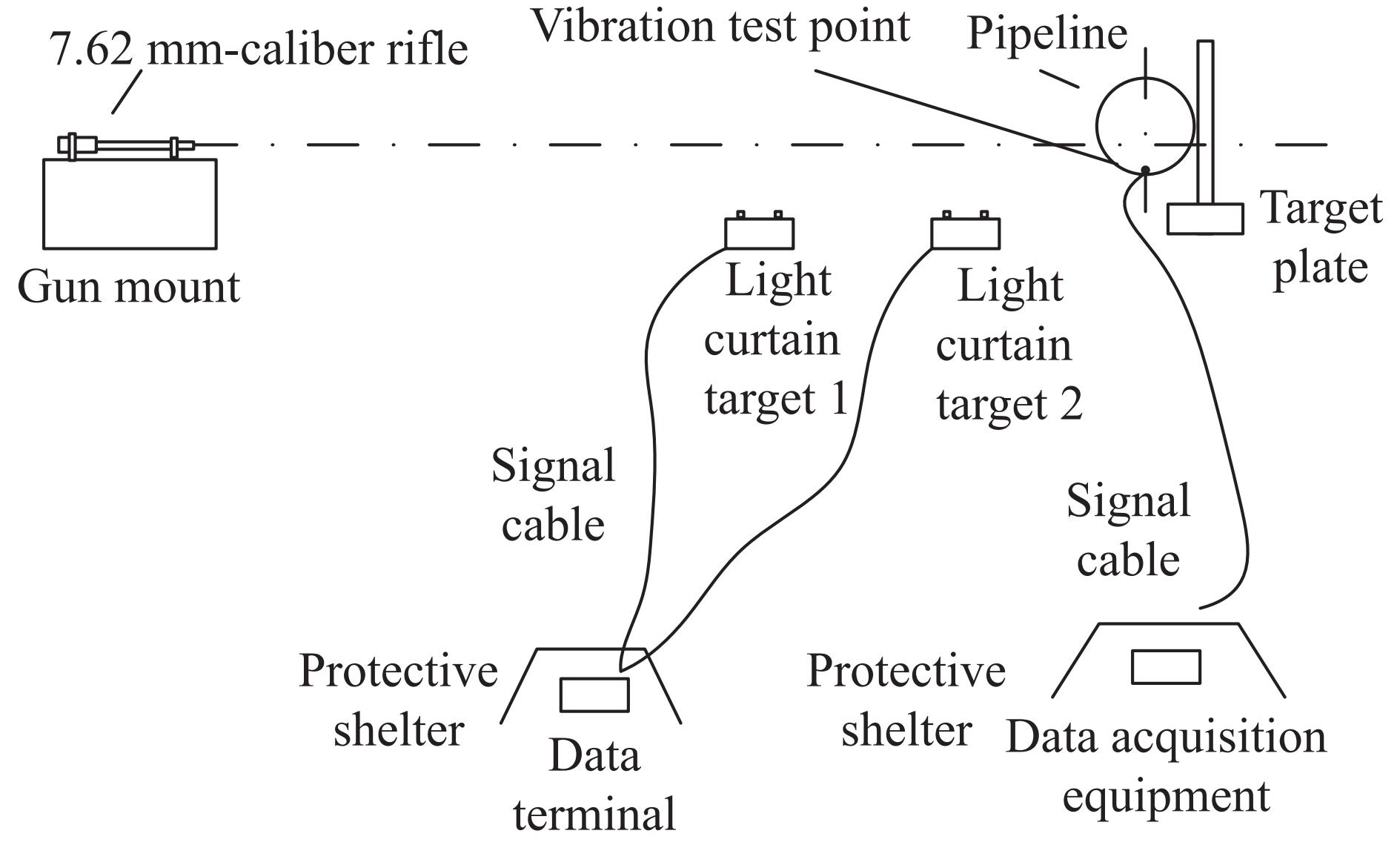
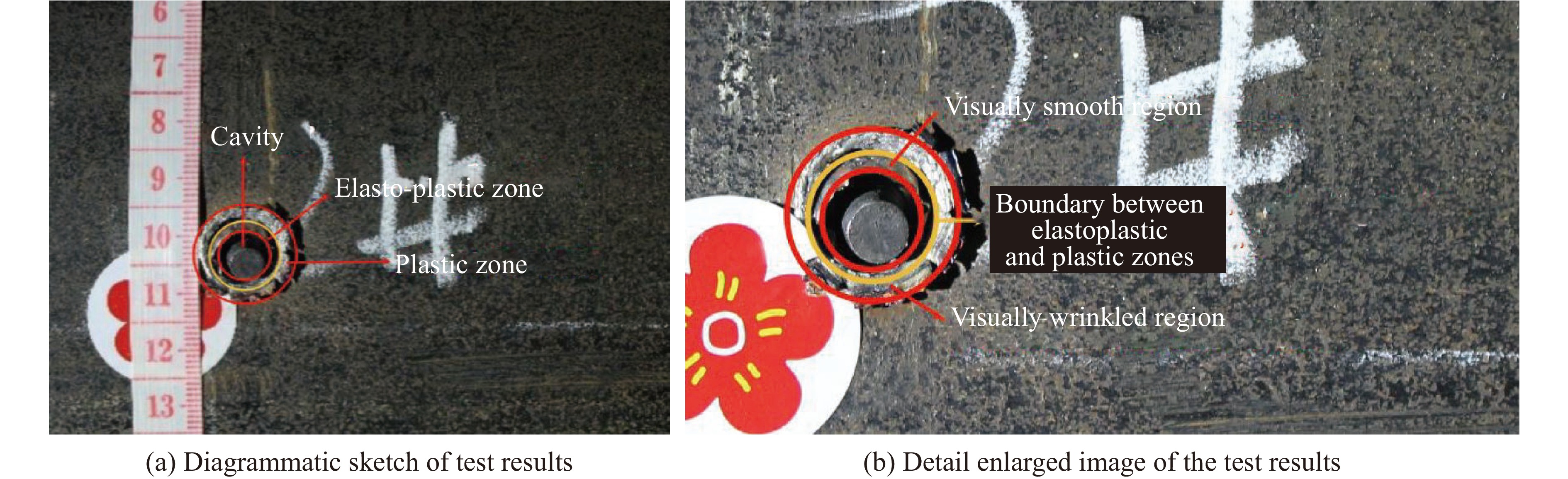
弹体质量m/g 管道厚度$ {r}_{\mathrm{th}} $/mm 撞击速度$ {v}_{0} $/(m·s−1) 塑性半径r/mm 8.1 9 727.2 7.5
下载: 导出CSV
表 4 L415M管道双线性弹塑性本构参数
Table 4. Bilinear elastoplastic constitutive parameters of L415M pipe
材料 密度/(kg·m−3) 弹性模量/GPa 泊松比υ 初始屈服强度/MPa 等效屈服强度[28]/MPa L415M 7800 210 0.3 415 510
下载: 导出CSV
表 5 弹体侵彻天然气管道数值模拟数据汇总
Table 5. Summary of numerical simulation data of penetration
弹体半径
rd/mm管道厚度
rt/mm撞击速度
v0/(m·s−1)塑性半径
测量值/mm塑性半径理论计算值/mm b=0 b=0.2 b=0.4 b=0.6 b=0.8 b=1.0 3.81 9 600 4.5 7.637 7.312 7.070 6.884 6.735 6.614 3.81 9 650 5.4 7.637 7.312 7.070 6.884 6.735 6.614 3.81 9 700 6.3 7.637 7.312 7.070 6.884 6.735 6.614 3.81 9 727 7.5 7.637 7.312 7.070 6.884 6.735 6.614 3.81 9 800 穿透 - - - - - - 4.65 11 600 3.9 9.334 8.936 8.641 8.413 8.232 8.083 4.65 11 700 5.7 9.334 8.936 8.641 8.413 8.232 8.083 4.65 11 727 6.9 9.334 8.936 8.641 8.413 8.232 8.083 4.65 11 800 8.8 9.334 8.936 8.641 8.413 8.232 8.083 4.65 11 900 穿透 - - - - - - 5.50 13 600 3.3 11.031 10.561 10.213 9.943 9.728 9.553 5.50 13 700 5.1 11.031 10.561 10.213 9.943 9.728 9.553 5.50 13 800 8.2 11.031 10.561 10.213 9.943 9.728 9.553 5.50 13 900 10.7 11.031 10.561 10.213 9.943 9.728 9.553 5.50 13 1000 穿透 - - - - - - 6.35 15 600 2.8 12.728 12.186 11.784 11.473 11.225 11.023 6.35 15 700 4.6 12.728 12.186 11.784 11.473 11.225 11.023 6.35 15 800 7.7 12.728 12.186 11.784 11.473 11.225 11.023 6.35 15 900 9.3 12.728 12.186 11.784 11.473 11.225 11.023 6.35 15 1050 11.6 12.728 12.186 11.784 11.473 11.225 11.023 6.35 15 1100 穿透 - - - - - - 7.20 17 700 4.1 14.425 13.811 13.335 13.003 12.722 12.492 7.20 17 800 7.1 14.425 13.811 13.335 13.003 12.722 12.492 7.20 17 1000 9.2 14.425 13.811 13.335 13.003 12.722 12.492 7.20 17 1100 11.6 14.425 13.811 13.335 13.003 12.722 12.492 7.20 17 1180 13.1 14.425 13.811 13.335 13.003 12.722 12.492 7.20 17 1250 穿透 - - - - - - 8.04 19 700 3.6 16.122 15.436 14.926 14.532 14.218 13.962 8.04 19 800 6.6 16.122 15.436 14.926 14.532 14.218 13.962 8.04 19 1000 10.3 16.122 15.436 14.926 14.532 14.218 13.962 8.04 19 1200 12.4 16.122 15.436 14.926 14.532 14.218 13.962 8.04 19 1340 14.9 16.122 15.436 14.926 14.532 14.218 13.962 8.04 19 1400 穿透 - - - - - - 注:当发生完全穿透时,管道局部塑性半径无法定义,因此不予给出理论值,用“-”标记。
下载: 导出CSV
表 6 $b=0.2 $时计算结果误差值对比
Table 6. Comparison of calculation error values under the condition of $b=0.2 $
管道厚度/mm 未穿透最大塑性
半径/mm塑性半径理论
计算值/mm误差/% 9 7.5 7.312 2.5 11 8.8 8.936 1.5 13 10.7 10.561 1.2 15 11.6 12.186 5.1 17 13.1 13.811 5.4 19 15.2 15.436 1.5
下载: 导出CSV
-
[1] 刘阳, 刘峻峰, 张斌, 等. 我国长输天然气用管线钢的发展现状与趋势 [J]. 材料热处理学报, 2024, 45(3): 98–112. DOI: 10.13289/j.issn.1009-6264.2023-0294.LIU Y, LIU J F, ZHANG B, et al. Development status and trend of pipeline steel for long-distance natural gas transportation in China [J]. Transactions of Materials and Heat Treatment, 2024, 45(3): 98–112. DOI: 10.13289/j.issn.1009-6264.2023-0294. [2] 董绍华, 袁士义, 张来斌, 等. 长输油气管道安全与完整性管理技术发展战略研究 [J]. 石油科学通报, 2022, 7(3): 435–446. DOI: 10.3969/j.issn.2096-1693.2022.03.038.DONG S H, YUAN S Y, ZHANG L B, et al. Research on integrity development strategy for long-distance oil and gas pipeline [J]. Petroleum Science Bulletin, 2022, 7(3): 435–446. DOI: 10.3969/j.issn.2096-1693.2022.03.038. [3] 向红军, 苑希超, 吕庆敖. 新概念武器弹药技术 [M]. 北京: 电子工业出版社, 2020: 56-68.XIANG H J, YUAN X C, LV Q A. Technology of new concept weapon and ammunition [M]. Beijing: Publishing House of Electronics Industry, 2020: 56-68. [4] 张博一, 赵威, 王理, 等. 泡沫铝子弹高速撞击下铝基复合泡沫夹层板的动态响应 [J]. 爆炸与冲击, 2017, 37(4): 600–610. DOI: 10.11883/1001-1455(2017)04-0600-11.ZHANG B Y, ZHAO W, WANG L, et al. Dynamic response of aluminum matrix syntactic foams sandwich panel subjected to foamed aluminum projectile impact loading [J]. Explosion and Shock Waves, 2017, 37(4): 600–610. DOI: 10.11883/1001-1455(2017)04-0600-11. [5] WANG Z Y, ZHAO Y, MA G W, et al. A numerical study on the high-velocity impact behavior of pressure pipes [J]. Journal of Zhejiang University-SCIENCE A, 2016, 17(6): 443–453. DOI: 10.1631/jzus.A1500112. [6] 魏建辉, 李旭, 黄威, 等. 高速冲击载荷下梯度金属泡沫夹芯梁的动态响应与失效 [J]. 爆炸与冲击, 2023, 43(5): 053301. DOI: 10.11883/bzycj-2022-0156.WEI J H, LI X, HUANG W, et al. Dynamic response and failure of sandwich beams with graded metal foam core under high-velocity impact [J]. Explosion and Shock Waves, 2023, 43(5): 053301. DOI: 10.11883/bzycj-2022-0156. [7] NI Y, LI G, ZENG Y. High-speed impact performance analysis and constitutive parameter inversion of fiber metal laminates [J]. Composite Structures, 2026, 376: 119842. DOI: 10.1016/J.COMPSTRUCT.2025.119842. [8] NIETO-FUENTES J C, ESPINOZA J, SKET F, et al. High-velocity impact fragmentation of additively-manufactured metallic tubes [J]. Journal of the Mechanics and Physics of Solids, 2023, 174: 105248. DOI: 10.1016/J.JMPS.2023.105248. [9] HUANG S, CHEN H Y, ZHANG R, et al. Uncovering the fracture behavior of metallic cylindrical shells under internal explosive loadings via careful design of densely-arranged multi-point photon Doppler velocimetry measurements [J]. International Journal of Impact Engineering, 2023, 180: 104679. DOI: 10.1016/J.IJIMPENG.2023.104679. [10] CHEN J L, LI S T, MA S, et al. The anti-penetration performance and mechanism of metal materials: a review [J]. Engineering, 2024, 40: 131–157. DOI: 10.1016/J.ENG.2024.03.023. [11] 崔莹, 赵均海, 屈展, 等. CFRP加固埋地油气管道在爆炸荷载下的损伤判定研究 [J]. 振动与冲击, 2022, 41(6): 60–69. DOI: 10.13465/j.cnki.jvs.2022.06.009.CUI Y, ZHAO J H, QU Z, et al. Damage assessment of a buried CFRP petroleum pipeline subjected to blast loading [J]. Journal of Vibration and Shock, 2022, 41(6): 60–69. DOI: 10.13465/j.cnki.jvs.2022.06.009. [12] 钟紫蓝, 赵鑫, 崔建阳, 等. 碳纤维增强复合材料加固后埋地压力钢管在逆断层作用下的力学性能研究 [J]. 震灾防御技术, 2023, 18(2): 252–260. DOI: 10.11899/zzfy20230206.ZHONG Z L, ZHAO X, CUI J Y, et al. Study on mechanical properties of buried steel pipelines strengthened with carbon fiber reinforced polymer under reverse fault [J]. Technology for Earthquake Disaster Prevention, 2023, 18(2): 252–260. DOI: 10.11899/zzfy20230206. [13] WANG H P, WU Y B, CHEN C, et al. Dynamic response of CFRP reinforced steel beams subjected to impact action based on FBG sensing technology [J]. Sensors, 2022, 22(17): 6377. DOI: 10.3390/S22176377. [14] SHUAIB M M, KIM YUEN S C K, NURICK G N. Numerical simulation of blast loaded CFRP retrofitted steel plates [J]. MATEC Web of Conferences, 2021, 347: 00038. DOI: 10.1051/MATECCONF/202134700038. [15] FORRESTAL M J, WARREN T L. Perforation equations for conical and ogival nose rigid projectiles into aluminum target plates [J]. International Journal of Impact Engineering, 2009, 36(2): 220–225. DOI: 10.1016/j.ijimpeng.2008.04.005. [16] 刘均伟, 张先锋, 刘闯, 等. 空腔膨胀理论靶体阻力模型及其应用研究进展 [J]. 爆炸与冲击, 2021, 41(10): 101101. DOI: 10.11883/bzycj-2021-0010.LIU J W, ZHANG X F, LIU C, et al. Research progress of target resistance model of cavity expansion theory and its application [J]. Explosion and Shock Waves, 2021, 41(10): 101101. DOI: 10.11883/bzycj-2021-0010. [17] 谭仪忠, 戴伟, 李杰, 等. 冻土靶体抗侵彻特性试验与抗侵彻深度计算 [J]. 振动与冲击, 2025, 44(9): 250–256. DOI: 10.13465/j.cnki.jvs.2025.09.028.TAN Y Z, DAI W, LI J, et al. Anti-penetration characteristics tests and anti-penetration depth calculation of frozen soil targets [J]. Journal of Vibration and Shock, 2025, 44(9): 250–256. DOI: 10.13465/j.cnki.jvs.2025.09.028. [18] 陈柏翰, 邹慧辉, 沈子楷, 等. 侵彻弹体冲击响应模型研究进展 [J]. 现代应用物理, 2024, 15(6): 60101. DOI: 10.12061/j.issn.2095-6223.202405001.CHEN B H, ZOU H H, SHEN Z K, et al. Research progress of impact response models for penetrating projectile [J]. Modern Applied Physics, 2024, 15(6): 60101. DOI: 10.12061/j.issn.2095-6223.202405001. [19] 蒋志刚, 宋殿义, 曾首义. 有限柱形空腔膨胀理论及其应用 [J]. 振动与冲击, 2011, 30(4): 139–143, 204. DOI: 10.13465/j.cnki.jvs.2011.04.006.JIANG Z G, SONG D Y, ZENG S Y. A finite cylindrical cavity expansion theory and its application [J]. Journal of Vibration and Shock, 2011, 30(4): 139–143, 204. DOI: 10.13465/j.cnki.jvs.2011.04.006. [20] 蒋志刚, 曾首义, 周建平. 中等厚度金属靶板的三阶段贯穿模型 [J]. 兵工学报, 2007, 28(9): 1046–1052. DOI: 10.3321/j.issn:1000-1093.2007.09.005.JIANG Z G, ZENG S Y, ZHOU J P, et al. A three-stage model for the perforation of moderately thick metallic plates [J]. Acta Armamentarii, 2007, 28(9): 1046–1052. DOI: 10.3321/j.issn:1000-1093.2007.09.005. [21] 蒋志刚, 曾首义, 周建平. 刚性尖头弹侵彻有限厚度金属靶板分析模型 [J]. 兵工学报, 2007, 28(8): 923–929. DOI: 10.3321/j.issn:1000-1093.2007.08.006.JIANG Z G, ZENG S Y, ZHOU J P, et al. An analytical model for penetration into finite thickness metallic target struck by rigid sharp-nosed projectiles [J]. Acta Armamentarii, 2007, 28(8): 923–929. DOI: 10.3321/j.issn:1000-1093.2007.08.006. [22] 宋殿义, 刘飞, 蒋志刚. 刚性尖头弹侵彻圆柱形金属厚靶分析模型 [J]. 工程力学, 2013, 30(1): 31–36. DOI: 10.6052/j.issn.1000-4750.2011.06.0391.SONG D Y, LIU F, JIANG Z G. An analytical model for penetration into cylindrical metallic thick target by rigid sharp-nosed projectiles [J]. Engineering Mechanics, 2013, 30(1): 31–36. DOI: 10.6052/j.issn.1000-4750.2011.06.0391. [23] 王娟, 赵均海, 周媛, 等. 高速长杆弹对有限直径金属厚靶的侵彻分析 [J]. 工程力学, 2022, 39(4): 238–245. DOI: 10.6052/j.issn.1000-4750.2021.02.0127.WANG J, ZHAO J H, ZHOU Y, et al. Penetration analysis of high-speed long rod projectile into thick metal target with finite diameter [J]. Engineering Mechanics, 2022, 39(4): 238–245. DOI: 10.6052/j.issn.1000-4750.2021.02.0127. [24] 张虎, 邵磊, 余成, 等. 冲击荷载对埋地管道影响的试验与数值模拟研究 [J]. 地震工程与工程振动, 2022, 42(3): 243–252. DOI: 10.13197/j.eeed.2022.0326.ZHANG H, SHAO L, YU C, et al. Experimental and numerical simulation study of impact loading on buried pipeline [J]. Earthquake Engineering and Engineering Dynamics, 2022, 42(3): 243–252. DOI: 10.13197/j.eeed.2022.0326. [25] 俞茂宏. 线性和非线性的统一强度理论 [J]. 岩石力学与工程学报, 2007, 26(4): 662–669. DOI: 10.3321/j.issn:1000-6915.2007.04.002.YU M H. Linear and nonlinear unified strength theory [J]. Chinese Journal of Rock Mechanics and Engineering, 2007, 26(4): 662–669. DOI: 10.3321/j.issn:1000-6915.2007.04.002. [26] 李芳涛, 胡志平, 陈南南, 等. 爆破荷载作用下隧道围岩裂隙范围计算方法研究 [J]. 振动与冲击, 2022, 41(8): 260–269. DOI: 10.13465/j.cnki.jvs.2022.08.032.LI F T, HU Z P, CHEN N N, et al. A study of fracture range of tunnel surrounding rock under blasting [J]. Journal of Vibration and Shock, 2022, 41(8): 260–269. DOI: 10.13465/j.cnki.jvs.2022.08.032. [27] 王娟, 赵均海, 张建华, 等. 刚性弹侵彻有限直径金属厚靶的机理与模型研究 [J]. 工程力学, 2021, 38(7): 239–247. DOI: 10.6052/j.issn.1000-4750.2020.07.0469.WANG J, ZHAO J H, ZHANG J H, et al. Research on mechanism and model of penetration into metallic thick target finite in radial extent by rigid projectile [J]. Engineering Mechanics, 2021, 38(7): 239–247. DOI: 10.6052/j.issn.1000-4750.2020.07.0469. [28] 马廷霞, 杨永和, 许震, 等. X60管线钢的本构关系及失效判据 [J]. 重庆大学学报, 2014, 37(8): 67–75. DOI: 10.11835/j.jssn.1000-582X.2014.08.010.MA T X, YANG Y H, XU Z, et al. Constitutive relation and failure criterion for X60 pipeline steel [J]. Journal of Chongqing University, 2014, 37(8): 67–75. DOI: 10.11835/j.jssn.1000-582X.2014.08.010. [29] 位国旭, 崔浩, 周昊, 等. 钨合金弹丸侵彻钢靶的数值模拟方法 [J]. 爆炸与冲击, 2025, 45(8): 084202. DOI: 10.11883/bzycj-2024-0147.WEI G X, CUI H, ZHOU, H, et al. Numerical simulation method for tungsten alloy projectile penetration into steel target [J]. Explosion and Shock Waves, 2025, 45(8): 084202. DOI: 10.11883/bzycj-2024-0147. [30] 张启瑞, 彭永, 余双洋, 等. D形截面弹体对UHPC靶的侵彻性能研究 [J]. 北京理工大学学报, 2025, 45(10): 1044–1052. DOI: 10.15918/j.tbit1001-0645.2025.082.ZHANG Q R, PENG Y, YU S Y, et al. Study on penetration performance of D-shaped cross-section projectile into UHPC targets [J]. Transactions of Beijing Institute of Technology, 2025, 45(10): 1044–1052. DOI: 10.15918/j.tbit1001-0645.2025.082. [31] 昝月稳, 俞茂宏. 岩石广义非线性统一强度理论 [J]. 西南交通大学学报, 2013, 48(4): 616–624. DOI: 10.3969/j.issn.0258-2724.2013.04.005.ZAN Y W, YU M H. Generalized nonlinear unified strength theory of rock [J]. Journal of Southwest Jiaotong University, 2013, 48(4): 616–624. DOI: 10.3969/j.issn.0258-2724.2013.04.005. [32] 金乘武, 王立忠, 张永强. 薄壁管道爆破压力的强度差异效应与强度准则影响 [J]. 应用数学和力学, 2012, 33(11): 1266–1274. DOI: 10.3879/j.issn.1000-0887.2012.11.002.JIN C W, WANG L Z, ZHANG Y Q. Strength differential effect and influence of strength criterion on burst pressure of thin-walled pipelines [J]. Applied Mathematics and Mechanics, 2012, 33(11): 1266–1274. DOI: 10.3879/j.issn.1000-0887.2012.11.002. -

计量
- 文章访问数: 694
- HTML全文浏览量: 269
- PDF下载量: 244
- 被引次数: 0