



Prediction of gas explosion consequences in residential buildings based on artificial neural network
-
摘要: 针对居民燃气爆炸事故灾害演化呈高度非线性、其后果难以精准预测问题,开展了数据驱动下的燃气爆炸后果预测研究。提出了一种基于人工神经网络的爆炸事故后果预测方法,借助大规模数值仿真,生成了涵盖多种居民户型的燃气爆炸后果数据集,通过敏感性分析和准确性验证,最终建立了燃气爆炸后果智能预测模型,其对室内最大爆炸超压和温度的预测误差分别低于15%和5%,空间位置坐标最大误差在25%以内。由此实现了对不同居民户型任意点火位置下的室内最严重爆炸后果及其空间位置的批量预测。结果表明:随着户型面积增大和空间布局逐渐复杂化,最大超压和温度依次提高。客厅区域始终表现为最低超压水平,而未设窗口的卧室墙体附近则易形成超压与温度的极值区域。厨房和卧室点火可分别导致室内产生最严重的超压和温度后果,反映出点火位置对爆炸后果的差异化影响规律。Abstract: Addressing the challenge of highly nonlinear evolution and the difficulty in accurately predicting the consequences of residential gas explosion accidents, a data-driven investigation into gas explosion consequence prediction was conducted. An artificial neural network-based prediction method for explosion accident consequences was proposed. By large-scale numerical simulations, a gas explosion consequence dataset covering various residential unit layouts was generated. Through sensitivity analysis and accuracy validation, an intelligent prediction model for gas explosion consequences was ultimately established. The model achieves prediction errors below 15% and 5% for indoor peak overpressure and temperature, respectively, while the maximum error in predicting spatial location coordinates remains within 25%. This enables batch prediction of the most severe indoor explosion consequences and their spatial locations for arbitrary ignition positions across different residential unit layouts. The results indicate that as unit area increases and spatial layout becomes progressively more complex, the peak overpressure and temperature values correspondingly increase. The living room consistently exhibits the lowest overpressure levels, whereas areas near windowless bedroom walls tend to form extreme overpressure and temperature zones. Ignition in the kitchen and bedroom leads to the most severe indoor overpressure and temperature consequences, respectively, reflecting the differential impact patterns of ignition location on explosion outcomes. The findings provide important references for expanding the predictive application of artificial intelligence in the field of gas explosions and for the efficient prevention and control of explosion accidents.
-
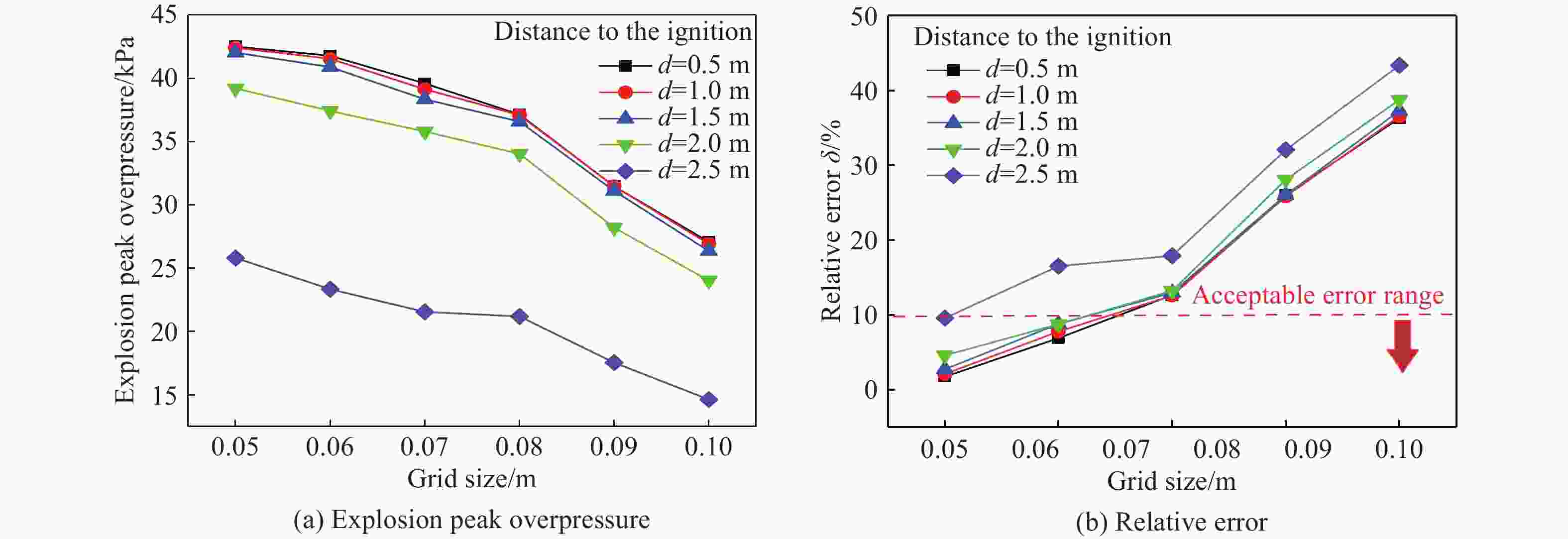
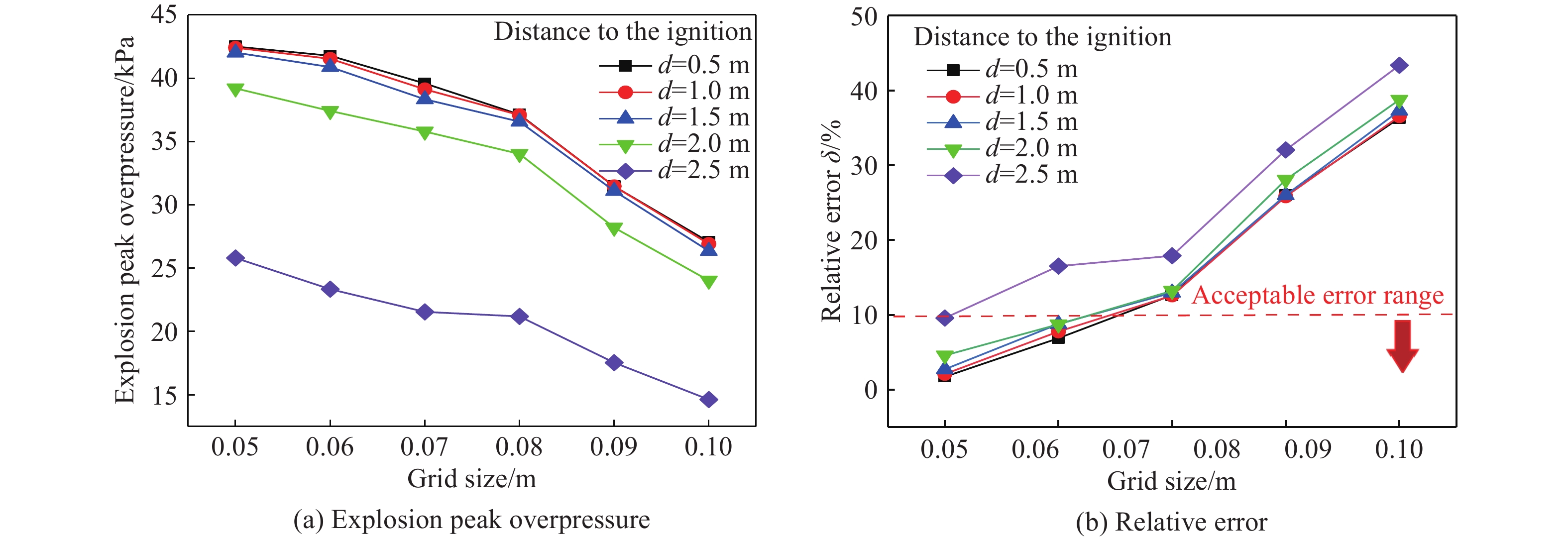
图 2 不同网格尺寸下爆炸峰值超压及相对误差对比
Figure 2. Comparison of explosion peak overpressure and relative error under different grid sizes
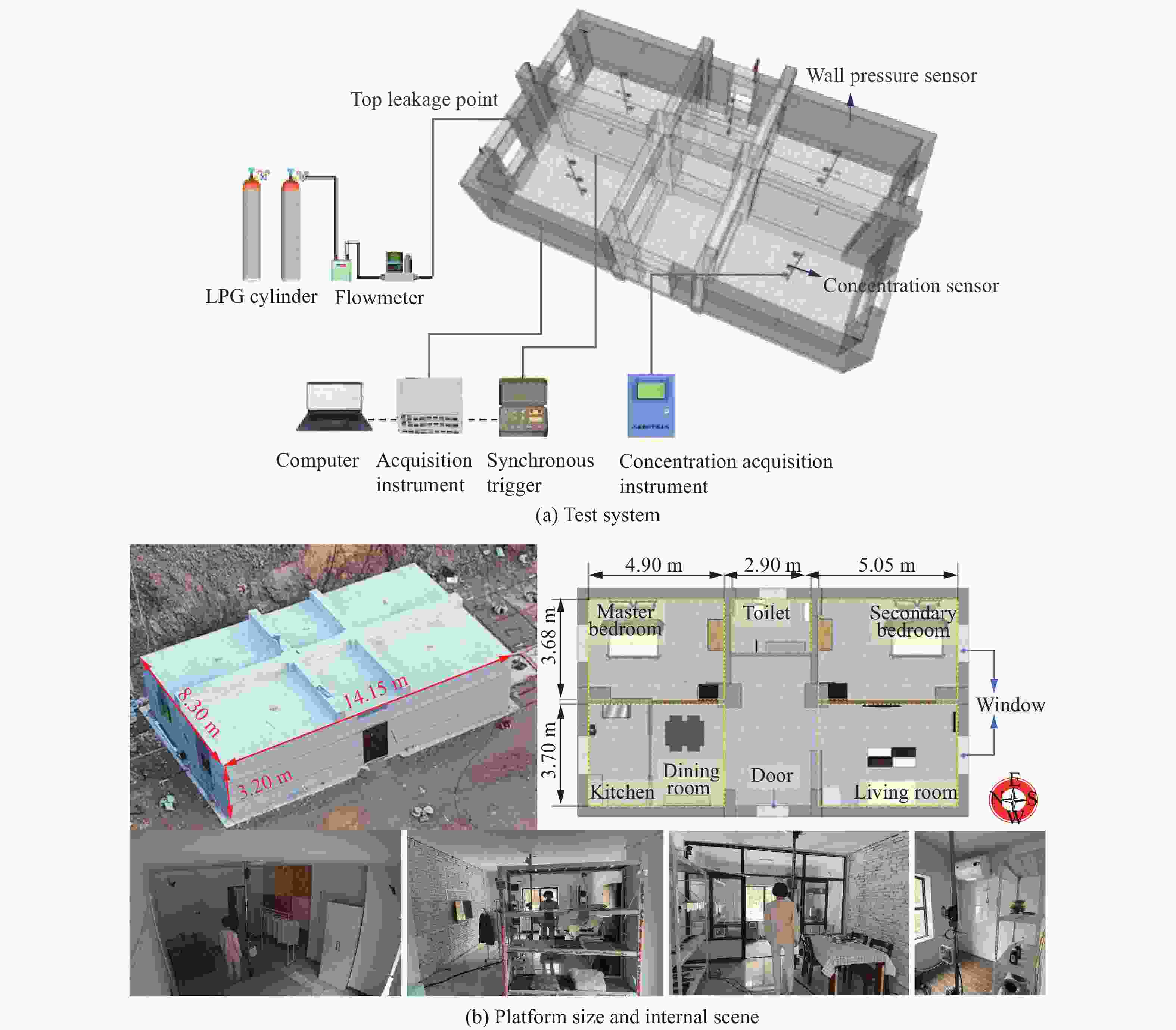
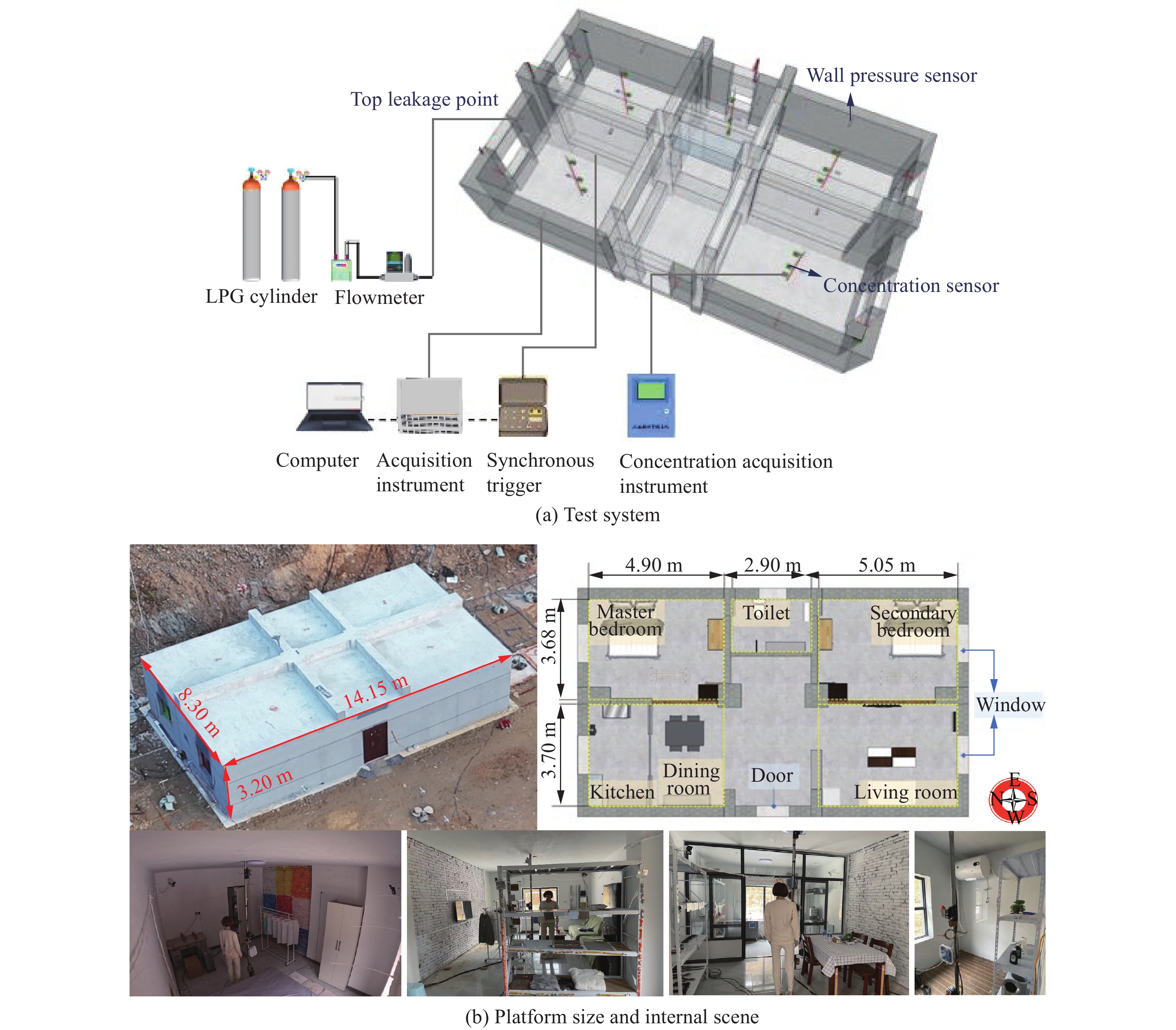
图 3 全尺寸居民住宅液化石油气爆炸实验平台
Figure 3. Full-size residential liquefied petroleum gas explosion experimental platform
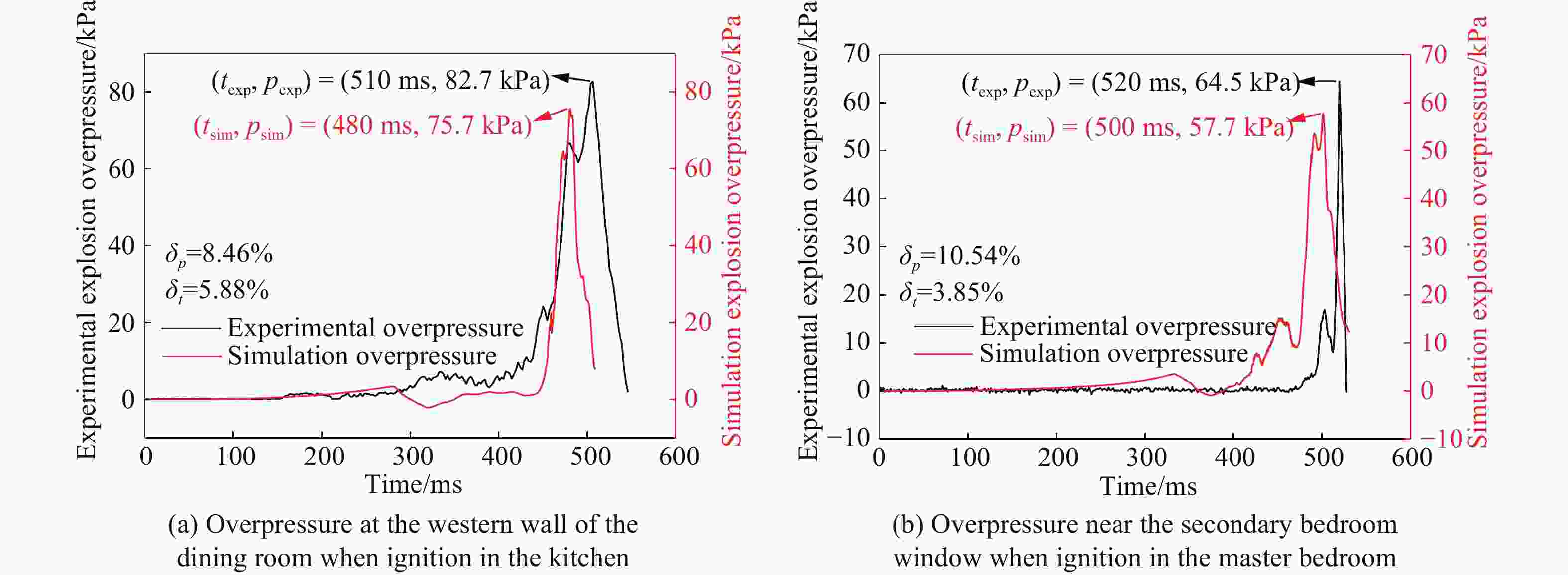
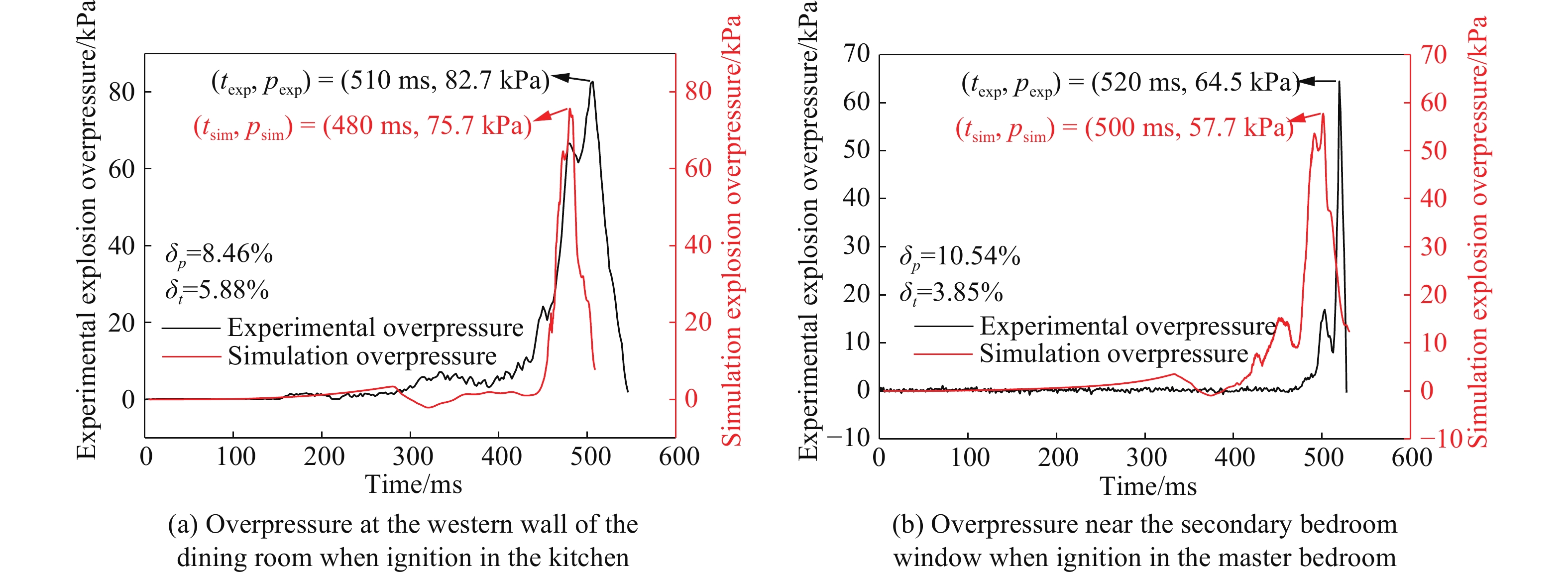
图 4 不同点火位置下模拟与实验爆炸超压时程曲线对比
Figure 4. Comparison of simulated and experimental explosion overpressure-time history curves at different ignition positions
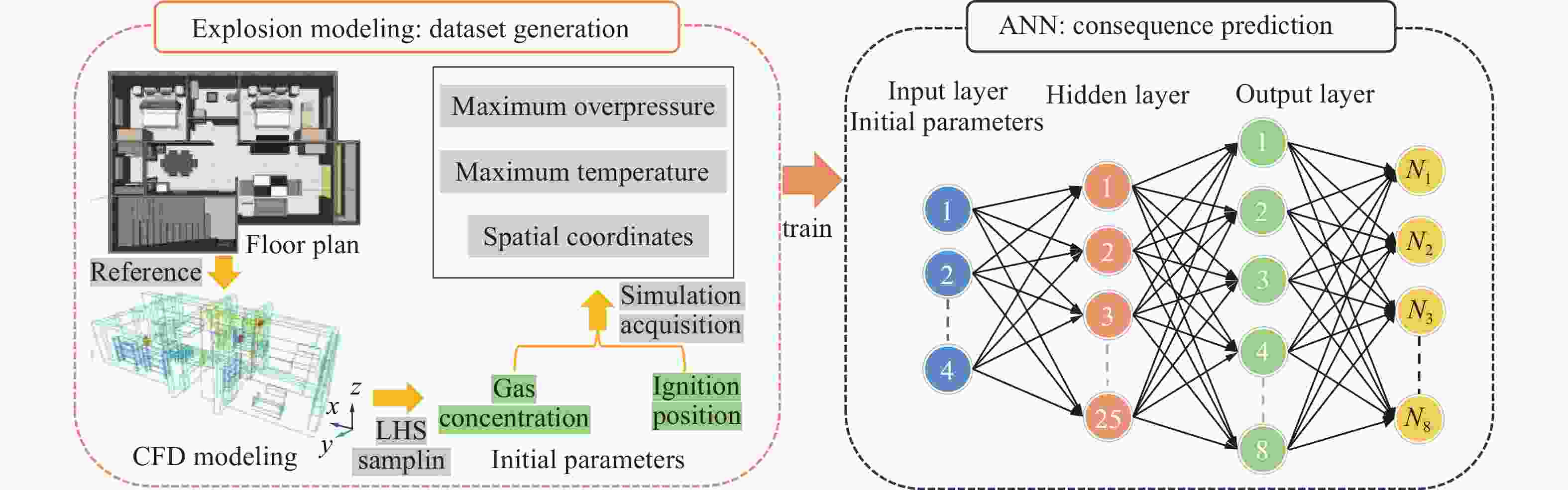
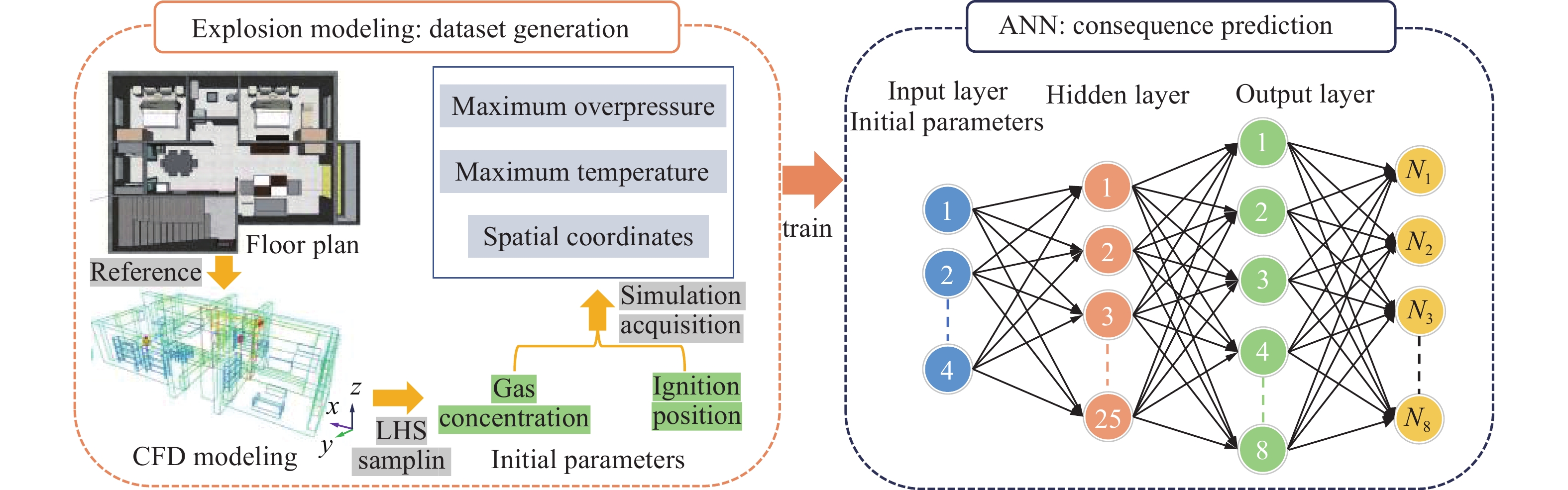
图 5 基于人工神经网络的居民燃气爆炸事故后果预测框架
Figure 5. Framework for predicting consequences of residential gas explosion accidents based on artificial neural network
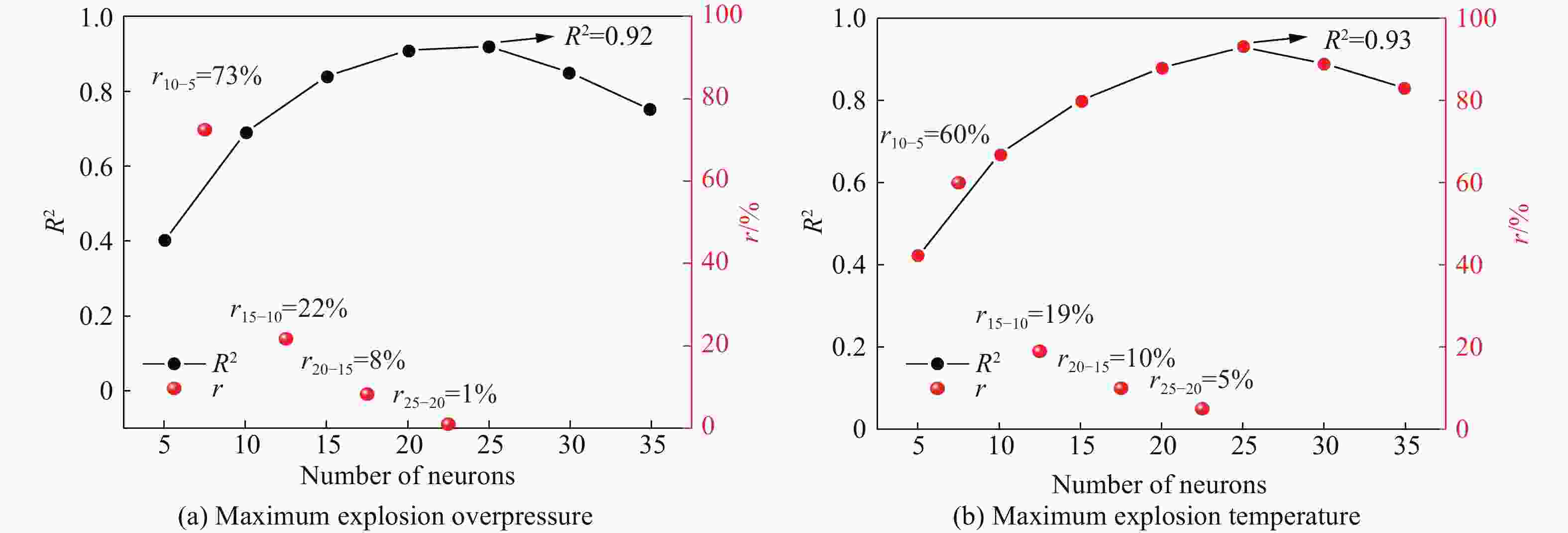
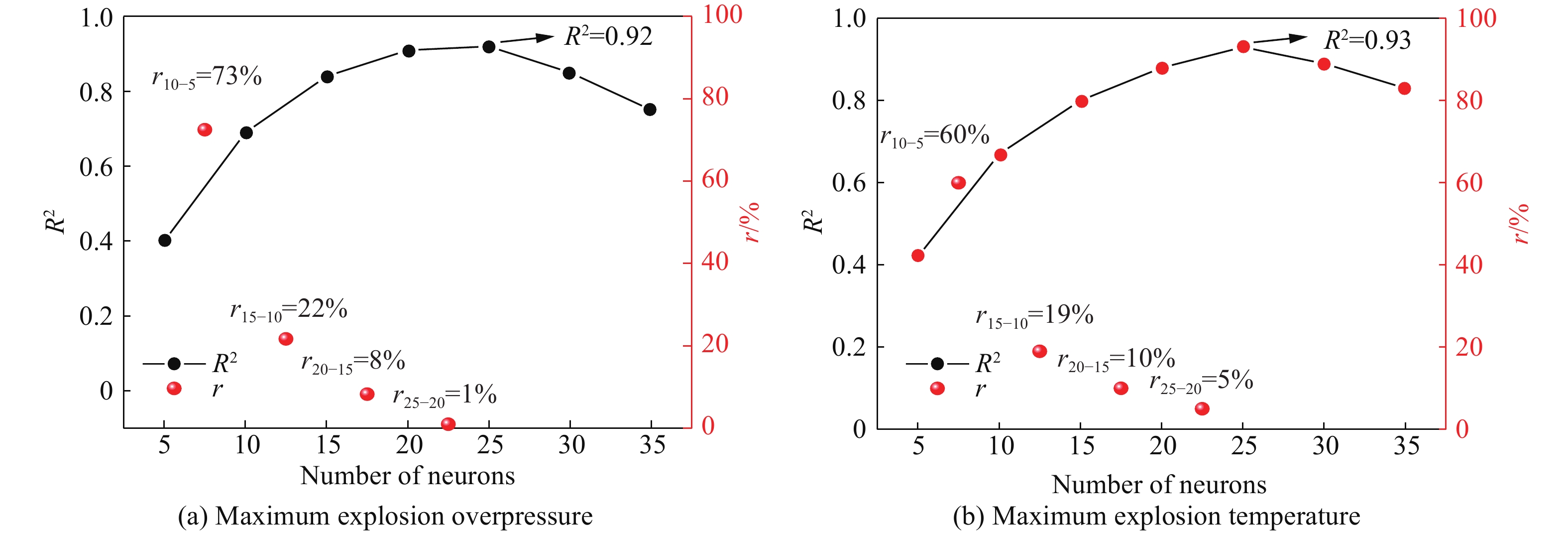
图 6 决定系数(R2)及其增长率(r)随隐含层神经元数量的变化
Figure 6. Variation of the coefficient of determination (R2) and its growth ratio (r) with the number of neurons in the hidden layer
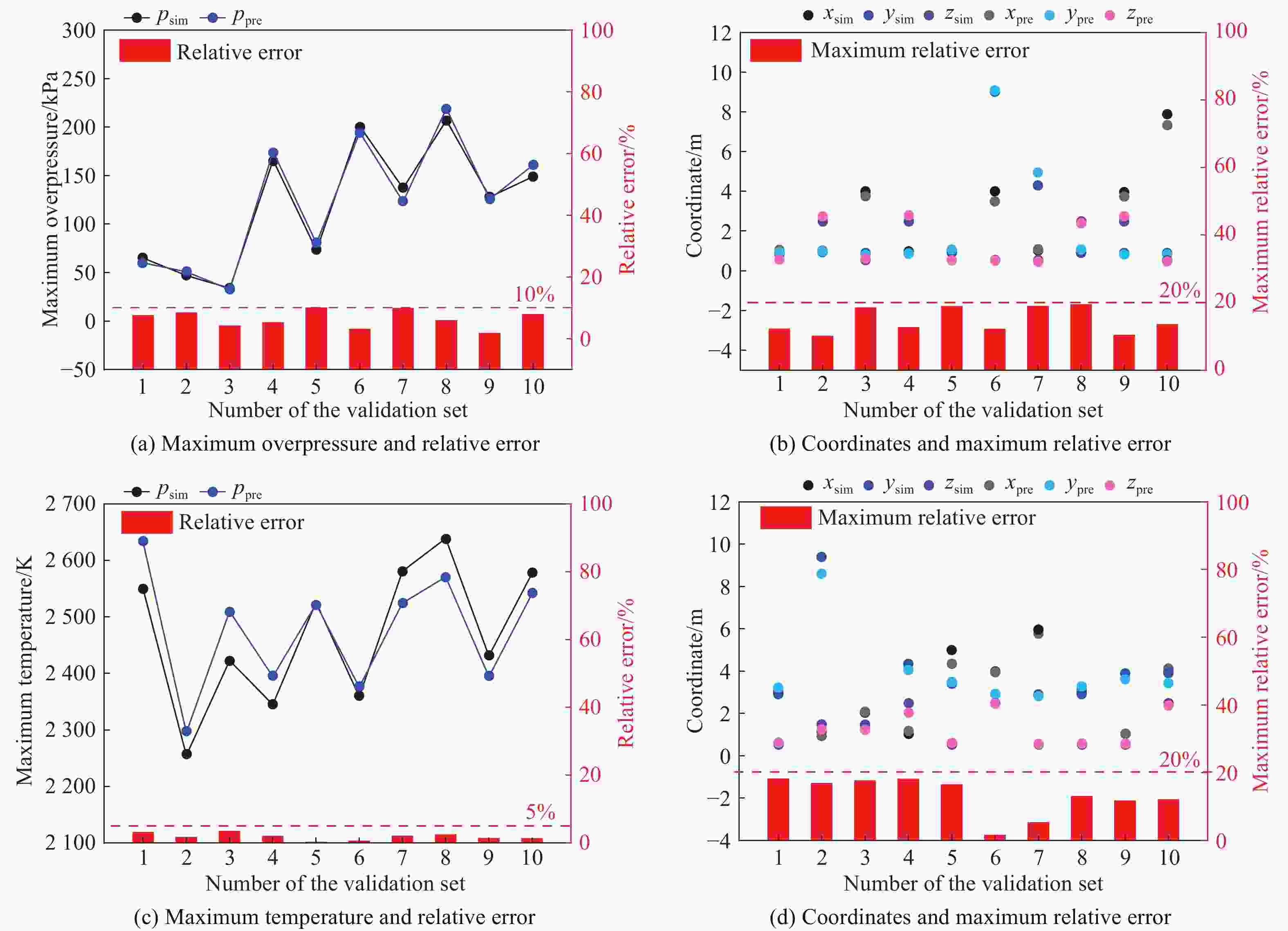
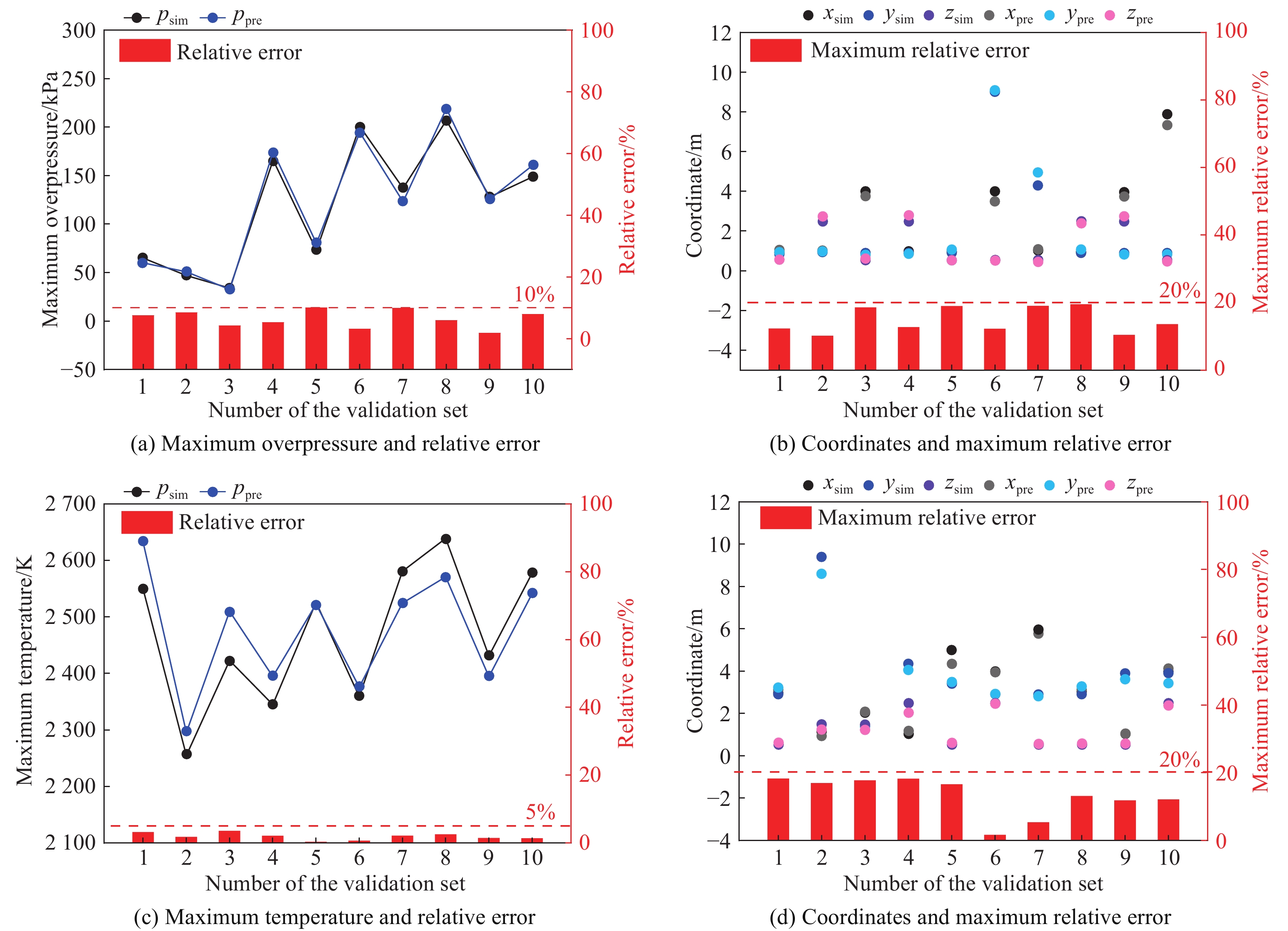
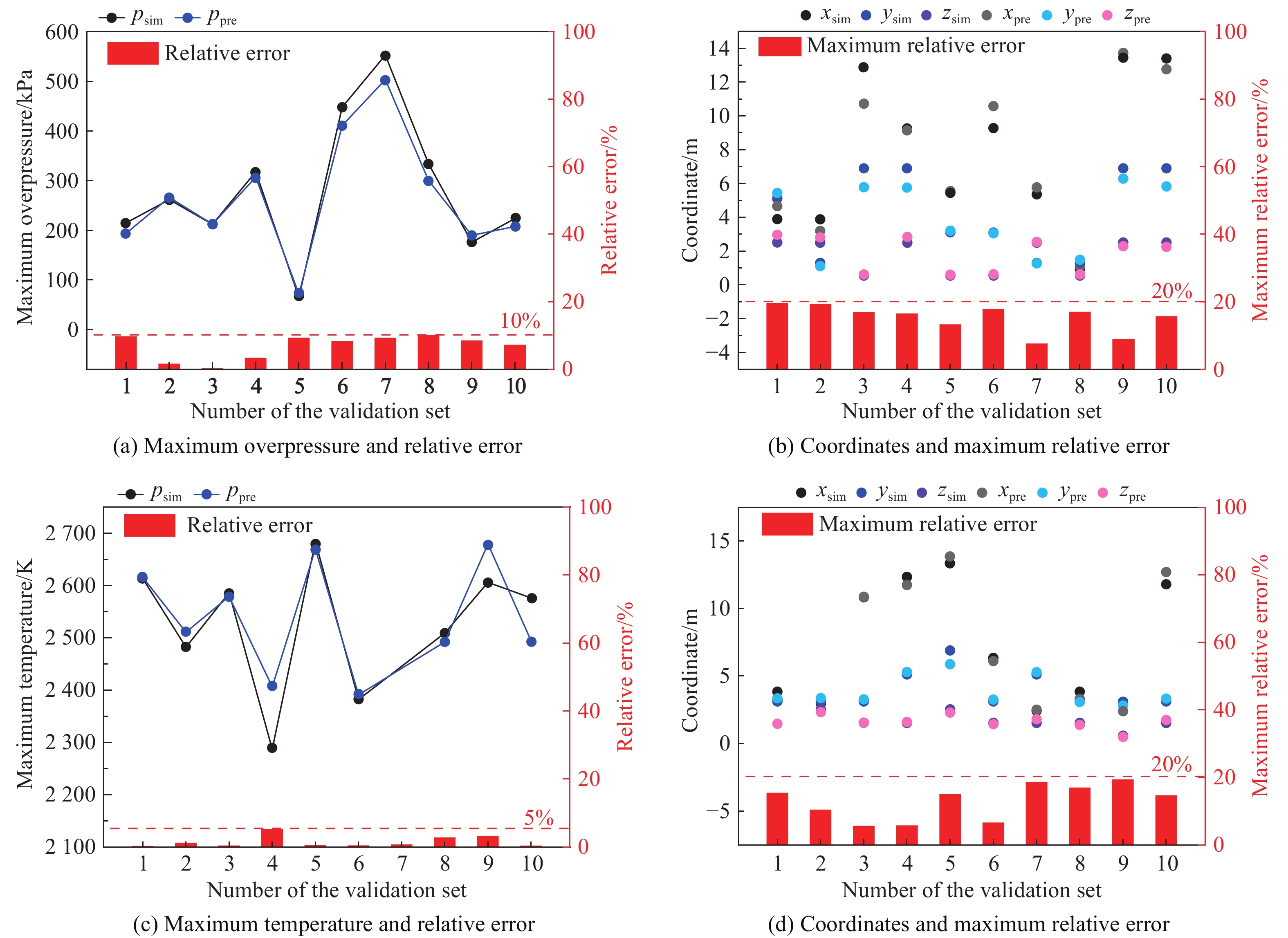
图 7 户型①室内最大超压、温度及其坐标的预测误差对比
Figure 7. Comparison of prediction errors of indoor maximum overpressure, temperature and coordinates in residential type ①
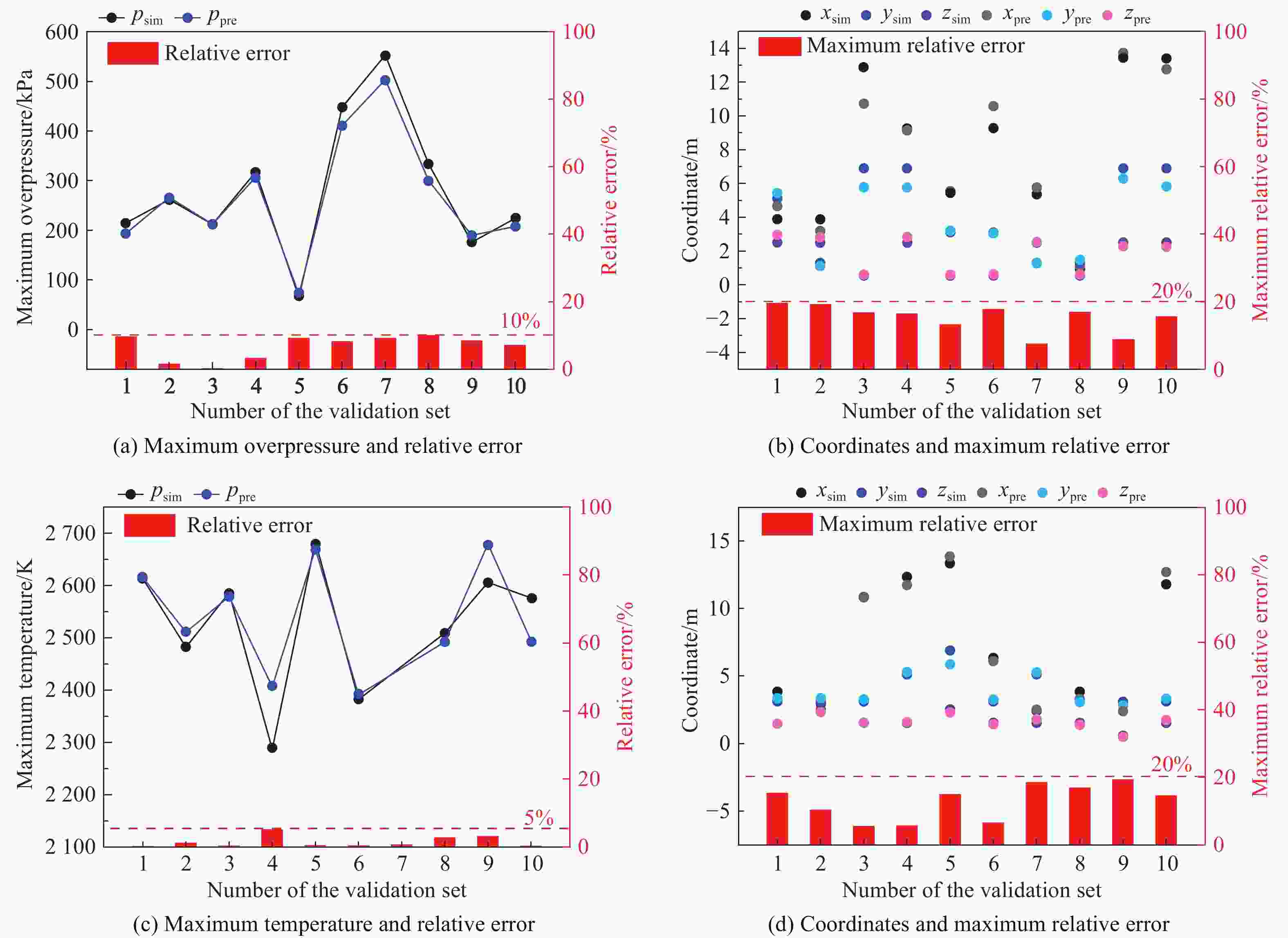
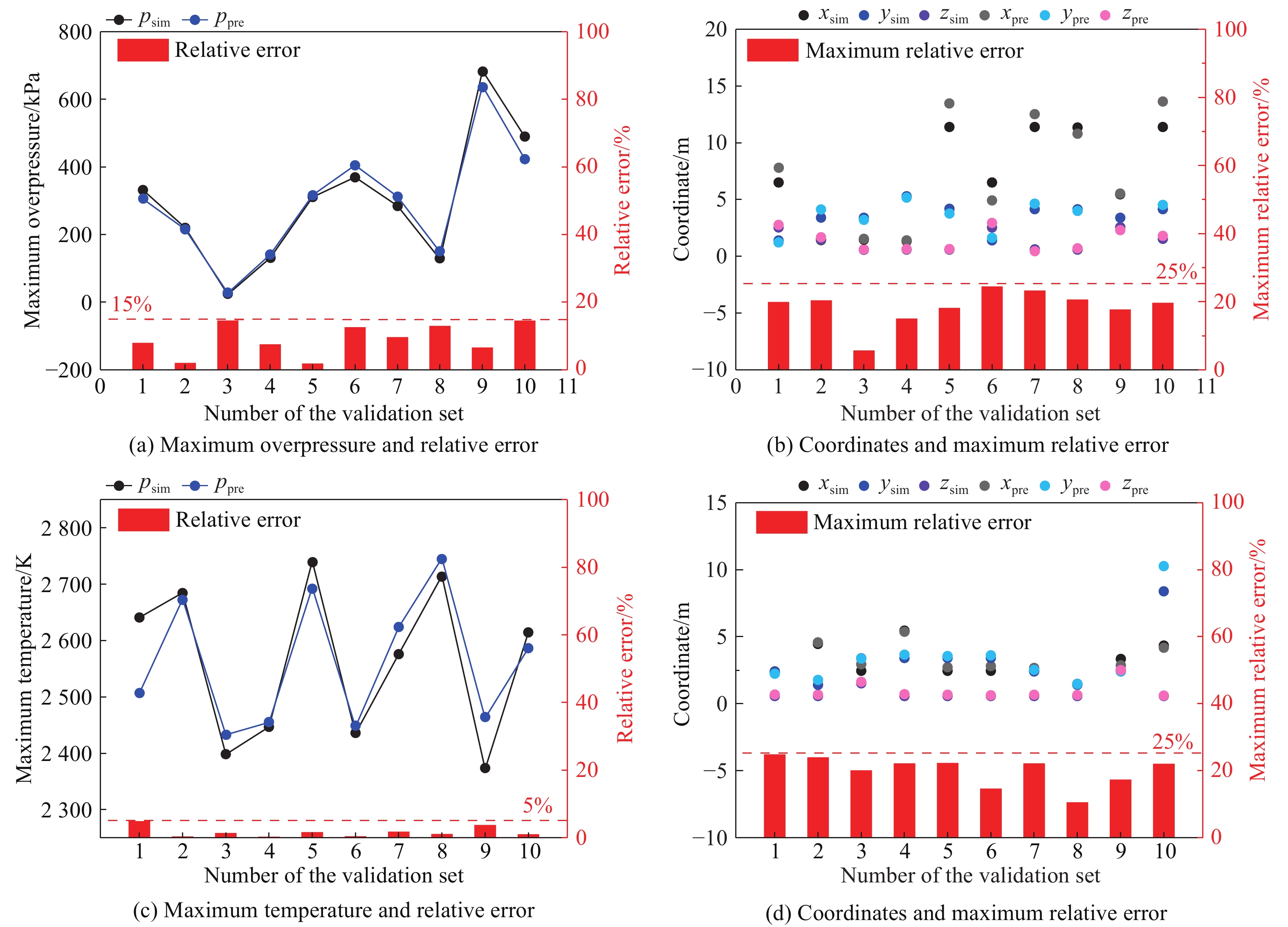
图 8 户型②室内最大超压、温度及其坐标的预测误差对比
Figure 8. Comparison of prediction errors of indoor maximum overpressure, temperature and coordinates in residential type ②
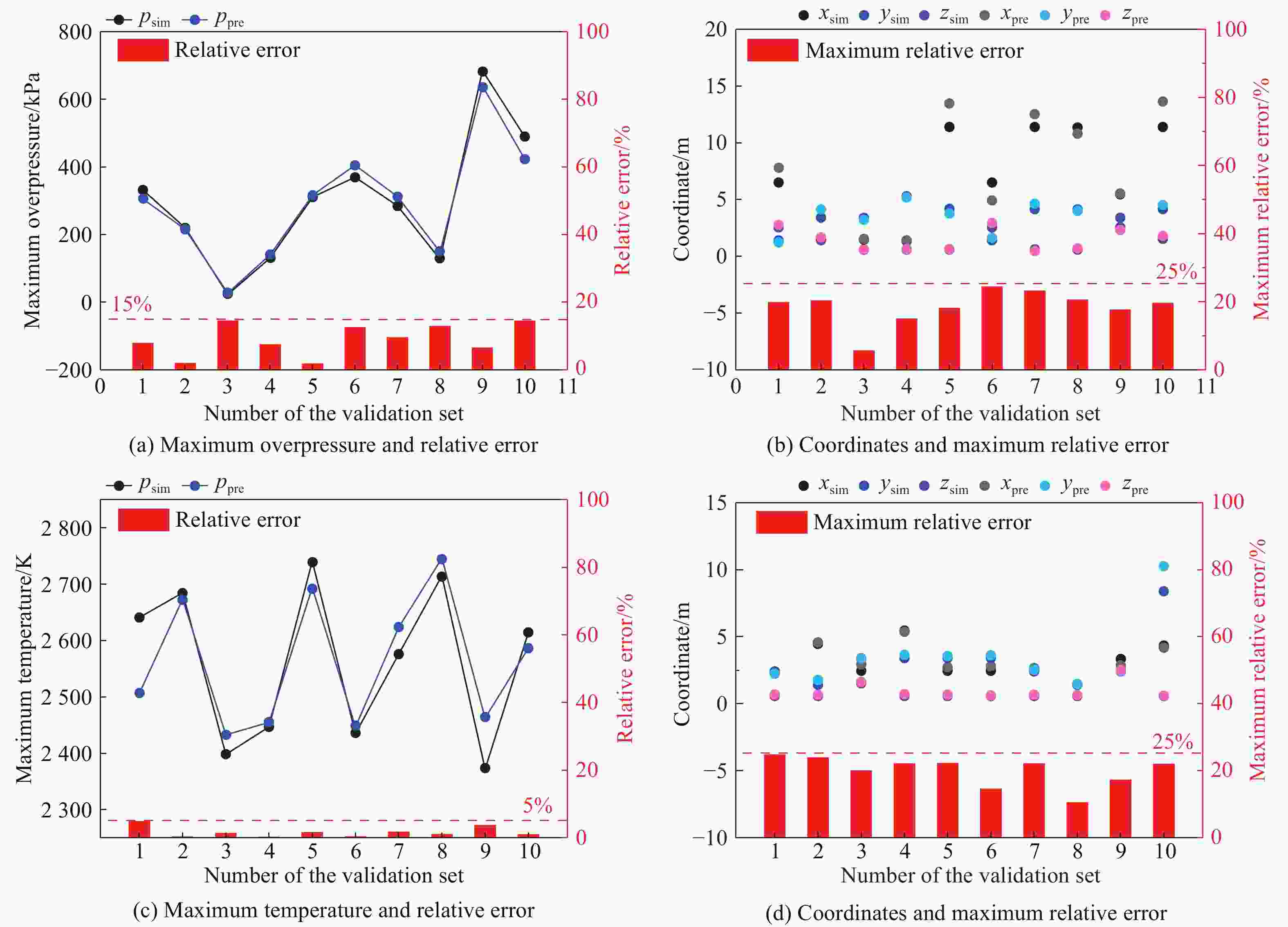
图 9 户型③室内最大超压、温度及其坐标的预测误差对比
Figure 9. Comparison of prediction errors of indoor maximum overpressure, temperature and coordinates in residential type ③
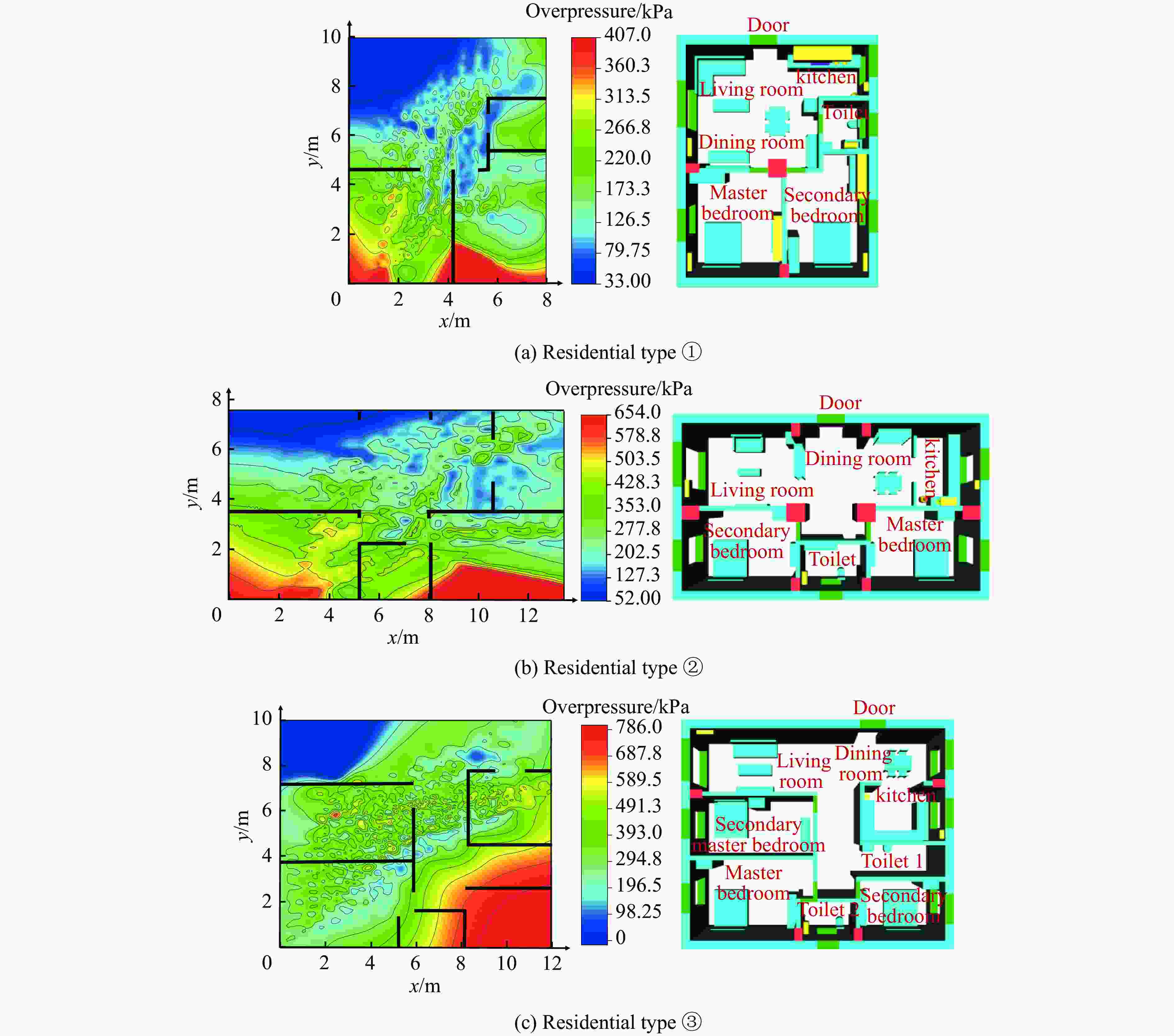
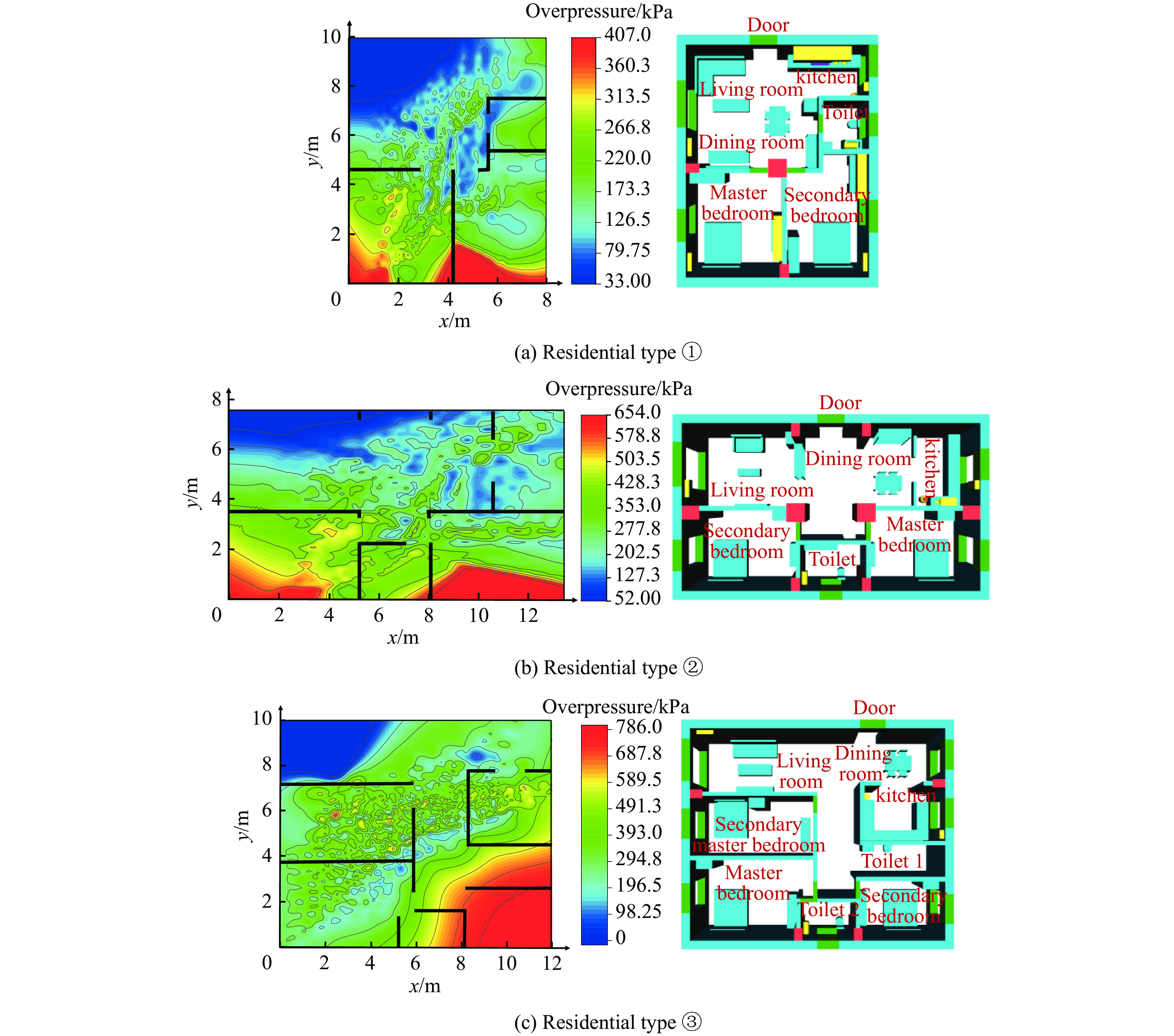
图 10 任意点火位置下室内最大超压等高线分布
Figure 10. Distribution of indoor maximum overpressure contours under arbitrary ignition
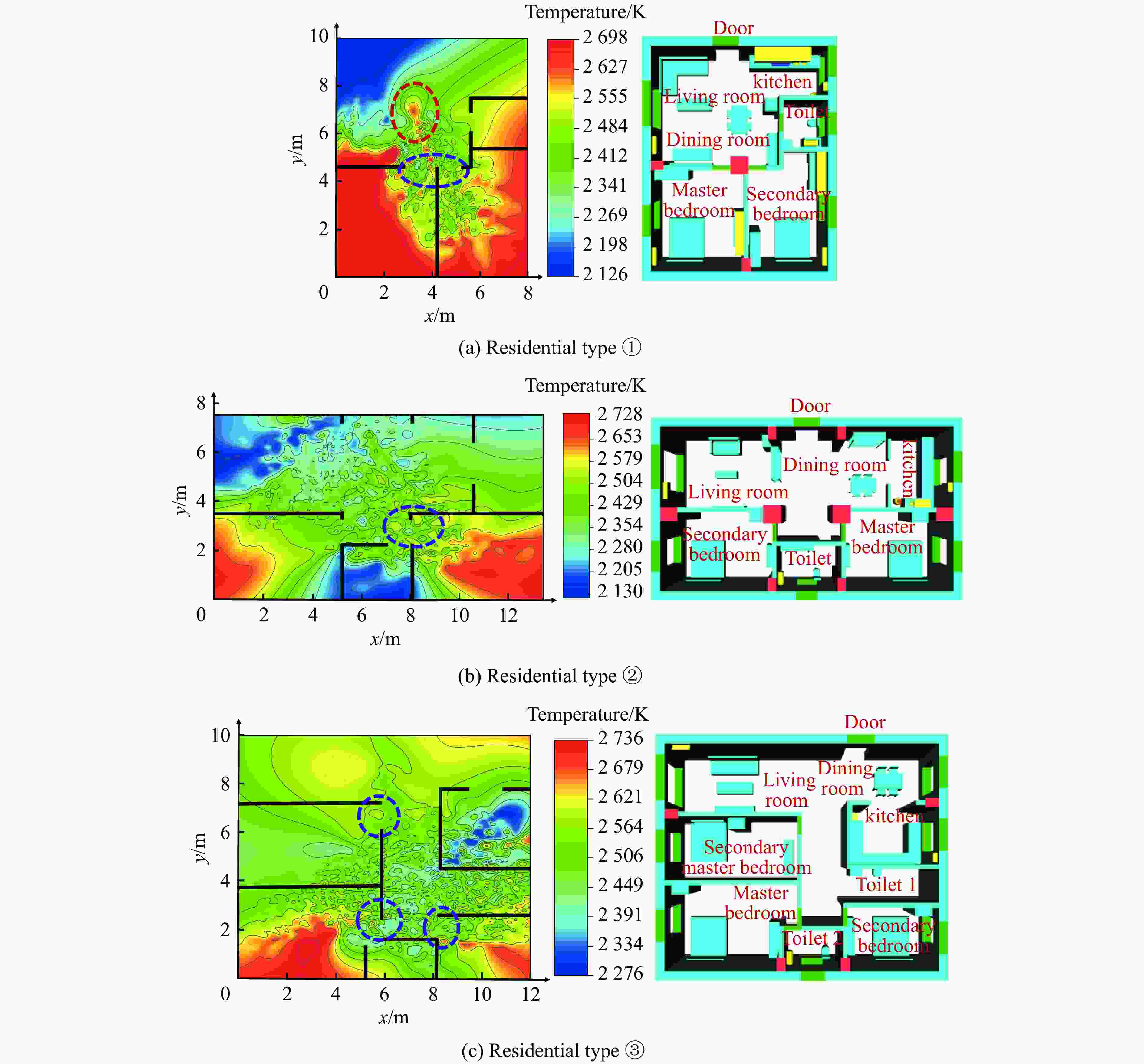
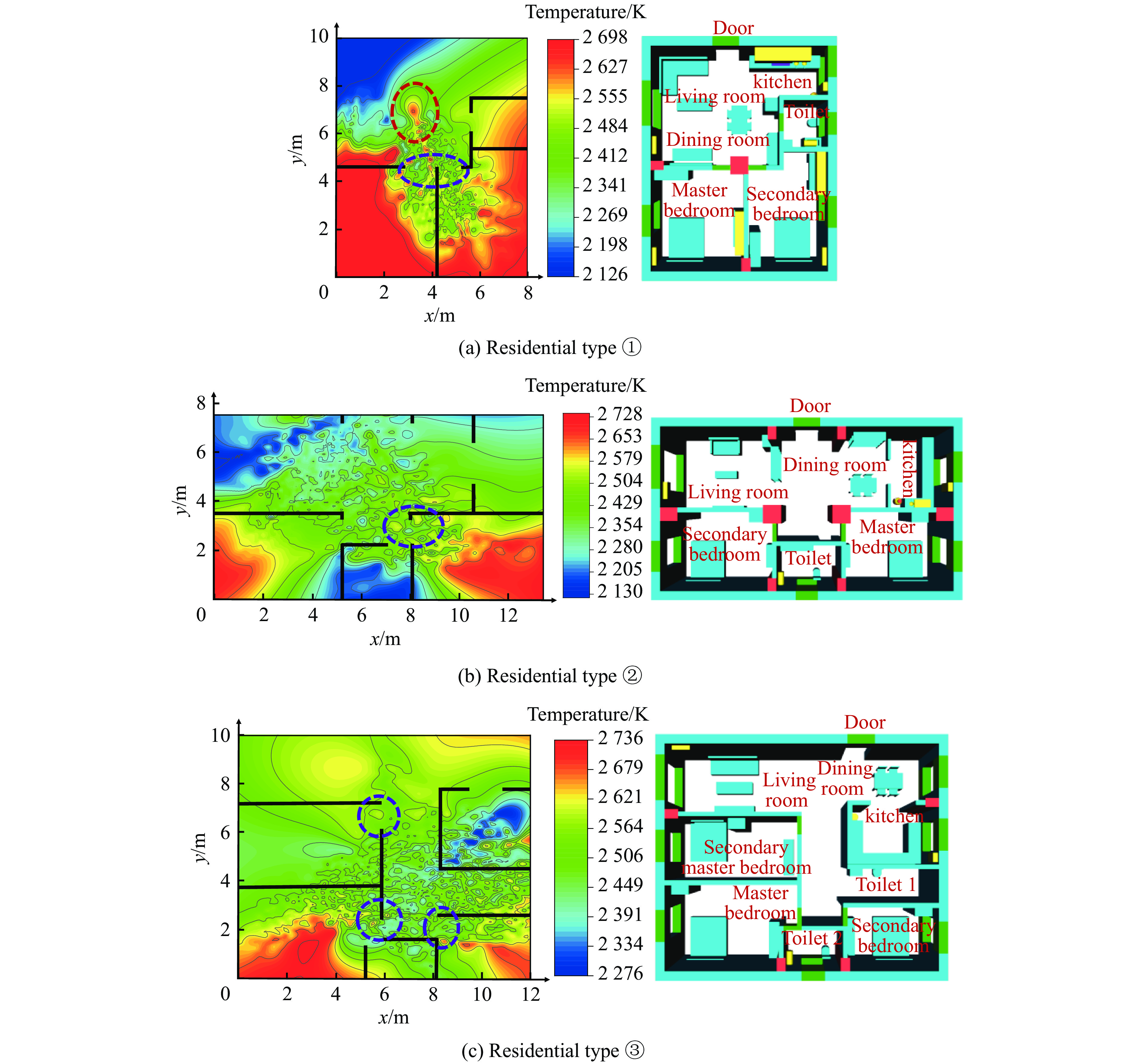
图 11 任意点火位置下室内最大温度等高线分布
Figure 11. Distribution of indoor maximum temperature contours under arbitrary ignition
表 1 爆炸数值计算参数
Table 1. Parameters for numerical calculation of explosion
参数 数值 参数 数值 火焰速度因子 0.15 湍流强度 2.58×10⁻³ 湍流燃烧模型系数 70 比热比 1.265 湍流动能/(m2·s−2) 1×10⁻⁵ 化学计量浓度/% 4 燃烧速率/(kg·s−1) 0.52 燃烧热/(J·kg−1) 2.751×10⁶ 耗散率 1×10⁻⁵ 黏度/(Ns·m−2) 2.5×10⁻⁵ 湍动能转换系数 1 最大计算循环步数 20000  下载: 导出CSV
表 2 爆炸后果预测特征
Table 2. Characteristics of explosion consequence prediction
输出层 特征 输出层 特征 输出层 特征 输出层 特征 N1 pmax N3 $L_{p_{\max {\text{-}}y}}$ N5 Tmax N7 LTmax-y N2 $L_{p_{\max {\text{-}}x}} $ N4 $L_{p_{\max {\text{-}}{\textit{z}}}} $ N6 LTmax-x N8 LTmax-z 注: p为超压, kPa; T为温度, K; Lp为最大超压出现位置; LT为最大温度出现位置; x、y、z为三维空间坐标, m。
下载: 导出CSV
表 3 最大超压/温度、出现位置及其对应点火位置
Table 3. The maximum overpressure/temperature, occurrence location and corresponding ignition position
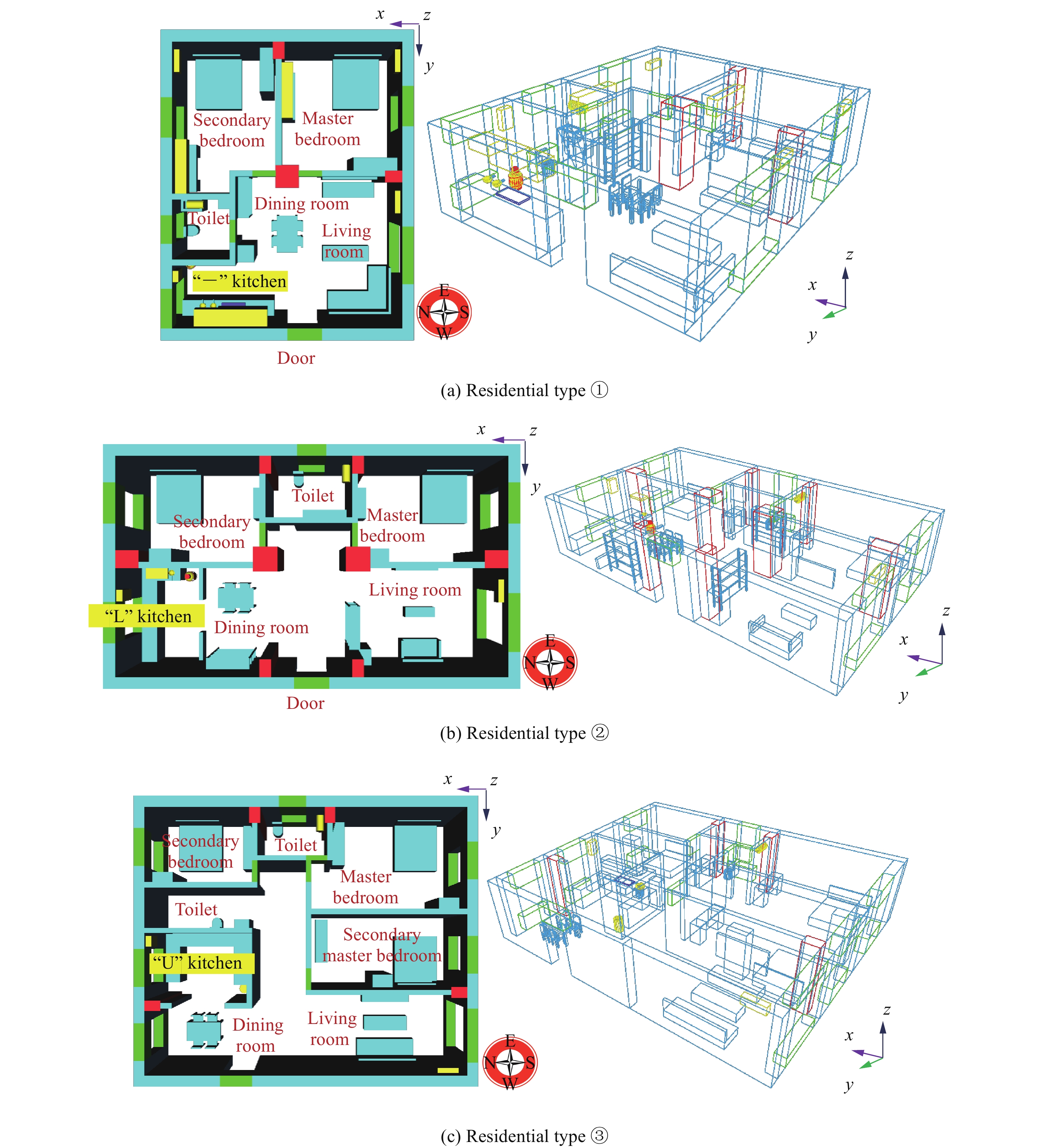
户型 最大超压/kPa 最大超压位置/点火位置 最大温度/K 最大温度位置/点火位置 ① 407 主卧/厨房 2682 次卧/主卧 ② 537 次卧/厨房 2697 次卧/主卧 ③ 785 次卧/厨房 2716 主卧/次卧
下载: 导出CSV
-
[1] 楚紫涵, 张云, 安文鑫, 等. 燃料浓度对受限空间内氢气/空气预混气体爆炸特性的影响 [J/OL]. 爆炸与冲击, 2026, 5. https://link.cnki.net/urlid/51.1148.o3.20250909.1135.010.CHU Z H, ZHANG Y, AN W X, et al. The influence of fuel concentration on the explosion dynamics characteristics of hydrogen/air premixed gas in confined spaces [J/OL]. Explosion and Shock Waves, 2026, 5. https://link.cnki.net/urlid/51.1148.o3.20250909.1135.010. [2] LI F, DUAN B Y, ZHANG Y, et al. Post-risk assessment model for gas explosion accidents based on the coupling effect of disaster-causing factors [J]. Reliability Engineering & System Safety, 2026, 266: 111733. DOI: 10.1016/j.ress.2025.111733. [3] LI C, PANG L, WANG Z R, et al. Influence of packing structure on the thermal-induced self-ignition of AlMg alloy powder [J]. Powder Technology, 2026, 468: 121669. DOI: 10.1016/j.powtec.2025.121669. [4] ZHANG Q, QIAN X, LI R, et al. Explosion characteristics and chemical kinetics of blended LPG/DME clean fuel based on pyrolysis and oxidation mechanism model [J]. Fuel, 2022, 320: 123896. DOI: 10.1016/j.fuel.2022.123896. [5] MOLKOV V V, MAKAROV D V. Rethinking the physics of a large-scale vented explosion and its mitigation [J]. Process Safety and Environmental Protection, 2006, 84(1): 33–39. DOI: 10.1205/psep.04232. [6] RASBASH D J. The relief of gas and vapour explosions in domestic structures [J]. Fire Safety Science, 1969, 759: 1–10. [7] 刘振翼, 石世旭, 李明智, 等. 建筑物内非均匀预混天然气泄漏爆炸过程数值模拟 [J]. 安全与环境学报, 2022, 22(5): 2404–2411. DOI: 10.13637/j.issn.1009-6094.2021.0260.LIU Z Y, SHI S X, LI M Z, et al. Numerical simulation of leakage and explosion process of inhomogeneous premixed natural gas in buildings [J]. Journal of Safety and Environment, 2022, 22(5): 2404–2411. DOI: 10.13637/j.issn.1009-6094.2021.0260. [8] TONG S, LI X, DING H, et al. Large-scale transient simulation for consequence analysis of hydrogen-doped natural gas leakage and explosion accidents [J]. International Journal of Hydrogen Energy, 2024, 54: 864–877. DOI: 10.1016/j.ijhydene.2023.08.088. [9] MA Q, GUO Y, ZHONG M, et al. Numerical simulation of hydrogen explosion characteristics and disaster effects of hydrogen fueling station [J]. International Journal of Hydrogen Energy, 2024, 51: 861–879. DOI: 10.1016/j.ijhydene.2023.05.129. [10] HU Q, QIAN X, SHEN X, et al. Investigations on vapor cloud explosion hazards and critical safe reserves of LPG tanks [J]. Journal of Loss Prevention in the Process Industries, 2022, 80: 104904. DOI: 10.1016/j.jlp.2022.104904. [11] 马梦飞, 於星, 张爱凤, 等. 开放空间高压氢气射流中点火爆炸的实验研究 [J]. 爆炸与冲击, 2024, 44(6): 062101. DOI: 10.11883/bzycj-2023-0037.MA M F, YU X, ZHANG A F, et al. An experimental study on ignition and explosion of high-pressure hydrogen jet in open space [J]. Explosion and Shock Waves, 2024, 44(6): 062101. DOI: 10.11883/bzycj-2023-0037. [12] TIAN J W, QI C, PENG K, et al. Improved permeability prediction of porous media by feature selection and machine learning methods comparison [J]. Journal of Computing in Civil Engineering, 2022, 36(2): 04021040. DOI: 10.1061/(ASCE)CP.1943-5487.0000983. [13] DAVIES W G, BABAMOHAMMADI S, YANG Y, et al. The rise of the machines: a state-of-the-art technical review on process modelling and machine learning within hydrogen production with carbon capture [J]. Gas Science and Engineering, 2023, 118: 205104. DOI: 10.1016/j.jgsce.2023.205104. [14] 陈梓薇, 王仲琦, 曾令辉. 基于BP神经网络的爆炸用激波管峰值压力预测方法 [J]. 爆炸与冲击, 2024, 44(5): 054101. DOI: 10.11883/bzycj-2023-0187.CHEN Z W, WANG Z Q, ZENG L H. A method for predicting peak pressure in an explosion shock tube based on BP neural network [J]. Explosion and Shock Waves, 2024, 44(5): 054101. DOI: 10.11883/bzycj-2023-0187. [15] XU Y, HUANG Y, MA G. A beetle antennae search improved BP neural network model for predicting multi-factor-based gas explosion pressures [J]. Journal of Loss Prevention in the Process Industries, 2020, 65: 104117. DOI: 10.1016/j.jlp.2020.104117. [16] VIANNA S S V, CANT R S. Explosion pressure prediction via polynomial mathematical correlation based on advanced CFD modelling [J]. Journal of Loss Prevention in the Process Industries, 2012, 25(1): 81–89. DOI: 10.1016/j.jlp.2011.07.005. [17] LIU L, LIU J, ZHOU Q, et al. An SVR-based machine learning model depicting the propagation of gas explosion disaster hazards [J]. Arabian Journal for Science and Engineering, 2021, 46(10): 10205–10216. DOI: 10.1007/s13369-021-05616-5. [18] XU Q, CHEN G, SU S, et al. Prediction of venting gas explosion overpressure based on a combination of explosive theory and machine learning [J]. Expert Systems with Applications, 2023, 234: 121044. DOI: 10.1016/j.eswa.2023.121044. [19] IDRIS A M, RUSLI R, MOHAMED M E, et al. Explosion pressure and duration prediction using machine learning: a comparative study using classical models with adam-optimized neural network [J]. Canadian Journal of Chemical Engineering, 2025, 103(1): 137–152. DOI: 10.1002/cjce.25258. [20] HEMMATIAN B, CASAL J, PLANAS E, et al. Prediction of BLEVE mechanical energy by implementation of artificial neural network [J]. Journal of Loss Prevention in the Process Industries, 2020, 63: 104021. DOI: 10.1016/j.jlp.2019.104021. [21] 庞磊, 胡倩然, 马菲菲, 等. 泄爆面特征参数对天然气爆炸超压峰值的影响规律 [J]. 中国安全生产科学技术, 2020, 16(4): 126–131. DOI: 10.11731/j.issn.1673-193x.2020.04.020.PANG L, HU Q R, MA F F, et al. Effect of vent characteristic parameters on overpressure peaks of natural gas explosion [J]. Journal of Safety Science and Technology, 2020, 16(4): 126–131. DOI: 10.11731/j.issn.1673-193x.2020.04.020. [22] MOLKOV V V, GRIGORASH A V, EBER R M. Vented gaseous deflagrations: modelling of spring-loaded inertial vent covers [J]. Fire Safety Journal, 2005, 40(4): 307–319. DOI: 10.1016/j.firesaf.2005.01.004. [23] JIANG H, CHI M, HOU D, et al. Numerical investigation and analysis of indoor gas explosion: a case study of “6·13” major gas explosion accident in hubei province, china [J]. Journal of Loss Prevention in the Process Industries, 2023, 83: 105045. DOI: 10.1016/j.jlp.2023.105045. [24] HU Q R, ZHANG Q, YUAN M Q, et al. Traceability and failure consequences of natural gas explosion accidents based on key investigation technology [J]. Engineering Failure Analysis, 2022, 139: 106448. DOI: 10.1016/j.engfailanal.2022.106448. [25] ZHANG Q, WANG Y, LIAN Z. Explosion hazards of LPG-air mixtures in vented enclosure with obstacles [J]. Journal of Hazardous Materials, 2017, 334: 59–67. DOI: 10.1016/j.jhazmat.2017.03.065. [26] PANG L, HU Q, ZHAO J, et al. Numerical study of the effects of vent opening time on hydrogen explosions [J]. International Journal of Hydrogen Energy, 2019, 44(29): 15689–15701. DOI: 10.1016/j.ijhydene.2019.04.175. [27] VYAZMINA E, JALLAIS S. Validation and recommendations for FLACS CFD and engineering approaches to model hydrogen vented explosions: effects of concentration, obstruction vent area and ignition position [J]. International Journal of Hydrogen Energy, 2016, 41(33): 15101–15109. DOI: 10.1016/j.ijhydene.2016.05.189. [28] MA Q, HE Y, GUO Y, et al. Research on the effect of the vent area on the external deflagration process during the explosion vent [J]. Fuel, 2022, 329: 125440. DOI: 10.1016/j.fuel.2022.125440. [29] 陈晔, 李毅, 李紫婷, 等. 受限空间氢泄爆外部超压特性研究 [J]. 消防科学与技术, 2022, 41(3): 310–315. DOI: 10.3969/j.issn.1009-0029.2022.03.005.CHEN Y, LI Y, LI Z T, et al. Ignition characteristics of finite thick PMMA exposed to thermal radiation [J]. Fire Science and Technology, 2022, 41(3): 310–315. DOI: 10.3969/j.issn.1009-0029.2022.03.005. [30] 于佳航. 基于机器学习的双燃料动力船舶机舱燃爆事故后果预测方法研究 [D]. 大连: 大连海事大学, 2022.YU J H. Research on consequence prediction method of engine room combustion and explosion accident of dual fuel power ship based on machine learning [D]. DaLian: Dalian Maritime University, 2022. [31] SHI J, KHAN F, ZHU Y, et al. Robust data-driven model to study dispersion of vapor cloud in offshore facility [J]. Ocean Engineering, 2018, 161: 98–110. DOI: 10.1016/j.oceaneng.2018.04.098. [32] SHI J, LI J, HAO H, et al. Vented gas explosion overpressure prediction of obstructed cubic chamber by Bayesian regularization artificial neuron network: Bauwens model [J]. Journal of Loss Prevention in the Process Industries, 2018, 56: 209–216. DOI: 10.1016/j.jlp.2018.05.016. -

计量
- 文章访问数: 401
- HTML全文浏览量: 161
- PDF下载量: 193
- 被引次数: 0