



An open-source information fusion-based analysis method for public safety explosion accidents
-
摘要: 为快速、准确评估爆炸事故的影响范围和损伤程度,制定科学合理的应急响应策略,提出了一种基于开源信息融合的公共安全爆炸事故分析方法。进一步,针对山东高密“5·27”化工车间爆炸事故,快速构建了事故分析逻辑链条,即:基于开源信息获取爆炸发生、冲击波传播、爆炸后厂区和远区建筑结构损伤破坏等重要信息;基于建筑结构毁伤判据和冲击波传播规律,反演爆源位置和爆炸当量,并分析事故发生原因;基于数值仿真方法,为工业厂房的安全防护提供依据。结果表明:爆源位于1号硝化装置,爆炸等效TNT当量约为
12000 kg,与基于现场勘察的调查结果一致,验证了该方法的有效性和准确性;此次事故主要原因是由于该公司实际生产负荷超出设计标准,设备长期处于满负荷运行状态,且长期忽视安全联锁系统;生产厂区应从严控爆炸危险物存量、总平面分区隔离、防殉爆安全管控、重点涉爆装置外围防护4个方面加强建筑抗爆性能,降低爆炸事故造成的人员、设备损伤,缩小毁伤范围。Abstract: Following an explosion accident, a public safety explosion accident analysis method based on open-source information fusion was proposed to quickly and accurately assess the scope and severity of the accident's impact and to formulate a scientific and reasonable emergency response strategy. Furthermore, regarding the May 27 chemical plant explosion accident in Gaomi, Shandong, a logical chain for accident analysis was rapidly constructed. Specifically, open-source information was used to obtain critical details such as the explosion generation, the shock waves propagation, and structural damage to buildings in both the plant area and far field. Based on criteria for structural damage and the laws of shockwave propagation, the explosion source location and TNT equivalent were reverse-calculated, and the cause of the accident was analyzed. Numerical simulations provided key evidence for improving safety protection in industrial plants. The results indicate that the explosion source was located at the No.1 nitration device, with a TNT equivalent of approximately12000 kg TNT, consistent with the conclusion based on field investigation, thereby verifying the effectiveness and accuracy of this method. The main causes of the accident were identified as the company's actual production load exceeding design standards, prolonged operation of equipment under full load conditions, and long-term neglect of the safety interlock system. The production plant should strengthen the blast-resistant protection measures for buildings from four aspects: control the stockpile of explosive hazardous materials, general layout zoning and isolation, safety control against sympathetic detonation, and peripheral protection for key explosion-prone installations, so as to improve the structural blast resistance, reduce casualties and equipment damage, and narrow the damage scope. The proposal of this method provides a novel approach to the existing accident investigation system, effectively enriches investigation techniques, overcomes the limitations of traditional analytical methods, and demonstrates the necessity for continued research and practical value. -
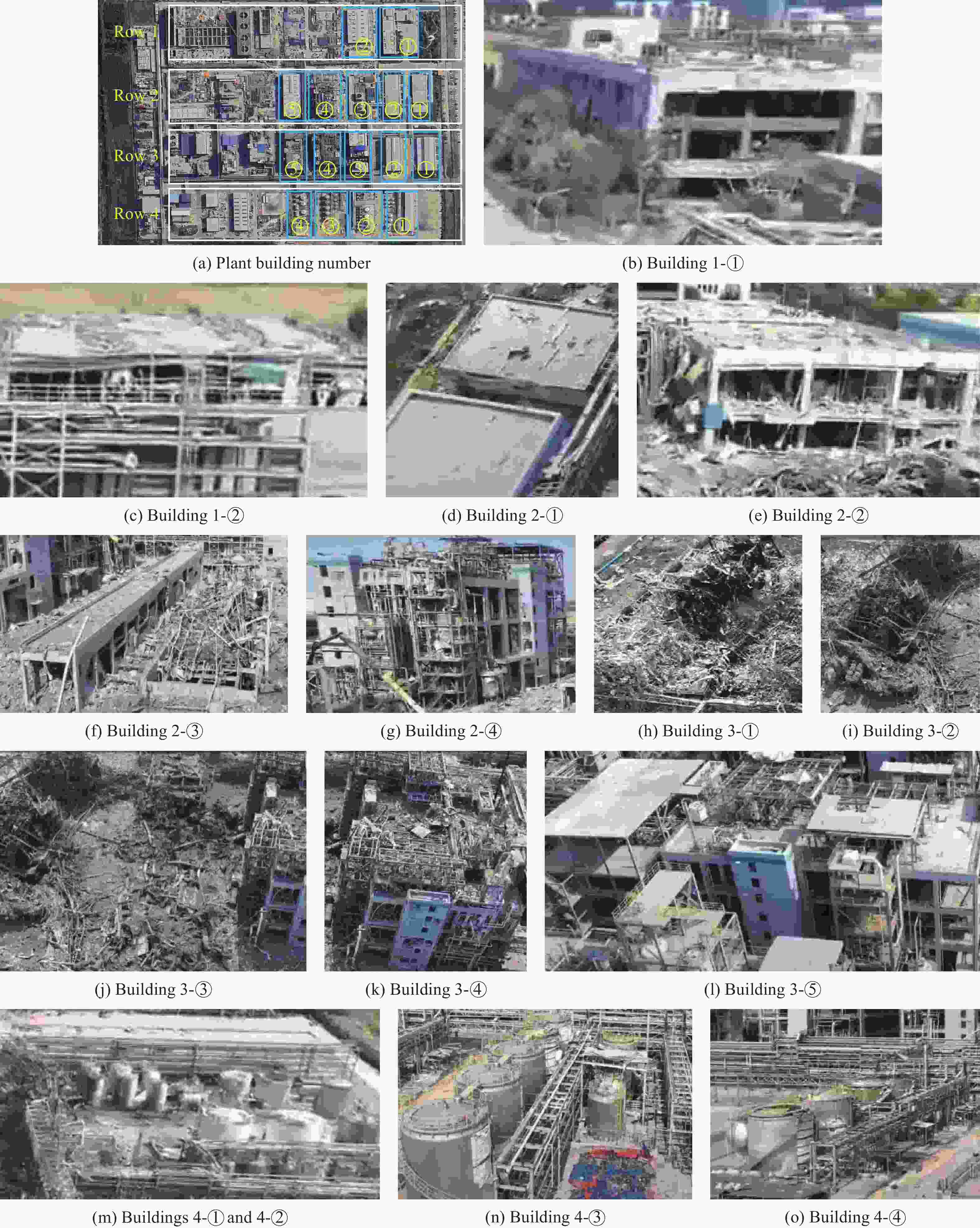
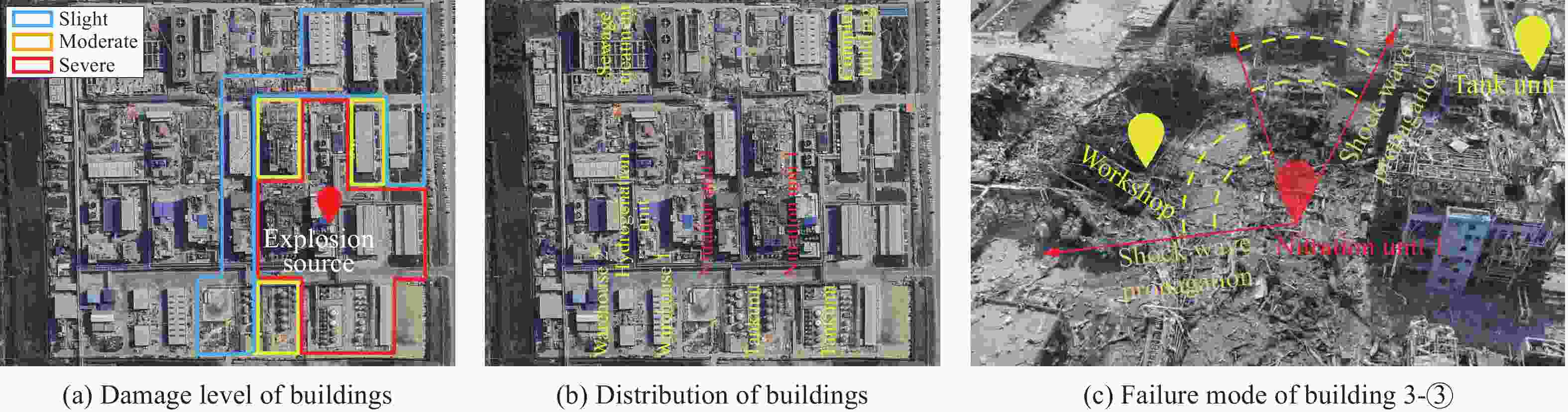
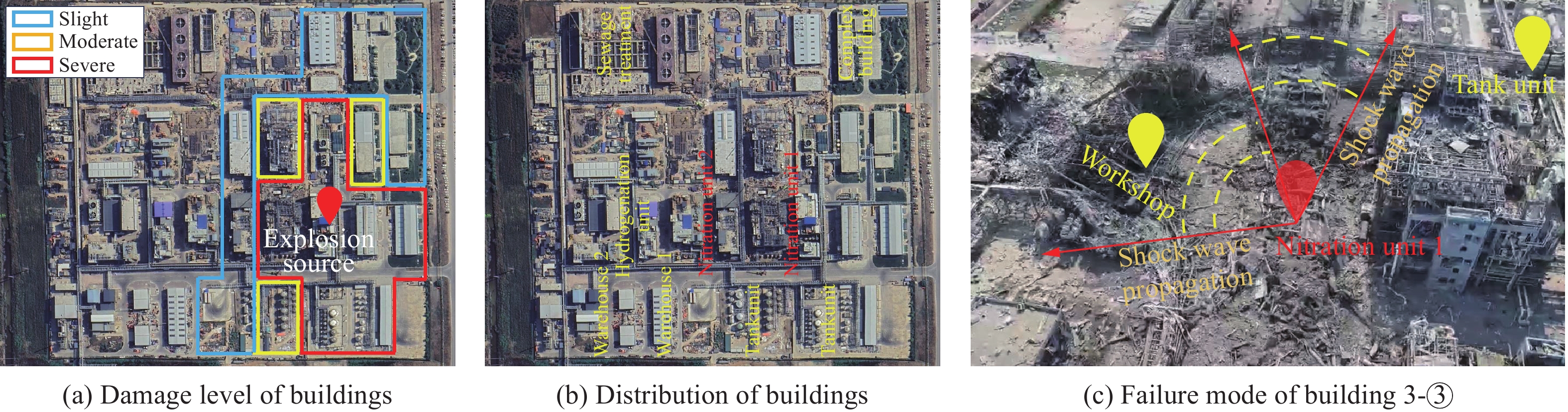
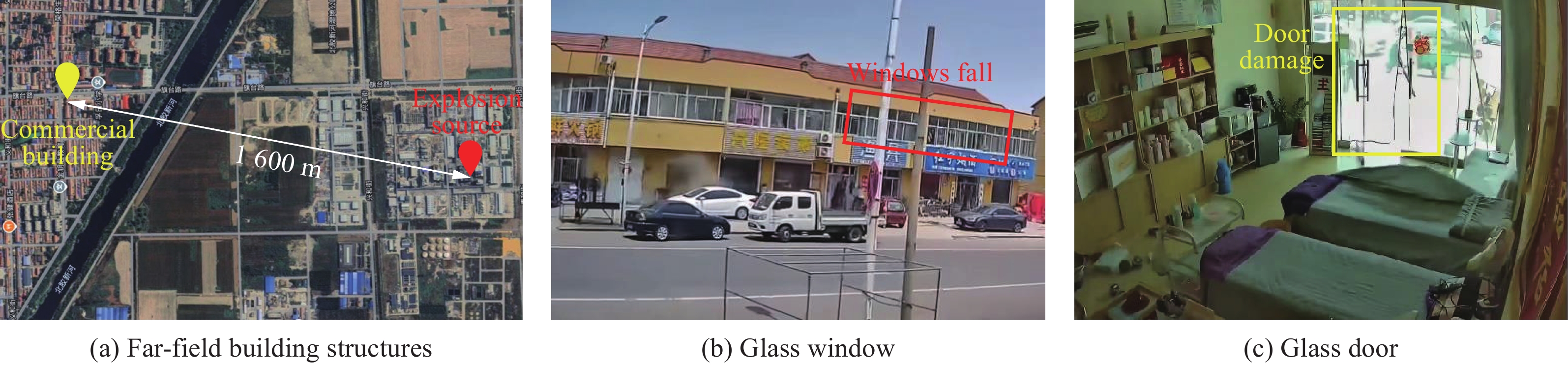
图 4 厂区建筑结构破坏范围及爆源位置确定
Figure 4. Damage range of buildings and determination of the explosion source
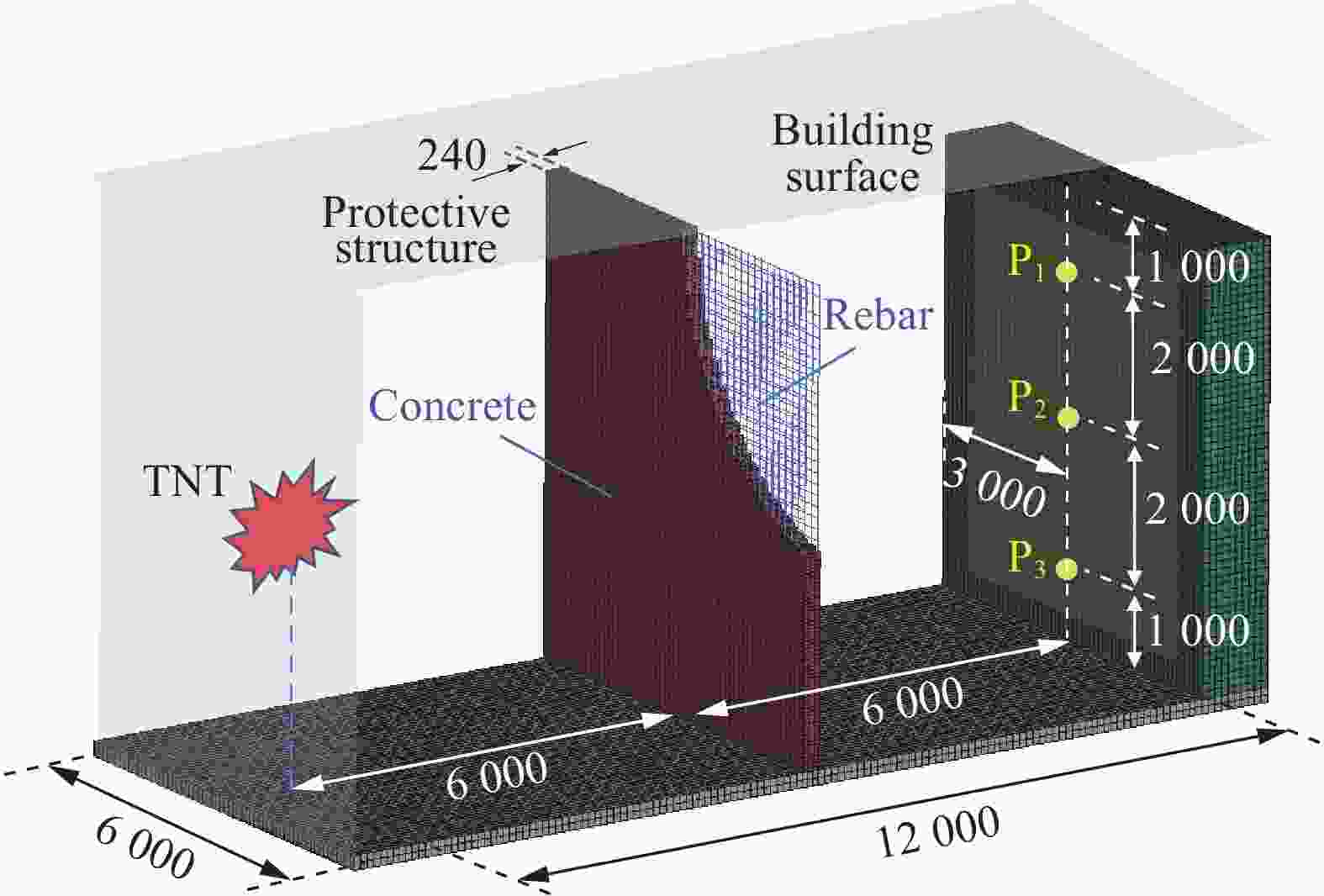
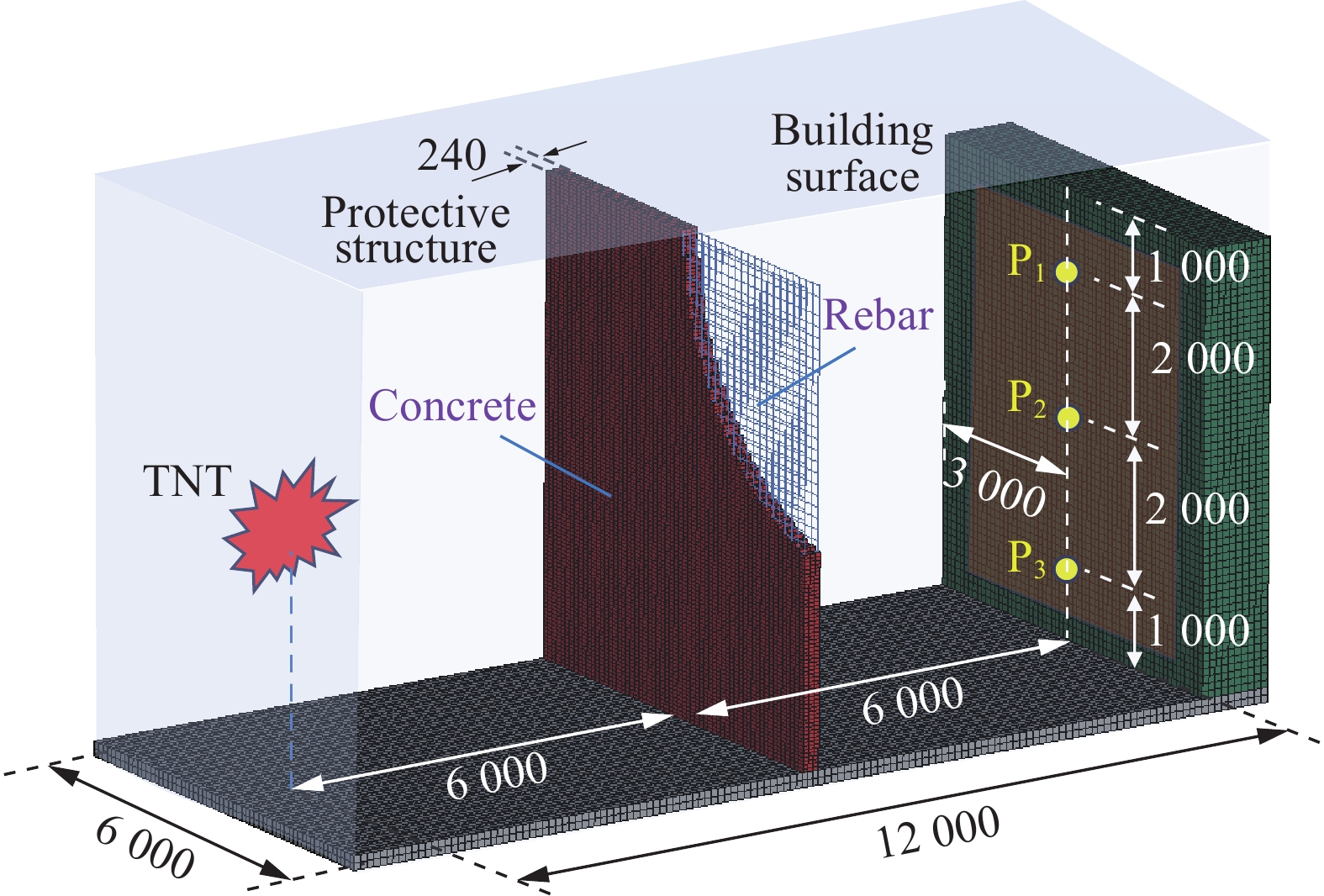
图 7 有限元模型与测点布置(单位:mm)
Figure 7. Finite element model and monitoring point layout (unit: mm)
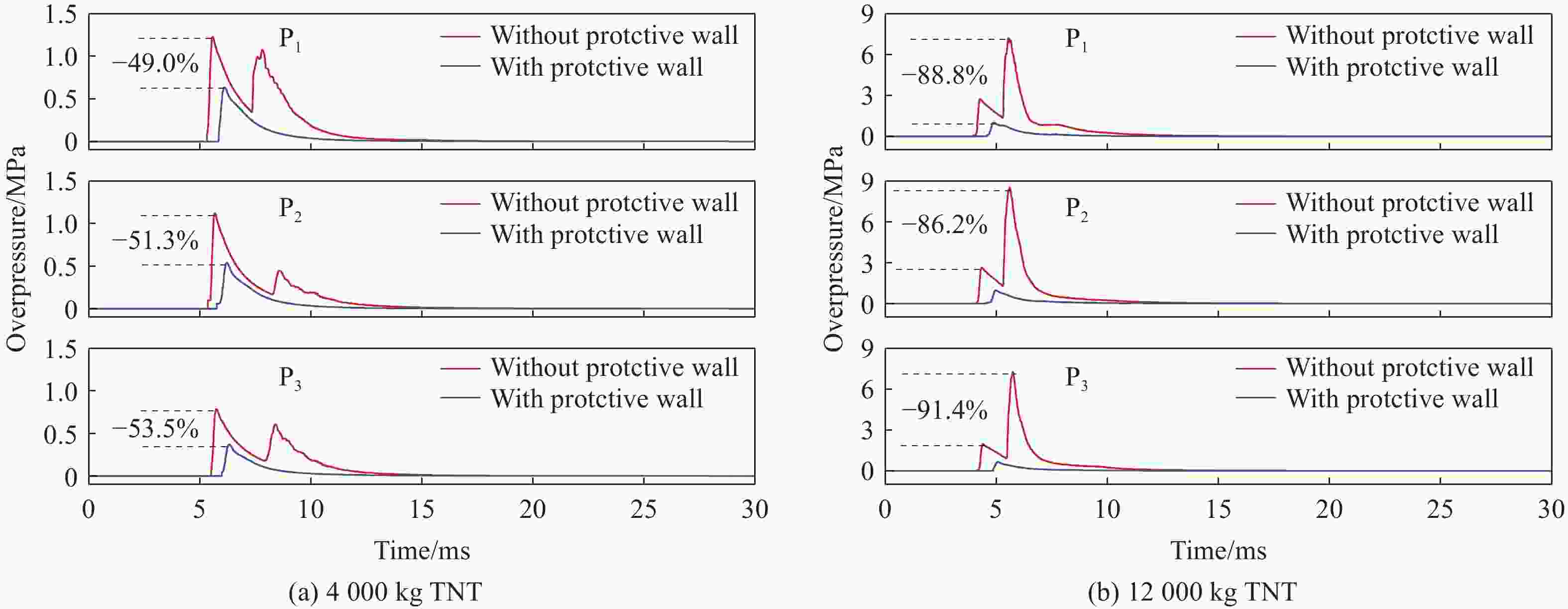
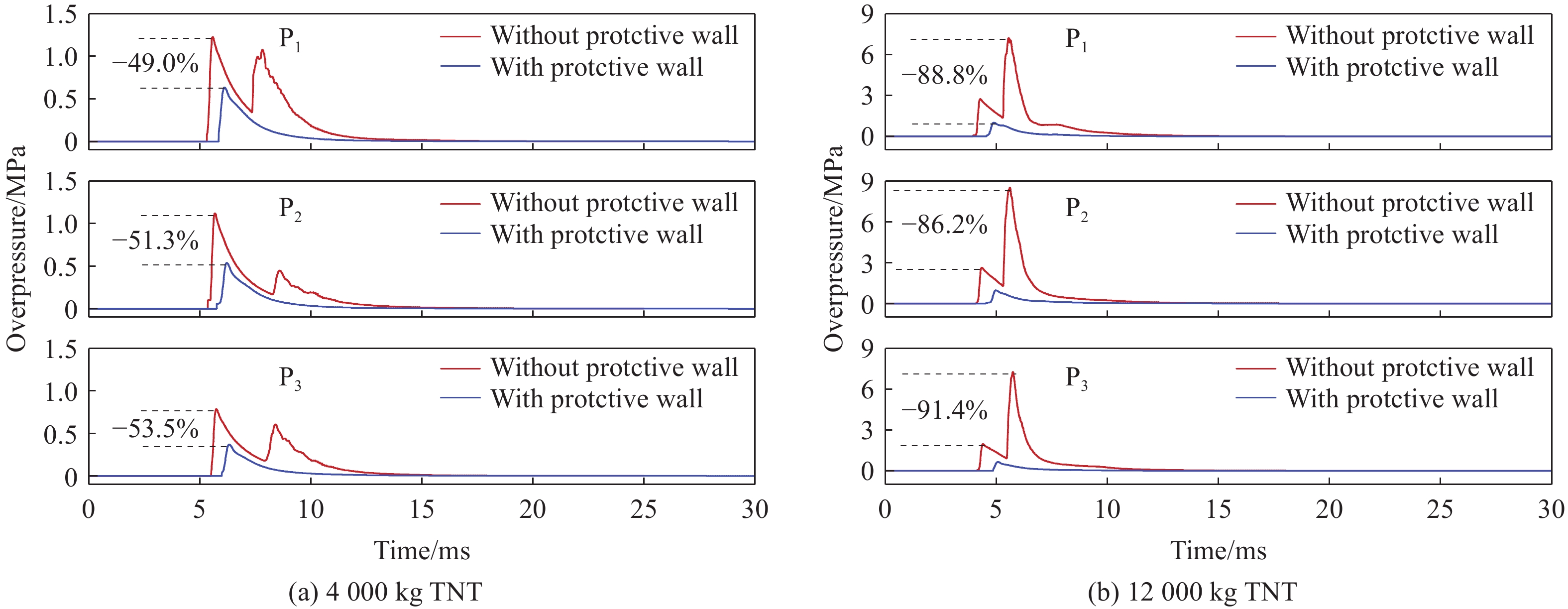
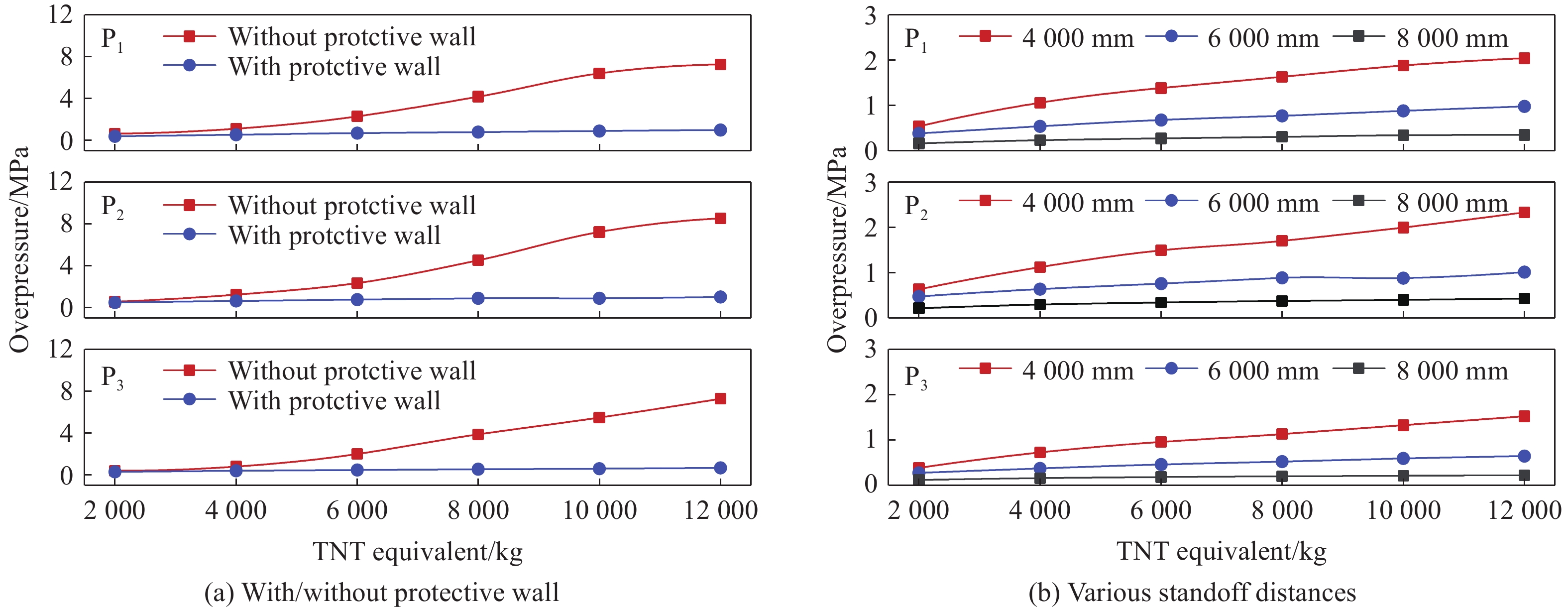
图 8 典型工况下不同测点的超压时程曲线
Figure 8. Overpressure-time histories at different monitoring points in typical scenario
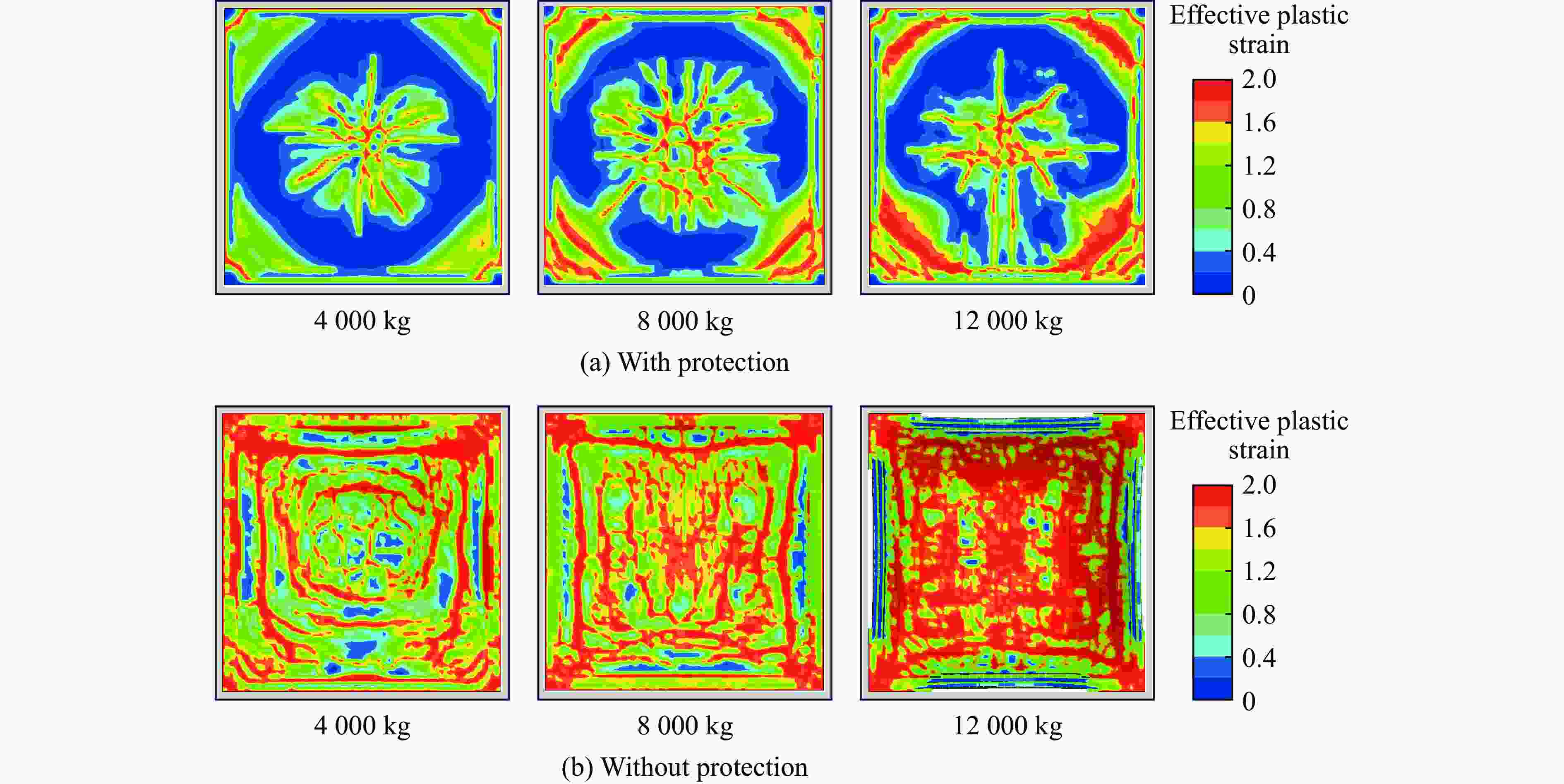
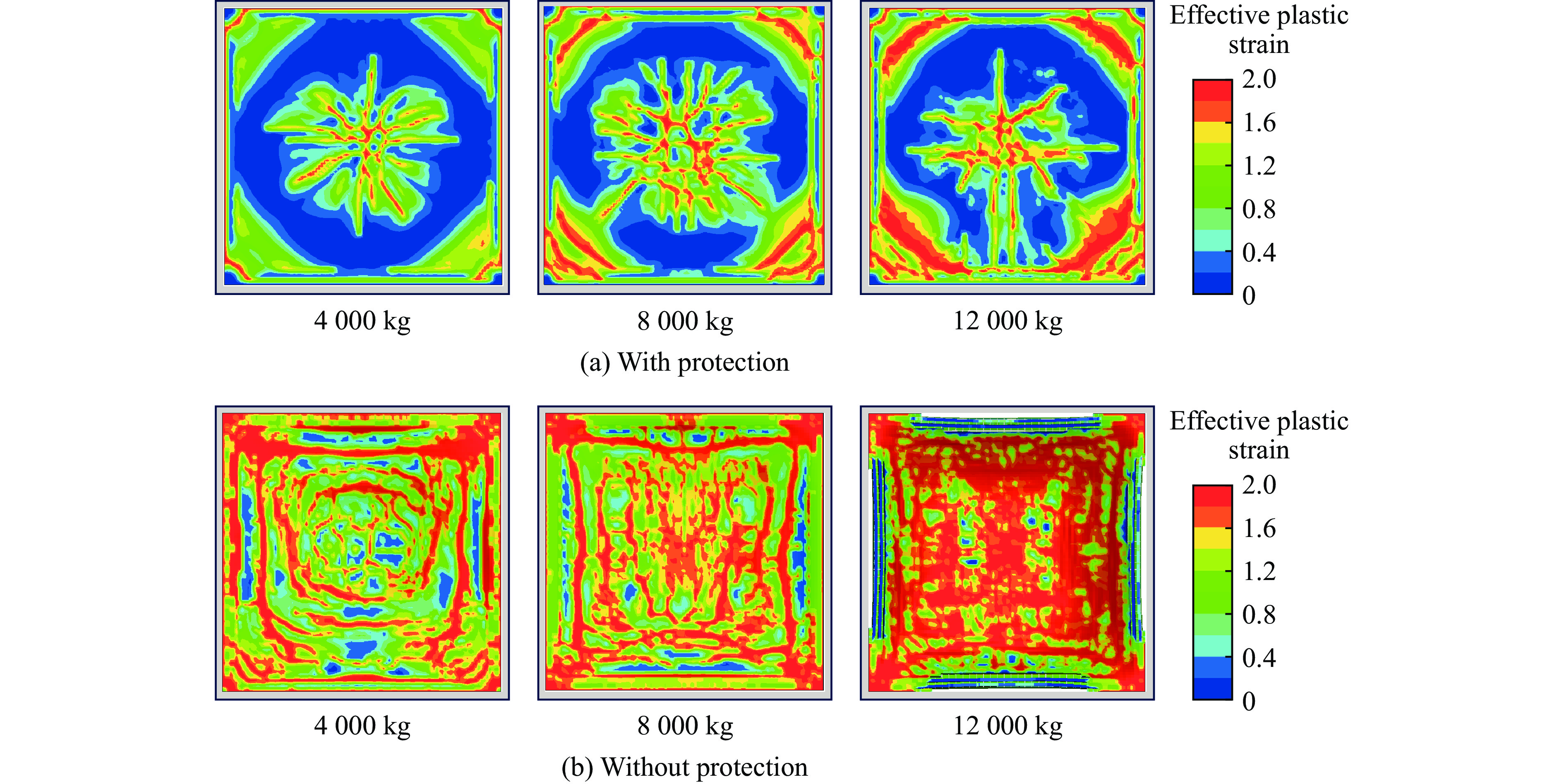
图 10 不同TNT当量爆炸作用下建筑结构外表面的损伤云图
Figure 10. Damage contours on building exterior surfaces subjected to different TNT equivalent explosion
表 1 冲击波超压作用下建筑物的毁伤等级[19]
Table 1. Damage levels of building structures under shock wave pressure[19]
等级 破坏特征描述 超压阈值/
kPa玻璃 木门窗 砖外墙 木屋盖 钢砼屋盖 瓦屋面 顶棚 内墙 无毁伤 偶然破坏 无损伤 无损伤 无损伤 无损伤 无损伤 无损伤 无损伤 2 轻度 部分呈
小块破坏窗扇破坏,窗框
门窗破坏裂缝较小,最大
宽度小于5 mm木屋面板变形,
偶然折裂无损伤 大量移动 抹灰大量
掉落板条墙
抹灰大量掉落>2~25 中度 粉碎 窗扇掉落内倒,
窗框门扇
大量破坏裂缝宽度,
较大5~50 mm,
砖垛明显倾斜木屋面板变形,
偶然折裂,木屋架
支座松动出现微小裂缝,
最大宽度小于
1 mm大量移动到
全部掀掉木龙骨部分
破坏、下垂砖内出现
小裂缝>25~40 重度 − − 部分倒塌 部分倒塌 出现较宽裂缝 − − 砖内墙出现严重
裂缝到部分倒塌>40~76  下载: 导出CSV
-
[1] 湖南省应急管理厅. 湖南临澧山洲花炮厂“6·16”爆炸事故初步通报 [EB/OL]. (2025-06-16)[2025-10-25]. https://yjt.hunan.gov.cn/xwzx/snyw/202506/t20250616_33550768.html. [2] 央视新闻. 俄罗斯车里雅宾斯克州一工厂发生爆炸致4死多伤 [EB/OL]. (2025-10-23)[2025-10-25]. https://news.sina.com.cn/w/2025-10-23/doc-infuvkux7382659.shtml. [3] 常颖, 梁国福, 吴宪. 燃气爆燃事故调查与测试技术 [J]. 消防科学与技术, 2022, 41(4): 575–578. DOI: 10.3969/j.issn.1009-0029.2022.04.034.CHANG Y, LIANG G F, WU X. Investigation and test technology of gas deflagration accident [J]. Fire Science and Technology, 2022, 41(4): 575–578. DOI: 10.3969/j.issn.1009-0029.2022.04.034. [4] 刘喜和. 爆炸现场勘察计算爆炸物数量的方法 [J]. 警察技术, 2006(1): 52–53. DOI: 10.3969/j.issn.1009-9875.2006.01.021.LIU X H. The way to reconnaissance and calculate the account of exploder at exploding scene [J]. Police Technology, 2006(1): 52–53. DOI: 10.3969/j.issn.1009-9875.2006.01.021. [5] GUPTA R K, PRZEKWAS A. Mathematical models of blast-induced TBI: current status, challenges, and prospects [J]. Frontiers in Neurology, 2013, 4: 59. DOI: 10.3389/fneur.2013.00059. [6] GARIMELLA H T, KRAFT R H. Modeling the mechanics of axonal fiber tracts using the embedded finite element method [J]. International Journal for Numerical Methods in Biomedical Engineering, 2017, 33(5): e2823. DOI: 10.1002/cnm.2823. [7] 康越, 马天, 黄献聪, 等. 颅脑爆炸伤数值模拟研究进展: 建模、力学机制及防护 [J]. 爆炸与冲击, 2023, 43(6): 061101. DOI: 10.11883/bzycj-2022-0521.KANG Y, MA T, HUANG X C, et al. Advances in numerical simulation of blast-induced traumatic brain injury: modeling, mechanical mechanism and protection [J]. Explosion and Shock Waves, 2023, 43(6): 061101. DOI: 10.11883/bzycj-2022-0521. [8] 王震, 胡可, 赵阳. 拱顶钢储罐内部蒸气云爆炸冲击荷载的数值模拟 [J]. 振动与冲击, 2013, 32(20): 35–40. DOI: 10.13465/j.cnki.jvs.2013.20.032.WANG Z, HU K, ZHAO Y. Numerical simulation for internal vapor cloud explosion loading in dome-roof steel tanks [J]. Journal of Vibration and Shock, 2013, 32(20): 35–40. DOI: 10.13465/j.cnki.jvs.2013.20.032. [9] D’UVA J A, DETATA D, LEWIS S W. Source determination of homemade ammonium nitrate using ATR-FTIR spectroscopy, trace elemental analysis and chemometrics [J]. Forensic Chemistry, 2022, 28: 100411. DOI: 10.1016/j.forc.2022.100411. [10] 孙振文, 张冠男, 乔婷, 等. 炸药爆炸残留物分析研究进展 [J]. 化学研究与应用, 2020, 32(7): 1117–1125. DOI: 10.3969/j.issn.1004-1656.2020.07.003.SUN Z W, ZHANG G N, QIAO T, et al. Research progress of explosive post-blast residue analysis [J]. Chemical Research and Application, 2020, 32(7): 1117–1125. DOI: 10.3969/j.issn.1004-1656.2020.07.003. [11] 李兴, 孙振文, 刘耀. 法庭科学领域烟火药及其爆炸残留物检验研究进展 [J]. 化学研究与应用, 2022, 34(10): 2265–2273. DOI: 10.3969/j.issn.1004-1656.2022.10.001.LI X, SUN Z W, LIU Y. Research progress of pyrotechnic composition and post-blast residue analysis in forensic science [J]. Chemical Research and Application, 2022, 34(10): 2265–2273. DOI: 10.3969/j.issn.1004-1656.2022.10.001. [12] 李来辉, 李景龙. 基于开源情报的核力量评估方法研究: 以美国科学家联盟(FAS)核信息项目为例 [J]. 情报杂志, 2025, 44(11): 42–47. DOI: 10.3969/j.issn.1002-1965.2025.11.006.LI L H, LI J L. The study of nuclear force assessment method based on open source intelligence: the example of nuclear information project of the federation of American scientists [J]. Journal of Intelligence, 2025, 44(11): 42–47. DOI: 10.3969/j.issn.1002-1965.2025.11.006. [13] 于申. 开源信息在科技情报领域的应用及展望 [J]. 科技创新与生产力, 2025, 46(7): 7–10,14. DOI: 10.3969/j.issn.1674-9146.2025.07.007.YU S. Application and prospects of open-source information in the field of sci-tech intelligence [J]. Sci-Tech Innovation and Productivity, 2025, 46(7): 7–10,14. DOI: 10.3969/j.issn.1674-9146.2025.07.007. [14] 冷烁, 李孙伟, 胡振中. 基于开源技术的城市地理信息平台构建方法研究 [J]. 图学学报, 2020, 41(6): 1001–1011. DOI: 10.11996/JG.j.2095-302X.2020061001.LENG S, LI S W, HU Z Z. Research on establishment of city geographic information platform based on open source technology [J]. Journal of Graphics, 2020, 41(6): 1001–1011. DOI: 10.11996/JG.j.2095-302X.2020061001. [15] 吴珍云, 金忠平, 王冬辰, 等. 基于开源GIS的地震应急信息可视化平台构建与应用 [J]. 实验室研究与探索, 2020, 39(1): 69–73. DOI: 10.3969/j.issn.1006-7167.2020.01.015.WU Z Y, JIN Z P, WANG D C, et al. Construction and application of information visualization platform for earthquake emergency based on open source GIS [J]. Research and Exploration in Laboratory, 2020, 39(1): 69–73. DOI: 10.3969/j.issn.1006-7167.2020.01.015. [16] 刘忠, 李保国, 许敏, 等. 基于开源Web-GIS的县域土壤信息系统设计 [J]. 农业工程学报, 2014, 30(17): 175–182. DOI: 10.3969/j.issn.1002-6819.2014.17.023.LIU Z, LI B G, XU M, et al. Design of county-level soil information system based on Web-GIS [J]. Transactions of the Chinese Society of Agricultural Engineering, 2014, 30(17): 175–182. DOI: 10.3969/j.issn.1002-6819.2014.17.023. [17] 国务院安委办. 山东友道化学“5·27”重大爆炸事故原因初步查明: 工艺技术有缺陷! [EB/OL]. (2025-07-09)[2025-10-25]. https://www.enongzi.com/news/details/24ee3ce4-cf96-4aef-976f-19b1b78e0df0. [18] 央广网. 山东高密化工园区爆炸前后光学卫星对比图公布-直击航拍现场 [EB/OL]. (2025-10-23)[2025-10-25]. https://www.douyin.com/root/search/山东高密化工厂爆炸事故/aid=0ece8dae-d7f1-454b-bf35-1c612ea3a50a&modal_id=7509770674395778330&type=general. [19] GB 50089—2018 民用爆炸物品工程设计安全标准 [S]. 北京: 中国计划出版社, 2018.GB 50089—2018 Safety standard for design of engineering of civil explosive materials [S]. Beijing: China Planning Press, 2018. [20] 哔哩哔哩. 5.27山东高密化工厂爆炸瞬间附近多个监控画面! [EB/OL]. (2025-05-29)[2025-10-25]. https://www.bilibili.com/video/BV1TnjkzoEiz/?spm_id_from=333.1391.0.0&vd_source=7d99ba198a3defd861acb087353000ab. [21] ORLENKO O. 爆炸物理学(上册) [M]. 孙承纬, 译. 北京: 科学出版社, 2011: 286–293.ORLENKO O. Explosion physics: Volume Ⅰ [M]. SUN C W, trans. Beijing: Science Press, 2011: 286–293. [22] BAKER W E. Fundamental studies in engineering [M]. Amsterdam: Elsevier Science Publishing Company, 1983. [23] 杨亚东, 李向东, 王晓鸣. 爆炸冲击波空中传播特征参量的优化拟合 [J]. 爆破器材, 2014, 43(1): 13–18. DOI: 10.3969/j.issn.1001-8352.2014.01.004.YANG Y D, LI X D, WANG X M. Optimum fitting for characteristic parameters of blast shockwaves traveling in air [J]. Explosive Materials, 2014, 43(1): 13–18. DOI: 10.3969/j.issn.1001-8352.2014.01.004. [24] WU C Q, HAO H. Modeling of simultaneous ground shock and airblast pressure on nearby structures from surface explosions [J]. International Journal of Impact Engineering, 2005, 31(6): 699–717. DOI: 10.1016/j.ijimpeng.2004.03.002. [25] 吕晓, 卢永刚, 牛公杰, 等. 基于音视频信息融合的事故爆炸当量反演[J]. 爆炸与冲击, 2026. DOI: 10.11883/bzycj-2025-0330.LYU X, LU Y G, NIU G J, et al. Inverse evaluation of explosion yield in accident scenarios based on audio-video information fusion [J]. Explosion and Shock Waves, 2026. DOI: 10.11883/bzycj-2025-0330. [26] 封面新闻. 山东高密化工厂爆炸致10死2失联, 初步调查结果公布 [EB/OL]. (2025-05-29)[2025-10-25]. https://baijiahao.baidu.com/s?id=1839611360201905384&wfr=spider&for=pc. [27] 坤弘远祥. 山东高密化工厂爆炸再敲警钟!鸓鸟守护化工安全生命线 [EB/OL]. (2025-05-29)[2025-10-25]. https://www.sckhyx.com/hangye-12/237.html. [28] 国家安全生产监督管理总局. 危险化学品重大危险源监督管理暂行规定 [Z]. 2011. [29] GB 55037—2022 建筑防火通用规范 [S]. 北京: 中国计划出版社, 2022.GB 55037—2022 General specification for building fire protection [S]. Beijing: China Planning Press, 2022. [30] 金融界. 山东高密化工厂发生爆炸! 附近居民家中电器被震出屋外, 系全球最大氯虫苯甲酰胺生产企业, 产能11000吨, 各大上市公司密集回应影响 [EB/OL]. (2025-05-27)[2025-10-25]. https://baijiahao.baidu.com/s?id=1833276316276065214&wfr=spider&for=pc. [31] GB/T 50010—2010 混凝土结构设计标准 [S]. 北京: 中国建筑工业出版社, 2011.GB/T 50010—2010 Code for design of concrete structures [S]. Beijing: China Architecture & Building Press, 2011. [32] GB 50016—2014 建筑设计防火规范 [S]. 北京: 中国计划出版社, 2018.GB 50016—2014 Code for fire protection design of buildings [S]. Beijing: China Planning Press, 2018. [33] GB 51182—2016 火炸药及其制品工厂建筑结构设计规范 [S]. 北京: 中国计划出版社, 2017.GB 51182—2016 Code for design of architecture and structure for the factory of explosives and their products [S]. Beijing: China Planning Press, 2017. [34] ZHANG Z H, JIA B, LU Y G, et al. Experimental and numerical investigation of internal explosions in RC frame structures with foam concrete infill walls [J]. Structures, 2025, 81: 110261. DOI: 10.1016/j.istruc.2025.110261. [35] 李军润, 卢永刚, 冯晓伟, 等. RC箱型结构内爆炸载荷特性和动力行为分析 [J]. 爆炸与冲击, 2026, 46(1): 013101. DOI: 10.11883/bzycj-2024-0388.LI J R, LU Y G, FENG X W, et al. Analysis of internal explosion load characteristics and dynamic behavior in RC box structures [J]. Explosion and Shock Waves, 2026, 46(1): 013101. DOI: 10.11883/bzycj-2024-0388. [36] ZHOU G P, WANG R, WANG M Y, et al. Explosion resistance performance of reinforced concrete box girder coated with polyurea: model test and numerical simulation [J]. Defence Technology, 2024, 33: 1–18. DOI: 10.1016/j.dt.2023.08.006. [37] WANG L B, BAI Z, QIAN B W, et al. The damage of sequential explosions in reinforced concrete: experimental and numerical investigation [J]. Defence Technology, 2025, 48: 284–297. DOI: 10.1016/j.dt.2025.02.012. -

计量
- 文章访问数: 463
- HTML全文浏览量: 179
- PDF下载量: 98
- 被引次数: 0