



Methods for determining the coupling coefficient and stemming coefficient of underground explosions
-
摘要: 耦合系数与填塞系数广泛应用于地下爆炸地冲击大小预测及爆炸破坏范围评估,随着埋深增加,爆炸地冲击耦合机制发生变化,不同耦合系数呈现不同演化规律。系统总结了地下爆炸耦合系数和填塞系数的试验与理论研究成果,介绍了常用耦合系数类型及换算关系,分析了现有试验中不同耦合系数及不同介质中耦合系数随埋深的变化规律,讨论了耦合系数计算方法及临界埋深确定方法,对比了不同介质中的等效当量系数和填塞系数,并对目前研究中尚有待解决的问题和下一步的研究方向进行了展望。Abstract: Coupling coefficients and stemming coefficients are essential for predicting ground shock magnitude and damage zones from underground explosions, yet their variation with burial depth and dependence on media and explosion types remain insufficiently compared. Experimental and theoretical methods for determining these coefficients in concrete, rock, and soil under both chemical and nuclear explosions were systematically reviewed. Based on collected data from published tests, definitions of different coupling coefficients (energy coupling, ground shock parameter coupling, equivalent yield, and stemming coefficients) were clarified, and conversion relationships among them were derived using energy conservation and wave attenuation principles. The critical burial depth for full coupling was analyzed separately for peak quantities (e.g., peak stress, particle velocity) and integral quantities (e.g., impulse, surface vibration). Experimental results show that peak quantities reach full coupling at a depth approximately equal to the contained explosion cavity radius, which is much shallower than the critical depth for contained explosions. In contrast, impulse and ground motion require depths close to the contained explosion threshold. The coupling energy is proportional to the volume of the damaged zone, and the evolution of coupling coefficients with scaled depth of burial follows a Boltzmann function, requiring only two parameters to define the entire curve. For chemical explosions, the fully coupled equivalent yield coefficient (relative to contained explosions) in concrete, limestone, and soils was quantified, with stemming coefficients ranging from 1.4~1.8 in rocks and 2.4~2.6 in soils. It is concluded that different ground shock parameters exhibit distinct coupling behaviors, challenging the assumption of a universal coupling coefficient. Proposed empirical formulas provide conservative estimates for engineering design, while the underlying mechanisms of free-surface unloading require further quantitative investigation.
-
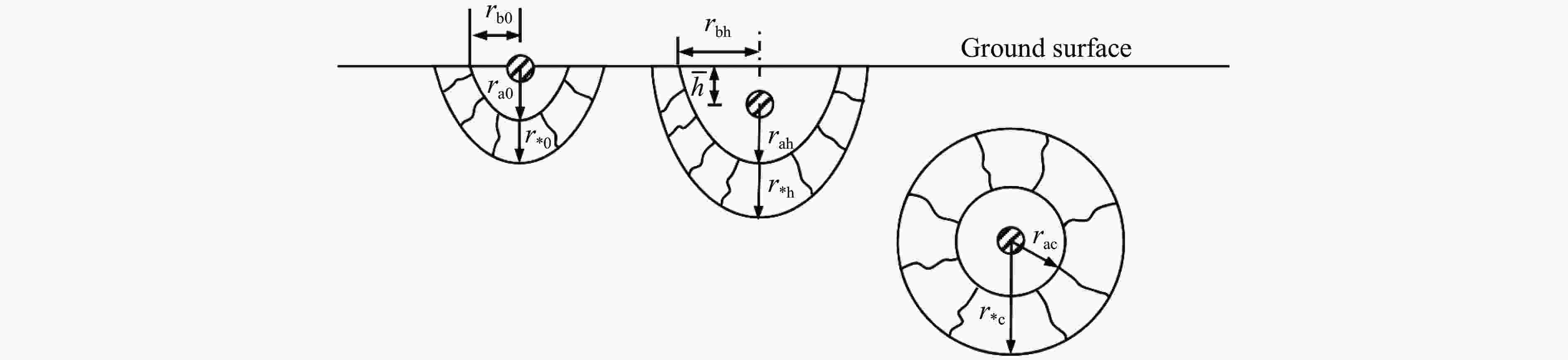
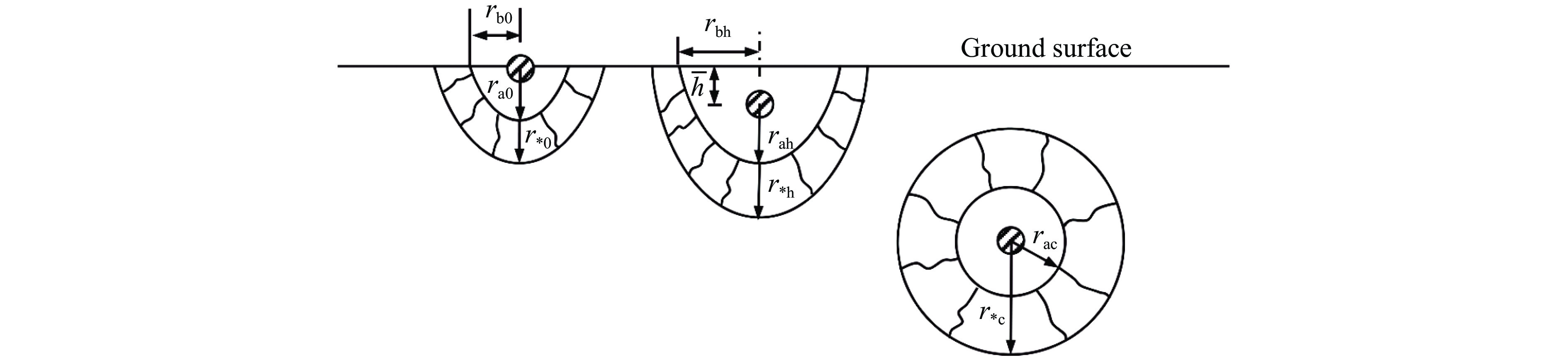
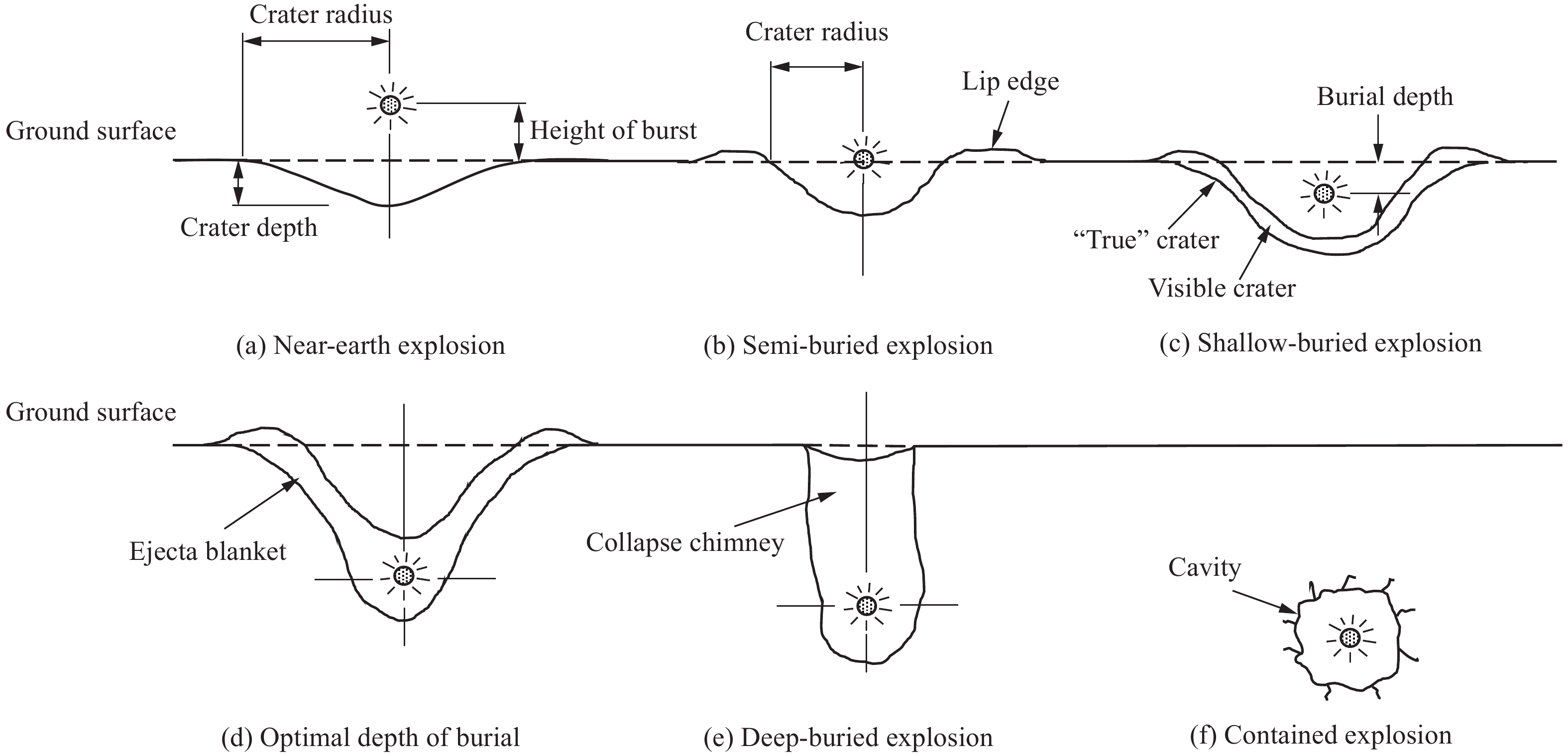
图 2 地下爆炸破坏区演化示意图
Figure 2. Schematic diagram of the evolution of damage zones of underground explosion
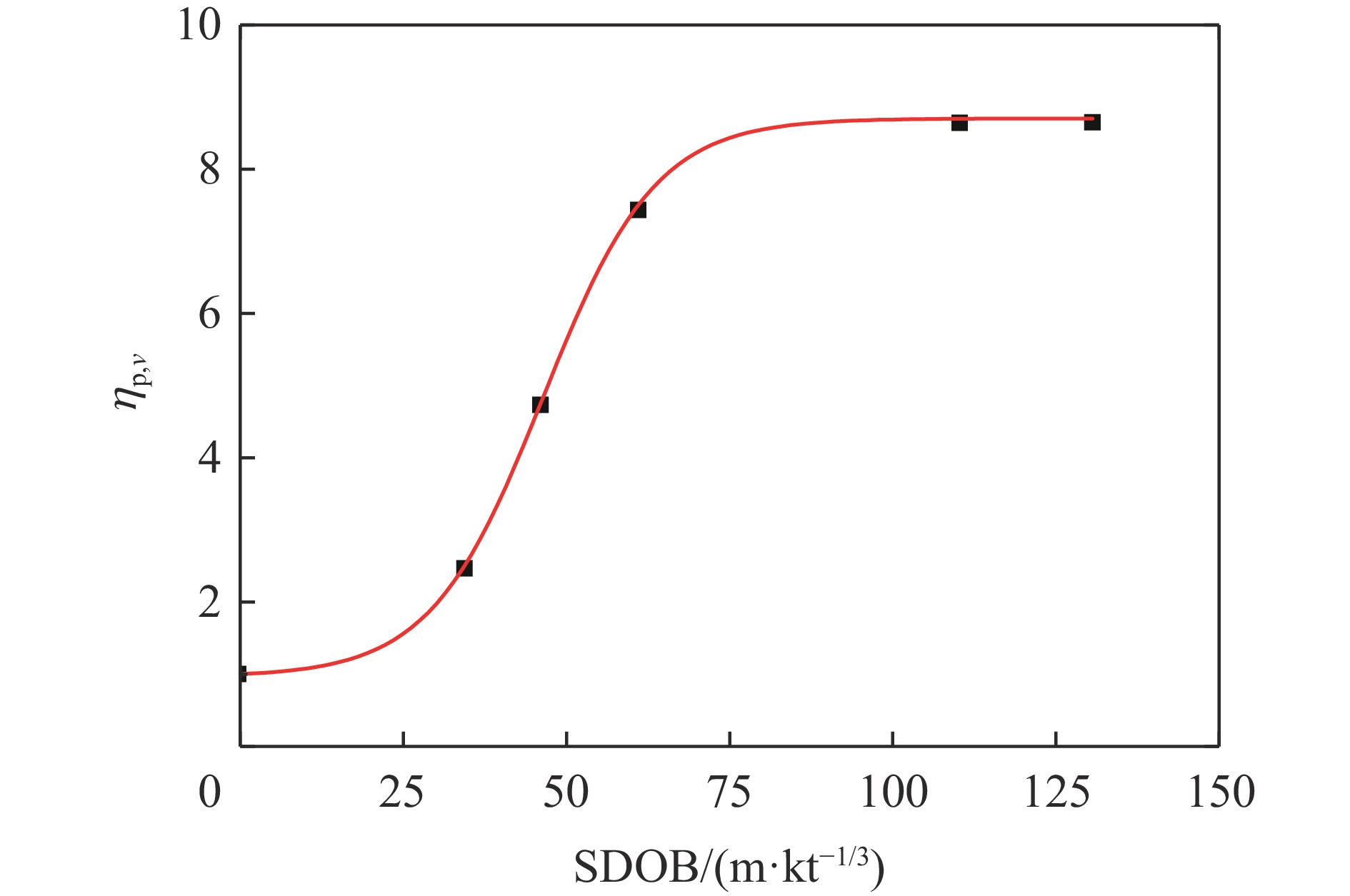
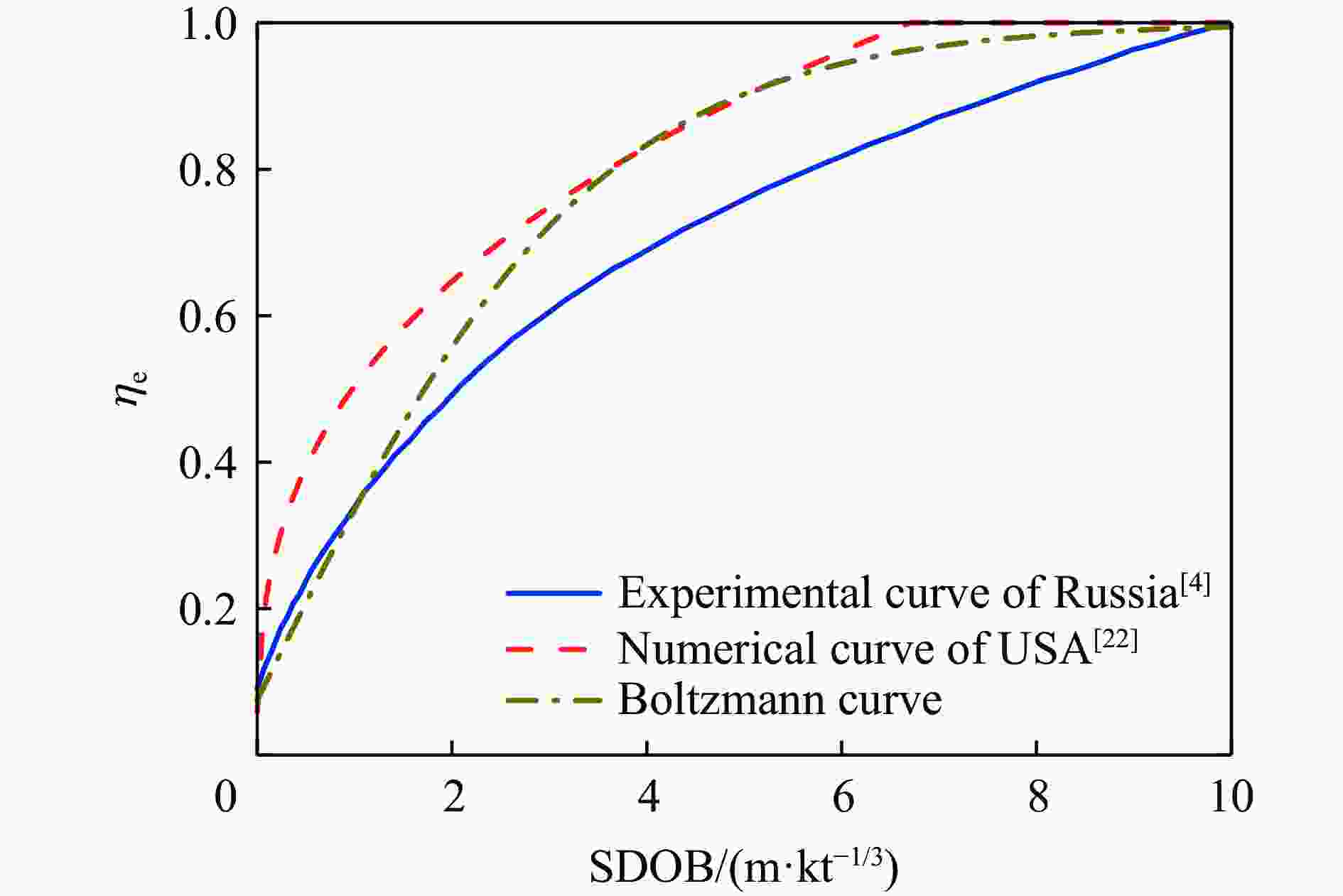
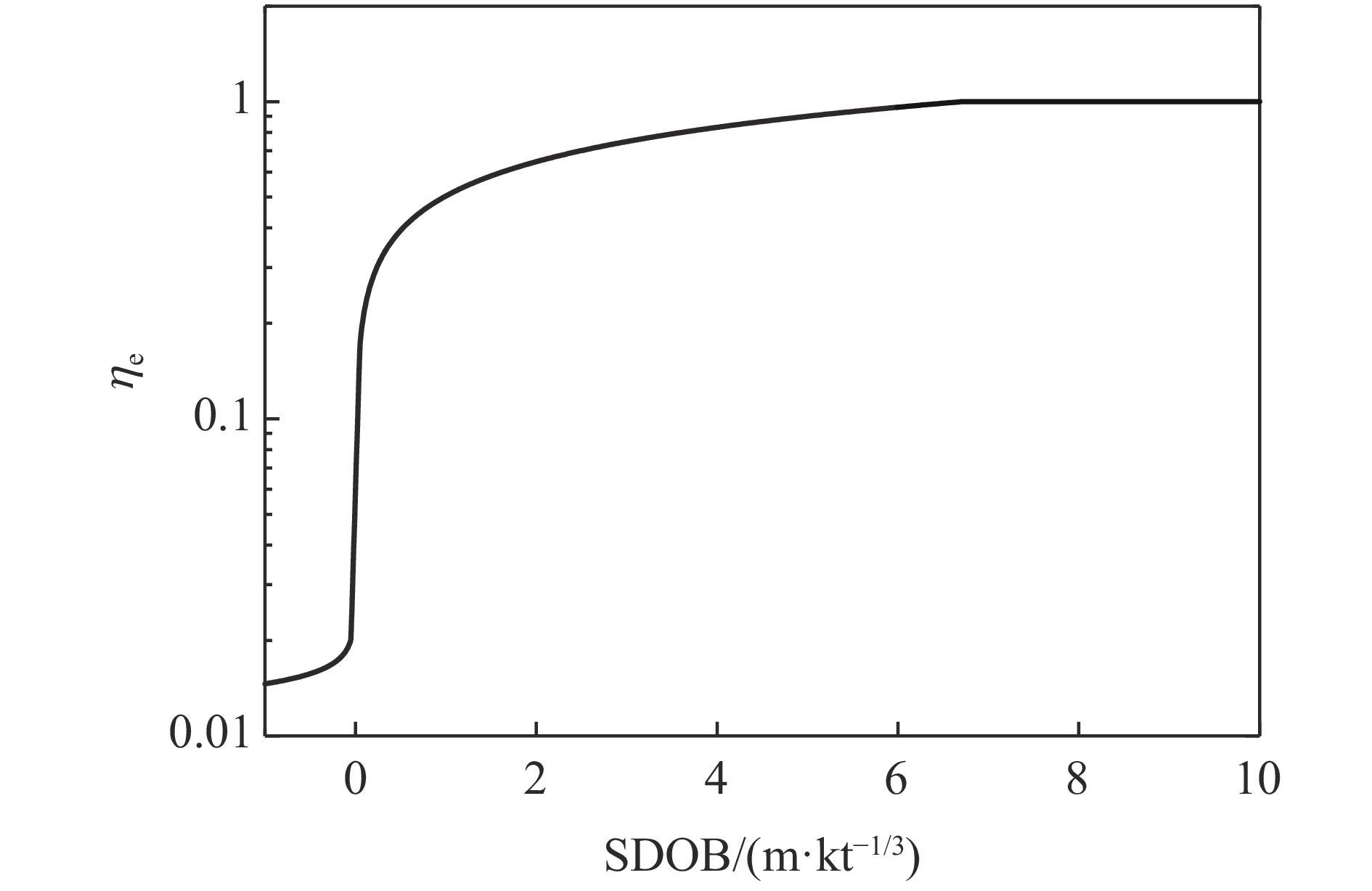
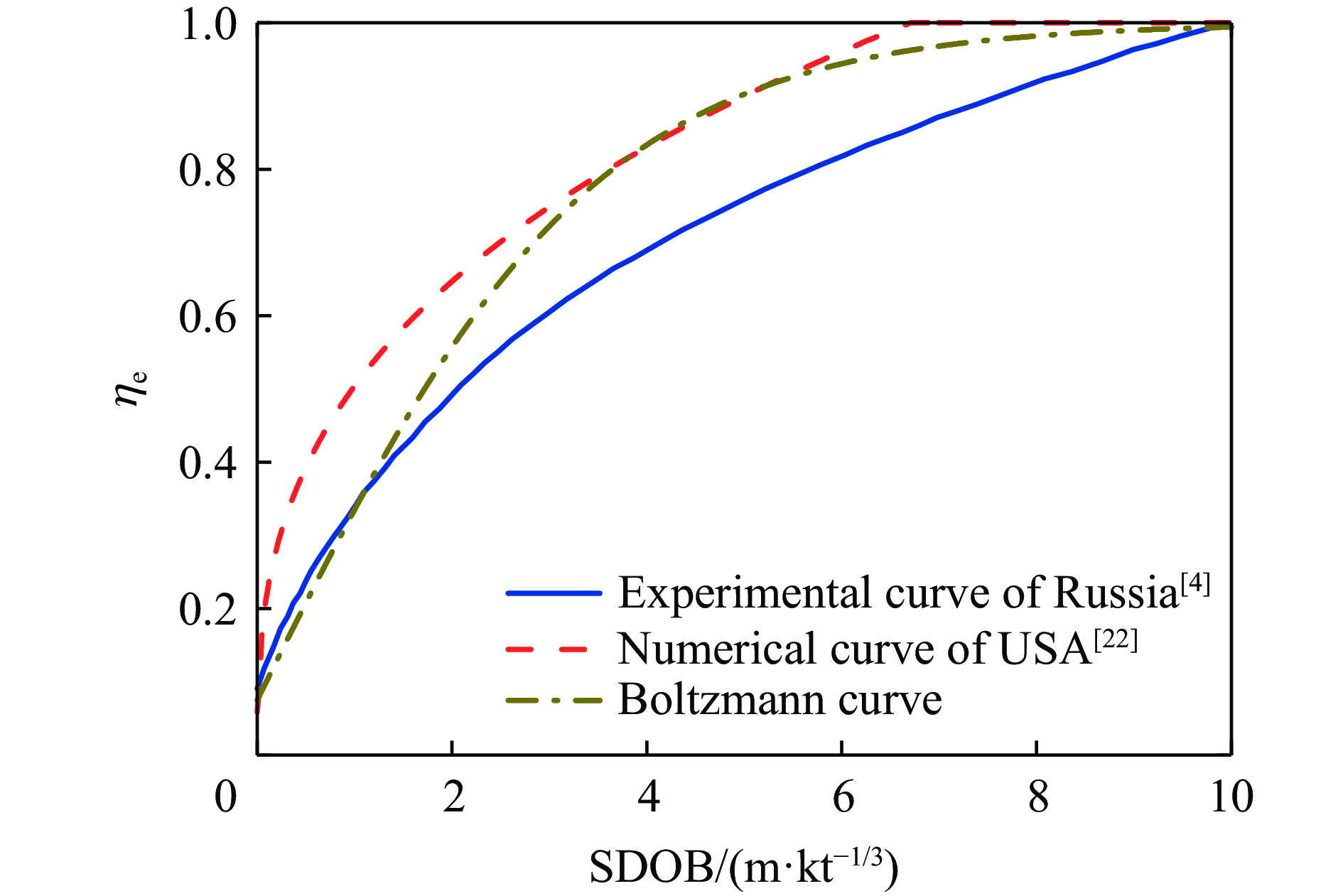
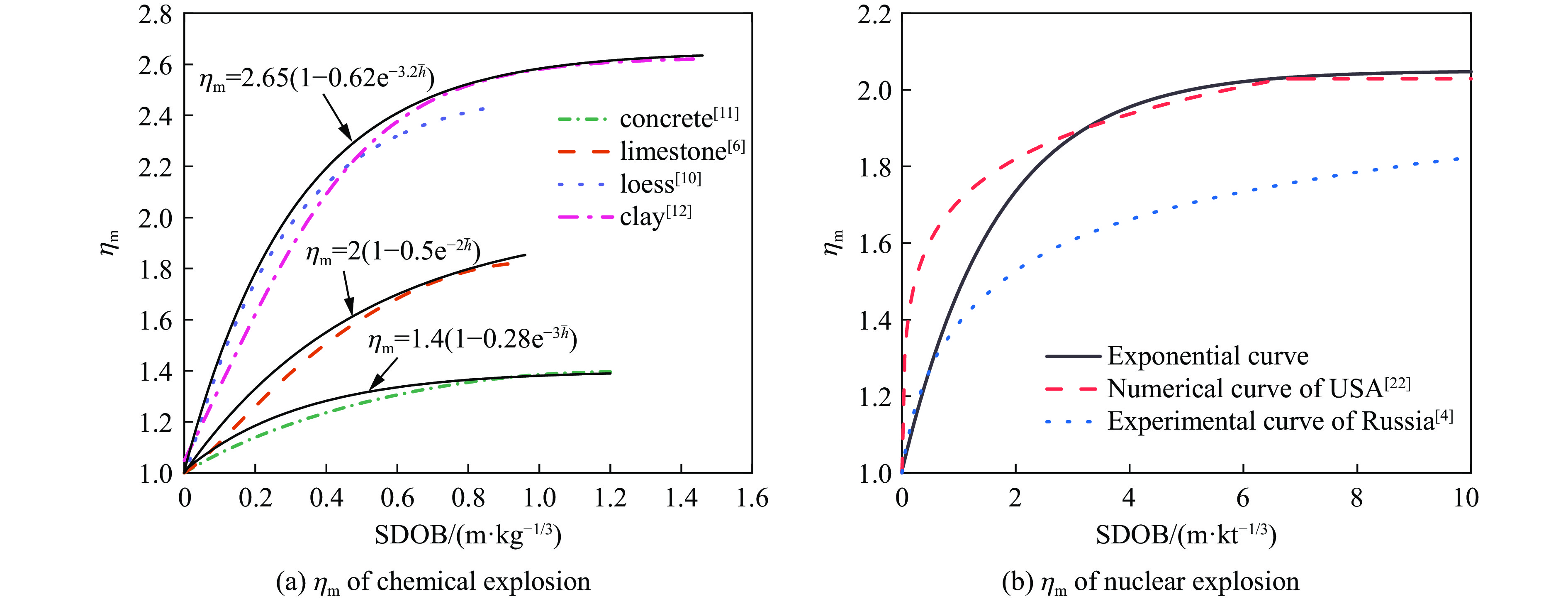
图 17 与美俄耦合系数曲线对比
Figure 17. Comparison between the Boltzmann curve and the curves of USA and Russia
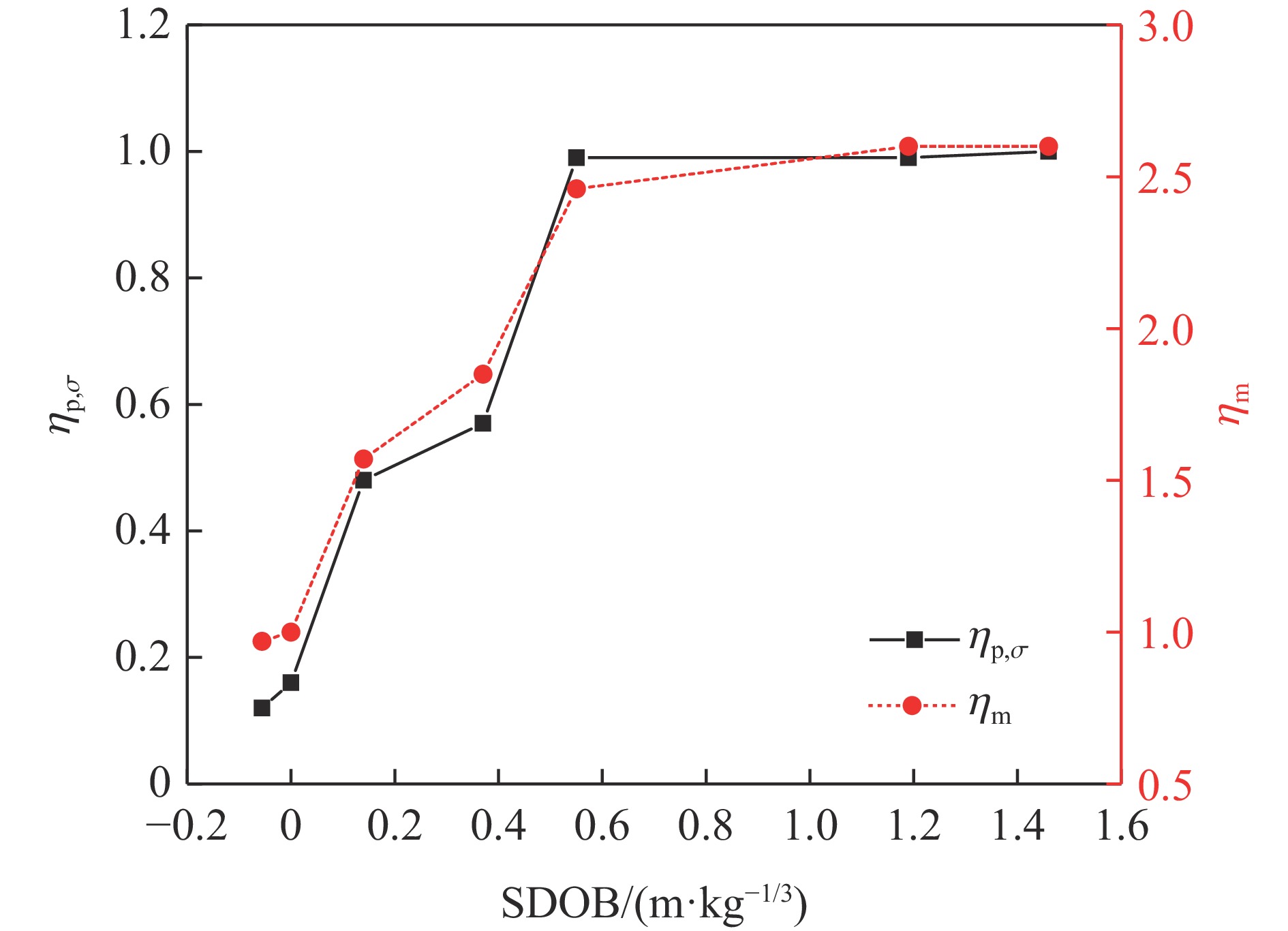
表 1 黏土中试验结果
Table 1. Experimental results in clay
装药埋深/(m·kg−1/3) 爆心下方压缩比例半径/(m·kg−1/3) −0.056 0.179 0 0.184 0.14 0.289 0.37 0.340 0.55 0.453 1.19 0.478 1.46 0.479  下载: 导出CSV
-
[1] 邓国强, 刘国军, 郑全平. 爆炸地冲击临界深度研究 [J]. 防护工程, 2019, 41(2): 31–37.DENG G Q, LIU G J, ZHENG Q P. Research on the critical depth of explosion ground shock [J]. Protective Engineering, 2019, 41(2): 31–37. [2] National Research Council. Effects of nuclear earth-penetrator and other weapons[M]. Washington D C: National Academies Press, 2005. [3] 奥尔连科. 爆炸物理学[M]. 孙承纬, 译. 北京: 科学出版社, 2011. [4] ADUSHKIN V V, SPIVAK A. Underground explosions[R]. Washington, DC: U. S. Department of State, 2015. [5] 穆朝民, 任辉启, 石必明. 变埋深条件下混凝土中爆炸加速度的传播规律 [J]. 振动与冲击, 2016, 35(3): 1–6.MU C M, REN H Q, SHI B M. Investigation on the shock acceleration of concrete at different depths of burst [J]. Journal of Vibration and Shock, 2016, 35(3): 1–6. [6] 赵红玲, 侯爱军, 童怀峰, 等. 石灰岩中不同埋深爆炸自由场直接地冲击参数的预计方法 [J]. 爆炸与冲击, 2011, 31(3): 290–294.ZHAO H L, HOU A J, DONG H F, et al. Prediction method of the direct ground shock parameters of explosionat different buried depths in free field of limestone [J]. Explosion and Shock Waves, 2011, 31(3): 290–294. [7] 吴祥云, 曲建波, 张光明, 等. 岩石中不同埋深爆炸自由场直接地冲击参数的预计方法[C]//第20届全国结构工程学术会议, 北京: 中国力学学会工程力学编辑部, 2011: 262–267.WU X Y, QU J B, ZHANG G M, et al. Prediction method of the direct ground shock parameters of explosion at different buried depths in free field of rock[C]// Proceedings of the Twentieth National Conference on Structural Engineering. Beijing: Engineering Mechanics, 2011: 262–267. [8] 叶亚齐, 任辉启, 李永池, 等. 砂质黏土中不同深度爆炸自由场地冲击参数预计方法研究 [J]. 岩石力学与工程学报, 2011, 30(9): 1918–1923.YE Y Q, REN H Q, LI Y C, et al. Study of prediction of ground shock parameters in free field at different depths of burst in sandy clay [J]. Chinese Journal of Rock Mechanics and Engineering, 2011, 30(9): 1918–1923. [9] 穆朝民, 任辉启, 李永池, 等. 变埋深条件下饱和土爆炸能量耦合系数的试验研究 [J]. 岩土力学, 2010, 31(5): 1574–1578.MU C M, REN H Q, LI Y C, et al. Experiment study of explosion energy coupling coefficient with different burial depths in saturated soils [J]. Rock and Soil Mechanics, 2010, 31(5): 1574–1578. [10] 穆朝民, 任辉启, 辛凯, 等. 变埋深条件下土中爆炸成坑效应 [J]. 解放军理工大学学报(自然科学版), 2010, 11(2): 112–116. DOI: 10.3969/j.issn.1009-3443.2010.02.003.MU C M, REN H Q, XIN K, et al. Effects of crater formed by explosion in soils [J]. Journal of Army Engineering University of PLA, 2010, 11(2): 112–116. DOI: 10.3969/j.issn.1009-3443.2010.02.003. [11] 李重情, 穆朝民, 石必明. 变埋深条件下混凝土中爆炸应力传播规律的研究 [J]. 振动与冲击, 2017, 36(6): 140–145. DOI: 10.13465/j.cnki.jvs.2017.07.021.LI C Q, MU C M, SHI B M. Investigate on shock stress propagation in concrete at different depths under blasting [J]. Journal of Vibration and Shock, 2017, 36(6): 140–145. DOI: 10.13465/j.cnki.jvs.2017.07.021. [12] 时本军, 李杰, 郭纬, 等. 黏土中爆炸成坑地冲击耦合效应实验研究 [J]. 爆炸与冲击, 2023, 43(6): 160–173.SHI B J, LI J, GUO W, et al. Experimental study on explosion cratering and coupled ground shock in clay [J]. Explosion and Shock Waves, 2023, 43(6): 160–173. [13] SHI B J, XU X H, LI J, et al. Experimental and numerical study on explosion cratering and coupled ground shock in clay [J]. International Journal of Impact Engineering, 2024, 187: 104923. DOI: 10.1016/j.ijimpeng.2024.104923. [14] 刘琦, 翟超辰, 张跃飞, 等. 地面和埋置爆炸土中地冲击作用分区数值模拟及试验研究 [J]. 爆炸与冲击, 2022, 42(8): 1–19.LIU Q, ZHAI C C, ZHANG Y F, et al. Numerical simulation and test study on ground shock subzones in soil produced by ground and buried explosion [J]. Explosion and Shock Waves, 2022, 42(8): 1–19. [15] U. S. Army Engineer Waterways Experiment Station. Fundamentals of protective design for conventional weapons[R]. Washington D. C. : Department of The Army, 1986. [16] SHISHKIN N I. Seismic efficiency of a contact explosion and a high-velocity impact [J]. Journal of Applied Mechanics and Technical Physics, 2007, 48(2): 145–152. DOI: 10.1007/s10808-007-0019-6. [17] 李杰, 郭纬, 徐天涵, 等. 地下爆炸等效当量及耦合地冲击计算 [J]. 岩石力学与工程学报, 2023, 42(S2): 4064–4072. DOI: 10.13722/j.cnki.jrme.2022.0734.LI J, GUO W, XU T H, et al. Calculation of equivalent and coupled ground shock of underground explosion [J]. Chinese Journal of Rock Mechanics and Engineering, 2023, 42(S2): 4064–4072. DOI: 10.13722/j.cnki.jrme.2022.0734. [18] 钱七虎, 王明洋. 岩土中的冲击爆炸效应[M]. 北京: 国防工业出版社, 2010. [19] 施鹏, 辛凯, 杨秀敏, 等. 土中装药不同埋深爆炸试验研究 [J]. 工程力学, 2006, 23(12): 171–174. DOI: 10.3969/j.issn.1000-4750.2006.12.030.SHI P, XIN K, YANG X M, et al. Experimental study of explosion with different burial depths in soil [J]. Engineering Mechanics, 2006, 23(12): 171–174. DOI: 10.3969/j.issn.1000-4750.2006.12.030. [20] 施鹏, 邓国强, 杨秀敏, 等. 土中爆炸地冲击能量分布研究 [J]. 爆炸与冲击, 2006, 26(3): 240–244.SHI P, DENG G Q, YANG X M, et al. Study on ground shock energy distribution of explosion in soil [J]. Explosion and Shock Waves, 2006, 26(3): 240–244. [21] 建筑工程部技术情报局. 岩石中地下建筑的设计侵彻和爆炸效应: 美国陆军工程兵教范EM1110-345-434[M]. 北京: 建筑工程部技术情报局, 1964. [22] 建筑工程部技术情报局. 防护结构的设计原理和方法[M]. 北京: 建筑工程部技术情报局, 1965. [23] 徐天涵, 邱艳宇, 谢方, 等. 钻地爆炸耦合地冲击等效计算理论与方法 [J]. 同济大学学报(自然科学版), 2023, 51(6): 811–817.XU T H, QIU Y Y, XIE F, et al. Theory and method of equivalent calculation of coupling ground shock of earth-penetrating explosion [J]. Journal of Tongji University (Natural Science), 2023, 51(6): 811–817. -

图(19) / 表(1)
计量
- 文章访问数: 276
- HTML全文浏览量: 61
- PDF下载量: 206
- 被引次数: 0