



A simplified calculation method for confined blast loading considering afterburning effect
-
摘要: 针对富燃料炸药在封闭空间内爆炸载荷特性复杂、高精度求解与工程应用成本高昂的问题,首先建立了封闭空间内考虑燃热增强效应的爆炸载荷数值计算方法,与试验的准静态压力、饱和响应时间内的冲量及靶板残余变形进行对比,误差均在10%以内,验证了数值计算方法的可靠性。系统分析了封闭空间内爆炸载荷的时空分布规律,并提出一种同时考虑饱和响应时间与准静态压力的等效载荷简化方法,与全耦合计算的中心点首峰值变形与残余变形对比,误差均在10%以内,验证了等效载荷简化方法的可靠性。通过研究等效载荷空间分布形式及准静态压力对结构响应的影响,结果表明:在当前研究范围内,等效载荷空间分布对结构响应的影响相对较小,而准静态压力贡献不可忽略。根据上述认识,最终提出了基于靶板中心点载荷特性的两阶段载荷简化模型,对比10组简化模型与试验的残余变形值,误差均在15%以内,验证了简化模型的可靠性。研究表明,该模型在不同工况下均具有良好的适用性,能够在保证计算精度的同时显著提升计算效率,可为封闭空间爆炸相关工程问题的简化分析提供技术路径。Abstract: Aiming at the problems of complex characteristics of blast load induced by fuel-rich explosives in confined spaces, as well as the high cost of high-precision solution and engineering application, a numerical calculation method for confined blast loading considering the afterburning effect was established. The method was verified for its reliability by comparing the calculated quasi-static pressure, impulse within the saturation response time and residual deformation of the target with the experimental results, with all relative errors controlled within 10%. The spatiotemporal distribution law of confined blast loading in confined spaces was systematically analyzed, and a simplified equivalent loading method considering both the saturation response time and quasi-static pressure was proposed. The reliability of the simplification method was validated by comparing the calculated first peak deformation and residual deformation at the central point with the results from fully coupled calculation, with all errors within 10%. Through an investigation into the spatial distribution form of the equivalent load and the influence of quasi-static pressure on structural response, the results show that within the scope of the current research, the spatial distribution of the equivalent load has a relatively minor effect on structural response, while the contribution of quasi-static pressure cannot be neglected. On the basis of the above findings, a two-stage load simplification model based on the load characteristics at the central point of the target plate was proposed. The reliability of the simplified model was confirmed by comparing the residual deformation values obtained from 10 groups of simplified model calculations with the experimental data, with all errors within 15%. The research results indicate that the proposed model exhibits good applicability under different working conditions; it can significantly improve the calculation efficiency while ensuring the calculation accuracy, and thus provides a technical approach for the simplified analysis of engineering problems related to confined space explosions.
-
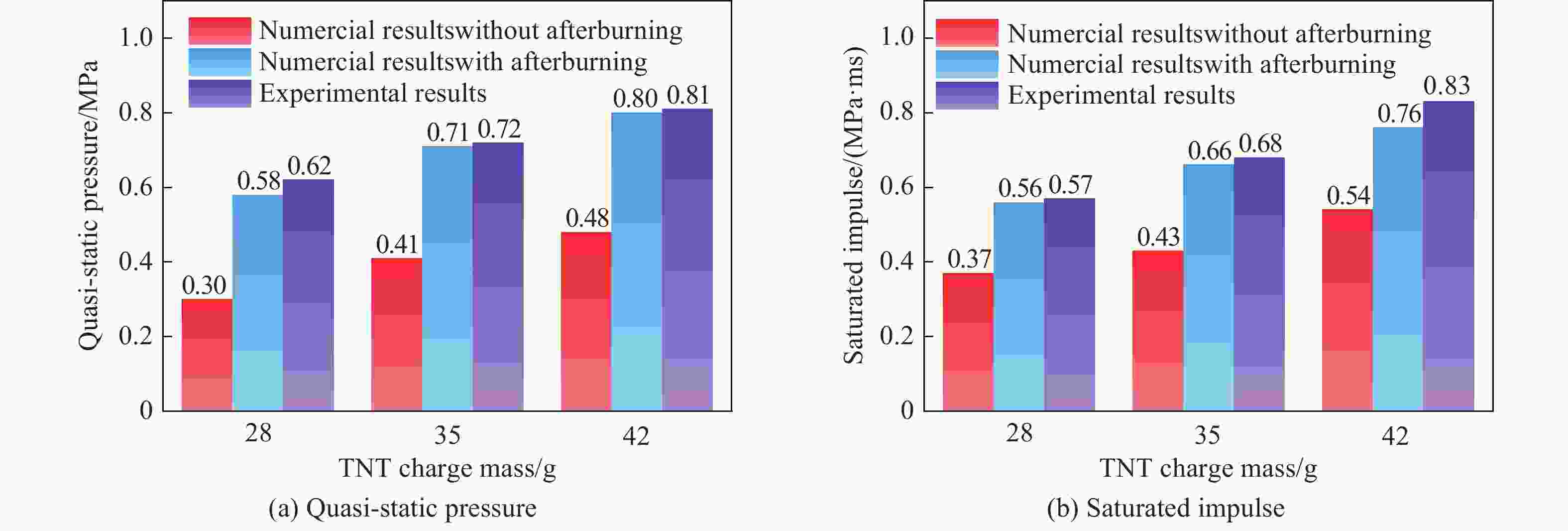
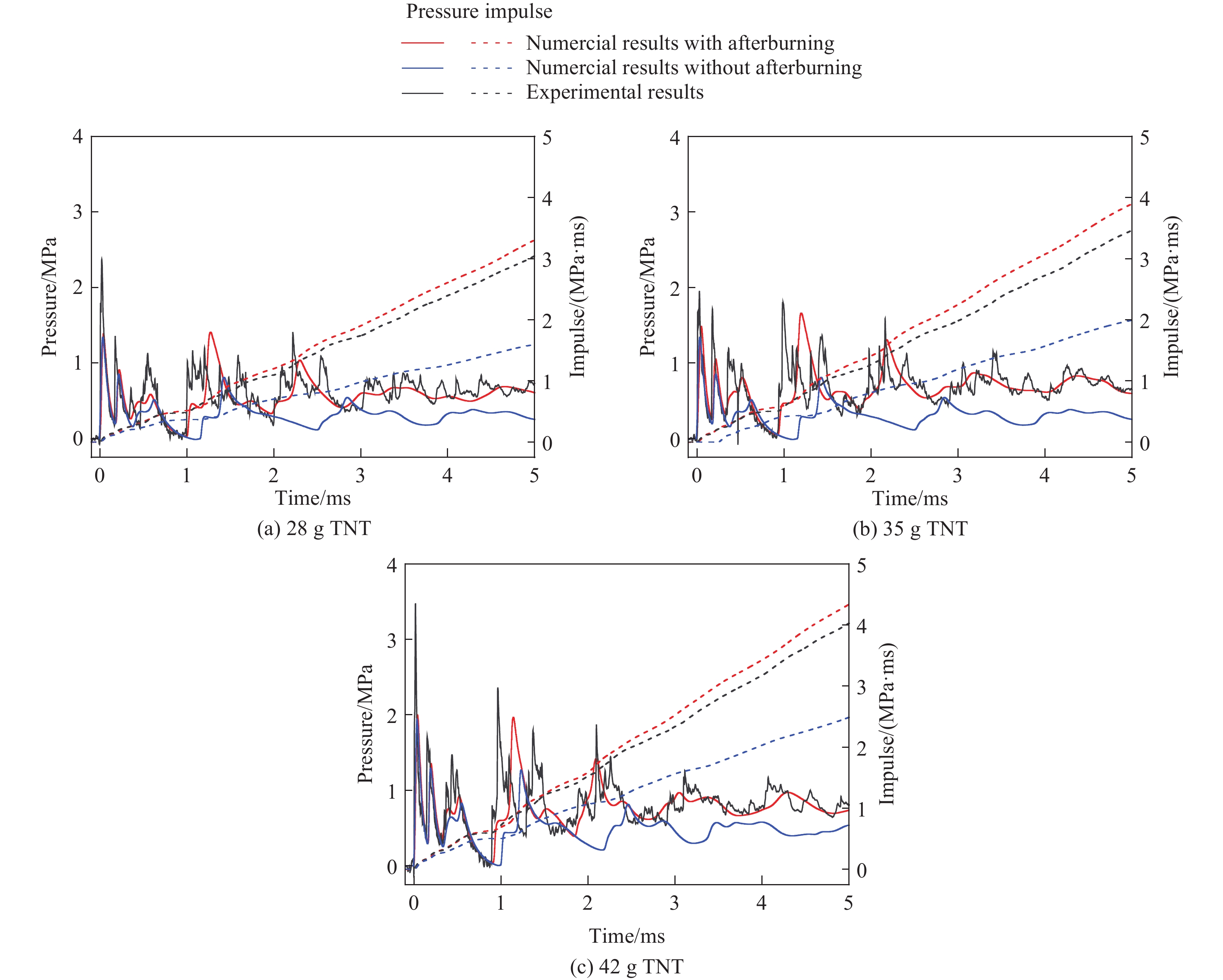
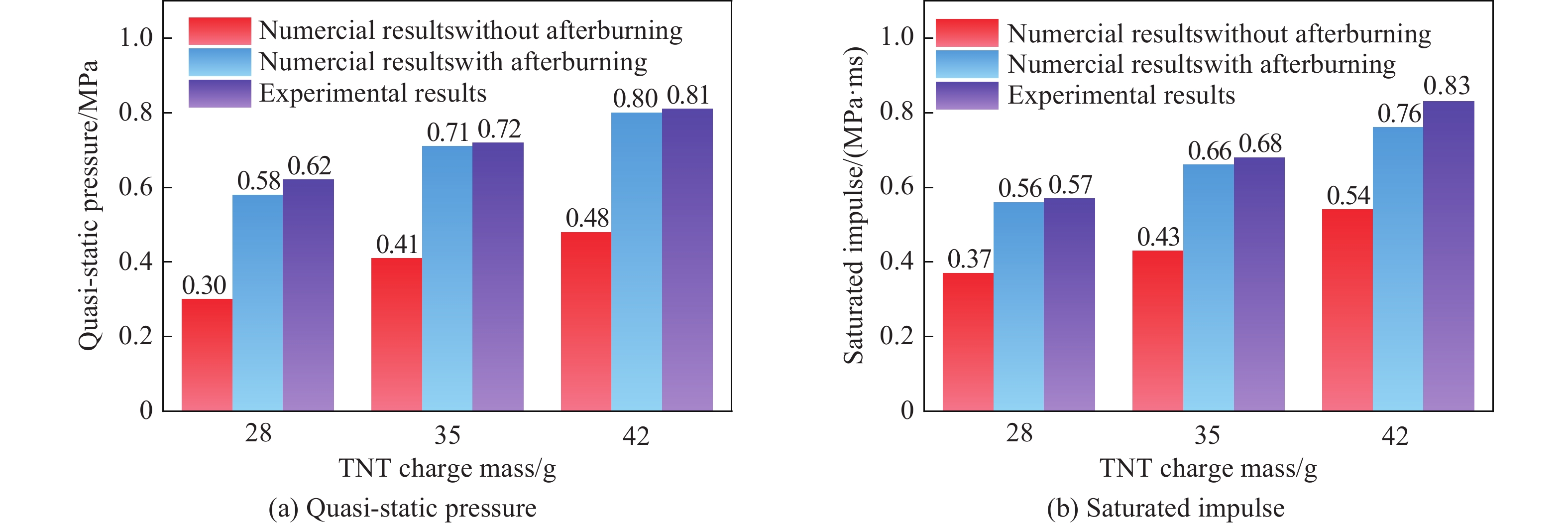
图 4 3种药量下数值计算与试验值的对比
Figure 4. Comparison of numerical calculation and experimental results under three charge masses
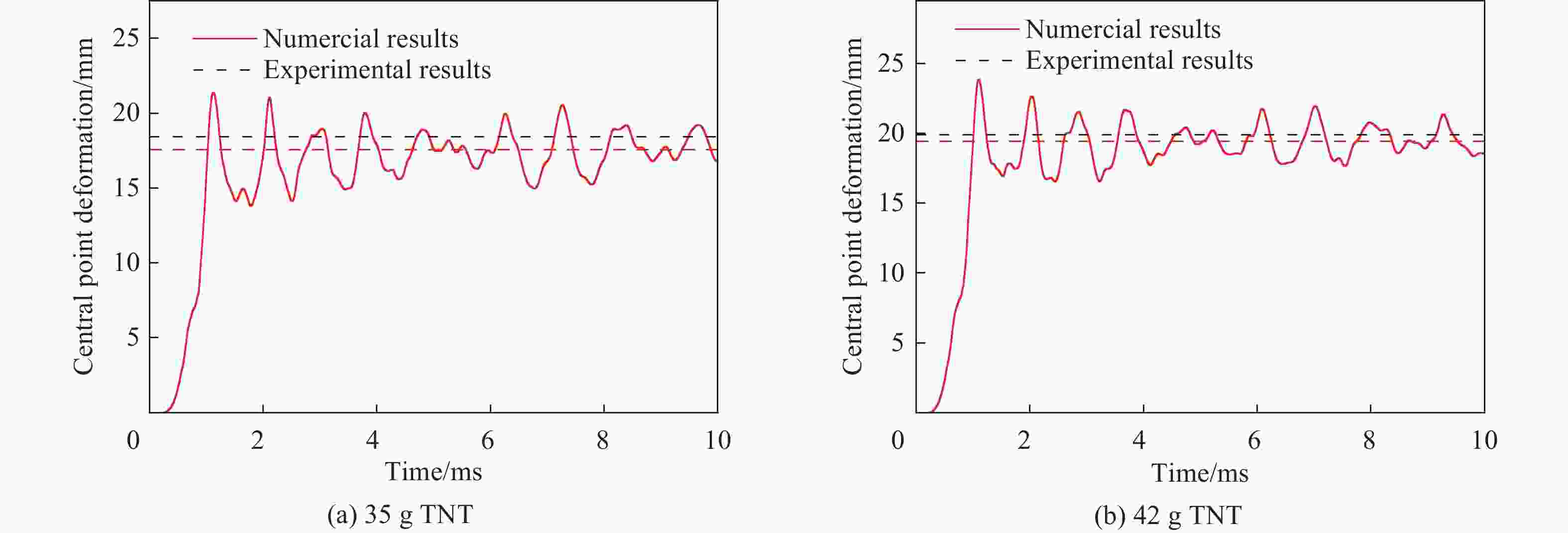
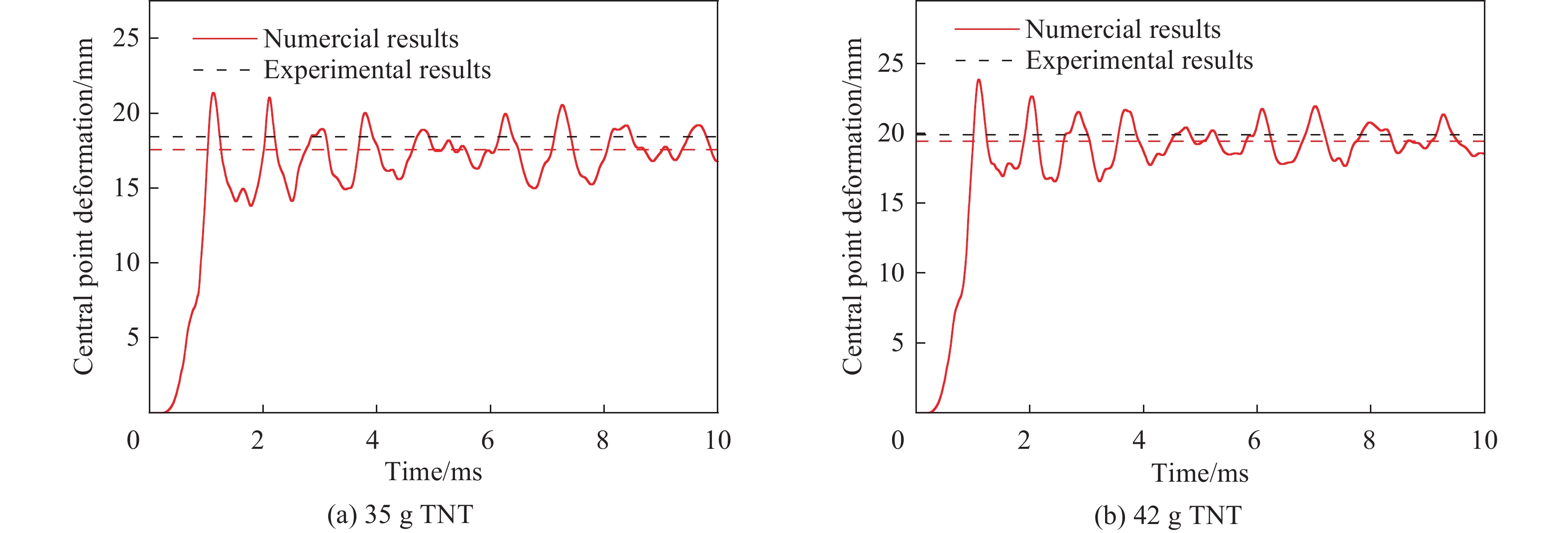
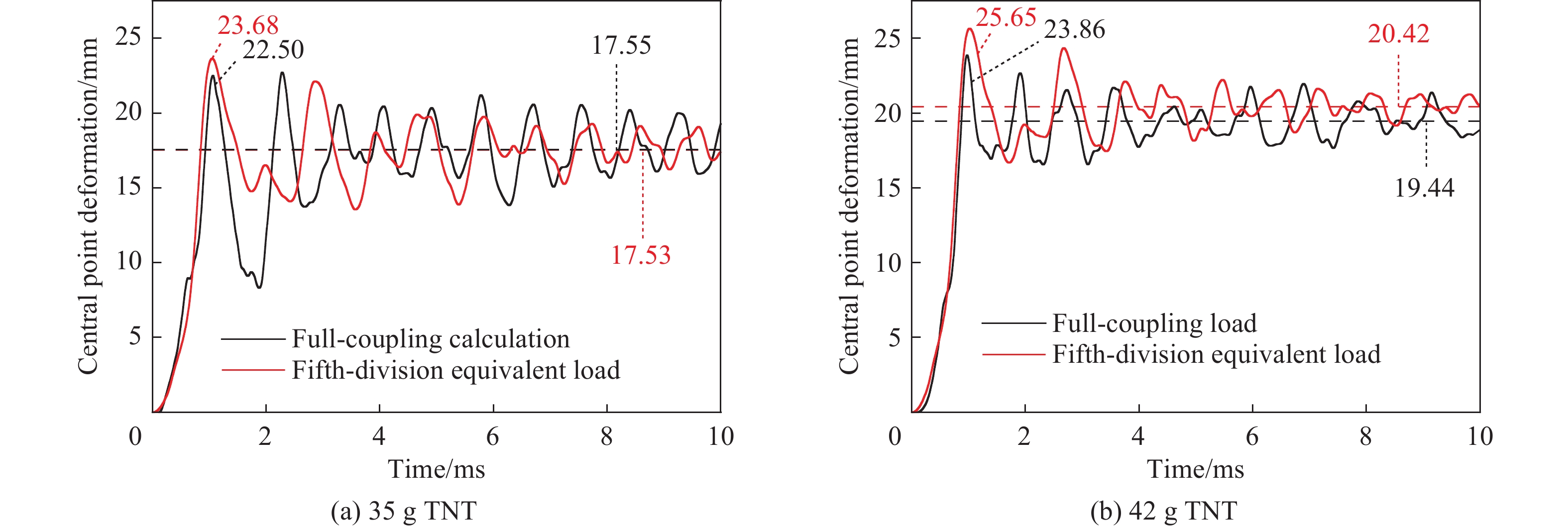
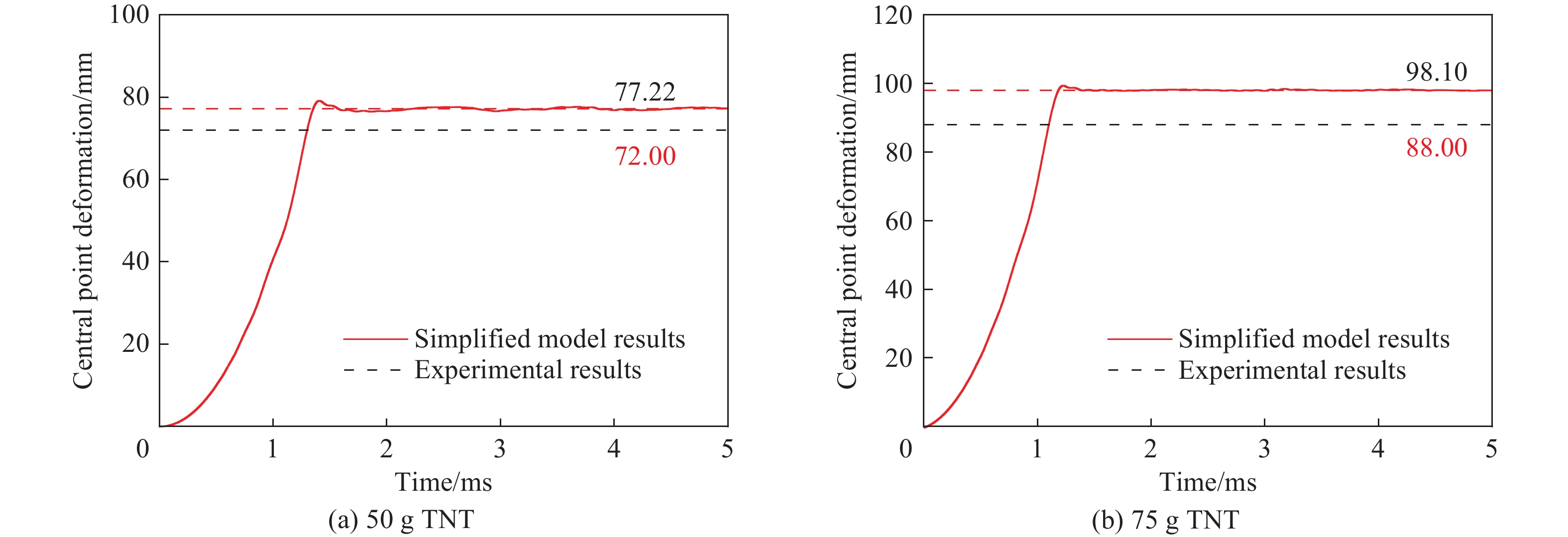
图 6 数值计算与试验的中心点变形时程曲线对比
Figure 6. Comparison of central point deformation time history curves between numerical calculation and experiment
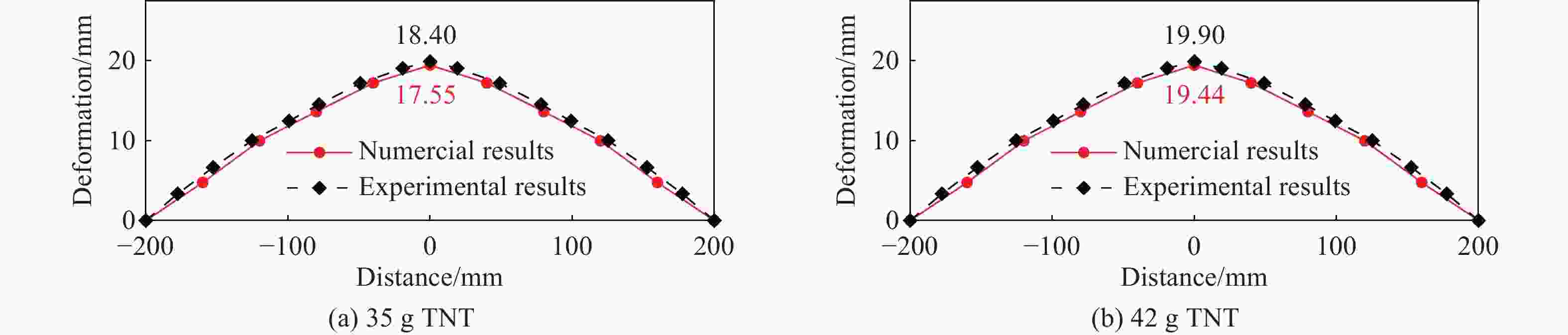
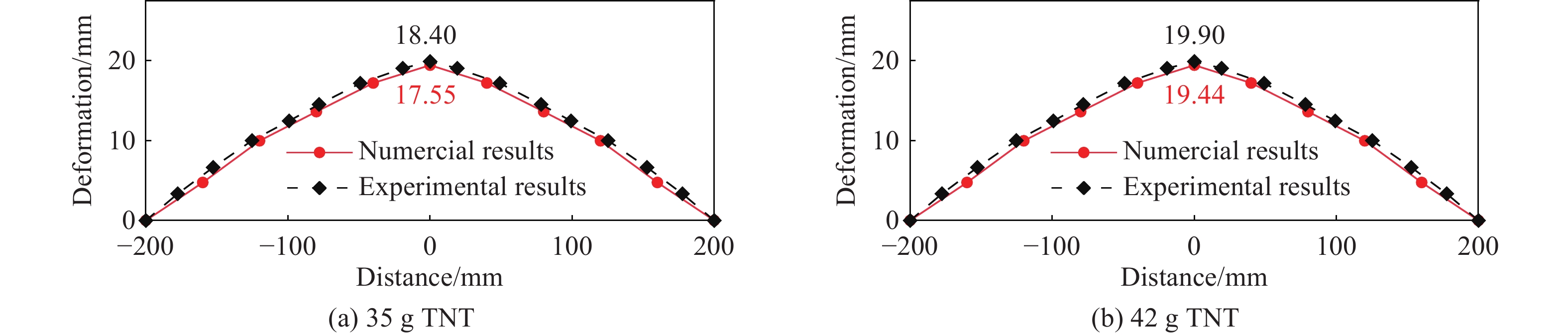
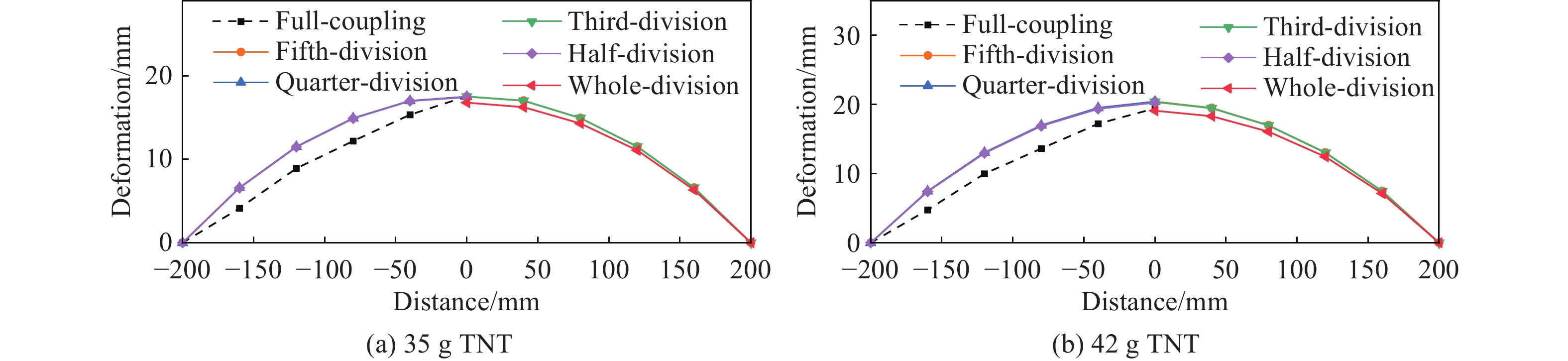
图 7 数值计算与试验的靶板剖面变形对比
Figure 7. Comparison of target plate cross-section deformation between numerical calculation and experiment
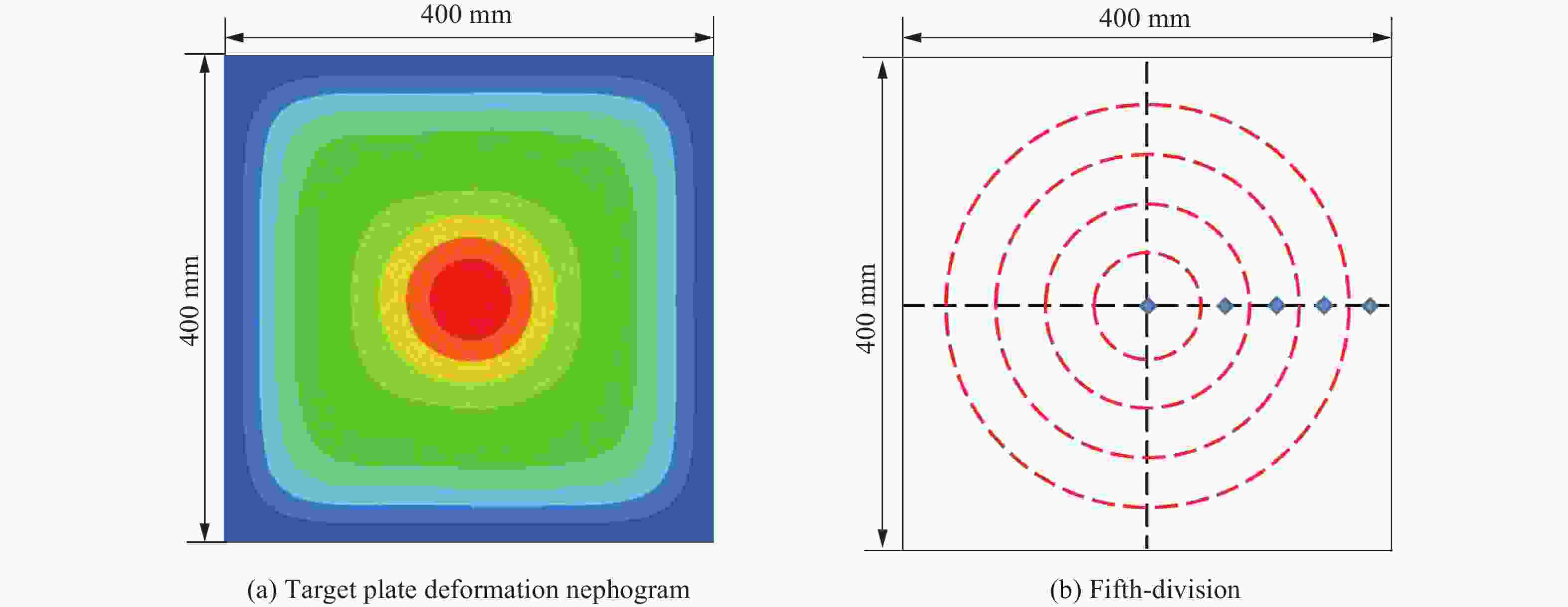
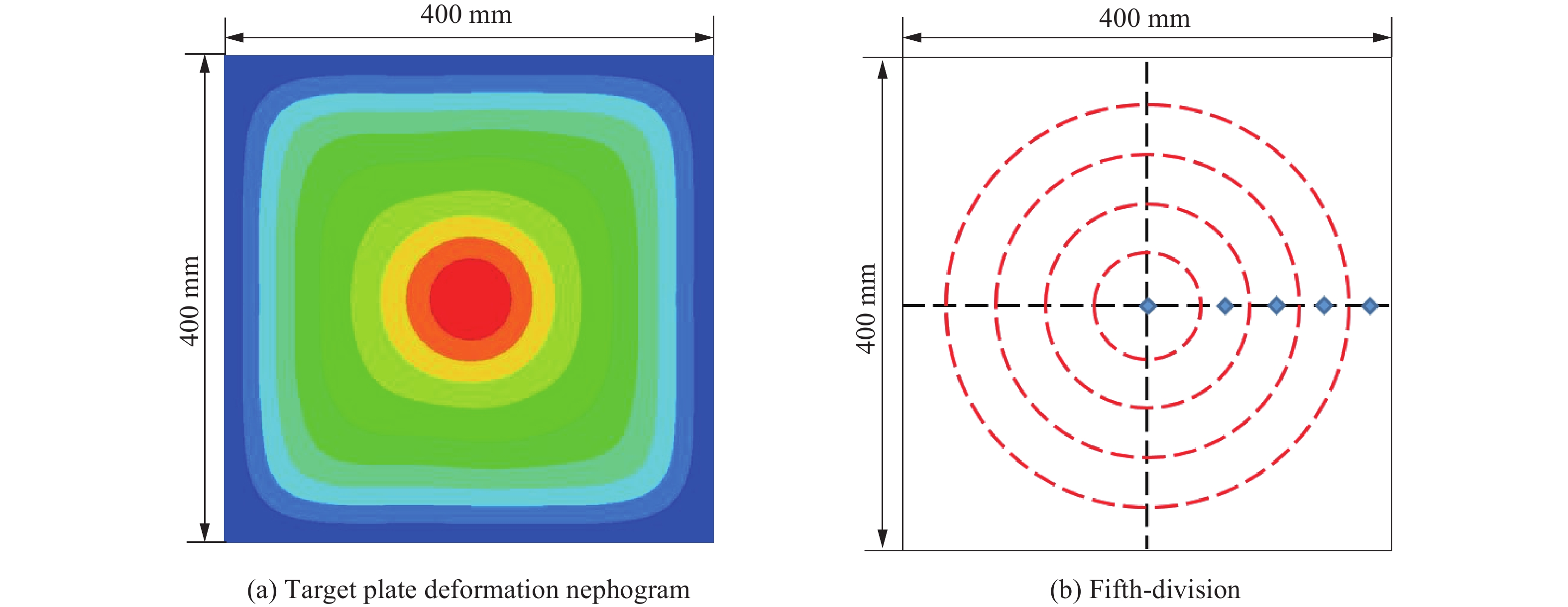
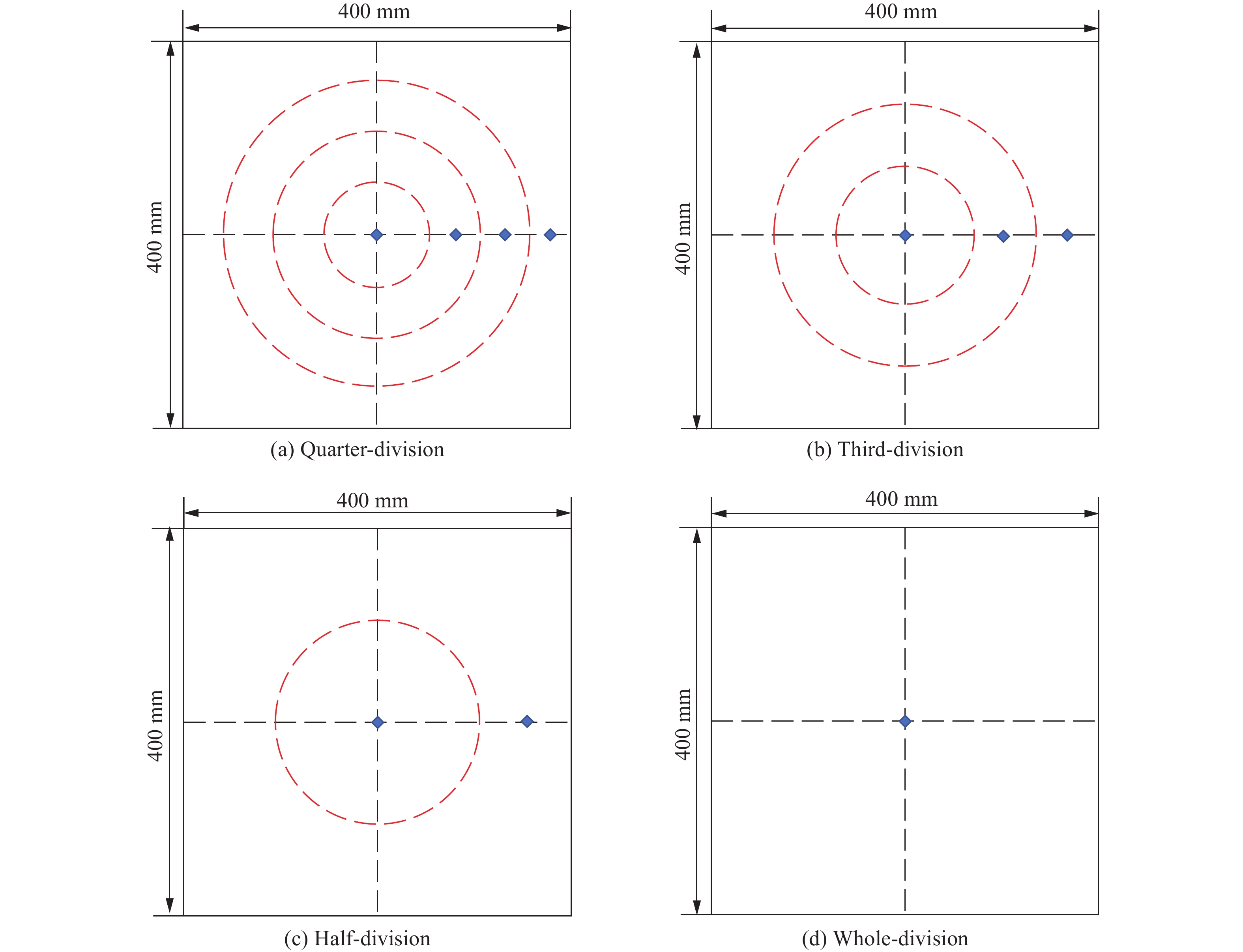
图 10 靶板加载区域划分示意图
Figure 10. Schematic diagram of loading area division on target plate
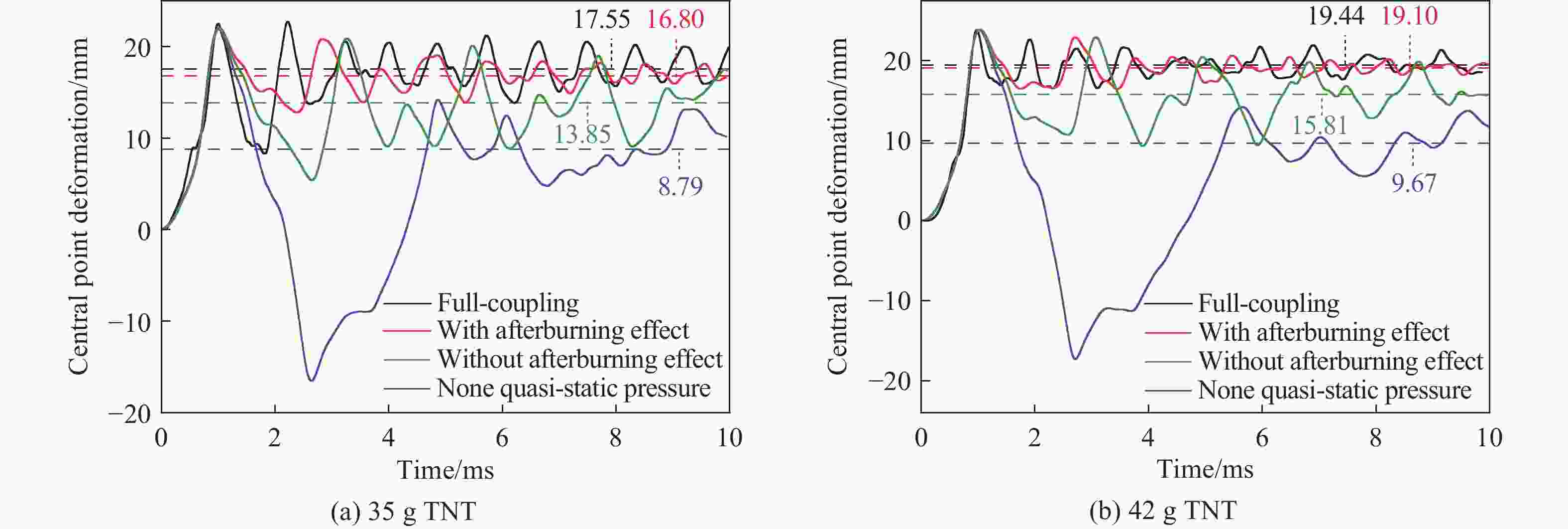
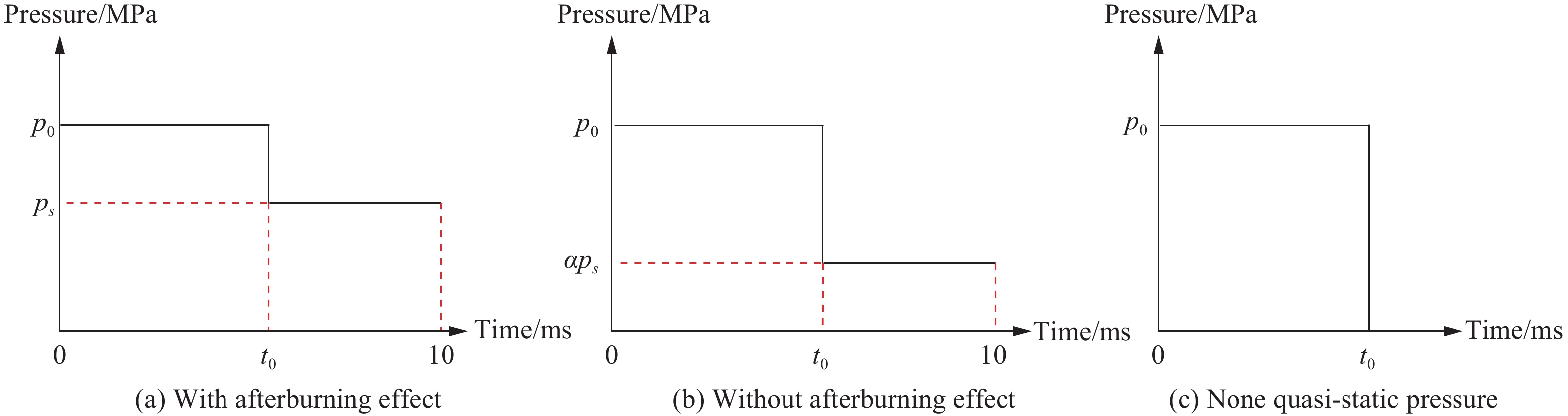
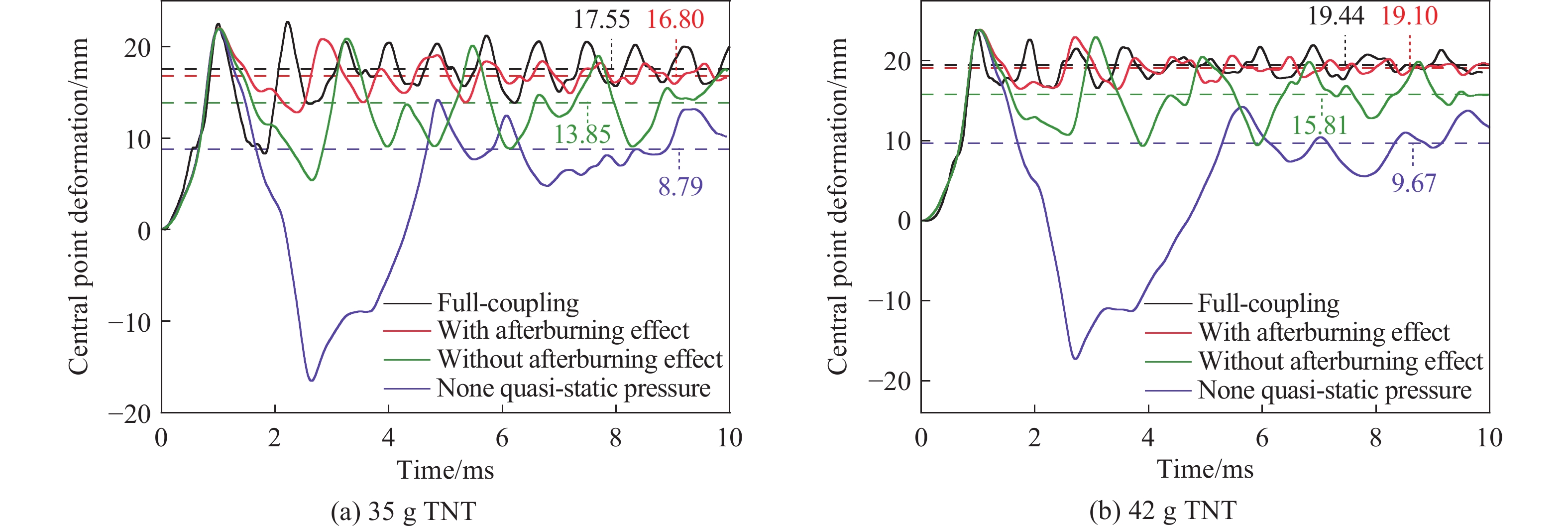
图 15 不同准静态压力下中心点变形时程曲线对比
Figure 15. Comparison of central point deformation time history curves under different quasi-static pressures
药量/g 直径/mm 高度/mm 28 25.2 36.0 35 30.1 31.2 42 30.1 37.6  下载: 导出CSV
A/GPa B/GPa R1 R2 w e0/(kJ·g-1) 371 3.23 4.15 0.95 0.30 4.30
下载: 导出CSV
表 3 3种药量的后燃烧能量
Table 3. Afterburning energies for three charge masses
药量/g (W·V-1)/(kg·m-3) 爆热/(kJ·g-1) 后燃烧能量/(kJ·g-1) 28 0.194 4.30 4.96 35 0.243 4.30 4.36 42 0.292 4.30 3.75
下载: 导出CSV
ρ/(g·cm−3) A/MPa B/MPa n D q 7.80 364 451 0.66 40 5.0
下载: 导出CSV
表 5 等效载荷与全耦合载荷计算的中心点变形对比
Table 5. Comparison of central point deformation between equivalent load and full-coupling load calculation
区域划分 药量/g 中心点变形 等效载荷/mm 全耦合载荷/mm 误差/% 五等分 35 残余变形 17.53 17.55 −0.16 首峰值变形 23.68 22.50 5.26 42 残余变形 20.42 19.44 5.03 首峰值变形 25.65 23.86 7.52 四等分 35 残余变形 17.52 17.55 −0.22 首峰值变形 23.66 22.50 5.16 42 残余变形 20.44 19.44 5.09 首峰值变形 25.65 23.86 7.54 三等分 35 残余变形 17.53 17.55 −0.14 首峰值变形 23.68 22.50 5.25 42 残余变形 20.37 19.44 4.75 首峰值变形 25.61 23.86 7.33 二等分 35 残余变形 17.46 17.55 −0.55 首峰值变形 23.61 22.50 4.94 42 残余变形 20.27 19.44 4.24 首峰值变形 25.55 23.86 7.11 一等分 35 残余变形 16.80 17.55 −4.32 首峰值变形 22.02 22.50 −2.12 42 残余变形 19.10 19.44 −1.76 首峰值变形 23.91 23.86 0.23
下载: 导出CSV
表 6 残余变形结果对比
Table 6. Comparison of residual deformation results
工况 板厚/mm 药量/g 简化模型值/mm 试验值/mm 误差 FC-3-2 3.4 20 14.99 15.70 −4.52% FC-3-4 3.4 30 20.46 21.80 −6.15% FC-3-5 3.4 40 25.36 27.50 −7.78% FC-3-6 3.4 50 31.34 34.60 −9.51% FC-3-7 3.4 60 35.15 39.80 −11.68% FC-3-8 3.4 70 40.16 43.30 −7.25% FC-4-1 4.0 20 12.55 11.60 7.76% FC-5-2 5.1 20 9.58 9.30 3.01%
下载: 导出CSV
-
[1] 朱锡, 张振华, 梅志远, 等. 舰船结构毁伤力学 [M]. 第1版. 北京: 国防工业出版社, 2013: 41–64. [2] 李营, 杜志鹏, 陈赶超, 等. 舰艇爆炸毁伤与防护若干关键问题研究进展 [J]. 中国舰船研究, 2024, 19(3): 3–60. DOI: 10.19693/j.issn.1673-3185.03930.LI Y, DU Z P, CHEN G C, et al. Fundamental problems in blast-induced damage and protection of naval vessels: a state-of-the-art review [J]. Chinese Journal of Ship Research, 2024, 19(3): 3–60. DOI: 10.19693/j.issn.1673-3185.03930. [3] EDRI I, SAVIR Z, FELDGUN V R, et al. On blast pressure analysis due to a partially confined explosion: I. Experimental studies [J]. International Journal of Protective Structures, 2011, 2(1): 1–20. DOI: 10.1260/2041-4196.2.1.1. [4] HU Y, WU C Q, LUKASZEWICZ M, et al. Characteristics of confined blast loading in unvented structures [J]. International Journal of Protective Structures, 2011, 2(1): 21–43. DOI: 10.1260/2041-4196.2.1.21. [5] 熊展, 巨圆圆, 张春辉, 等. 舱内爆炸冲击波载荷特性试验研究 [J]. 舰船科学技术, 2023, 45(22): 8–12. DOI: 10.3404/j.issn.1672-7649.2023.22.002.XIONG Z, JU Y Y, ZHANG C H, et al. Experimental research on loading characteristics of blast shock wave in cabin [J]. Ship Science and Technology, 2023, 45(22): 8–12. DOI: 10.3404/j.issn.1672-7649.2023.22.002. [6] 孔祥韶, 况正, 郑成, 等. 舱室密闭空间中爆炸载荷燃烧增强效应试验研究 [J]. 兵工学报, 2020, 41(1): 75–85. DOI: 10.3969/j.issn.1000-1093.2020.01.009.KONG X S, KUANG Z, ZHENG C, et al. Experimental study of afterburning enhancement effect for blast load in confined compartment space [J]. Acta Armamentarii, 2020, 41(1): 75–85. DOI: 10.3969/j.issn.1000-1093.2020.01.009. [7] KUHL A L, REICHENBACH H. Combustion effects in confined explosions [J]. Proceedings of the Combustion Institute, 2009, 32(2): 2291–2298. DOI: 10.1016/j.proci.2008.05.001. [8] 周沪, 岳学森, 孔祥韶, 等. 战斗部舱内爆炸下舰船耦合毁伤数值计算 [J]. 中国舰船研究, 2022, 17(5): 241–249,267. DOI: 10.19693/j.issn.1673-3185.02917.ZHOU H, YUE X S, KONG X S, et al. Numerical calculation of coupled damage effects on ship subjected to internal blast loading of warhead [J]. Chinese Journal of Ship Research, 2022, 17(5): 241–249,267. DOI: 10.19693/j.issn.1673-3185.02917. [9] ZHOU H, ZHENG C, YUE X S, et al. TNT equivalency method in confined space based on steel plate deformation [J]. International Journal of Impact Engineering, 2023, 178: 104587. DOI: 10.1016/j.ijimpeng.2023.104587. [10] ZHU L, YU T X. Saturated impulse for pulse-loaded elastic-plastic square plates [J]. International Journal of Solids and Structures, 1997, 34(14): 1709–1718. DOI: 10.1016/S0020-7683(96)00111-4. [11] ZHAO Y P, YU T X, FANG J. Large dynamic plastic deflection of a simply supported beam subjected to rectangular pressure pulse [J]. Archive of Applied Mechanics, 1994, 64(3): 223–232. DOI: 10.1007/BF00806819. [12] ZHAO Y P, YU T X, FANG J. Saturation impulses for dynamically loaded structures with finite-deflections [J]. Structural Engineering and Mechanics, 1995, 3(6): 583–592. DOI: 10.12989/SEM.1995.3.6.583. [13] NURICK G N, MARTIN J B. Deformation of thin plates subjected to impulsive loading: a review part Ⅱ: experimental studies [J]. International Journal of Impact Engineering, 1989, 8(2): 171–186. DOI: 10.1016/0734-743X(89)90015-8. [14] NURICK G N, MARTIN J B. Deformation of thin plates subjected to impulsive loading: a review [J]. International Journal of Impact Engineering, 1989, 8(2): 159–170. DOI: 10.1016/0734-743X(89)90014-6. [15] PICKERD V, BORNSTEIN H, MCCARTHY P, et al. Analysis of the structural response and failure of containers subjected to internal blast loading [J]. International Journal of Impact Engineering, 2016, 95: 40–53. DOI: 10.1016/j.ijimpeng.2016.04.010. [16] DRAGOS J, WU C Q, OEHLERS D J. Simplification of fully confined blasts for structural response analysis [J]. Engineering Structures, 2013, 56: 312–326. DOI: 10.1016/j.engstruct.2013.05.018. [17] 孔祥韶, 周沪, 郑成, 等. 基于饱和响应时间的封闭空间内爆炸载荷等效方法研究 [J]. 爆炸与冲击, 2019, 39(9): 092102. DOI: 10.11883/bzycj-2018-0183.KONG X S, ZHOU H, ZHENG C, et al. An equivalent calculation method for confined-blast load based on saturated response time [J]. Explosion and Shock Waves, 2019, 39(9): 092102. DOI: 10.11883/bzycj-2018-0183. [18] 罗峰, 孔祥韶, 周沪, 等. 封闭空间内活性毁伤元战斗部爆炸载荷特性研究 [J]. 含能材料, 2024, 32(9): 911–920. DOI: 10.11943/CJEM2024138.LUO F, KONG X S, ZHOU H, et al. Blast load characteristic of reactive damage element warheads in enclosed space [J]. Chinese Journal of Energetic Materials, 2024, 32(9): 911–920. DOI: 10.11943/CJEM2024138. [19] 周沪. 热塑性纤维增强金属层合板爆炸响应与抗弹特性研究 [D]. 武汉: 武汉理工大学, 2020: 49–61. [20] ZHOU H, YUE X S, ZHENG C, et al. Dynamic behavior of steel plates subjected to confined blast loading considering afterburning effect [J]. International Journal of Impact Engineering, 2024, 188: 104934. DOI: 10.1016/j.ijimpeng.2024.104934. [21] ZHOU H, LU A G, ZHENG C, et al. Experimental and numerical approach of afterburning effects in fuel-rich explosives within confined spaces [J]. Defence Technology, 2025, 51: 67–79. DOI: 10.1016/j.dt.2025.05.009. [22] KONG X S, ZHOU H, KUANG Z, et al. Corrected method for scaling the dynamic response of stiffened plate subjected to blast load [J]. Thin-Walled Structures, 2021, 159: 107214. DOI: 10.1016/j.tws.2020.107214. [23] LEE E, FINGER M, COLLINS W. JWL equation of state coefficients for high explosives: UCID-16189 [R]. California: Lawrence Livermore National Laboratory, 1973. [24] 岳学森, 周沪, 孔祥韶, 等. 舱室内爆载荷燃烧增强效应试验及仿真研究 [J]. 中国舰船研究, 2023, 18(4): 223–232. DOI: 10.19693/j.issn.1673-3185.02708.YUE X S, ZHOU H, KONG X S, et al. Experimental and simulation study of afterburning effect for blast load in confined cabin [J]. Chinese Journal of Ship Research, 2023, 18(4): 223–232. DOI: 10.19693/j.issn.1673-3185.02708. [25] FELDGUN V R, KARINSKI Y S, EDRI I, et al. Prediction of the quasi-static pressure in confined and partially confined explosions and its application to blast response simulation of flexible structures [J]. International Journal of Impact Engineering, 2016, 90: 46–60. DOI: 10.1016/j.ijimpeng.2015.12.001. [26] UFC 3-340-02 Structures to resist the effects of accidental explosions [S]. Washington: UFC, 2008. [27] 周沪, 孔祥韶, 罗峰, 等. 基于结构响应的舱室内爆TNT等效方法 [J]. 中国舰船研究, 2024, 19(3): 86–95. DOI: 10.19693/j.issn.1673-3185.03484.ZHOU H, KONG X S, LUO F, et al. TNT equivalency method in confined cabin based on structural response [J]. Chinese Journal of Ship Research, 2024, 19(3): 86–95. DOI: 10.19693/j.issn.1673-3185.03484. [28] ZHOU H, LU A G, ZHENG C, et al. Study on blast loading from cased charges in confined spaces using reactive flow modelling of afterburning [J]. International Journal of Impact Engineering, 2026, 209: 105580. DOI: 10.1016/j.ijimpeng.2025.105580. [29] KONG X S, ZHOU H, XU J B, et al. Scaling of confined explosion and structural response [J]. Thin-Walled Structures, 2023, 186: 110656. DOI: 10.1016/j.tws.2023.110656. [30] 徐敬博, 卢安格, 周沪, 等. 封闭空间内爆载荷下结构响应试验及仿真研究 [J]. 舰船科学技术, 2024, 46(10): 34–42. DOI: 10.3404/j.issn.1672-7649.2024.10.006.XU J B, LU A G, ZHOU H, et al. Experimental and simulation research on structural response under blast load in confined space [J]. Ship Science and Technology, 2024, 46(10): 34–42. DOI: 10.3404/j.issn.1672-7649.2024.10.006. [31] 郑成. 舱内爆炸载荷下单层及多层层合板响应特性研究 [D]. 武汉: 武汉理工大学, 2018: 57–72.ZHENG C. Research on the dynamic response of single-layer and multi-layer plates under confined blast loading [D]. Wuhan: Wuhan University of Technology, 2018: 57–72. [32] GERETTO C, YUEN S C K, NURICK G N. An experimental study of the effects of degrees of confinement on the response of square mild steel plates subjected to blast loading [J]. International Journal of Impact Engineering, 2015, 79: 32–44. DOI: 10.1016/j.ijimpeng.2014.08.002. [33] YUAN Y, ZHANG C J, XU Y X. Influence of standoff distance on the deformation of square steel plates subjected to internal blast loadings [J]. Thin-Walled Structures, 2021, 164: 107914. DOI: 10.1016/j.tws.2021.107914. -

计量
- 文章访问数: 704
- HTML全文浏览量: 249
- PDF下载量: 231
- 被引次数: 0