



Mechanical behavior of wheel-rail rolling-sliding contact in high-speed railways based on an impact fatigue constitutive model
-
摘要: 冲击疲劳是指材料/结构在反复冲击载荷的作用下,局部应力集中和应变快速累积引发材料/结构内部微损伤,并最终发生断裂失效的现象。冲击疲劳载荷具有作用时间短、加载速度快和应变率较高等特点,比常规疲劳具有更大的危害性。高速铁路轮轨动态接触载荷具有典型的冲击疲劳载荷特征,会引起冲击疲劳损伤累积,加剧服役性能劣化,从而影响高速列车运行的安全性。基于此,本文结合轮轨材料冲击疲劳损伤耦合本构模型,开展了三维轮轨滚动接触有限元模拟,厘清了高速铁路轮轨瞬时滚滑接触应力/应变状态和黏滑特性,分析了轮轨冲击疲劳损伤的分布特征和累积演化规律,探讨了列车速度、摩擦因数和牵引系数对冲击疲劳损伤的影响,比较了材料本构模型对轮轨滚滑接触力学行为的影响。结果表明,本文提出的轮轨材料冲击疲劳本构模型可以较好地模拟轮轨滚滑接触力学响应、黏滑分布特征和冲击疲劳损伤累积规律;轮轨多次滚动接触时,钢轨冲击疲劳损伤随滚动次数的增加呈现出非线性累积增长的趋势,但增长速率逐渐减小并近似趋于稳定;与弹塑性本构模型相比,冲击疲劳本构模型预测的轮轨接触力学响应更偏危险,且随着车轮滚动次数的增加,冲击疲劳损伤耦合影响逐渐增大。研究结果可为高速轮轨系统的疲劳损伤评估与寿命预测提供理论指导和技术支持。Abstract: Impact fatigue refers to the phenomenon in which materials or structures, subjected to repeated impact loading, experience localized stress concentrations and rapid strain accumulation, leading to the initiation of internal micro-damage and ultimately the fracture failure. Impact fatigue loads are characterized by their short duration, rapid loading rates and significantly elevated strain-rates, which has greater threat than conventional fatigue. The wheel-rail dynamic contact forces of high-speed trains exhibit typical characteristics of impact fatigue loading, which induces the accumulation of impact fatigue damage, accelerates the deterioration of material’s mechanical properties; and consequently, compromises the operational safety of high-speed trains. The present study integrates a material-based impact fatigue damage-coupled constitutive model to develop a comprehensive three-dimensional wheel-rail rolling contact finite element model. The stress-strain states and adhesion-slip characteristics of wheel-rail rolling/sliding contact are clarified, and the distribution features and accumulation evolution of wheel-rail impact fatigue damage are analyzed. Meanwhile, the effects of train speed, friction coefficient, and traction coefficient on impact fatigue damage are studied, and the influence of material constitutive model on typical wheel-rail contact mechanical behavior is examined. The results clearly indicate that the proposed impact fatigue model is able to well represent the wheel-rail contact responses, adhesion-slip distribution characteristics and damage accumulation. Under repeated rolling contact, the impact fatigue damage of the rail exhibits a nonlinear cumulative increasing trend with the increase of rolling cycles; however, the growth rate gradually decreases and eventually tends to stabilize approximately. Compared with the elastoplastic constitutive model, the wheel-rail contact mechanical responses predicted by the impact fatigue constitutive model are more severe and dangerous. Moreover, the coupling effect of impact fatigue damage gradually intensifies with the increase of wheel passages. These findings provide valuable theoretical insights and technical support for fatigue damage assessment and life prediction of high-speed wheel-rail systems.
-
Key words:
- impact fatigue /
- rolling contact /
- plastic deformation /
- finite element analysis /
- high-speed wheel-rail
-
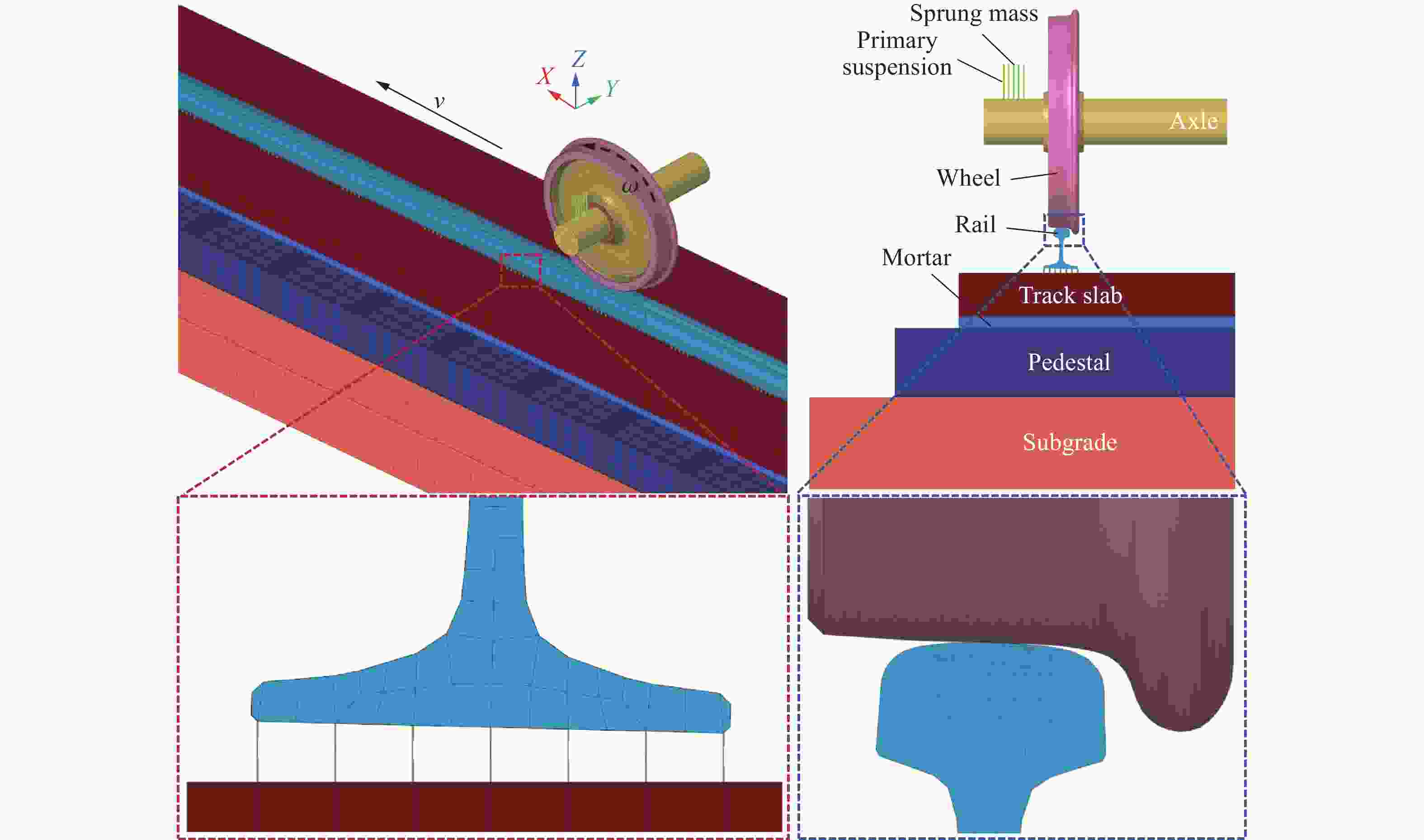
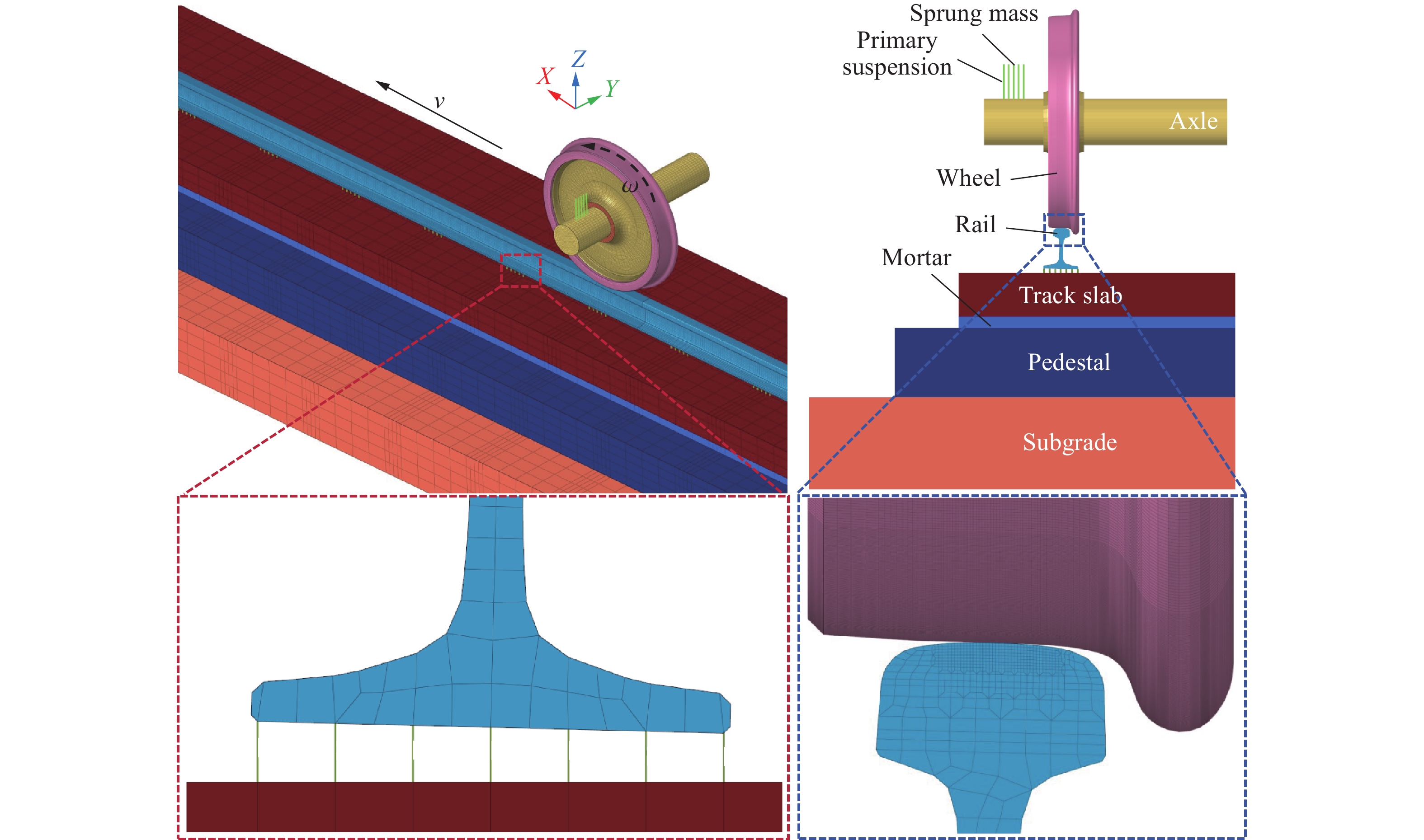
图 1 半轮对-钢轨三维轮轨滚动接触有限元模型
Figure 1. Three-dimensional rolling contact finite element model of half-wheel-rail system
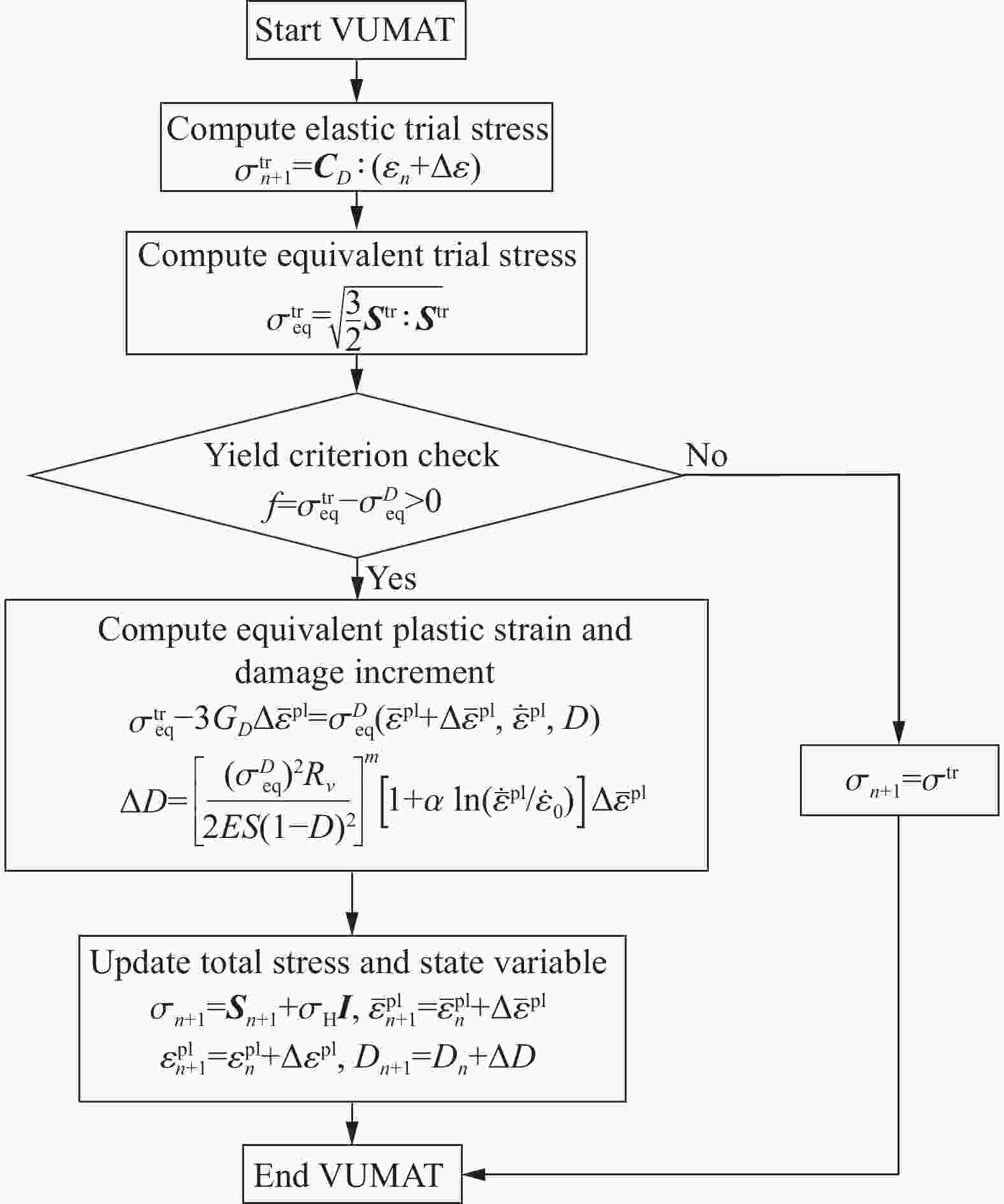
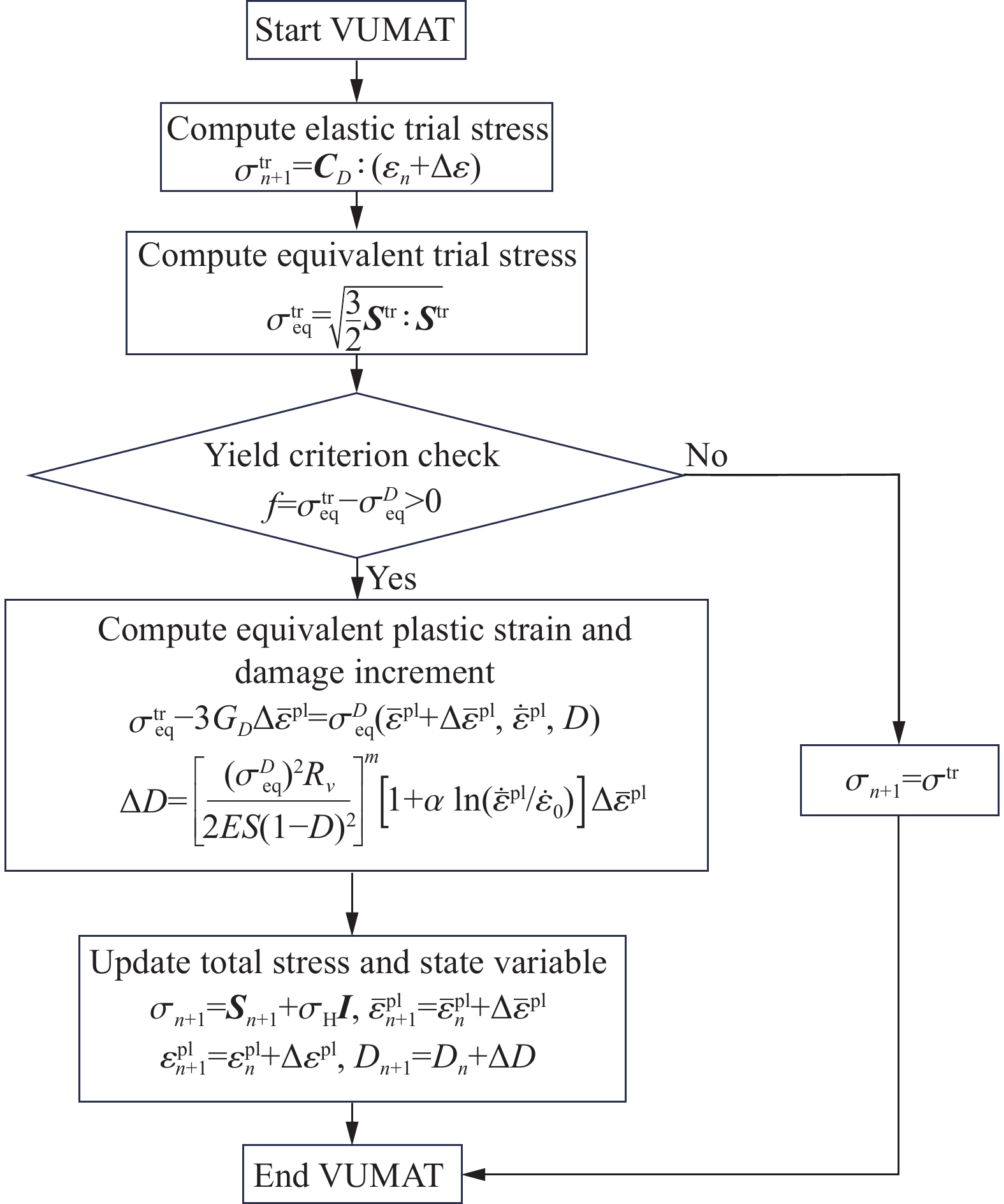
图 2 损伤耦合本构模型子程序流程图
Figure 2. Flowchart of the user material subroutine for the damage-coupled constitutive model
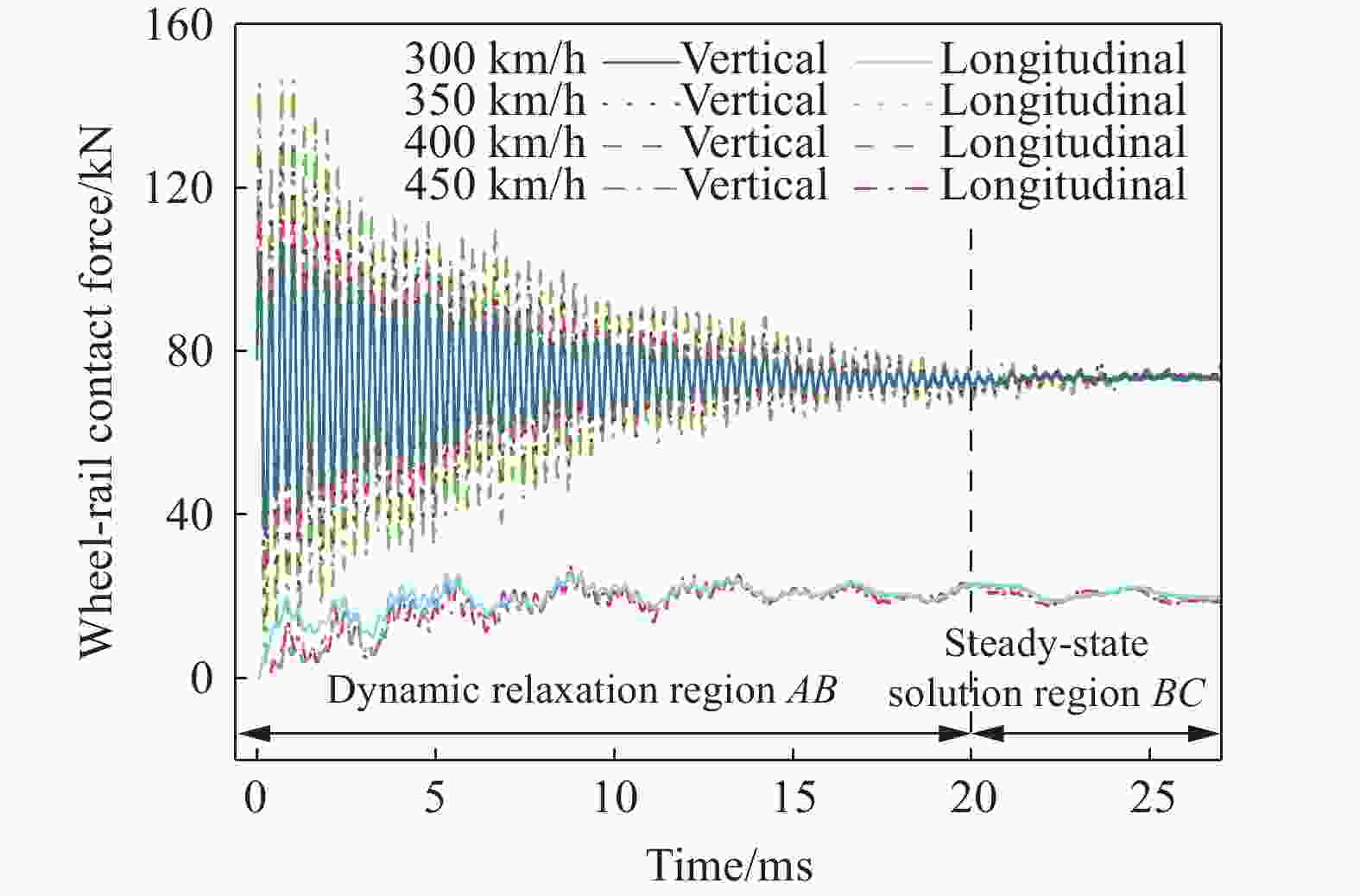
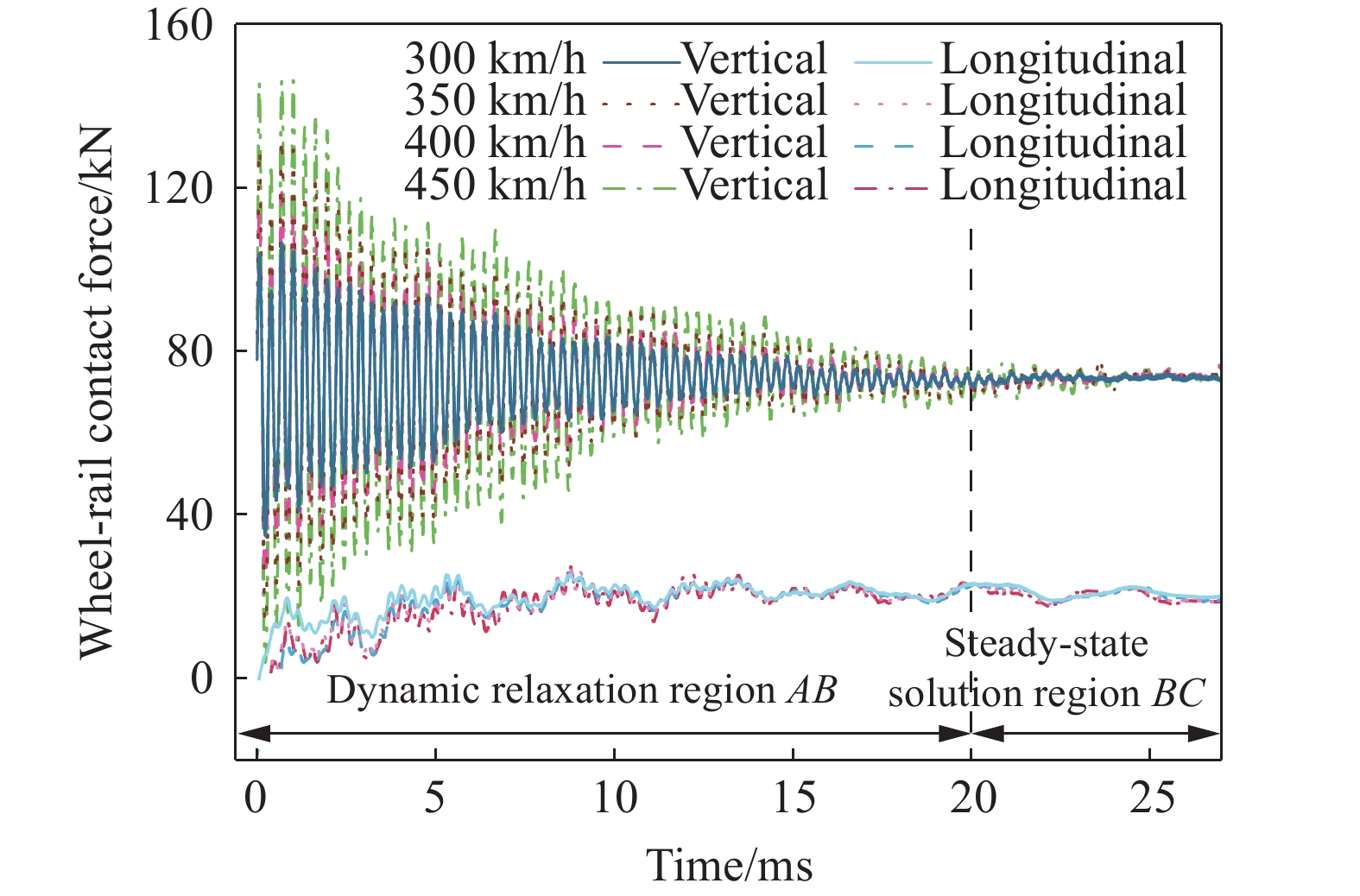
图 3 不同列车速度下的轮轨接触力时程曲线
Figure 3. Time-history curves of wheel-rail contact forces at different train speeds
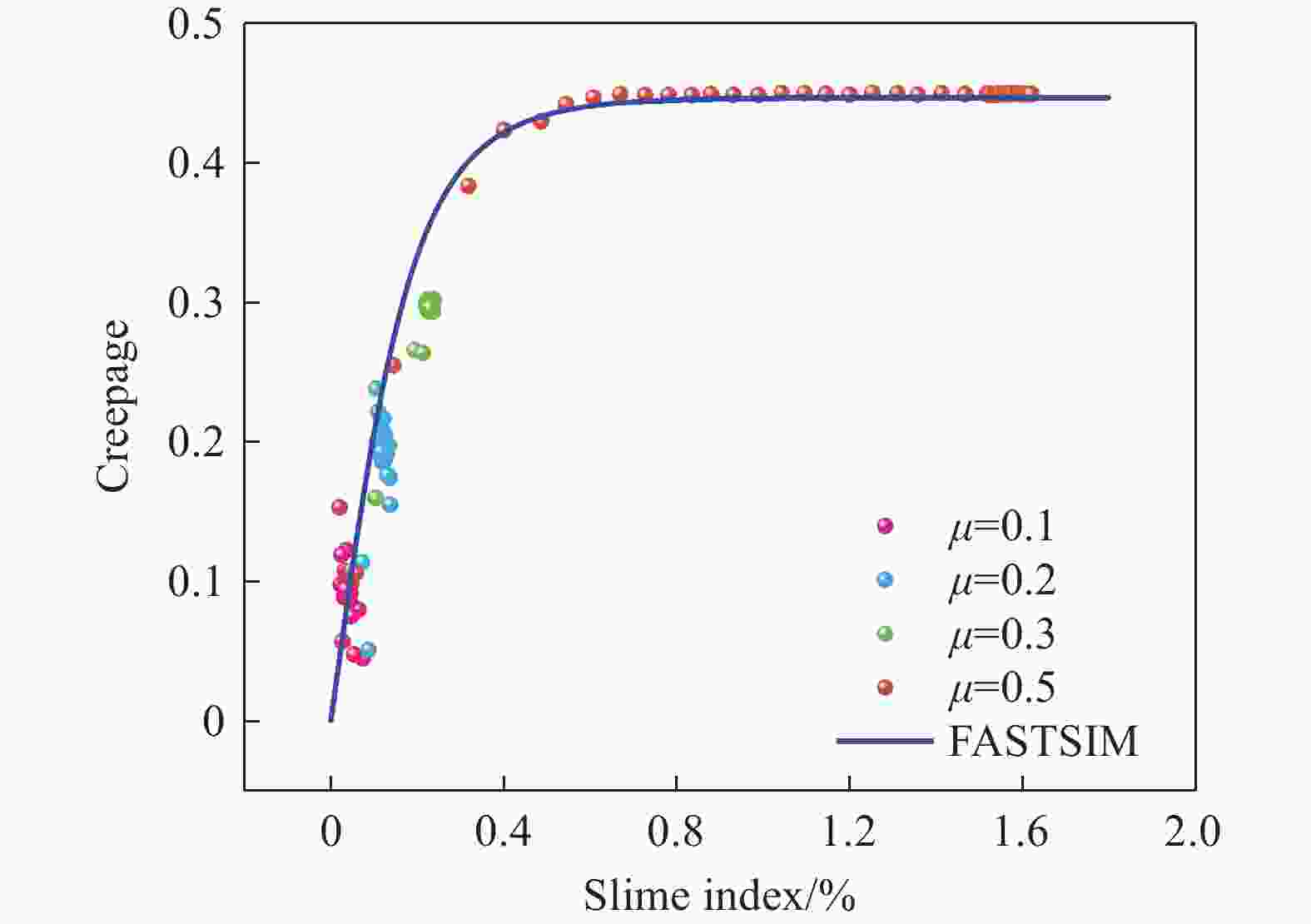
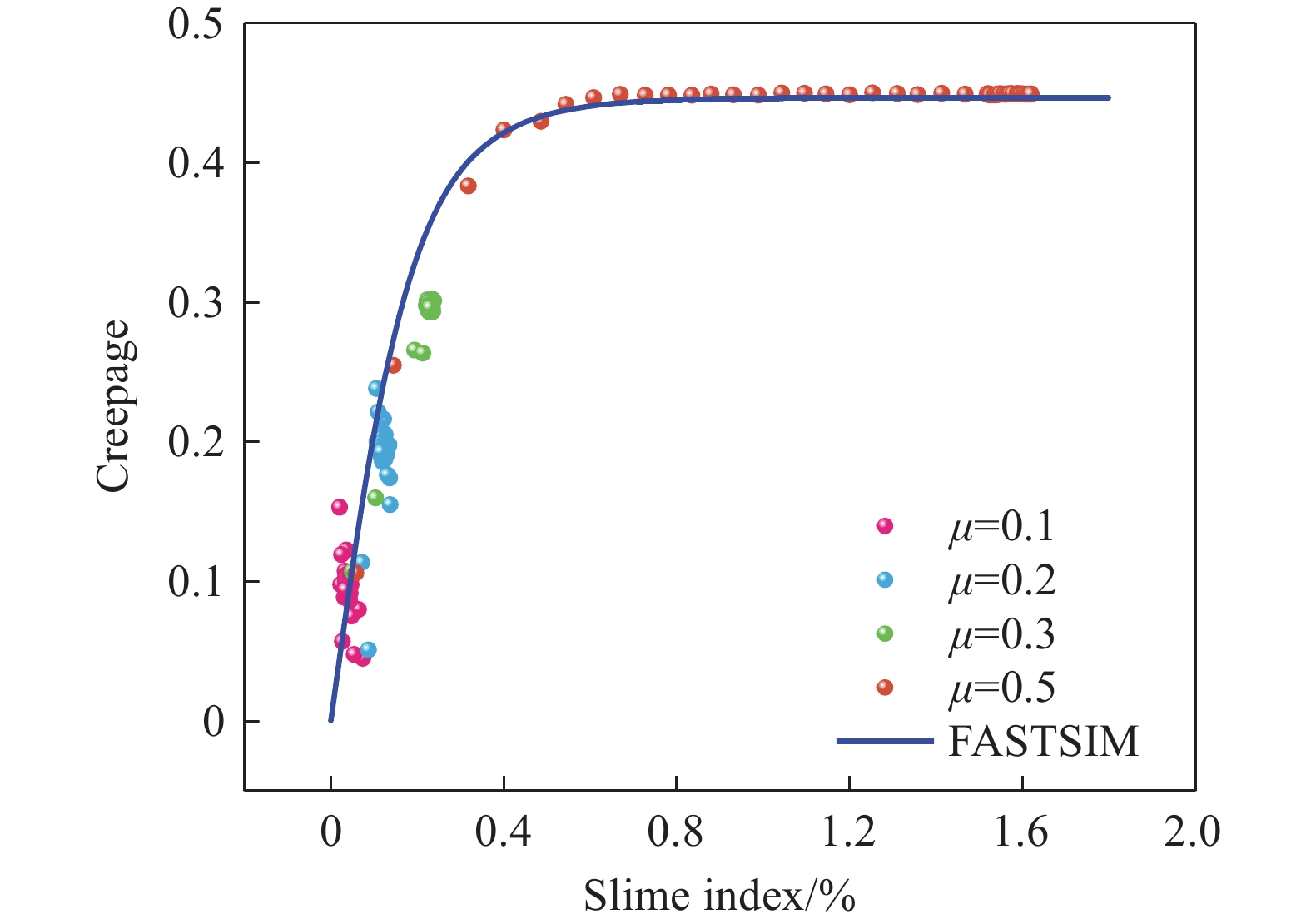
图 4 基于有限元法和FASTSIM算法的黏滑特性曲线
Figure 4. Adhesion-slip characteristic curve based on the finite element method and FASTSIM algorithm
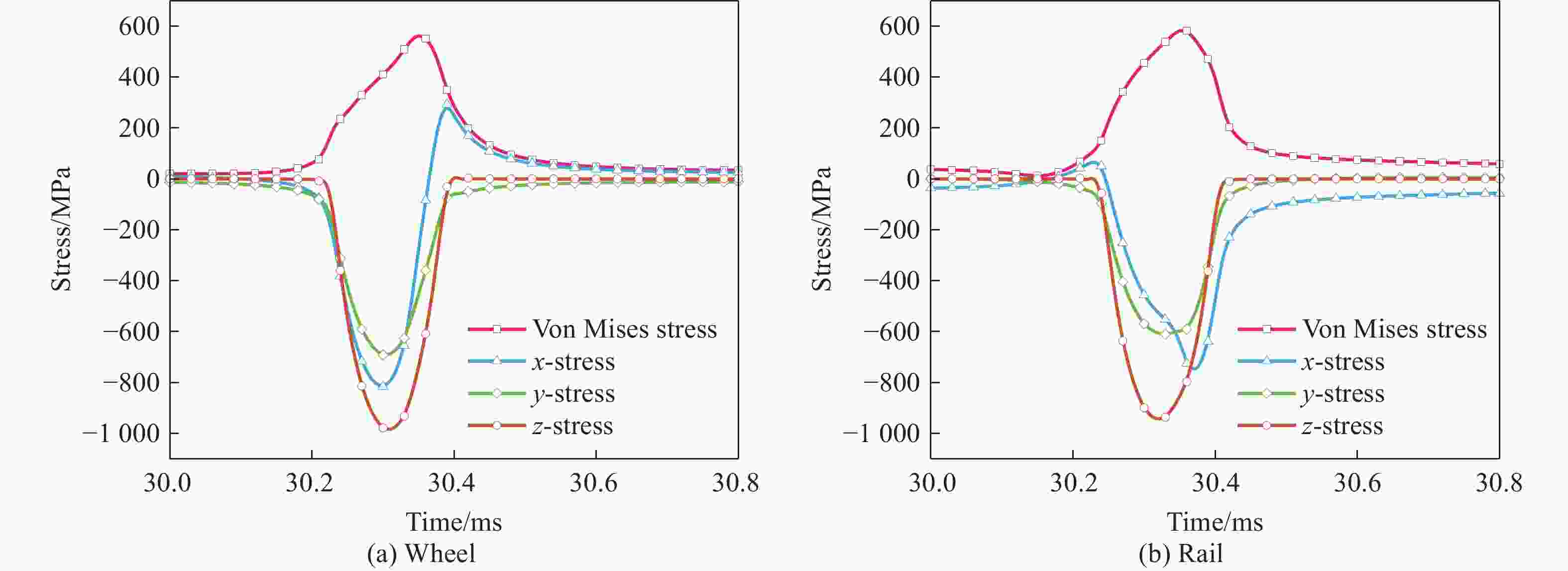
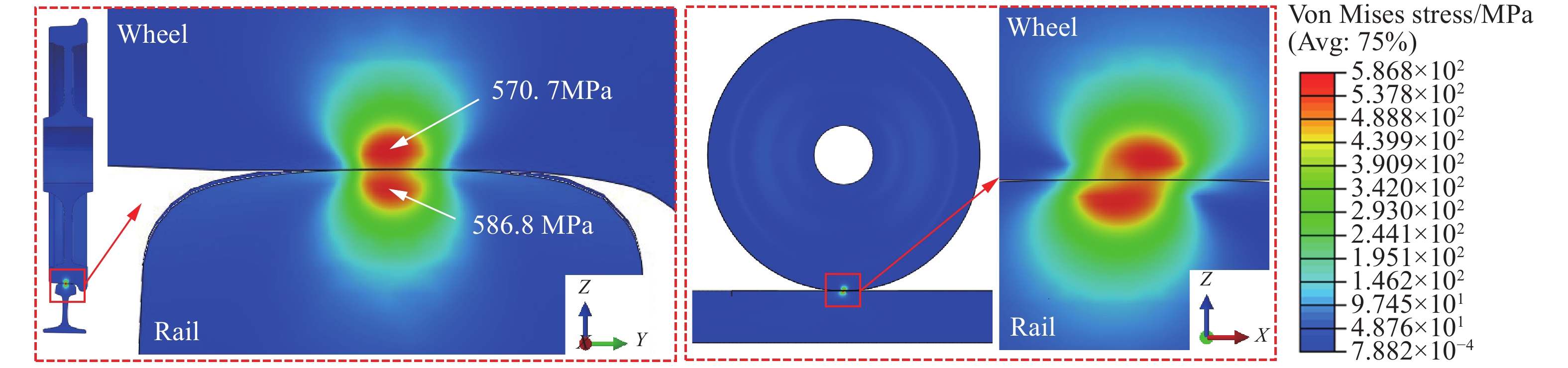
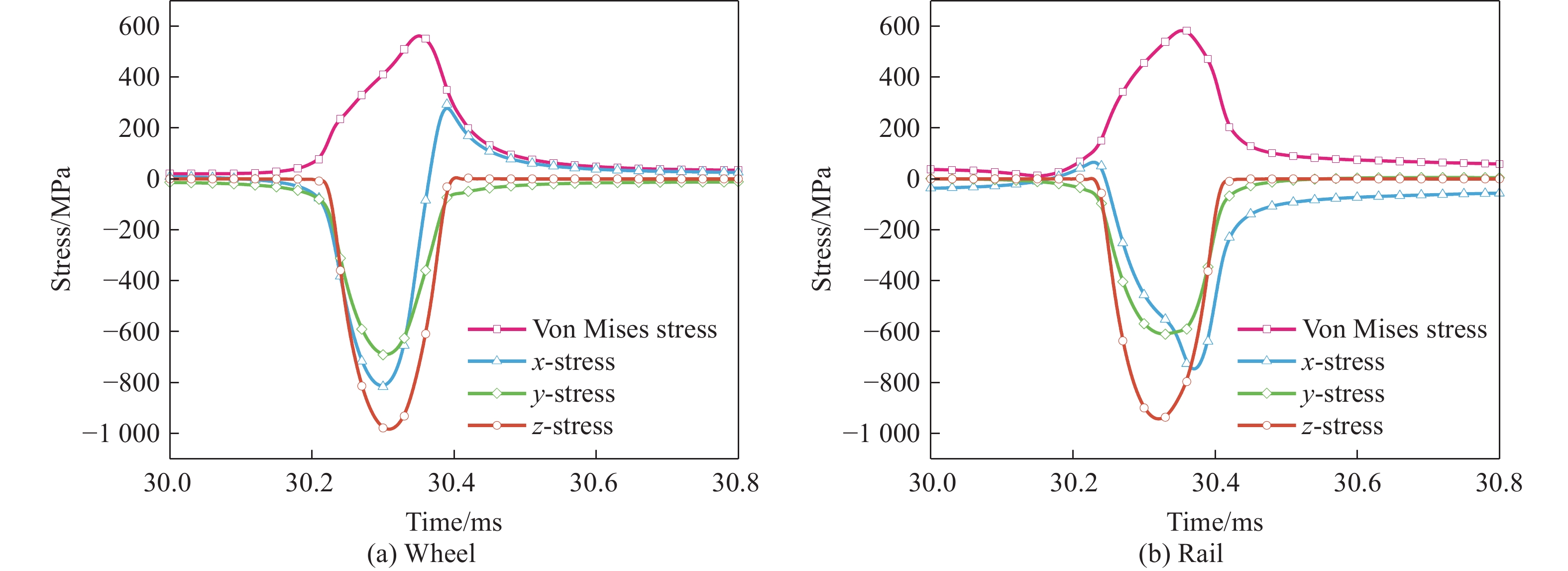
图 6 轮轨接触区车轮和钢轨的应力时程曲线
Figure 6. Stress-time curves of wheel and rail on the wheel-rail contact interface
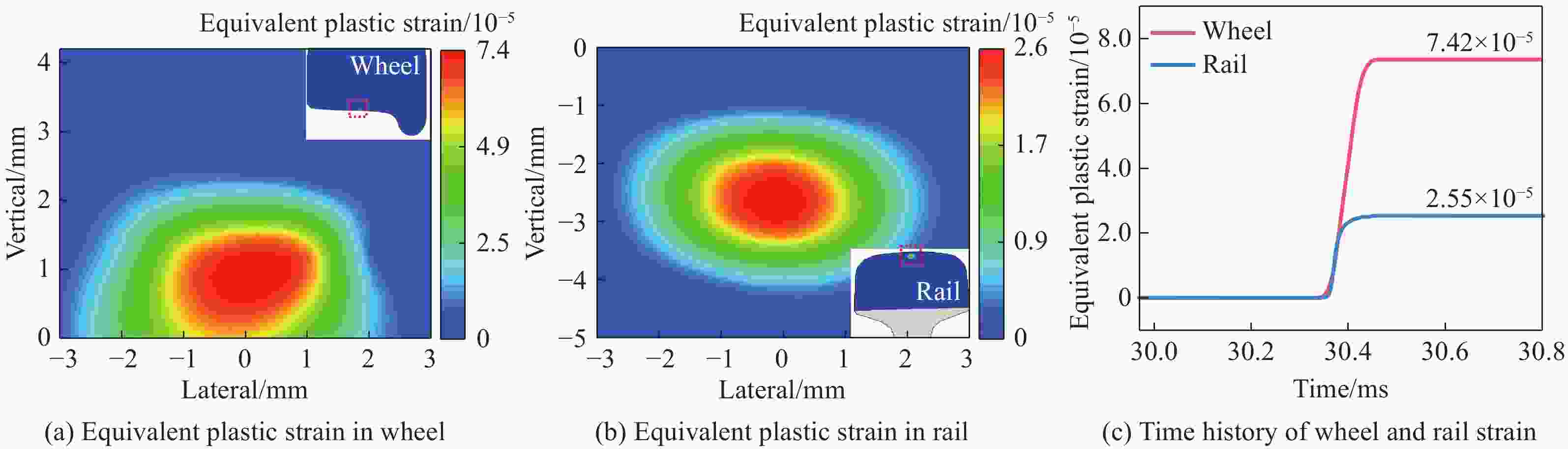
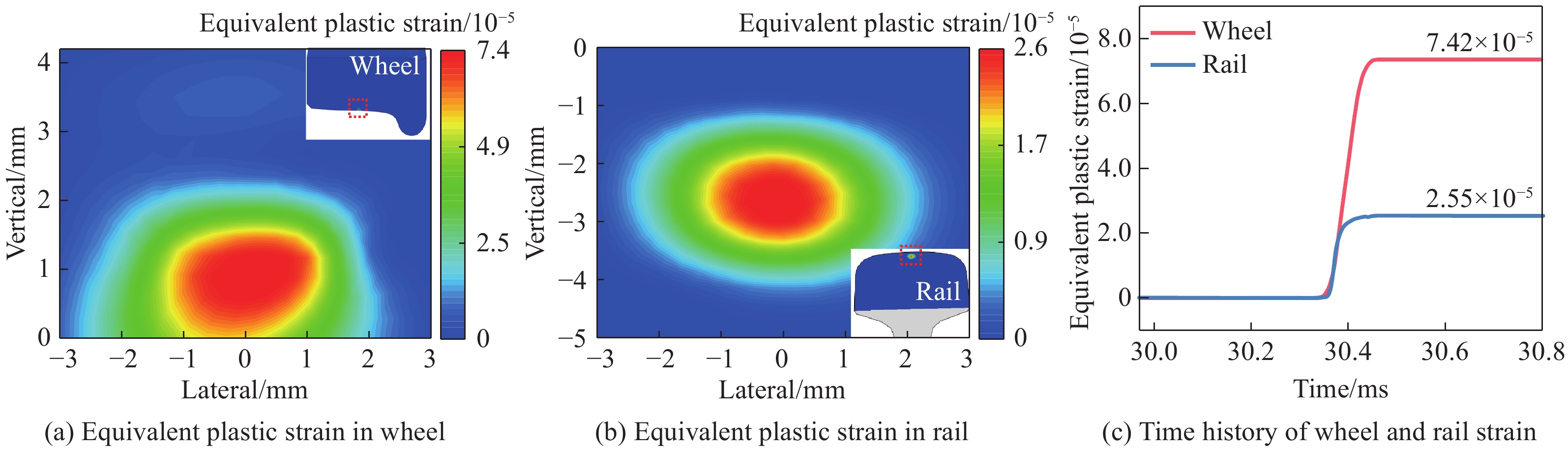
图 7 轮轨的等效塑性应变分布及其时程响应特征
Figure 7. Equivalent plastic strain distributions on the wheel-rail contact interface, and their time-history curves
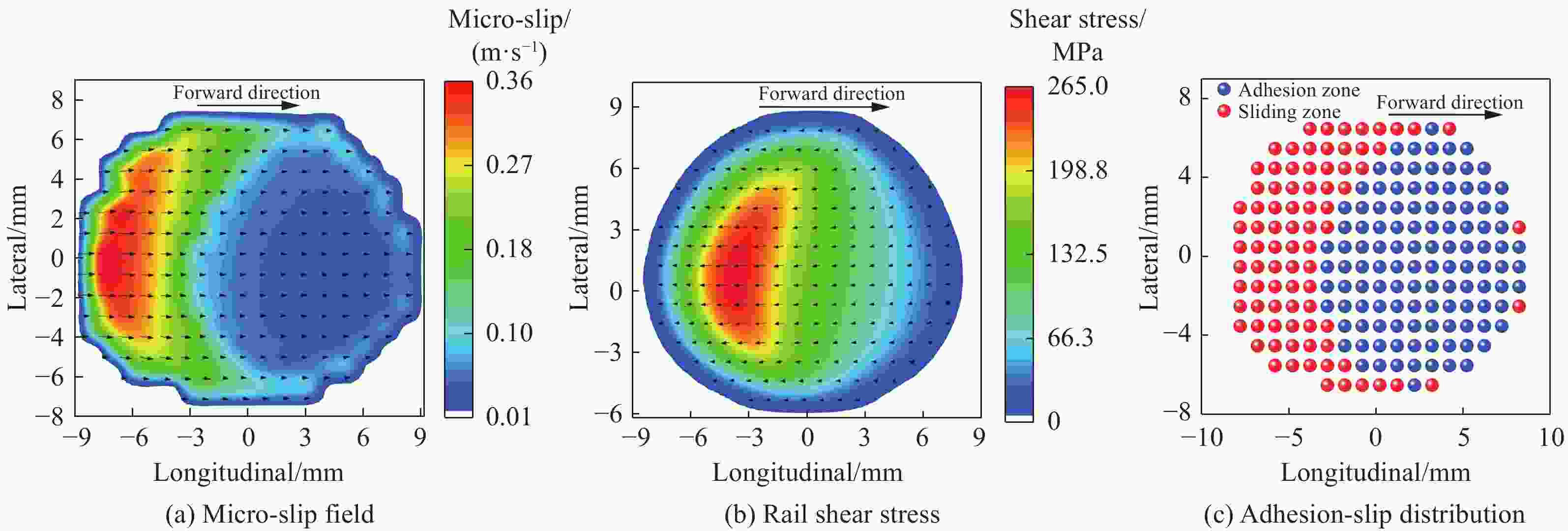
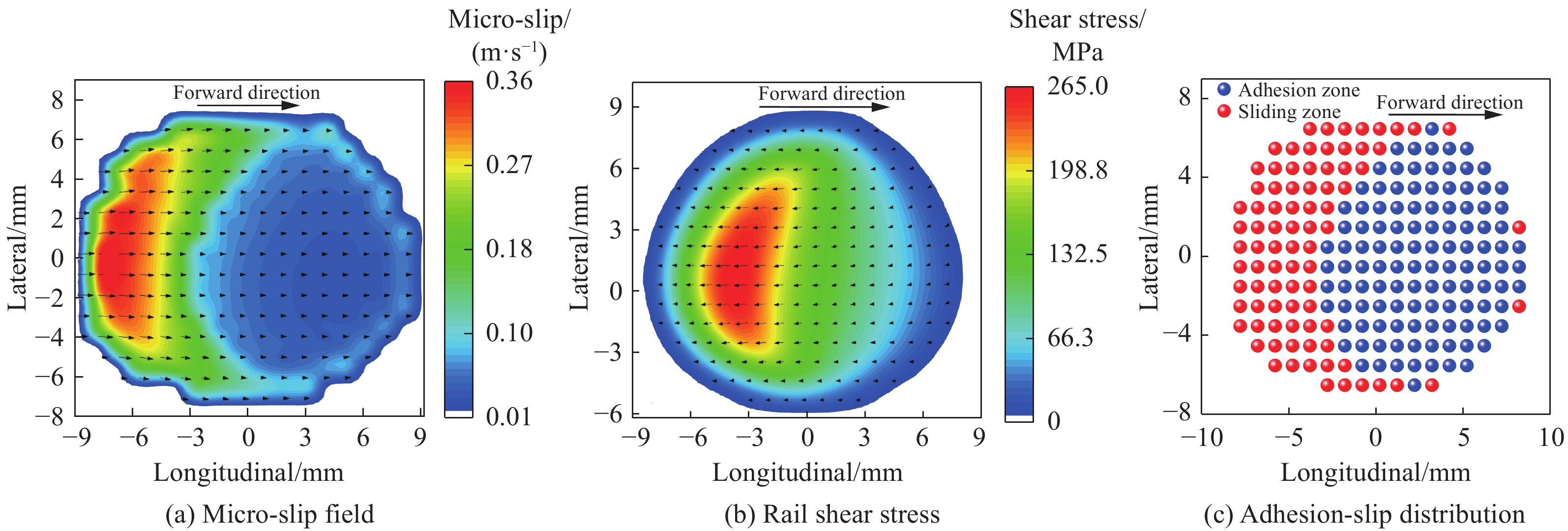
图 8 轮轨接触界面黏滑状态与剪切应力的分布特性
Figure 8. Adhesion-slip behavior and shear stress distribution at the wheel-rail contact interface
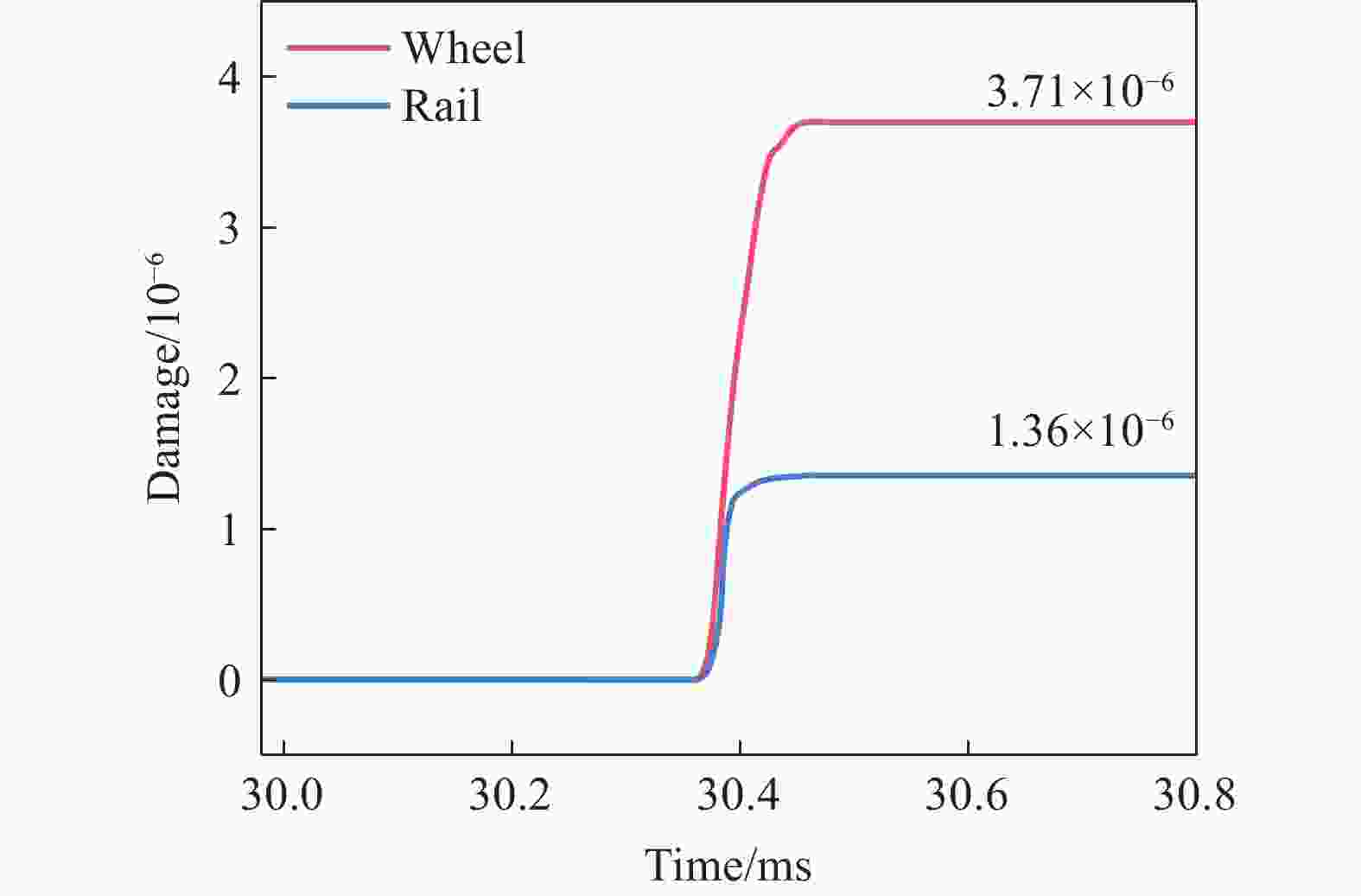
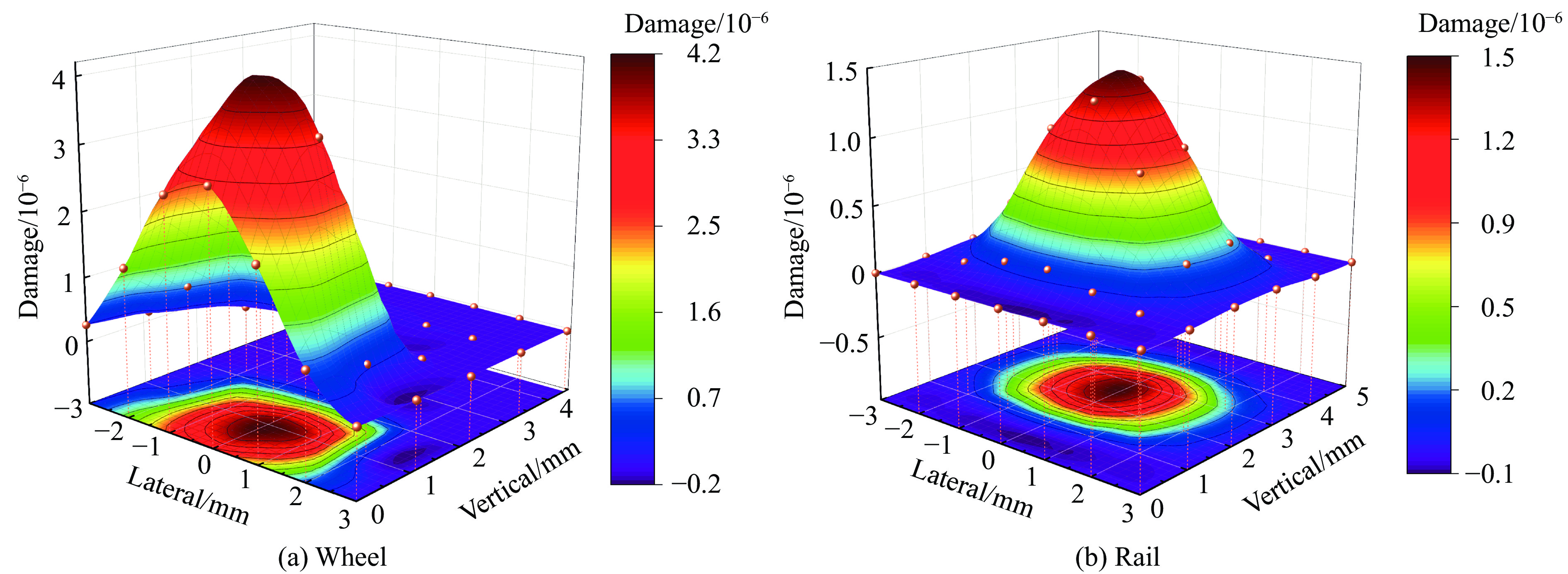
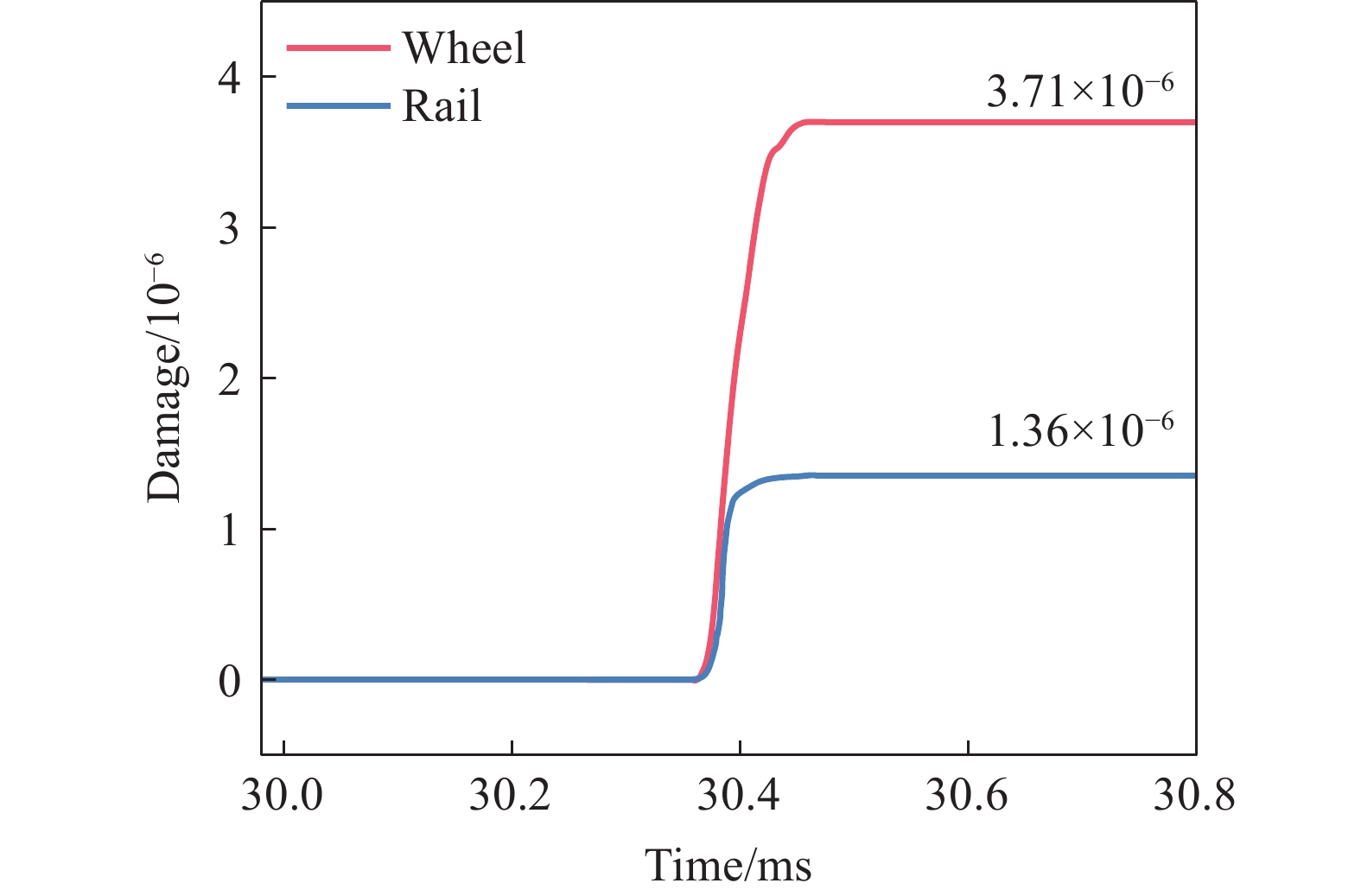
图 10 轮轨冲击疲劳损伤时程响应曲线
Figure 10. Time-response curves of wheel-rail impact fatigue damage
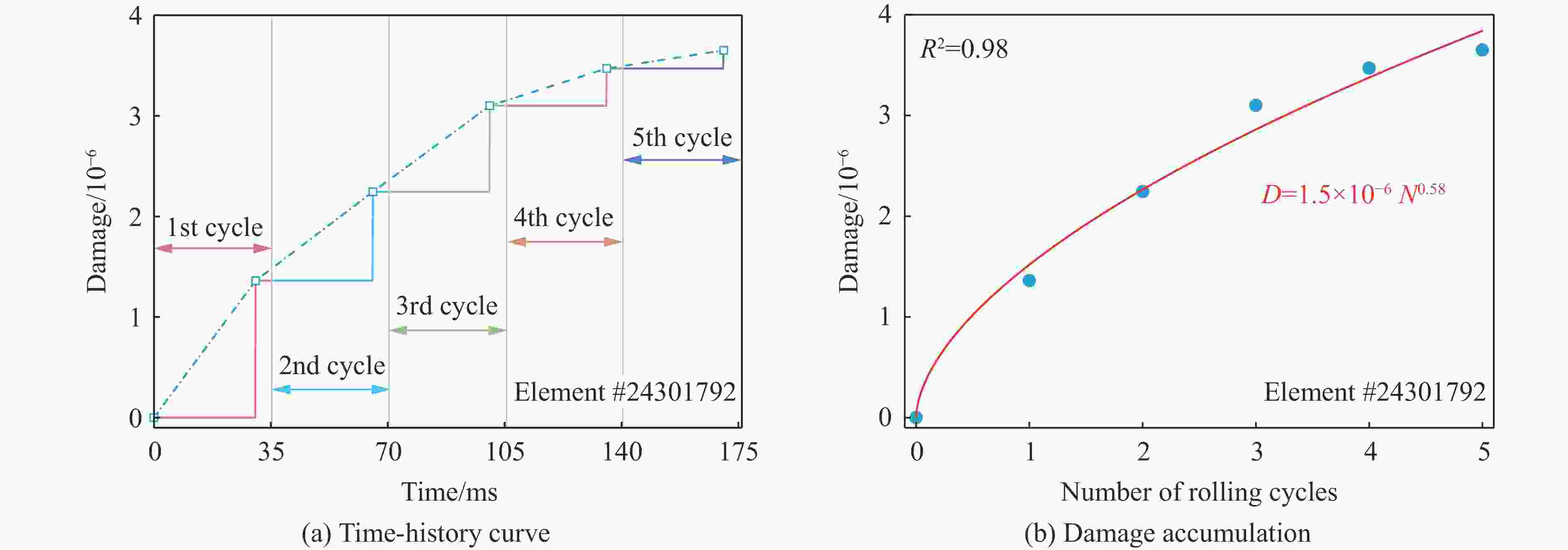
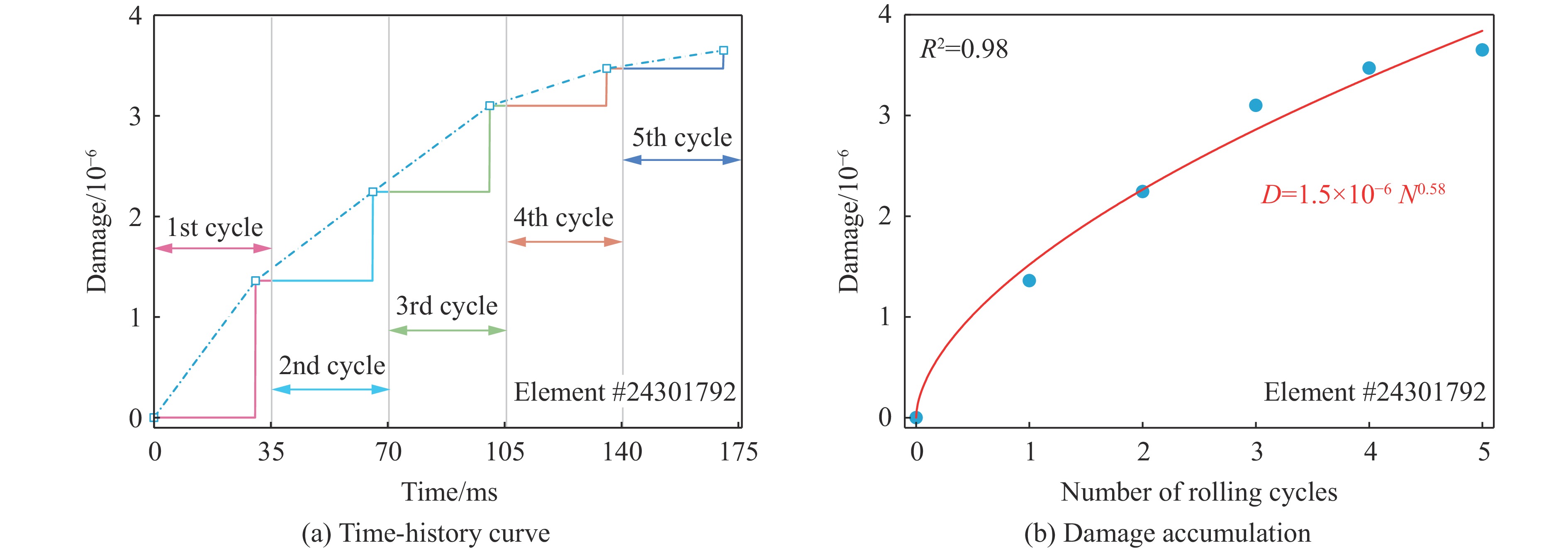
图 11 钢轨单元损伤变量随轮对通过次数的累积曲线
Figure 11. Accumulation of damage variable in rail element with increasing number of wheel passages
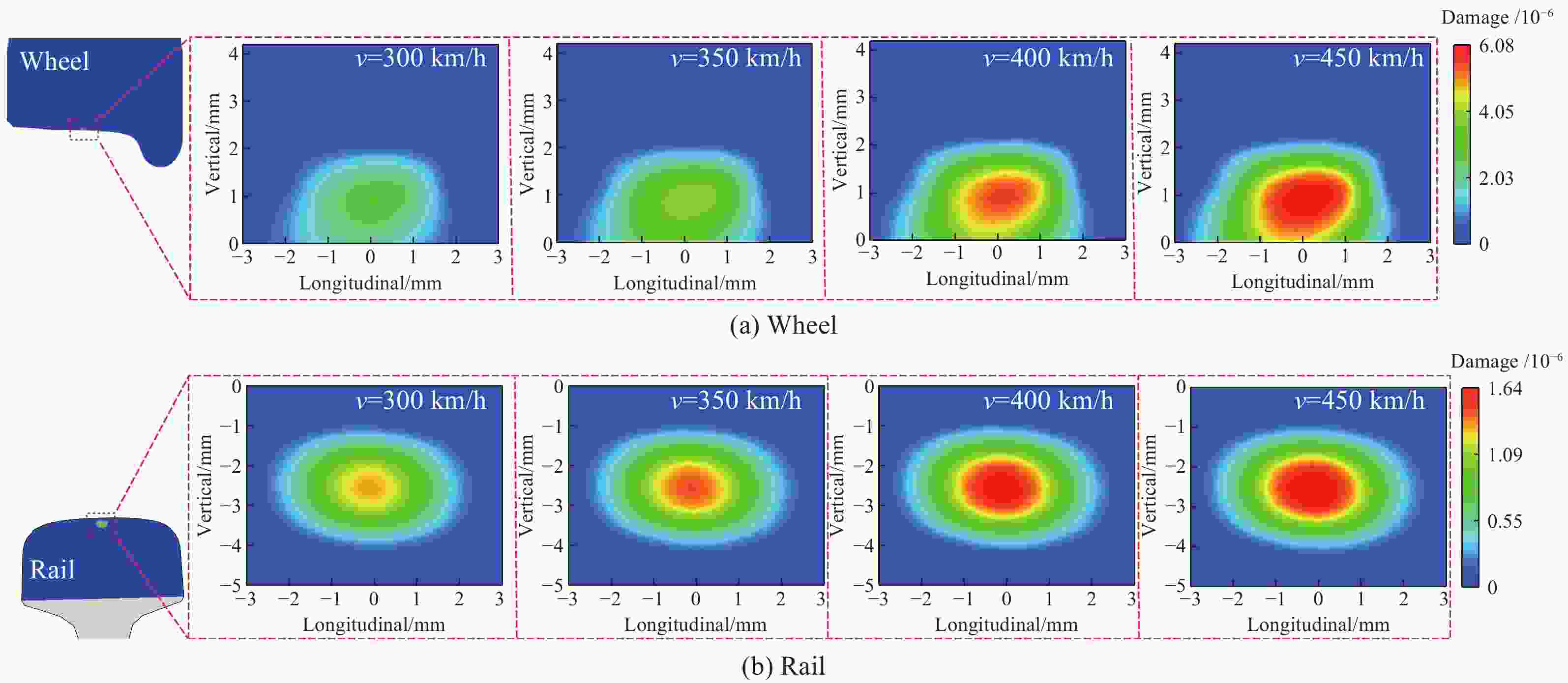
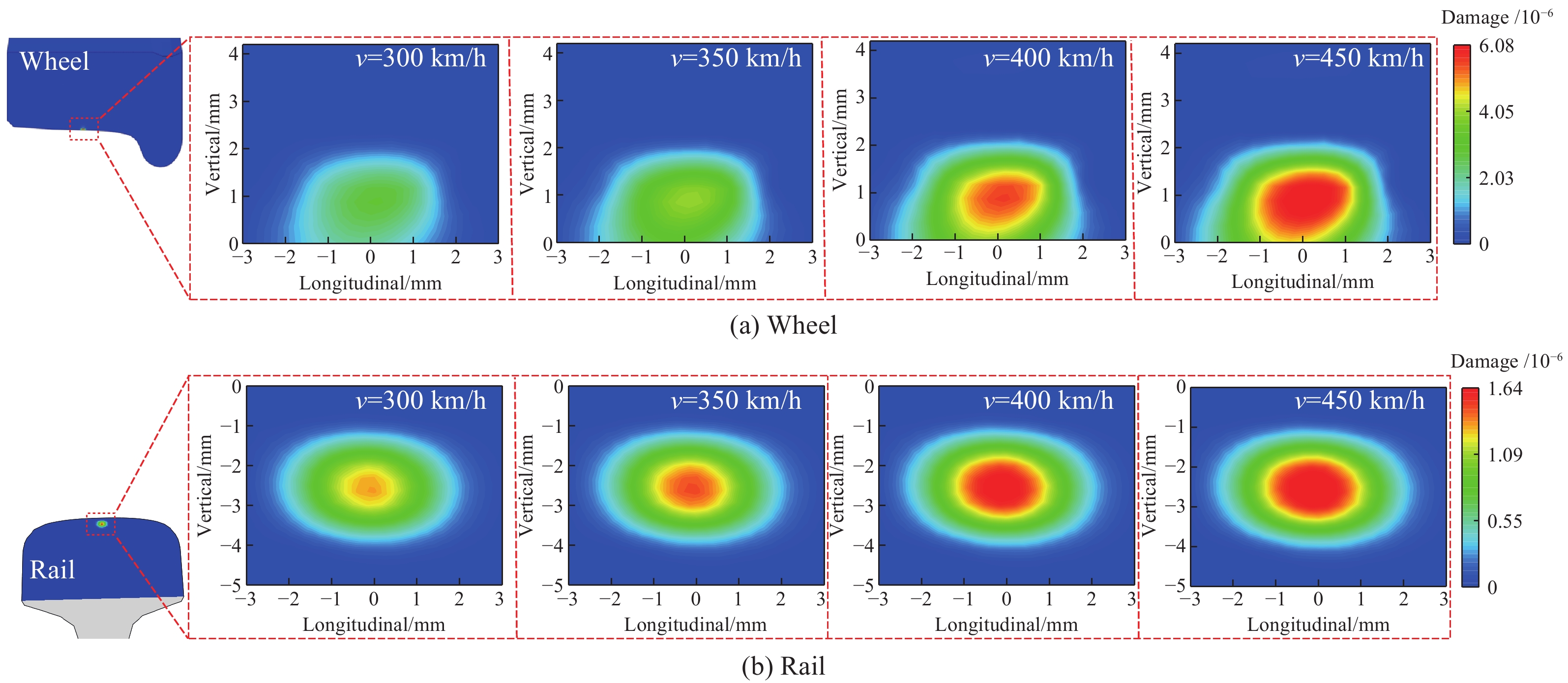
图 12 不同列车速度下的轮轨冲击疲劳损伤分布云图
Figure 12. Contour map of wheel-rail impact fatigue damage distribution at different train speeds
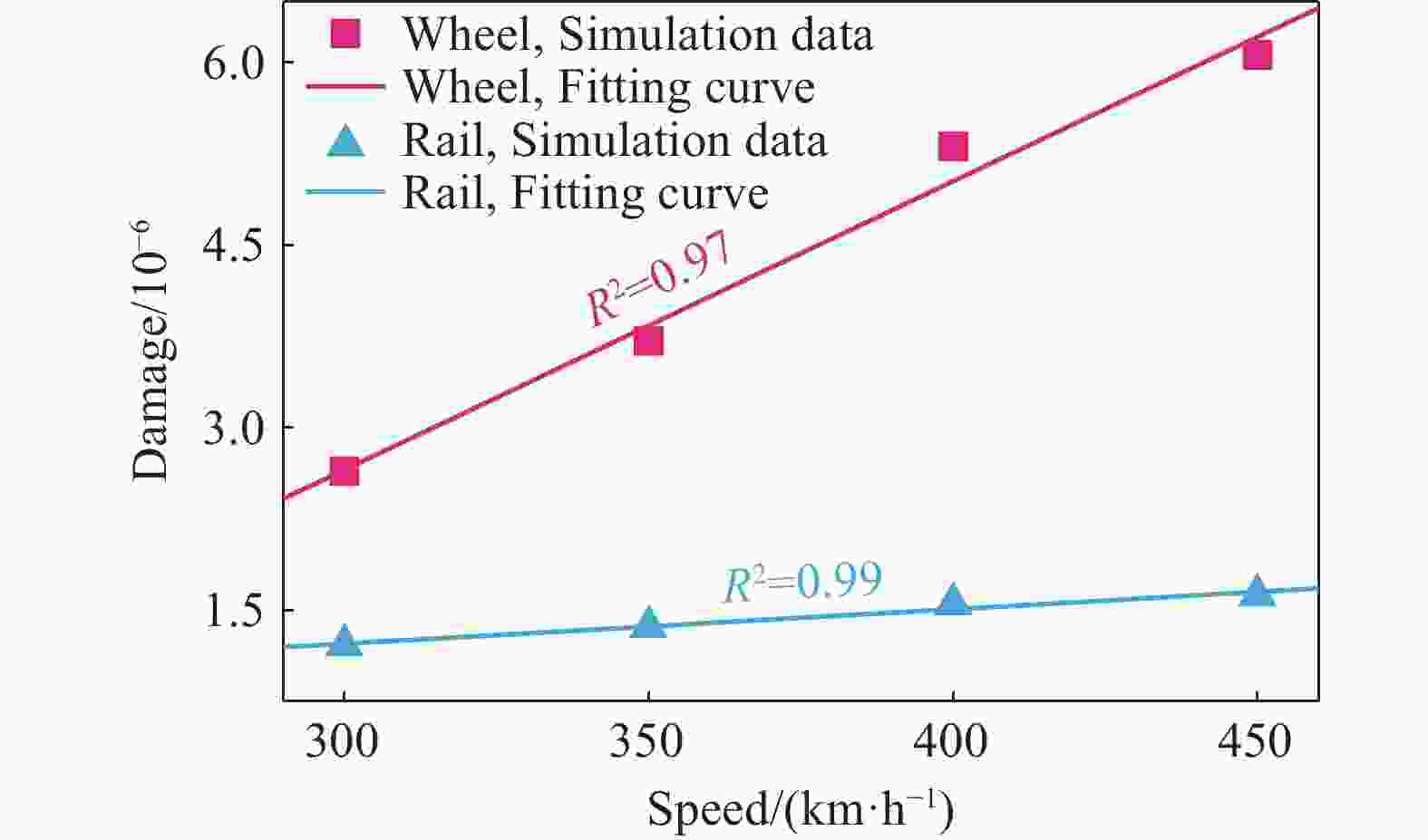
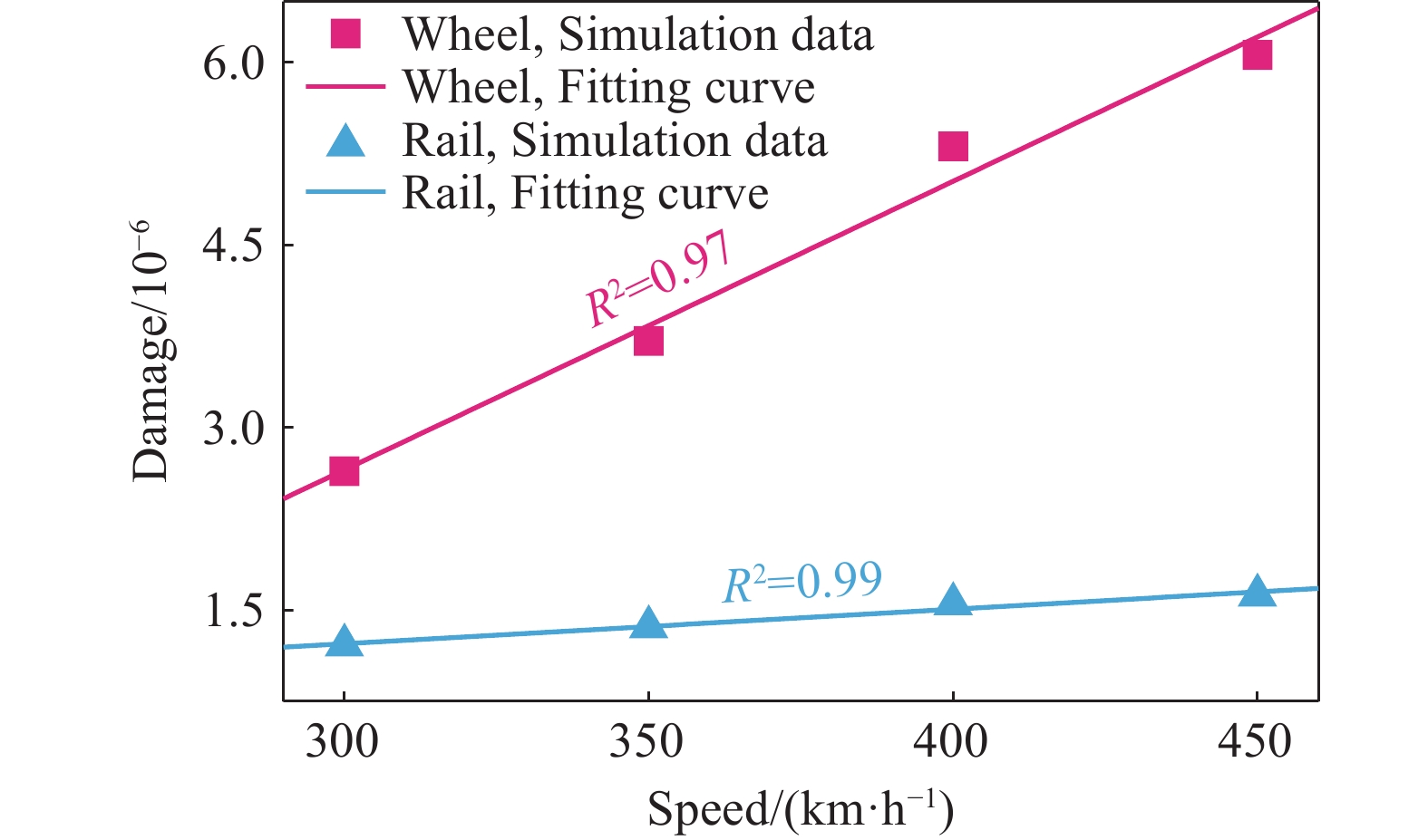
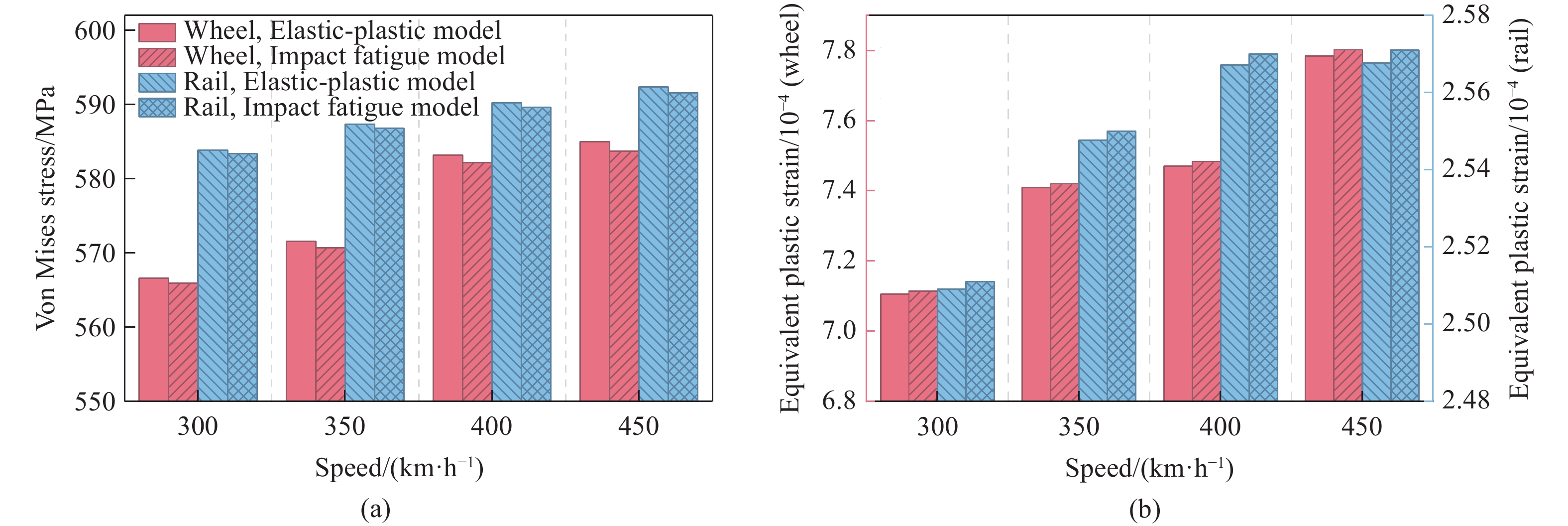
图 13 列车速度对轮轨冲击疲劳损伤的影响
Figure 13. Effect of train speed on wheel-rail impact fatigue damage
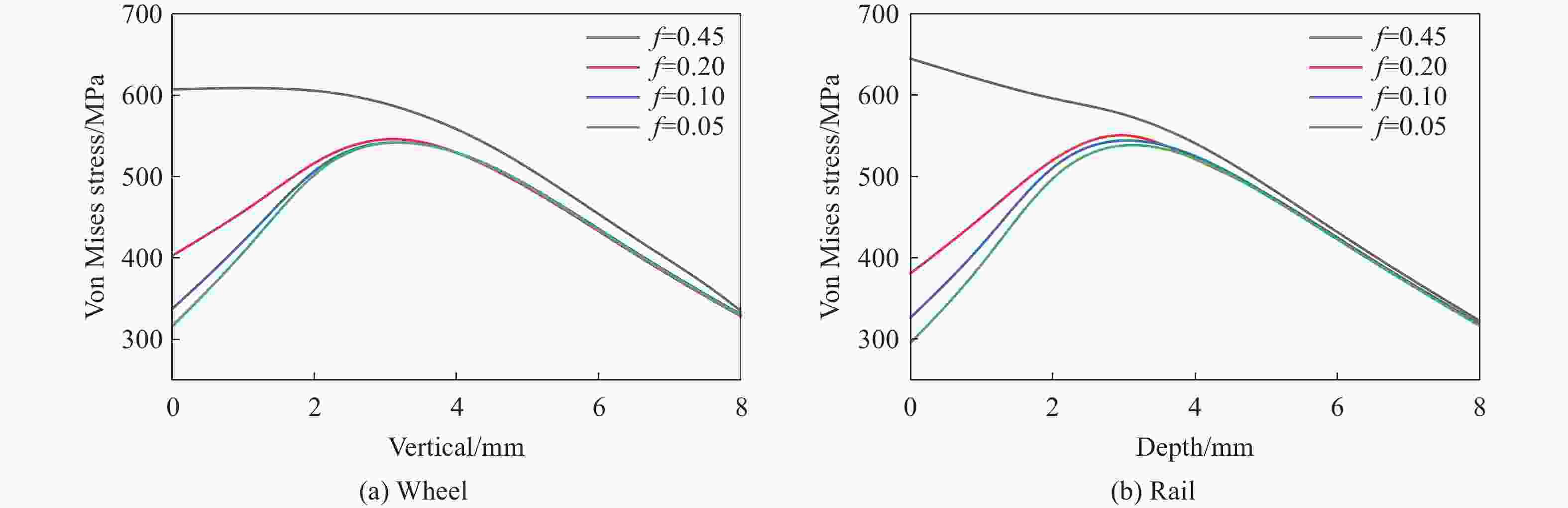
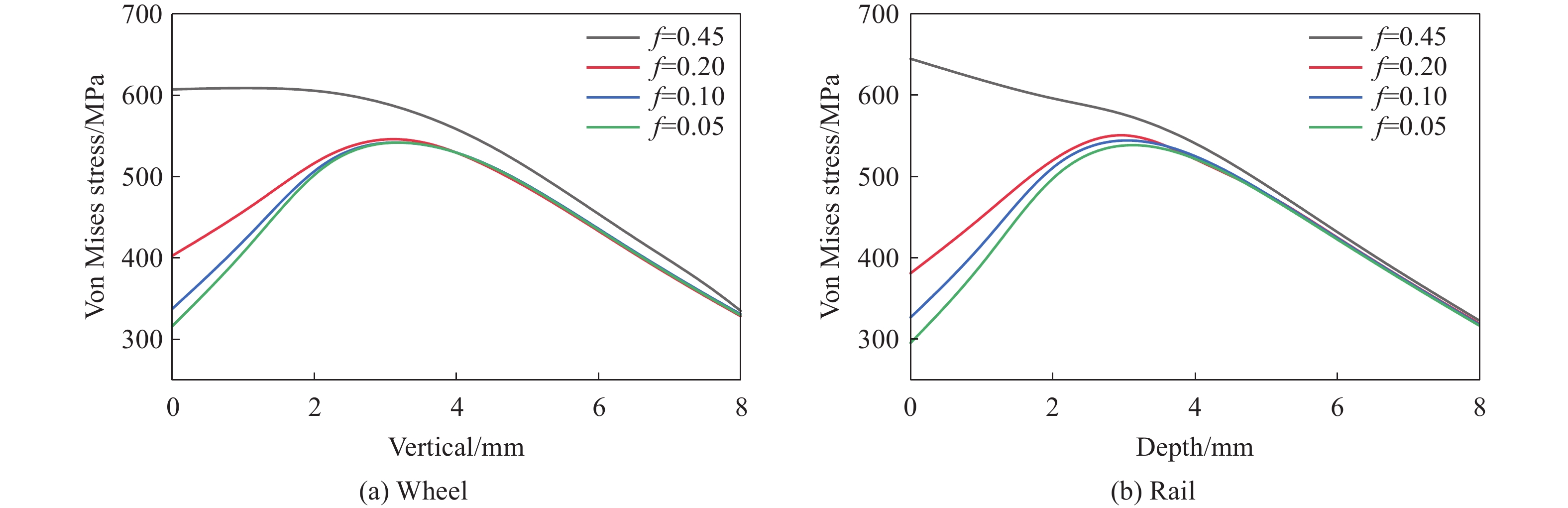
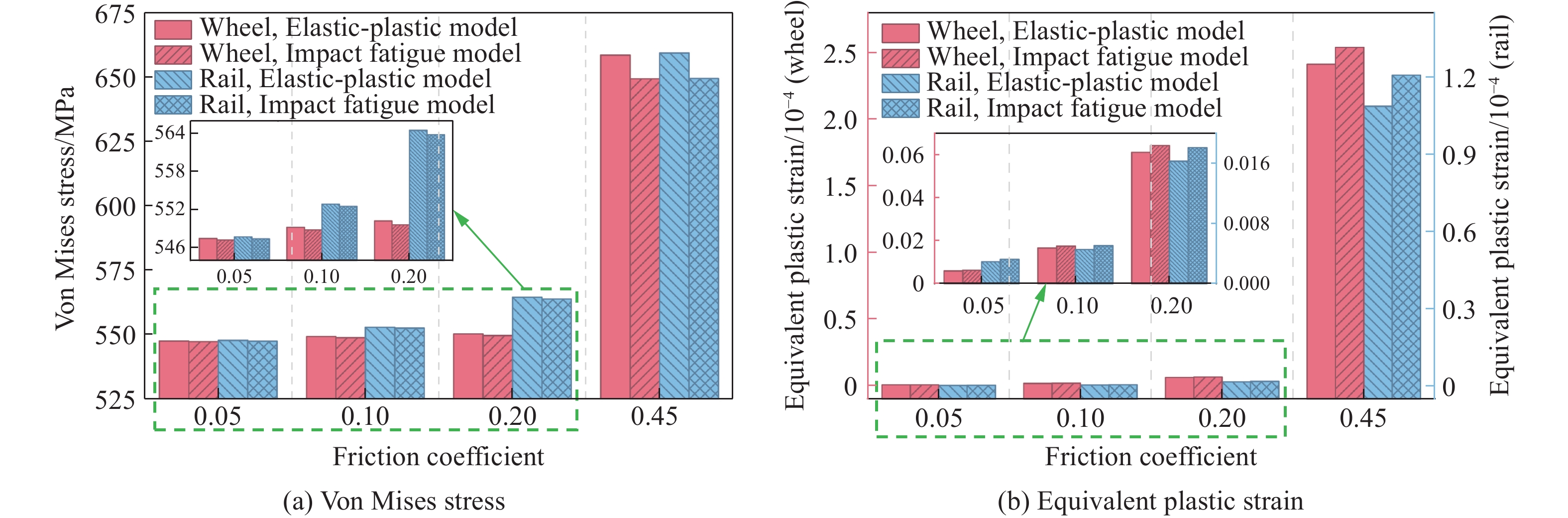
图 14 摩擦因数对轮轨最大von Mises应力的影响
Figure 14. Effect of friction coefficient on maximum von Mises stress in wheel-rail interaction
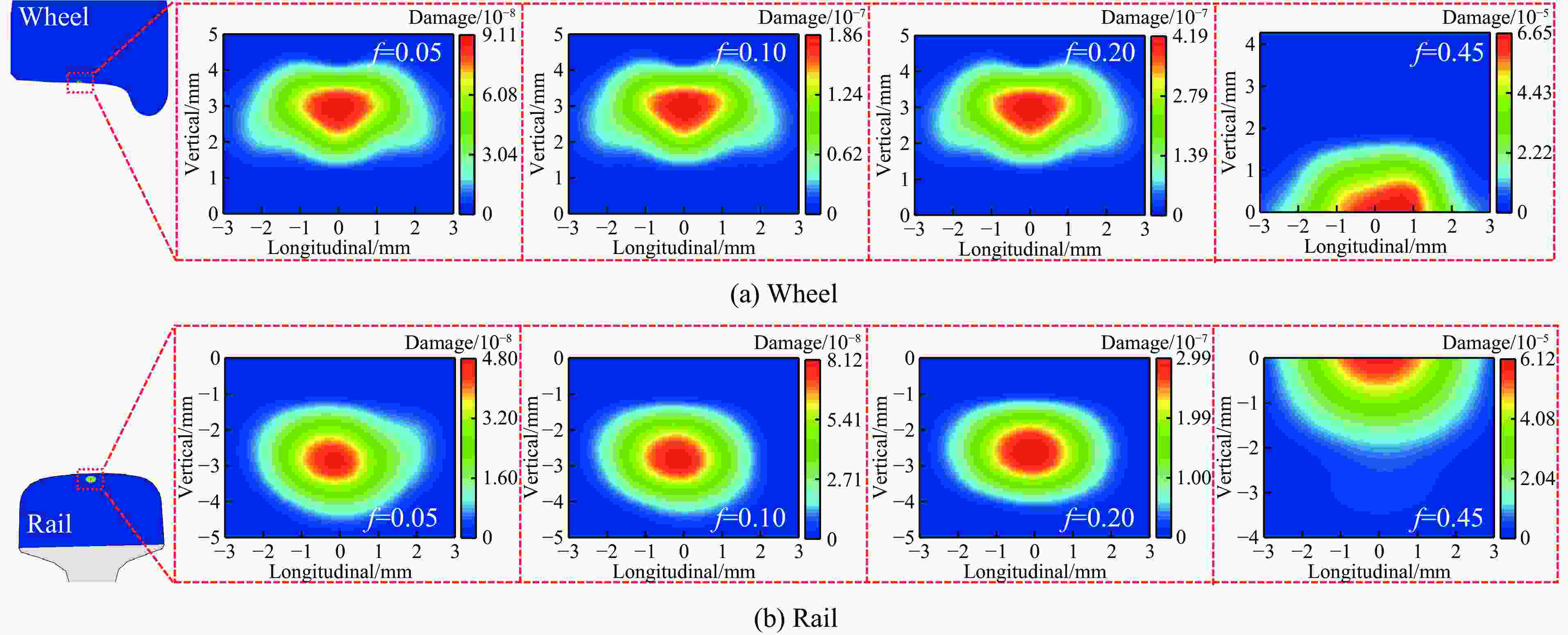
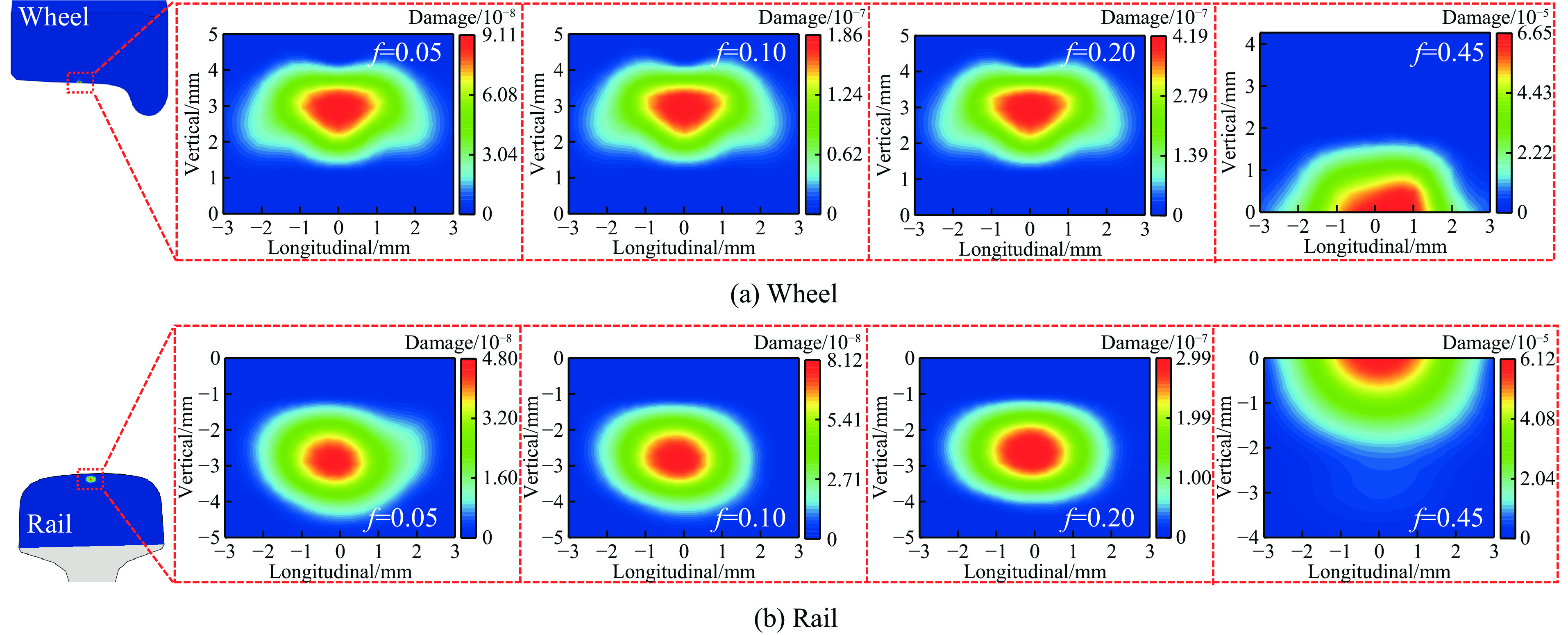
图 15 不同摩擦因数下的轮轨冲击疲劳损伤分布云图
Figure 15. Contour map of wheel-rail impact fatigue damage distribution with different friction coefficients
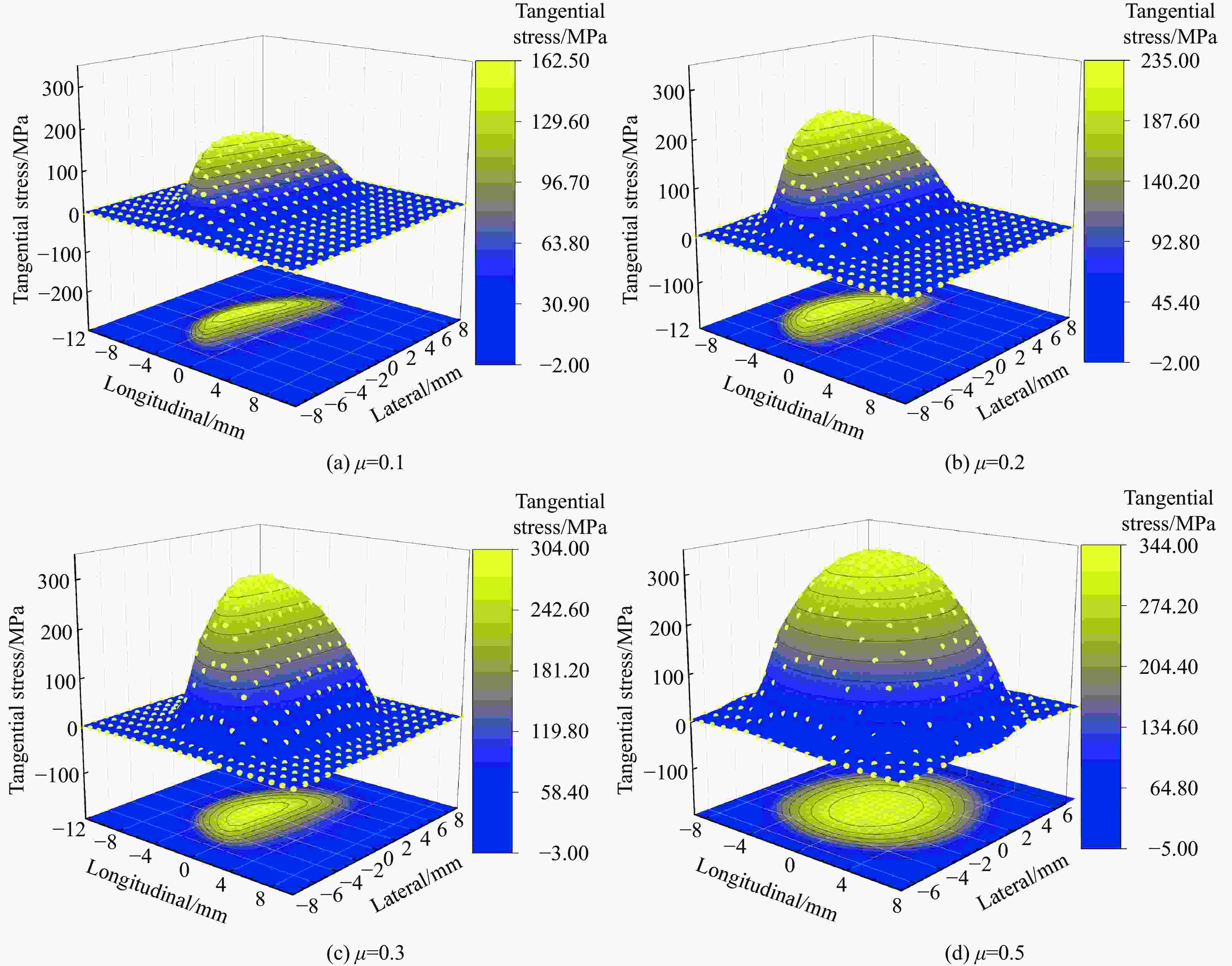
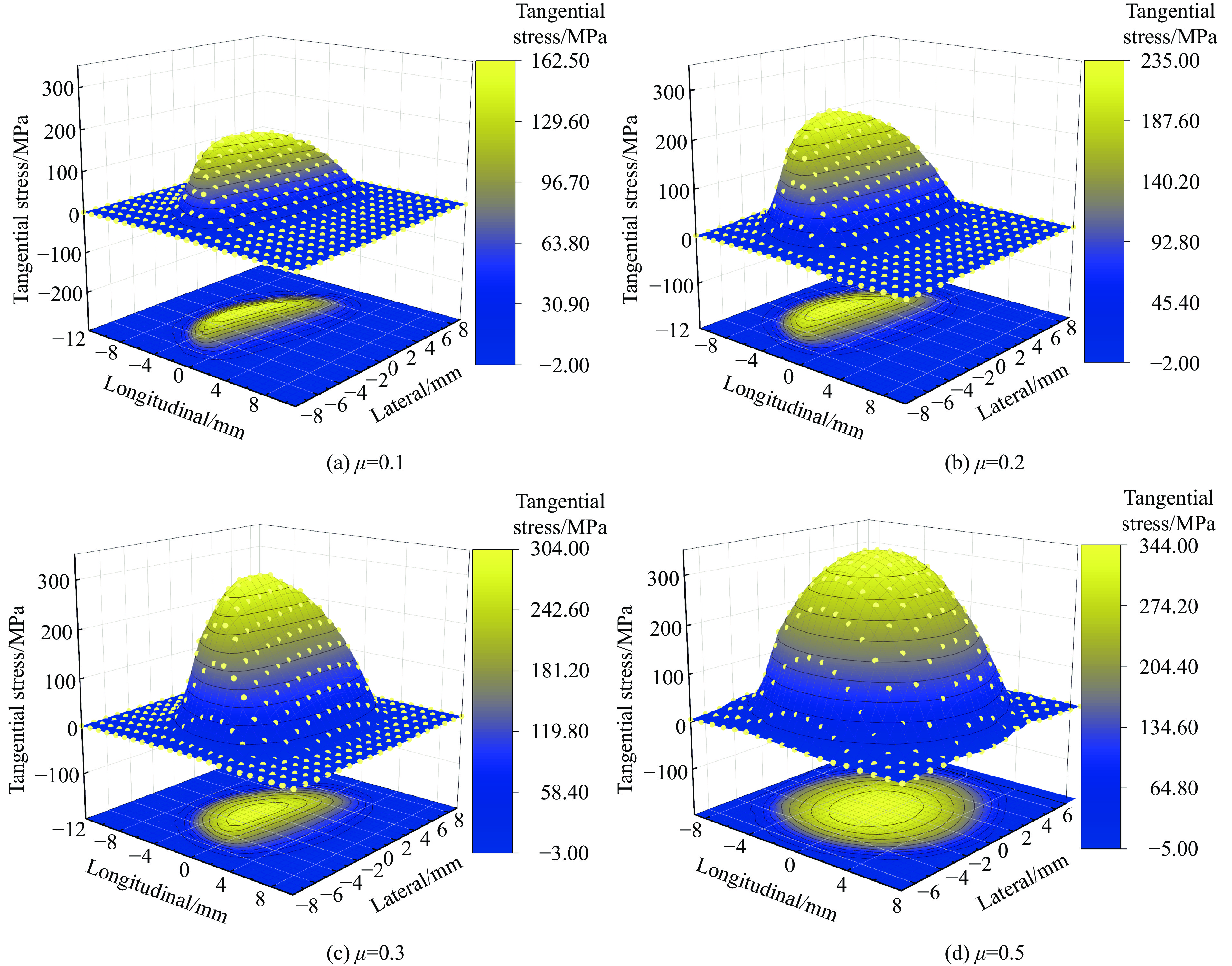
图 16 不同牵引系数轮轨表面切向应力分布
Figure 16. Tangential stress distribution on wheel-rail surfaces with different traction coefficients
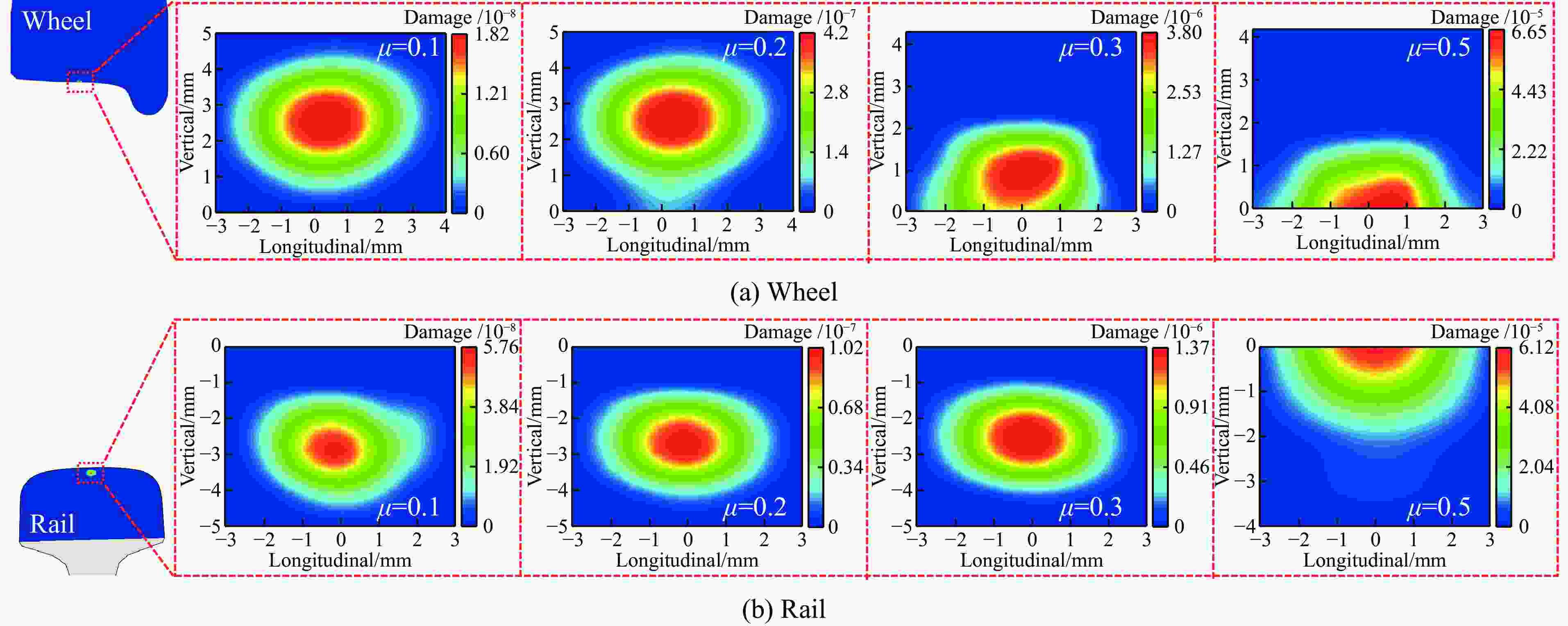
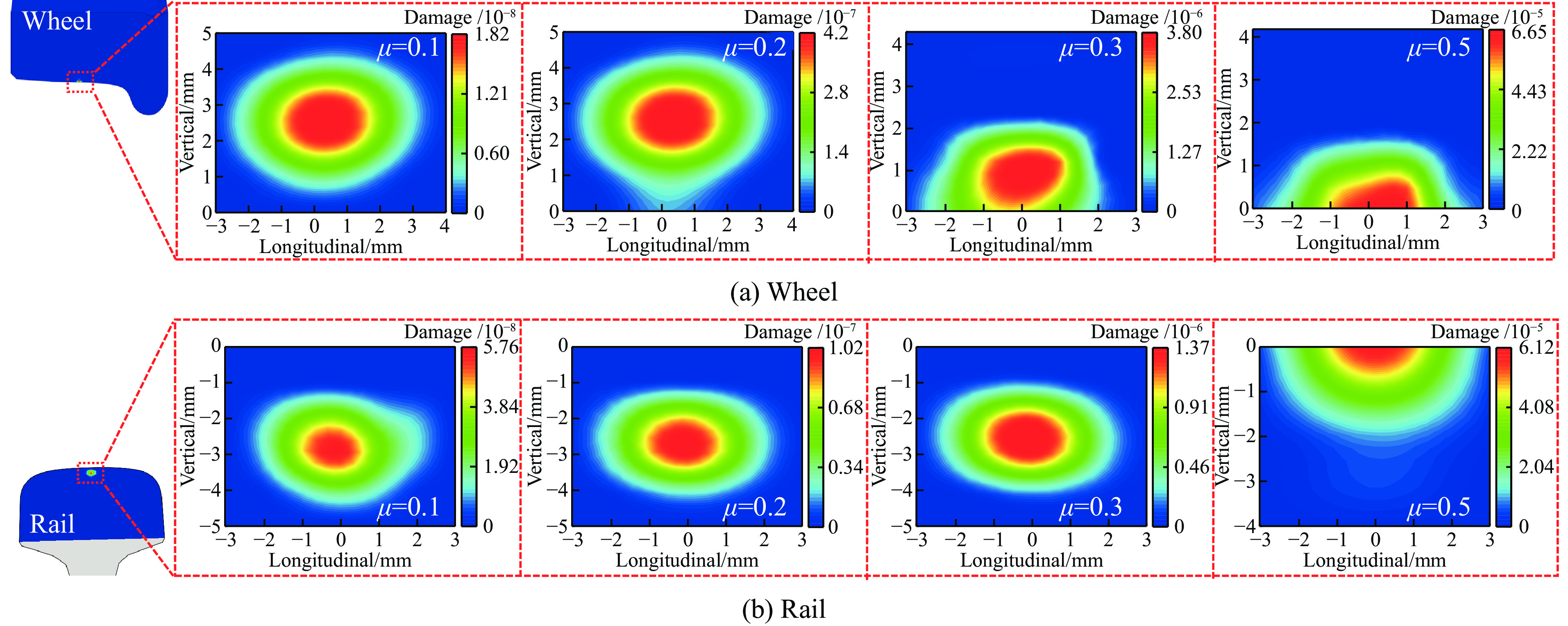
图 17 不同牵引系数下的轮轨冲击疲劳损伤分布云图
Figure 17. Contour map of wheel-rail impact fatigue damage distribution with different traction coefficients
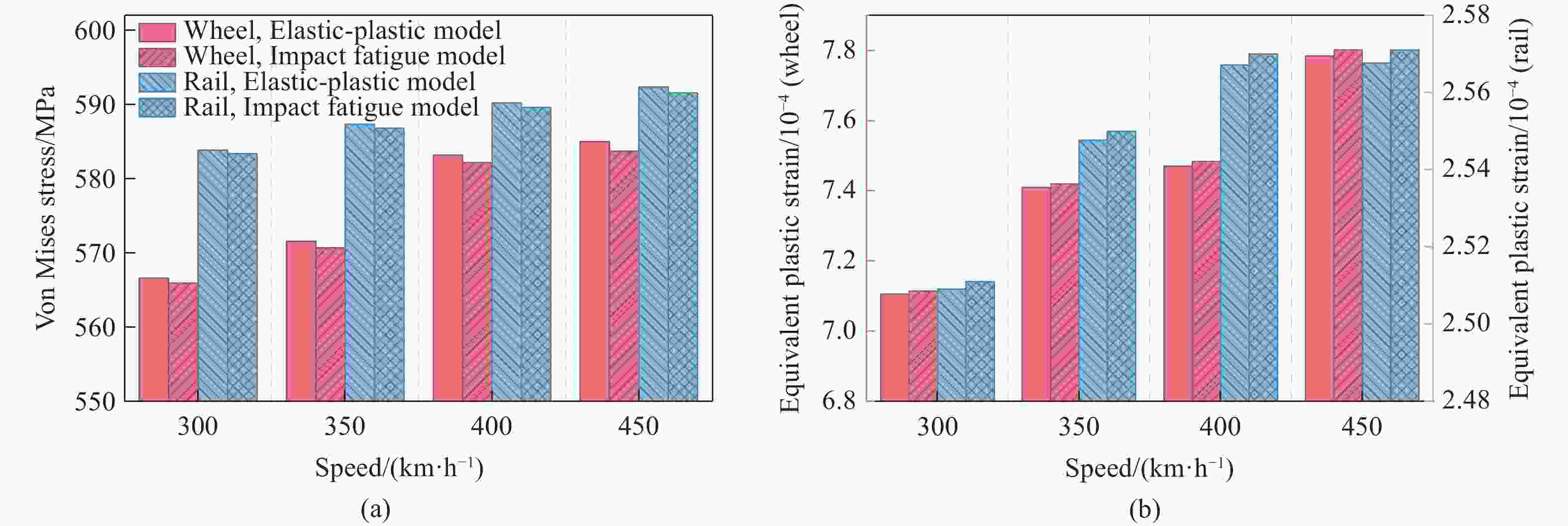
图 18 不同列车速度下的轮轨瞬态接触力学响应
Figure 18. Mechanical responses due to wheel-rail transient contact at different train speeds
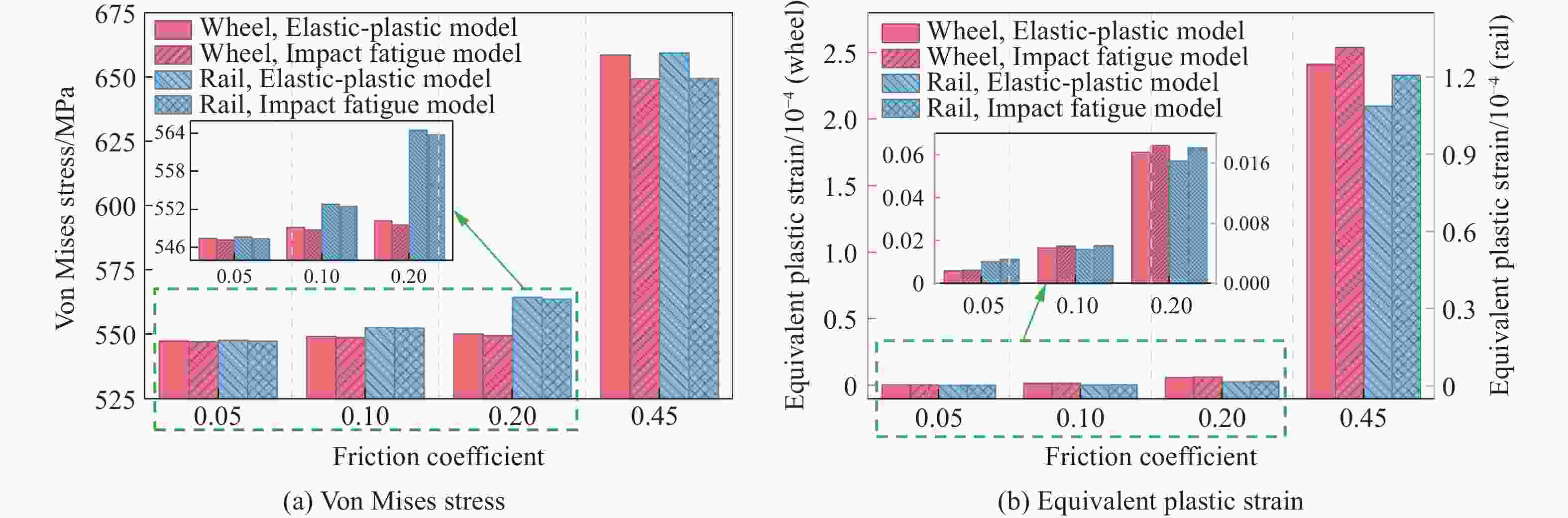
图 19 不同摩擦因数下的轮轨瞬态接触力学响应
Figure 19. Mechanical responses due to wheel-rail transient contact for different friction coefficients
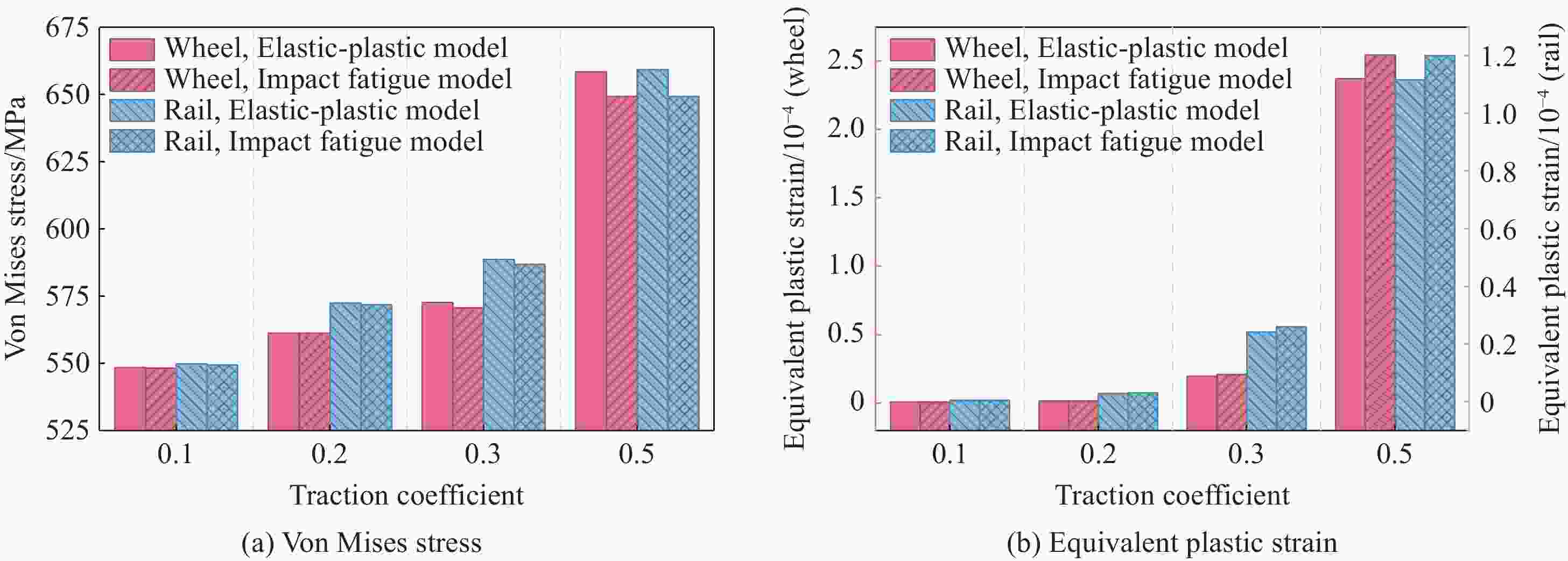
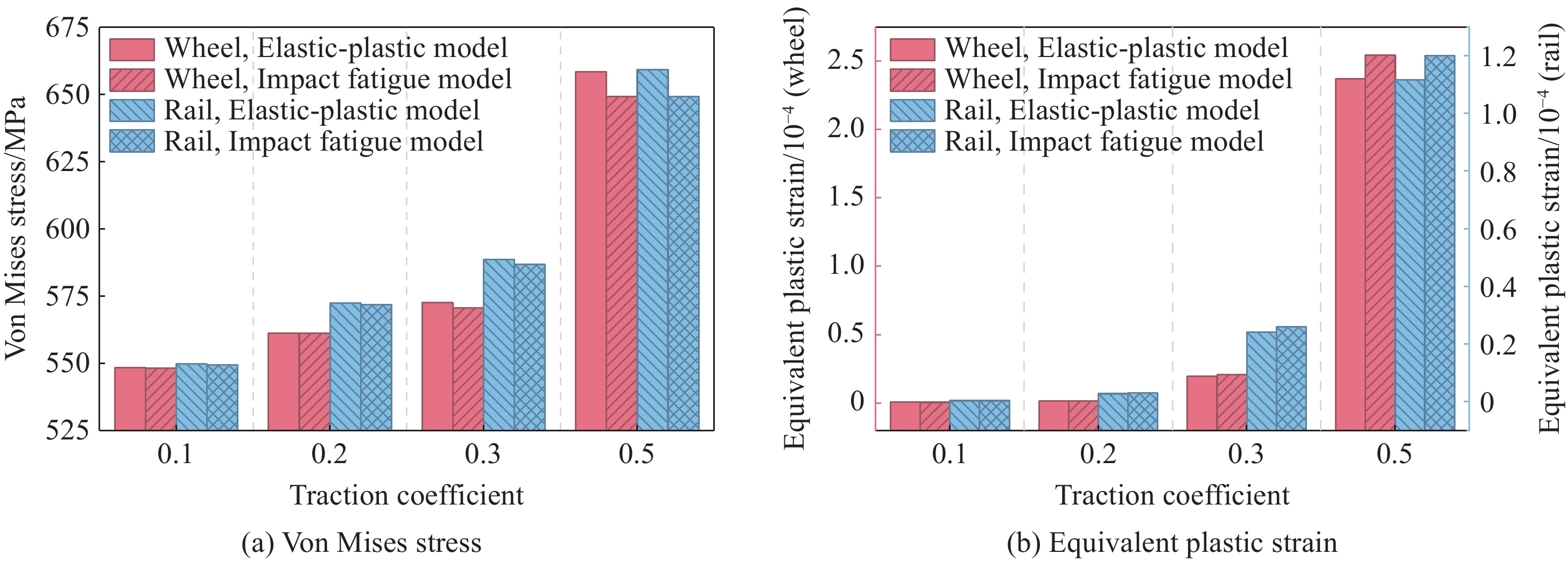
图 20 不同牵引系数下的轮轨瞬态接触力学响应
Figure 20. Mechanical responses due to wheel-rail transient contact for different traction coefficients
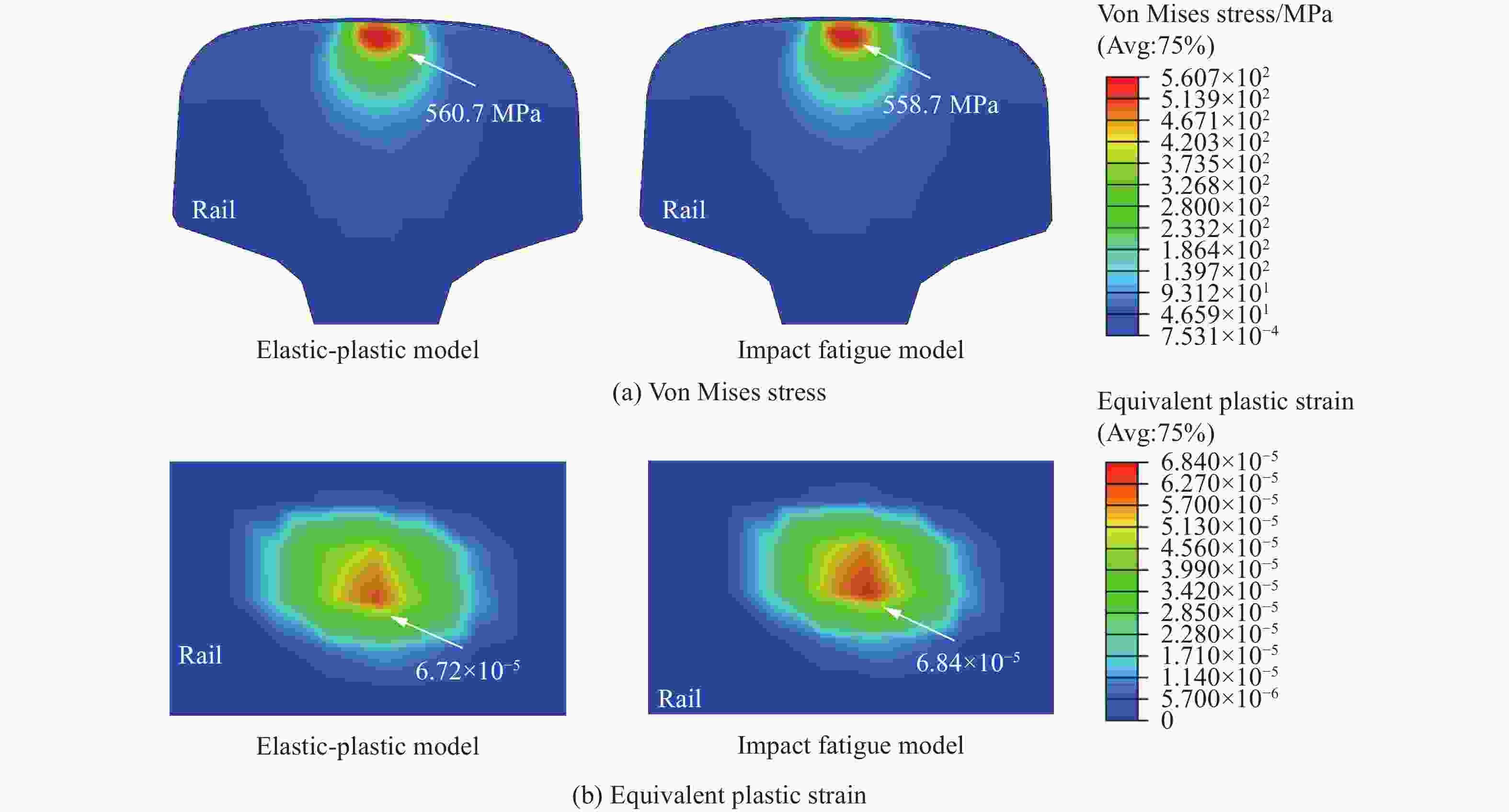
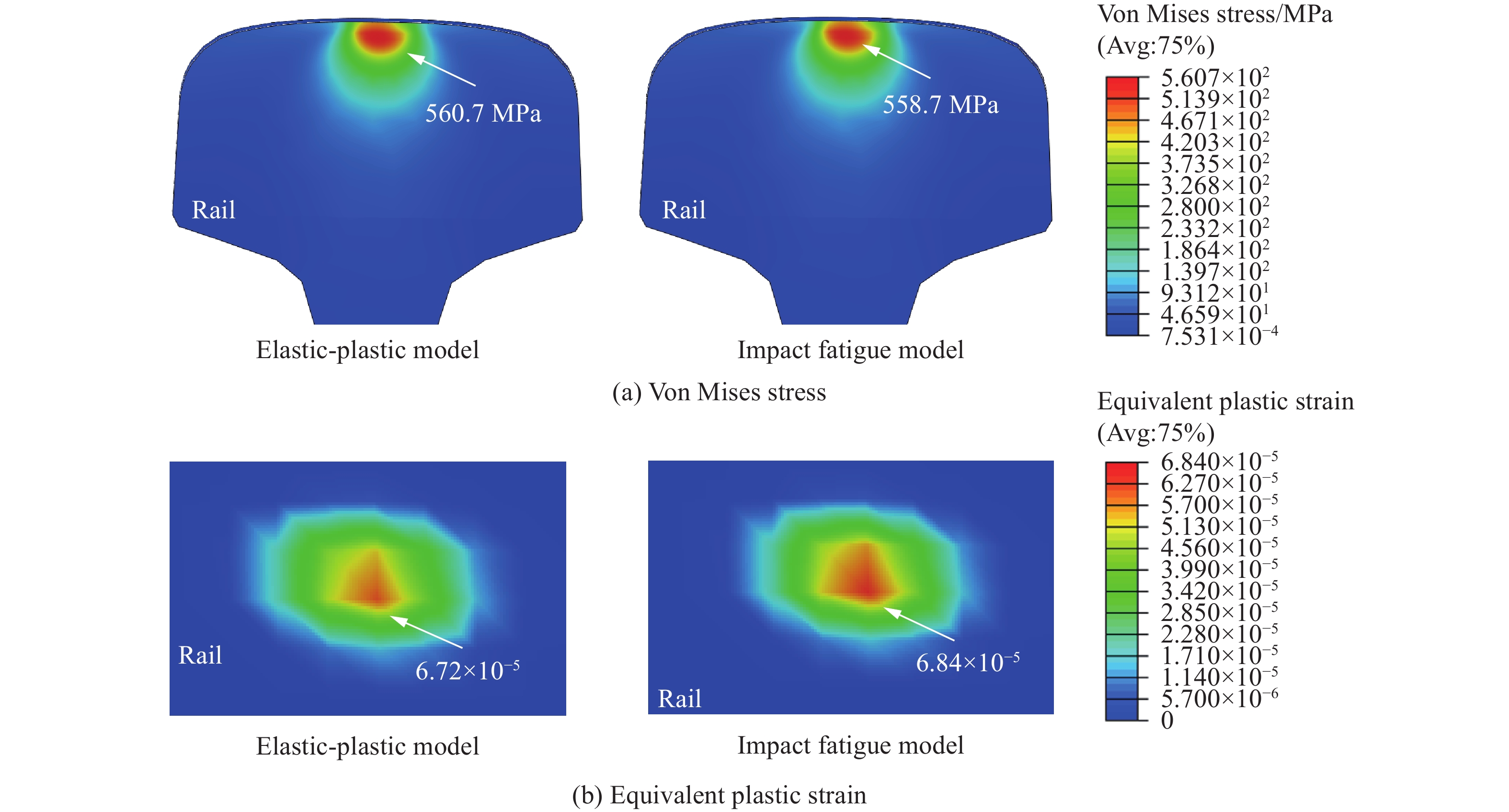
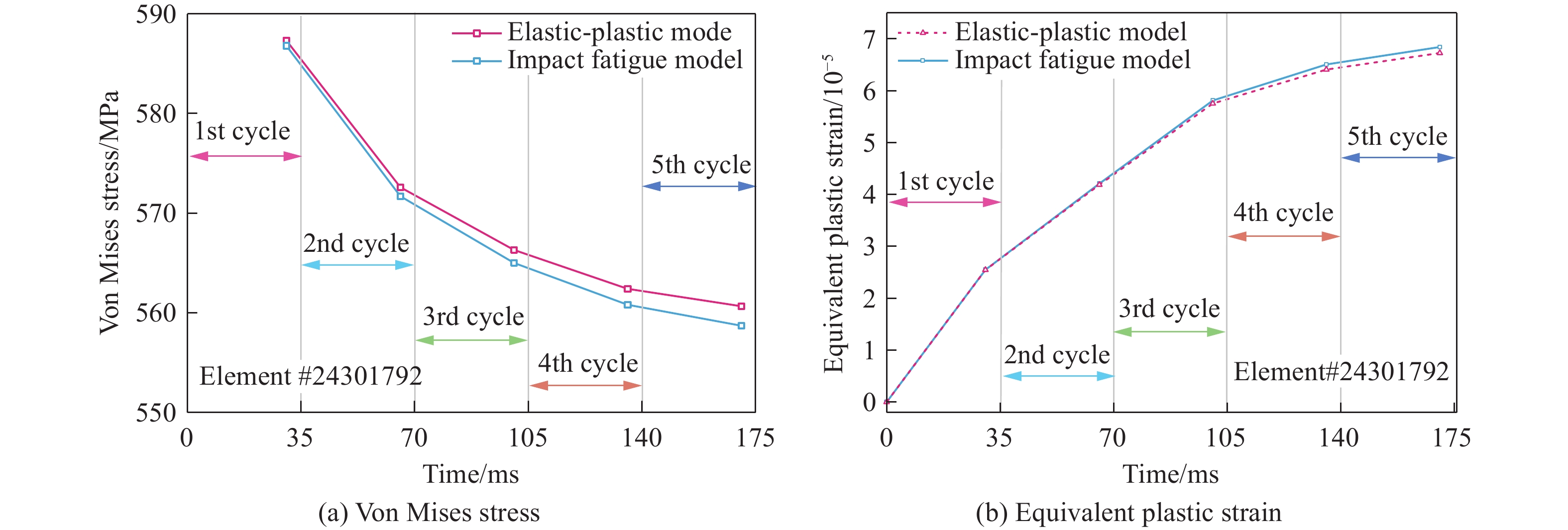
图 21 轮对通过5次后钢轨的von Mises应力和等效塑性应变分布
Figure 21. Von Mises stress and equivalent plastic strain distribution of the rail after five wheel passages
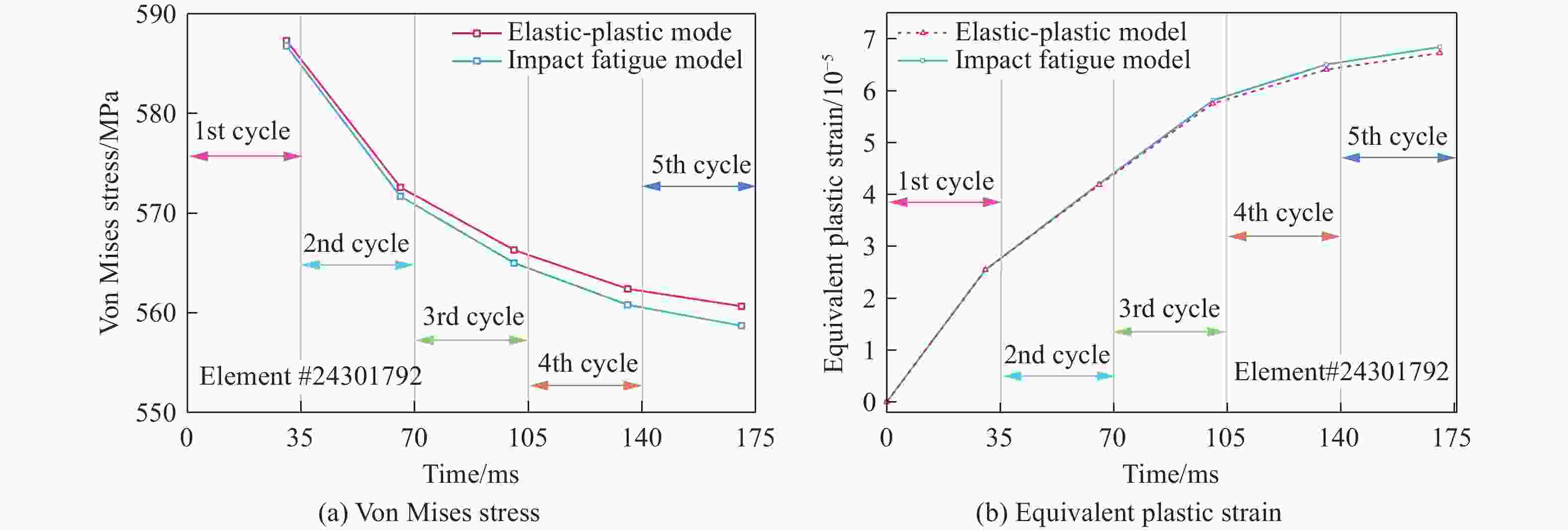
图 22 不同滚动次数下钢轨的von Mises应力和等效塑性应变
Figure 22. Von Mises stress and equivalent plastic strain of rail under different rolling cycles
表 1 轮轨系统模型参数
Table 1. Wheel-rail system model parameters
参数 参数值 车轮半径/mm 460 簧上质量/kg 6600 一系悬挂刚度K1/(kN·m−1) 880 一系悬挂阻尼C1/(kN∙s·m−1) 8 扣件总刚度K2/(kN·m−1) 49000 扣件总阻尼C2/(kN∙s·m−1) 63 列车速度(km·h−1) 300、350、400、450 摩擦因数f 0.05、0.1、0.2、0.45 牵引系数μ 0.1、0.2、0.3、0.5  下载: 导出CSV
表 2 轮轨冲击疲劳损伤耦合本构模型参数
Table 2. Parameters of the coupled constitutive model for wheel-rail impact fatigue damage
结构 E /MPa ν A/MPa B/MPa n C S/MPa m α 轮辋 213000 0.3 530 829.9 0.25 0.0095 2.7 2.34 4.1 钢轨 193000 0.3 525 837 0.23 0.0085 3.9 1.47 0.0057
下载: 导出CSV
表 3 轮轨系统其他部位的力学性能参数[25]
Table 3. Structural mechanical performance parameters of wheel-rail systems[25]
结构 密度/(kg·m−3) 泊松比 弹性模量/GPa 屈服强度/MPa 切线模量/GPa 轮辐 7800 0.3 216 395 21 轮毂 7800 0.3 213 417 21 车轴 7800 0.3 206 560 20 轨道板 2500 0.167 36.5 − − 砂浆层 1800 0.2 7 − − 底座 2400 0.2 34 − − 路基 2250 0.2 0.19 − −
下载: 导出CSV
-
[1] GAO Y, WANG P, WANG K, et al. Damage tolerance of fractured rails on continuous welded rail track for high-speed railways [J]. Railway Engineering Science, 2021, 29(1): 59–73. DOI: 10.1007/s40534-020-00226-7. [2] JOHNSON A A, STOREY R J. The impact fatigue properties of iron and steel [J]. Journal of Sound and Vibration, 2007, 308(3/4/5): 458–466. DOI: 10.1016/j.jsv.2007.06.044. [3] 刘小川, 王彬文, 白春玉, 等. 航空结构冲击动力学技术的发展与展望 [J]. 航空科学技术, 2020, 31(3): 1–14. DOI: 10.19452/j.issn1007-5453.2020.03.001.LIU X C, WANG B W, BAI C Y, et al. Progress and prospect of aviation structure impact dynamics [J]. Aeronautical Science & Technology, 2020, 31(3): 1–14. DOI: 10.19452/j.issn1007-5453.2020.03.001. [4] 杨素淞, 白春玉, 杨强, 等. 金属材料与结构冲击疲劳问题研究综述 [J]. 航空科学技术, 2021, 32(2): 1–13. DOI: 10.19452/j.issn1007-5453.2021.02.001.YANG S S, BAI C Y, YANG Q, et al. Review on impact fatigue of metallic materials and structures [J]. Aeronautical Science & Technology, 2021, 32(2): 1–13. DOI: 10.19452/j.issn1007-5453.2021.02.001. [5] 郭玉佩, 王彬文, 杨强, 等. 航空材料的冲击疲劳问题研究进展与展望 [J]. 航空工程进展, 2020, 11(5): 609–617. DOI: 10.16615/j.cnki.1674-8190.2020.05.001.GUO Y P, WANG B W, YANG Q, et al. Research progress and prospect of impact fatigue of aeronautical materials [J]. Advances in Aeronautical Science and Engineering, 2020, 11(5): 609–617. DOI: 10.16615/j.cnki.1674-8190.2020.05.001. [6] HOLMES G, SARTOR P, REED S, et al. Prediction of landing gear loads using machine learning techniques [J]. Structural Health Monitoring, 2016, 15(5): 568–582. DOI: 10.1177/1475921716651809. [7] ZHU Q D, MENG X, ZHANG Z. Simulation research on motion law of arresting hook during landing [J]. Applied Mechanics and Materials, 2013, 300/301: 997-1002. DOI: 10.4028/www.scientific.net/amm.300-301.997. [8] 王金能, 郭鑫, 敬霖, 等. 高速列车车轮踏面剥离引起的轮轨冲击力学响应有限元模拟 [J]. 爆炸与冲击, 2022, 42(4): 045103. DOI: 10.11883/bzycj-2021-0374.WANG J N, GUO X, JING L, et al. Finite element simulations of wheel-rail impact response induced by wheel tread spalling of high-speed trains [J]. Explosion and Shock Waves, 2022, 42(4): 045103. DOI: 10.11883/bzycj-2021-0374. [9] LIU C, XU J M, WANG K, et al. Numerical investigation on wheel-rail impact contact solutions excited by rail spalling failure [J]. Engineering Failure Analysis, 2022, 135: 106116. DOI: 10.1016/j.engfailanal.2022.106116. [10] 惠煜中, 徐浩嘉, 郝宏炜, 等. 高应变率载荷下纯钛的非连续冲击疲劳失效模型及其微观机理 [J]. 爆炸与冲击, 2024, 44(1): 013103. DOI: 10.11883/bzycj-2023-0073.HUI Y Z, XU H J, HAO H W, et al. Discontinuous impact fatigue failure model and its microscopic mechanism of pure titanium under high strain rate loading [J]. Explosion and Shock Waves, 2024, 44(1): 013103. DOI: 10.11883/bzycj-2023-0073. [11] LI X F, HU W P, WANG B, et al. A new combined impact fatigue damage model and its application of influencing factors analysis on impact fatigue of TC18 titanium alloy [J]. International Journal of Fatigue, 2024, 182: 108180. DOI: 10.1016/j.ijfatigue.2024.108180. [12] LI B L, ZHAO S H, WANG J J, et al. Impact fatigue behavior of laser metal deposition 316L stainless steel with an automated impact fatigue system based on split Hopkinson bar technique [J]. International Journal of Fatigue, 2024, 185: 108370. DOI: 10.1016/j.ijfatigue.2024.108370. [13] 钱诚成, 白春玉, 杨强, 等. 金属材料重复冲击拉伸试验方法研究 [J]. 航空科学技术, 2021, 32(12): 98–106. DOI: 10.19452/j.issn1007-5453.2021.12.011.QIAN C C, BAI C Y, YANG Q, et al. Research on repeated impact tensile test method for metallic materials [J]. Aeronautical Science & Technology, 2021, 32(12): 98–106. DOI: 10.19452/j.issn1007-5453.2021.12.011. [14] ZHAO S H, LI B L, YUAN K B, et al. Design of a continuously repeated impact method with constant amplitude based on Hopkinson bar: principle and impact fatigue life testing [J]. International Journal of Impact Engineering, 2024, 193: 105038. DOI: 10.1016/j.ijimpeng.2024.105038. [15] HAN L L, JING L, ZHAO L M. Finite element analysis of the wheel–rail impact behavior induced by a wheel flat for high-speed trains: the influence of strain rate [J]. Proceedings of the Institution of Mechanical Engineers, Part F: Journal of Rail and Rapid Transit, 2018, 232(4): 990–1004. DOI: 10.1177/0954409717704790. [16] HAO C J, ZHU X X, WANG W, et al. An adaptive multi-axial fatigue model and fatigue damage prediction of the turnout rail [J]. Construction and Building Materials, 2025, 472: 140934. DOI: 10.1016/j.conbuildmat.2025.140934. [17] 敬霖, 刘凯. 车轮踏面缺陷引起的轮轨动态响应综述 [J]. 交通运输工程学报, 2021, 21(1): 285–315. DOI: 10.19818/j.cnki.1671-1637.2021.01.014.JING L, LIU K. Review on wheel-rail dynamic responses caused by wheel tread defects [J]. Journal of Traffic and Transportation Engineering, 2021, 21(1): 285–315. DOI: 10.19818/j.cnki.1671-1637.2021.01.014. [18] WANG J N, JING L, ZHOU X F, et al. Influence of material properties on the high-speed wheel-rail rolling contact behaviour [J]. Vehicle System Dynamics, 2024, 62(7): 1686–1712. DOI: 10.1080/00423114.2023.2251617. [19] ZHOU X F, WANG J N, JING L. Coupling effects of strain rate and fatigue damage on wheel-rail rolling contact behaviour: a dynamic finite element simulation [J]. International Journal of Rail Transportation, 2023, 11(3): 317–338. DOI: 10.1080/23248378.2022.2083711. [20] ZHOU Z J, TAO G Q, WEN Z F. Finite element analysis of wheel–rail cyclic rolling contact and ratcheting on corrugated rail [J]. Engineering Failure Analysis, 2026, 186: 110483. DOI: 10.1016/j.engfailanal.2025.110483. [21] 马登程, 刘腾, 周雄飞, 等. 曲线段高速轮轨循环滚动接触力学响应与黏滑行为 [J/OL]. 交通运输工程学报, (2026-03-04)[2026-03-08]. https://doi.org/ 10.19818/j.cnki.1671-1637.2026.205. DOI: 10.19818/j.cnki.1671-1637.2026.205.MA D C, LIU T, ZHOU X F, et al. Cyclic rolling contact mechanical responses and stick-slip behavior of high-speed wheel-rail on curved tracks [J/OL]. Journal of Traffic and Transportation Engineering, (2026-03-04)[2026-03-08]. https://doi.org/ 10.19818/j.cnki.1671-1637.2026.205. DOI: 10.19818/j.cnki.1671-1637.2026.205. [22] WANG B W, QIAN C C, BAI C Y, et al. Study on impact fatigue test and life prediction method of TC18 titanium alloy [J]. International Journal of Fatigue, 2023, 168: 107391. DOI: 10.1016/j.ijfatigue.2022.107391. [23] Zhou C W, Liang Y X, Yuan K B, et al. Impact fatigue behavior and damage constitutive model of U71MnG rail steel under high strain-rate loading [J]. International Journal of Fatigue, 2026, 212: 109794. DOI: 10.1016/j.ijfatigue.2026.109794. [24] LEMAITRE J. A continuous damage mechanics model for ductile fracture [J]. Journal of Engineering Materials and Technology, 1985, 107(1): 83–89. DOI: 10.1115/1.3225775. [25] LIU K, JING L. A finite element analysis-based study on the dynamic wheel–rail contact behaviour caused by wheel polygonization [J]. Proceedings of the Institution of Mechanical Engineers, Part F: Journal of Rail and Rapid Transit, 2020, 234(10): 1285–1298. DOI: 10.1177/0954409719891549. [26] 敬霖, 冯超, 苏兴亚, 等. 高速动车组D2车轮钢的率温耦合变形机理与本构关系 [J]. 科学通报, 2022, 67(34): 4068–4079. DOI: 10.1360/TB-2022-0437.JING L, FENG C, SU X Y, et al. Strain rate-temperature coupling deformation mechanism and constitutive relationship of D2 wheel steel for high-speed EMUs [J]. Chinese Science Bulletin, 2022, 67(34): 4068–4079. DOI: 10.1360/TB-2022-0437. [27] 苏兴亚. 复杂载荷下高速轮/轨钢的动态力学行为与本构关系 [D]. 成都: 西南交通大学, 2019. DOI: 10.27414/d.cnki.gxnju.2019.002295.SU X Y. The dynamic mechanical behavior and consititutive relationship of high-speed wheel/rail steels under complex loadings [D]. Chengdu: Southwest Jiaotong University, 2019. DOI: 10.27414/d.cnki.gxnju.2019.002295. [28] 安博洋, 王平, 徐义新, 等. 基于POLACH方法的轮轨蠕滑曲线研究 [J]. 机械工程学报, 2018, 54(4): 124–131. DOI: 10.3901/JME.2018.04.124.AN B Y, WANG P, XU Y X, et al. Study on wheel/rail creep curve based on POLACH’s method [J]. Journal of Mechanical Engineering, 2018, 54(4): 124–131. DOI: 10.3901/JME.2018.04.124. -

计量
- 文章访问数: 755
- HTML全文浏览量: 247
- PDF下载量: 263
- 被引次数: 0