


Study on multi-bubble coupling characteristics in underwater explosions under hypergravity conditions
-
摘要: 在众多研究水下多点爆炸气泡耦合及形态演化特性的方法中,基于离心机的超重力水下爆炸实验因同时满足Mach数和Froude数相似,被认为是大当量水下爆炸原型实验研究的最佳手段之一。本文对超重力场下水下多点爆炸气泡间的耦合规律开展了实验和数值研究。首先开展了离心加速度为100g(g为重力加速度)的超重力环境下的水下两点爆炸实验,通过高速相机高精度捕捉了双气泡形态的演化过程。然后,利用基于实验数据验证的超重力水下多点爆炸数值模型进一步探究了重力场对水下爆炸双气泡耦合形态演化及特征参数的影响。结果表明,较大重力场下,水下爆炸气泡的形态演化、脉动和迁移特性与常重力场存在显著差异,超重力这一极端条件会强化压力梯度与浮力效应,导致射流行为呈现独特规律。超重力环境增大了流场中的垂向压力梯度,增强了气泡表面的不稳定性,引发了更强烈的流体加速运动,促使气泡迁移速度加快;超重力场造成了气泡脉动的“时空压缩效应”,同时改变了气泡系统的浮力-惯性力关系,对气泡射流方向和气泡间的相互作用强度影响较大,进而改变了双气泡系统中能量的分布。Abstract: The bubble coupling and morphological evolution characteristics in underwater multipoint explosions have long been a focus of research. Among various research approaches, the centrifuge-based hypergravity underwater explosion experiments have emerged as one of the most effective methods for conducting prototype experiments on large-yield underwater explosions, owing to its simultaneous satisfaction of both the Mach number and the Froude number. This study presents both experimental and numerical investigation into the coupling dynamics of underwater multipoint explosion bubbles under hypergravity conditions. First, two-point underwater explosion experiments were conducted under a hypergravity environment with a acceleration of 100g, and the morphological evolution of dual bubbles was captured with high precision using a high-speed camera. Second, a hypergravity underwater multi-point explosion numerical model, validated against the experimental data, was employed to further investigate the effects of gravitational field on the coupled morphological evolution and characteristic parameters of dual bubbles. The results indicate that under higher gravitational acceleration, the morphological evolution, pulsation, and migration characteristics of underwater explosion bubbles differ significantly from those under normal gravity. This hypergravity environment, as an extreme physical condition, intensifies the pressure gradient and buoyancy effects, leading to unique jetting behaviors. The hypergravity environment increases the vertical pressure gradient in the flow field, enhances the instability on the bubble surfaces, and induces more intense fluid acceleration, thereby leading to higher bubble migration velocities. In addition, the hypergravity field introduces a "spatiotemporal compression effect" on bubble pulsation and alters the buoyancy-inertia force balance of the bubble system, which significantly affects the jetting direction and the interaction intensity between the bubbles, consequently modifying the energy distribution within the dual-bubble system.
-
Key words:
- underwater explosion /
- bubble coupling /
- hypergravity /
- bubble pulsation /
- jet
-
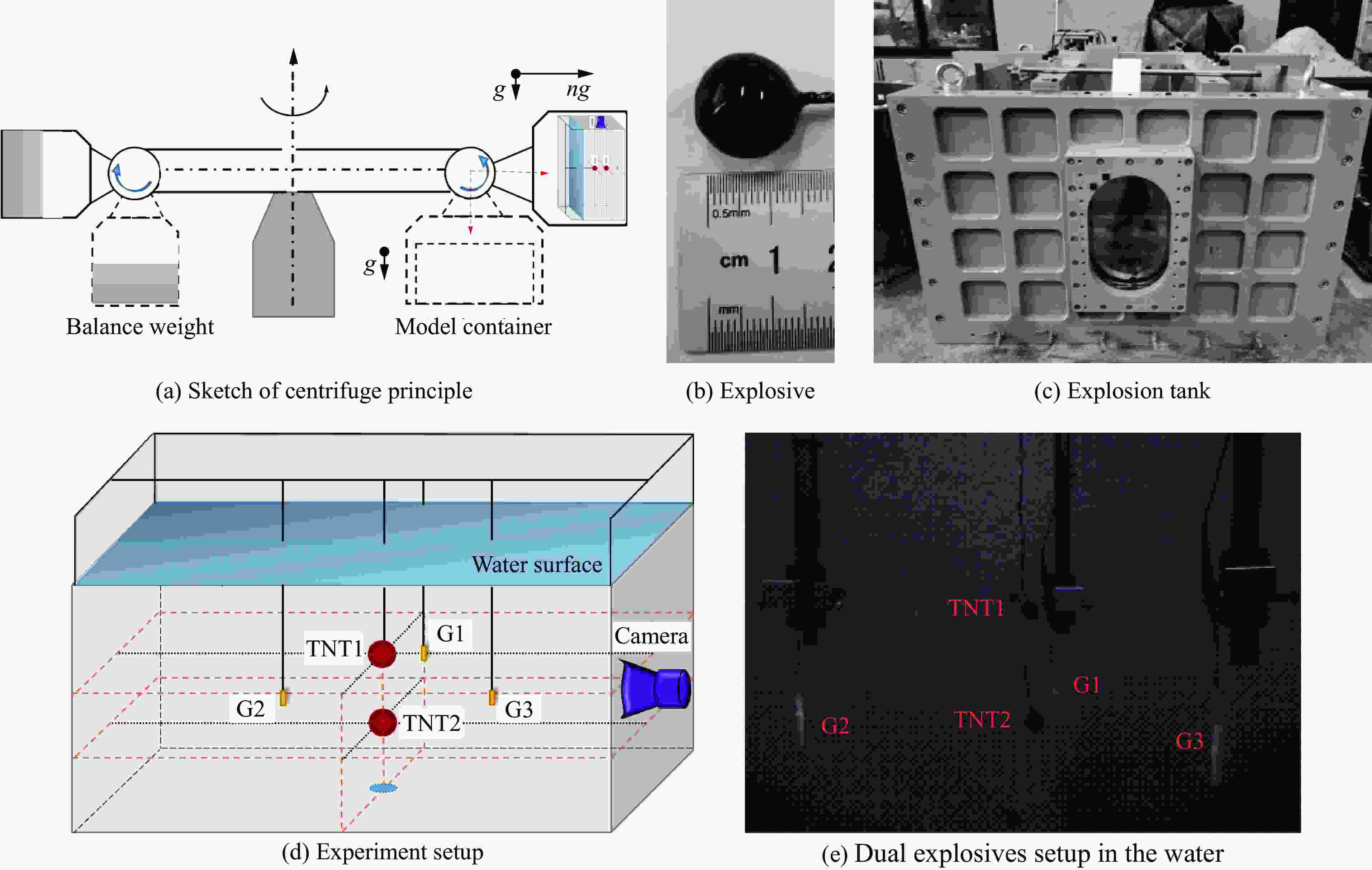
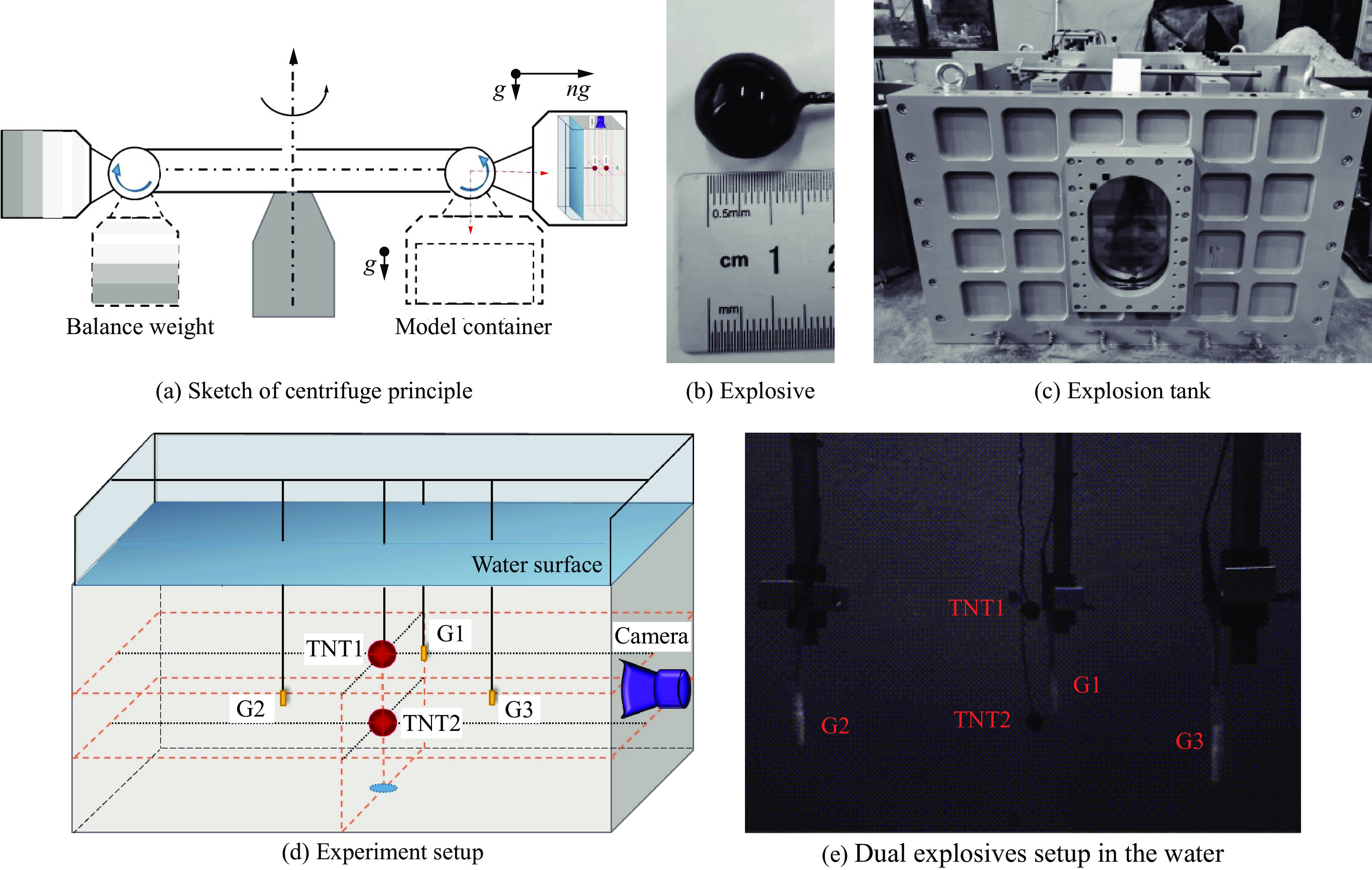
图 1 离心机水下多点爆炸实验布置
Figure 1. Experimental setup for underwater multi-point explosion in a centrifuge
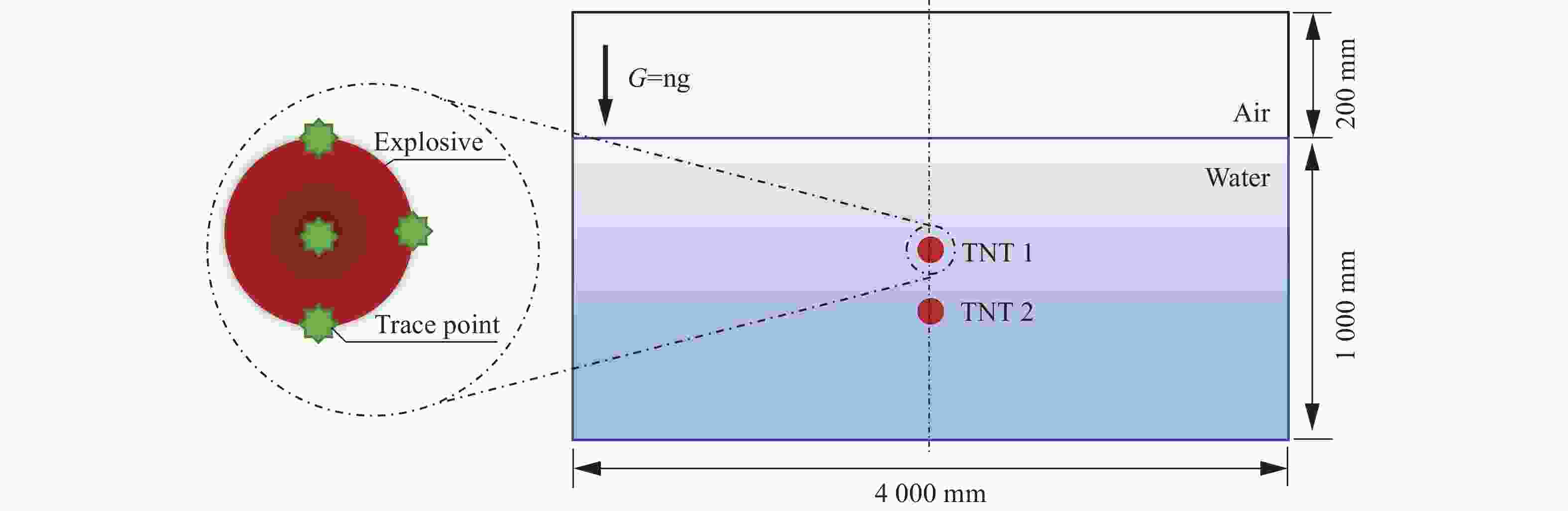
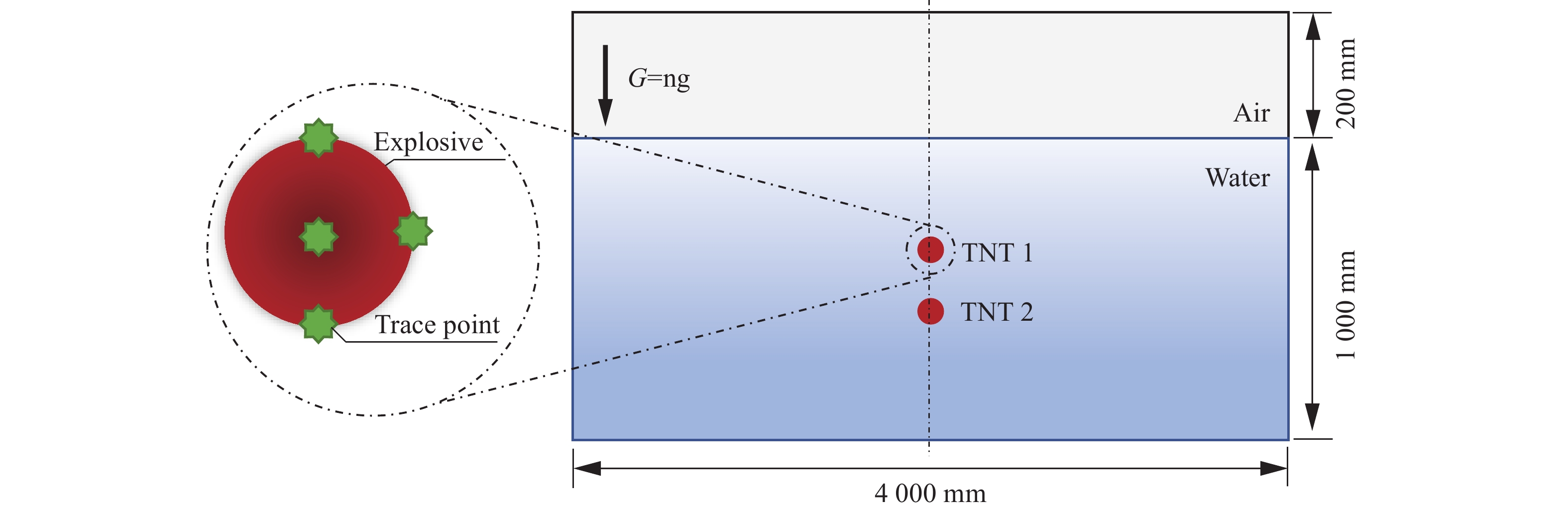
图 2 超重力水下两点爆炸二维轴对称数值模型
Figure 2. 2D axisymmetric numerical models of two-charge underwater explosions in hypergravity environment.
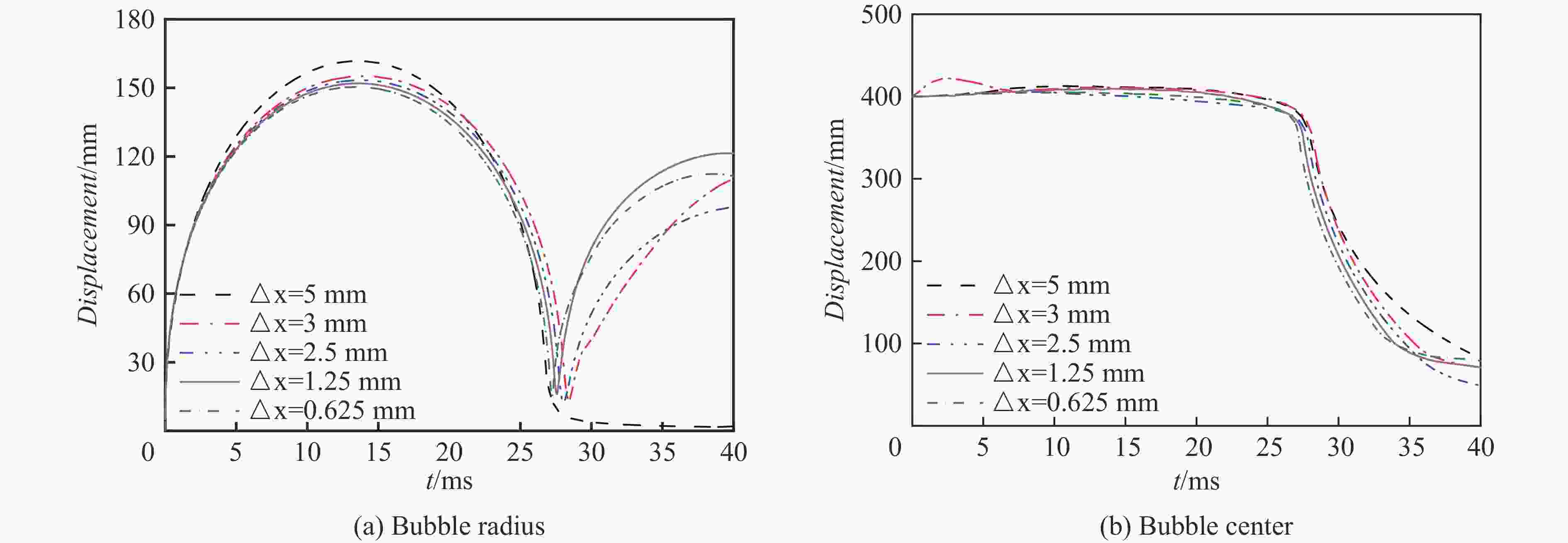
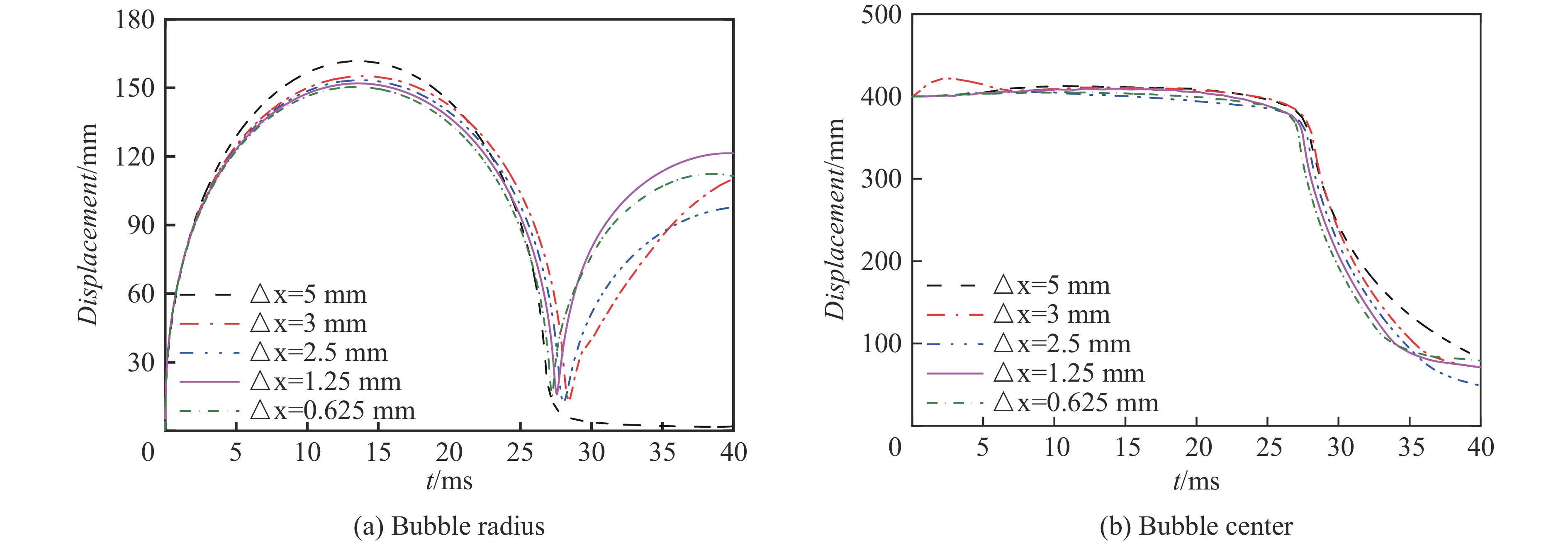
图 3 不同网格尺寸对应气泡特征尺寸
Figure 3. Bubble characteristic sizes obtained under different mesh sizes
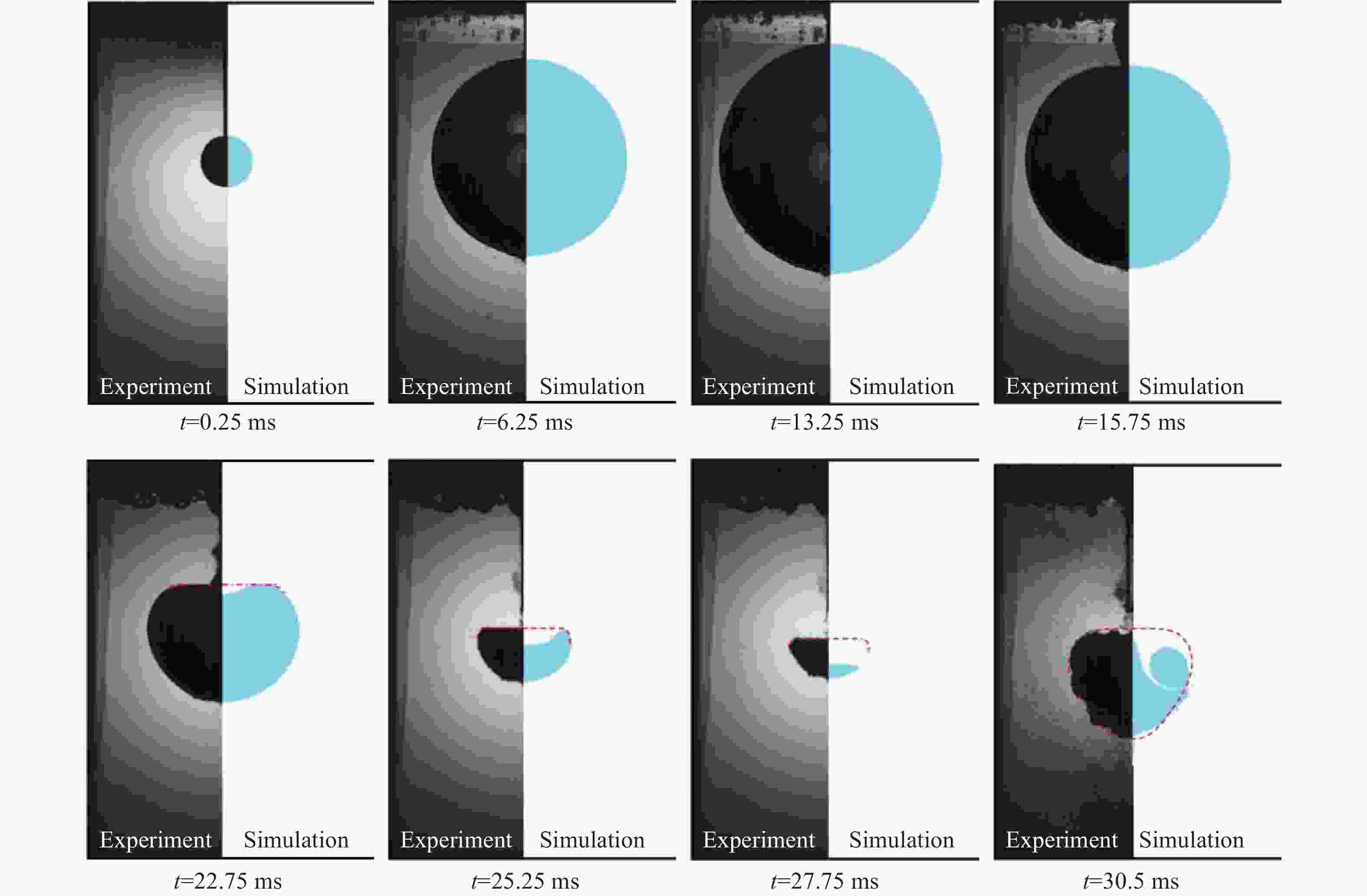
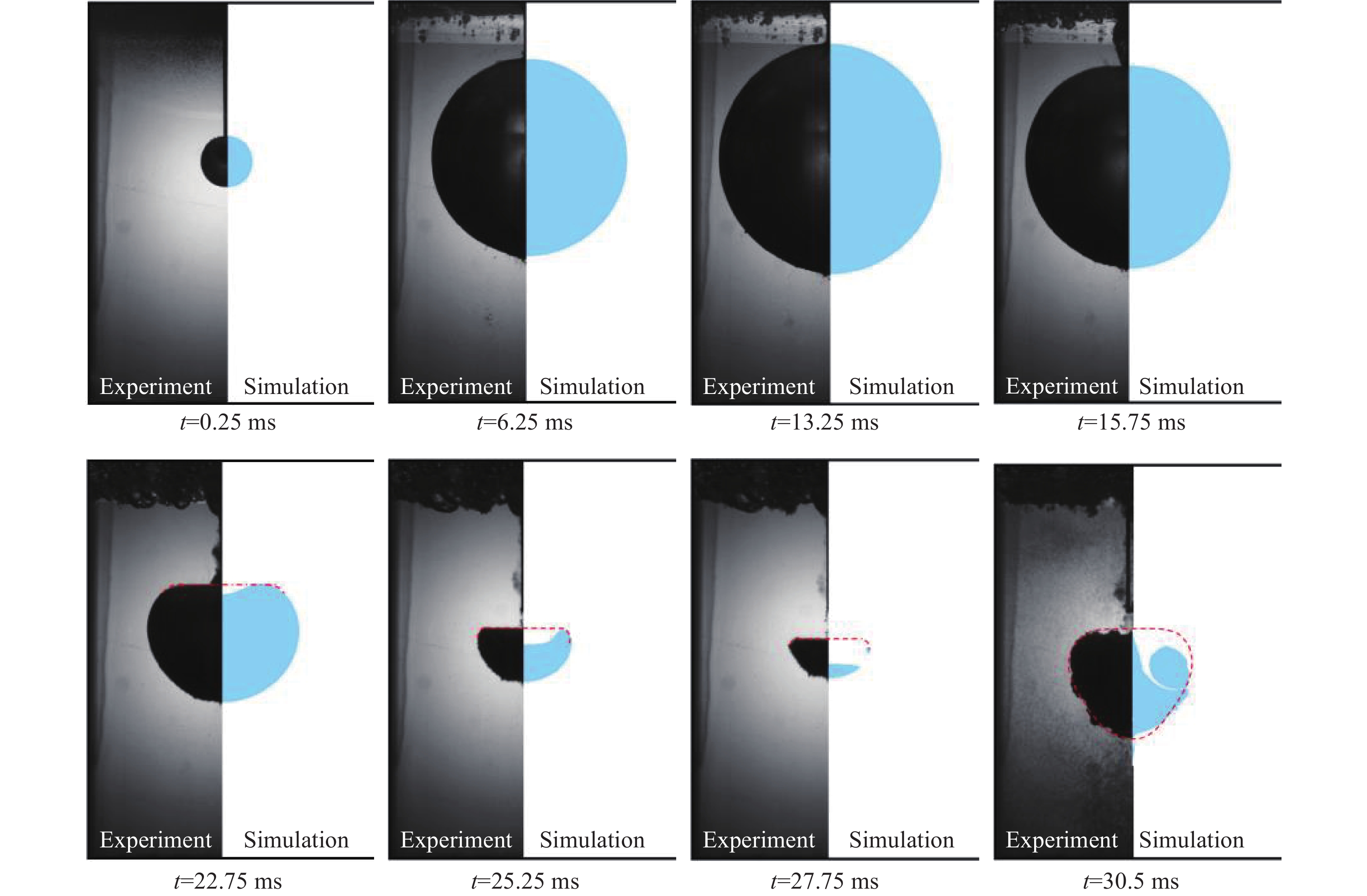
图 4 气泡形态演化实验与数值结果(W=1 g TNT)
Figure 4. Experimental and numerical bubble behaviors for W=1 g TNT
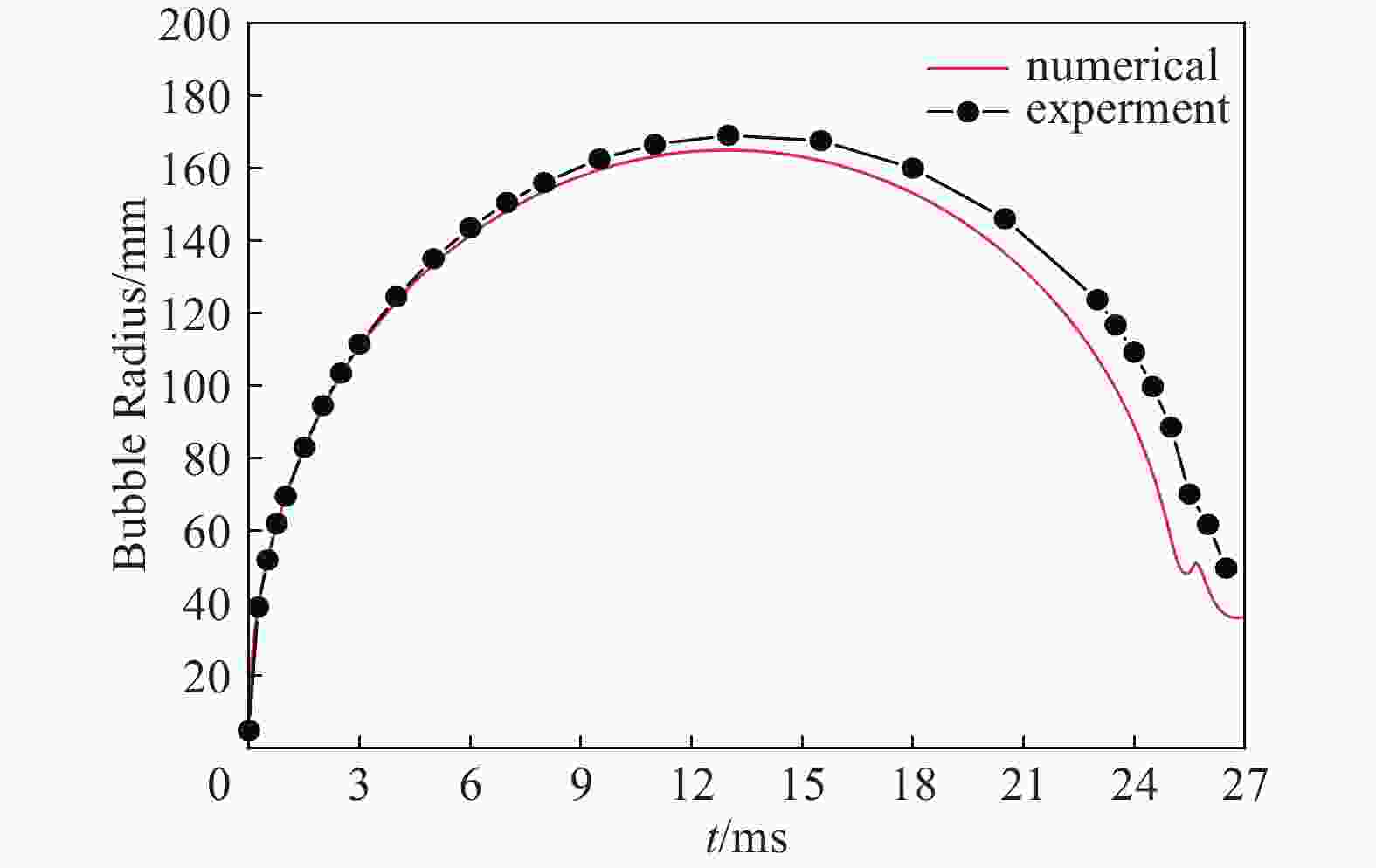
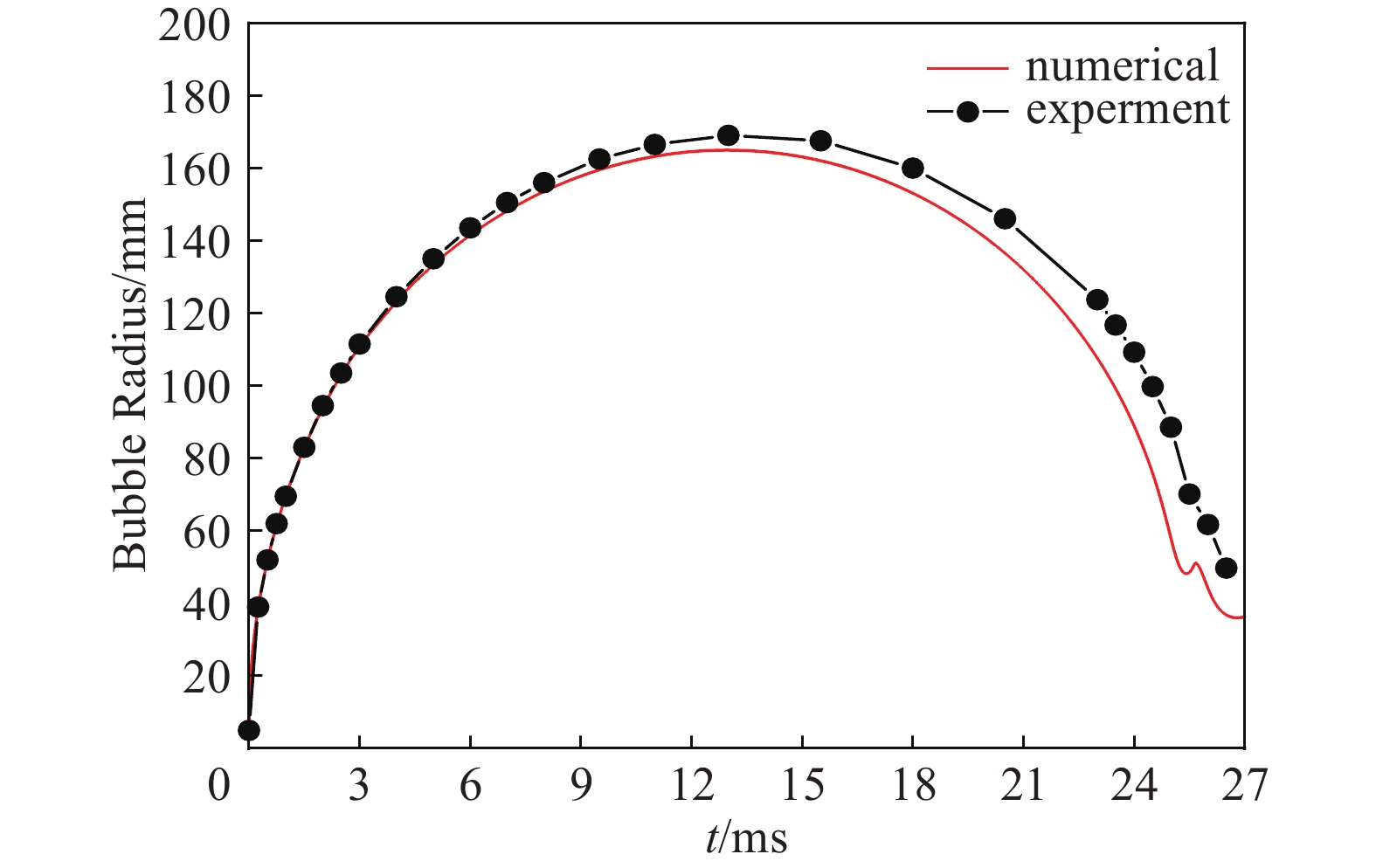
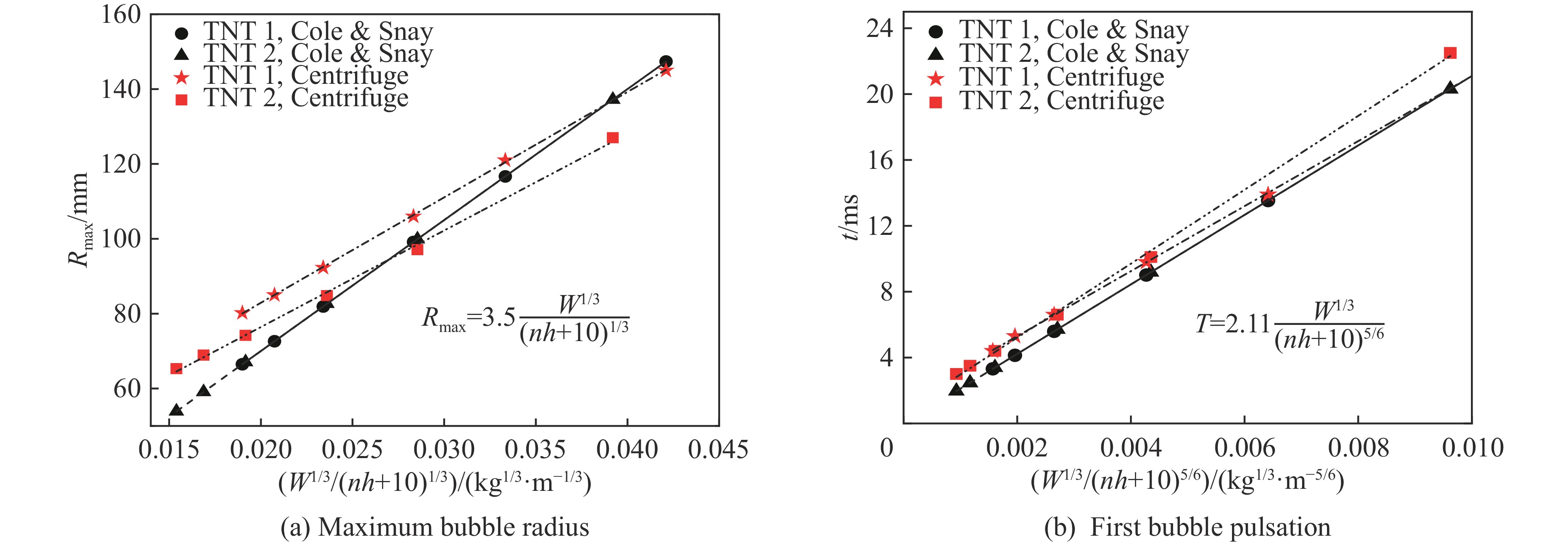
图 5 水下爆炸气泡半径时历曲线数值与实验结果对比
Figure 5. Comparison of time-history curves of underwater explosion bubble radius derived from experiment and numerical simulation.
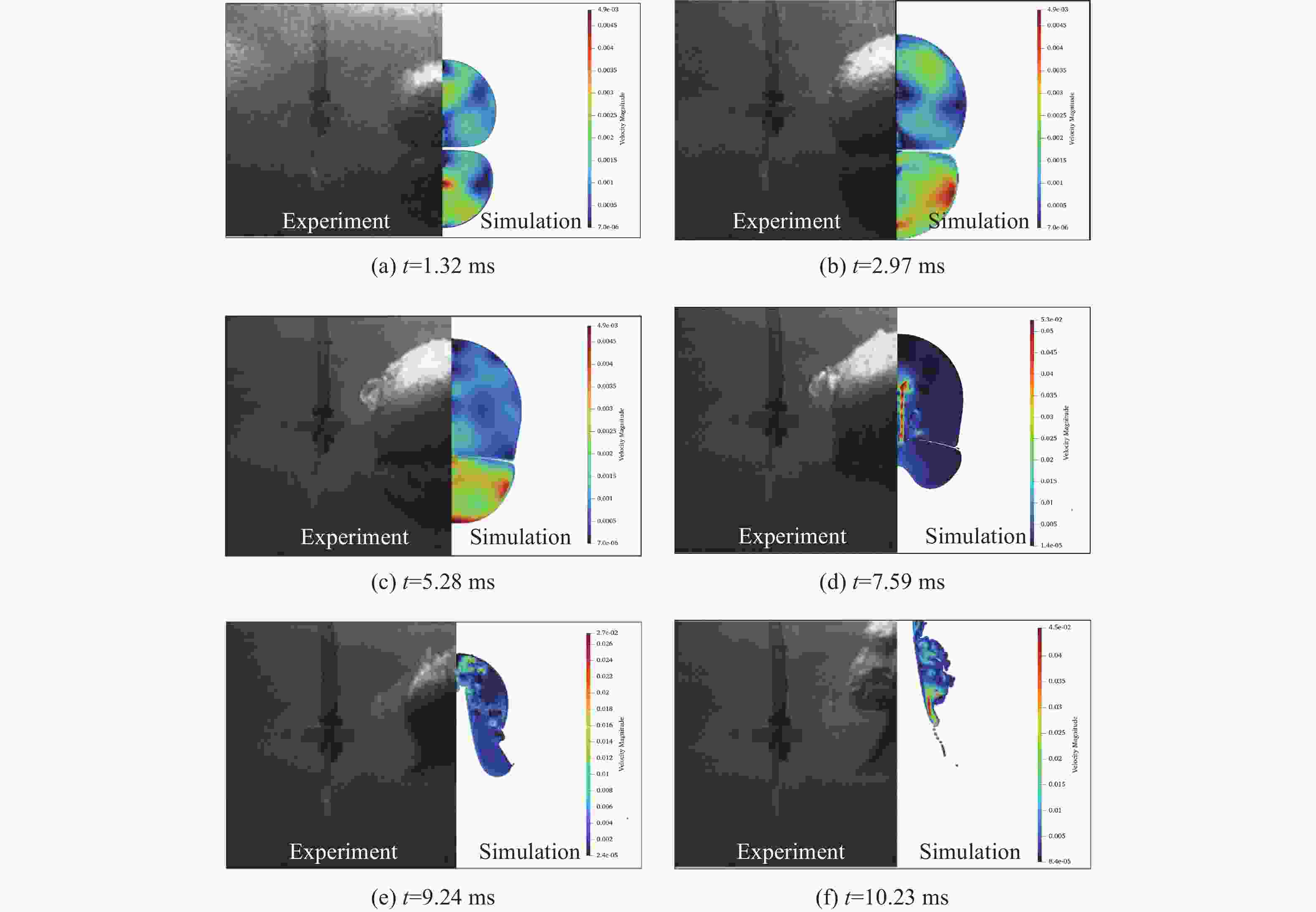
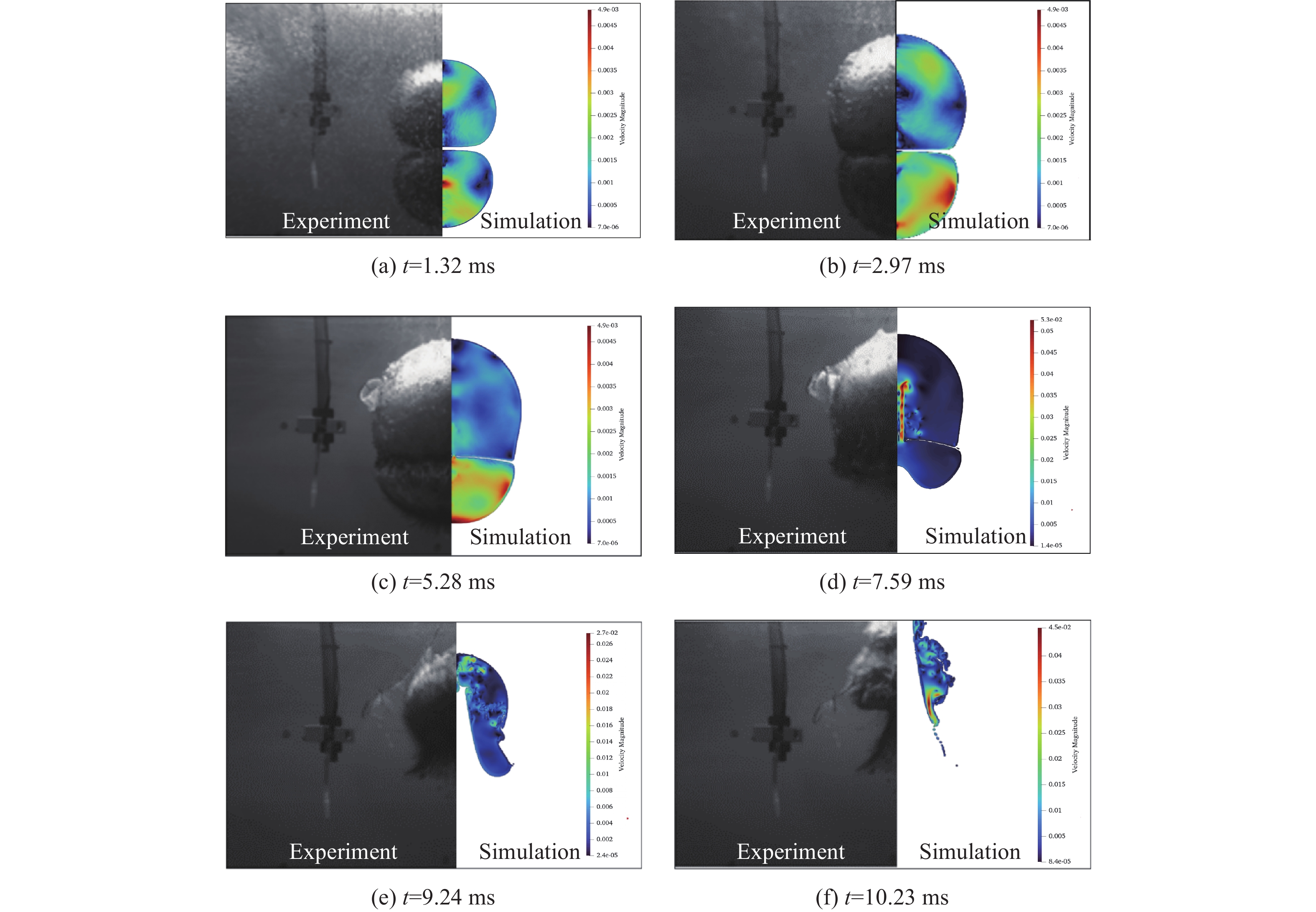
图 6 超重力(100g)水下爆炸双耦合气泡形态演化进程实验与数值结果
Figure 6. Comparison of experimental(left) and numerical(right) results on the evolution process of dual-coupled bubbles underwater explosion in hypergravity environment(100g).
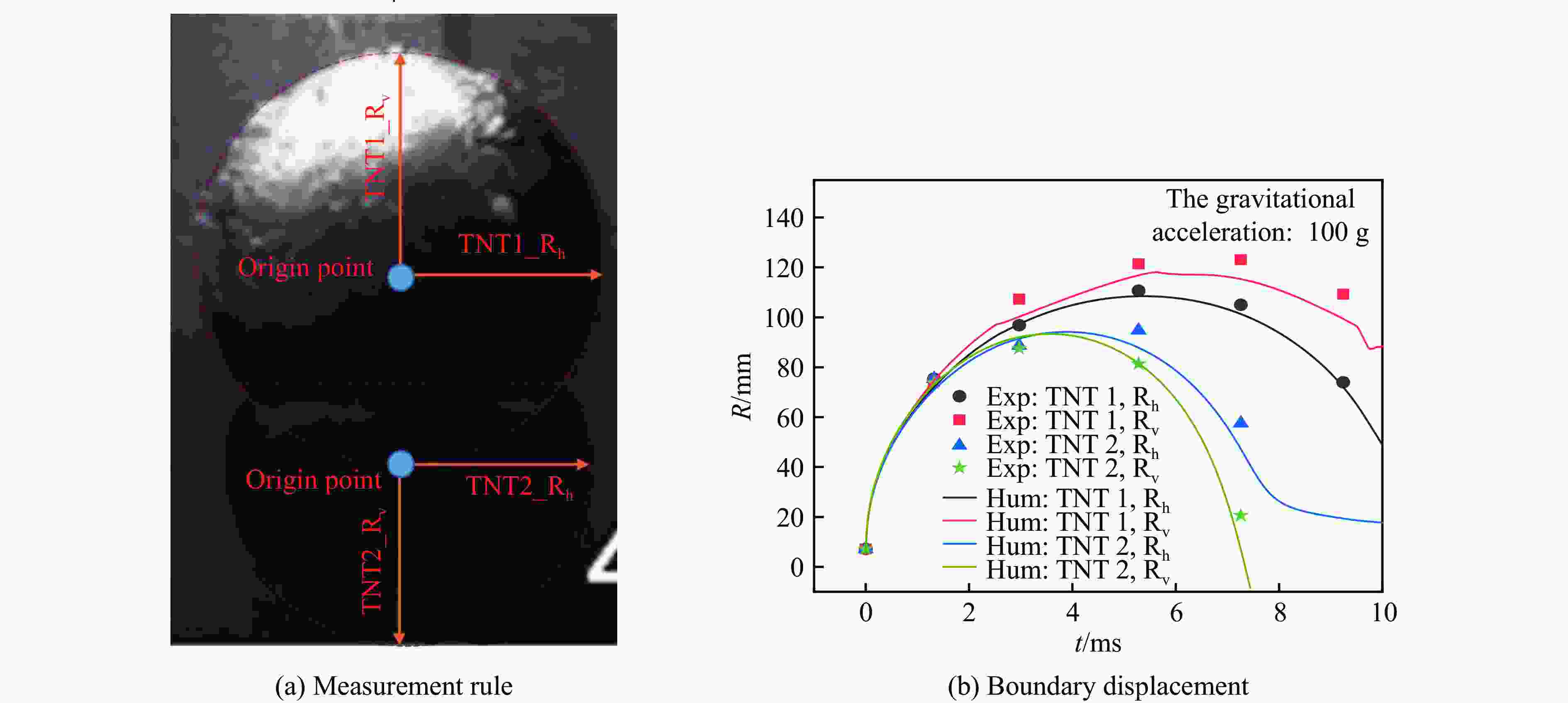
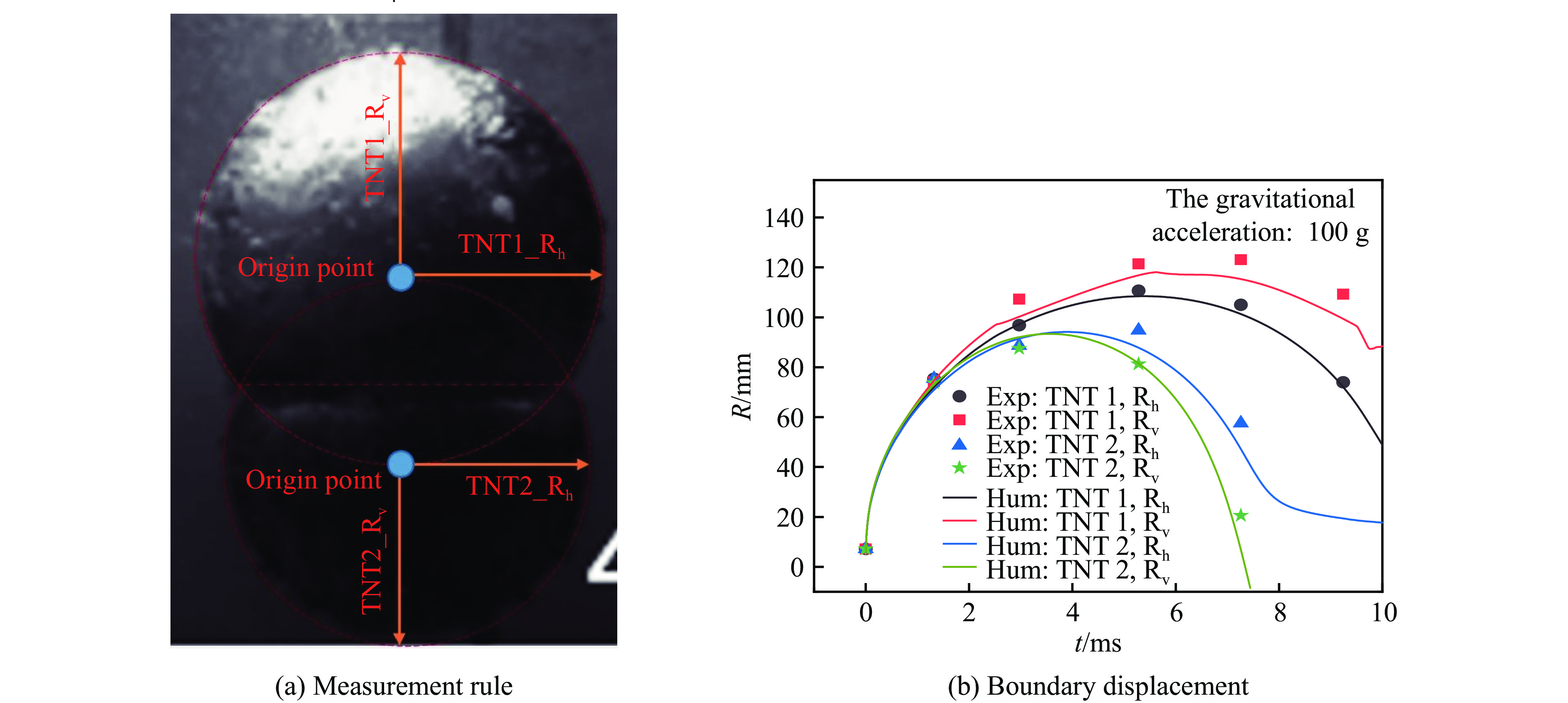
图 7 超重力水下爆炸双气泡边界扩张时历曲线(实验与数值结果)
Figure 7. Comparison of experimental and numerical bubble radius curves of underwater explosion in hypergravity environment
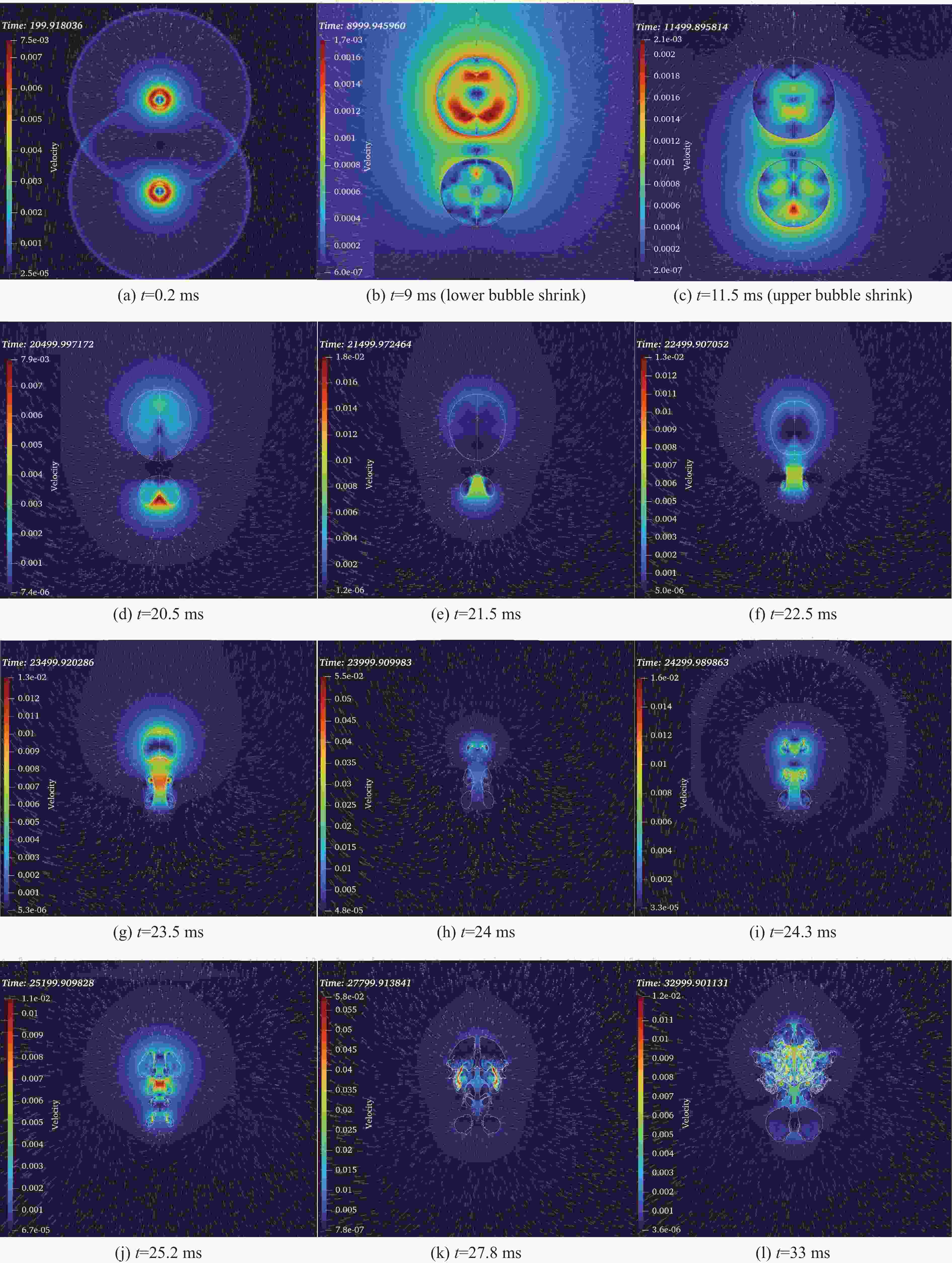
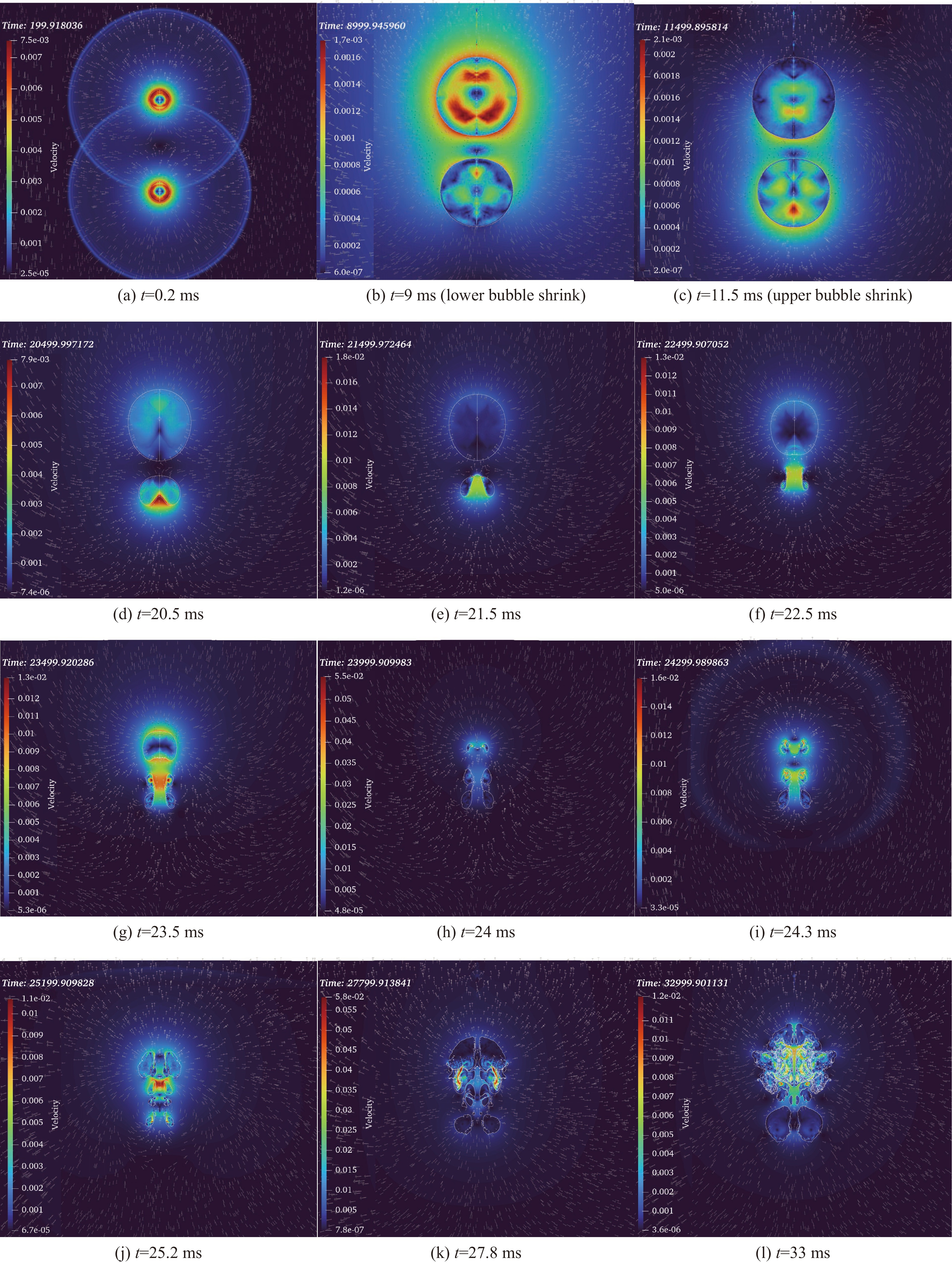
图 8 超重力场下双气泡形态耦合、融合、迁移和射流过程(云图为速度场,白色箭头为速度矢量方向,G=10g)
Figure 8. Dual-bubble interaction, coalescence, migration and jetting in hypergravity environment. (The color contour denotes the velocity magnitude and the white arrows denote the velocity direction,G=10g)
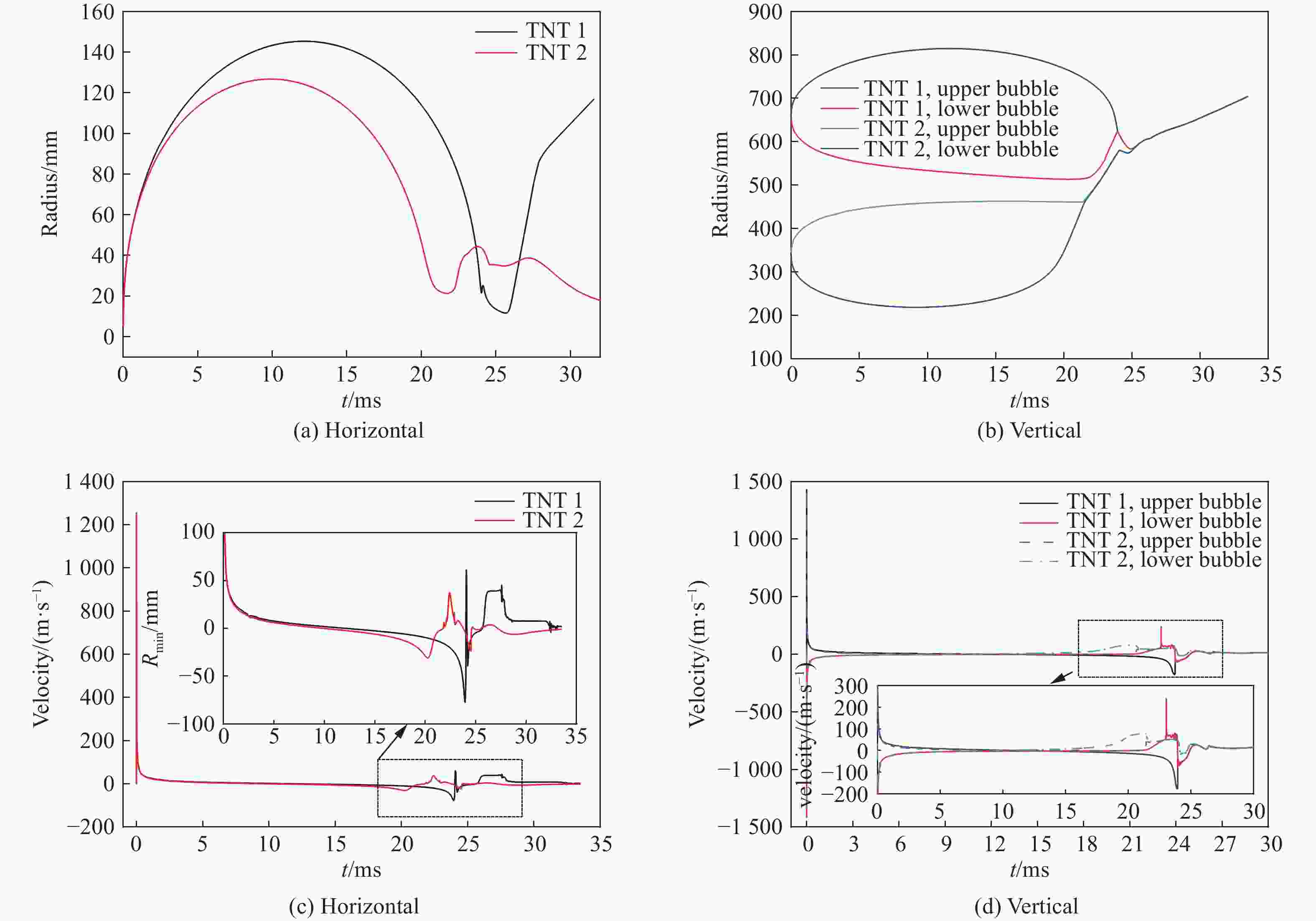
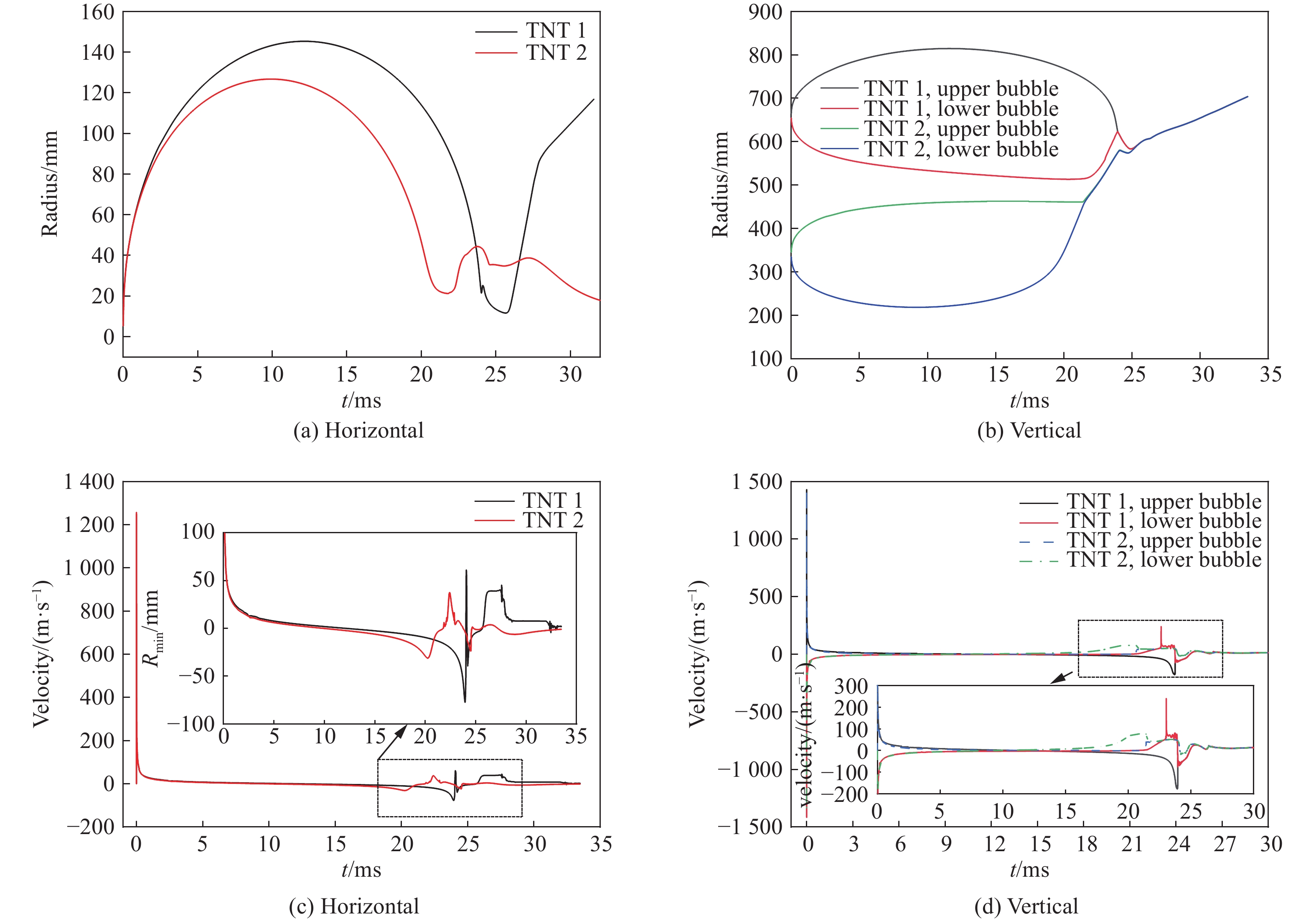
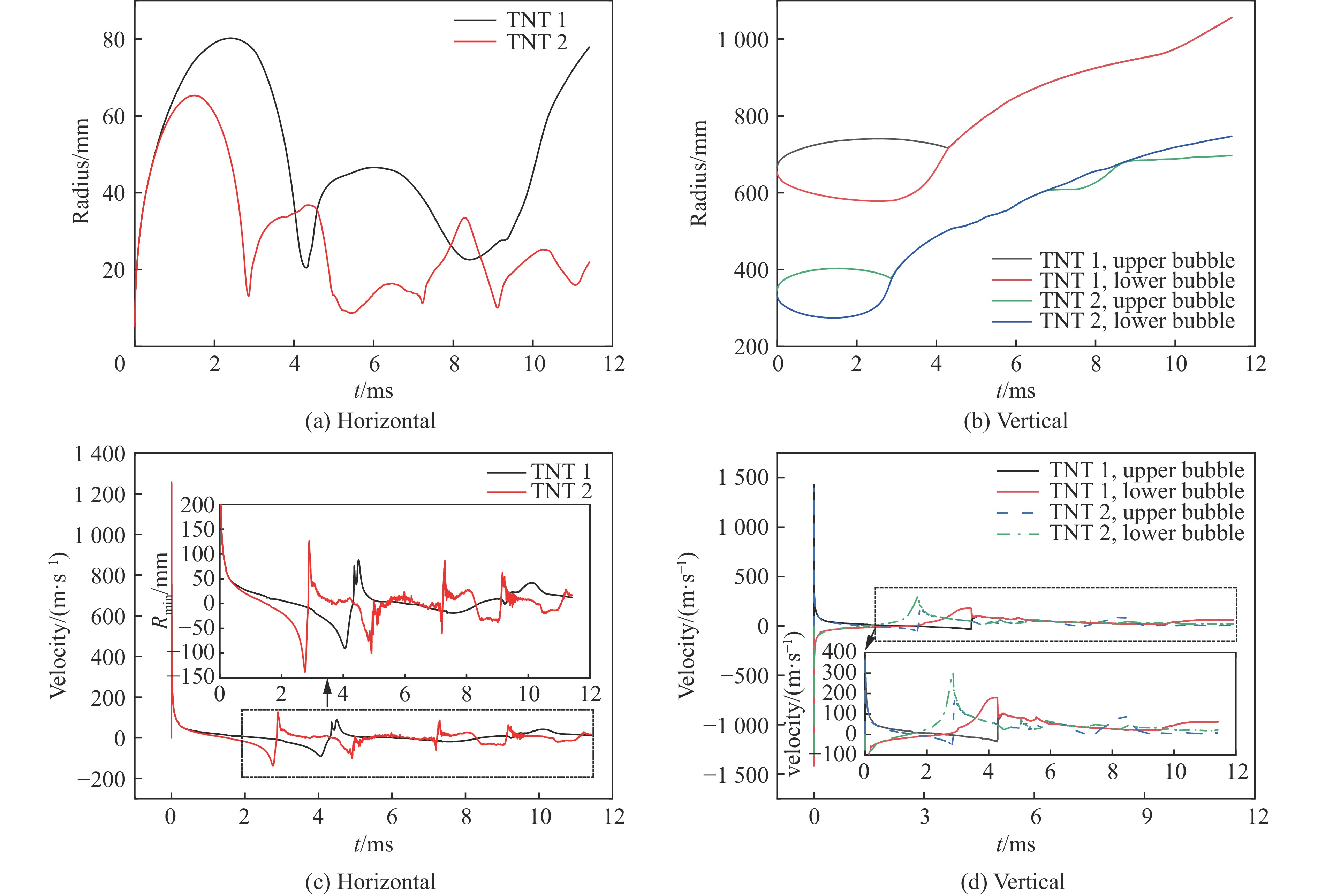
图 9 超重力场下双气泡边界位移及速度时历曲线 (G=10g)
Figure 9. Time-history curve of the displacement and velocity of the dual-bubble boundaries in hypergravity environment (G=10g)
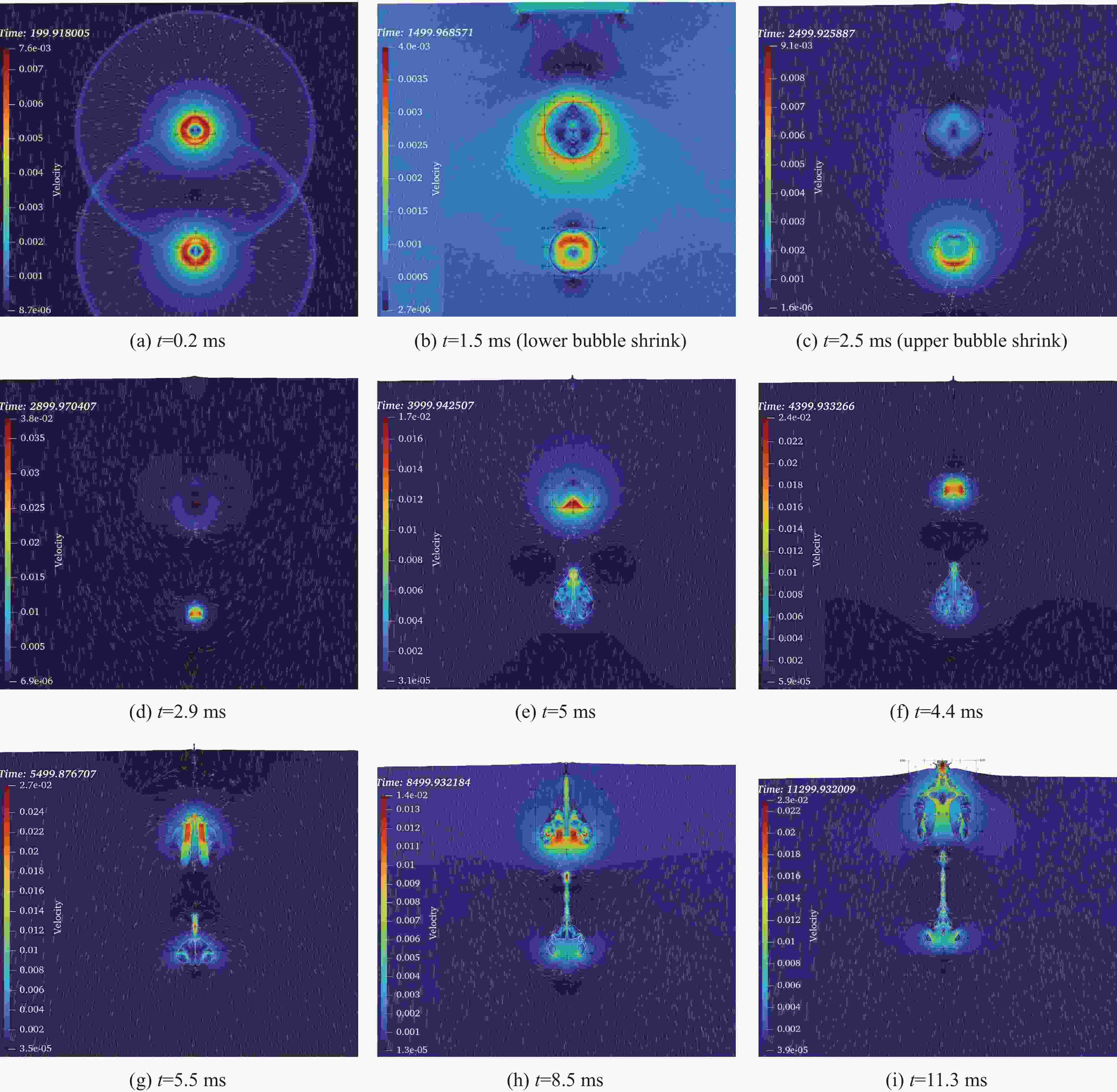
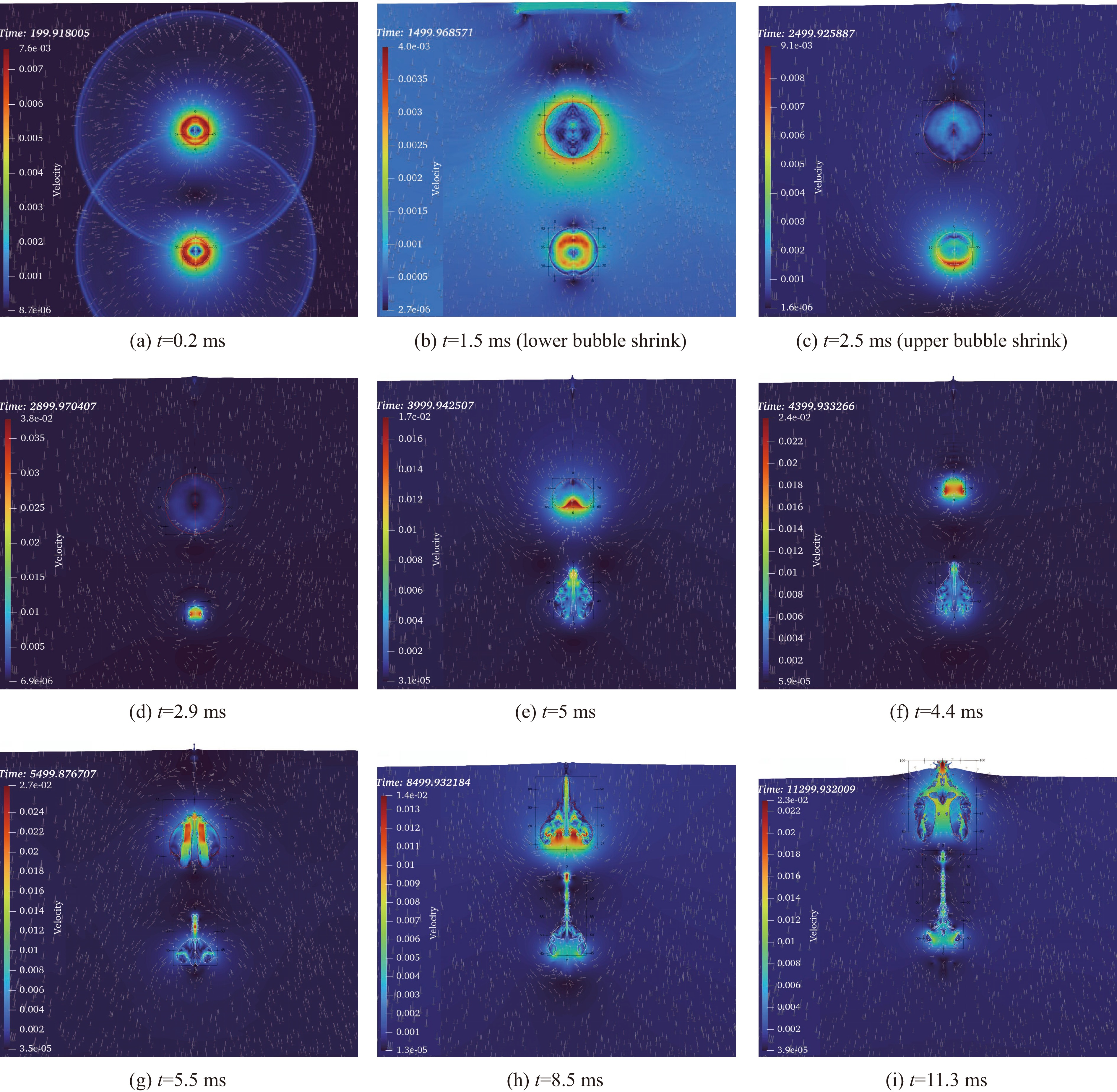
图 10 超重力场(400g)下双气泡形态耦合、融合、迁移和射流过程
Figure 10. Interaction, coalescence, migration and jetting of dual bubbles in hypergravity environment (400g)
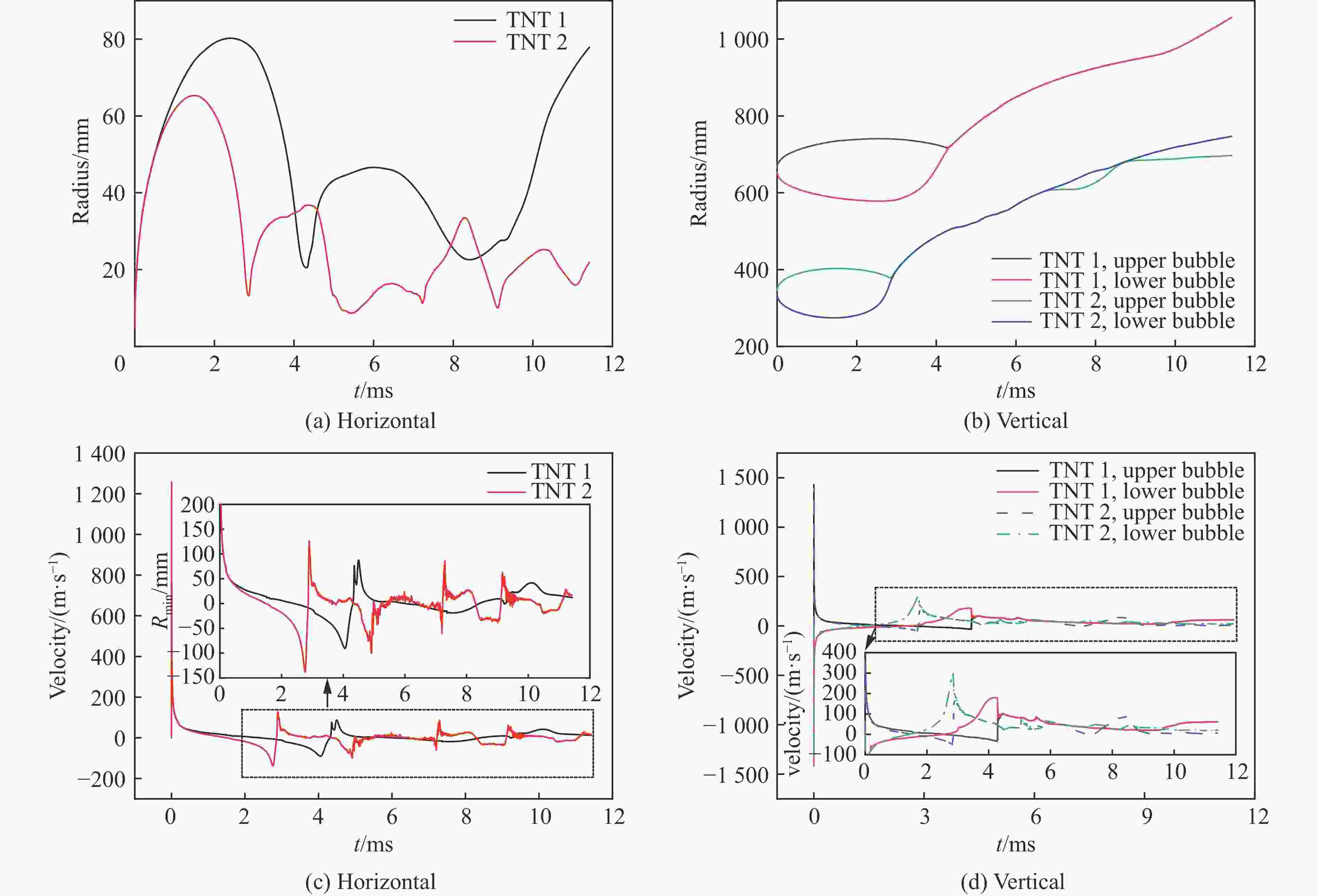
图 11 超重力场下气泡边界位移和速度时历曲线 G=400g
Figure 11. Time-history curves of the displacement and velocity of the dual-bubble boundaries in hypergravity environment, G=400g
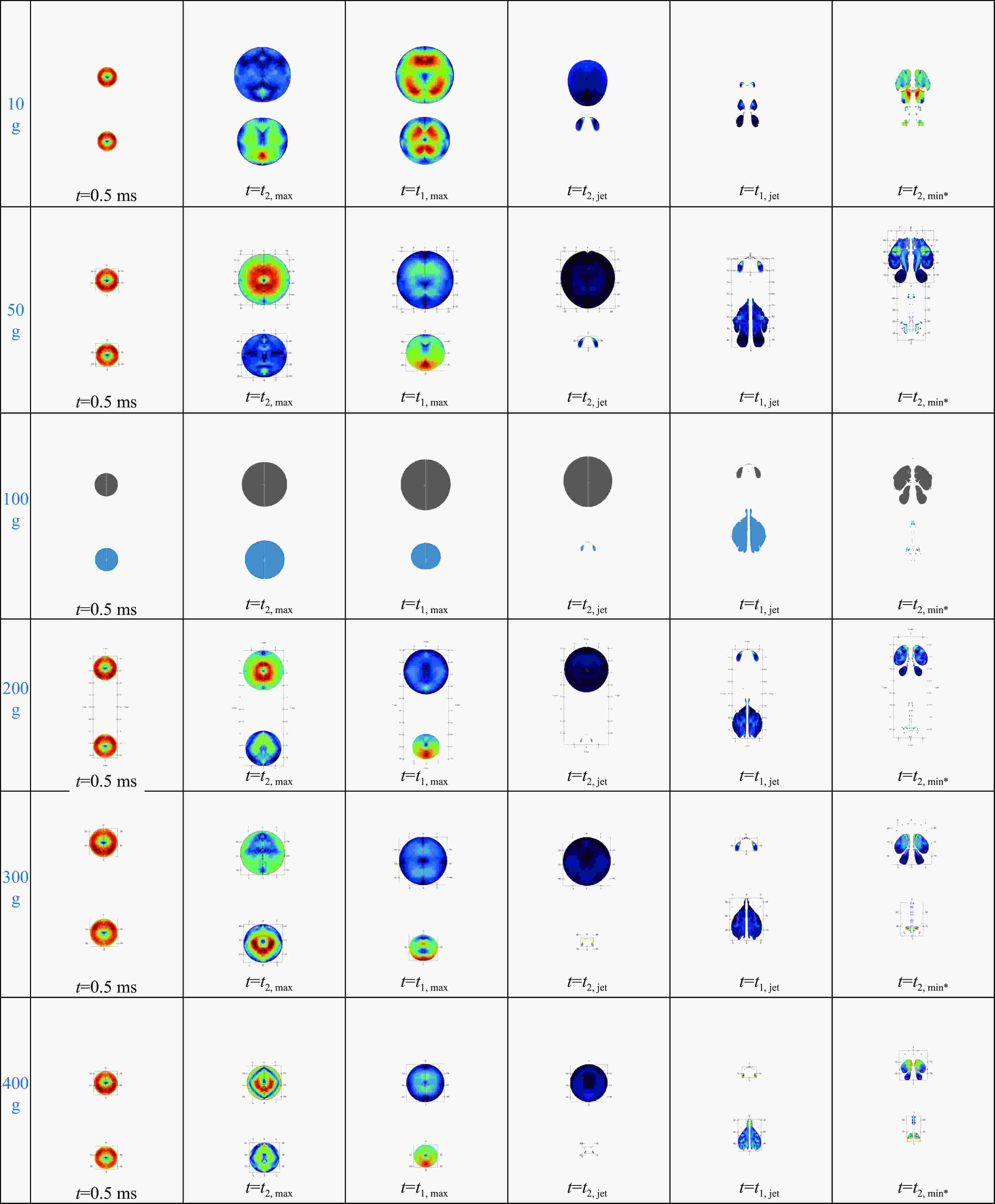
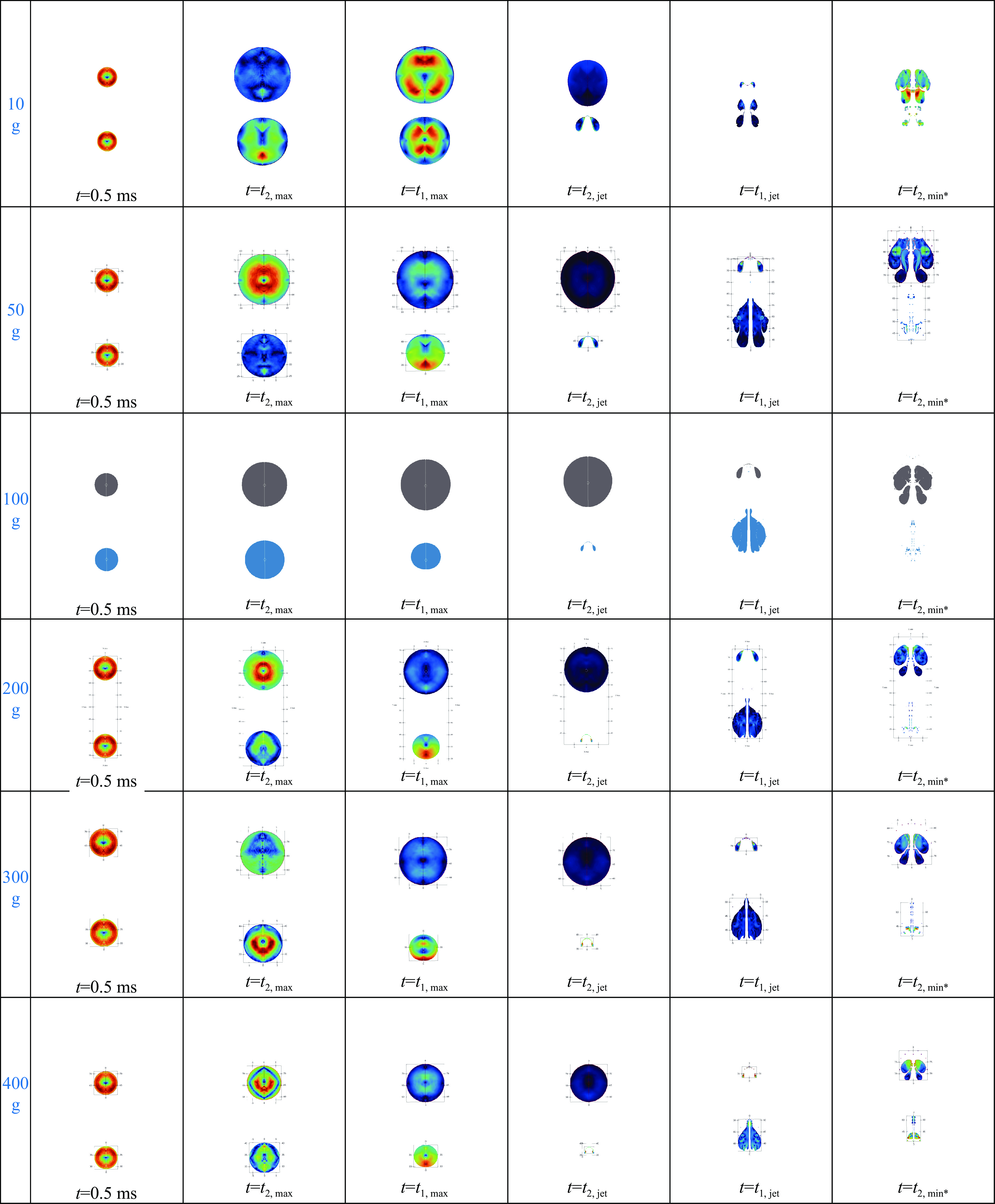
图 12 不同重力环境下水下爆炸双气泡形态演化对比
Figure 12. Comparison of morphological evolution of dual bubbles in underwater explosions under varying gravity conditions $ t_{2}^{\max } $
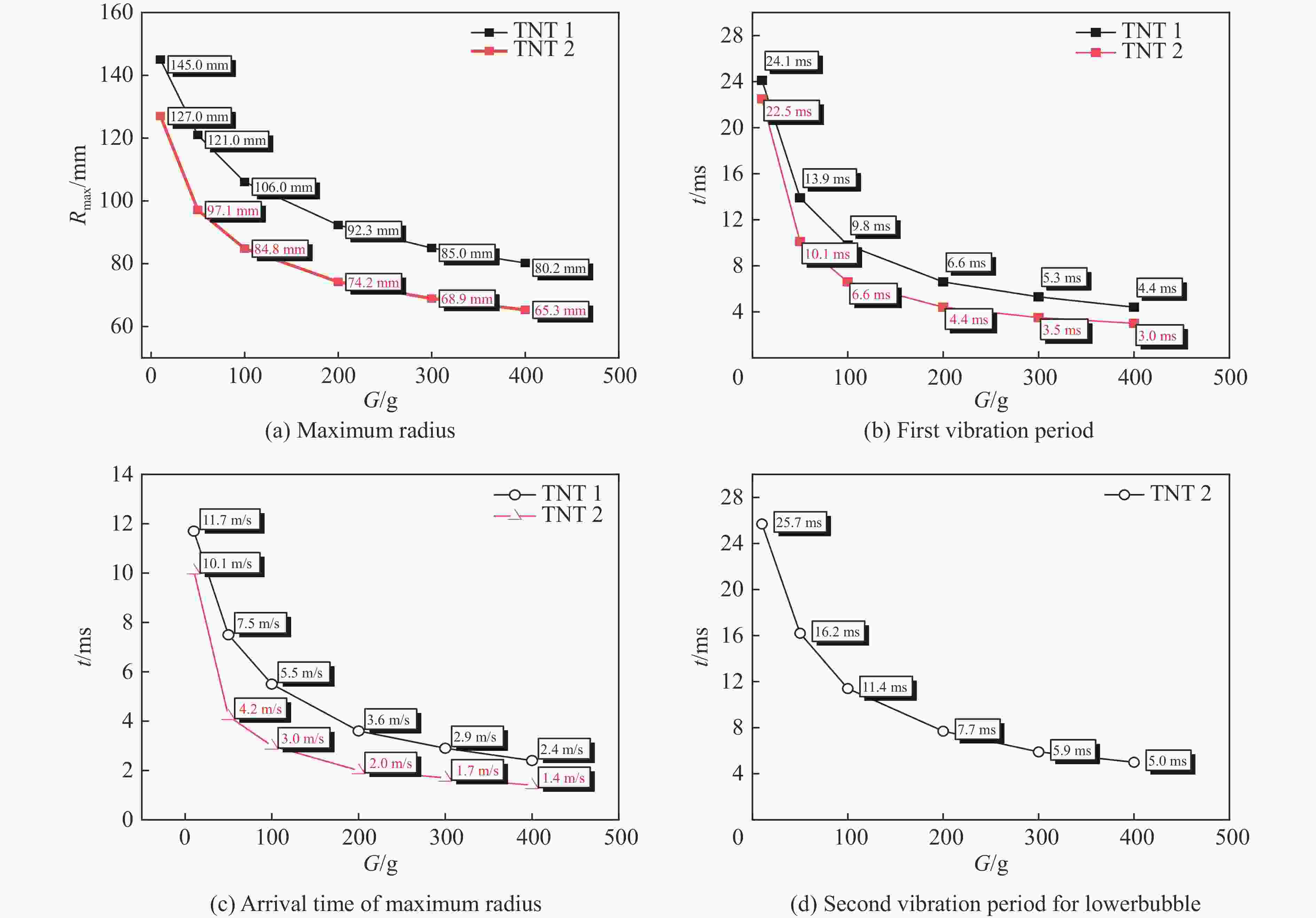
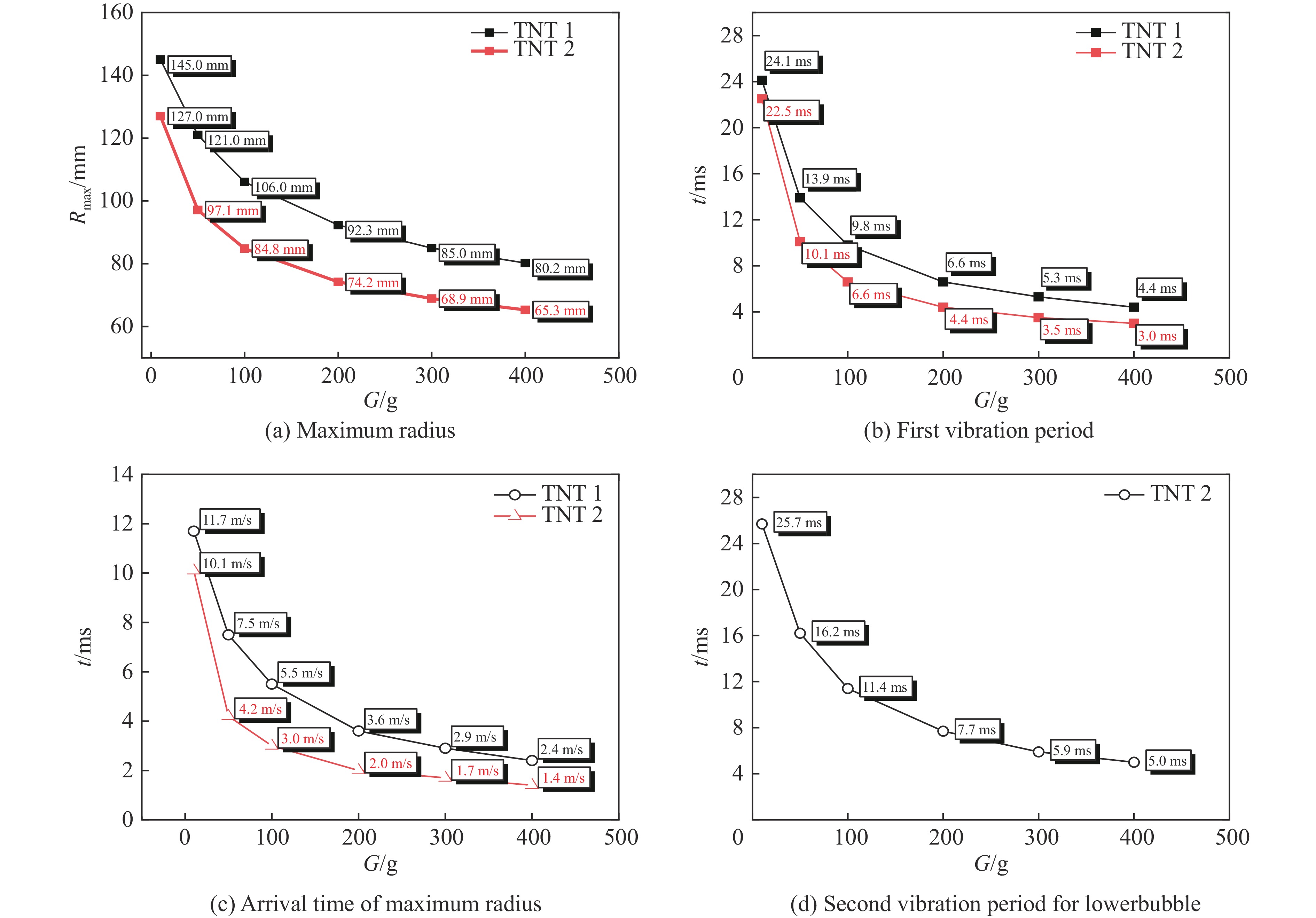
图 13 不同重力环境下气泡特征参数对比
Figure 13. Comparison of bubble characteristic parameters in different gravity environment.
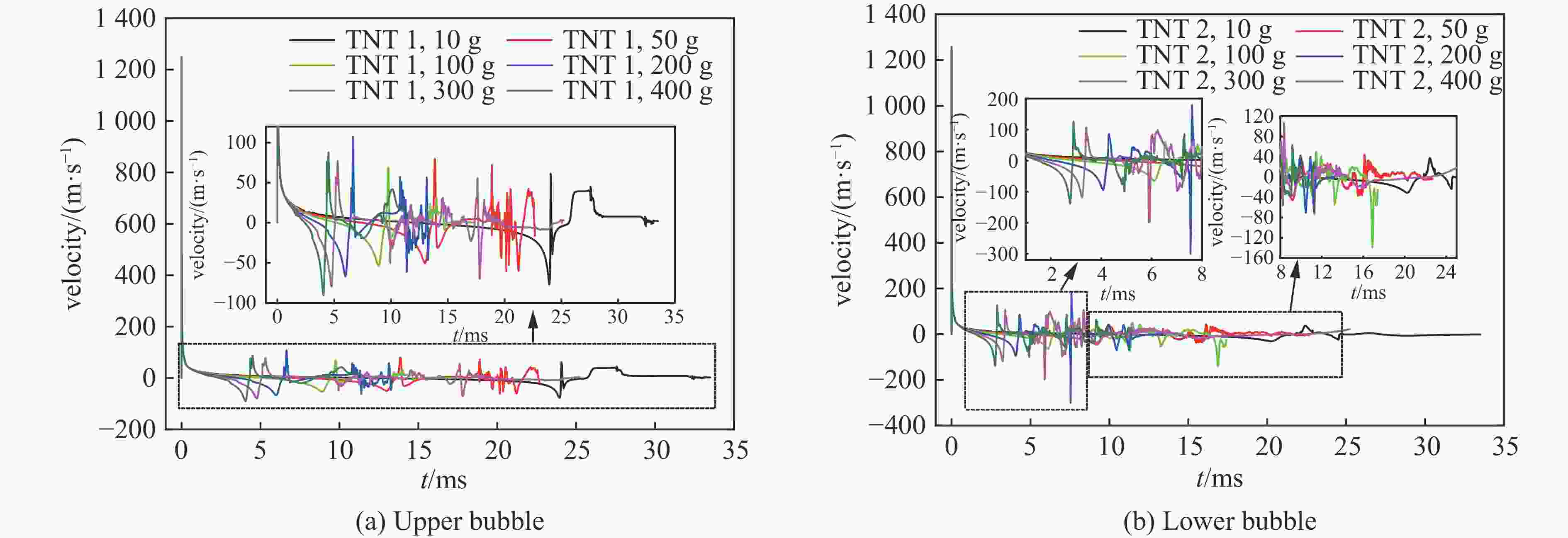
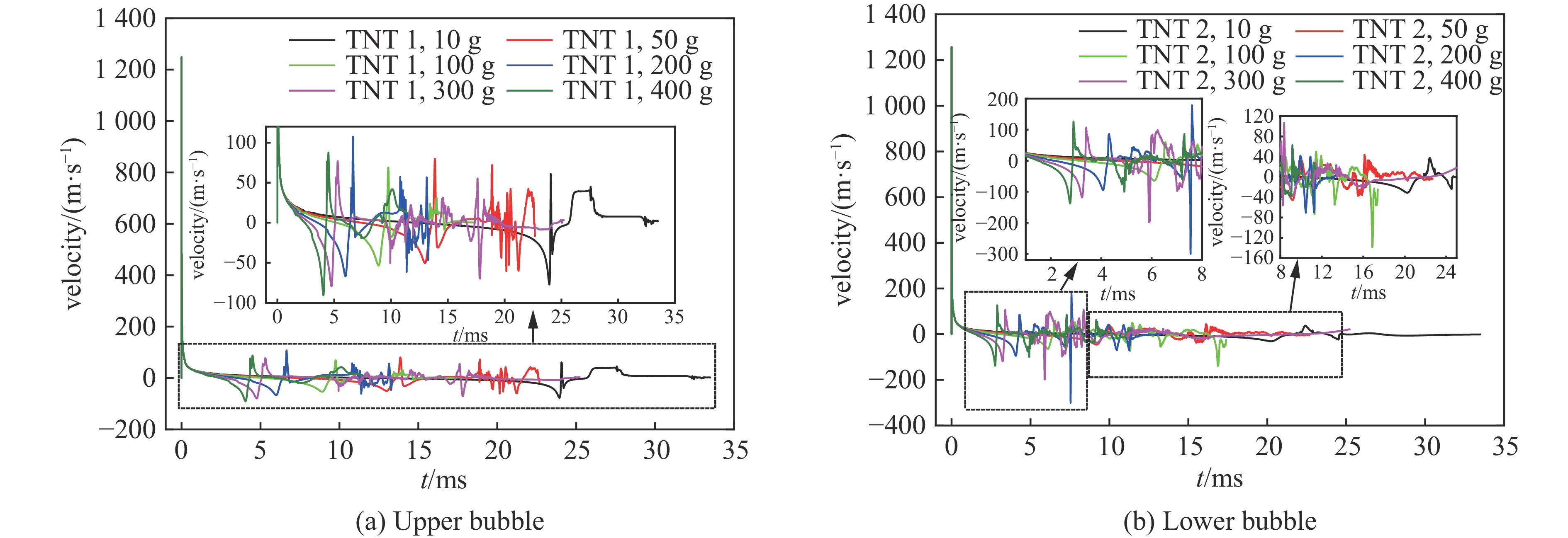
图 14 不同重力环境下气泡半径膨胀速度对比
Figure 14. Comparison of bubble radius expansion velocities in different gravity environment
表 1 超重力水下爆炸实验特征量相似关系
Table 1. Scaling law for characteristic parameters in hypergravity underwater explosion
类别 特征量名称 量纲 原型特征量 离心机特征量 特征量比例因子 重力场 离心加速度 LT−2 g ng n 介质 水密度 ML−3 $ {\rho }_{\text{w}} $ $ {\rho }_{\text{w}} $ 1 空气密度 ML−3 $ {\rho }_{\text{a}} $ $ {\rho }_{\text{a}} $ 1 装药 装药密度 ML−3 $ {\rho }_{0} $ $ {\rho }_{0} $ 1 装药量 M W W/n3 1/n3 装药能量 ML2T−2 E E/n3 1/n3 爆炸深度 L h h/n 1/n 爆距 L R R/n 1/n 装药半径 L R0 R0/n 1/n 气泡 气泡半径 L Rb Rb/n 1/n 气泡迁移高度 L hb hb/n 1/n 气泡脉动周期 T Tb Tb/n 1/n  下载: 导出CSV
表 2 实验及数值模拟工况
Table 2. Experimental and numerical simulation conditions
工况
编号装药当量
W/g双爆源间距
d/mm水深hw/mm 双爆源形心
深度hc/mm超重力加
速度G原型装药当量
Wp/kg原型爆源
间距dp/m原型水深hp/m
1此列分成3列
2 量符号的含义要说明研究方法 EX-1 1 320 1000 500 10g 1 kg 3.2 m 5 m 数值模拟 EX-2 1 320 1000 500 50g 125 kg 16 m 25 m EX-3 1 320 1000 500 100g 1000 32 m 50 m EX-4 1 320 1000 500 200g 8000 64 m 100 m EX-5 1 320 1000 500 300g 27000 96 m 150 m EX-6 1 320 1000 500 400g 64000 128 m 200 m EX-7 1 120 800 400 100g 1000 12 m 40 m 双爆源实验 EX-8 1 − 735 211 1g − − − 单爆源实验
下载: 导出CSV
表 3 气泡特征参数数值结果与实验、经验公式对比
Table 3. Numerical results vs. experiments and empirical formulas for bubble characteristics parameters
研究方法 气泡最大半径/mm 第一次脉动周期/ms 实验 169 26.5 经验 161 30.4 数值 165 26.8 数值结果与实验值的误差 −2.37% 1.13% 数值结果与经验值的误差 2.48% −11.84%
下载: 导出CSV
-
[1] RAYLEIGH L. VIII. On the pressure developed in a liquid during the collapse of a spherical cavity [J]. The London, Edinburgh, and Dublin Philosophical Magazine and Journal of Science, 1917, 34(200): 94–98. DOI: 10.1080/14786440808635681. [2] ZHANG A M, LI S M, XU R Z, et al. A theoretical model for compressible bubble dynamics considering phase transition and migration [J]. Journal of Fluid Mechanics, 2024, 999: A58. DOI: 10.1017/jfm.2024.954. [3] PRITCHETT J W. An evaluation of various theoretical models for underwater explosion bubble pulsation: IRA-TR-2-71 [R]. Berkeley: Information Research Associates Inc, 1971. DOI: 10.21236/AD0737271. [4] KELLER J B, KOLODNER I I. Damping of underwater explosion bubble oscillations [J]. Journal of Applied Physics, 1956, 27(10): 1152–1161. DOI: 10.1063/1.1722221. [5] BARRETT L C, THORNE C J. Oscillations of the gas bubble produced by an underwater explosion: AD0495826 [R]. Salt Lake City: UTAH UNIV, 1952. [6] RILEY M. Analytical solutions for predicting underwater explosion gas bubble behavior: DRDC-ATLANTIC-TM-2010-237 [R]. Dartmouth: Defence Research and Development Atlantic, 2010. [7] CUI P, ZHANG A M, WANG S P. Small-charge underwater explosion bubble experiments under various boundary conditions [J]. Physics of Fluids, 2016, 28(11): 117103. DOI: 10.1063/1.4967700. [8] SNAY H G, TIPTON R V. Charts for the parameters of migrating explosion bubbles [R]. White Oak: Naval Ordnance Lab, 1963. DOI: 10.21236/ad0414350. [9] SNAY H G. Underwater explosion phenomena: the parameters of migrating bubbles: NAVORD 4185 [R]. White Oak: Naval Ordnance Lab, 1962. DOI: 10.21236/ad0296424. [10] 方厚林, 卢强, 郭权势, 等. 水下爆炸冲击波和气泡行为自由面效应的实验研究 [J]. 爆炸与冲击, 2024, 44(8): 081444. DOI: 10.11883/bzycj-2024-0003.FANG H L, LU Q, GUO Q S, et al. Experimental research on the free surface effect of shock wave and bubble behavior of small yield underwater explosion [J]. Explosion and Shock Waves, 2024, 44(8): 081444. DOI: 10.11883/bzycj-2024-0003. [11] 郭权势, 卢强, 方厚林, 等. 基于光学法的水下爆炸冲击波流场压强测量与分析 [J]. 现代应用物理, 2024, 15(2): 021002. DOI: 10.12061/j.issn.2095-6223.2024.021002.GUO Q S, LU Q, FANG H L, et al. Measurement and analysis of underwater explosion shockwave overpressure based on optical method [J]. Modern Applied Physics, 2024, 15(2): 021002. DOI: 10.12061/j.issn.2095-6223.2024.021002. [12] HSU C Y, LIANG C C, Nguyen A T, et al. A numerical study on the underwater explosion bubble pulsation and the collapse process [J]. Ocean Engineering, 2014, 81: 29–38. DOI: 10.1016/j.oceaneng.2014.02.018. [13] WANG C, KHOO B C. An indirect boundary element method for three-dimensional explosion bubbles [J]. Journal of Computational Physics, 2004, 194(2): 451–480. DOI: 10.1016/j.jcp.2003.09.011. [14] GEERS T L, HUNTER K S. An integrated wave-effects model for an underwater explosion bubble [J]. The Journal of the Acoustical Society of America, 2002, 111(4): 1584–1601. DOI: 10.1121/1.1458590. [15] LI T, WANG S P, LI S, et al. Numerical investigation of an underwater explosion bubble based on FVM and VOF [J]. Applied Ocean Research, 2018, 74: 49–58. DOI: 10.1016/j.apor.2018.02.024. [16] LINDQUIST W B. Numerical simulation of the collapse of an underwater explosion bubble: AD-A203 744 [R]. New York: Courant Institute of Mathematical Sciences, 1988. [17] LIU N N, ZHANG A M, CUI P, et al. Interaction of two out-of-phase underwater explosion bubbles [J]. Physics of Fluids, 2021, 33(10): 106103. DOI: 10.1063/5.0064164. [18] 张阿漫, 汪玉, 闻雪友, 等. 水下爆炸气泡动态特性研究综述 [J]. 船舶力学, 2009, 13(5): 828–840. DOI: 10.3969/j.issn.1007-7294.2009.05.022.ZHANG A M, WANG Y, WEN X Y, et al. Review of the dynamics of the underwater explosion bubble [J]. Journal of Ship Mechanics, 2009, 13(5): 828–840. DOI: 10.3969/j.issn.1007-7294.2009.05.022. [19] 胡晶. 水下爆炸对结构作用的离心试验及数值模拟 [D]. 北京: 北京航空航天大学, 2018. DOI: 10.26937/d.cnki.gbhtu.2018.000001.HU J. Centrifugal and numerical modeling on structures impacted by underwater explosion [D]. Beijing: Beihang University, 2018. DOI: 10.26937/d.cnki.gbhtu.2018.000001. [20] 马上, 陈叶青, 王振清, 等. 水下爆炸离心机试验中爆炸荷载的缩比关系研究 [J]. 土木工程学报, 2021, 54(10): 20–29. DOI: 10.15951/j.tmgcxb.2021.10.006.MA S, CHEN Y Q, WANG Z Q, et al. Study on load scaling relationship in centrifuge test of underwater explosion [J]. China Civil Engineering Journal, 2021, 54(10): 20–29. DOI: 10.15951/j.tmgcxb.2021.10.006. [21] 娄浩然, 胡晶, 梁向前, 等. 超重力场下球形炸药水下爆炸实验及数值模拟 [J]. 工程爆破, 2017, 23(3): 15–21,36. DOI: 10.3969/j.issn.1006-7051.2017.03.004.LOU H R, HU J, LIANG X Q, et al. Underwater explosion experiment and numerical simulation of spherical explosives under hypergravity field [J]. Engineering Blasting, 2017, 23(3): 15–21,36. DOI: 10.3969/j.issn.1006-7051.2017.03.004. [22] HU J, CHEN Z Y, ZHANG X D, et al. Underwater explosion in centrifuge part I: validation and calibration of scaling laws [J]. Science China Technological Sciences, 2017, 60(11): 1638–1657. DOI: 10.1007/s11431-017-9083-0. [23] WANG Q S, LIU S C, LOU H R. Calibration of numerical simulation methods for underwater explosion with centrifugal tests [J]. Shock and Vibration, 2019, 2019(1): 2670836. DOI: 10.1155/2019/2670836. [24] 宋歌, 龙源, 钟明寿, 等. 离心机和密闭加压容器中水下爆炸相似关系 [J]. 爆炸与冲击, 2019, 39(2): 024102. DOI: 10.11883/bzycj-2017-0321.SONG G, LONG Y, ZHONG M S, et al. Similarity relations of underwater explosion in centrifuge and pressurizing vessels [J]. Explosion and Shock Waves, 2019, 39(2): 024102. DOI: 10.11883/bzycj-2017-0321. [25] 刘世聪, 王秋生, 娄浩然. 水下爆炸问题的数值模拟及离心机试验验证 [J]. 中国测试, 2019, 45(12): 138–145. DOI: 10.11857/j.issn.1674-5124.2019030022.LIU S C, WANG Q S, LOU H R. Numerical simulation and centrifuge test verification of underwater explosion [J]. China Measurement & Testing Technology, 2019, 45(12): 138–145. DOI: 10.11857/j.issn.1674-5124.2019030022. [26] ZHANG J, GUAN L H, LI W J, et al. Centrifuge modeling of underwater explosion near the water-soil interface [J]. Physics of Fluids, 2025, 37(4): 047124. DOI: 10.1063/5.0260821. [27] LI S, ZHANG A M, HAN R, et al. Experimental and numerical study of two underwater explosion bubbles: coalescence, fragmentation and shock wave emission [J]. Ocean Engineering, 2019, 190: 106414. DOI: 10.1016/j.oceaneng.2019.106414. [28] CUI P, WANG Q X, WANG S P, et al. Experimental study on interaction and coalescence of synchronized multiple bubbles [J]. Physics of Fluids, 2016, 28(1): 012103. DOI: 10.1063/1.4939007. [29] CHEW L W, KLASEBOER E, OHL S W, et al. Interaction of two differently sized oscillating bubbles in a free field [J]. Physical Review E, 2011, 84: 066307. DOI: 10.1103/PhysRevE.84.066307. [30] GEL’FAND B E, TAKAYAMA K. Similarity criteria for underwater explosions [J]. Combustion, Explosion and Shock Waves, 2004, 40(2): 214–218. DOI: 10.1023/B:CESW.0000020144.55275.df. [31] 张效慈. 水下爆炸试验相似准则 [J]. 船舶力学, 2007, 11(1): 108–118. DOI: 10.3969/j.issn.1007-7294.2007.01.014.ZHANG X C. Similarity criteria for experiment of underwater explosion [J]. Journal of Ship Mechanics, 2007, 11(1): 108–118. DOI: 10.3969/j.issn.1007-7294.2007.01.014. [32] COLE R H. Underwater explosions [M]. Princeton: Princeton University Press, 1948. DOI: 10.5962/bhl.title.48411. [33] SUPPONEN O, OBRESCHKOW D, KOBEL P, et al. Shock waves from nonspherical cavitation bubbles [J]. Physical Review Fluids, 2017, 2(9): 093601. DOI: 10.1103/PhysRevFluids.2.093601. -

计量
- 文章访问数: 393
- HTML全文浏览量: 41
- PDF下载量: 81
- 被引次数: 0