



Analysis of damage characteristics and criteria of independent embedded steel sheet piles under shallow water explosion
-
摘要: 独立植埋式钢板桩施工便捷、抗毁伤能力强,广泛应用于近海防护等领域,其在浅水爆炸下的毁伤特性决定了结构的抗爆能力。针对现有研究缺乏对该结构浅水爆炸下毁伤机理的研究问题,基于水下爆炸荷载衰减规律,建立了钢板桩浅水抗爆毁伤工程计算模型,构建了水-炸药-钢板桩-砂土耦合仿真计算模型。同时,开展模型试验验证了工程模型与数值结果的可靠性,分析了爆炸当量、爆源目标距离、水深对其毁伤效果的影响。研究表明:钢板桩毁伤薄弱区集中于水土交界处,主要破坏模式为冲切断裂与弯曲变形;比例爆源目标距离是影响毁伤效果的核心参数,当比例爆源目标距离小于0.086 m/kg1/3时发生冲切断裂,大于1.026 m/kg1/3时无明显毁伤,介于两者之间时产生塑性弯曲变形;水深增大对钢板桩断裂毁伤影响较小,但可延长弯曲段长度,其增幅可达35%。理论计算、数值模拟与模型试验结果吻合度较好,相对误差小于10%,满足工程预测精度需求。研究成果可为独立植埋式钢板桩的抗爆设计、毁伤评估及防护加固提供理论支撑与工程技术参考。Abstract: Independent embedded steel sheet piles, characterized by convenient construction and strong damage resistance, are widely used in nearshore coastal protection engineering. The damage characteristics of steel sheet piles subjected to shallow-water explosions play a critical role in determining the reliability of blast-resistant design. However, existing studies remain insufficient to fully elucidate the damage mechanisms of steel sheet piles under shallow-water blast loading. Based on the attenuation law of underwater explosion loads, an engineering calculation model was established to evaluate the blast-induced damage of steel sheet piles in shallow water. Meanwhile, a coupled numerical simulation model accounting for the interaction among multiple materials was developed. Model tests were further conducted to validate the reliability of both the engineering calculation model and the numerical simulations. The effects of explosive charge equivalent, standoff distance, and water depth on the structural damage response were systematically analyzed. The results indicate that the weak zone of steel sheet piles is mainly concentrated near the water-soil interface, with punching shear fracture and bending deformation identified as the dominant failure modes. The scaled distance was found to be the key parameter governing the damage behavior. When the scaled distance is less than 0.086m/kg1/3, punching shear fracture occurs; when it exceeds 1.026 m/kg1/3, no significant damage is observed; and within the intermediate range, plastic bending deformation develops. Increasing water depth has a limited effect on fracture failure but can significantly extend the bending deformation zone, with an increase of up to 35%. Good agreement was achieved among the theoretical calculations, numerical simulations, and experimental results, with relative errors within 10%, satisfying the accuracy requirements for engineering prediction. These findings provide a reliable theoretical basis and practical guidance for the blast-resistant design, damage assessment, and protective reinforcement of independent embedded steel sheet pile structures.
-
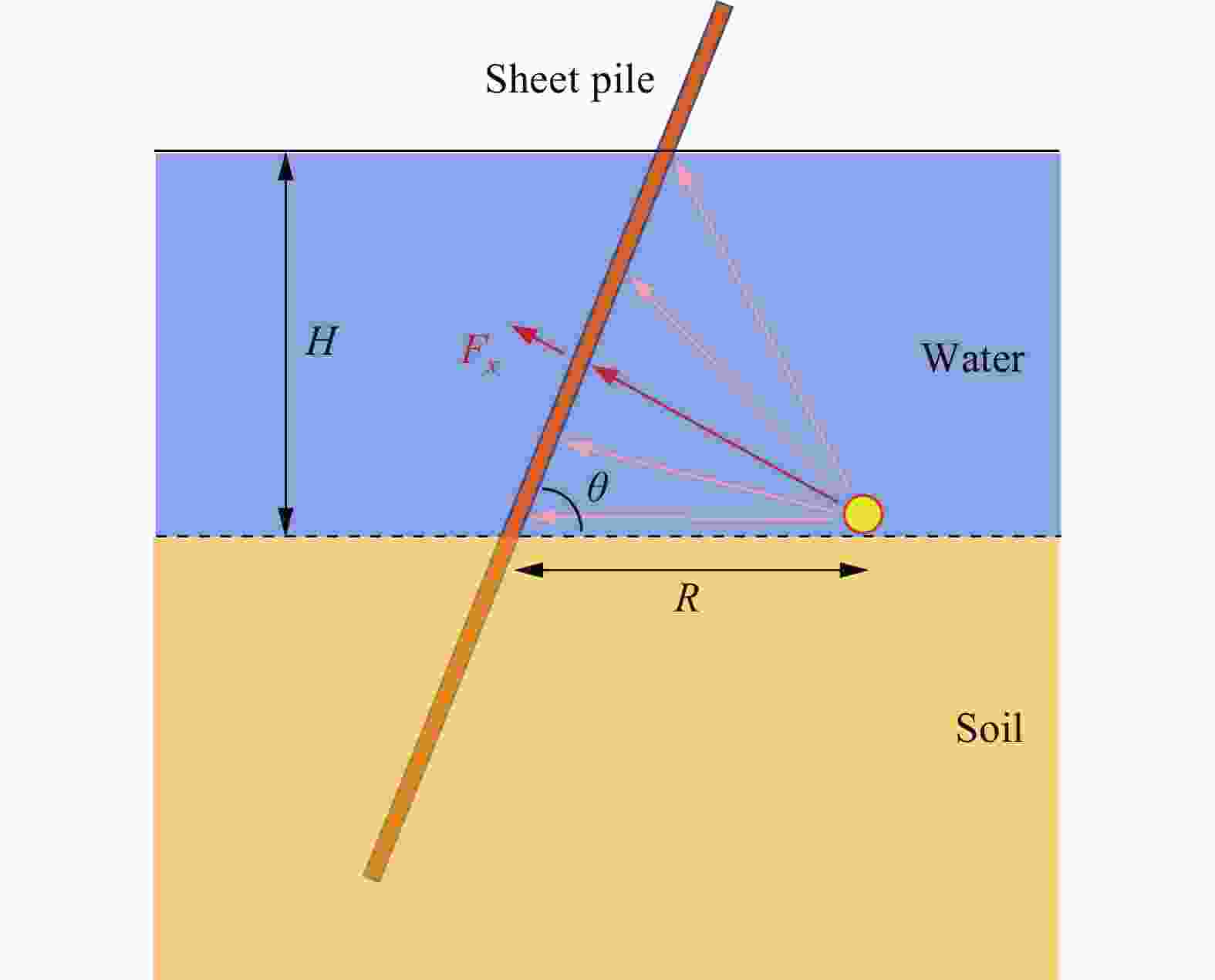
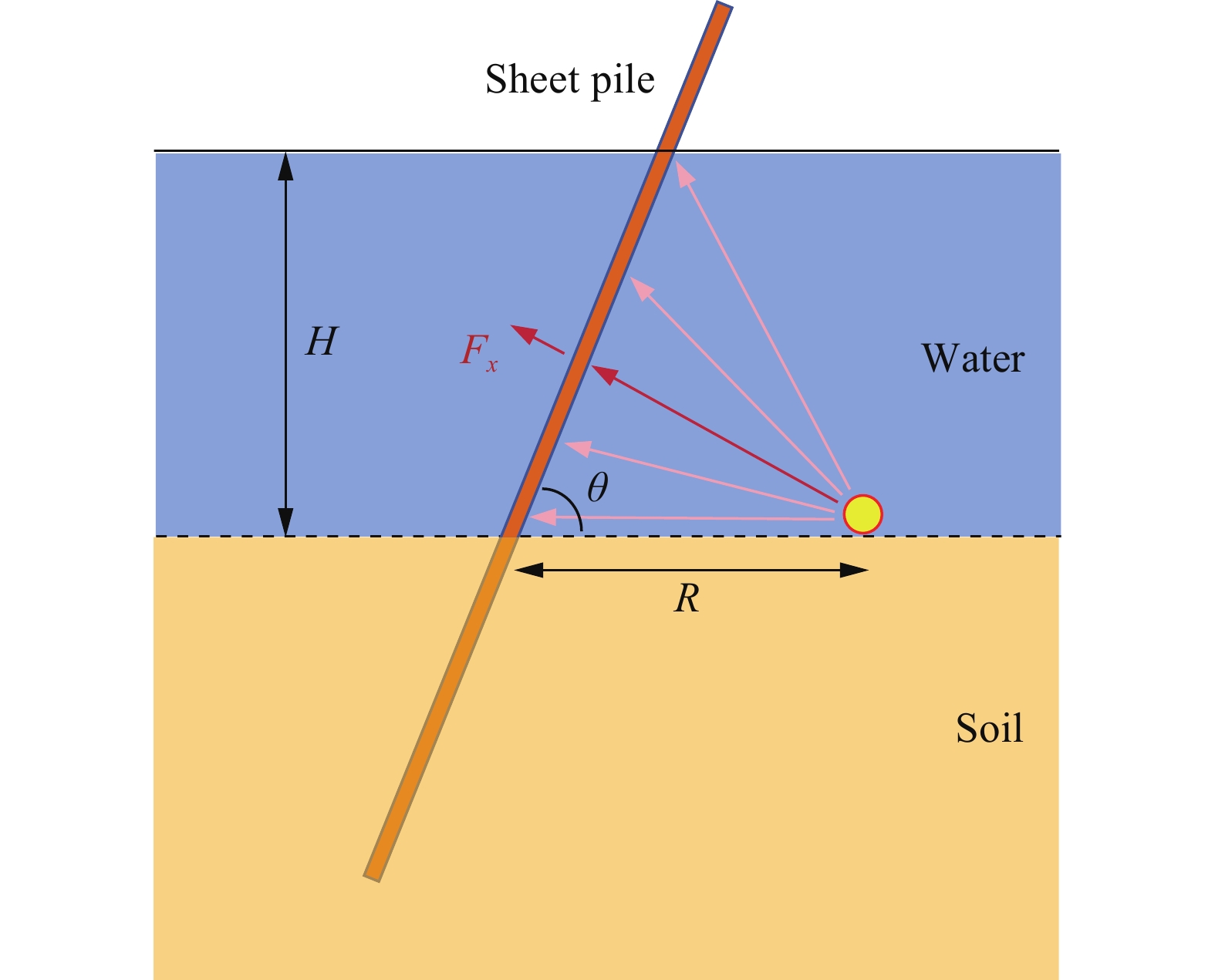
图 1 浅水爆炸钢板桩荷载示意图
Figure 1. Schematic of load on steel sheet pile under shallow water explosion
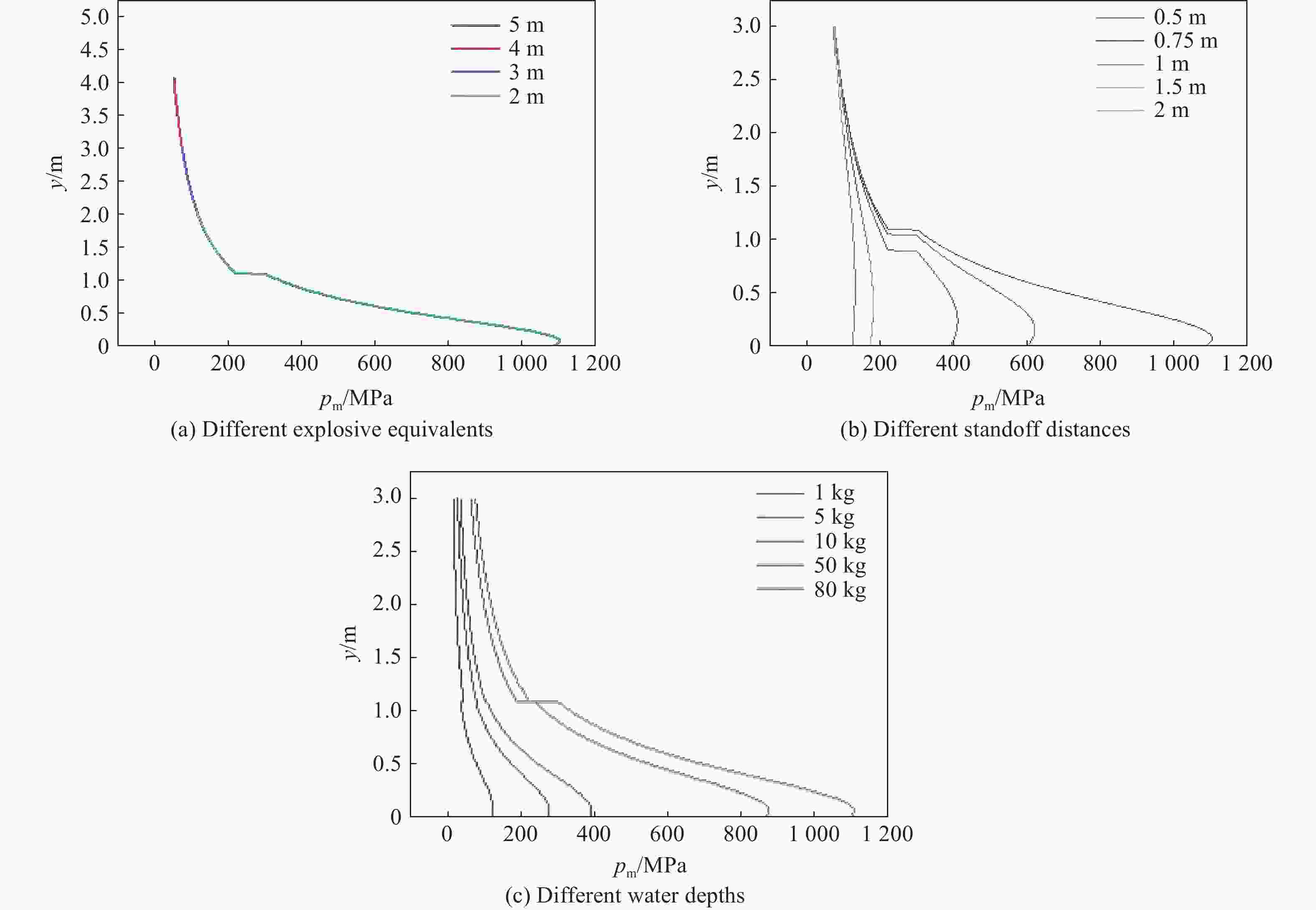
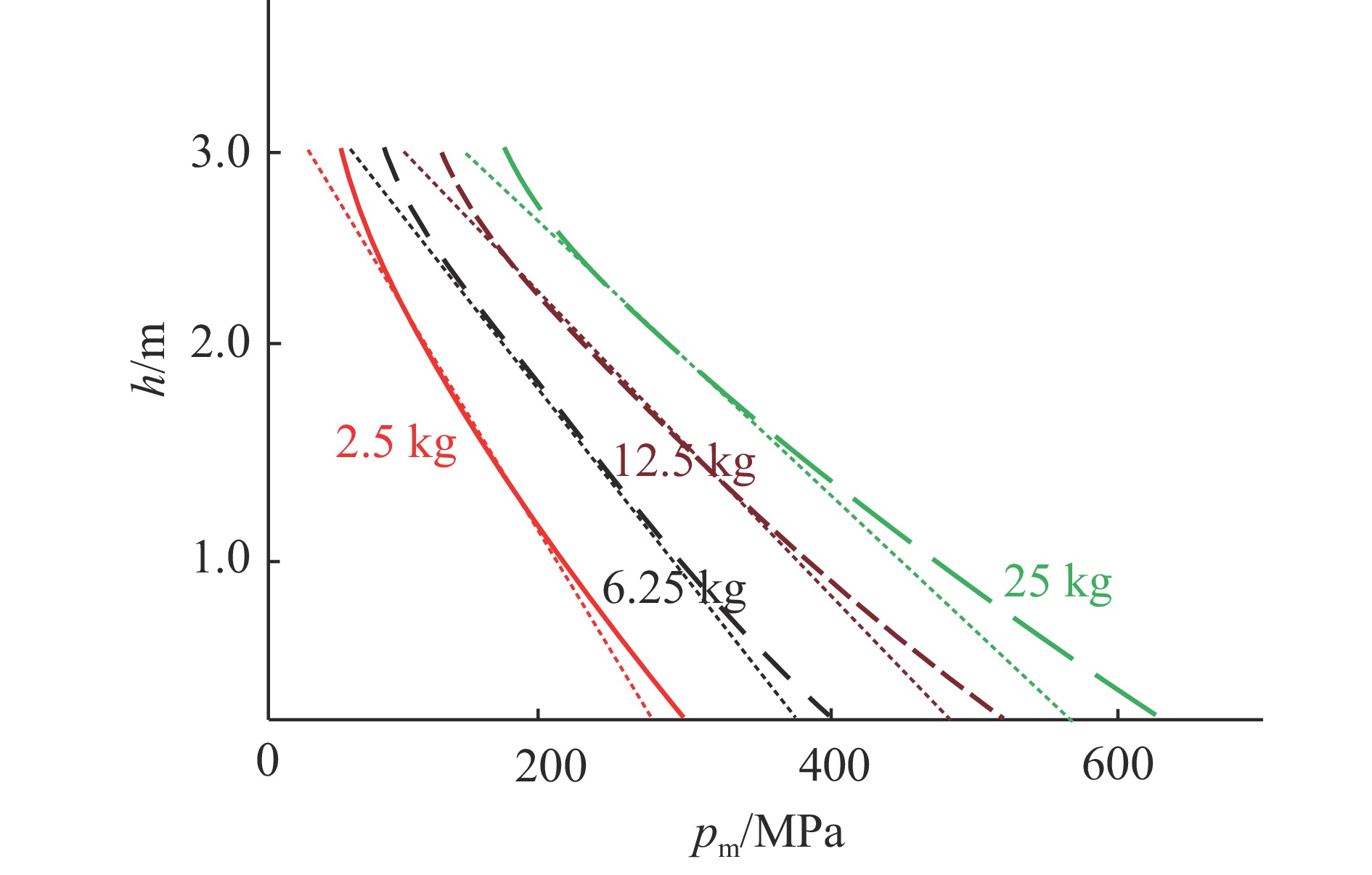
图 2 不同工况下钢板桩表面的荷载分布
Figure 2. Load distribution on the surface of steel sheet pile under different working conditions
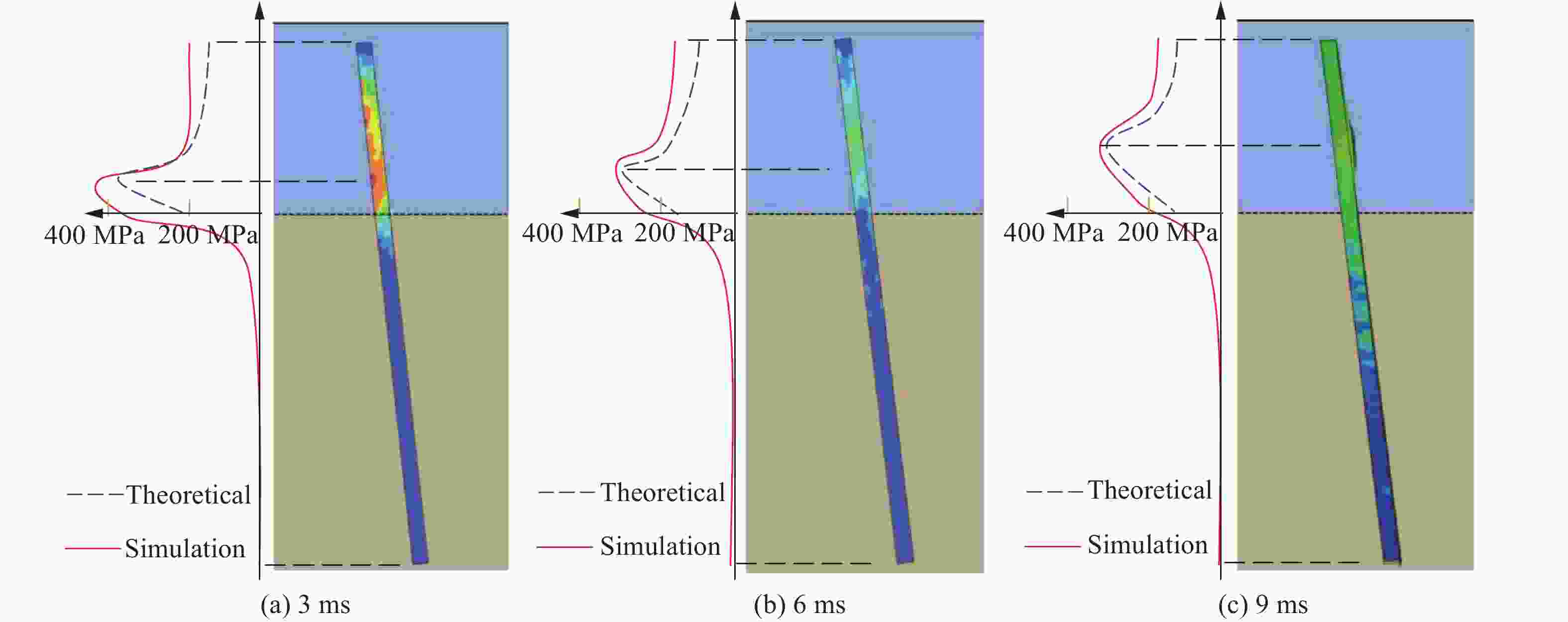
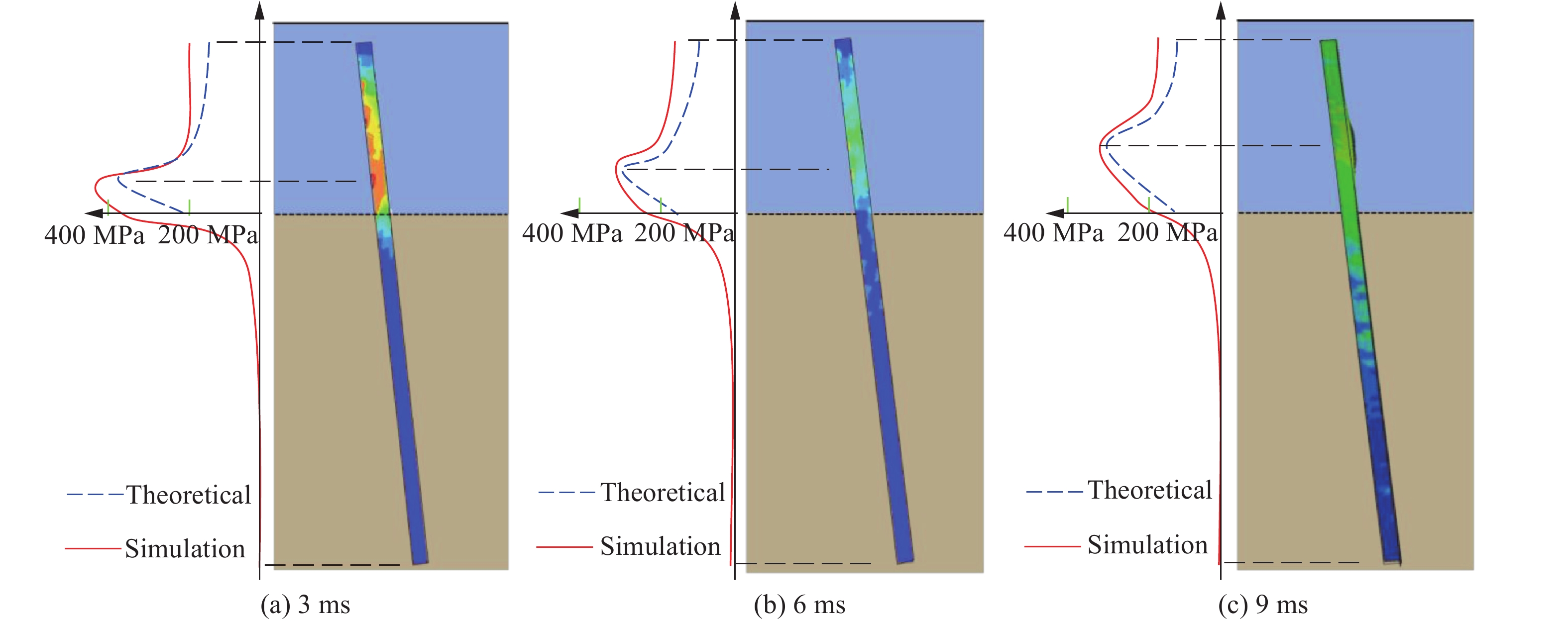
图 4 浅水爆炸下钢板桩表面的荷载分布对比
Figure 4. Comparison of load distribution on the surface of steel sheet pile under shallow water explosion
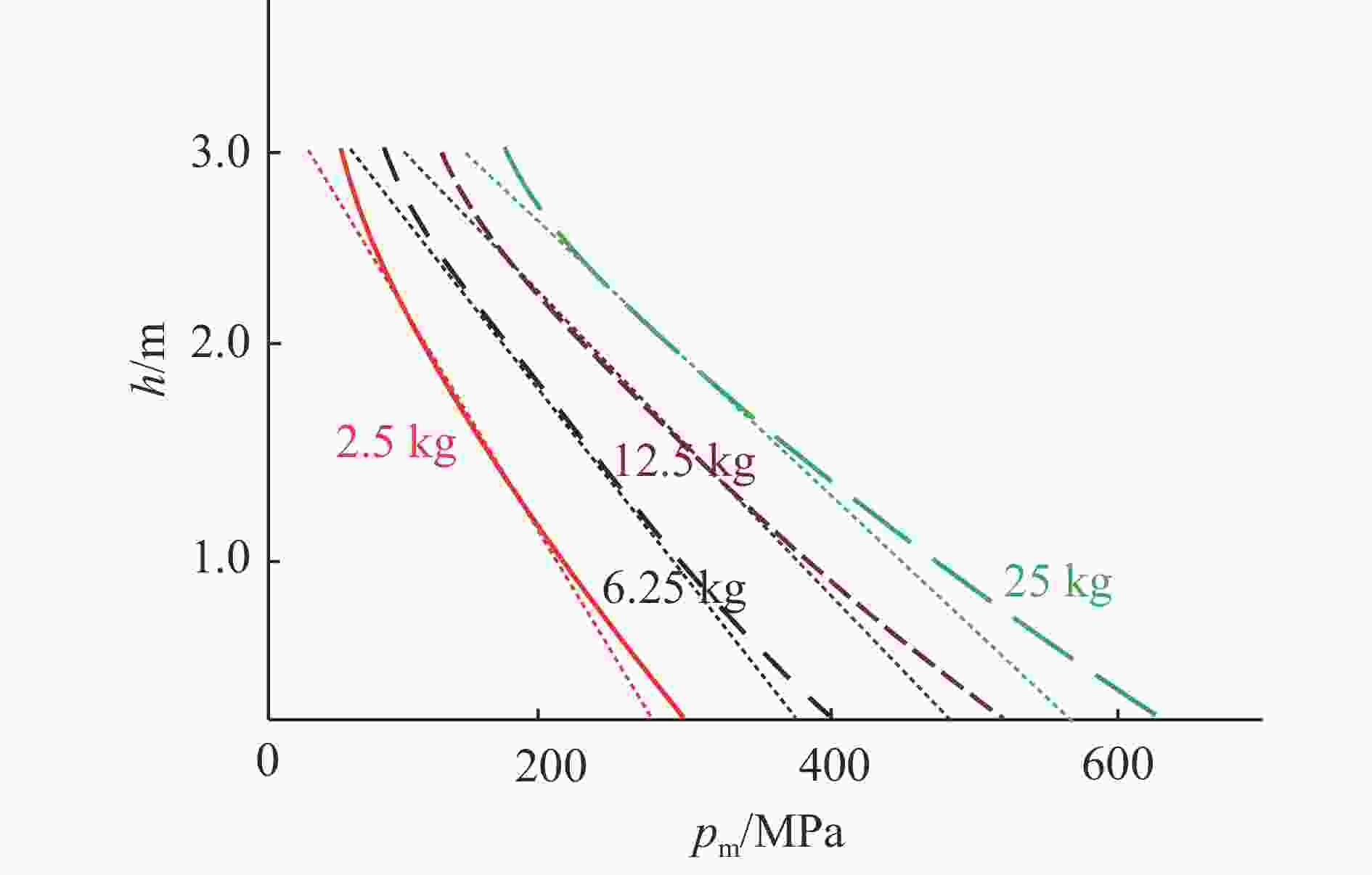
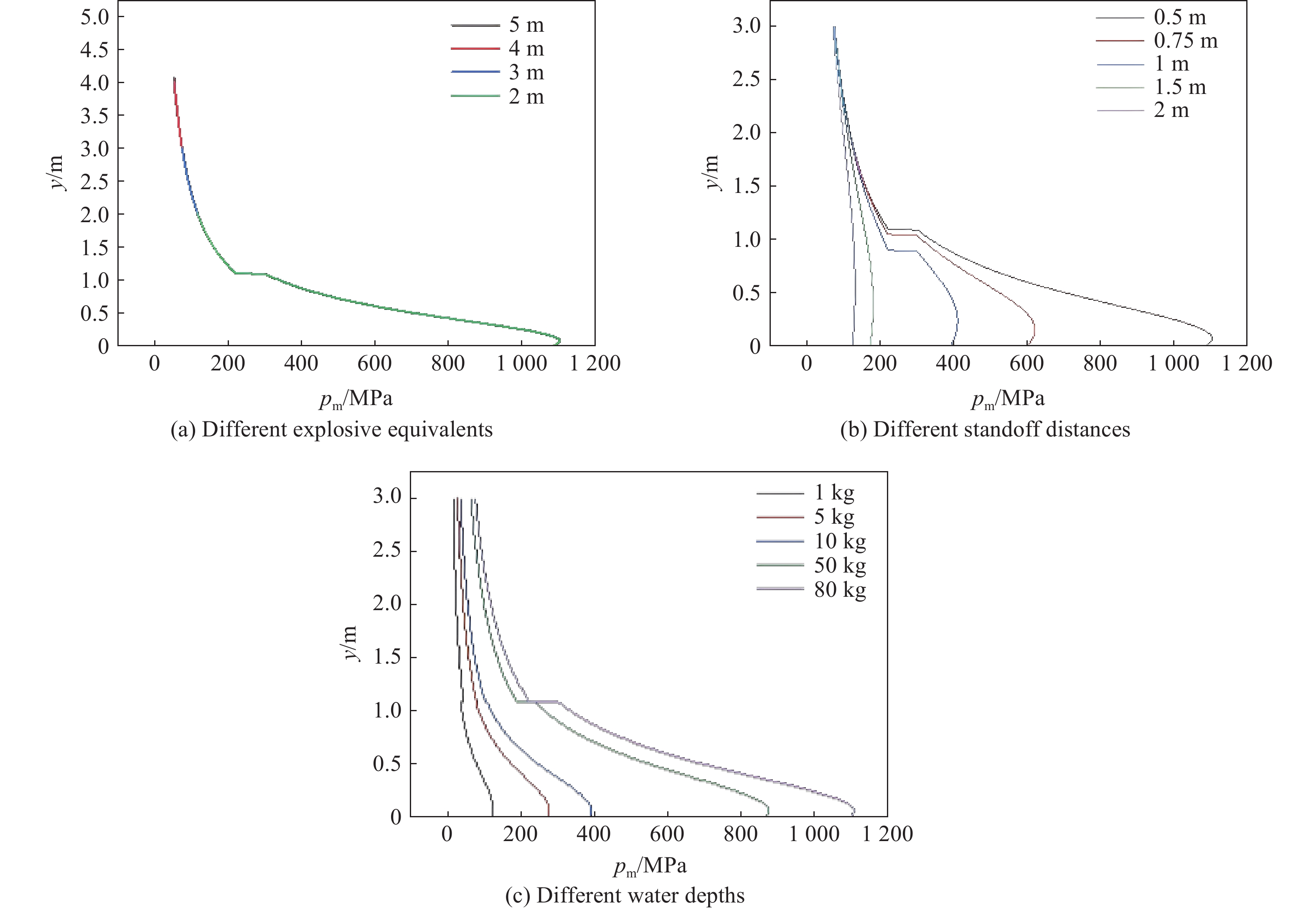
图 5 不同爆炸当量钢板桩受水中冲击波荷载峰值分布
Figure 5. Peak load distribution of underwater shock wave on steel sheet pile with different explosion equivalents
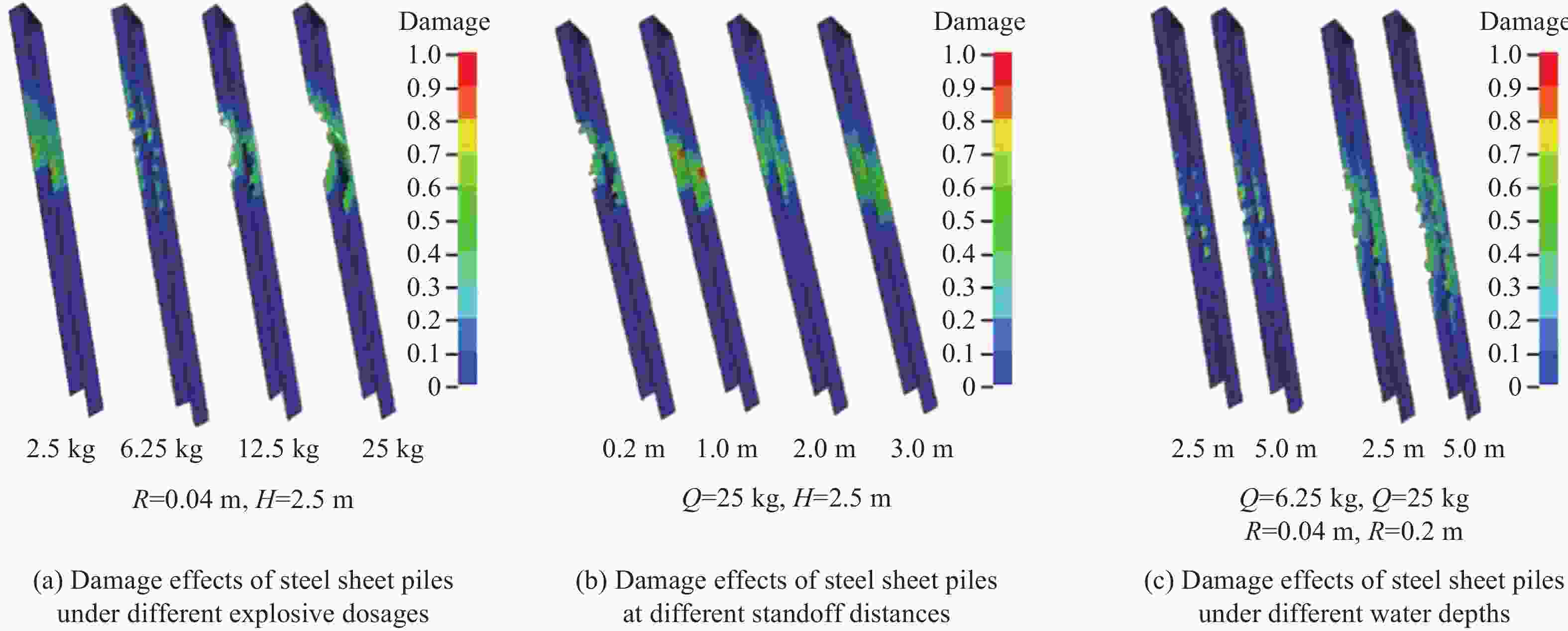
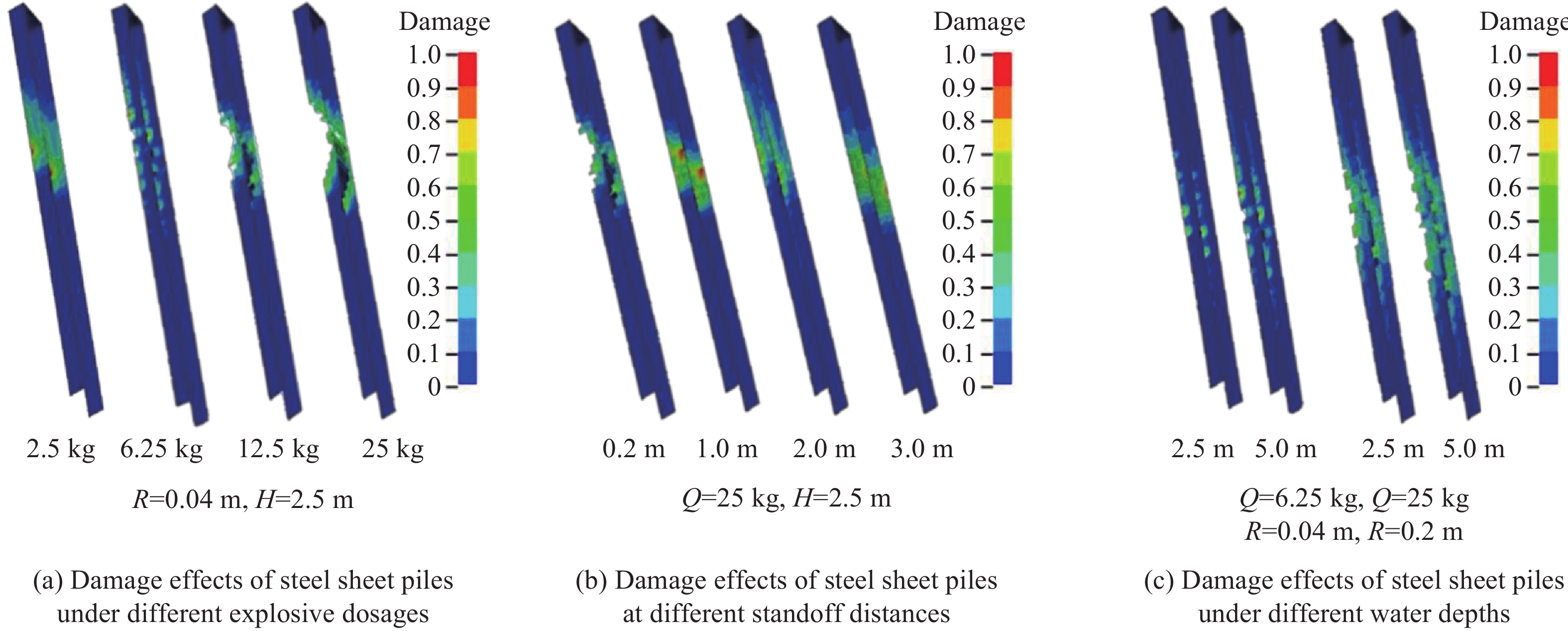
图 6 不同条件下钢板桩毁伤效果的数值模拟结果
Figure 6. Numerical simulation results of steel sheet pile damage effect under different conditions
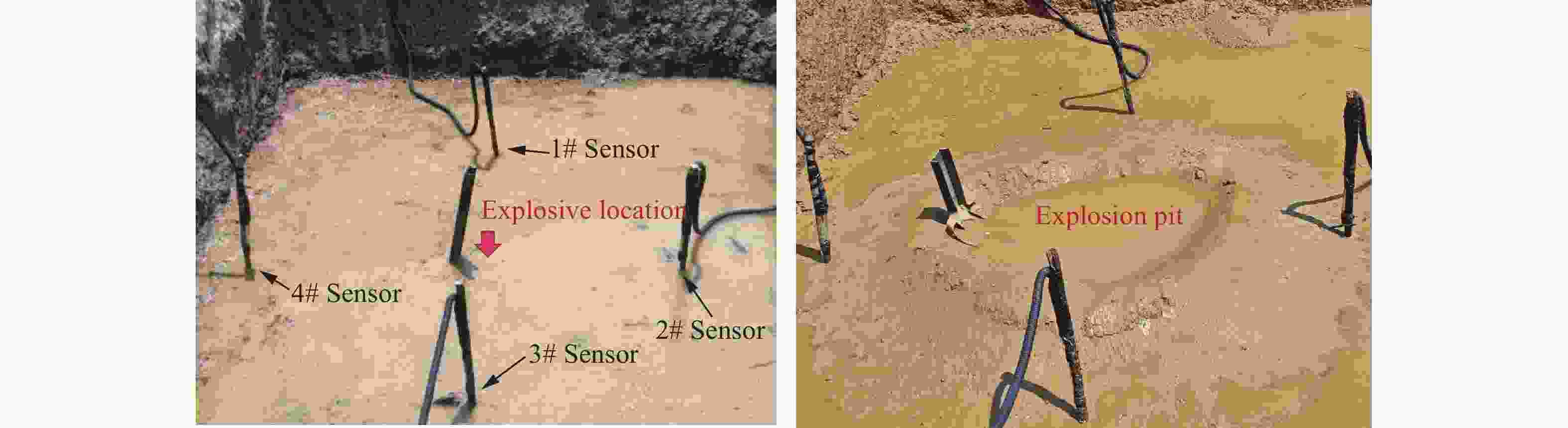
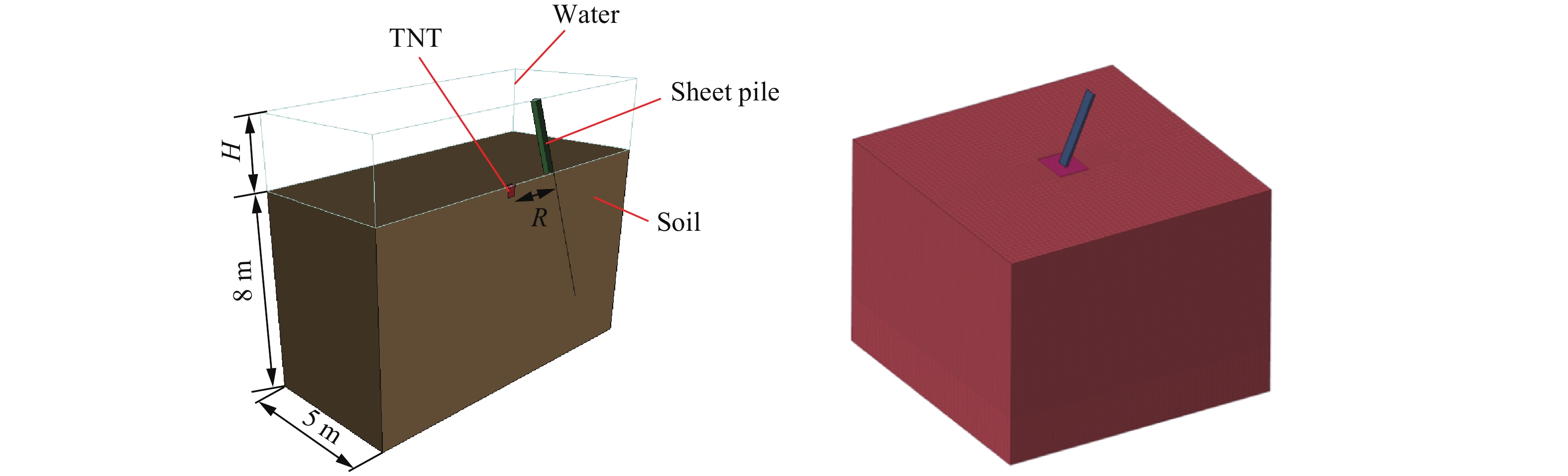
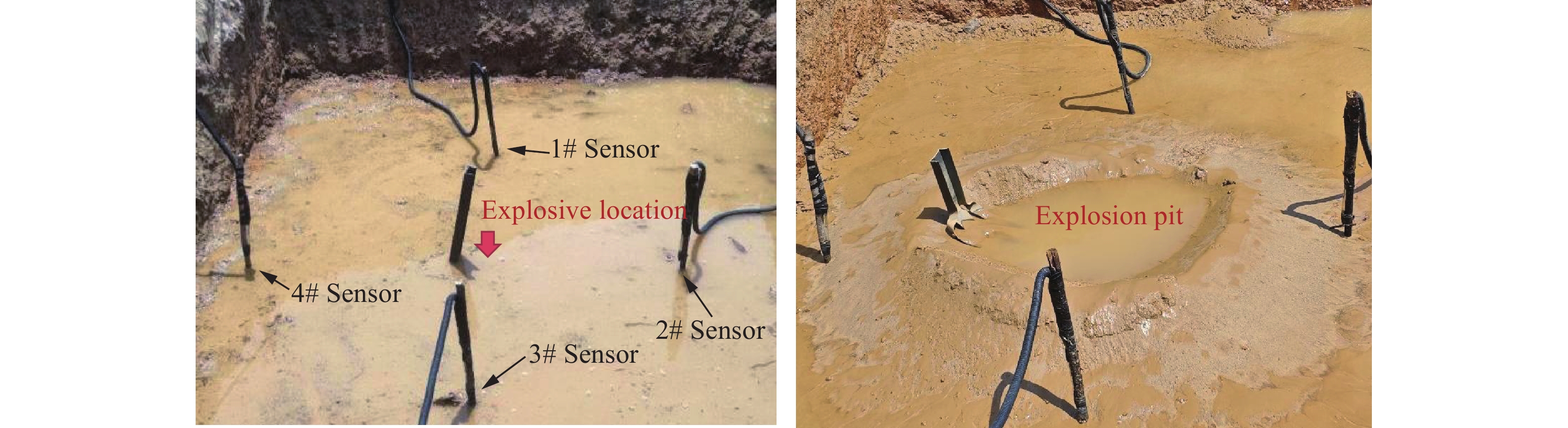
图 7 钢板桩模型试验布置与爆后效果图
Figure 7. Model test arrangement and post-explosion effect diagram of steel sheet pile
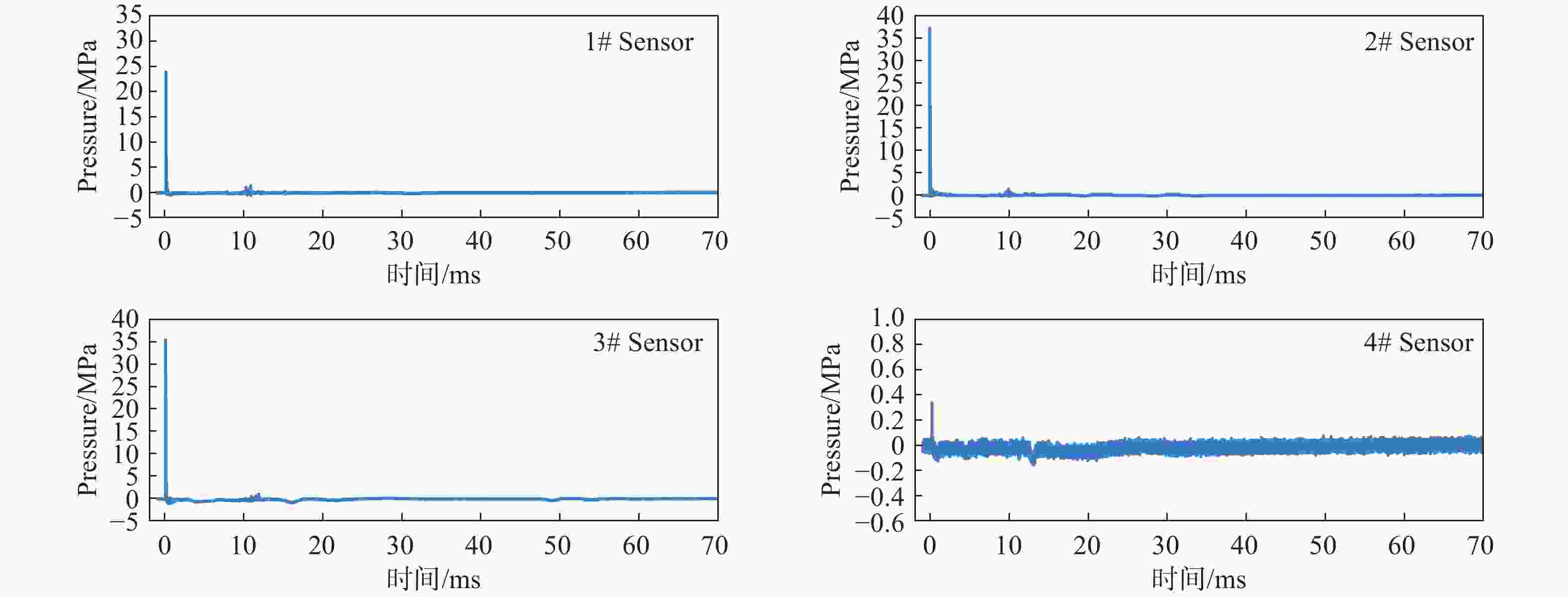
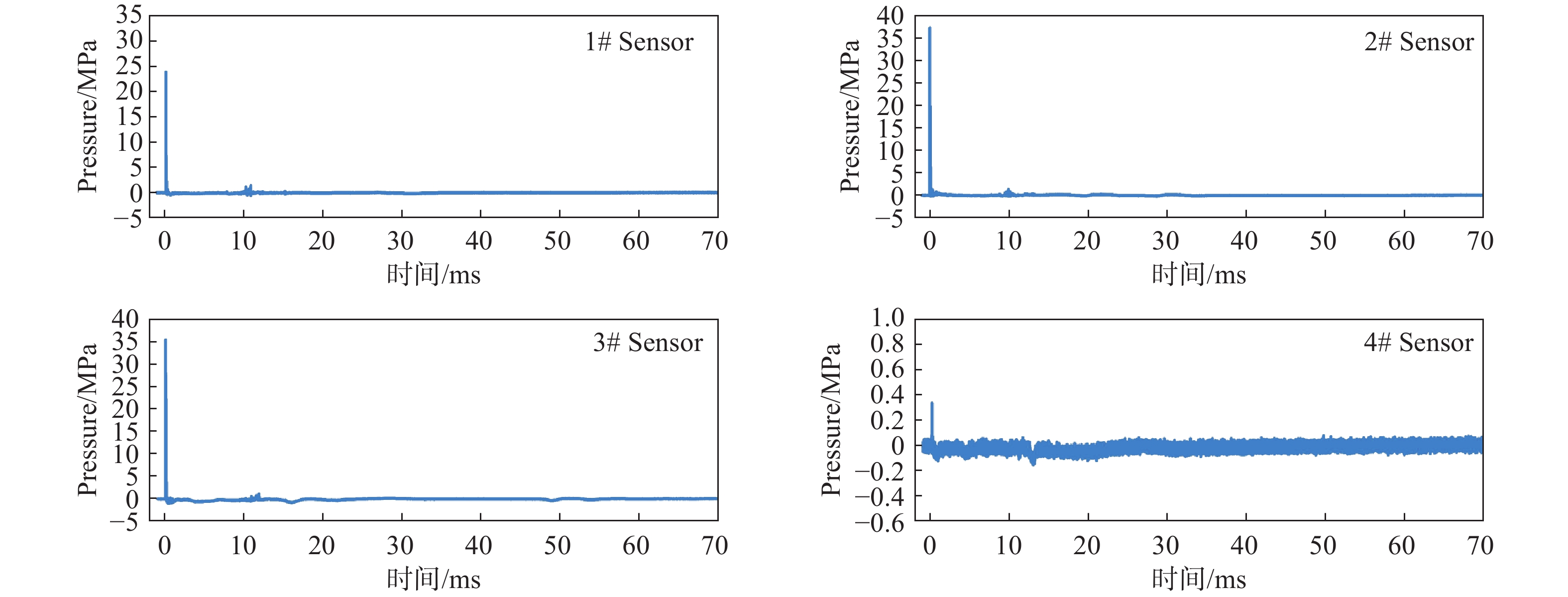
图 8 模型试验中各压力传感器测得的典型水中爆炸冲击波荷载时程曲线
Figure 8. Typical time-history curves of underwater explosion shock wave loads measured by each pressure sensor in model tests
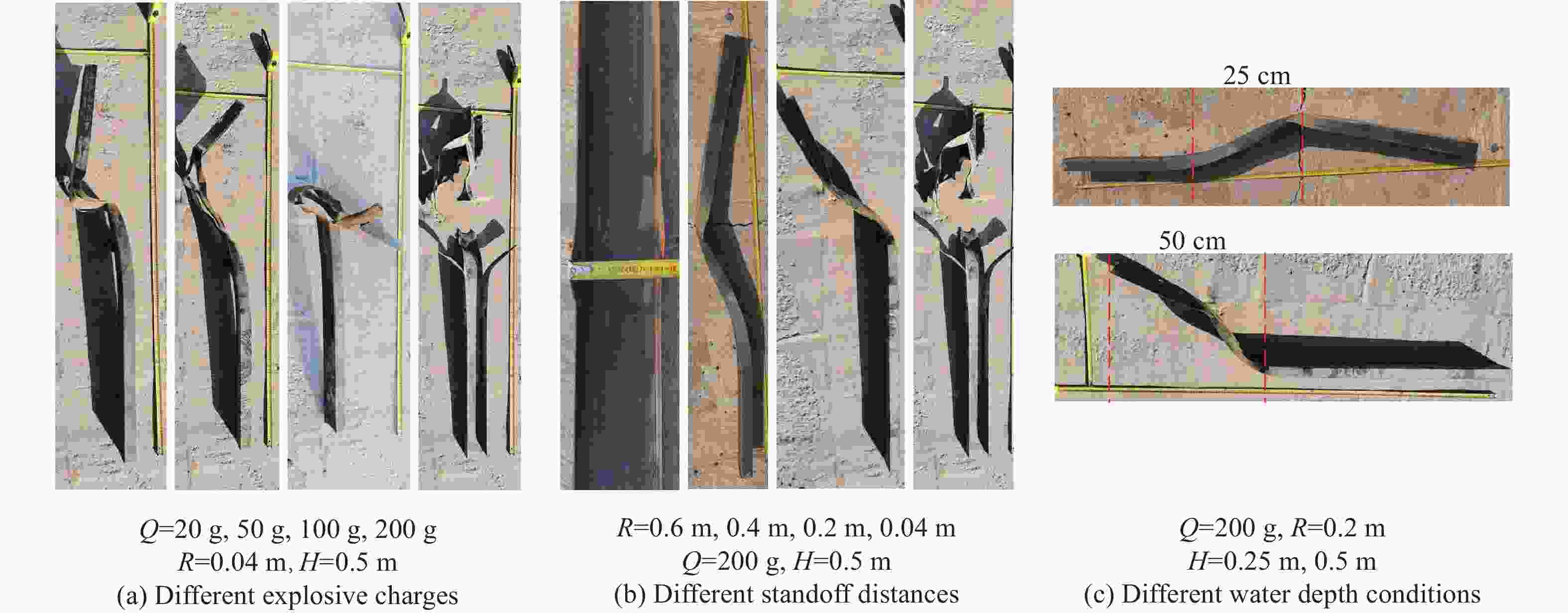
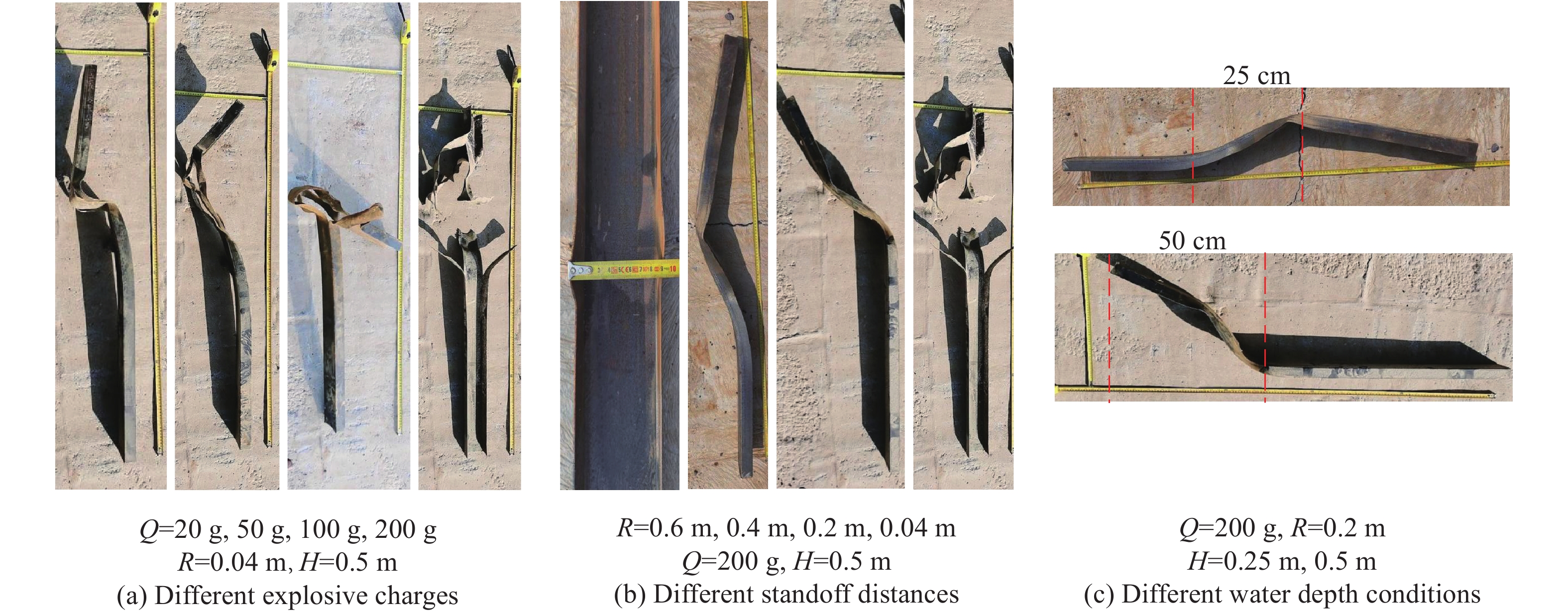
图 9 不同爆炸当量、不同爆源目标距离和不同水深条件下钢板桩的毁伤效果
Figure 9. Damage effect of steel sheet pile under different explosion equivalents, standoff distance and water depths
表 1 炸药、水体、钢板桩模型参数取值
Table 1. Model parameter values of explosive, water body and steel sheet pile
炸药 密度ρ/(kg·m−3) 爆速D/(m·s−1) 爆轰压pCJ/GPa A/GPa B/GPa R1/ R2/ ω/ 初始比内能/GPa 1630.0 6930.00 21.00 4371.3 7.43 4.15 0.95 0.30 7.00 水体 密度ρ/(kg·m−3) 声速c/(m·s−1) S1/ S2/ S3/ γ0 A 比内能E0/Pa V0/ 998.00 1647 1.921 −0.096 0 0.35 0 2.895×10⁵ 1.00 钢桩 弹性模量/Pa 泊松比/ 密度ρ/(kg·m−3) 屈服强度/Pa Β C P Etan/Pa 失效应变 2.0×10¹¹ 0.3 7850.00 2.35×10⁸ 0 40.00 5.00 1.1×10⁹ 0.20 注:A、B、R1、R2和ω为炸药特征参数;γ0、S1、S2、S3为状态方程常数;A为Grüneisen系数修正项;V0为初始体积;B为硬化参数;C、P为Cowper-Symonds应变率参数;Etan为切线模量。  下载: 导出CSV
表 2 砂土地基模型参数取值
Table 2. Model parameter values of sandy soil foundation
模型参数 参数值 模型参数 参数值 模型参数 参数值 ρ 1810 kg·m−3EPS1 0 P1 0 kPa G 12.0 MPa EPS2 −0.005 P2 100 kPa BULK 25.0 MPa EPS3 −0.1 P3 200 kPa A0 0.005 EPS4 −0.15 P4 300 kPa A1 1.5×10⁻⁷ EPS5 −0.2 P5 500 kPa A2 0.1 EPS6 −0.25 P6 800 kPa PC −50.0 Pa EPS7 −0.3 P7 1200 kPaVCR 0 EPS8 −0.35 P8 1600 kPa注:ρ为密度;G为剪切模量;BULK为卸载时的体积模量;A0、A1、A2为屈服函数常量;PC为拉伸压力切断值;VCR为体积破碎选项;EPS1~EPS8为体积应变值;P1~P8为对应压力。
下载: 导出CSV
表 3 不同工况下钢板桩的毁伤特征统计
Table 3. Statistics of damage characteristics of steel sheet pile under different working conditions
设计参数 爆炸当量/kg 爆源目标
距离/m比例爆源目标
距离/(m·kg−1/3)水深/m 钢板桩毁伤效果对比 工程算法及判据 数值模拟 模型试验 爆炸当量影响 2.5 0.2 0.147 0.5 弯曲变形(判据1) 弯曲变形 弯曲变形 6.25 0.2 0.109 0.5 弯曲变形(判据1) 弯曲变形 弯曲变形 12.5 0.2 0.086 0.5 断裂(判据2) 断裂 严重弯曲变形 25.0 0.2 0.068 0.5 断裂(判据2) 断裂 断裂 爆源目标
距离影响25.0 0.2 0.068 0.5 断裂(判据2) 断裂 断裂 25.0 1.0 0.342 0.5 弯曲变形(判据1) 弯曲变形 弯曲变形 25.0 2.0 0.684 0.5 弯曲变形(判据1) 弯曲变形 弯曲变形 25.0 3.0 1.026 0.5 无毁伤(判据1~2) 无毁伤 无毁伤 水深影响 25.0 1.0 0.342 2.5 弯曲变形(判据1) 弯曲变形 弯曲变形 25.0 1.0 0.342 1.25 弯曲变形(判据1) 弯曲变形 弯曲变形
下载: 导出CSV
-
[1] 刘靖晗, 唐廷, 韦灼彬, 等. 刚性柱附近浅水爆炸荷载特性研究 [J]. 高压物理学报, 2019, 33(5): 055104. DOI: 10.11858/gywlxb.20180704.LIU J H, TANG T, WEI Z B, et al. Pressure characteristics of shallow water explosion near the rigid column [J]. Chinese Journal of High Pressure Physics, 2019, 33(5): 055104. DOI: 10.11858/gywlxb.20180704. [2] 刘靖晗, 唐廷, 韦灼彬, 等. 浅水爆炸冲击波在柱体附近荷载规律研究 [J]. 兵器装备工程学报, 2021, 42(1): 168–173. DOI: 10.11809/bqzbgcxb2021.01.031.LIU J H, TANG T, WEI Z B, et al. Research on explosive shock wave around column in shallow water [J]. Journal of Ordnance Equipment Engineering, 2021, 42(1): 168–173. DOI: 10.11809/bqzbgcxb2021.01.031. [3] 刘靖晗, 唐廷, 韦灼彬, 等. 沉箱码头在空中和水下爆炸作用下的累积毁伤效应研究 [J]. 振动与冲击, 2024, 43(12): 298–306. DOI: 10.13465/j.cnki.jvs.2024.12.033.LIU J H, TANG T, WEI Z B, et al. Cumulative damage effect of the caisson wharf induced by air and underwater explosions [J]. Journal of Vibration and Shock, 2024, 43(12): 298–306. DOI: 10.13465/j.cnki.jvs.2024.12.033. [4] 董琪, 韦灼彬, 唐廷, 等. 港池环境近水面水下爆炸特性及其毁伤效应 [J]. 高压物理学报, 2019, 33(4): 045103. DOI: 10.11858/gywlxb.20180638.DONG Q, WEI Z B, TANG T, et al. Loading characteristics and damage effect of near-surface underwater explosion in harbor basin [J]. Chinese Journal of High Pressure Physics, 2019, 33(4): 045103. DOI: 10.11858/gywlxb.20180638. [5] 程淑杰, 梁争峰, 阮喜军, 等. 浅水爆炸冲击波特性及其毁伤效应研究进展 [J]. 火炸药学报, 2024, 47(1): 17–28. DOI: 10.14077/j.issn.1007-7812.202304003.CHENG S J, LIANG Z F, RUAN X J, et al. Research progress on shallow water explosion shock wave characteristics and its damage effect [J]. Chinese Journal of Explosives & Propellants, 2024, 47(1): 17–28. DOI: 10.14077/j.issn.1007-7812.202304003. [6] 庄铁栓, 伍俊, 许文轩, 等. 水中爆炸冲击波在高桩圆柱结构上的分布规律试验研究 [J]. 中国测试, 2018, 44(10): 60–66. DOI: 10.11857/j.issn.1674-5124.2018.10.010.ZHUANG T S, WU J, XU W X, et al. Experimental investigation of distributing rule on high column stake for shock wave in underwater explosion [J]. China Measurement & Test, 2018, 44(10): 60–66. DOI: 10.11857/j.issn.1674-5124.2018.10.010. [7] WARDLAW A B JR, LUTON J A. Fluid-structure interaction mechanisms for close-in explosions [J]. Shock and Vibration, 2000, 7(5): 265–275. DOI: 10.1155/2000/141934. [8] ZAMYSHLYAEV B V, YAKOVLEV Y S. Dynamic loads in underwater explosion: AD757183 [R]. Washington: Naval Intelligence Support Center, 1973. [9] CHEN L K, ZHAO H Y, ZHANG Y L. Study on the effect of shape parameters and initiation points of rectangular high explosive on the spatial distribution of blast loads [J]. Acta Mechanica Sinica, 2025, 41(3): 423470. DOI: 10.1007/s10409-024-23470-x. [10] LIU J H, TANG T, WEI Z B, et al. Damage process of high-piled wharf subjected to underwater explosion [J]. //IOP Conference Series: Materials Science and Engineering., 2020, 735(1): 012043. DOI: 10.1088/1757-899X/735/1/012043. [11] 张秀华, 张唯佳, 张宇. Q460高强钢柱在近爆荷载作用下的动力响应研究 [J]. 振动与冲击, 2022, 41(3): 107–114,147. DOI: 10.13465/j.cnki.jvs.2022.03.013.ZHANG X H, ZHANG W J, ZHANG Y. Dynamic response of Q460 high strength steel column under near explosion load [J]. Journal of Vibration and Shock, 2022, 41(3): 107–114,147. DOI: 10.13465/j.cnki.jvs.2022.03.013. [12] 张振华, 朱锡, 白雪飞. 水下爆炸冲击波的数值模拟研究 [J]. 爆炸与冲击, 2004, 24(2): 182–188. DOI: 10.3321/j.issn:1001-1455.2004.02.014.ZHANG Z H, ZHU X, BAI X F. The study on numerical simulation of underwater blast wave [J]. Explosion and Shock Waves, 2004, 24(2): 182–188. DOI: 10.3321/j.issn:1001-1455.2004.02.014. [13] 余晓菲, 刘土光, 张涛. 水下爆炸冲击波的载荷强度计算 [J]. 舰船科学技术, 2006, 28(5): 22–28.YU X F, LIU T G, ZHANG T. Computation of the blast loading strength of underwater explosion shock waves [J]. Ship Science and Technology, 2006, 28(5): 22–28. [14] 刘钊, 武浩文, 孙文豪, 等. 水下爆破冲击波对混凝土坞门影响试验研究 [J]. 中国港湾建设, 2022, 42(12): 33–36,136. DOI: 10.7640/zggwjs202212007.LIU Z, WU H W, SUN W H, et al. Research on the effect of underwater blasting shock waves on concrete dock doors [J]. China Harbour Engineering, 2022, 42(12): 33–36,136. DOI: 10.7640/zggwjs202212007. [15] SYMONDS P S. Survey of methods of analysis for plastic deformation of structures under dynamic loading: BU/NSRDC//1-67 [R]. Naval Ship Research and Development Center, 1967. 10.21236/ad0659972. [16] 孙远翔, 陈岩武. 水下爆炸载荷下水面舰艇双层结构的毁伤与防护研究进展 [J]. 水下无人系统学报, 2022, 30(3): 342–353. DOI: 10.11993/j.issn.2096-3920.2022.03.010.SUN Y X, CHEN Y W. Research progress in damage and protection of surface ship’s double-layer structure subjected to underwater explosion load [J]. Journal of Unmanned Undersea Systems, 2022, 30(3): 342–353. DOI: 10.11993/j.issn.2096-3920.2022.03.010. [17] 黄义铭, 赵密, 王丕光, 等. 动力荷载作用下水-桩-土相互作用简化分析研究 [J]. 振动工程学报, 2022, 35(6): 1511–1520. DOI: 10.16385/j.cnki.issn.1004-4523.2022.06.023.HUANG Y M, ZHAO M, WANG P G, et al. Simplified analysis of water-pile-soil interaction under dynamic loads [J]. Journal of Vibration Engineering, 2022, 35(6): 1511–1520. DOI: 10.16385/j.cnki.issn.1004-4523.2022.06.023. [18] CHEN S, QIN J, DENG S, et al. Experimental and numerical studies on fixed steel sheets subjected to underwater explosion [J]. Materials, 2022, 15(18): 6419. DOI: 10.3390/ma15186419. [19] 罗泽立, 周章涛, 毛海斌, 等. 水下爆炸强冲击波与平板结构相互作用的理论分析方法 [J]. 高压物理学报, 2017, 31(4): 443–452. DOI: 10.11858/gywlxb.2017.04.013.LUO Z L, ZHOU Z T, MAO H B, et al. Theoretical analysis of the interaction between the plate structure and strong shock wave in underwater explosion [J]. Chinese Journal of High Pressure Physics, 2017, 31(4): 443–452. DOI: 10.11858/gywlxb.2017.04.013. [20] 胡红星. 复合钢板衬砌的抗爆防护性能研究 [J]. 科技与创新, 2023(11): 1–6. DOI: 10.15913/j.cnki.kjycx.2023.11.001.HU H X. Research on anti-explosion protection performance of composite steel plate lining [J]. Science and Technology & Innovation, 2023(11): 1–6. DOI: 10.15913/j.cnki.kjycx.2023.11.001. -

计量
- 文章访问数: 314
- HTML全文浏览量: 65
- PDF下载量: 83
- 被引次数: 0